My daughter-in-law pushed a stack of greasy plates into my hands and told me, “Could you finish these? My mother prefers her wine chilled.”
My son poured Brenda a glass while I stood beside the sink like hired help.
I quietly dried my hands, put on my coat, and walked out without washing a single dish.
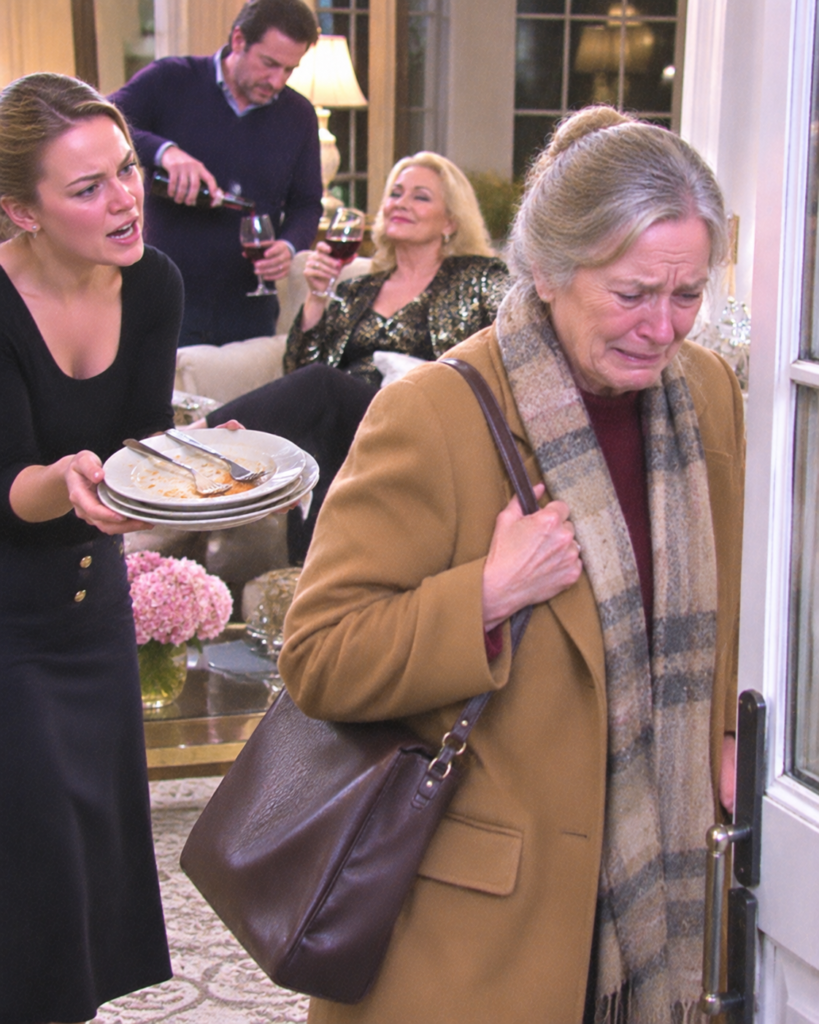
The sound of wine glasses clinking drifted in from the dining room just as Rachel pressed a stack of warm, oily plates against me.
She was already turning toward the living room before she even finished speaking, as though refusing had never occurred to her.
“Could you finish these up, Patricia? My mother prefers her wine chilled, and I need to entertain.”
I caught the plates without thinking.
That was the humiliating part.
My hands reacted before my mind did, trained by a full year of Sunday dinners to take whatever Rachel passed to me.
Through the wide archway, I could see my son David beside the leather sofa, pouring a generous glass of white wine for Rachel’s mother.
Brenda, with carefully styled silver-blond hair and a cream cashmere sweater, laughed at something he said before settling comfortably into the cushions.
I had helped pay for that sofa six months earlier.
Rachel had called me from the furniture showroom because the one they wanted was “just a little outside the budget,” and I had covered the difference without making them feel embarrassed.
I still remembered David hugging me afterward and saying, “You always come through, Mom.”
At the time, those words had made me happy.
Standing there now with someone else’s dirty dinner plates in my arms, they sounded very different.
Sunday dinners had changed so slowly that I couldn’t pinpoint the exact moment I stopped being treated like a guest.
I usually arrived around four because Rachel always needed “just a little help” getting dinner ready.
A little help meant peeling potatoes.
Chopping vegetables.
Setting the table.
Keeping my grandchildren occupied while she finished getting dressed.
Making whatever side dish she had forgotten.
Rachel’s mother usually arrived shortly before dinner carrying either a bottle of wine or nothing at all.
Brenda was never asked to chop onions.
She was never expected to scrape casserole dishes.
And she was certainly never told to finish cleaning up while everyone else relaxed.
At first, I found excuses for it.
Brenda lived farther away.
Brenda had back problems.
Brenda was a guest.
The problem with that explanation was obvious once I finally allowed myself to examine it.
I was supposed to be a guest too.
I loved David.
And I adored my grandchildren, seven-year-old Leo and five-year-old Mia, with the particular devotion grandchildren seem to inspire in women who have spent decades believing motherhood means being useful.
After my husband died, being useful filled a lot of empty space.
David was my only child.
When he married Rachel, I made myself a quiet promise that I would never become the kind of interfering mother-in-law people joked about at office lunches and hair salons.
So I gave.
I babysat.
I brought groceries whenever money was tight.
Several years earlier, when David was between jobs, I started giving them $500 on the first Monday of every month to help with food.
Even after he found steady work again, I continued because stopping felt mean when giving had become easy.
Some habits last long after the reason for them disappears.
I also paid for school shoes now and then.
Birthday parties.
Summer camp deposits.
And enough restaurant meals that Rachel had stopped reaching for her purse whenever the check arrived.
None of that bothered me while I still felt appreciated.
The problem was that appreciation had slowly turned into expectation.
“Patricia, can you bring dessert?”
“Patricia, can you grab the kids?”
“Patricia, David forgot his wallet.”
“Patricia, since you’re already here…”
There are five dangerous words in any family arrangement:
since you’re already here.
That Sunday, I had arrived at three-thirty carrying a homemade spinach casserole because Rachel had texted that morning saying she was “overwhelmed.”
I helped Mia search for a missing doll shoe.
I laid out napkins.
I stirred gravy.
I washed the first batch of mixing bowls before dinner had even begun.
Brenda arrived at five-thirty.
Rachel kissed her on both cheeks.
“Mom, sit down. You look exhausted.”
I was standing three feet away holding a roasting pan.
Nobody asked whether I was tired.
Dinner itself was pleasant enough, if you ignored the social ranking hiding beneath the casual conversation.
Brenda talked about a cruise she was considering.
Rachel complained about a coworker.
David mostly listened while cutting Leo’s chicken into smaller pieces.
Whenever I tried to tell a story, Rachel found a way to interrupt without sounding openly rude.
I mentioned an exhibit at the local art museum.
“Oh, Mom would love that,” Rachel said, immediately turning toward Brenda. “Remember that gallery in Boston?”
And just like that, my sentence vanished.
I wasn’t angry.
I understood that only later.
At dinner, what I felt was smaller and sadder.
I was present, but never really included.
After dessert, Brenda carried her wineglass into the living room.
David followed her.
Rachel stood and began gathering the plates.
For one hopeful second, I thought she was finally going to wash them herself.
Then she walked directly toward me.
“Could you finish these up, Patricia?”
The stack landed in my hands.
“My mother prefers her wine chilled, and I need to entertain.”
Then she turned away.
I stood there listening to her heels tap across the hardwood floor.
The sink was already filled with cloudy water from the pots I had washed earlier.
Small circles of grease floated beneath the kitchen light.
Someone had left half a dinner roll soaking beside a serving spoon.
Through the archway, David handed Brenda her chilled glass of Pinot Grigio.
They laughed.
Rachel settled onto the opposite end of the sofa.
Nobody looked toward the kitchen.
That was the moment everything became clear.
Nothing dramatic snapped inside me.
I didn’t feel a speech building.
I didn’t want to throw a plate.
I didn’t need everyone to hear a list of everything I had done for them.
Instead, I understood the situation with an almost peaceful clarity.
I was not being treated like David’s mother.
I was not being treated like Rachel’s mother-in-law.
I had become unpaid household staff who happened to buy Christmas presents.
I looked down at the plates.
Then I carefully placed them on the marble counter.
I didn’t pick up the sponge.
I didn’t turn on the faucet.
And I didn’t call into the living room to announce that someone else could clean up after dinner for once.
I took a paper towel and slowly dried my hands.
Then I walked toward the hallway closet.
My wool coat hung beside Rachel’s expensive winter parka.
I slipped mine on, picked up my purse, and checked that my car keys were inside.
The laughter continued from the next room.
They still hadn’t noticed.
That hurt for about three seconds.
Then it became useful information.
I opened the front door.
Cold evening air brushed across my face.
I stepped outside and gently pulled the door closed behind me.
The latch clicked softly, barely louder than the voices inside.
No one followed me.
No one called my name.
I walked down the porch steps, crossed the driveway, and headed toward my car, which I had parked halfway down the block because Brenda had taken the closest space.
By the time my phone started vibrating inside my coat pocket, I was already smiling.
Not because I had won anything.
But because, for the first time in a year, the dirty dishes behind me were exactly where they belonged.
Behind me.
PART 2 — THE NIGHT I STOPPED BEING THEIR SERVANT
My phone was still vibrating when I reached my car.
I sat behind the steering wheel and looked at the screen.
David.
Then Rachel.
Then David again.
I didn’t answer.
Instead, I watched the messages appear one after another.
David: Mom, where are you?
Rachel: Patricia, you can’t just leave in the middle of dinner.
David: Mom, seriously. Brenda is still here. Can you come back and finish cleaning up?
I stared at that last message for several seconds.
Not one of them had asked whether I was okay.
Not one of them had wondered why I had left.
They were concerned about the dishes.
I put my phone face down on the passenger seat and started the engine.
For the first time in twelve months, I drove home without wondering whether David had enough groceries, whether Rachel needed help with the children, or whether I had forgotten something they expected me to do.
When I got home, I made myself a cup of tea and sat at my kitchen table.
Then I opened my banking app.
There it was.
A recurring transfer scheduled for the following Monday.
$500.
Every month.
For years, I had convinced myself that helping my son was simply what a mother did.
But as I looked at that number, another question came to mind.
When had helping become an obligation?
I canceled the recurring transfer.
Then I opened my calendar and deleted the next four Sunday dinners.
I wasn’t angry when I did it.
I was simply finished.
At 8:47 that evening, my phone rang again.
David.
This time, I answered.
“Mom, what happened?”
His voice sounded irritated rather than worried.
“Nothing happened, David.”
“Then why did you leave?”
“I was tired.”
There was a pause.
“Tired? You left all the dishes on the counter.”
I closed my eyes.
There it was.
Not, “You seemed upset.”
Not, “Did Rachel say something?”
Just the dishes.
“Yes,” I said quietly. “I did.”
“Mom, that’s not like you.”
I almost laughed.
He was right.
It wasn’t like me.
For years, I had swallowed every disappointment, every thoughtless comment, and every little humiliation because I didn’t want to make things uncomfortable for my son.
But perhaps that was exactly the problem.
“I know, David.”
“Rachel is really upset. Brenda had to help clean everything.”
I looked down at my teacup.
“How terrible for Brenda.”
“Mom!”
“What?”
“You know what I mean.”
“Actually, David, I don’t think I do.”
He sighed.
“Can we not turn this into a big thing?”
I let the silence sit between us.
Then I asked him something I had never asked before.
“David, when was the last time you invited me over just because you wanted to spend time with me?”
He didn’t answer.
“When was the last time you called to ask how I was doing without needing something?”
More silence.
“Mom, that’s not fair.”
“Isn’t it?”
He started explaining that Rachel had been stressed, that the children were difficult lately, that Brenda was visiting, and that everyone had been busy.
I listened.
I had spent years listening.
When he finally stopped, I said, “I’m your mother, David. Not your cleaning lady.”
He went quiet.
Then he said something I will never forget.
“Nobody thinks you’re a cleaning lady.”
I glanced toward my kitchen sink.
I had washed every dish in my own house that evening.
And somehow, I felt more respected standing there alone than I had felt in their beautiful dining room.
“Then perhaps you should start treating me like your mother.”
I ended the call.
The following morning, Rachel sent me a long text.
It began with an apology.
At least, the first two sentences did.
Rachel: Patricia, I’m sorry if you felt uncomfortable last night. I didn’t mean to offend you.
Then came the explanation.
She had been busy.
Brenda was visiting.
The dinner had been stressful.
She hadn’t realized I was so sensitive about helping around the house.
Sensitive.
I read that word twice.
Then I put my phone down.
I didn’t respond.
At 10:15, David called again.
This time, his voice was different.
“Mom, did you cancel the monthly transfer?”
I looked out my kitchen window.
“Yes.”
“Why?”
“Because I decided I no longer needed to send it.”
“But we budget around that money.”
I slowly put down my coffee.
“David, you have a full-time job. Rachel has a full-time job. You have two incomes.”
“That’s not the point.”
“Then what is the point?”
He hesitated.
“Mom, we’ve got expenses.”
“So do I.”
Another silence.
I could almost hear him trying to find the right words.
Then he said, “You never told us you wanted to stop.”
I gave a small, tired smile.
“I never told you I wanted to wash all your dishes either.”
He didn’t have an answer.
For the next two weeks, I heard very little from them.
No invitations.
No casual phone calls.
No pictures of the children.
I wondered whether David was angry or simply waiting for me to return to my usual role.
Then, on a Wednesday afternoon, my phone rang.
It was my granddaughter Mia.
“Grandma?”
Her little voice immediately softened something inside me.
“Hello, sweetheart.”
“Are you coming on Sunday?”
I looked at the calendar.
“No, honey. Not this Sunday.”
“Why?”
I swallowed.
“Grandma needs a little rest.”
There was a pause.
Then she whispered, “Daddy said you’re mad at us.”
My heart sank.
“Oh, sweetheart. I’m not mad at you.”
“Did I do something wrong?”
“No, baby. Absolutely not.”
“Then why don’t you come anymore?”
I had no easy answer for a five-year-old.
So I told her the truth in the gentlest way I could.
“Grandma loves you very much. Sometimes grown-ups need to learn how to treat each other kindly. That’s all.”
She was quiet for a moment.
Then she asked whether I could come to her school art show the following Friday.
I promised I would.
And I kept that promise.
On Friday, I arrived at the elementary school fifteen minutes early.
Mia spotted me across the gymnasium and ran straight into my arms.
“Grandma!”
I hugged her tightly.
Leo came over a moment later, carrying a paper drawing of our family.
There was a house, a dog, his father, his mother, Mia, and me.
I noticed something immediately.
I was standing outside the house.
“Why am I out here, sweetheart?” I asked.
Leo shrugged.
“Because you left.”
The words were innocent.
But they hurt more than anything Rachel had said.
I knelt beside him.
“Sometimes people leave a room because they need to be treated kindly, Leo. It doesn’t mean they stop loving the people inside.”
He considered that for a moment.
Then he handed me the picture.
“You can keep it.”
I folded it carefully and placed it in my purse.
When I stood up, I saw David watching us from the other side of the gym.
He looked uncomfortable.
After the art show, he approached me while Rachel was helping Mia put on her coat.
“Mom, can we talk?”
I nodded.
He led me toward the empty hallway.
For a moment, neither of us spoke.
Then he said, “Rachel thinks you’re punishing us.”
I looked directly at him.
“Do you think that?”
He rubbed the back of his neck.
“I think things have gotten out of hand.”
“David, do you remember the sofa?”
He frowned.
“What sofa?”
“The leather one in your living room. The one I helped pay for.”
“Yeah.”
“Do you remember what you told me when I helped you?”
He looked away.
“You said I always came through.”
He nodded slowly.
“I meant it, Mom.”
“I know. But somewhere along the way, you started believing I always had to.”
His expression changed.
For the first time, he looked as though he was actually hearing me.
I continued.
“I don’t regret helping you. I don’t regret buying the children their school shoes or paying for summer camp. I don’t regret bringing food when you were struggling.”
I took a breath.
“But I regret teaching you that my love was something you could schedule, request, and expect without ever giving anything back.”
His eyes became wet.
“Mom, I didn’t know you felt that way.”
“That’s because you never asked.”
He lowered his head.
Then, very quietly, he said, “I’m sorry.”
I wanted to believe him.
But an apology was only a beginning.
So I told him what needed to change.
“I will visit my grandchildren. I will have dinner with you. I’ll even help when someone genuinely needs help. But I will no longer be responsible for your household, your expenses, or your mother’s entertainment.”
He gave a small nod.
“Okay.”
“And David?”
He looked up.
“Next time you see me standing in your kitchen, don’t assume I am there to work.”
He nodded again.
That evening, I drove home with Leo’s drawing on the passenger seat.
I placed it on my refrigerator with a small magnet shaped like a sunflower.
The following Sunday, I didn’t go to David’s house.
I went to a little restaurant downtown, ordered roast chicken, and enjoyed a meal I hadn’t cooked or cleaned up after.
Nobody handed me a stack of dirty plates.
Nobody interrupted my stories.
And nobody made me feel that I had to earn my place at the table.
Three weeks later, David called and invited me to dinner.
“Just dinner, Mom,” he said. “You don’t have to bring anything.”
I agreed.
When I arrived, Rachel opened the door herself.
She looked nervous.
“Hi, Patricia.”
“Hello, Rachel.”
The house smelled wonderful.
The children ran toward me, and I hugged them both.
Then I noticed something.
The kitchen sink was empty.
The table was already set.
And when dinner was over, David stood up and began collecting the plates.
Rachel followed him.
I watched them disappear into the kitchen.
A moment later, David came back.
“Mom, would you like some coffee?”
I smiled.
“Yes, please.”
He brought it over and sat beside me.
For the first time in a long time, nobody expected me to do anything.
I don’t know whether Rachel truly understood what had happened.
I don’t know whether David would remember that evening six months from now.
But I had learned something important.
Being a mother doesn’t mean sacrificing your dignity to prove your love.
Being a grandmother doesn’t mean accepting disrespect to remain close to your grandchildren.
And being generous doesn’t mean allowing people to mistake your kindness for an obligation.
I still love my son.
I still love Rachel.
And I will always adore Leo and Mia.
But I no longer measure my worth by how much I can do for them.
The next Sunday, my phone rang at four o’clock.
It was David.
“Mom, we’re having dinner. Would you like to come?”
I smiled.
“I’d love to.”
Then he added something that made me pause.
“And Mom? Don’t bring anything. We’ve got everything covered.”
For the first time, I believed he meant it.
I hung up and looked at the little sunflower magnet holding Leo’s drawing to the refrigerator.
I thought about that first Sunday.
The greasy plates.
The chilled wine.
The woman standing in the kitchen while everyone else enjoyed themselves.
And I realized something.
I hadn’t walked away from my family that night.
I’d simply walked away from the role they had assigned me.
I was still their mother.
But I was finally my own person again.