PART 1
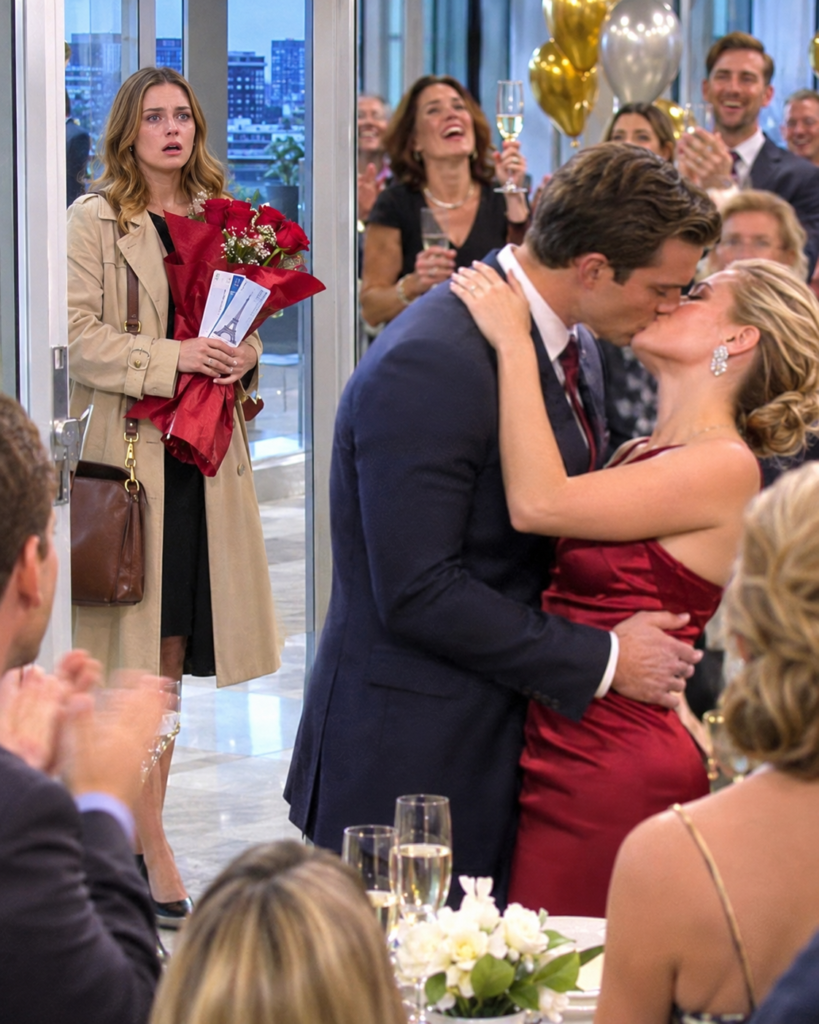
The first thing I saw was my husband kissing another woman beneath a silver banner that read HAPPY ENGAGEMENT. The second thing I saw was two hundred employees applauding him like I had never existed.
I stood just beyond the glass doors of Whitmore Dynamics, holding twelve red roses in one hand and two first-class tickets to Paris in the other.
Valentine’s Day. Ten years of marriage. I had planned everything.
Daniel had been working late for weeks, telling me the company’s new CEO, Vanessa Cole, was “restructuring aggressively.” I believed him because I had spent most of our marriage believing the version of Daniel he performed for me at home.
Then Vanessa lifted her left hand.
A diamond the size of a teardrop flashed under the chandeliers.
Daniel raised a champagne glass. “To new beginnings.”
The room exploded in cheers.
Someone near the door noticed me. Her smile vanished.
Daniel followed her stare.
For one long second, his face emptied.
Then Vanessa turned, saw me, and actually laughed.
“Oh,” she said. “You came.”
I looked at Daniel. “You’re engaged?”
He stepped toward me, lowering his voice. “Claire, not here.”
“Interesting choice of words.”
Vanessa folded her arms. “Daniel said your marriage was basically over.”
“Basically?”
Daniel’s jaw tightened. “We were going to talk tonight.”
I glanced at the ring. “Before or after Paris?”
His eyes dropped to the tickets in my hand.
The room went silent.
Vanessa’s smile sharpened. “This is embarrassing.”
I looked at her, then at him. I felt something inside me break cleanly—not like glass, but like a lock opening.
I placed the roses on the reception desk.
“Congratulations,” I said.
Daniel blinked. “Claire, wait.”
I turned around and walked out.
In the elevator, my hands stopped shaking.
By the time I reached the parking garage, I had canceled the Paris trip.
By the time I started my car, I had frozen every joint personal account requiring my authorization.
By the time I reached home, I had called Miriam Shaw, my attorney.
She answered on the second ring. “What happened?”
“I need the marital protection agreement activated.”
Silence.
Then: “Are you sure?”
“Yes.”
Daniel had spent years telling people he built Whitmore Dynamics from nothing.
That was his favorite lie.
The truth was simpler.
My late father had founded the company.
And after his death, eighty-three percent of it had passed to me.
Daniel knew I was a shareholder. What he never bothered to learn was how my father had protected those shares, or the power that came with them. He thought grief made me passive. He mistook silence for ignorance. Standing in my kitchen, I realized that mistake was about to cost him everything.
PART 2
Miriam moved faster than I had ever seen a lawyer move.
Within twenty minutes, she had emailed me three documents to sign electronically. The first revoked the voting proxy I had handed Daniel four years ago, back when my father’s funeral flowers were still wilting on the dining room table and I couldn’t make myself read a quarterly report. The second formally withdrew my eighty-three percent stake from the shareholder voting pool Daniel had been managing on my behalf. The third notified Calder Capital, the private equity firm Daniel had been courting for months, that my shares were no longer available as collateral for any transaction.
On paper, those shares were worth roughly five hundred fifty-eight million dollars.
In reality, they were the floor Daniel had been standing on for a decade.
I signed all three with my thumb on a phone screen, standing barefoot on the cold kitchen tile. It felt absurd that something so enormous could be done so quietly.
Then the calls started.
At first I watched them come in. Daniel. Daniel. Vanessa Cole, a number I didn’t even know I had saved. Daniel again. Then names I recognized from holiday parties I had sat through smiling politely: Greg Hollister, the CFO. Marcus Tate, head of legal. Two board members. A reporter from the Boston Business Journal, which made my stomach turn.
I put the phone face down on the counter and made myself a cup of tea I didn’t drink.
When I flipped it back over, the screen read: 152 missed calls.
Thirty minutes. One hundred fifty-two calls.
In ten years of marriage, Daniel had never once called me twice in a row. Not when I was in the hospital in 2019. Not the night my father died.
He was calling now.
Not because he had lost me. Because he had lost my signature.
Then the doorbell rang.
I froze. Through the kitchen window, I could see the rain had started, hard and slanted. My first thought was that it was Daniel, that he had driven like a maniac across town to stand on my porch and perform remorse. I almost didn’t answer.
The doorbell rang again. Then a knock. Small, urgent.
I checked the camera on my phone.
It wasn’t Daniel.
It was a woman in a soaked navy blazer, hair plastered to her face, clutching her purse against her chest like a shield. I recognized her immediately. She was the one at the party who had seen me first. The one whose smile had vanished.
I opened the door.
“Mrs. Whitmore-Hale,” she said, breathless. “I’m Gloria Reyes. I’m Daniel’s executive assistant. I’m so sorry to show up like this.”
“You were at the party.”
“Yes.” Her eyes filled. “I didn’t know you were coming. I swear I didn’t know any of it was going to happen like that. He told everyone you two had separated months ago.”
I stepped aside and let her in.
She stood dripping on my entryway rug, refusing to sit. “I don’t have long. If he figures out I came here, I lose my job. Maybe worse.”
“Worse?”
She opened her purse and pulled out a small silver flash drive. Her hand was trembling.
“Three weeks ago, Daniel asked me to scan some documents and send them to Calder Capital’s legal team. I didn’t read them closely. I should have. Tonight, after you left, he went into his office and screamed at Marcus Tate. He said, ‘She can’t revoke anything. She already signed it over. The consent is notarized.’” Gloria swallowed. “So I went back and looked at what I’d scanned.”
She held out the drive.
“There’s a spousal consent and voting transfer agreement on there. It gives Daniel permanent voting control over your shares. It has your signature on it. It’s dated January twenty-third.”
My blood went cold. “I never signed anything like that.”
“I know,” she whispered. “Because on January twenty-third, you were in Vermont with your aunt. Daniel told the whole office. He said it was the first quiet week he’d had in years.”
I took the drive. It weighed nothing. It felt like holding a live wire.
“Why are you doing this?” I asked. “You don’t know me.”
Gloria looked at me for a long moment.
“Your father hired me,” she said. “Eleven years ago, when I was a single mom with a GED and no references. He told me the only thing he’d ever ask in return was that I tell the truth when it counted.” Her voice cracked. “I think it counts.”
Before I could answer, headlights swept across the front windows.
A car door slammed. Then another.
Gloria went pale. “That’s his Range Rover.”
Footsteps pounded up the porch. The doorbell rang once, then again and again, a frantic, furious rhythm. A fist hit the door.
“Claire!” Daniel’s voice, raw and unfamiliar. “Claire, open the door. Right now.”
I put a hand on Gloria’s arm and guided her toward the hallway, out of sight of the glass.
“Claire, listen to me!” he shouted. “You don’t understand what you just did. If those shares leave the trust tonight—”
His voice dropped, suddenly quiet and terribly close to the door.
“—then we both go to prison.”
PART 3
I didn’t open the door.
I stood three feet from it, my heart pounding so hard I could feel it in my teeth, and I spoke through the wood.
“Say that again.”
“Open the door and I’ll explain.”
“No. Explain from there.”
I heard him exhale, that long-suffering sigh he used whenever I asked a question he considered beneath him. For years that sigh had made me feel small. Tonight it made me furious.
“There are loans,” he said. “Bridge financing. Whitmore Dynamics has been bleeding cash for two years, Claire. I kept it afloat. I did that. And some of those guarantees have your name on them. If the Calder deal collapses, the lenders call the notes, and they don’t just come after the company. They come after the guarantors.”
“I never guaranteed anything.”
“You signed a lot of papers after your dad died.”
“I signed what you put in front of me,” I said, and the words tasted like ash. “Because I trusted you.”
“Exactly.” His voice softened, turning into the warm, reasonable tone he used on investors. “So trust me now. Reverse what you did with Miriam, and we’ll figure the rest out like adults. Vanessa is a business arrangement. That’s all. The engagement is optics for Calder. They wanted stability in leadership.”
Down the hall, I heard Gloria make a small sound of disbelief.
“Optics,” I repeated. “You kissed her in front of two hundred people.”
“It was a performance.”
“Then you’re very good at performances, Daniel. You’ve been giving one in my kitchen for ten years.”
Silence. Then a second voice, sharp and female, from farther down the porch steps.
“Daniel, get in the car. She’s recording you.”
Vanessa.
I looked down. My phone was in my hand, the doorbell camera app open, the red dot glowing. I hadn’t even realized it was saving.
Daniel’s tone changed instantly. “This conversation never happened. Anything you think you heard was said under emotional duress. Goodnight, Claire.”
The Range Rover’s engine roared, and then they were gone.
Miriam arrived forty minutes later, carrying a leather briefcase older than I was and a garment bag of what turned out to be pajamas, because she said she wasn’t leaving me alone tonight. Miriam Shaw was sixty-four, silver-haired, five-foot-one, and had once made a federal judge apologize to her in open court. She had been my father’s attorney for thirty years before she was mine.
She hugged Gloria, which surprised me. “Richard always said you had a spine.”
We plugged the flash drive into my laptop at the kitchen table.
The document was exactly what Gloria had described. Twelve pages. Legal language so dense it felt intentional. And on the last page, my signature. Claire Whitmore-Hale. It looked like mine. It looked so much like mine that for a dizzy second I wondered if I’d lost my mind and signed it in my sleep.
Notarized. Stamped. A notary named R. Delacroix.
“It’s good,” Miriam murmured. “It’s very good. Whoever did this had samples.”
“He has ten years of birthday cards,” I said quietly.
Miriam closed the laptop. She was quiet for a while, tapping one finger against the table.
“Claire, there’s something I need to give you. Your father made me promise I would only hand it over if the marital protection agreement was ever activated.” She unlatched her briefcase. “I hoped I’d retire before that happened.”
She set an envelope in front of me.
Heavy cream paper. Sealed with red wax. On the front, in my father’s slanting, impatient handwriting:
For Claire. Only if.
I hadn’t seen that handwriting in four years. My throat closed.
“Do you know what it says?” I asked.
“No. He wrote it alone in my office and sealed it in front of me.” Miriam’s voice gentled. “But I know the agreement he drafted, and I know he spent three months on it. Article Nine. If your spouse commits marital infidelity or attempts to obtain control of your shares through fraud, every right he has ever held through you is void. Retroactively. Not just voting. Everything. Any compensation he received as an officer because of your support. Any equity he was promised. Any spousal claim. It all reverts to the trust.”
“He thought Daniel would cheat on me?”
“He thought Daniel was patient,” Miriam said. “And your father didn’t trust patient men who smile too much.”
I broke the seal.
Inside was a single sheet of paper, folded twice. The handwriting was shakier than on the envelope. He must have written it near the end, when his heart was already failing and he was pretending to all of us that he was fine.
My sweet girl,
If you are reading this, Daniel has done exactly what I feared, and I am sorry I was not braver about telling you while I was alive. You loved him. I did not want to be the man who took that from you.
Listen carefully. The company is not in the trouble they will tell you it is in. Check the money. Follow it to the end.
And Claire—
Do not trust anyone at Whitmore with this. Not even Thomas.
The paper slipped from my fingers.
Thomas Avery. My godfather. My father’s best friend for forty years. The man who had walked me down the aisle when my father’s legs were too weak to stand through the ceremony. The man who had held me at the funeral while I sobbed into his coat.
The man who, Gloria told me in a small voice, had stood beside Daniel tonight at the engagement party and led the toast.
PART 4
The emergency board meeting was called for nine a.m. the next morning.
I hadn’t been inside the Whitmore Dynamics boardroom since my father’s memorial reception. It still had his portrait on the far wall, a stern oil painting he’d hated because the artist had made him look “like a man who forecloses on orphans.” Twelve leather chairs surrounded a walnut table he’d bought from a closing law firm in 1994.
I took the chair at the head of the table.
Nobody told me I couldn’t.
Miriam sat at my right. To my left, a man I had met for the first time at seven that morning: Nathan Brennan, a forensic accountant Miriam swore by. He was in his early forties, quiet, wearing reading glasses and a cardigan that made him look more like a high school chemistry teacher than someone who had helped send two hedge fund managers to federal prison. He had been awake all night going through the company’s public filings.
“Your father was right,” he’d told me in the parking garage, handing me coffee. “The numbers don’t add up. But not the way Daniel claims.”
The board filed in one by one. Seven members. Most avoided my eyes.
Thomas Avery came in last.
He looked older than I remembered, his white hair thinner, his tan a little too orange. When he saw me, his face lit with what looked like genuine relief. He came straight to me and squeezed my shoulder.
“Claire, sweetheart. I’m so sorry about yesterday. I had no idea it would play out like that. If I’d known you were coming—”
“You’d have what, Thomas?” I asked quietly.
He hesitated just a moment too long. “I’d have warned you.”
“You knew about the engagement.”
“I knew about the business arrangement.” He lowered his voice. “Let’s talk after. Privately.”
Not even Thomas. I nodded and said nothing.
Daniel and Vanessa arrived together. Daniel wore the navy suit I had bought him for our eighth anniversary. Vanessa wore white. I had to admire the nerve.
Daniel didn’t look at me. He went straight to the opposite end of the table and remained standing.
“I want to start by saying I regret how yesterday unfolded,” he said to the board, voice smooth as a newscaster’s. “Personal matters should never interfere with company business. Unfortunately, my wife, in an emotional state, has attempted to sabotage the most important transaction in Whitmore’s history. Marcus?”
Marcus Tate, head of legal, slid copies of the forged consent across the table.
“As you can see,” Daniel continued, “Claire signed a binding agreement three weeks ago granting me permanent voting control. Her attempted revocation last night has no legal effect. The Calder deal proceeds Monday.”
Every head turned toward me.
I let the silence stretch. My father used to do that. He said people tell you the truth in the pause after they’ve finished lying.
“That’s interesting,” I said finally. “Because on January twenty-third, I was at my aunt’s house in Woodstock, Vermont. Snowed in. My credit card records show it. So does her neighbor, who plowed us out. So does the photo my aunt posted of me holding her new goat, which has, as of this morning, four hundred and twelve likes.”
A board member coughed into his hand, possibly to hide a laugh.
Daniel didn’t flinch. “Notaries can travel.”
“To a goat farm in a blizzard?”
Miriam stood. “The board should also be aware that Mrs. Whitmore-Hale’s shares are held under a trust instrument with a marital protection agreement. Under Article Nine, any proxy, consent, or transfer obtained through fraud or during a period of marital infidelity is void. As of last night, Mr. Hale holds no voting authority of any kind. Neither does anyone acting at his direction.”
Now Daniel looked at me. Really looked. For the first time in years, I saw something in his eyes I didn’t recognize. It took me a moment to name it.
Fear.
The meeting dissolved into shouting. Calder Capital’s representative left before the coffee was cold. Greg Hollister, the CFO, sat with his head in his hands. Thomas tried to call for order and nobody listened.
In the chaos, I slipped out to the restroom to breathe.
I was washing my hands when the door opened behind me.
Vanessa.
She leaned against the sink beside mine, checking her lipstick in the mirror like we were coworkers on a break.
“You played that well,” she said.
“I wasn’t playing.”
“Everyone’s playing, Claire.” She snapped her compact shut. “You think I’m the villain here. The other woman. Fine. But let me ask you something. When you were married to him—are married, sorry—did you ever ask where the money went?”
“What money?”
She turned to face me. Up close, without the champagne and the chandeliers, she looked tired. Older than thirty-six.
“Ask him about the forty million,” she said. “Ask him why he needed the Calder deal closed by Monday and not a day later.”
She walked out before I could respond.
I went back to the boardroom. It had mostly emptied. Nate Brennan was still at the table, his laptop open, his face unusually still.
“Claire,” he said. “Close the door.”
I did.
“I’ve been tracing outflows from the company’s operating accounts over the last three years. Consulting fees, mostly. Paid to a firm called Northlight Advisory LLC. Delaware company. No website, no employees I can find. Total payments: just over forty-one million dollars.”
Forty million. Vanessa hadn’t been bluffing.
“Who owns Northlight?” I asked.
Nate turned the laptop toward me.
It was the company’s state registration. The registered agent. The organizer. The single listed manager.
Thomas J. Avery.
PART 5
I didn’t confront Thomas.
Everything in me wanted to. I wanted to drive to his house in Wellesley, pound on his door, and scream until the neighbors called the police. But my father’s letter was clear. Follow it to the end. And if I’d learned anything in the last forty-eight hours, it was that the first answer was never the whole answer.
So instead, I drove to Gloucester to see Ruth Okafor.
Ruth had been my father’s secretary for twenty-six years. She retired the month after he died and moved into a small gray-shingled cottage by the harbor, where she grew tomatoes and ignored every email Whitmore Dynamics sent her. She was seventy-three, sharp as a tack, and the only person besides my mother who had ever been allowed to tell my father he was wrong.
She opened the door before I knocked.
“I wondered when you’d come,” she said. “Come in. I’ll put the kettle on.”
Her kitchen smelled like basil and sea air. She listened to everything—the party, the shares, the forged consent, the letter, Northlight—without interrupting once. When I finished, she was quiet for a long time.
“Your father found Northlight,” she said finally. “About eight months before he died.”
My hands tightened around the mug. “He knew?”
“He knew something was wrong. He didn’t know all of it.” She stood, walked to a cabinet, and took out a worn leather planner. “He kept this. Not on the computer. He said computers had too many eyes at that company.”
She opened it to a page in March, four years ago. In my father’s handwriting: Northlight—T.A.?? Why? And beneath it, underlined twice: D.H. signed the invoices.
D.H. Daniel Hale.
“He went to Thomas first,” Ruth said. “I remember because they had a terrible argument in his office. I could hear them through the door. Your father kept saying, ‘Forty years, Tom. Forty years.’ And Thomas kept saying, ‘You don’t understand what he’s holding over me.’”
“What was Daniel holding over him?”
“I never found out.” Ruth’s eyes softened. “Your father got sick soon after. Heart failure moves fast once it decides to. He spent his last good months with Miriam, building that agreement. I asked him once why he didn’t just fire Daniel. Do you know what he said?”
I shook my head.
“He said, ‘Because Claire loves him. And if I’m wrong, I’ll have broken my daughter’s heart for nothing. But if I’m right, he’ll show her himself. All I can do is make sure she’s standing on solid ground when he does.’”
I cried then. Properly, for the first time since the party. Ruth held my hand across her kitchen table and let me.
I thought about all the things I’d let slide. The miscarriage in 2019, when Daniel had been “stuck in Chicago” and sent flowers with a card his assistant had signed. The way he’d talked me out of joining the board after Dad died, saying I was too fragile, too grieving, that business was “a cruel place for someone as gentle as you.” The way he’d made my silence feel like a gift to him instead of a cage he’d built around me.
He hadn’t been protecting me. He’d been keeping me out of the room.
My phone buzzed on the drive home. I didn’t recognize the number at first. Then I did.
Patricia Hale. Daniel’s mother.
“Claire, honey,” she said, her voice thick with practiced worry. “Daniel told me everything. I’m so worried about you. He says you’re not sleeping, you’re making wild accusations, you’ve cut him off from money he needs for his medication—”
“What medication?”
A pause. “Well—his blood pressure.”
“Patricia, Daniel has a gym membership and the resting heart rate of a golden retriever.”
“You’re not yourself. Everyone can see it. After your father, after the baby—you were never the same. Daniel has carried so much.”
I pulled the car onto the shoulder because I could no longer see the road clearly.
“Did he tell you he got engaged?” I asked. “While still married to me? In front of two hundred people?”
Silence on the line. Then, small and uncertain: “He said that was a misunderstanding.”
“Ask him to show you the ring,” I said, and hung up.
When I got home, Miriam’s car was in my driveway. She was sitting on my front steps in the cold, holding a thick stack of papers.
That was when I knew something new had gone wrong.
“Daniel’s lawyers filed in probate court an hour ago,” she said, standing. “It’s an emergency petition.”
“For what?”
“For a temporary conservatorship over your financial affairs. They’re claiming that since your father’s death and your miscarriage, you’ve suffered from untreated grief disorder, that your behavior at the office and last night’s actions prove you’re incapable of managing assets of this size. They want the court to appoint a temporary conservator to control your shares until a full evaluation.”
My knees went weak. “Who do they want as conservator?”
“Daniel. As your spouse.”
“They can’t win that.”
“Normally, I’d agree,” Miriam said grimly. “But they attached a sworn declaration from someone who’s known you since birth. Someone who says he’s watched you deteriorate for four years and fears for your safety.”