Part 1: The Daughter at the White House
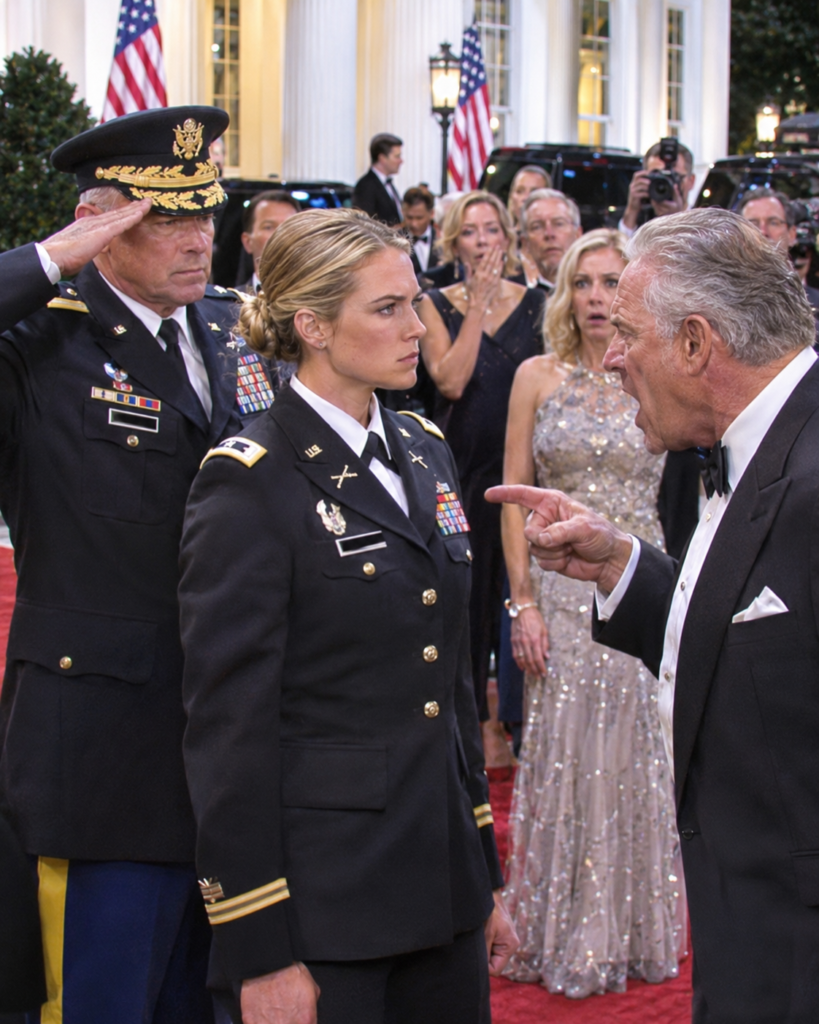
For twenty-six years, my father pretended I did not exist. Then he saw me outside the White House East Wing, standing in my Army service uniform among diplomats, lawmakers, defense executives, and senior officers awaiting security clearance. Victor Caldwell stood ahead of me in the donor line with his wife, Lorraine, and her thirty-six-year-old son, Blake, who had never kept a job. Victor wore an expensive tuxedo while Blake admired his diamond cuff links.
When Blake noticed me, he smirked. “Well, this is unexpected. Maya finally made it to the White House.”
Victor turned. Surprise briefly disrupted his polished expression before contempt replaced it.
“What are you doing here?”
“Good morning, Dad.”
Blake studied my uniform without recognizing the silver eagles on my shoulders. “Security detail? Don’t let any senators steal the silverware.”
Lorraine laughed while Victor pulled me aside. “This event matters to Caldwell Defense Systems. People connected to future contracts are here, so complete your assignment and stay away from us.”
Then he lowered his voice. “Pretend you don’t know us.”
After decades of unanswered calls, returned cards, and Victor introducing Blake as his only child, his rejection no longer surprised me.
“All right.”
I walked toward the principal checkpoint. An event coordinator initially redirected me, but immediately apologized after reading my invitation.
A Secret Service officer scanned my military identification and the encrypted code on the invitation. Her terminal changed, and her expression became serious.
“Command, hold inner traffic at East reception,” she said into her microphone.
Behind me, Victor laughed. “I knew there would be a problem with her credentials.”
The officer contacted General Marcus Hale’s office. After hearing the confirmation, she straightened.
“Colonel Caldwell, General Hale is coming to receive you personally.”
The corridor fell silent. Double doors opened, and a four-star general walked toward us as every nearby service member snapped to attention.
I had known General Hale for six years. Victor, however, had never seen me beside someone he could neither charm nor purchase.
The general passed my father’s welcoming smile without slowing. In that moment, I finally learned what Victor Caldwell looked like when his money stopped working.
Part 2: The Salute
My father had his hand out before General Hale was even halfway down the corridor. I knew that hand. I had watched it work rooms my whole childhood: a firm grip, a warm squeeze at the elbow, a laugh that made powerful men feel like old friends.
“General Hale,” Victor said, stepping into his path. “Victor Caldwell, Caldwell Defense Systems. We met briefly at the Reagan Forum—”
The general walked past him as if he were a coat rack.
He stopped in front of me, squared his shoulders, and raised his right hand in a crisp salute.
The corridor seemed to stop breathing. By regulation, a colonel salutes a general first. Every person in uniform within thirty feet knew that. A four-star breaking protocol in front of the White House was not an accident. It was a statement.
I returned the salute, my throat suddenly tight.
“Colonel Caldwell,” General Hale said, loud enough for everyone to hear. “Secretary Whitfield is waiting for you. So is the President.”
Behind me, I heard Lorraine whisper, “The President?”
Blake made a sound like a man who had swallowed one of his own cuff links.
As we walked through the double doors, I glanced back once. My father was still standing with his hand half-raised, his smile frozen in place like a photograph somebody had forgotten to throw away.
“You didn’t have to do that, sir,” I said quietly once the doors closed behind us.
General Hale kept his eyes forward. “Six years ago you climbed into a burning MRAP outside Erbil and pulled my son out by his body armor. Owen has two daughters now. They’ll grow up with a father because of you.” He finally looked at me. “I’ll salute you any time I please, Colonel. And I’ll be damned if I’m going to shake hands with the man who taught you that you weren’t worth claiming.”
I hadn’t known he knew. I had mentioned my father exactly once, at a dinner after Owen’s homecoming, and only to say we didn’t speak.
“You’re not the only one who does background checks,” he said, reading my face.
The Green Room was smaller than I expected. Secretary of Defense Diane Whitfield stood by the window, reading glasses perched on her nose, a thick folder tucked under one arm. She was in her early sixties, silver-haired, a former Navy JAG officer with a reputation for ending careers with a single question.
“Colonel.” She shook my hand. “Sit. We have eleven minutes before the President walks into the East Room, and I want you to hear this from me first.”
I sat.
“In a few minutes, the President is going to announce the creation of the Joint Acquisition Integrity Task Force. Its first job is a full review of Project Sentinel.”
I knew the name. Everyone in the Pentagon did. Sentinel was a $4.2 billion program to build a counter-drone shield for American bases overseas, the kind of system that might have saved the soldiers I’d buried in the last ten years.
“Three companies are finalists,” Whitfield continued. “One of them is Caldwell Defense Systems.”
There it was.
“Ma’am, I need to state for the record that Victor Caldwell is my biological father.”
“I know.” She opened the folder and slid a single page across the table. It was the ethics disclosure I’d filed six years ago, when I first moved into acquisition oversight. Every year I’d updated it. Every year the answer was the same: No contact. No financial relationship. No communication since 2000.
“You disclosed it before anyone asked,” Whitfield said. “You walled yourself off from two prior reviews involving his company. You’ve never once used his name. That’s precisely why you’re the right person for this job.” She tapped the page. “You won’t score Caldwell’s bid. Your deputy handles that with a separate team. But you’ll run the integrity side, which means test data, supply chains, and anyone trying to buy influence. And Colonel, people are already trying.”
“Who?”
“If I knew that, I wouldn’t need you.”
An aide knocked. “Madam Secretary. Two minutes.”
Whitfield stood. “One more thing. The President is also announcing your nomination for brigadier general. Congratulations. Try to look surprised.”
I didn’t have to try.
The East Room was a blur of chandeliers and camera flashes. I stood beside General Hale while the President spoke about accountability, about soldiers deserving equipment that worked, about a colonel who had once grounded an entire fleet of helicopters because she found counterfeit bolts in a supply crate. When my name was called, the applause rolled through the room like weather.
In the third row, I saw my father.
He was clapping louder than anyone.
At the reception afterward, I lasted twenty minutes before he found me. Lorraine hovered three steps behind him, wearing the smile of a woman calculating exchange rates. Blake had disappeared toward the bar.
“Maya.” Victor’s voice had changed completely. It was soft now, almost tender, the voice he used to use when I was eight and had a fever. “Sweetheart. I had no idea. Why didn’t you ever tell me?”
“I sent you a letter when I graduated from West Point,” I said. “And when I made major. And when I was wounded. They all came back unopened.”
Something flickered across his face. It was there and gone, too quick to name.
“There’s been a misunderstanding,” he said. “A lot of misunderstandings. Let me take you to dinner tomorrow. Just the two of us.”
“I don’t think that’s appropriate.”
He pressed a business card into my hand before I could pull away. On the back, in his sharp slanted handwriting, he had written an address in McLean and a time: 7 p.m.
Then he leaned close enough that Lorraine couldn’t hear.
“Come alone,” he whispered. “There’s something about your mother you need to know. Something she never told you.”
Part 3: The Dinner
I didn’t sleep that night.
My apartment in Arlington was quiet in the way that only a single officer’s apartment can be: clean, sparse, every surface organized. On the bookshelf sat the only photograph I had of my mother and me together. I was eleven, missing a front tooth, standing beside her at a science fair. She was holding up my homemade circuit board as if it were the Hope Diamond.
Elena Ruiz Caldwell had been an engineer. That was the first thing anyone ever said about her. She could rewire a lamp, rebuild a carburetor, and explain differential equations to a sixth grader using pizza slices. When my father left us, she went to work for a small aerospace firm in Dayton and raised me in a two-bedroom rental with a leaky roof she fixed herself.
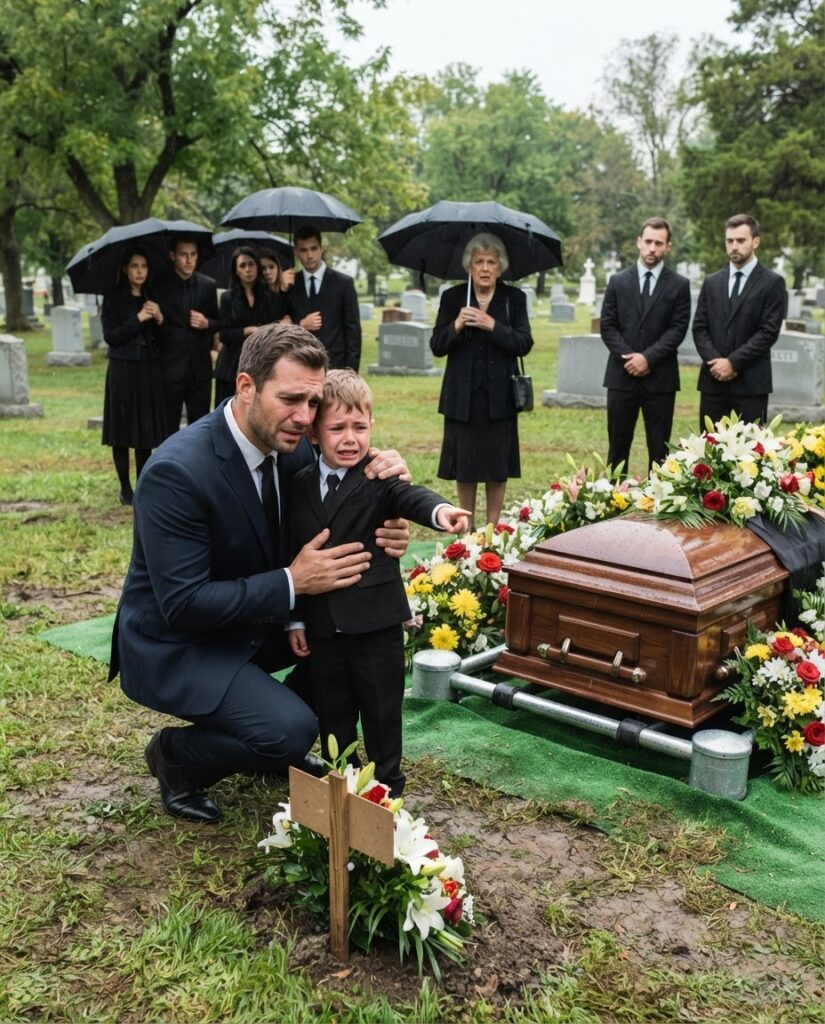
She died of ovarian cancer when I was nineteen, during my sophomore year at West Point. My father did not come to the funeral. He sent flowers. White lilies. The card said, With sympathy, Caldwell Defense Systems.
Not Victor. Not Dad. His company.
At six a.m., my phone buzzed.
Daniel: Saw you on the news. Brigadier General Caldwell has a nice ring to it. Coffee? I’ll even let you pay since you’re famous now.
Daniel Reyes had flown Black Hawks in my old brigade before a back injury grounded him. Now he taught high school physics in Alexandria and lived two floors below me. For two years he had been asking me to dinner, and for two years I’d been finding reasons to say no. He never pushed. He just kept showing up with coffee, fixing my leaky faucet, and leaving bad science puns on sticky notes on my door.
I met him at the café on the corner. He took one look at my face and pushed his blueberry muffin across the table.
“Talk,” he said.
So I did. I told him about the White House, the salute, the business card in my pocket. When I finished, he was quiet for a long moment.
“You’re going,” he said. It wasn’t a question.
“He said it was about my mother.”
“He’s a defense contractor and you just became the person standing between him and four billion dollars.” Daniel turned his coffee cup slowly. “I’m not telling you not to go. I’m telling you to go knowing exactly who’s sitting across the table.”
“I’ve always known who he is.”
“No,” Daniel said gently. “You’ve known who he was to you. You haven’t seen who he is when he needs something.”
Before I went anywhere, I called my deputy, Lieutenant Colonel Jordan Pike, a sharp-tongued JAG officer who had served with me for three years. I told her everything. She made me promise to write a memo for the record within an hour of leaving, and to discuss nothing about Sentinel.
“If he so much as says the word contract,” Jordan said, “you stand up and walk out.”
The house in McLean was enormous. Stone columns, a circular driveway, a fountain lit from below. A housekeeper in a gray uniform opened the door and led me to a dining room where my father sat alone at the head of a table built for twenty.
He stood when I entered. For a moment he simply looked at me.
“You look like her,” he said. “God, you look just like her.”
“You said you had something to tell me about my mother.”
“Sit. Please. Eat something.” He gestured to the plates. Filet mignon. Roasted asparagus. Crème brûlée. My favorites when I was twelve. He remembered. I hated that he remembered.
I sat, but I didn’t touch the food.
He talked for twenty minutes. He talked about regret, about being young and proud, about how my mother had “made things very difficult” after the divorce. He said she’d poisoned me against him. He said she had wanted a clean break, that she’d asked him to stay away.
“That’s a lie,” I said quietly.
“Maya—”
“I was there. I was twelve, not two. I remember her calling you every Sunday for a year, asking you to come to my birthday. I remember her crying in the kitchen when you didn’t.”
His jaw tightened. Then, like a man switching channels, he smiled.
“Let’s not dwell on the past. Let’s talk about your future.” He slid a leather folder across the table. Inside was a letter on Caldwell Defense letterhead, offering me a position on the board of directors upon my retirement from the Army. Below it was a trust document. Two million dollars. In my name.
“This is what you deserved all along,” he said. “I want to make it right.”
I closed the folder.
“You told me to come alone because you had something to tell me about my mother. Instead, you’ve offered me a board seat and a bribe, four weeks before your company’s bid gets reviewed by my task force.”
“That’s not what this is.”
“Then what is it?”
He didn’t answer.
I stood, placed his business card on top of the folder, and walked out. My hands were shaking by the time I reached my car. I sat in the driveway and dictated the memo to Jordan word for word, including the trust amount and the board offer.
When I got home, a manila envelope was leaning against my apartment door. No stamp. No return address. Just my name, written in an elderly person’s careful cursive.
Inside was a photocopy of a patent application from 1999. The invention was called Kestrel: Adaptive Guidance Algorithm for Autonomous Interception. It was the technology Caldwell Defense Systems had been built on.
The inventor’s name had been crossed out in black ink and replaced with Victor J. Caldwell.
But the original name was still faintly visible beneath the line.
Elena M. Ruiz.
Part 4: What My Mother Traded
The envelope contained one more thing: a sticky note with a phone number and five words.
Your mother deserved better. —R.
I didn’t call right away. I’m a soldier and an investigator; I know what a setup looks like. If someone wanted to compromise me, slipping documents under my door about my own father’s company was a clever way to do it. If I used my position to dig into this personally, I’d be finished.
So I did it by the book. The next morning, I walked the envelope into Jordan’s office, along with a written statement explaining how I’d received it.
Jordan read the patent copy twice. Then she looked up at me with an expression I’d never seen on her before. It was something close to sorrow.
“Maya. If this is real, your father didn’t just leave your mother. He robbed her.”
“I know.”
“You can’t touch this. Not officially. Any IP fraud in Caldwell’s background goes to the Defense Criminal Investigative Service, and you stay fifty feet away from it.”
“Agreed.” I hesitated. “But this is also my mother. I have the right, as her daughter, to call an old family friend.”
Jordan sighed. “Document every word.”
The number belonged to Ruth Okafor, seventy-four years old, living in a brick row house in Baltimore with a garden full of tomato plants and a cat named Fermat. When she opened her door and saw me, she put a hand over her mouth.
“Oh, honey,” she said. “You have her eyes.”
Ruth made tea. Her hands trembled slightly as she poured. She had been Caldwell Defense’s very first employee, back when it was three people in a rented warehouse in Chantilly. Victor handled the money and the handshakes. Ruth handled operations.
And my mother wrote the code.
“Elena was the genius,” Ruth said simply. “Victor was a salesman who married a genius. Kestrel was hers, every line of it. She built it at our kitchen table on nights and weekends while you were asleep. Victor took it to the Pentagon and they went crazy for it.”
“Then why is his name on the patent?”
Ruth set down her cup. “Because of the divorce.”
She told me the story slowly, the way people tell stories they’ve carried for too long. When the first big contract came through, Victor started changing. There were new suits, new friends, and a new woman named Lorraine who worked as his lobbyist. My mother found out about the affair and asked for a divorce. She wanted her share of the company, which, since she had written the core technology, should have been most of it.
“Victor’s lawyers told her he would fight for full custody,” Ruth said. “He’d paint her as an unstable woman working eighty-hour weeks. They had money, connections, and judges who played golf at the same club. Elena’s lawyer told her she had maybe a forty percent chance of keeping you.”
My chest went cold.
“He never wanted custody,” Ruth said. “He made that clear the minute she signed. But Elena couldn’t take the risk. So she signed over the patents. All of it. Her name came off Kestrel, and in exchange, she kept you.”
I couldn’t speak. I thought of our leaky roof in Dayton, the secondhand furniture, my mother working weekends at a job beneath her talents while my father bought a house with a fountain.
“She traded a fortune for you,” Ruth said softly. “And she never once regretted it. She told me that the day before she died.”
“Why didn’t she ever tell me?”
“Because she signed a nondisclosure agreement. And because she didn’t want you growing up hating your father.” Ruth’s mouth twisted. “She was a better person than any of us.”
I wiped my eyes with the back of my hand. “Ruth, why now? Why send this after twenty-six years?”
She glanced at the window, as if someone might be listening.
“Because I saw you on television. And because I still have friends at Caldwell. Old engineers, people who remember when the company had a conscience.” She leaned forward. “Elena found a flaw in Kestrel before she left. Under certain conditions, like heavy electronic jamming or swarms of more than twelve targets, the algorithm can lock onto the wrong object. She wrote a fix, but Victor shelved it because it would have delayed the first contract.”
“Sentinel is built on Kestrel,” I said slowly.
“Sentinel is Kestrel with a fancier coat of paint.” Ruth’s voice dropped. “My friend inside says the swarm tests failed three months ago. Badly. And then the failure reports vanished. New reports showed up saying everything passed.”
“Who altered them?”
“She doesn’t know. But she’s frightened.” Ruth reached across the table and gripped my hand. “Maya, if Sentinel gets deployed with that flaw, soldiers will die believing they’re protected.”
I drove back to Arlington with my hands locked on the steering wheel. That night I wrote everything down for Jordan and for the Defense Criminal Investigative Service, every word, every name.
At 11:47 p.m., my phone rang. Unknown number.
“Colonel Caldwell?” A woman’s voice, low and urgent. “This is Special Agent Teresa Molina, DCIS. I received your referral an hour ago. I need you to listen carefully.”
“I’m listening.”
“Your memo mentions altered test data at Caldwell Defense. We’ve been investigating that company for eight months on an unrelated tip.” She paused. “Our tip came from inside Victor Caldwell’s own household.”
Part 5: The Stepbrother
Agent Molina wouldn’t say more over the phone. “Not your lane, Colonel. Keep your distance, keep your records clean, and call me if anyone from that family contacts you.”
Somebody from that family contacted me the very next evening.
I was coming back from a run along the Potomac when I saw Blake leaning against my car in the parking garage. He was wearing a rumpled designer blazer, and his eyes were bloodshot. A silver Porsche was parked crookedly across two spaces behind him.
“Sister,” he said, drawing out the word. “Or should I say General?”
“I’m not your sister, Blake. What do you want?”
“Just a chat. Family to family.” He pushed off the car and swayed slightly. He’d been drinking. “You’ve really turned things upside down, you know that? Victor’s been in a mood for three days. Throwing things. He threw a crystal decanter at the wall. Mom says it cost eleven thousand dollars.”
“I’m sorry for the wall.”
He laughed, but it came out wrong, cracked down the middle. “You think you’ve won something, don’t you? Little Maya, the daughter he threw away, comes back with stars on her shoulders and everybody claps.” He stepped closer. “Let me tell you what you don’t understand. Victor doesn’t love anybody. Not you, not me, not my mother. He loves the company. That’s it. That’s the whole list.”
For a moment, under the bravado, I saw something I didn’t expect.
Fear.
“Why are you really here, Blake?”
He looked away. “He’s changing his will. Did you know that? Ever since the White House. His lawyers came to the house yesterday. Mom heard him on the phone saying the word ‘Maya’ four times.” He swallowed. “Twenty-four years I’ve been his son. Twenty-four years I’ve laughed at his jokes and worn his suits and said, ‘Yes, Victor,’ and ‘Of course, Victor.’ And you show up once and he’s ready to hand you everything.”
“I don’t want his money.”
“Everybody wants his money!” His voice echoed off the concrete. Then quieter, almost to himself: “And it won’t even matter. There’s not going to be anything left anyway.”
I went still. “What does that mean?”
Blake blinked, as if he had just heard what he’d said. His face shut like a door.
“Nothing. Forget it.” He pulled out a checkbook from his blazer pocket, scribbled something, and tore it off. “Here. Fifty thousand. Recuse yourself from Sentinel. Tell them it’s a conflict of interest. Everyone will understand.”
I didn’t take the check. “Blake, you just tried to bribe a federal official in a parking garage with a security camera pointed at your face.”
He looked up at the camera. All the color drained from his skin.
“I’m going to report this,” I said calmly. “I’d recommend you go home, sober up, and call a lawyer. A good one.”
He crumpled the check and shoved it in his pocket. At the door of his Porsche, he turned back.
“You think I’m the problem?” he said. “You have no idea what’s happening in that house. You’re going to wish you’d taken the money.”
He drove out of the garage too fast, tires squealing.
I reported it within ten minutes. Jordan pulled the security footage. Agent Molina called back within the hour and listened without interrupting.
“‘There’s not going to be anything left anyway,’” she repeated. “He said that exactly?”
“Exactly.”
“Interesting,” was all she said.
The next morning, I learned what Blake had meant by you’re going to wish you’d taken the money.
Daniel knocked on my door at 6:15 a.m. holding his phone. He didn’t say a word. He just turned the screen toward me.
It was a story on a popular political gossip website. The headline read:
DEFENSE TYCOON’S ESTRANGED DAUGHTER HOLDS KEYS TO $4 BILLION CONTRACT — AND SHE’S OUT FOR REVENGE
The article painted me as a bitter, vindictive woman nursing a lifelong grudge against her successful father. It quoted “a source close to the family” claiming I had once threatened to “destroy Victor and everything he built.” It included a photograph of me at the White House reception, cropped so that I appeared to be glaring at my father.
“I’ve never said anything like that in my life,” I said.
“I know,” Daniel said. “But four hundred thousand people have already read it.”
By noon, two senators had called for my recusal. By three, a cable news panel was debating whether “family trauma” disqualified me from leading the task force. By five, my phone had ninety-three missed calls.
At 6:40 p.m., Secretary Whitfield called me directly.
“Colonel,” she said, and her voice was very careful. “I need you in my office tomorrow at oh-seven-hundred. We have a serious problem.”
“Ma’am, if this is about the article—”
“It’s not about the article.” A pause. “This afternoon, my Inspector General received a formal ethics complaint. It includes text messages. The complaint alleges you contacted your father privately and demanded ten million dollars in exchange for a favorable review of Caldwell’s bid.”
The floor tilted beneath me.
“Those messages,” Whitfield said, “appear to have come from your personal phone.”
Part 6: The Frame
The text messages were good. That was the worst part.
I sat in Secretary Whitfield’s office at seven the next morning, reading printouts while she watched me over her glasses. General Hale stood by the window, arms crossed, jaw like granite.
The messages were timestamped over three weeks. They were written in short, clipped sentences, exactly the way I texted. They used my habit of skipping capital letters. They even used a phrase I said often, “copy that,” and referred to details about my mother that only family would know.
you owe me for her. 10 million and sentinel goes your way.
clock is ticking dad. copy that?
“I didn’t write these,” I said.
“I believe you,” Whitfield said. “My problem is that belief isn’t evidence. Until the IG completes a forensic review, I have no choice. As of this moment, you’re suspended from the task force pending investigation. Lieutenant Colonel Pike will serve as acting director. Your nomination is on hold.”
I had known it was coming, but hearing it felt like a blow to the ribs.
“I understand, ma’am.”
After she left, General Hale sat down across from me. He looked older than he had at the White House.
“Somebody worked hard on this,” he said. “Whoever wrote those knew how you talk. That means someone close to you, or someone who studied you.”
“Or someone who has my old phone records,” I said slowly. “My father’s company paid for a family phone plan when I was a teenager. Before he cut us off.”
Hale nodded once. “Give that to the investigators.”
I spent the next three days in my apartment, stripped of my badge, my work, my purpose. It’s a peculiar feeling, being benched after nineteen years in uniform. Daniel came by every evening. He didn’t try to fix anything. He cooked terrible spaghetti, graded physics exams on my couch, and once made me laugh so hard by explaining Newton’s Third Law with my own life (“every action has an equal and opposite reaction, which is why your father is currently panicking”) that I almost forgot to be miserable.
On the fourth day, my father came to my door.
He was alone. No tuxedo this time, just a navy overcoat and a face that hadn’t slept.
“May I come in?”
“No.”
He nodded as if he had expected that. “Then I’ll say it here. I know about the complaint. I know you didn’t write those messages.”
“Did you file it?”
“No.” He said it too fast, then repeated it slower. “No, Maya. I swear to you.”
“Your word doesn’t mean much to me.”
“I know.” He took a breath. “But I can make this go away. I have lawyers. I have friends on the Armed Services Committee. All you’d have to do is write a short statement saying we’ve reconciled, that there’s no animosity, and that you believe Caldwell Defense deserves fair consideration. The complaint disappears. Your nomination comes back. Everyone wins.”
I stared at him. The worst part was that I could tell he thought he was being generous.
“You’re offering to clear my name,” I said, “if I help you win the contract.”
“I’m offering to help my daughter.”
“You didn’t have a daughter for twenty-six years. You only remembered her when she became useful.” My voice didn’t rise. It didn’t need to. “Here is my statement, Dad. I would rather lose my stars than lie for you. Mom taught me that. You should have stuck around long enough to learn it.”
His face crumpled. Just for an instant, but I saw it. Then he turned and walked down the hallway, shoulders bent like a much older man.
That night, at 9:12 p.m., Agent Molina called.
“Colonel, I’m not technically supposed to tell you this, because you’re a subject of the IG inquiry. But you’re also a witness in mine, and I need you to know something before you hear it somewhere else.”
I sat up. “Go ahead.”
“The DoD Inspector General’s forensic team finished their analysis of those text messages. They weren’t sent from your phone at all. They were generated using a messaging app that spoofs caller identity, then screenshotted to look authentic.” Papers rustled. “The account was paid for with a corporate credit card registered to Caldwell Defense Systems.”
My heart thudded. “My father’s card?”
“No,” Molina said. “The card belongs to a subsidiary consulting firm called Larkspur Strategic Partners. Its sole officer is listed as Blake Hollister.”
Blake.
“There’s more,” she said quietly. “Larkspur has received fourteen million dollars from Caldwell Defense in the past two years. The payments were all approved by the company’s chief financial officer.”
“Who’s the CFO?”
A long pause on the line.
“Lorraine Caldwell.”
Part 7: The House of Cards
Within forty-eight hours, the ethics complaint against me was formally dismissed. Secretary Whitfield called personally to reinstate me and restored my nomination with a one-line statement to the press: Colonel Caldwell was the target of a fabricated complaint. She has the Department’s full confidence.
The gossip site deleted its article without an apology. The senators who’d called for my recusal suddenly found other things to talk about.
I should have felt triumphant. Instead, I felt like I was standing at the edge of something much deeper.
Jordan briefed me in a secure conference room at the Pentagon. She had spread documents across the table like a crime scene. Since DCIS had now formally opened a criminal case, my task force was cooperating as a witness, and I was walled off from any decisions about Caldwell’s bid.
“Here’s what we know so far,” Jordan said. “Larkspur Strategic Partners is a shell. No employees, no office. Fourteen million went in. Most of it went out again to accounts in the Cayman Islands. Some went to a gaming debt Blake owes in Atlantic City. And three million went to a lab in Maryland that does independent weapons testing.”
“The Sentinel swarm tests,” I said.
Jordan nodded grimly. “The lab’s lead technician resigned two months ago. DCIS found her yesterday. She says Lorraine paid her to rewrite the failure reports. Kestrel failed seven of nine swarm trials. In two of them, the interceptor locked onto a friendly decoy instead of the incoming drone.”
I closed my eyes. In a real attack, the “friendly decoy” would be a helicopter full of soldiers. Or a mess tent at dinnertime.
My mother had warned about exactly that flaw twenty-seven years ago.
“Why would Lorraine risk prison?” I asked. “Caldwell is already worth hundreds of millions.”
Jordan slid one final document across the table. It was a confidential term sheet from a private equity firm offering to acquire Caldwell Defense Systems for $1.8 billion, contingent upon award of the Project Sentinel contract.
“Your father transferred forty percent of the company’s voting shares to Lorraine three years ago for tax purposes,” Jordan said. “Another ten percent went to Blake. Together, they have enough votes to approve the sale over his objection. Win Sentinel, sell the company, cash out before the flaws show up in the field. By the time soldiers start dying, Lorraine and Blake are on a beach somewhere, and Victor is holding the blame.”
“And Victor knew nothing?”
“That’s what DCIS is trying to figure out.”
I found out that evening.
My father called me nine times. I didn’t pick up. On the tenth call, he left a voicemail. His voice was unrecognizable. It was raw, trembling, almost childlike.
“Maya. They came to the house today. Federal agents. They took Lorraine’s computers. And Blake’s. They asked me about Larkspur, and I…” A ragged breath. “I didn’t know what it was. I swear to God, I didn’t know. She’s been signing my name. For years. She’s been signing my name.”
The voicemail went silent for several seconds. I thought it had ended.
Then: “I need to see you. Please. I’ll come anywhere you say. I’m not asking for anything. I just need to give you something before they take everything else away.”
I listened to it three times. Then I called Agent Molina.
“He wants to meet,” I told her. “He says he has something to give me.”
“Do you think he’s trying to influence you?”
“I don’t know.” I looked at the photo of my mother on my bookshelf. “But I don’t think he has anything left to bargain with.”
Molina was quiet for a moment. “Meet him in a public place. Tell him up front that anything relevant to the investigation goes straight to me. If he agrees, I don’t see a problem.”
I texted my father a single line: Tomorrow. 10 a.m. The coffee shop on Wilson Boulevard. Anything you bring, I give to federal investigators. If you agree, come.
His reply came within thirty seconds.
I agree. I’ll bring them all.
Them? I typed back.
There was a long gap. The three dots appeared and disappeared four times.
Then:
Your mother’s notebooks. I’ve kept them for twenty-six years. And the letters she wrote to me that I never answered. There’s one addressed to you. She asked me to give it to you after she died. I never did.
Part 8: The Notebooks
My father arrived at the café at 9:51 a.m., nine minutes early, carrying a cardboard banker’s box against his chest like a man carrying a child out of a fire.
Daniel sat at a corner table pretending to read a newspaper. I hadn’t asked him to come. He had simply been there when I walked in, and when I raised an eyebrow, he shrugged and said, “Free country. Great muffins.”
Victor set the box on the table between us. He looked like he’d aged ten years in a week. His hair hadn’t been combed. There was a coffee stain on his cuff.
“I agree to your terms,” he said before sitting down. “Everything goes to the investigators. I’ve already called a lawyer. Not the company’s lawyer. My own.” He gave a weak laugh. “First time in thirty years I’ve needed one of those.”
I lifted the lid.
Inside were seven spiral notebooks, their covers faded, corners soft with age. I recognized my mother’s handwriting instantly. It was small and slanted, with little doodles in the margins: a stick-figure cat, a sun with sunglasses, an equation crossed out with the word NOPE beside it.
The first notebook was dated 1996. The last was dated 1999. Pages and pages of code, diagrams, and notes. And on a page near the end of the final notebook, circled twice in red ink:
KESTREL SWARM CONDITION — DANGER. Above 12 targets + heavy jamming = lock confusion. Could select friendly IFF decoy. MUST FIX BEFORE FIELDING. Told V. He says “after the contract.” NOT ACCEPTABLE.
Beneath it, three pages of handwritten corrections. My mother’s fix. Twenty-seven years old and never used.
I stared at the page until the letters blurred.
“She told me,” my father said quietly. “Over and over. I told her we’d fix it later. And then the company got bigger, and it was always later.” He rubbed his face. “I’ve never let myself read those notebooks. I just kept them in my safe. I don’t even know why. Maybe I thought if I threw them away, she’d really be gone.”
“You took everything from her,” I said. “Her name. Her work. Her life’s best idea.”
“I know.”
“And you threatened to take me.”
He flinched as if I’d struck him. “I never would have gone through with it. I didn’t want custody. I just wanted her to sign.”
“That makes it worse, not better.”
“I know,” he said again, and his voice broke. “Maya, I know.”
At the bottom of the box was a stack of envelopes held together by a rubber band. My birthday cards. My letters from West Point. My Christmas cards. The letter I’d written from Walter Reed after the explosion that took part of my hearing in my left ear.
Every single one was stamped RETURN TO SENDER.
“I need you to know something,” Victor said. “I told my secretary, back in 2000, to return anything from you or your mother. I was angry and ashamed and stupid. That’s mine. I own it.” He swallowed. “But a few years later, I changed my mind. I told Lorraine I wanted to reach out to you. She said she’d handle it. She said you’d written back saying you never wanted to hear from me again.”
“I never wrote that.”
“I know that now.” He pushed one of the envelopes toward me. “This one came in 2019. From the hospital. I never saw it. Lorraine kept every letter in a locked drawer in her study. The agents found them two days ago and gave copies to my lawyer.”
I picked up the Walter Reed letter. I remembered writing it with my right hand still bandaged, asking my father, for the last time, if he’d come see me.
“Did you know I was wounded?” I asked.
“Not until Tuesday.” His eyes filled. “I didn’t know my daughter almost died until a federal agent showed me a letter my wife hid in a drawer.”
It was too much. I had spent twenty-six years building walls high enough to keep this man out, and now he was sitting across from me, a broken old man, telling me some of the bricks had been laid by someone else.
It didn’t excuse him. He had started this. He had chosen money over my mother and me long before Lorraine ever touched a single envelope. But it changed the shape of the story.
Finally, beneath the letters, there was one last envelope. Lavender stationery. My mother’s handwriting.
For Maya. Please give this to her when I’m gone. — E.
“She mailed that to me two weeks before she died,” Victor whispered. “She asked me to give it to you at your graduation. I couldn’t make myself face you.”
My hands were shaking too hard to open it. Daniel was suddenly beside me, one hand resting lightly on my shoulder. He didn’t say anything. He didn’t need to.
“I’ll read it later,” I managed.
I closed the box and slid it toward the edge of the table. “This goes to Agent Molina today.”
“I know. I’ll sign whatever statement they need.” Victor stood slowly. “I’m going to testify, Maya. About Kestrel. About the fix I buried. About everything. It’s going to destroy me.”
“Yes,” I said. “It probably will.”
He nodded, accepting it. As he turned to go, his phone buzzed. He glanced at the screen and went pale.
“It’s Blake,” he said, holding it out so I could see the text.
She’s leaving tonight. Dulles. Private charter to Grand Cayman. She’s taking the drive with the real test data and she’s going to sell it to the highest bidder. I’m not going with her. Tell Maya I’ll give her everything, but only her. Arlington Cemetery. Her mother’s grave. One hour. Come alone or I disappear too.
Part 9: At My Mother’s Grave
Of course I didn’t go alone.
Agent Molina had two teams moving within ten minutes. One raced toward Dulles International Airport to intercept Lorraine’s charter. The other followed me to Arlington National Cemetery at a careful distance, plainclothes agents in rental sedans with flowers on the dashboards like ordinary mourners.
My mother is buried at Arlington. Not because she served, but because I did. She was my dependent when she died, and years later, when I earned the right, I had her moved there so I could visit her among the people I’d served beside. It was the only thing I’d ever been able to give her.
The October afternoon was gray and cool. Rows of white headstones stretched over the hills like a frozen tide. I walked down Section 54 with Molina’s voice in my earpiece.
“We have eyes on him. He’s sitting on the bench near her headstone. No visible weapon. He’s… I think he’s crying, Colonel.”
Blake looked up as I approached. He was holding a small black hard drive in both hands, turning it over and over.
“You came,” he said, sounding genuinely surprised.
“I didn’t come alone. I want you to know that. There are federal agents nearby.”
He gave a hollow laugh. “Of course there are. You’re the honest one. That’s your whole thing.” He wiped his nose with his sleeve. “It’s fine. I’m done running.”
I sat down on the other end of the bench, leaving space between us.
“Why my mother’s grave, Blake?”
He looked at the headstone. Elena Maria Ruiz. Beloved Mother. Engineer. 1962–2007.
“Victor used to come here,” he said. “Did you know that? Once a year, on her birthday. He never told anybody. I followed him once when I was twenty-five. I thought he was having an affair.” He shook his head. “He just stood here for an hour. Didn’t say anything. Then he drove home and acted like nothing happened.”
I didn’t know what to do with that, so I said nothing.
“My mother hated that,” Blake went on. “She hated Elena. Hated you. Said as long as you two existed, Victor would never fully belong to us.” He laughed bitterly. “Turns out he never belonged to anybody.”
“Tell me about the drive.”
He held it up. “Real Sentinel test results. All nine trials, unedited. Plus every payment Mom made through Larkspur, every email to the private equity firm, and the buyer she lined up for the data. It’s a foreign company. I don’t even know which country. She wanted to sell the swarm failures to them before the contract went through. Get paid twice.”
“And you’re giving this to me?”
“I’m giving it to the only person in my whole life who ever told me no to my face and meant it as a favor.” He stared at the drive. “In that parking garage. You said, ‘Go home, sober up, call a lawyer.’ Nobody ever said anything like that to me. Mom always fixed everything. Victor always paid for everything. Nobody ever told me I was going the wrong way.”
He held the drive out to me.
“I made those fake texts,” he said. “Mom told me to. She wrote half of them herself. I’m sorry. I’m really, really sorry, Maya.”
I didn’t take the drive yet. “Blake, I can’t make you any promises. I’m not a prosecutor. But I can tell you this: the first person to tell the truth usually gets treated better than the last person.”
He nodded slowly, tears running down his face. Then he placed the drive on the bench between us, stood, and raised his hands as two agents walked quietly up the slope.
“I’m Blake Hollister,” he told them. “I’d like to talk to a lawyer, and then I’d like to tell you everything.”
As they led him away, he looked back once. “Tell Victor I’m sorry I ruined his company.”
“You didn’t ruin it,” I said. “It was rotten long before you got there.”
Twenty minutes later, Molina’s voice came through my earpiece, breathless with adrenaline.
“Colonel. We got her. Lorraine Caldwell was detained at the Dulles private terminal with a carry-on bag containing a second copy of the test data, two passports, and four hundred thousand dollars in bearer bonds. She’s asking for her lawyer. And she’s demanding to speak with her husband.”
I closed my eyes and let out a breath I felt I’d been holding since the East Wing.
“Thank you, Agent Molina.”
“Thank you. Go home, Colonel. Get some rest.”
But I didn’t go home. Not yet.
I sat back down on the bench in front of my mother’s headstone. The wind moved through the old oaks overhead, scattering gold leaves across the grass. From the inside pocket of my jacket, I took out the lavender envelope. I had carried it all afternoon without opening it.
Now, with my mother’s name in front of me, I finally broke the seal.
Her handwriting, shakier than in the notebooks, the hand of a woman who knew she was running out of time:
My darling Maya,
If you’re reading this, your father finally found the courage to give it to you, or he never did and someone else found it. Either way, I need you to know three things.
First: I was never poor. Not for one single day. I had you.
Second: Don’t spend your life trying to prove you’re worth loving. You were worth it the moment you were born. People who can’t see that are blind, not right.
Third, and this is the hardest one: someday your father may come back to you. If he does, you don’t owe him forgiveness. But don’t let his failures make your heart smaller. Be bigger than what was done to us. That’s how we win.
I love you more than all the stars in all the skies. Go be brave.
Mom
I read it three times. Then I folded it carefully, pressed it to my chest, and cried at my mother’s grave the way I hadn’t let myself cry in nineteen years.
When I finally looked up, Daniel was standing a few rows away, hands in his coat pockets, waiting. He’d driven over the minute Molina’s team cleared the area.
He didn’t come closer until I nodded.
Then he sat beside me, put his arm around my shoulders, and let me lean on him until the sky turned violet and the cemetery lights came on, one by one, like small promises.
Part 10: Be Bigger
Justice rarely arrives all at once. It comes in pieces, like spring after a long winter, one thaw at a time.
In January, a federal grand jury indicted Lorraine Caldwell on eleven counts, including wire fraud, conspiracy to defraud the United States, falsification of military test data, obstruction of justice, and attempted unlawful export of defense technical information. Her lawyers tried to negotiate. Prosecutors had the drive, the bearer bonds, the hidden letters, and her son’s testimony. In June, she pleaded guilty and was sentenced to fourteen years in federal prison.
Blake pleaded guilty to two counts and cooperated fully. Because he came forward voluntarily and helped prevent the foreign sale, the judge gave him thirty months, followed by mandatory addiction treatment. Before his sentencing, he sent me a short handwritten note: I’m learning to go the right way. Slowly. Thank you for telling me no.
I wrote back. Just one line: Slowly still counts.
Caldwell Defense Systems was permanently disqualified from Project Sentinel. The contract went to another company whose system passed every swarm test with clean margins. Using my mother’s original notebooks, Pentagon engineers confirmed that the flaw she identified in 1999 existed in several older systems still in service. Those systems were quietly recalled and repaired with corrections based on her design.
Her fix, ignored for twenty-seven years, now protects American bases on three continents.
As for Victor Caldwell, he kept his word.
He testified before the Senate Armed Services Committee for six hours. He told them everything: how he’d buried Elena’s warning, how he’d taken her patents, how he’d let his company grow fat on technology he knew was flawed. He didn’t blame Lorraine for his own choices. He didn’t blame Blake. When a senator asked why he was confessing to things that could ruin him, he looked straight into the cameras and said:
“Because my daughter wouldn’t lie for me. And it took me twenty-six years to understand that she was the only person in my life who ever really told me the truth.”
The board removed him as CEO the next morning. He paid a $40 million civil settlement to the government. He avoided prison because he hadn’t known about the falsified tests, but his name, the one he’d spent his life polishing on buildings and letterhead, would be remembered now for one thing only.
Then he did something I didn’t expect.
He petitioned the U.S. Patent and Trademark Office and filed sworn affidavits to correct the inventorship records on every Kestrel patent. In March, the corrections were granted. My mother’s name was restored to the work she created at our kitchen table.
Elena M. Ruiz, Inventor.
He also transferred the remaining royalties to a foundation in her name. Its first project was the Elena Ruiz Scholarship at West Point, awarded each year to a cadet raised by a single parent who wants to study engineering.
In May, I stood on a stage at West Point, wearing a single silver star on each shoulder. The Senate had confirmed my promotion two months earlier. General Hale had pinned the stars on himself, with Owen and his two little girls watching from the front row. One of them, age five, had asked loudly whether I was a real general or a pretend one. Hale told her, “The realest one I know.”
Now I looked out at the audience of cadets and families as I announced the first Elena Ruiz Scholar. Her name was Destiny Alvarez, from El Paso, raised by a mother who worked two jobs and still made it to every robotics competition. When she walked up to shake my hand, she was crying.
“My mom always says she’s not rich,” Destiny whispered. “But she says she’s got me, so she’s doing fine.”
I had to stop for a moment before I could speak.
“Your mom,” I told her, “sounds a lot like mine.”
After the ceremony, I found Ruth Okafor in the second row. She had dressed in her Sunday best and wore a small brooch shaped like a cat. “Fermat insisted,” she said when I laughed, hugging her.
Agent Molina had come too, out of uniform for once. Jordan Pike, now a full colonel and permanent director of the Integrity Task Force, stood beside her, pretending not to tear up.
And in the very last row, alone, sat my father.
I’d told him about the ceremony. I hadn’t told him whether he could come. He had come anyway and sat as far back as possible, the way a man sits when he knows he hasn’t earned the front.
When the crowd thinned, I walked up the aisle and stopped beside him.
He stood quickly, clutching a program he’d folded into a tight square.
“She would have been proud,” he said. “Of the scholarship. Of you. Mostly of you.”
“I know she would.”
He nodded, looking down at the folded program. “I’m not going to ask you for anything, Maya. I don’t have the right. I just wanted to see it.”
I thought about my mother’s letter. You don’t owe him forgiveness. But don’t let his failures make your heart smaller.
“Daniel and I host dinner on Sundays,” I said. “Ruth comes. Jordan, sometimes. General Hale when he’s in town. It’s nothing fancy. Daniel makes terrible spaghetti.”
My father looked up slowly.
“You can come once,” I said. “Next Sunday. Six o’clock. You don’t bring anything. Not a gift, not a check, not a lawyer. Just yourself. And then we’ll see.”
His face did something complicated: grief, gratitude, shame, and hope all at once. He opened his mouth, closed it, and finally just nodded.
“Just myself,” he repeated. “I can do that. I think I can do that.”
He came that Sunday. He arrived exactly on time, carrying nothing. He sat quietly at the end of our small table, listened more than he talked, and laughed, really laughed, when Ruth told the story of my mother once fixing the warehouse air conditioner with a coat hanger and a paper clip. He helped Daniel wash dishes afterward and called the spaghetti “honest food,” which Daniel decided to take as a compliment.
It wasn’t forgiveness. Not yet. Maybe someday. But it was a door left open an inch, and that was more than he had ever given me.
Later that night, after everyone had gone, Daniel and I sat on my small balcony looking at the lights of Washington. The Capitol dome glowed in the distance. Somewhere across the river, the White House where all of this had started was settling down for the night.
“So,” Daniel said. “I’ve been meaning to ask you something for about two years.”
“Daniel, if this is about dinner again—”
“It’s not about dinner.” He reached into his jacket and took out a small velvet box. His hands were shaking. This was a man who used to fly helicopters into firefights. “It’s about every dinner. For the rest of our lives. If you’ll have me.”
Inside was a simple ring, a small diamond set in white gold.
I stared at it. Then at him. Then I laughed through sudden tears.
“Yes,” I said. “Yes, you ridiculous man. Yes.”
He slid the ring onto my finger. Below us, a car horn honked as if the city itself were applauding.
For twenty-six years, I believed my family was something that had been taken from me, something I had to win back or prove I deserved. I spent my whole life standing at attention, waiting for someone to see me.
But my mother was right. I was never poor. Not for a single day.
Family isn’t the name on your birth certificate or the blood in your veins. It’s the people who show up. It’s a general who salutes you because you saved his son. It’s an old friend who keeps your mother’s secret until you’re strong enough to carry it. It’s a stepbrother who finally learns to walk the right way, slowly. It’s a man downstairs who brings coffee for two years without ever asking for anything in return.
And sometimes, if you’re very lucky and very brave, it’s a father who finally learns that the only things worth keeping are the ones money can’t buy.
Self-respect means refusing to lie, even for the people you once wanted most to love you. Love means leaving room for the possibility that they might change.
My mother taught me both.
I’m still learning to be bigger than what was done to us.
But every day, I’m winning.
The End.