Christmas Eve found me fourteen hours into a sixteen-hour double shift in the emergency room. I had volunteered so a younger nurse with small children could spend the holiday at home, and the only thing keeping me going was imagining my sixteen-year-old daughter Abby celebrating at my parents’ house. It was her first year driving herself to our traditional Christmas Eve gathering, and she had been ridiculously excited about it. I pictured her surrounded by grandparents, aunts, cousins, Christmas lights, and the smell of my mother’s turkey while I finished caring for patients.
By the time I clocked out at 11:15 p.m., exhaustion had settled into every bone in my body. I drove home expecting an empty house and a few hours of sleep before joining everyone on Christmas morning.
The moment I opened the front door, I knew something was wrong. Abby’s snow-covered boots were beside the entrance, her coat had been dropped across the sofa, and the overnight bag she had carefully packed was still zipped on the floor.
Then I saw her curled beneath a thin blanket on the couch. She was sleeping with her knees pulled against her chest, making herself so small that my instincts as both a mother and an ER nurse immediately went on alert.
“Abby? Sweetheart, wake up.”
Her eyes opened slowly, and when she recognized me, the confusion in her face turned into a sadness that made my stomach tighten.
“Mom?”
“What are you doing here? I thought you were staying with Grandma and Grandpa.”
She stared at the blanket instead of looking at me.
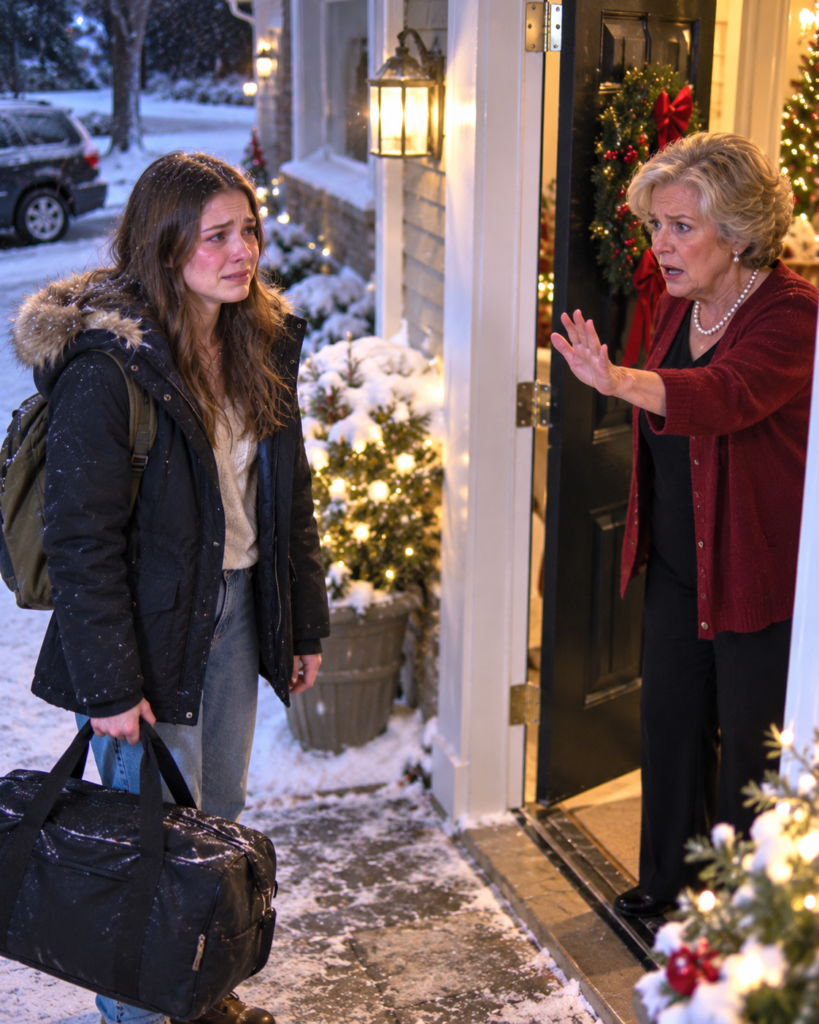
“They said there wasn’t room.”
For a moment, I thought I had misunderstood her. My parents lived in a four-bedroom house, and Christmas Eve had always meant squeezing in anyone who showed up.
“No room? What happened?”
Abby explained that when she arrived, the driveway was packed with cars. My mother opened the door, looked surprised to see her, and said everyone was already seated and the table had been arranged perfectly.
“She said they weren’t expecting me. She said she couldn’t just add another chair.”
Abby told me Aunt Janelle’s children had taken the place where she usually slept, while Grandpa remained in the living room watching television. Nobody offered another solution, nobody volunteered to drive her home, and nobody even asked whether she had eaten.
My voice became quieter.
“What did you have for dinner?”
She finally looked at me, tears shining in her eyes.
“Toast. And half a banana.”
Something inside me went completely cold.
My daughter had driven to her grandparents’ house expecting Christmas dinner and had been turned away while twenty-eight other people ate inside. She had driven home alone late at night and spent Christmas Eve in a dark house eating toast while I was working an emergency-room shift.
“They made it feel like I was bothering them,” she whispered.
I sat beside her and pulled her into my arms as the tears finally came. While she trembled against me, the part of myself that had spent years making excuses for my family quietly disappeared.
The next morning, my husband Mark returned from his shift at the fire station. When I told him what had happened, his expression hardened.
“They made room for twenty-eight people, but not Abby?”
I nodded.
He looked at me for several seconds.
“So what do we do?”
I already knew.
“I’m not making a scene. I’m taking action.”
My parents believed Christmas Eve had ended when they closed the door on my daughter.
They had no idea it was the night they lost the house they were living in.
Part 2: The Letter on Their Door
For the next two weeks, Mark, Abby, and I lived inside a strange pocket of calm. We had our own Christmas at home with Chinese takeout, old movies, and no obligation to pretend everything was fine, while my mother and sister filled my phone with cheerful messages asking when we planned to come over.
I deleted every voicemail without answering. During those same two weeks, I met with my attorney and explained exactly what had happened on Christmas Eve, along with one detail my parents had apparently forgotten.
The house they lived in belonged to me.
Seven years earlier, my father’s bad investments had left my parents facing foreclosure. I bought another house for them, kept the property and mortgage entirely in my name, and paid the taxes, insurance, utilities, and maintenance while they contributed nothing toward ownership.
There was no lease. Legally, they were tenants at will.
My attorney prepared formal notice requiring them to vacate within sixty days. Instead of delivering it myself and giving my mother another opportunity to manipulate the conversation, I had a process server take the papers directly to their door and obtain a signature.
Three hours later, my phone began ringing.
I ignored the first five calls. On the sixth, I answered and immediately had to pull the phone away from my ear.
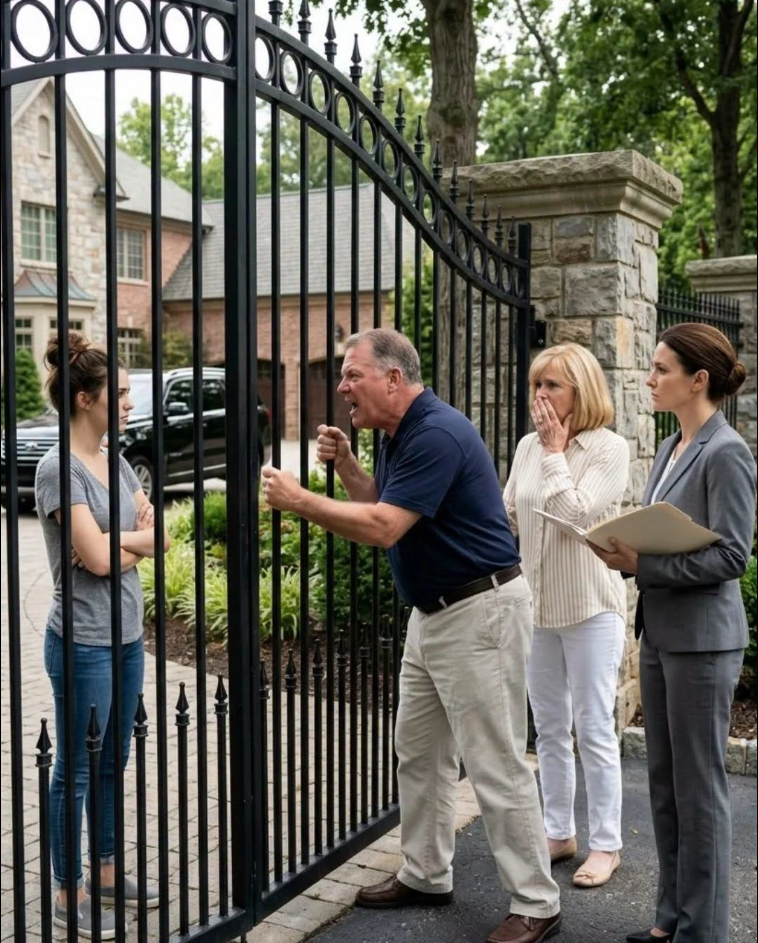
“How dare you do this to us! After everything we’ve done for you, you’re throwing your own parents into the street?”
My father was shouting loudly in the background.
“If you go through with this, you are no daughter of ours! We are finished!”
I waited until they finally paused.
“The notice is legal. You have sixty days.”
My mother demanded an explanation, but what struck me most was what she did not say. She never asked why I was angry, never asked what had happened on Christmas Eve, and never mentioned Abby once.
Their only concern was losing the house.
The air in the room remained completely still long after the call ended. Mark sat across from me at the kitchen table, his coffee mug held tightly in both hands. Abby was upstairs, reading in her room. For seven years, I had quietly shouldered the burden of their mortgage, insurance, property taxes, and upkeep, telling myself I was being a good daughter. But the moment they closed that heavy wooden front door in my daughter’s face on Christmas Eve, the illusion of family loyalty shattered forever.
Part 3: The Gathering Storm
Over the next thirty days, my parents attempted every tactic in the textbook. First came the flying monkeys: distant aunts, long-lost cousins, and family friends who had enjoyed the twenty-eight-person Christmas banquet called me at all hours. They accused me of being cold-hearted, ungrateful, and cruel for “evicting elderly parents in the middle of winter.”
I listened to none of them. When my aunt calling from Florida demanded to know how I could treat my mother this way, I asked a simple question: “Did you notice my sixteen-year-old daughter standing in the entryway while you ate your third helping of roast beef?” The phone line went silent, followed by a soft click.
Then came the financial reality. Vanessa, my sister—whose children had claimed Abby’s room and who had sat silently while Abby was turned back out into the snow—realized what this meant. If my parents lost the house, they would either have to rent a small apartment on their fixed pension or move in with her.
Vanessa turned up at my doorstep three weeks into the sixty-day window. It was a rainy Tuesday afternoon. When I opened the door, she stood on the porch with her arms crossed, her mascara slightly smudged, looking furious.
“Are you insane, Clara?” she barked, stepping inside before I could stop her. “You’re putting Mom and Dad out on the street over a stupid misunderstandings! It was Christmas! People were stressed! The table was set! Why are you making such a big deal out of nothing?”
I walked over to the kitchen island and leaned against it, keeping my voice as calm as an ER triage protocol.
“Vanessa,” I said softly. “Abby drove through a snowstorm to spend Christmas with her family. Mom looked her in the eye and told her there was no room for her. Then she spent the night alone eating toast while twenty-eight people celebrated. That wasn’t a misunderstanding. That was a choice.”
“She could have asked for a plate!” Vanessa snapped. “She could have stayed in the living room!”
“She was sixteen. She was treated like an uninvited stranger by her own grandmother. And not one person in that house—including you—stood up for her.” I pointed toward the front door. “Get out of my house.”
“If you evict them, you break this family apart forever!” she screamed, her voice cracking.
“Good,” I replied. “It was already broken. You just made me realize it.”
When day sixty arrived, my parents had not packed a single box. They believed I was bluffing—that no daughter would actually follow through with legal action against her own parents. They were wrong. On day sixty-one, my attorney filed a formal unlawful detainer lawsuit. A week later, a court date was set.
My mother showed up to the courthouse in her finest clothes, clutching a tissue, ready to play the victim before the judge. But real estate law is unconcerned with manufactured tears. The deed was solely in my name. There was no lease agreement, no payment history from them, and no legal defense. The judge granted the order of possession and gave them seven days to clear out before the sheriff’s office executed a forced removal.
That night, my father left me a single voicemail. His voice was cold, devoid of the earlier screaming: “You are dead to us. Do not ever contact us again.”
Part 4: The Legacy We Choose
The day the movers cleared out the four-bedroom house, Mark and I drove over to inspect the property. The house was empty, echoing with every step we took. They had taken everything they owned and left behind piles of trash, stripped beds, and a palpable bitterness that hung in the air.
Standing in the grand dining room where twenty-eight people had sat feast-bound while my child was turned away, I felt no regret. I felt only a profound, liberating lightness.
Two months later, we put the house on the market. It sold quickly in a competitive market, yielding a substantial amount of equity—money I had poured into the property over nearly a decade.
We didn’t keep a single cent for ourselves.
Instead, Mark and I transferred the entire profit directly into a high-yield trust fund for Abby’s college education and future home down payment. The very asset my parents thought they were entitled to abuse became the foundation for my daughter’s security and independence.
That summer, we spent a quiet weekend camping near the coast. Sitting around a crackling campfire under a star-filled sky, Abby looked over at Mark and me. She was laughing, her face lit by the warm glow of the fire, healthy and happy.
“Mom?” she asked softly, holding a toasted marshmallow over the coals.
“Yeah, sweetie?”
“Thanks. For having my back.”
I took her hand and gave it a firm squeeze. “Always. There will always be a place for you at my table.”
We haven’t spoken to my parents or Vanessa since that courtroom afternoon. Some relatives still gossip, and some bridges burned down to ash. But in protecting my daughter, I learned the most valuable lesson of my life: family isn’t defined by blood or traditional holiday gatherings. It is defined by who makes room for you when the night gets cold.