PART 1: The Fourteen Stairs
At three in the morning, my dying cat climbed fourteen stairs he had not climbed in two months, and the moment I saw him standing beside my pillow, I knew exactly why he had come.
Charlie had been with me since I was twenty-one.
By the time that night arrived, I was thirty-seven, and there were very few pieces of my adult life that did not have him somewhere in the background.
A blur of orange fur in an old photograph.
A paw on the edge of my laptop.
A tail crossing the television screen.
A chipped orange food bowl beside a succession of refrigerators in apartments and houses I had once believed would be permanent.
He had been there through almost everything.
And now he was dying.
That night, I had left him downstairs in the little orthopedic bed I had placed beside the couch because he could no longer climb the staircase.
At least, I thought he couldn’t.
For almost two months, Charlie had stopped trying.
The stairs in my house were ordinary—fourteen carpeted steps from the living room to the second floor. For most of his life, Charlie had treated them like a racetrack. He would charge up them at midnight for no reason, skid around the corner, and then stare back at me as if I were the strange one.
But kidney failure had taken that from him.
Near the end, walking ten feet to his water dish exhausted him.
Getting into the litter box sometimes required two attempts.
When he stood, his back legs trembled.
The last time he had tried climbing the stairs, he made it to the third step before his hind legs gave out. I caught him before he rolled backward.
After that, I moved everything downstairs.
His food.
His water.
His bed.
His litter box.
His favorite faded blue blanket.
And eventually, myself.
For weeks, I slept on the couch so he would not spend his nights alone.
But on that final evening, I knew something had changed.
Charlie had refused breakfast.
Then lunch.
Then the little spoonful of tuna water I had used as a last resort.
Even when he had been sick, tuna water could usually bring his head up.
That night, it did not.
He lay curled in his bed near the bottom of the stairs, his orange coat duller than it used to be, his breathing slow enough that I found myself counting the seconds between each rise of his ribs.
I sat beside him for nearly an hour.
I stroked his forehead.
He opened his eyes every few minutes, but only halfway.
The vet’s words from earlier that week kept repeating in my head.
“You know him better than anyone.”
She had said it gently.
That was the cruel part.
Because I did know him.
I knew the sound of his hungry meow compared with his annoyed meow.
I knew he hated closed doors but also hated being picked up.
I knew he preferred fresh water poured in front of him, even if there was already perfectly good water in his bowl.
I knew he would sit beside someone who was crying but leave immediately if they tried to hug him.
I knew he slept facing the bedroom door whenever I was sick.
I knew he had spent sixteen years quietly monitoring my life.
And because I knew him, I also knew the cat lying in front of me that night was tired.
Still, I kept asking myself the same terrible questions.
Was he ready?
Was I keeping him here because he still wanted to stay?
Or because I could not stand to let him go?
I had called the veterinary clinic twice that week without scheduling the appointment.
The first time, I hung up before anyone answered.
The second time, I asked questions I already knew the answers to.
What would happen?
Would he be scared?
Would I be allowed to hold him?
How would I know I wasn’t doing it too soon?
The receptionist had been patient.
She told me I could call whenever I was ready.
I hated that word.
Ready.
There was no version of my life in which I was going to be ready to choose a day when Charlie would stop existing.
But that evening, as he turned his face away from food for the third time, I finally admitted what I had been avoiding.
Tomorrow.
I would call in the morning.
I would ask for the earliest appointment.
And I would stay with him until the end.
I lowered myself onto the floor beside his bed.
“Hey, buddy.”
His ear moved slightly.
“I think we’re getting close, huh?”
Charlie opened his eyes.
For sixteen years, I had talked to him as if he understood every word.
Maybe that sounds ridiculous.
Maybe it was.
But if you have loved an animal long enough, eventually you stop caring whether anyone else thinks the conversations make sense.
“I’m sorry,” I whispered.
His eyes remained on me.
“I kept hoping you’d tell me.”
My throat tightened.
“That’s stupid, isn’t it? You’re a cat. You don’t know how to tell me.”
Charlie gave one faint purr.
Or maybe it was only his breathing.
I put my hand against the side of his body.
He was so light.
At his healthiest, Charlie had weighed fourteen pounds and carried most of it like a football under his belly. He had stolen turkey from sandwiches, butter from toast, and once an entire dinner roll from a Thanksgiving basket.
Now he weighed barely seven pounds.
I could feel every rib.
Every sharp angle.
His spine under my fingers.
I hated touching him and feeling how much of him was already gone.
I bent down and kissed the top of his head.
“Good night, buddy.”
His fur still smelled like Charlie.
Dust.
Warm blankets.
Something faintly sweet that I could never explain.
“Thank you for staying with me.”
I left the lamp on beside the couch.
Then, for the first time in weeks, I went upstairs.
I told myself I needed a real bed.
I told myself Charlie was sleeping.
I told myself I would come back down before sunrise.
The truth was harder.
I needed twenty minutes somewhere I could cry without him watching me.
That sounds silly too.
But throughout my adult life, I had always tried not to fall apart in front of Charlie.
Even though he had seen me do exactly that dozens of times.
I lay down without changing clothes.
The bedroom felt wrong without him.
For years, Charlie had slept on the left side of my bed, always near my knees. If I moved too much, he would leave dramatically and come back ten minutes later as though granting me a second chance.
That side of the blanket had been empty for weeks.
I stared at it until exhaustion finally pulled me under.
Then, sometime around three, a sound woke me.
A faint vibration.
Soft.
Uneven.
For several seconds, I thought it was part of a dream.
Then I heard it again.
A broken purr.
My eyes opened.
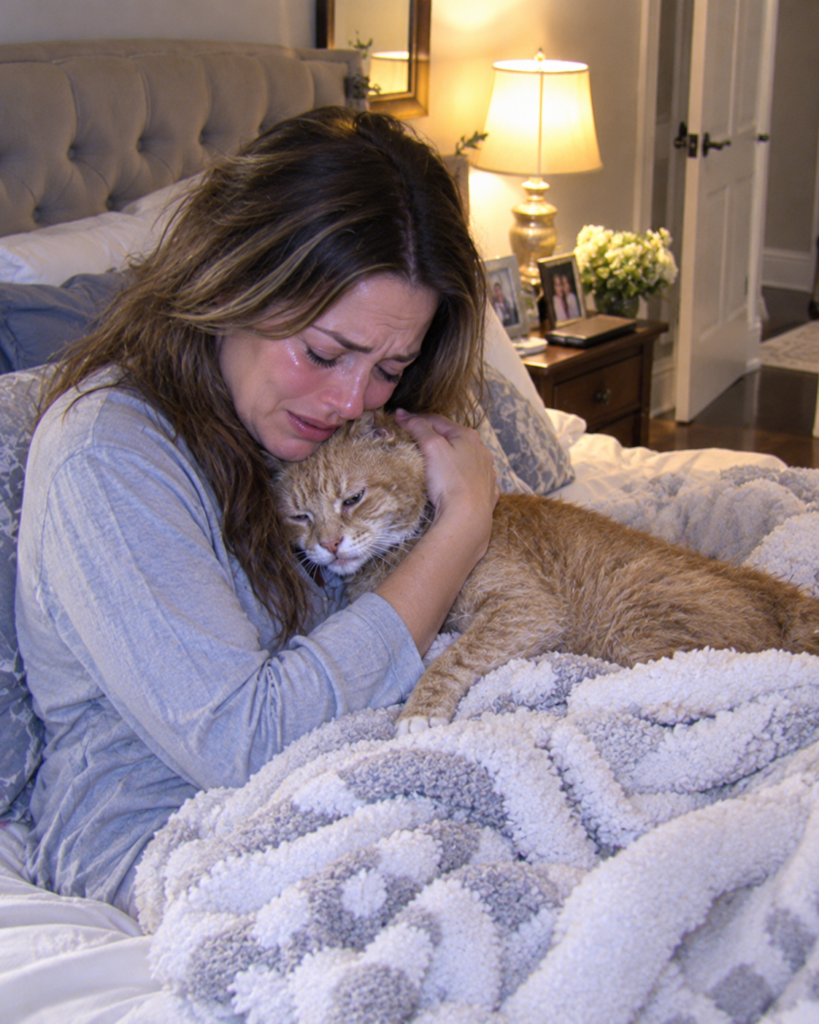
Charlie was standing beside my pillow.
For a moment, I could not understand what I was seeing.
The hallway light was on behind him, casting a thin gold line across the bedroom floor.
His front paws were on the blanket.
His body shook.
One back paw slipped and he caught himself.
“Charlie?”
He looked at me.
I sat up so quickly that the blanket fell to the floor.
“Oh my God.”
He had climbed the stairs.
All fourteen.
The cat who could barely walk from his bed to the water bowl had somehow crossed the living room, reached the staircase, and pulled himself step by step to the second floor.
I lifted him carefully onto the bed.
He did not resist.
That frightened me more than anything.
Charlie had never liked being carried.
Even at sixteen, even sick, he usually complained with a low offended sound.
That night, he simply collapsed against my chest.
His heart was beating rapidly.
His breathing was shallow.
His paws were cold.
I wrapped both arms around him.
“Why did you do that?”
My voice broke immediately.
“Buddy, why did you climb all the way up here?”
Charlie pushed his head weakly beneath my chin.
Then he did something he had not done in months.
He lifted one paw and placed it against my chest.
And suddenly I remembered another room.
Another floor.
Another version of me.
Twenty-one years old.
Crying beside a secondhand bed in a tiny Ohio apartment.
And a skinny orange shelter cat slowly crawling out from underneath it because he had decided I should not be alone.
That was when I understood.
Charlie had not come upstairs because he was confused.
He had not come looking for food.
He had not suddenly regained his strength.
He had spent whatever strength he had left to find me.
Sixteen years earlier, when I had been the one falling apart, Charlie had come and sat beside me.
Now he was the one leaving.
And he had come to say goodbye.
PART 2: The Cat Who Hid Under My Bed
I met Charlie when I was twenty-one years old and pretending I was much braver than I actually was.
I had moved to Ohio for my first full-time job after college.
The salary sounded enormous when they offered it to me.
It stopped sounding enormous when I paid rent.
My apartment was on the second floor of an old brick building where the pipes groaned at night and the neighbors could hear one another sneeze.
My furniture came from garage sales.
My dining table was a folding card table.
The refrigerator rattled so loudly that I sometimes kicked the bottom panel to make it stop.
For the first few months, I spent most evenings alone.
I knew people from work, but not well enough to call them on a Friday night.
My family lived several states away.
My mother called every Sunday and asked whether I was making friends.
“Of course,” I lied.
I was not.
I was lonely in a way I had never experienced before.
Not dramatic loneliness.
Nothing tragic had happened.
That almost made it worse.
It was ordinary loneliness.
Coming home and having no reason to say hello.
Eating spaghetti directly from the pot because there was nobody to judge me.
Hearing something funny on television and instinctively turning toward an empty room.
One Saturday, I saw a handwritten sign outside a small animal shelter.
ADOPTION WEEKEND.
I went in telling myself I was only looking.
The woman behind the desk walked me past rows of kennels.
Some cats reached through the bars.
Some meowed.
One small black kitten practically climbed the door trying to get to me.
Then I saw Charlie.
He was pressed against the rear wall of his enclosure.
Skinny.
Orange.
One ear torn.
One chipped canine tooth visible because his lip had caught slightly on it.
He looked deeply unimpressed by my existence.
“That one has personality,” the shelter woman said.
“That’s one word for it.”
She laughed.
“He’s about a year old, we think. Maybe a little older.”
I crouched.
Charlie stared at me without moving.
“What’s his story?”
Her smile faded slightly.
“He was found outside. He’s been adopted twice.”
“Twice?”
“Returned twice.”
“Why?”
She shrugged.
“Hides too much. Doesn’t adjust quickly. Second family said he wasn’t affectionate.”
I looked at Charlie.
He looked away.
Something about that hurt me.
Maybe because I understood what it was to enter a room and not know how to belong there.
“Can I meet him?”
The woman opened the enclosure.
Charlie immediately retreated into a cardboard box.
I sat on the floor.
Five minutes passed.
Then ten.
He did not come out.
The woman finally said, “We have other cats that are much more social.”
“I know.”
She waited.
I kept staring at the box.
“I think I want this one.”
Charlie came home with me that afternoon.
For three days, I barely saw him.
He lived under my bed.
I put food near the edge.
If I entered the bedroom while he was eating, he vanished underneath again.
At night, I would sometimes hear him exploring.
The moment I turned on a light, he disappeared.
I considered calling the shelter.
Not to return him.
Just to ask whether I was doing something wrong.
Then, on the fourth night, my mother called.
I had been having a bad week at work.
My manager had corrected me in front of everyone during a meeting.
My bank balance was low.
My car needed a repair I could not afford.
I had spent thirty dollars at a grocery store and somehow come home with nothing that looked like a meal.
My mother heard something in my voice.
“You okay?”
“I’m fine.”
“You don’t sound fine.”
That was all it took.
I cried.
I told her I hated my job.
I hated my apartment.
I missed home.
I had no friends.
I had made a terrible decision.
My mother did what mothers do.
She listened.
She reminded me I could come home if I truly wanted to.
She also reminded me that four difficult months did not define the rest of my life.
When we hung up, I sat on the bedroom floor with my back against the wall and cried harder.
Then I heard movement beneath the bed.
Charlie appeared.
Slowly.
Suspiciously.
Like someone approaching a dangerous animal.
I wiped my face.
“Hey.”
He stopped.
I held out my hand.
He ignored it.
Instead, he walked directly to my leg.
Then he sat.
His side pressed against my calf.
That was all.
No lap.
No licking.
No dramatic movie moment.
Just warmth against my leg.
I stopped crying long enough to look down at him.
“So you’re only nice when I’m miserable?”
Charlie blinked.
That became our arrangement.
He was never the kind of cat who greeted everyone.
He hid when strangers visited.
He hated being held.
He would allow exactly three stomach rubs before violence became possible.
But he learned me.
He knew when I was sick before I admitted I was sick.
He knew the sound of my car in the parking lot.
He knew which cabinet contained treats.
He knew Sunday mornings meant clean sheets, and clean sheets meant his personal obligation to lie directly in the middle of them.
Most importantly, he knew sadness.
Whenever I cried, Charlie appeared.
Sometimes he sat beside me.
Sometimes he climbed onto the bed and pressed his back against my ribs.
When a four-year relationship ended in my late twenties, I spent an entire evening locked in my bathroom because I did not want to look at the apartment we had chosen together.
Charlie scratched the door.
I ignored him.
He scratched again.
Then again.
Finally, I opened it.
He walked in without looking at me, turned around three times on the bath mat, and sat down.
“You know you’re annoying, right?”
He closed his eyes.
I cried for another hour.
Charlie stayed.
When I lost my job two years later, he refused to let unemployment interfere with his schedule.
At 6:15 every morning, he tapped my face.
The first few mornings, I pushed him away.
By the fourth, I realized something.
If Charlie forced me to get out of bed to feed him, I was already standing.
If I was standing, I could make coffee.
If I could make coffee, I could open my laptop.
If I opened my laptop, I could send one résumé.
Then another.
Maybe I give him too much credit.
But depression loves stillness.
Charlie never allowed much of it.
He needed breakfast.
He needed water.
He needed his litter box cleaned.
He needed the blinds raised at exactly 8:00 so he could lie in a square of sunlight.
There is a strange mercy in being needed by something small.
My hardest year came when I was thirty-two.
My mother had been sick for several months.
Cancer.
By the end, I was traveling home almost every weekend.
Charlie always knew when I was packing.
He would sit inside my suitcase.
“Move.”
Nothing.
“Charlie.”
He would stare at me.
The final trip home lasted twelve days.
When I returned, I came back without my mother.
I opened the front door and dropped my bag.
Charlie stood in the hallway.
For several seconds, neither of us moved.
Then he walked toward me.
I sat on the floor.
He put both front paws on my knee.
That night, he slept against my chest.
He had never done that before.
Every time I woke, he was still there.
After that, something between us changed.
Charlie was aging.
I was too, though I didn’t think about it that way yet.
His muzzle began turning pale.
He slept more.
His leaps became careful calculations.
Still, I believed we had time.
That is the arrogance love gives us.
When something has been beside you for years, your mind quietly promotes it from temporary to permanent.
You know intellectually that it won’t last forever.
But forever is always somewhere else.
Then Charlie began drinking water.
A lot of water.
At first, I joked about it.
“You opening a hydration business?”
He emptied the bowl.
I refilled it.
Then he began losing weight.
The change was subtle until suddenly it wasn’t.
One morning, he jumped toward the couch and missed.
His body hit the side cushion, and he fell sideways onto the rug.
He stood quickly, embarrassed.
I was already beside him.
“Hey. Hey, buddy.”
He walked away from me.
But I had felt something when I picked him up.
His ribs.
Too many of them.
I called the vet that afternoon.
Three days later, I sat in an examination room while Charlie hid his face against the inside of his carrier.
The veterinarian returned carrying bloodwork.
Her expression changed everything before she said a word.
“His kidney values are extremely elevated.”
I stared at her.
“What does that mean?”
She pulled the stool closer.
“It means his kidneys are failing.”
I remember looking at Charlie.
He was sitting on the metal examination table now, offended by the universe.
“Failing how much?”
She hesitated.
“Based on these numbers, Charlie is in end-stage renal disease.”
There are sentences that divide your life into before and after.
That was one of mine.
“Can you fix it?”
“We can support him.”
“Can you fix it?”
She looked at me with painful kindness.
“No.”
I swallowed.
“How long?”
“Every cat is different.”
“How long?”
“A few weeks, possibly. Maybe longer if he responds well to fluids and supportive care.”
Weeks.
Charlie had been with me sixteen years.
And suddenly our remaining life together could be counted in weeks.
PART 3: Eleven Weeks
I turned Charlie’s illness into a job because jobs had instructions.
Grief did not.
Every morning, I measured his medication.
Every other day, I gave him subcutaneous fluids.
The first time the vet technician showed me how to insert the needle beneath the loose skin between his shoulders, my hands shook so badly that she put her hand over mine.
“It looks worse than it feels to them.”
Charlie disagreed loudly.
At home, I hung the fluid bag from a coat hook and sat on the floor with him between my knees.
“I’m sorry.”
Charlie growled.
“I know.”
He tried to leave.
“Thirty seconds.”
He growled harder.
“You’re very brave.”
That earned me a furious look.
Afterward, I always gave him his favorite soft treat.
For several weeks, the fluids helped.
He ate.
Not much, but enough.
He started sitting in the living room window again.
One sunny afternoon, he even batted at a fly.
I took a video.
In it, you can hear me laughing behind the camera.
“That’s my guy.”
Watching that video later nearly destroyed me.
Because that is another cruel thing about terminal illness.
It gives you good days.
Just enough of them to confuse you.
A bad day comes and you think, This is it.
Then the next morning, they eat breakfast.
They walk into a patch of sunlight.
They purr.
And you think, I almost gave up too soon.
So you begin bargaining with every small improvement.
One more day.
One more meal.
One more good morning.
Charlie lasted eleven weeks after his diagnosis.
During week three, he still followed me into the kitchen.
Week four, he stopped jumping onto furniture.
I bought pet stairs for the couch.
He refused to use them.
Instead, he stared at me until I lifted him.
Week five, he stopped going upstairs.
That was when I moved his main bed downstairs.
The first night I slept on the couch, Charlie seemed confused.
He walked to the bottom of the staircase, looked upward, then looked at me.
“I’m staying here.”
He stood there another few seconds.
Then he came back and curled up near my feet.
Week six, I moved his litter box closer.
Week seven, I put a water bowl in every room.
Week eight, he began sleeping more than twenty hours a day.
Week nine, he stopped grooming himself properly.
I bought a soft brush and brushed him every evening.
Charlie had always hated brushes.
Now he tolerated it.
That frightened me.
I missed being scratched.
I missed the old Charlie who would bite me if I touched the wrong part of his stomach.
Weakness had made him agreeable.
I would have given anything for him to be difficult again.
By week ten, my life had narrowed around him.
I declined dinner invitations.
I stopped staying late at work.
I ordered groceries instead of shopping because I did not want to leave him longer than necessary.
People told me gently that I needed to care for myself too.
I knew they meant well.
But there would be time later to care for myself.
Charlie had weeks.
Maybe days.
Every minute I spent somewhere else felt stolen.
The vet called to check on us.
“How’s his appetite?”
“Up and down.”
“Mobility?”
“Not good.”
“Any vomiting?”
“A little.”
“Is he still seeking affection?”
That question stayed with me.
“Yes.”
At the time, it was true.
He still leaned against my hand.
Still purred when I rubbed beneath his chin.
Still wanted me close.
“Then watch him,” she said. “He’ll tell you when more of his day is discomfort than comfort.”
Again.
He’ll tell you.
Everyone said some version of that.
I wanted instructions.
Numbers.
A test.
I wanted Charlie to sit up and say, Today is the day.
Instead, I got signs.
A skipped meal.
A longer nap.
A stumble.
A look.
And I had to decide what they meant.
Near the end of week eleven, Charlie had his worst day.
He tried to walk to the kitchen and stopped halfway.
I found him standing in the hallway, staring at the floor.
“Charlie?”
He looked at me but did not move.
I picked him up.
His body felt limp.
I carried him back to his bed.
His heartbeat was fast beneath my hand.
That afternoon, I called the clinic.
“I think we’re close.”
The receptionist recognized my voice.
“I’m sorry.”
I sat at the kitchen table staring at Charlie.
“How do people know?”
There was a pause.
Then she said, “Most people don’t know with absolute certainty.”
That answer made me cry.
“I don’t want to betray him.”
“You aren’t.”
“What if he wants another week?”
“What if he’s asking you not to make him carry another week?”
I could not answer.
She told me there was an appointment available the next afternoon.
I opened my mouth.
Nothing came out.
“I can hold it for you.”
I stared at Charlie.
His eyes were closed.
“Can I call tomorrow morning?”
“Of course.”
I hung up.
Coward.
That word appeared immediately in my head.
I hated myself for delaying.
Then I hated myself for considering the appointment at all.
That evening, Charlie refused food.
I warmed it.
He turned away.
I added tuna.
Nothing.
I brought the bowl to his bed.
He smelled it, then lowered his head again.
“Please.”
I don’t know why I said that.
Please what?
Please eat because you’re hungry?
Or please eat because if you did, I could pretend we had more time?
Charlie did not move.
Later, I carried him to the litter box.
He used it, took two steps out, and lay down on the floor.
I scooped him up.
His head rested against my arm.
“Okay.”
The word came out as a whisper.
“Okay, buddy.”
I knew.
Not perfectly.
Not without doubt.
But enough.
Tomorrow.
I would call.
The decision hurt, but underneath the hurt was something else.
Relief.
Not relief that he would die.
Relief that I had finally stopped asking him to prove he was sick enough.
That night, I sat beside his bed.
I told him stories.
Stories he had technically lived through but probably did not remember.
“You remember my first apartment?”
His ear flicked.
“You ruined the blinds.”
Nothing.
“That security deposit was two hundred dollars, by the way.”
His eyes opened slightly.
“I never told Mom it was you.”
I smiled.
Then I cried.
I told him about the night he crawled out from beneath the bed.
About all the moving boxes he had claimed.
About the time he ran out the apartment door and I spent forty-five minutes searching the building before discovering him sitting two feet from the doorway behind a plant.
About my mother.
I said her name out loud.
“She loved you, you know.”
Charlie breathed slowly.
“She used to say you only tolerated her.”
His paw moved.
“I think she was right.”
I sat there until almost midnight.
Finally, exhaustion won.
I kissed his forehead.
“Good night, buddy.”
Then, without planning to say it, I added:
“Thank you for staying with me.”
I went upstairs.
Three hours later, Charlie came after me.
PART 4: Why He Came
When Charlie collapsed against my chest at three in the morning, I knew we were out of tomorrows.
His breathing sounded different.
Not painful exactly.
Just distant.
As if every breath had to travel farther to reach him.
I turned on the bedside lamp.
“Hey.”
His eyes opened.
They were cloudy with age, but they found mine.
“I’m here.”
Charlie had climbed fourteen stairs to hear those words.
At least, that is what I choose to believe.
I held him carefully.
His body was cold enough that I pulled the blanket around both of us.
For the first several minutes, I kept talking too quickly.
“You’re okay.”
Then I stopped.
Because he wasn’t okay.
And pretending otherwise suddenly felt disrespectful.
I pressed my cheek against the top of his head.
“No. You’re not okay, are you?”
His purr came weakly.
I started crying.
“I’m sorry it took me so long.”
Charlie stayed beneath my chin.
“I’m sorry I kept asking you for another day.”
His paw was still resting against my chest.
“I just didn’t know how to do this.”
I had spent eleven weeks afraid of the moment when Charlie would leave.
But lying there with him, I realized something.
He had never asked me to know how.
He had only asked me to stay.
That was what he had always done for me.
He had never fixed my grief.
He had never solved my problems.
He had never made my mother’s cancer disappear.
He had simply stayed.
So that was what I would do.
I stopped talking about tomorrow.
I stopped negotiating.
I stopped begging him to eat, drink, fight, or give me a sign.
For the first time in weeks, I asked nothing from him.
I just held him.
At 3:17, I took a photograph.
I almost didn’t.
It felt wrong somehow.
Too private.
But something inside me said, Take it.
The photograph is not beautiful.
My hair is tangled.
My eyes are swollen.
The lamp casts everything in yellow light.
Charlie looks impossibly small against my chest.
But his face is turned toward me.
His paw is still touching my shirt.
It became the last photograph I ever took of him alive.
Around four, Charlie moved.
For one terrible second, I thought he was trying to get down.
Then he crawled higher.
He placed his head against the base of my throat.
That had been one of his sleeping spots when he was younger.
I remembered waking with orange hair in my mouth.
“You’re making this really hard, you know.”
My voice shook.
His ear moved.
“You always have to get the last word.”
Another faint purr.
I don’t know how long we stayed that way.
Time lost its shape.
At some point, I looked at the clock and it was 4:42.
Then 5:10.
The sky beyond the curtains began changing from black to gray.
I had always imagined Charlie’s final night would be chaotic.
An emergency.
A rush to an animal hospital.
Fear.
Instead, the house was almost completely silent.
At 5:36, Charlie lifted his head.
He looked toward the window.
Then at me.
I thought again of that first apartment.
I thought of a twenty-one-year-old girl sitting on a floor believing loneliness would swallow her.
And the shy cat who had been returned twice because he hid too much.
Neither of us had understood then what the other would become.
Sixteen years.
Three apartments.
One house.
Two jobs.
One unemployment period.
One devastating breakup.
My mother’s death.
Thousands of ordinary evenings.
Sixteen Christmases.
Sixteen birthdays.
Countless mornings when he demanded breakfast as though I had never fed him before.
So much life.
And it had begun because two lonely creatures had ended up in the same room.
At six, I called the veterinary clinic’s emergency line.
My voice barely worked.
“My cat has end-stage kidney failure.”
The woman asked for my name.
Then Charlie’s.
She found his file.
“How is he doing?”
“He climbed upstairs.”
There was silence.
I started crying.
“He hasn’t been able to do that in two months.”
Her voice softened.
“Is he with you now?”
“Yes.”
“How is his breathing?”
I described it.
She asked several more questions.
Then she said, “Bring him in when you’re ready. We’ll be waiting.”
There was that word again.
Ready.
This time, I understood it differently.
I did not have to be ready to lose Charlie.
I only had to be ready to protect him from suffering.
Those were not the same thing.
I wrapped him in his blue blanket.
When I stood, he made a quiet sound.
“I know.”
I carried him downstairs.
Fourteen steps.
The same fourteen he had climbed hours earlier.
I counted every one.
Thirteen.
Twelve.
Eleven.
At the bottom, I stopped.
Charlie looked toward his little bed.
For weeks, that corner had been his entire world.
Water bowl.
Food dish.
Blanket.
Bed.
Medical supplies.
I stood there holding him and felt suddenly furious.
Kidney disease had made his world smaller one object at a time.
But in his final night, he had refused the boundary it had given him.
He had climbed out of that little world.
For me.
I sat on the couch for another twenty minutes.
I could not make myself put him in the carrier.
Eventually, I realized I didn’t have to.
I called the clinic again.
“Can I carry him in?”
“Of course.”
I wrapped the blanket tighter around him.
The drive took eleven minutes.
I remember almost none of it.
At the clinic, a technician opened the door before I reached it.
She saw Charlie in my arms and did not ask me to check in.
“This way.”
They took us into a quiet room.
There was a couch.
Soft lighting.
No metal examination table.
I sat down with Charlie.
The veterinarian came in a few minutes later.
She had been treating him throughout those eleven weeks.
When she saw him, her expression changed.
“Oh, Charlie.”
She crouched beside us.
“He came upstairs last night,” I told her.
“Did he?”
“All fourteen stairs.”
She touched his paw.
“That’s a long climb for this guy.”
“He came to my bed.”
The vet nodded.
I started crying again.
“I think he was saying goodbye.”
She did not tell me that was sentimental.
She did not explain animal behavior.
She simply said, “Maybe he needed to know where you were.”
That was enough.
She examined him gently.
Then she looked at me.
“He’s very tired.”
I nodded.
“Am I doing the right thing?”
The question came out before I could stop it.
She sat on the floor in front of me.
“I can’t make the decision for you.”
I appreciated that.
“But based on what I’m seeing, I don’t believe Charlie is going to recover from this decline. His body is shutting down. If you choose to let him go today, I believe you’re protecting him from what comes next.”
I looked down.
Charlie had closed his eyes.
For the first time since his diagnosis, the decision stopped feeling like something I was doing to him.
It became something I was doing for him.
“Okay.”
The vet waited.
I kissed Charlie’s head.
“Okay.”
PART 5: Thank You for Staying With Me
The veterinarian explained everything before she began.
First, Charlie would receive a sedative.
He would become sleepy.
Then, when I was ready, she would give the final medication.
His heart would stop.
There would be no pain.
“You can take as much time as you need.”
I nodded.
Charlie had never been good at cooperating with needles, but when the sedative went in, he barely reacted.
I hated that.
Again, I wished he would fight.
I wished he would become young and angry.
Instead, he relaxed against my chest.
His breathing became slower.
I stroked the torn edge of his left ear.
That ear had been torn before I met him.
For sixteen years, I had sometimes wondered how it happened.
A fight?
A fence?
Another animal?
Charlie had arrived in my life already carrying scars from a story I would never know.
It struck me then that love does not require knowing everything that came before you.
Sometimes you simply become the person who stays after.
I rubbed the place beneath his chin that had always made him purr.
One last vibration moved through him.
The vet left the room for several minutes.
Charlie was asleep now.
His body was warm.
His face looked peaceful.
I whispered into his ear.
“Do you remember the shelter?”
I smiled through tears.
“You were terrible.”
My voice broke.
“Everyone else was trying to get adopted, and you were hiding in a box.”
I rested my forehead against his.
“They said you weren’t affectionate.”
I laughed once.
“They didn’t know you.”
Charlie breathed.
“They didn’t know you at all.”
I told him I loved him.
Then I told him something I had never said out loud.
“You saved me.”
The sentence felt melodramatic.
But it was true in all the quiet ways that mattered.
Charlie had not saved me from a burning building.
He had not pulled me out of traffic.
He had not performed some impossible heroic act.
He had saved me in smaller pieces.
He got me out of bed.
He made empty apartments feel inhabited.
He gave me a reason to come home.
He placed his warm body next to mine during nights when grief made the world feel unbearable.
He reminded me, over and over, that being alone and feeling alone were not always the same thing.
He taught me that comfort does not require answers.
Sometimes love is simply a presence in the room saying, without words:
I am still here.
The veterinarian returned.
“Are you ready?”
No.
“Yes.”
She sat beside us.
I kept Charlie in my arms.
She inserted the catheter carefully.
Then she looked at me.
“Take your time.”
I bent over Charlie.
This was the moment I had feared for eleven weeks.
Maybe for sixteen years.
I expected panic.
Instead, I felt an enormous sadness so deep that it was strangely calm.
There was nothing left to negotiate.
Nothing left to fix.
Only love.
“Hey, buddy.”
Charlie did not open his eyes.
“It’s okay.”
Those were the words I had needed somebody to say to me.
So I said them to him.
“You don’t have to stay anymore.”
My throat closed.
“I’ve got it from here.”
I stroked his forehead.
“Thank you for finding me.”
The veterinarian gave the medication.
Charlie took one breath.
Then another.
A smaller one.
His body softened.
I kissed him between the ears.
“I love you.”
Then he was still.
The vet placed her stethoscope against his chest.
She listened.
Moved it slightly.
Listened again.
Then she looked at me.
“He’s gone.”
Three words.
That was all.
Sixteen years ended in three words.
I kept holding him.
The veterinarian touched my shoulder and left the room.
I don’t know how long I sat there.
Ten minutes.
Thirty.
Maybe longer.
I cried into Charlie’s fur.
I told him I was sorry.
Then I told him thank you.
Then I repeated both until the words stopped meaning anything.
Eventually, I noticed something.
His face looked different.
For eleven weeks, there had been tension around his eyes.
I had not fully realized it until it disappeared.
Now his body was completely at rest.
No shaking.
No shallow breathing.
No exhaustion.
Just Charlie.
The cat I remembered.
I placed my hand over his side.
For sixteen years, there had always been movement there.
Breathing.
Purring.
A heartbeat.
Now nothing.
That silence was the worst sound I have ever heard.
When I finally stood, the technician asked whether I wanted his blanket back.
I looked at the faded blue fabric.
Charlie had slept on it for years.
“Yes.”
She folded it carefully.
Then she handed me his collar.
Charlie had not worn it recently because he had become too thin.
The small metal tag still had my phone number engraved on it.
On the other side:
CHARLIE.
I closed my fist around it.
The drive home was worse than the drive there.
Because on the way to the clinic, Charlie had been beside me.
On the way home, the passenger seat was empty.
When I opened the front door, I automatically said, “I’m home.”
Then I froze.
The house did not answer.
His water bowl was still full.
The food from the night before was still sitting beside his bed.
His litter box was clean because I had cleaned it before going upstairs.
His medication was lined up on the counter.
A half-used fluid bag hung from the coat hook.
Death is strange because the world does not rearrange itself immediately.
The objects remain.
A bed.
A bowl.
A blanket.
A bottle.
A little indentation in the couch cushion.
Everything waits for someone who is not coming back.
I sat on the living room floor.
For the first time in sixteen years, I lived in a home without Charlie.
I cried until afternoon.
At some point, I must have fallen asleep.
When I woke, the sunlight had shifted.
For one confused second, I thought I heard him drinking water.
I lifted my head.
Nothing.
The next morning was worse.
At 6:15, I woke suddenly.
For years, that had been Charlie’s time.
He would tap my face.
Once.
Twice.
Then, if necessary, claws.
I lay there staring at the ceiling.
Nobody came.
I would learn later that grief has habits.
You do not only miss the person or animal you lost.
You miss everything your body had learned to expect because of them.
I looked for Charlie when I entered rooms.
I stepped around invisible versions of him in the hallway.
I left cabinet doors open because he used to inspect them.
Twice, I opened a can and waited for the sound of paws running toward the kitchen.
The silence afterward was brutal.
Friends checked on me.
Some understood.
Some tried.
One person said, “At least he was just a cat.”
I never spoke to her about Charlie again.
Another friend sent me a message that said:
Sixteen years isn’t “just a cat.” Sixteen years is family.
I saved that one.
A week later, Charlie’s ashes came home.
The clinic placed them in a small wooden box.
Inside the bag was a card with his paw print pressed into clay.
I sat in my car in the clinic parking lot and held it for almost an hour.
His paw.
The same paw that had tapped my cheek every morning.
The same paw that had rested against my chest on his final night.
For months, I could not look at the staircase without seeing him there.
Fourteen steps.
I kept thinking about how impossible that climb must have been.
I imagined him at the bottom.
Weak.
Dehydrated.
Legs shaking.
Looking upward.
I imagined the first step.
Then the second.
Maybe he rested.
Maybe he nearly turned around.
Maybe his body told him to stop.
But something in him kept going.
People offered explanations.
Cats sometimes seek familiar people when they are distressed.
Animals can have bursts of energy near the end.
Maybe he was disoriented.
Maybe he simply wanted warmth.
All of those things may be true.
I don’t need to argue with any of them.
Because I knew Charlie.
And I knew what he had done sixteen years earlier.
When I was twenty-one and crying on the floor, he had crawled out from beneath the bed and pressed himself against my leg.
No solution.
No explanation.
Just presence.
On his last night, he was downstairs.
I was upstairs.
And Charlie had spent sixteen years making sure I was never alone when something hurt.
So he climbed.
Months passed.
I eventually moved his bowls.
That took longer than I expected.
I washed them and put them in a box with his collar, his favorite toy mouse, his brush, and the clay paw print.
I kept the blue blanket.
For a while, it stayed folded at the end of my bed.
Sometimes I still reached down at night expecting to feel him there.
The grief changed.
It did not vanish.
It became less sharp.
That first winter without Charlie, I found one of his orange hairs woven into an old wool coat.
I stood in the closet holding it between my fingers and started laughing.
Then crying.
Sixteen years, and apparently he was still shedding.
On the anniversary of his death, I looked through old photographs.
There were hundreds.
Charlie asleep in a cardboard box.
Charlie glaring at snow through a window.
Charlie sitting on my laptop keyboard.
Charlie wearing a Christmas ribbon for approximately four seconds before attacking it.
Charlie beside my mother.
That one stopped me.
My mother was sitting on my couch, smiling at the camera.
Charlie was beside her.
Not on her lap.
He would never have given her that satisfaction.
But close.
I remembered what I had told him during his final night.
She loved you.
Maybe, if there is something after this life, she finally managed to get him into her lap.
I like to imagine he complained about it.
People sometimes ask whether I would do anything differently.
Would I have chosen the appointment earlier?
Would I have saved him a few difficult days?
Would I have waited longer?
For a long time, those questions tortured me.
Now I understand that grief searches for a mistake because mistakes feel fixable.
If I chose the wrong day, then maybe there was a version of the story where I could have done everything perfectly.
There wasn’t.
There was no perfect ending available.
Only love.
Only responsibility.
Only a terrible decision made for someone who could not make it himself.
And one final night that I will remember for the rest of my life.
I no longer think Charlie climbed those fourteen stairs because he wanted me to save him.
I think he climbed them because he knew I couldn’t.
Maybe he knew before I did that our time was over.
Maybe animals understand endings differently.
Or maybe he simply knew I was upstairs.
Whatever the reason, he came.
That matters to me.
Because Charlie’s entire life with me can be reduced to one simple pattern.
When I hurt, he came closer.
When he hurt, he came looking for me.
Years later, whenever someone tells me they are facing that terrible decision with an old dog or cat, I never tell them what day to choose.
I only tell them what I eventually learned.
Do not spend every final moment demanding another sign.
Don’t make love prove itself by surviving one more day.
Sit beside them.
Watch them.
Listen.
And when the time comes, stay.
That is the promise.
Not forever.
We never truly get forever.
The promise is:
For as long as you are here, you will not have to do this alone.
Charlie kept that promise to me for sixteen years.
On the last night of his life, when his kidneys were failing and his body had almost nothing left to give, he dragged himself up fourteen stairs to keep it one final time.
He reached my bed at three in the morning.
He put his paw against my chest.
And he stayed there until sunrise.
Sixteen years earlier, I had brought home a frightened shelter cat because someone told me he hid too much and wasn’t affectionate enough.
They were wrong.
Charlie loved quietly.
He loved by waiting outside bathroom doors.
By waking me for breakfast.
By sleeping beside grief he could not understand.
By pressing his forehead under my chin when words were useless.
And finally, by climbing fourteen impossible stairs because the person he loved was at the top.
I used to think I rescued Charlie.
I don’t anymore.
I think we found each other at exactly the right time.
And on his last night, when his legs were shaking and every step must have hurt, my old orange cat found me one final time.
So I could hold him.
So he could stop fighting.
So neither of us had to say goodbye alone.