“No…” Beatrice whispered.
Her eyes were fixed on the front of the store.
For a moment, nobody moved.
The fluorescent lights hummed overhead. Somewhere near the bakery, a metal tray clattered. A child sitting in a shopping cart stopped talking and stared toward aisle six as though he understood that something important had just happened.
Beatrice’s hands remained wrapped around the red plastic handle of her cart.
Then a man stepped into view.
He was perhaps sixty-five, tall despite a slight stoop in his shoulders, with silver hair and a dark wool coat folded over one arm.
He wasn’t dressed like a man preparing to confront someone.
He looked tired.
That somehow made Beatrice more frightened.
“Dad.”
The word came out so quietly that I barely heard it.
The elderly woman beside me lifted her head.
And something changed in her face too.
Recognition.
The man walking toward us was Conrad Vale.
Even if you didn’t know him personally, almost everyone in town knew the name. Vale Motors had three dealerships across the county. Vale Properties owned apartment buildings, office blocks, and a row of old storefronts downtown.
People assumed Conrad Vale had always been wealthy.
His daughter certainly behaved as if wealth had been passed down through generations.
Conrad stopped several feet from her.
His gaze moved over the cart.
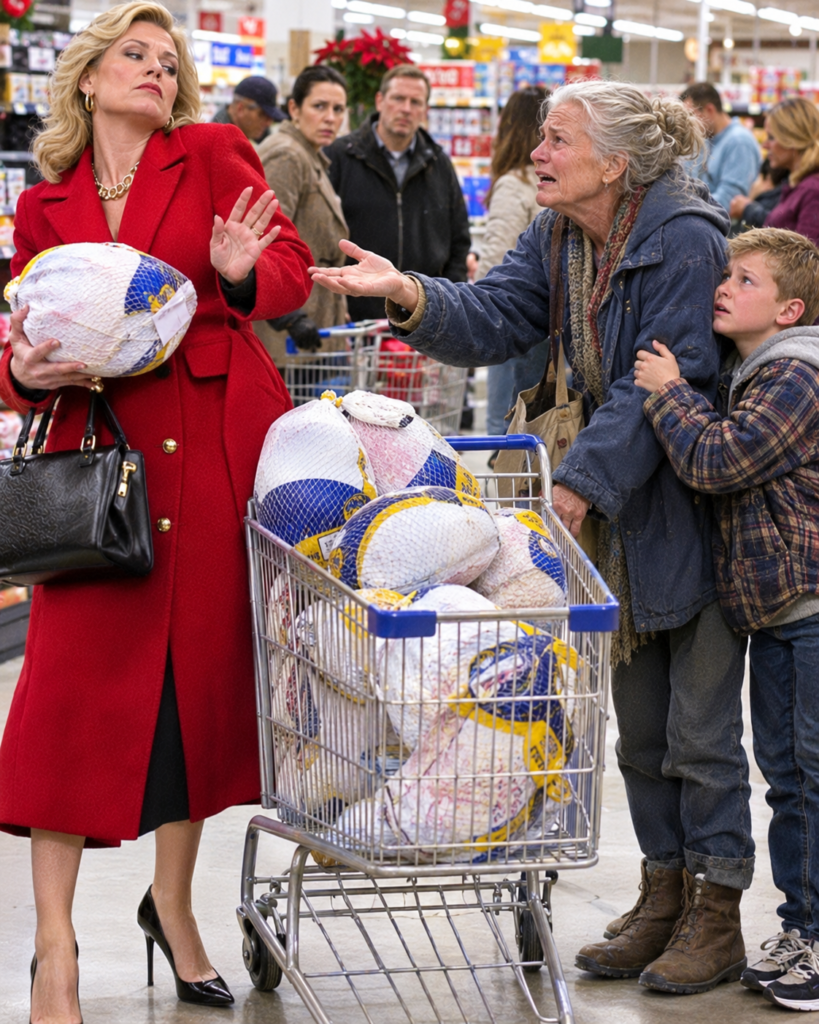
Thirteen turkeys.
Then he looked at the elderly woman.
His face went still.
“Maggie?”
The old woman’s fingers tightened around her basket.
“Hello, Conrad.”
Beatrice stared between them.
“You know her?”
Neither answered immediately.
Conrad looked as though someone had opened a door onto a room he had spent years trying not to enter.
Finally, he said, “Yes.”
Beatrice gave a nervous laugh.
“Okay. Well, apparently everybody has decided grocery shopping is a town meeting now.”
Conrad didn’t react.
“I was in the manager’s office,” he said.
“Why?”
“The community pantry account.”
Beatrice rolled her eyes slightly.
“Of course.”
Conrad noticed.
Something passed through his expression—not anger, exactly.
Disappointment, perhaps.
But he didn’t raise his voice.
He looked at the people gathering at either end of the aisle.
“We don’t need an audience.”
Then he nodded toward the manager approaching from the front.
“Sam, would you mind?”
Sam—a broad man in a green store vest—understood immediately.
“Folks, nothing to see here. Aisle five is still open.”
People reluctantly returned to their shopping.
I started to step away too.
Maggie touched my sleeve.
“Would you stay?”
I hesitated.
She looked suddenly small beneath the hard white grocery-store lights.
“If you don’t mind.”
So I stayed.
Beatrice noticed.
“Seriously?”
Conrad spoke before I could.
“She asked.”
Beatrice looked away.
Sam approached the cart.
“Mrs. Vale, I should mention that clearance quantities are supposed to be limited to four per customer. The sign fell behind the display sometime this morning.”
Beatrice stared at him.
“There was no sign.”
“I know. That’s our mistake.”
“So these are mine.”
“Four of them can be.”
Her jaw tightened.
“That’s ridiculous.”
Conrad said quietly, “Beatrice.”
She looked at him sharply.
“What?”
“Four turkeys are enough.”
“You don’t even know what I’m doing with them.”
“Then tell me.”
She opened her mouth.
Nothing came out.
Conrad waited.
Finally she said, “I was going to freeze them.”
“All thirteen?”
“They were ten dollars.”
“That wasn’t my question.”
Something in her face hardened.
Not the smug expression from before.
Something younger.
More defensive.
“When something is cheap, you buy it.”
Conrad blinked.
For the first time since he had arrived, he looked genuinely startled.
Maggie looked at him.
And I saw something pass silently between them.
Beatrice noticed it too.
“What?”
Nobody answered.
“What was that?”
Conrad lowered his voice.
“We’ll talk about it later.”
“No. You both just looked at each other.”
Maggie shifted her nearly empty basket.
“I should go.”
Conrad turned.
“Please don’t.”
“My grandson is waiting.”
“How old is he now?”
“Twelve.”
Conrad’s expression softened.
“Twelve.”
“He’s had a fever since Saturday. Doctor says it’s influenza, nothing dangerous so far. But he’s miserable, and he won’t eat much.”
Beatrice glanced at Maggie’s basket.
A bag of carrots.
Two onions.
Celery.
A small box of noodles.
Everything needed for soup except the meat.
Her eyes returned to the turkeys.
For half a second, I thought she might reach for one.
Instead, she folded her arms.
Maggie noticed.
“Don’t,” she said.
Beatrice looked at her.
“I wasn’t—”
“You were thinking about giving me one now because your father is standing here.”
Beatrice’s cheeks flushed.
“I was going to offer.”
“I know.”
“Then take it.”
“No.”
That seemed to surprise everybody.
Maggie’s voice remained gentle.
“I asked you when it was yours to give.”
She nodded toward the cart.
“Now you’re embarrassed. That’s different.”
“I’m not embarrassed.”
“Yes, you are.”
Beatrice’s eyes narrowed.
Maggie added, “And embarrassment sometimes makes people generous for five minutes.”
The words weren’t cruel.
That made them harder to dismiss.
Sam cleared his throat.
“I can hold one at customer service for you, ma’am. Same clearance price.”
Maggie smiled faintly.
“Thank you.”
“I’ll take it up there myself.”
Beatrice looked at him.
“You’re taking it from my cart?”
Sam met her eyes.
“Store limit is four.”
Her lips pressed together.
Conrad said nothing.
One by one, Sam removed nine turkeys.
The soft thuds seemed unusually loud.
When only four remained, Beatrice stared at them as though they represented something other than frozen food.
Conrad turned toward Maggie.
“How is Claire?”
The color left Maggie’s face.
She lowered her eyes.
Conrad noticed immediately.
“Maggie?”
She swallowed.
“Claire died three years ago.”
Beatrice looked up.
Conrad took a half step backward.
“No.”
“I thought you knew.”
“No.”
“She got sick.”
“I—”
He stopped.
The certainty had disappeared from his voice.
“Why didn’t anyone tell me?”
Maggie gave him a tired look.
“Who would have?”
That sentence seemed to land somewhere deep.
Conrad glanced at his daughter.
Beatrice was no longer looking irritated.
“Who’s Claire?” she asked.
Maggie turned to her.
“You don’t remember?”
“No.”
Maggie studied her face.
Then something like sadness passed through the old woman’s expression.
“You really don’t.”
Beatrice shifted uncomfortably.
“Should I?”
Conrad spoke.
“Yes.”
Beatrice turned toward him.
“Why?”
He didn’t answer.
Instead, he rubbed one hand across his mouth.
It was such an ordinary gesture that for a second he stopped looking like Conrad Vale, the wealthy businessman whose name appeared on buildings.
He looked like an aging father who had just heard something he wished he had known years earlier.
Maggie looked toward the front of the store.
“I need to get home.”
Conrad stepped aside.
“Of course.”
Sam had already placed one turkey into a separate cart.
“I’ll ring this through for you.”
Maggie thanked him.
Before leaving, she looked at Beatrice.
Not angrily.
Almost curiously.
“Your mother used to say the same thing.”
Beatrice froze.
“What?”
Maggie nodded toward the remaining turkeys.
“When something is cheap, you buy it.”
Conrad shut his eyes.
Beatrice stared at him.
“You knew that?”
He opened his eyes again.
“Yes.”
“My mother never worried about grocery prices.”
Conrad didn’t answer.
“She bought groceries at Westbrook Market.”
“No.”
“She wore designer clothes.”
“Later.”
“We lived in the house on Briar Hill.”
“Later.”
Beatrice’s voice became quieter.
“What are you talking about?”
Maggie’s expression changed.
She seemed to realize Conrad had never told his daughter something.
“Conrad.”
He looked at her.
“Not here,” he said.
Beatrice gave a short laugh without humor.
“You just announced my name over an entire grocery store, but now it’s ‘not here’?”
“I shouldn’t have done that.”
That admission took some of the air out of her anger.
Conrad continued.
“I heard what happened. Sam told me you were leaving. I reacted.”
“So you embarrassed me.”
“Yes.”
He paused.
“And I’m sorry for doing it publicly.”
Beatrice clearly hadn’t expected the apology.
Neither had I.
“But,” he said, “what you said to Maggie still happened.”
Beatrice looked away.
“I know.”
“Do you?”
Her eyes flashed.
“You think I don’t?”
“I think you’ve become very good at making people feel small whenever you feel uncomfortable.”
That struck something.
Beatrice’s face tightened.
She picked up her purse.
“I’m leaving.”
“Beatrice.”
“No.”
She started around the cart.
Maggie spoke.
“Your mother lived with me for six weeks.”
Beatrice stopped.
The aisle became quiet again.
Slowly she turned.
“What?”
Maggie’s eyes went to Conrad.
He looked defeated.
“You might as well tell her,” he said.
Maggie adjusted the collar of her worn blue coat.
“It was before you started kindergarten.”
Beatrice shook her head immediately.
“No. We lived in Clifton then.”
“You lived in Clifton afterward.”
“My parents never—”
“Our first dealership failed,” Conrad said.
Beatrice turned toward him.
“What?”
“We weren’t always wealthy.”
“I know that.”
“No,” Conrad said. “You know the version I told you.”
The distinction hung between them.
He looked toward the refrigerated shelves.
“For almost a year, I was underwater. Loans. Business debt. Medical bills. Your mother was working evenings. I was working days and nights. We lost the rental house.”
Beatrice stared at him.
“You told me we moved because the landlord sold it.”
“I lied.”
“Why?”
“Because you were five.”
“That explains then. It doesn’t explain thirty years.”
Conrad had no answer.
Maggie quietly said, “Your mother and you stayed in my apartment.”
Beatrice looked at her.
“With you?”
“And my daughter.”
“Claire?”
“Yes.”
Beatrice seemed to be searching her memory.
Nothing came.
“I don’t remember.”
“You were little.”
“Six weeks?”
“Almost seven.”
Maggie smiled faintly.
“You hated oatmeal.”
Conrad actually laughed once.
A broken, surprised sound.
“She did.”
“Wouldn’t eat it unless Claire put raisins in the shape of a smile.”
Beatrice’s expression changed.
A flicker.
“What?”
Maggie repeated, “A raisin smile.”
Beatrice stared past her.
The color slowly drained from her face.
“I remember a yellow bowl.”
Maggie’s eyes softened.
“It had ducks around the rim.”
Beatrice whispered, “And a crack.”
“On the side.”
Beatrice sat abruptly on the edge of the refrigerated display.
Her expensive handbag slipped from her shoulder.
Conrad took a step toward her.
She lifted a hand.
“Don’t.”
He stopped.
“Why did you never tell me?”
“I wanted you to forget.”
“Why?”
Conrad looked toward the floor.
“Because I hadn’t.”
That answer seemed to hurt more than any excuse could have.
Maggie remained silent.
Beatrice stared at her shoes.
“I remember sleeping on a couch.”
“Yes.”
“And someone singing in the kitchen.”
“Claire.”
A small crease appeared between Beatrice’s eyebrows.
“She had dark hair.”
“She did.”
“She let me wear a silver bracelet.”
Maggie’s breath caught.
“That was hers.”
Beatrice pressed her fingers to her temple.
“I thought that was a dream.”
“No.”
Conrad’s voice was almost inaudible.
“It wasn’t.”
For several moments, no one spoke.
Then Beatrice looked up at Maggie.
“You knew me.”
“Yes.”
“And ten minutes ago I told you—”
Her voice broke.
She stopped before finishing.
Maggie did not rescue her from the sentence.
She simply waited.
Beatrice swallowed.
“I’m sorry.”
Maggie nodded once.
“Thank you.”
It wasn’t immediate forgiveness.
It wasn’t punishment either.
Just acknowledgment.
Beatrice looked at the cart.
Then at Sam.
“I’ll take one turkey.”
Sam raised an eyebrow.
“Store limit is four.”
“One is enough.”
Maggie picked up her basket.
“I really do need to go.”
Conrad reached into his pocket.
“Let me at least—”
“No.”
He stopped.
Maggie smiled.
“You always did try to solve uncomfortable things with your wallet once you got one.”
His hand slowly came out of his pocket.
“Fair.”
Sam led Maggie toward customer service.
She walked three steps before turning.
“Beatrice.”
Beatrice looked up.
Maggie hesitated.
“There’s something else.”
Conrad stiffened.
Maggie noticed.
“So you remember.”
He stared at her.
“I hoped you’d thrown it away.”
“I nearly did.”
Beatrice stood.
“What?”
Maggie looked at Conrad.
“You didn’t tell her about that either?”
“Maggie.”
“No. I suppose you didn’t.”
Beatrice stepped closer.
“Tell me what?”
Maggie reached inside her coat.
From an inner pocket, she removed a small envelope.
It was old enough that the paper had yellowed along the edges.
Beatrice’s name was written across the front.
Not typed.
Written.
The handwriting was delicate, slanted slightly to the right.
The moment Beatrice saw it, she stopped breathing.
“Mum.”
Conrad looked away.
Maggie held the envelope with both hands.
“She gave this to me twenty-nine years ago.”
Beatrice didn’t take it.
“Why?”
“She told me not to give it to you until the right moment.”
“What moment?”
Maggie’s gaze drifted toward the abandoned pile of discounted turkeys.
Then back to Beatrice.
“She said I would know.”
Conrad’s voice was strained.
“Eleanor said many things when she was frightened.”
Maggie looked sharply at him.
“She wasn’t frightened when she gave me this.”
Beatrice finally reached for the envelope.
Her fingers trembled before touching it.
“What’s inside?”
“I don’t know.”
“You never opened it?”
“It wasn’t mine.”
Beatrice turned it over.
The seal remained intact.
On the back, in the same handwriting, were five words:
When enough never feels enough.
Beatrice read them twice.
Then she looked at her father.
Conrad had gone pale.
“Dad?”
He stared at the sentence.
“What did she know?”
Conrad didn’t answer.
Beatrice stepped toward him.
“What did Mum know?”
Maggie’s face tightened.
“Conrad.”
He finally looked at his daughter.
There were tears in his eyes.
Not dramatic ones.
Just the tired tears of someone who had spent too many years carrying the same unopened door inside himself.
“I think,” he said, “your mother knew exactly who you might become if I never told you where we came from.”
Beatrice looked down at the envelope.
Then back at him.
“And what else did she know?”
Conrad opened his mouth.
Before he could answer, Maggie spoke.
“There was one more thing your mother left.”
All three of us turned toward her.
Maggie’s hand tightened around the handle of her worn basket.
“A ledger.”
Conrad’s face changed instantly.
“Maggie.”
Beatrice heard the fear in his voice.
So did I.
She stared at her father.
“What ledger?”
Conrad said nothing.
And for the first time that afternoon, Beatrice no longer looked like the most powerful person in the aisle.
She looked like someone standing at the edge of a family history she had never been allowed to see.
-END OF Chapter 1–
Beatrice did not open her mother’s letter in the grocery store.
That surprised me.
Ten minutes earlier, she had seemed like someone who expected the world to move at her pace. Doors opened. Employees hurried. People made exceptions.
Yet she stood holding that yellowed envelope as though opening it carelessly might destroy whatever remained inside.
Maggie bought the turkey.
She counted ten dollars from a tiny coin purse.
Beatrice watched but did not offer to pay.
That mattered.
Maggie noticed too.
Outside, rain had begun tapping softly against the windows.
Conrad offered Maggie a ride.
She declined.
“My bus comes in eleven minutes.”
“It’s raining.”
“I own an umbrella.”
“Maggie—”
She smiled.
“You still haven’t learned.”
He stopped.
“What?”
“You offer once.”
Conrad’s shoulders lowered.
“All right.”
Beatrice looked at her father as if this was a language she had never heard him speak.
Then Maggie glanced at her.
“You can walk me to the bus stop if you like.”
Beatrice blinked.
“In this?”
“You won’t melt.”
Five minutes later, the woman who had arrived in polished heels and a camel-colored coat was standing beneath a scratched plastic bus shelter beside a grandmother carrying a discounted turkey.
I followed at a distance because my own car was parked near the stop.
Conrad remained inside speaking with the store manager.
For a while, neither woman said anything.
Cars hissed over wet pavement.
Finally Beatrice said, “What was my mother like then?”
Maggie looked at her.
“You remember her.”
“I remember my mother when things were good.”
“That was still her.”
“No.”
Beatrice touched the envelope inside her purse.
“I mean before.”
Maggie considered the question.
“Funny.”
Beatrice looked surprised.
“My mother?”
“Very.”
“She was never funny.”
“Then you missed something.”
Despite herself, Beatrice smiled.
Maggie continued.
“She worried constantly. She clipped coupons. She knew exactly which supermarket discounted bread after seven in the evening.”
Beatrice’s smile disappeared.
“She never told me.”
“She wanted you to feel safe.”
“Apparently everyone did.”
There was bitterness in that.
Maggie heard it.
“Safety and truth aren’t enemies,” she said. “But parents sometimes act like they are.”
The bus appeared around the corner.
Before boarding, Maggie wrote an address on the back of an old receipt.
“My house.”
Beatrice looked at it.
“For the ledger?”
“For soup.”
Beatrice almost smiled again.
“Eli probably won’t eat much tonight, but I’m cooking anyway. Come tomorrow if you want.”
“Why would you invite me?”
Maggie shrugged.
“Because your mother would have.”
Then she boarded.
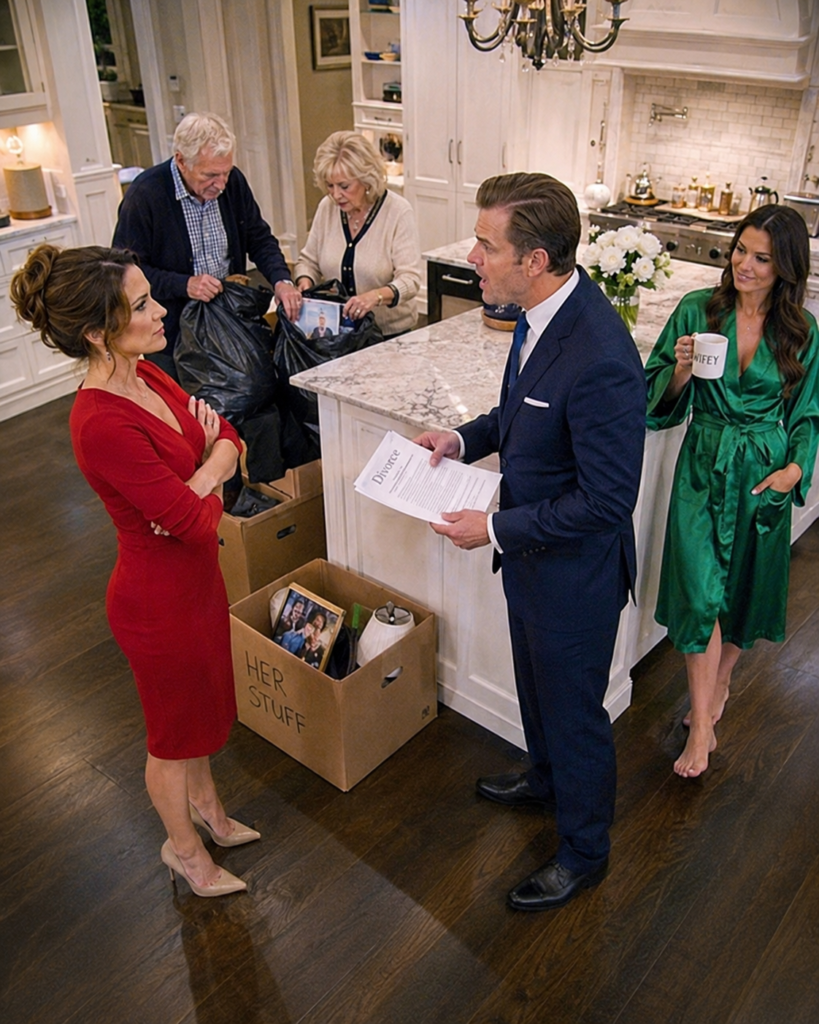
That evening, Beatrice sat alone at the marble island in her enormous kitchen.
She later told me this part herself.
Months afterward, when all of us understood how much that afternoon had changed.
The house on Briar Hill had twelve rooms.
Beatrice used four.
Her husband, Charles, had moved out eight months earlier.
Officially, they were “taking some space.”
Unofficially, their marriage had slowly turned into a calendar of separate dinners, separate trips, and conversations conducted through assistants.
The silence in the kitchen felt especially large that night.
Beatrice placed her mother’s envelope beneath the pendant light.
She opened it.
Inside were three sheets of stationery.
The letter began simply.
My darling Bea,
If you are reading this, Margaret Doyle has decided that you need it.
Beatrice laughed once through her nose.
“Apparently.”
Then she kept reading.
I hope she waited until you were old enough to understand something I am only beginning to understand myself.
There are two kinds of hunger.
One happens when the cupboard is empty.
The other happens when the cupboard is full and you are still terrified somebody might take something from you.
Beatrice stopped.
Her eyes moved toward the pantry.
Shelves lined with food.
Imported pasta.
Glass jars.
Boxes purchased in multiples.
She walked over and opened the freezer.
Three steaks.
Six frozen pizzas.
Four bags of shrimp.
Containers stacked behind containers.
She had lived alone for eight months.
She closed the door.
Then returned to the letter.
Her mother described the year the dealership failed.
The repossessed car.
The unpaid electric bill.
The night Eleanor had pretended they were having a “camping adventure” because the electricity had been disconnected.
Beatrice remembered candles.
She had always thought it was a birthday.
The letter told her about Maggie.
About Claire.
About neighbors who passed grocery bags through the apartment door without knocking because Eleanor was too proud to accept them face-to-face.
Then came a sentence Beatrice read four times.
Your father believes the worst thing that happened to us was being poor.
He is wrong.
The worst thing was becoming ashamed of having needed people.
Beatrice set the letter down.
Her phone rang.
Conrad.
She let it ring twice.
Then answered.
“Did you read it?”
“Yes.”
Silence.
“Bea—”
“Did you know what it said?”
“No.”
“But you knew about the letter.”
“Yes.”
“And the ledger?”
A longer silence.
“Yes.”
“What is it?”
Conrad exhaled.
“A notebook your mother kept.”
“Of what?”
“Names.”
“What names?”
“People who helped us.”
Beatrice closed her eyes.
“How many?”
“I don’t remember.”
“You do.”
“Thirty-seven.”
The answer came too quickly.
“You remember every one.”
“I remember enough.”
“Where is it?”
“I don’t know.”
“Maggie does.”
“Then ask her.”
Beatrice heard something odd in his voice.
“You’re afraid of it.”
“No.”
“You are.”
Conrad was silent.
“Why?”
“Because a list of what you owe people looks very different when you’ve spent thirty years pretending you owe nobody.”
Beatrice leaned against the counter.
“You built the company.”
“With help.”
“You always said—”
“I know what I said.”
His voice cracked slightly.
Beatrice went quiet.
Conrad continued.
“I spent years turning our worst period into a heroic story because it made me feel better. Conrad Vale nearly loses everything. Conrad Vale fights back. Conrad Vale builds an empire.”
“That is what happened.”
“Partly.”
“What’s the other part?”
“A mechanic worked three weeks without pay because he believed I’d recover. A landlord let us stay two months after rent stopped. Maggie fed you. Claire watched you while your mother worked. A parts supplier extended credit when every bank refused me.”
He paused.
“I was never a self-made man, Beatrice.”
She looked around her kitchen.
Everything suddenly felt borrowed.
The counters.
The polished floors.
Even the silence.
“What does this have to do with me taking turkeys?”
Conrad answered softly.
“Maybe nothing.”
Then:
“Maybe everything.”
The next afternoon, Beatrice went to Maggie’s house.
She brought nothing.
That was intentional.
No flowers.
No groceries.
No envelope of cash.
Maggie opened the door and looked at her empty hands.
“Good.”
Beatrice frowned.
“What?”
“You’re learning.”
Eli was asleep upstairs.
The house smelled of onions, rosemary and broth.
Maggie had roasted part of the turkey and simmered the rest with vegetables.
Beatrice stood in the kitchen doorway.
“I remember this room.”
Maggie looked surprised.
“You do?”
“Not exactly.”
She touched the edge of a wooden chair.
“But something about it.”
The kitchen had changed over thirty years, but the shape of the room remained.
A narrow window.
A radiator.
A table against the wall.
Beatrice looked toward the cupboard.
“Did there used to be a clock shaped like a cat?”
Maggie smiled.
“Yes.”
“Where is it?”
“Stopped working.”
“Of course.”
Maggie ladled soup into a bowl.
Eli appeared on the stairs wearing pajama pants and wrapped in a blanket.
He was thin, pale and suspicious.
“That her?”
Maggie sighed.
“Eli.”
“What?”
Beatrice almost laughed.
“Yes. I’m her.”
“The turkey lady?”
Maggie closed her eyes.
Beatrice actually laughed this time.
“I suppose that’s fair.”
Eli sat at the table.
“You made Grandma sad.”
“I did.”
“Why?”
Beatrice leaned against the counter.
She could have said she’d been having a difficult day.
She could have blamed misunderstanding.
She could have explained that clearance shopping triggered old habits she hadn’t understood.
Instead she said, “Because I was selfish.”
Eli considered that.
“Are you still selfish?”
“Probably.”
Maggie covered a smile.
Beatrice continued, “But I’m trying not to be.”
Eli nodded as if this was an acceptable answer.
Then he ate three spoonfuls of soup.
Maggie looked relieved enough to cry.
Later, when Eli returned upstairs, Maggie took Beatrice into the sitting room.
From beneath a cabinet she removed a faded biscuit tin.
Inside was a black notebook.
The ledger.
Beatrice opened it.
Her mother’s handwriting filled page after page.
Names.
Amounts.
Dates.
Tiny notes.
Mrs. Doyle — groceries, repeatedly.
Raymond Pike — car repair, no charge.
Hassan family — electricity payment, December.
Claire Doyle — childcare, 114 hours.
Beatrice smiled faintly.
“She counted the hours?”
“Your mother counted everything.”
Then Beatrice turned another page.
Her smile vanished.
The heading read:
Promises to Keep When We Have Enough.
Underneath were names.
Some had checkmarks.
Some did not.
Then she saw one she recognized.
Claire Doyle.
Beside it, Eleanor had written:
If Conrad succeeds, Claire must never be forgotten. Not for the money.
Beatrice looked at Maggie.
“What does that mean?”
Maggie’s face became guarded.
“I’m not sure.”
Below that was another sentence.
What she gave him is worth more than she knows.
And beneath it:
Bellweather. Blue file.
Beatrice stared.
Bellweather Apartments was one of Vale Properties’ oldest buildings.
Her father had bought it twenty-eight years earlier.
The same year he opened the dealership that made him wealthy.
“Why would my mother write this?”
Maggie shook her head.
“I never knew.”
Beatrice closed the ledger.
Then a loose piece of paper slipped from the back cover and fluttered to the floor.
She picked it up.
It was a photocopy of an old business document.
At the bottom were two signatures.
Conrad Vale.
And Claire Doyle.
Across the top:
Bellweather Customer Partnership Proposal.
Beatrice looked at Maggie.
“You said Claire babysat me.”
“She did.”
“This looks like a business agreement.”
Maggie stared at the page.
“I’ve never seen that.”
Beatrice read the date.
Her heartbeat quickened.
Three months before Vale Motors opened its second dealership.
“What did Claire do for my father?”
Maggie sat slowly.
“I thought she just worked the reception desk.”
Beatrice examined the final page.
At the bottom was a handwritten notation.
Ownership terms to be finalized.
No ownership terms followed.
Only Conrad’s signature.
And Claire’s.
Beatrice felt the room shift beneath her.
The story of her family’s rise—the one repeated in magazines, charity dinners and newspaper profiles—had always begun with one sentence.
Conrad Vale had a brilliant idea.
Now, holding a document nobody had mentioned in nearly thirty years, Beatrice wondered whether the brilliant idea had ever been his.
-END OF Chapter 2–
Bellweather Apartments stood six blocks from downtown.
Beatrice had passed it thousands of times without entering.
Vale Properties had renovated the exterior twice. The brick was clean, the windows replaced, the lobby repainted in a tasteful gray.
The basement was another story.
Dust covered filing cabinets that had survived three management companies and four computer systems.
Conrad met her there Saturday morning.
“You could have called.”
“I did.”
“You called at six twenty.”
“You were awake.”
“I’m sixty-six.”
“You’ve been awake since four my entire life.”
He couldn’t argue with that.
Beatrice held up the photocopy.
“What was Claire’s idea?”
Conrad looked at it.
Then he sat on a metal folding chair.
For nearly a minute he said nothing.
Finally:
“Trust.”
Beatrice waited.
“The first dealership failed because I treated customers like numbers.”
“That’s not exactly a revolutionary confession.”
“No.”
He smiled without humor.
“Claire was nineteen when she worked for me.”
“Mum’s letter makes it sound important.”
“It was.”
Conrad rubbed his hands together.
“She told me people hated buying used cars because they assumed every salesperson was trying to cheat them. She suggested fixed prices. Inspection reports on the windshield. A thirty-day repair promise.”
Beatrice frowned.
“Vale Assurance.”
“Yes.”
“That’s our entire brand.”
“Now.”
“And that was Claire’s?”
“The foundation of it.”
Beatrice stared at him.
“Did you steal it?”
“No.”
“Did you pay her?”
“Yes.”
“How much?”
Conrad looked uncomfortable.
“Eight hundred dollars.”
Beatrice laughed.
Not because it was funny.
“You built hundreds of millions of dollars in business value on an idea you paid eight hundred dollars for?”
“It wasn’t that simple.”
“It sounds extremely simple.”
“She was offered a partnership.”
“Then why didn’t she have one?”
Conrad looked toward the shelves.
“Because I was still broke. She needed money immediately. Her mother was behind on rent. She took cash instead.”
“And the document?”
“We discussed giving her a percentage if the next location succeeded.”
“Did it?”
“Yes.”
“So?”
Conrad’s voice grew quieter.
“She left town.”
“Why?”
“I don’t know.”
“You expect me to believe that?”
“I know part of it.”
Beatrice folded her arms.
“Which part?”
“Your mother and Claire argued.”
“About what?”
“I never found out.”
Beatrice studied him.
“You really don’t know?”
“No.”
For once, she believed him.
Together they searched the cabinets.
Two hours later Beatrice found a blue folder.
Inside were store layouts.
Advertising drafts.
Customer surveys.
And letters.
Claire’s handwriting.
Page after page of ideas.
A family waiting area.
Free car-seat checks.
Transparent financing sheets.
A shuttle service for elderly customers.
Small things.
Human things.
The very things Vale Motors later became famous for.
At the back was one final letter.
Conrad read over Beatrice’s shoulder.
Mr. Vale,
I am grateful for the offer, but I cannot accept ownership under the circumstances. Eleanor knows why.
Please keep the program.
Just promise me something.
If it ever works, remember that people trusted you before you had earned it.
There was no accusation.
No demand.
No threat.
Just a request.
Conrad sat down.
“I never saw this.”
“It’s in your file.”
“My accountant handled the Bellweather records after we moved offices.”
Beatrice read it again.
“Why would Mum know why Claire refused?”
“I don’t know.”
They drove to Maggie’s house.
Maggie was reluctant to talk at first.
Then Beatrice showed her the letter.
Maggie closed her eyes.
“Oh, Claire.”
“You know.”
“Yes.”
“Why did she leave?”
Maggie looked toward the stairs.
Eli was at school now, recovered enough to complain about returning.
“She was pregnant.”
Beatrice blinked.
Conrad went motionless.
“With Eli?”
“No.”
Maggie shook her head.
“Eli came much later.”
“Then what happened?”
“She lost the baby.”
The room became quiet.
Maggie continued.
“The father disappeared when she told him. She was nineteen, frightened, angry at everyone. Your mother helped her through it.”
Beatrice sat down.
“That’s why Mum knew.”
“Yes.”
“She refused the partnership because—”
“She wanted to leave town. Every corner reminded her of something.”
Conrad covered his mouth.
“I thought she hated me.”
“She never hated you.”
Maggie looked at him.
“She was ashamed.”
The same word again.
Ashamed.
It seemed to run through all of them like an old wire behind the walls.
Beatrice asked, “Did Claire know what her idea became?”
“Oh, yes.”
“Was she angry?”
“Sometimes.”
Conrad looked stricken.
Maggie continued.
“Mostly at herself.”
“She deserved more,” Beatrice said.
“Yes.”
“Why didn’t she contact us?”
“She did.”
Conrad looked up.
“When?”
“After Eleanor died.”
His face tightened.
“I never received anything.”
“She sent letters.”
“To where?”
“The dealership.”
Conrad turned toward Beatrice.
She already knew what he was thinking.
During those years, Conrad had been traveling constantly.
Assistants filtered his mail.
Corporate staff handled donation requests, complaints and unsolicited proposals.
Anything handwritten from a woman named Claire Doyle could easily have vanished into a filing cabinet.
“What did she want?” Beatrice asked.
“Not money.”
Maggie stood and crossed toward a bookshelf.
“She wanted Conrad to know she had a daughter.”
“Eli’s mother?”
“Yes.”
“Claire had another child?”
Maggie smiled sadly.
“My granddaughter, Anna.”
Beatrice frowned.
“I thought Claire was Eli’s mother.”
“No.”
The realization came slowly.
“Anna was.”
Maggie nodded.
“Anna died when Eli was eight.”
Beatrice looked toward the stairs.
Two generations of loss.
A grandmother left raising a boy.
Suddenly the almost empty shopping basket made even more sense.
“What happened to Claire?”
“Cancer.”
“When?”
“Three years ago.”
“And she never received anything from the company?”
“Christmas cards.”
Conrad looked as though someone had struck him.
Maggie added quietly, “Signed by a machine.”
Beatrice expected her father to defend himself.
He didn’t.
Instead he said, “I failed her.”
Maggie looked at him for a long time.
“You lost track of her.”
“That sounds kinder.”
“It isn’t kindness. It’s accuracy.”
She sat down opposite him.
“You don’t fix the past by making it uglier than it was.”
Conrad looked at her.
“And I suppose I don’t fix it with a check.”
“No.”
A faint smile touched Maggie’s mouth.
“You really are learning.”
Over the following week, Beatrice did something unusual.
She listened.
She spoke to retired employees.
Former tenants.
The mechanic who had worked without pay was dead, but his daughter remembered that Conrad had later paid him triple.
The Hassan family had received help buying their first home.
Others had been forgotten completely.
The truth wasn’t clean enough to turn Conrad into either a hero or a villain.
He had repaid some debts.
Avoided others.
Remembered certain kindnesses.
Buried certain shame.
Beatrice found that more difficult than discovering a simple betrayal.
Simple villains were easy.
Families rarely were.
One evening she returned to Bellweather alone.
At the bottom of the blue file she found a photograph.
Claire stood beside Eleanor Vale.
Both women were young.
Both were laughing.
Between them stood a five-year-old Beatrice wearing oversized sunglasses.
On the back, Eleanor had written:
Three girls who will change the Vale family.
Beatrice smiled.
Then she noticed another sentence beneath it.
Even if Conrad never understands how.
She turned the photograph over again.
Something was tucked behind the backing.
A folded page.
She opened it.
At the top:
PROPOSED COMMUNITY TRUST
The document named three original trustees.
Eleanor Vale.
Claire Doyle.
And a third name Beatrice had never heard.
Thomas Wren.
Beside his name Eleanor had written:
He knows where the rest is.
Beatrice stared at the words.
The basement suddenly felt much colder.
Her phone rang.
Her father.
She answered.
“Who is Thomas Wren?”
Silence.
“Dad?”
“I haven’t heard that name in twenty-five years.”
“Who is he?”
Conrad’s answer came slowly.
“He was your mother’s attorney.”
Beatrice looked down at the document.
“Why would Mum need an attorney you never mentioned?”
Conrad didn’t answer immediately.
Then he said something that changed the direction of everything.
“Because three months before she died, your mother changed her will.”
-END OF Chapter 3–
Beatrice had always believed she knew what her mother left behind.
Jewelry.
A small collection of paintings.
The Briar Hill house, indirectly.
A trust divided between Beatrice and Conrad.
Nothing mysterious.
Nothing unfinished.
“Changed it how?” she asked.
Conrad remained silent on the phone.
“Dad.”
“I don’t know.”
“You signed the probate documents.”
“Yes.”
“So how can you not know?”
“The final will I received was the same one we had prepared years earlier.”
Beatrice looked again at Thomas Wren’s name.
“Then why did you say she changed it?”
“Because she told me she was going to.”
“But?”
“She died before I saw anything.”
Beatrice sat on the basement steps.
“What did she want to change?”
“She wouldn’t tell me.”
“Did that bother you?”
“At the time?”
“Yes.”
“I was furious.”
That honesty surprised her.
Conrad continued.
“I thought she didn’t trust me.”
“Did she?”
“I think she did.”
A pause.
“She just didn’t trust what money had done to us.”
The next morning, Beatrice searched for Thomas Wren.
He was eighty-one and living two towns away.
Retired.
Widowed.
Still listed in the state bar directory, though inactive.
She called.
The moment she said her name, he became quiet.
“Beatrice Vale.”
“Yes.”
“I wondered whether this call would ever come.”
She gripped the phone more tightly.
“You knew my mother.”
“I did.”
“I found your name on a trust document.”
Another silence.
“Where did you find it?”
“Bellweather.”
Thomas exhaled.
“Then Eleanor’s system finally worked.”
“What system?”
“You should come see me.”
His home was small and immaculate.
Thomas Wren answered the door wearing a cardigan and slippers.
He studied Beatrice’s face.
“You have Eleanor’s eyes.”
People had told her that all her life.
This time it meant something different.
Thomas made tea.
Then he listened while Beatrice told him about the grocery store, Maggie, the letter and the ledger.
When she finished, he leaned back.
“Your mother worried about you.”
Beatrice almost laughed.
“Apparently everyone did.”
“Not because she thought you were bad.”
He chose his next words carefully.
“She thought you were afraid.”
“Of what?”
“Losing things.”
Beatrice looked toward the window.
Thomas continued.
“You remembered more of those poor years than your parents realized.”
“I barely remember anything.”
“Children don’t always remember events.”
He tapped his chest gently.
“They remember sensations.”
Dark rooms.
Whispered arguments.
An empty refrigerator.
Adults saying everything is fine when nothing feels fine.
Beatrice thought of the turkeys.
Thirteen of them.
When something is cheap, you buy it.
Thomas placed a folder on the table.
“This was never a secret will.”
Beatrice looked up sharply.
“Then what was it?”
“A draft.”
She opened it.
The Community Trust.
Eleanor and Claire had wanted to create an emergency fund for employees and tenants.
Not traditional charity.
Small zero-interest loans.
Temporary rent relief.
Childcare during medical emergencies.
Transportation assistance.
Exactly the sort of help their own family had once needed.
“Why didn’t it happen?”
“Eleanor became ill.”
Beatrice looked at him.
Cancer had taken her mother within eleven months.
“Afterward?”
“Your father was barely functioning.”
“That doesn’t sound like him.”
Thomas smiled sadly.
“Then you never saw him alone.”
Beatrice looked down.
The folder contained budgets.
Notes.
Lists.
Her mother had designed something simple.
Practical.
Quiet.
At the bottom was a sentence in her handwriting:
Help should preserve dignity, not purchase gratitude.
Beatrice thought of Maggie refusing her father’s money.
She understood immediately.
“Did Claire want this?”
“Very much.”
“Why didn’t she contact you?”
“She did, once.”
“And?”
“She asked me not to pursue it.”
“Why?”
“She said Conrad was grieving and Beatrice was a child.”
Thomas looked at her.
“She believed there would be time.”
There rarely was.
Beatrice closed the folder.
“So there’s no hidden trust.”
“No fortune.”
“No secret ownership?”
“No.”
She was surprised by her own disappointment.
Not because she wanted money.
Because mysteries felt easier when they ended with documents.
Real life ended with people.
“What do I do with this?”
Thomas smiled.
“That is not a legal question.”
“No.”
“Then perhaps ask someone who needs the answer.”
She knew exactly who he meant.
Maggie was making tea when Beatrice arrived that afternoon.
Eli sat at the table doing mathematics homework.
“I hate fractions,” he announced.
“Nobody likes fractions,” Beatrice said.
“I do,” Maggie replied.
Both stared at her.
“What?”
“You know where you stand with fractions.”
Beatrice laughed.
It happened more easily now.
She showed Maggie the trust proposal.
Maggie read every page.
When she finished, tears filled her eyes.
“Claire wanted this.”
“I know.”
“She used to talk about it.”
“Why didn’t you tell me?”
“Because until last week I didn’t know whether you’d listen.”
Beatrice accepted that.
“What would help you?”
Maggie looked almost offended.
“I don’t want—”
“I’m not asking what I can buy you.”
That changed the conversation.
Beatrice sat opposite her.
“I mean, if this trust existed today, what would actually matter?”
Maggie considered.
“Rent that doesn’t jump without warning.”
Beatrice nodded.
“Transportation when someone gets sick.”
Another nod.
“After-school care.”
Eli raised his hand.
“And better snacks.”
Maggie gave him a look.
“Important policy issue,” Beatrice said gravely.
He grinned.
Over the next month, Beatrice did something her family’s company had never done before.
She asked tenants.
Not through surveys designed by consultants.
In rooms.
Face-to-face.
Sometimes people criticized her.
Sometimes unfairly.
Often fairly.
She learned that one apartment building had a broken laundry machine for eleven weeks.
A retired man was spending almost forty dollars a week getting to medical appointments because he no longer drove.
A single father working evenings had nearly lost his job when his childcare arrangement collapsed.
None of these problems required dramatic rescue.
They required systems.
The Eleanor Vale Community Fund began as a six-month pilot.
Conrad supplied initial money.
Beatrice insisted a tenant committee help decide policies.
Maggie refused a seat.
“I have enough meetings in my life.”
“You’re retired.”
“Exactly.”
Instead, she nominated a school secretary named Lena Ortiz who lived in Bellweather and seemed immune to being impressed by wealthy people.
Beatrice liked her immediately.
Conrad publicly credited Claire Doyle with designing the customer-trust model that had shaped Vale Motors.
Not in a dramatic press conference.
In the company’s annual report.
On its website.
And, most importantly to Maggie, on a plaque in the employee training center.
CLAIRE DOYLE CUSTOMER TRUST PROGRAM
People trusted us before we earned it.
Maggie touched the inscription once.
Then stepped away.
“She would have complained the font was too big.”
Conrad laughed.
“Really?”
“She hated attention.”
“Runs in the family?”
“No. I enjoy attention.”
Conrad laughed harder than Beatrice had heard in years.
Something between them was changing too.
Slowly.
Not repaired.
But honest.
One evening, after a community fund meeting, Beatrice and Conrad sat in an empty conference room.
“You knew I was unhappy,” she said.
“Yes.”
“Why didn’t you ever ask why?”
“I thought unhappy rich people should keep quiet.”
“That sounds healthy.”
“I never claimed to be emotionally sophisticated.”
She smiled faintly.
Then asked, “Were you afraid of becoming poor again?”
“Every day.”
“Even now?”
He looked around the room.
“Yes.”
That surprised her.
“Why?”
“Because fear doesn’t check your bank balance.”
She thought about that.
Then he added:
“I think I taught you mine.”
Beatrice looked at him.
“You taught me plenty.”
“Some good?”
“A few things.”
He smiled.
“Excellent.”
She grew serious.
“But you also taught me that needing somebody meant failing.”
His smile disappeared.
“I know.”
“And Mum didn’t believe that.”
“No.”
“So why did you?”
Conrad considered.
“Because when people help you, they see you helpless.”
He swallowed.
“And I never wanted anyone to see me that way again.”
Beatrice understood him then.
Not completely.
But enough.
Two days before Thanksgiving, Thomas Wren called.
“Ms. Vale?”
“Beatrice.”
“Beatrice.”
His tone was strange.
“I found something.”
Her pulse quickened.
“What?”
“I was clearing an old safe cabinet.”
“And?”
“There is an envelope here.”
“For me?”
“No.”
That disappointed her.
Then Thomas said:
“It’s for whoever finally creates the trust.”
Beatrice stopped walking.
“What does it say?”
“I haven’t opened it.”
“Whose handwriting?”
Thomas paused.
“Claire Doyle’s.”
Beatrice stared through the conference-room window at the city below.
Claire had been dead three years.
Her mother nearly three decades.
Yet somehow both women were still speaking.
“What’s inside?”
“I think,” Thomas said, “you should come find out.”
-END OF Chapter 4–
Claire’s envelope contained no legal secret.
No scandal.
No hidden fortune.
Just four pages.
Beatrice read them at Thomas Wren’s kitchen table while rain touched the windows.
Claire had written the letter twenty-seven years earlier.
She described her belief that wealth changed people most dangerously when it convinced them they had succeeded alone.
She wrote about Eleanor.
About Conrad.
About the little girl who once slept on her family’s couch and insisted raisins had to smile before oatmeal tasted right.
Then came the part Beatrice would remember.
If this fund ever exists, please do not name it after us.
Beatrice stopped.
Thomas smiled.
“I suspected that might complicate things.”
She continued.
If someone needs help, the last thing they need is to walk past a rich person’s name to receive it.
Beatrice laughed quietly.
“That sounds like Claire?”
“So I’m told.”
The letter ended:
Call it Enough.
Because sometimes that is what money is for.
Two weeks later, the board approved the rename.
Not everyone liked it.
Marketing hated it.
“Enough Fund sounds unfinished,” one consultant complained.
“Good,” Beatrice said.
“It is.”
The fund became permanent the following spring.
It did not transform the city.
It did not eliminate poverty.
It did not save everyone.
That would have been a prettier story.
It simply helped.
A hundred dollars toward an emergency prescription.
Two weeks of childcare.
A repaired furnace.
A bus pass.
Three months of controlled rent during a layoff.
Small interventions before small crises became large ones.
Beatrice remained wealthy.
She kept her house.
Her expensive clothes.
Her car.
Maggie never asked her to pretend money itself was shameful.
“You don’t have to become poor to understand poor people,” she told her once.
“What do I have to become?”
“Less annoying would be a strong start.”
Beatrice stared.
Then Maggie laughed so hard she had to sit down.
By summer, the two women had developed a strange friendship.
Maggie distrusted Beatrice’s instinct to solve everything.
Beatrice distrusted Maggie’s instinct to refuse everything.
They met somewhere in the middle.
Eli recovered completely.
He grew three inches in ten months and developed an alarming appetite.
One afternoon, Beatrice found him eating cereal directly from a mixing bowl.
“You know they make smaller bowls.”
“Not for this amount of cereal.”
She accepted the logic.
Conrad changed too.
He began visiting the community meetings without announcing himself.
Sometimes he spoke.
More often, he listened.
The first time a tenant openly criticized Vale Properties while Conrad sat three chairs away, everybody became uncomfortable except Conrad.
The tenant finished.
Conrad wrote something down.
Then said, “You’re right.”
Beatrice almost fell off her chair.
Later she asked him whether he’d been replaced by an impostor.
“Very funny.”
“Mum would have been shocked.”
“Your mother would have asked why it took me thirty years.”
That silenced both of them.
Grief became easier when they stopped treating it as a room nobody was allowed to enter.
They talked about Eleanor now.
Her impatience.
Her terrible singing voice.
Her coupon box.
The time she had backed into the garage door and blamed the garage.
Beatrice learned that remembering someone honestly did not diminish them.
It made them return.
Thanksgiving came again.
One year after the grocery store.
Maggie volunteered at the community center dinner.
So did Beatrice.
No photographers.
No company banner.
No announcement.
Just folding tables, mismatched chairs, paper decorations and enough food for everyone who arrived.
Conrad carved turkeys.
Badly.
“You own three car dealerships,” Maggie told him. “How can you not operate a knife?”
“Cars have steering wheels.”
“So does a shopping cart. You nearly lost control of one of those once too.”
Beatrice nearly dropped a tray laughing.
Around six o’clock, most people had eaten.
Eli sat with friends.
Maggie carried plates toward the kitchen.
Beatrice stood near the serving tables, looking at the rows of trays.
One turkey remained untouched.
She remembered the grocery aisle.
Thirteen frozen birds piled in her cart.
The frightened certainty that if she did not take everything available, someone else would.
She had spent her entire adult life mistaking abundance for safety.
Now she understood something her mother had tried to tell her before she was old enough to hear it.
Enough was not a number.
It was the moment you stopped asking whether there was more and started noticing whether somebody beside you had less.
Conrad came up beside her.
“What are you thinking?”
“Dangerous question.”
“I’ll risk it.”
She looked at the last turkey.
“Mum knew.”
“Knew what?”
“That I remembered.”
Conrad followed her gaze.
“I think so.”
“Why didn’t she tell me herself?”
“You were eight when she died.”
“I know.”
He slipped his hands into his pockets.
“Maybe she thought she had more time.”
That simple possibility hurt more than any mystery.
Beatrice nodded.
“So did Claire.”
“Yes.”
“So do we.”
Conrad looked at her.
She smiled.
“Come on. Maggie says you’re destroying the turkey.”
“I’m carving it.”
“You’re committing an offense against poultry.”
He followed her into the kitchen.
Later that night, after the last table had been folded and the remaining food packed into containers, Beatrice stepped outside.
Snow had begun falling.
Softly.
The parking lot was nearly empty.
Maggie stood by the door waiting for Eli to find his gloves.
“You need a ride?” Beatrice asked.
Maggie narrowed her eyes.
“Was that one offer?”
“Yes.”
“Then I accept.”
Beatrice smiled.
Progress.
Eli emerged.
“Found them.”
“Where?”
“My pockets.”
Maggie sighed.
They started toward Beatrice’s car.
A voice called behind them.
“Ms. Vale.”
Beatrice turned.
Thomas Wren stood beneath the awning.
“What are you doing here?”
“I was invited.”
“You left an hour ago.”
“I came back.”
Something about his expression made her stop smiling.
Maggie noticed too.
“What happened?”
Thomas approached slowly.
In his hand was a tiny envelope.
“I found another item in the cabinet.”
Beatrice laughed.
“You need a better filing system.”
“I needed one thirty years ago.”
He handed her the envelope.
It contained a small brass key.
Nothing else.
Beatrice held it beneath the parking-lot light.
A number was stamped into the metal.
“What does it open?”
Thomas looked at Maggie.
Maggie’s face had changed.
“You know,” Beatrice said.
Maggie didn’t answer.
“Maggie?”
The old woman looked toward Thomas.
“I thought Eleanor closed that.”
“So did I,” he said.
Beatrice’s pulse quickened.
“Closed what?”
Thomas removed his glasses and cleaned them with a handkerchief.
“Your mother rented a safe-deposit box.”
Beatrice stared at the key.
“When?”
“About six weeks before she died.”
“What’s in it?”
“I don’t know.”
“Why wasn’t it in the estate records?”
“The account was prepaid through a private trust arrangement. It should have expired years ago.”
“But it didn’t.”
“No.”
Beatrice turned the key between her fingers.
“Why give it to me now?”
Thomas looked at her.
“Because the envelope containing it had instructions.”
“What instructions?”
He reached inside his coat and unfolded a small piece of stationery.
Eleanor’s handwriting.
Beatrice recognized it immediately.
Thomas handed it to her.
There was only one sentence.
Give this to Beatrice after she learns that giving something away is not the same as losing it.
The snow seemed to fall more quietly.
Beatrice read the sentence again.
Then she looked at Maggie.
“You knew about this?”
“Only that Eleanor had a box.”
“What did she put in it?”
Maggie shook her head.
“She never told me.”
Conrad emerged from the building behind them.
“What’s going on?”
Nobody answered.
Then he saw the key.
He stopped.
Beatrice watched his face.
“You recognize it.”
Conrad walked closer.
“No.”
“Dad.”
“I’ve never seen the key.”
“But you know something.”
He looked toward Thomas.
The two older men exchanged a long glance.
Beatrice felt the old frustration returning.
The secrets.
The pauses.
The careful looks.
But this time she did not raise her voice.
She simply waited.
Finally Conrad said, “A week before your mother died, she asked me one question.”
“What?”
“She asked whether I believed you could grow up surrounded by money without letting money decide who you were.”
Beatrice swallowed.
“What did you say?”
“I said yes.”
His eyes glistened.
“I think she knew I was lying.”
The key felt surprisingly heavy in Beatrice’s palm.
“Which bank?”
Thomas smiled faintly.
“It isn’t a bank.”
Beatrice frowned.
“Then what does it open?”
Thomas looked toward the old downtown district beyond the parking lot.
“Do you remember the apartment where you stayed with Maggie?”
“Yes.”
“The building was renovated twenty years ago.”
“So?”
“There was one room Eleanor asked never to be changed.”
Maggie stared at him.
“The basement room?”
Thomas nodded.
Conrad looked genuinely confused.
“What basement room?”
Thomas turned to Beatrice.
“Bellweather was not the first property your family owned.”
Beatrice’s breath caught.
Thomas continued.
“Technically, it wasn’t Conrad’s at all.”
He pointed toward the key.
“Your mother bought one small property before Vale Properties existed.”
Conrad stared at him.
“That’s impossible.”
“No.”
“With what money?”
Thomas folded the note.
“That,” he said, “is what Eleanor apparently wanted Beatrice to discover.”
Maggie whispered, “The old house.”
Beatrice looked at her.
“What old house?”
Maggie’s eyes filled with recognition.
“The place Claire used to call the beginning.”
Eli, who had been unusually quiet, tugged on his grandmother’s sleeve.
“What’s in the room?”
Maggie shook her head.
“I don’t know.”
Beatrice closed her fingers around the brass key.
A year earlier, she would have demanded answers immediately.
She would have driven there that night.
She would have believed possessing the secret was the same as understanding it.
Instead she looked at her father.
Then Maggie.
Then Thomas.
Three people carrying different pieces of a woman she had spent most of her life remembering incompletely.
Beatrice slipped the key into her coat pocket.
“Tomorrow.”
Conrad raised an eyebrow.
“You’re waiting?”
“For one night.”
Maggie smiled.
“Look at you.”
“Don’t make a big deal out of it.”
They started toward the car.
Behind them, the lights in the community hall went out one row at a time.
Beatrice glanced once toward the darkened windows.
A year ago, a ten-dollar turkey had seemed worth fighting over.
Now a locked room containing one final secret waited somewhere across town.
And for once, Beatrice did not feel compelled to possess what was inside before anyone else could reach it.
She only wanted to understand why her mother had waited thirty years for her to become ready to open the door.
Tomorrow, she would find out.