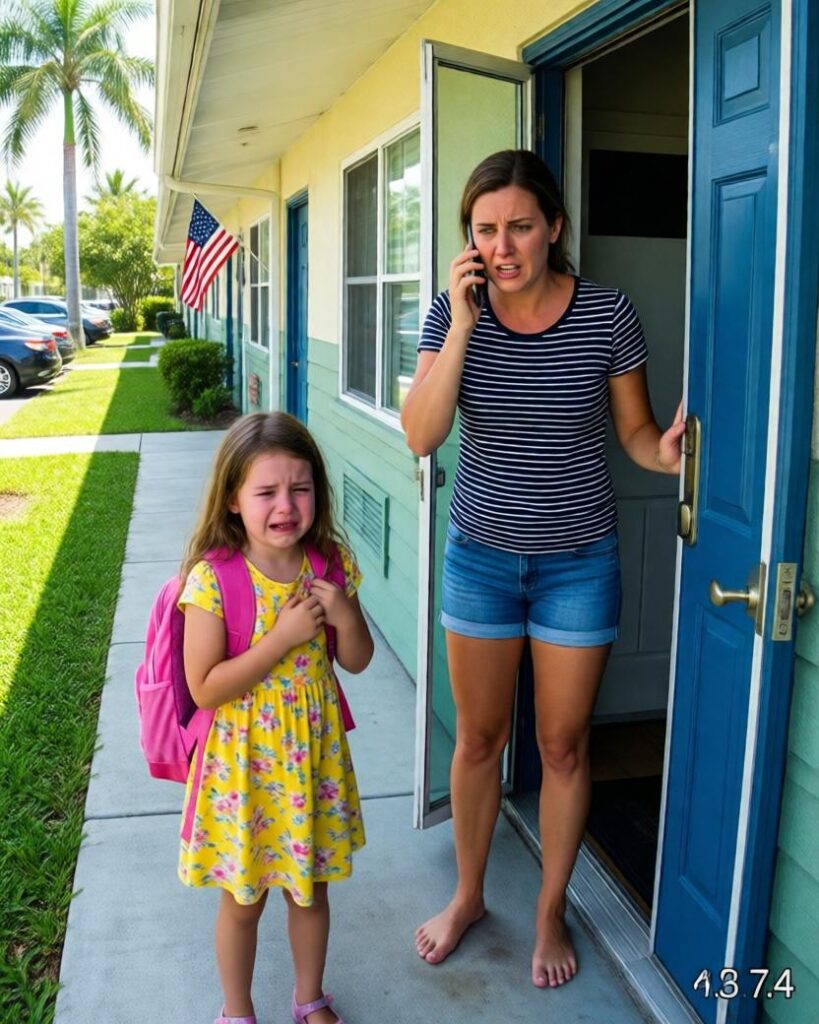
“They left me,” Ella sobbed into a stranger’s phone, and the kitchen around me went silent.
I gripped the counter so hard my knuckles hurt. My seven-year-old daughter was supposed to be on a family vacation in Miami with my parents, my sister Briana, and her cousins.
Instead, an unknown woman was telling me Ella was crying outside an apartment door.
“Put her on,” I said.
There was shuffling, a soft voice, then my child. “Mommy?”
“I’m here,” I said fast. “I’m right here.”
“They left me,” she cried. “Grandma and Grandpa went to the beach with Paige and Lucas. Aunt Briana said I needed my real dad. I don’t want to be here.”
My stomach dropped through the floor.
The address belonged to Preston, my ex-husband. The man I had kept away from Ella for a reason. The man my parents still admired because he used to pay bills and flash money like character.
But Preston had not even opened the door.
A stranger.
I forced my voice steady for Ella. “Stay with the lady who called me. Do not leave with anyone else. I’m sending someone safe.”
Then I called my aunt Paula in Miami, the one person in my family who had ever felt like shelter. She answered on the first ring. I gave her the address, and she was already moving before I finished the sentence.
Only after that did I call my mother.
She picked up cheerful. “Dana. Oh good. Don’t worry. Everything’s fine.”
Fine.
“You left my daughter on someone’s doorstep.”
“Not someone,” she said smoothly. “Her father.”
“A woman answered the door. Not him.”
The silence that followed told me they knew exactly how bad it looked.
Then my mother recovered. “You’ll thank us later. This is what’s best for Ella.”
Briana cut in, sharp and smug. “You kept her from him long enough. She needs her real father. We’re helping.”
Helping.
That was the word they chose for leaving a little girl crying at a stranger’s apartment while they took the other kids to the beach.
“She was terrified,” I said. “Do you even care?”
“You’re too sensitive,” my mother snapped. “You always turn everything into drama.”
I stared at the wall, phone hot against my ear, and listened to them justify what no decent adult could explain.
Then I ended the call.
No screaming. No begging. Just a decision settling cold and clean in my chest.
Within an hour, Steven and I had booked the earliest flight. He did not ask whether I needed him. He heard the story and said, “You’re not doing this alone.”
By the time we reached Miami, Paula had already brought Ella to her small bungalow with peeling shutters and lace curtains. It was not fancy. It was not beachfront. But when my daughter ran into my arms, that little house felt safer than every expensive place my family had ever entered.
Ella clung to my shirt like I might vanish.
“I’m here,” I whispered into her hair. “I’m not leaving.”
Steven wrapped his arms around both of us, and Paula stood in the doorway with her jaw tight.
“Stay here tonight,” she said. “You need family. Real family.”
That word hit differently after what my parents had done.
The next morning, sunlight came through Paula’s kitchen curtains while Ella colored at the table with old crayons. Her hands still shook when a car door slammed outside.
Paula poured tea and said, “I wish I could say I’m surprised.”
I looked at her.
“Your parents always thought they knew best,” she said. “This time they just got more dangerous.”
She was right.
My parents had been deciding my life for years. They pushed me into things I never wanted, ignored what I said, and wrapped control in one phrase: “You’ll thank us later.”
They loved Briana harder, praised her louder, excused her faster. If she hummed, she was talented. If I excelled, I was expected to be grateful.
Then Preston came along with expensive gifts and mortgage checks, and my family acted like I had won the lottery.
They did not care that behind closed doors he was cold. That he cheated. That he thought money made every betrayal acceptable.
When I left him, I walked away with almost nothing because I did not want to drag Ella into his orbit. My parents did not call that protection.
They called it selfish.
Because leaving Preston meant their golden goose was gone.
Still, I kept sending money. Mortgage help for my parents. Utility payments when they were short. Little extras for Briana’s kids, Paige and Lucas.
I told myself I was keeping peace.
Really, I was paying rent on being tolerated.
After Miami, I opened my laptop at Paula’s kitchen table and logged into every account.
No speech. No warning.
Mortgage transfer: canceled.
Utility help: canceled.
Briana’s little emergency money: canceled.
Each click felt like taking oxygen back.
Steven watched from the doorway and nodded once.
That night, Ella slept between us, waking every few minutes to ask, “You’re still here, right?”
Every time, I answered, “Yes.”
And every time, my decision got sharper.
My parents would never be alone with her again. Briana would never get another chance to call abandonment “help.” I did not need a shouting match to make that real.
I just closed the door.
Three days after we got home, I was folding laundry when Briana’s name lit up my phone.
I almost ignored it.
Then I answered.
Her voice came through ragged, furious, and scared.
“What did you do?”
I sat down slowly.
“What are you talking about?”
“I’ve been suspended, Dana,” she snapped. “My principal says parents are talking. They said I’m a risk around kids. You called my school, didn’t you?”
The laundry basket sat at my feet, half full of tiny shirts, and suddenly the room felt too still to breathe.
For one second, I could not speak.
Because I had not called anyone.
And somehow, the truth had already found them…
PART 2
I had not called her school.
I didn’t need to. In a community as tight-knit and gossipy as the private prep academy where Briana taught primary art, a woman’s reputation was built on glass.
“I didn’t call anyone, Briana,” I said, my voice dangerously calm.
“Liars! You’re all liars!” she shrieked. “Someone told the administrative board that I left a minor on an unsupervised stoop in Florida while I went to the beach! They said it shows a ‘fundamental defect in moral judgment.’ Do you have any idea what this means for my career?!”
“It means people finally see you for what you are,” I replied.
“It was an intervention!” Briana’s voice cracked into a desperate, high-pitched whine. “Mom and Dad said Preston had money! He wanted to reconnect! If he took her off your hands, you wouldn’t be so bitter! We were trying to give Ella a father!”
“You left a seven-year-old girl with a stranger in an unfamiliar city,” I said, every word weighted like lead. “You used my child as collateral to curry favor with a man who hasn’t paid a dime of child support in four years. Never call me again.”
I hung up.
Before I could even set the phone on the counter, it began to ring again. My mother. I didn’t answer. She left a voicemail, her voice devoid of the smooth, patronizing warmth she usually reserved for me. She sounded frantic.
“Dana! What is the meaning of this? The bank just called about the house. The mortgage payment bounced! The electric company sent a final shut-off notice! You need to fix this right now. Your father’s heart can’t take this stress. Call me back!”
I deleted the message. Then I blocked her number. I blocked my father. I blocked Briana.
For thirty years, I had been the steady foundation beneath their sinking house. When my father’s small business failed, I quietly covered the property taxes. When Briana wanted to send Paige and Lucas to summer camp, I paid the tuition under the guise of an “early birthday present.” When my mother complained about her rising medical co-pays, I set up an automatic monthly transfer.
I had convinced myself I was being a good daughter, a good sister. But the truth was far uglier: I was funding my own emotional abuse. I was paying the salaries of the people who viewed my daughter not as a person, but as a bargaining chip.
Without my monthly subsidies, the house of cards didn’t just wobble; it collapsed.
Two weeks later, Aunt Paula called with the updates. She was the only bridge left, and she reported the carnage with a grim satisfaction.
“Your parents are putting the house on the market,” Paula told me while Ella was in the living room doing her math homework with Steven. “They can’t afford the property taxes, let alone the mortgage without your check. Your mother is telling everyone in town that you’re a heartless monster who threw her aging parents into the street.”
“Let her,” I said. “What about Briana?”
“Fired,” Paula said flatly. “Turns out, when the school investigated the incident, someone pulled Preston’s public police records to see who they’d left Ella with. Preston wasn’t just living with a new girlfriend, Dana. He was under active investigation for wire fraud and money laundering. The school couldn’t risk having Briana on staff after she tried to hand a student’s peer over to a federal target.”
My stomach turned. Preston’s “flashing money like character” hadn’t been real. It was a illusion, a criminal enterprise built on stolen funds—the exact reason I had run from him four years ago when the first red flags appeared. My parents had tried to hand my daughter over to a man on the brink of an FBI indictment, all because he drove a nice car and bought my father expensive scotch.
A month later, the final blow came.
Steven and I were sitting on the back patio while Ella played on the swing set he had built for her. The autumn air was crisp, clean, and entirely free of the suffocating weight I had carried my entire life.
My front doorbell rang.
Steven started to get up, but I put a hand on his arm. “I’ll get it.”
I walked to the front door, opened it, and found my father standing on the porch.
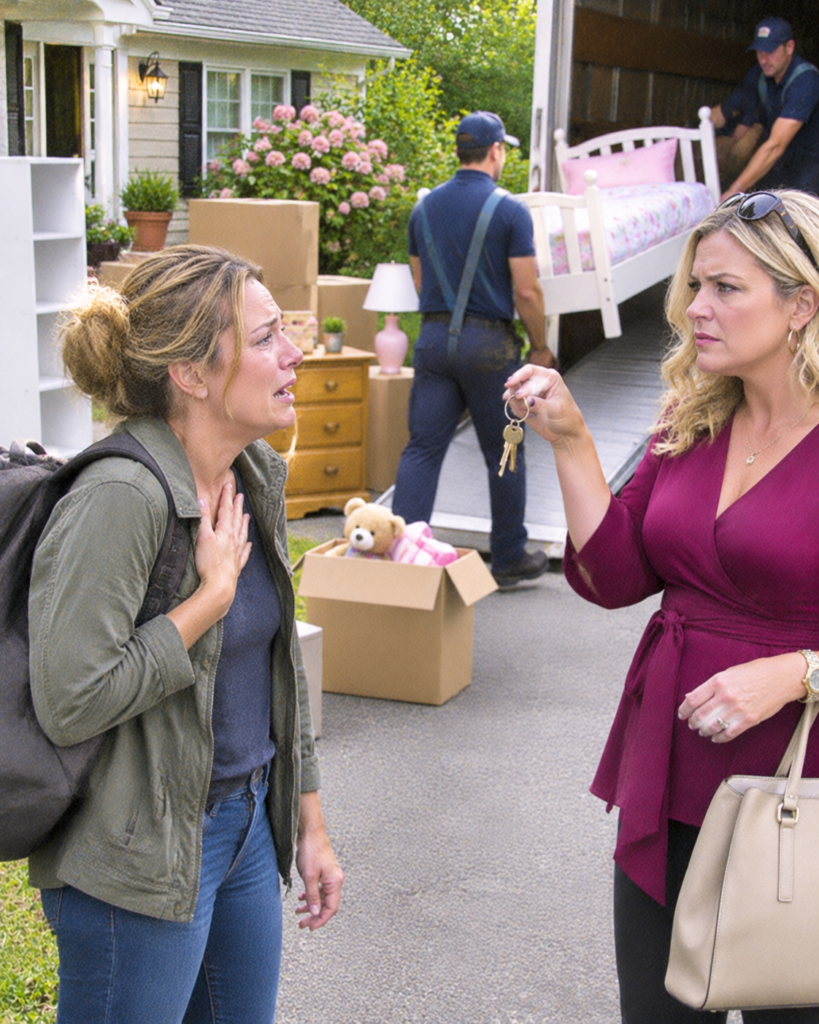
He looked smaller. The grand, commanding patriarch who used to dismiss my tears with a wave of his hand now looked frail in a jacket that was beginning to show wear at the cuffs. Behind him, parked at the curb, was a rented moving truck.
“Dana,” he said. His voice lacked its usual thunder.
I didn’t open the screen door. I stood behind the mesh, my arms crossed. “What are you doing here, Dad?”
“We sold the house,” he said, looking at his shoes before forcing his eyes up to meet mine. “We had to downsize to a two-bedroom condo on the edge of town. Briana… Briana is living with us now with the kids. She’s working retail.”
“I know,” I said.
“We need to talk about this,” he pleaded, reaching out a hand, though he didn’t touch the door. “This has gone too far. We made a mistake, okay? We thought… we thought Preston could help you. We thought if he was back in the picture, he’d pay for Ella’s college, help with the family…”
“You used my daughter to secure a paycheck,” I said, my voice steady, unyielding. “You left her on a doorstep because you cared more about Preston’s money than her safety.”
“We’re your family!” he choked out, anger flaring through his desperation. “After everything we did for you! You’re going to destroy this family over one misunderstanding?!”
“You destroyed it in Miami,” I said. “I’m just cleaning up the wreckage.”
“Dana, please,” he rasped, tears finally spilling over his weathered cheeks. “We can’t survive without your help. The condo fees, the utilities… we’re drownin’. Just… just come home for Sunday dinner. Let us see Ella.”
At that moment, the inner door opened behind me. Ella walked up, holding a drawing she had just finished. She looked past me, saw the man standing on the porch, and stiffened. She didn’t run to him. She didn’t smile. She quietly slid her hand into mine and stepped back into the shadow of the hallway.
My father saw it. He saw the cold, unyielding space between him and the grandchild he had discarded for an afternoon at the beach.
“You will never touch her again,” I said softly. “You will never speak to her again. And you will never take another dollar from me.”
“Dana—”
“Goodbye, Dad.”
I closed the heavy wooden door, turned the deadbolt, and locked out the noise, the greed, and the conditional love that had bound me for decades.
I took Ella’s drawing—a picture of a small house with a bright yellow sun and three people holding hands—and pinned it to the refrigerator. Outside, the engine of the moving truck rumbled to life and slowly faded down the street. Inside, the house was quiet, warm, and entirely ours.