Part 1: The Woman Holding Number 47
The Auction
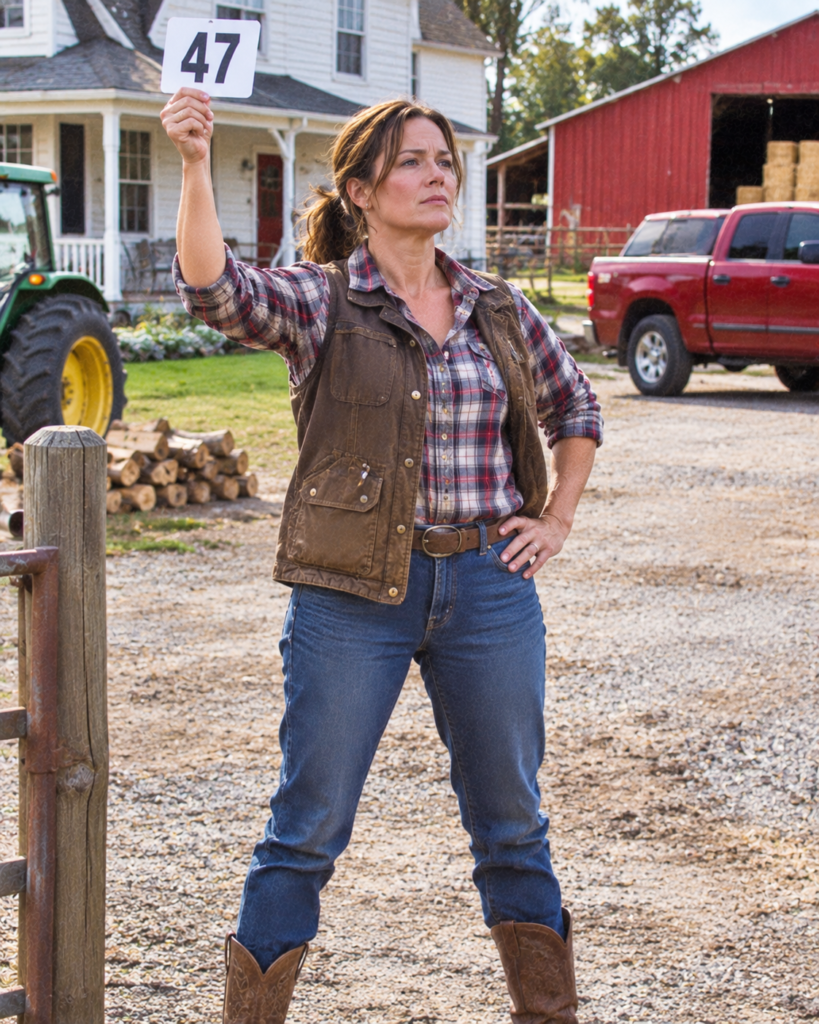
My father-in-law sold the family farm for $286,000 to a hunter from Denver because his son had married a girl from town. Four years later, I returned to that very farmyard for an auction, holding bidder card number 47.
The elderly farmer in my dental chair waited until I moved the suction tube away.
“Your father-in-law’s been talking at the co-op coffee table,” he said.
“Walt says his boy married a town girl.”
“Says she’d have that place chopped into lots by Christmas.”
I placed my scaler on the instrument tray.
I’d grown up in Kearney. That much was true.
My husband, Luke, had been raised on that farm.
A white farmhouse. A red barn. Eighty acres of pasture, eleven miles outside town.
His mother, June, passed away that January.
By February, Walt announced he intended to sell.
We sat across from him at the kitchen table and asked whether we could purchase it through a contract.
We would make payments straight to him, the same arrangement his father had once used.
“I’ll think on it,” he said.
But in April, he sold the property to a Denver man interested in pheasant hunting.
Luke learned about the sale through a two-minute call while working at the county shop.
When I repeated what the farmer had heard at the co-op, Luke remained standing at our kitchen counter for a long while.
“Ames, he just buried Mom. I’m not going to fight him over a sentence.”
He had a point.
So I chose not to argue either.
We spent Easter at Luke’s sister’s home in Gibbon.
Fourteen family members. Ham, scalloped potatoes, and June’s glass plate for deviled eggs.
Just before the prayer, I got to my feet.
“Walt, thank you for giving Luke that farm to grow up on.”
“Whatever happens to it, he had it. Our kids had it.”
The room went completely still.
Walt lowered his eyes to his plate and gave one nod.
On our drive home, Luke wanted to know why I’d said those words.
Because I’d already made up my mind to reclaim that farm.
And I refused to let anger be the reason.
The following Monday, I contacted a dentist in Hastings looking for a hygienist on Saturdays.
For the next four years, I walked out our door at 6:30 every Saturday morning.
Every dollar from those Saturday shifts went directly into a separate savings account.
We skipped vacations. Kept driving the same minivan. Bought the children’s clothes at church rummage sales.
Once each month, we visited the property and cut the grass along the ditch near the mailbox.
I sent the Denver owner a letter asking permission to water June’s lilac bushes.
“Sure,” he said. “I’m only out there in November.”
Walt attended every baseball game our son played.
He never brought up the farm.
And neither did I.
Then, this February, an auction announcement appeared in the Kearney Hub.
Before Luke returned home, I’d already called the man in Denver.
“It’s signed with the auction company,” he said. “Public sale. You’re welcome to bid.”
Our savings had reached $71,400.
At the bank, the banker wrote our maximum amount on a sticky note.
$305,000.
We couldn’t exceed it by even one dollar.
The final Saturday of March was bitterly cold.
A gray sky. Wind from the north. Bare cottonwood branches shaking.
More than sixty people gathered in the gravel farmyard.
Denny Kruse conducted the auction from a hay wagon.
He and Walt had attended school together.
Someone handed me a white bidding card.
47.
Luke had originally been the one expected to bid.
After all, it was his family’s farm.
But he kept his hand buried in his coat pocket.
His eyes remained fixed on his mother’s porch.
So I lifted card 47 instead.
And continued lifting it.
The representative from the Grand Island land company didn’t raise a bidder card.
All he did was nod.
Two-eighty.
Two-ninety.
Two-ninety-five.
Finally, Luke pulled his hand out of his pocket.
But he didn’t raise it.
Instead, he placed it gently against my lower back.
That was when I spotted Walt at the rear of the crowd.
His good church coat. Arms hanging at his sides. Not moving at all.
“Three hundred,” Denny said. “Now three-oh-one.”
The man representing the land company stared straight at me.
Then gave another nod.
Denny faced me, waiting for my response.
I lifted card 47.
“Three-oh-two!” Denny called.
A gust of wind swept across the gravel, carrying loose straw past our boots.
The land company representative spoke quietly into his phone. Then he nodded again.
“Three-oh-three!”
I raised my card.
“Three-oh-four!”
The man nodded.
I looked at Luke.
He knew what came next.
Three hundred and five thousand dollars was our absolute ceiling. Not a negotiating position. Not a number we could stretch by calling another bank. It was the largest purchase price our approved financing and savings could support.
I raised my card one last time.
“Three hundred and five thousand dollars!” Denny announced. “Looking for three-oh-six!”
The representative hesitated.
I could hear my own breathing.
Then he nodded.
“Three hundred and six thousand!”
My hand remained at my side.
Luke squeezed my shoulder.
“It’s okay, Ames.”
But it wasn’t okay.
Four years of Saturday mornings suddenly felt terribly heavy.
I remembered standing in our kitchen before sunrise, drinking coffee while the children slept. I remembered the Hastings dentist asking whether I could stay late, and saying yes even when my back ached.
I remembered June’s lilacs blooming against a house that no longer belonged to her family.
And now we were losing it again.
Denny searched the crowd.
“Three hundred six thousand. Do I hear three-oh-seven?”
Nobody moved.
“Going once.”
I looked toward the farmhouse.
The kitchen curtains were gone. The porch railing needed paint. One of the shutters hung crooked.
Still, I could picture June standing at the screen door with a dish towel over her shoulder.
“Going twice.”
Then a voice rose from the back of the crowd.
“Three hundred and seven.”
Every head turned.
Walt had raised his hand.
For a moment, I couldn’t understand what I was seeing.
My father-in-law, the man who had sold the property rather than let us buy it, was bidding against the same land company that had just beaten us.
Denny lowered his microphone.
“Walt?”
“Three-oh-seven,” Walt repeated.
The land company representative glanced at his phone.
Another nod.
“Three hundred and eight!”
Walt didn’t hesitate.
“Three-ten.”
A murmur spread through the crowd.
Luke stepped away from me.
“Dad?”
Walt kept his eyes on Denny.
The land company representative made another call. His expression tightened. Finally, he shook his head.
Denny waited.
“Three hundred ten thousand dollars. Going once. Going twice.”
The hammer struck the wooden rail.
“Sold!”
People began clapping.
But I couldn’t move.
Walt stood alone near the old cattle gate, looking as if someone had just told him something terrible.
Luke crossed the gravel toward him.
I followed a few steps behind.
“Dad,” Luke said. “What are you doing?”
Walt stared toward the barn.
“Buying a farm.”
“Why?”
“Because somebody ought to.”
Luke’s jaw tightened.
“You sold it four years ago.”
“I remember.”
“You wouldn’t sell it to us.”
“I remember that too.”
I expected an argument.
Instead, Walt reached into his coat pocket and took out a folded white envelope.
His hands trembled as he offered it to Luke.
“Your mother left this.”
Luke didn’t take it.
“Mom died four years ago.”
“I know.”
“Then why are you giving it to me now?”
Walt looked at me.
There was something in his expression I had never seen before.
Fear.
“Because I promised June I’d wait until the farm came back up for sale.”
Luke finally accepted the envelope.
Across the front, written in June’s familiar sloping handwriting, were five words:
For Luke, when the farm returns.
I felt the cold settle deep inside my coat.
June had died before Walt sold the property.
How could she have known it would return?
Luke opened the envelope carefully.
Inside was a letter and a small brass key tied to a faded blue ribbon.
He unfolded the paper.
His mother’s handwriting filled both sides.
He read the first sentence aloud.
“My darling boy, if you’re holding this letter, your father has finally done the hardest thing I ever asked of him.”
Luke stopped.
Walt turned away.
I touched Luke’s arm.
“Keep reading.”
His voice grew quieter.
“I know you may think he sold the farm because he was ashamed of the woman you married. But that was never the truth.”
My breath caught.
Luke looked up sharply.
Walt closed his eyes.
“There’s something underneath the old farmhouse,” Luke continued, “and until your father knows it’s safe, neither you nor your children must live there.”
The wind seemed to stop.
Luke read the final line.
“When the farm is yours again, take the brass key to the locked cabinet in the cellar. And whatever you find, remember that your father was trying to protect you.”
I stared at the key swinging from Luke’s fingers.
Then at Walt.
“What is underneath that house?”
He looked toward the farmhouse, his face pale.
“Something your mother made me promise never to tell you.”
Part 2: The Promise Beneath the Floorboards
The Hidden Cabinet
Nobody spoke for several seconds.
Around us, the auction crowd dispersed. Pickup doors slammed. Engines started. Denny Kruse climbed down from the hay wagon, carrying his clipboard.
But Luke remained fixed on his father.
“What did Mom know?”
Walt folded his hands.
“More than I wanted her to.”
“About what?”
Walt glanced toward the farmhouse.
“Not here.”
Luke gave a humorless laugh.
“You bought the place for three hundred and ten thousand dollars, Dad. You handed me a letter from my dead mother telling me something is hidden underneath it. And now you don’t want to talk?”
“I want to talk,” Walt said quietly. “I just want to do it somewhere we can sit down.”
I stepped between them.
“Then we’ll sit down.”
Denny approached us.
“Walt, I’ll need you over at the trailer to sign the purchase agreement.”
“I know.”
Luke looked at his father.
“Can you actually pay for it?”
Walt nodded.
“I sold the north quarter of my other land last fall. The money’s there.”
It was the first we’d heard about that sale.
Luke’s expression changed.
“You sold more land?”
“Forty acres. Land I wasn’t farming anymore.”
“And you didn’t tell me?”
Walt’s shoulders sagged.
“Son, I haven’t known how to tell you much of anything for four years.”
He walked toward the auction trailer.
Luke stood motionless.
I watched him, seeing the boy who had grown up believing his father understood everything about farming, responsibility, and keeping one’s word.
Now he was looking at a man he barely recognized.
“Come on,” I said. “Let’s get warm.”
We waited in our minivan with the heater running while Walt finished the paperwork.
Luke held June’s letter open across his knees.
He read it again, silently this time.
Then he handed it to me.
The rest of the letter was brief.
June wrote about the lilacs beside the porch and the way Luke had planted one of them with her when he was nine.
She wrote about our children, Caleb and Annie, and how much she loved hearing their footsteps in the kitchen.
Then came a paragraph that made my chest tighten.
I hope you will forgive your father for the things he cannot explain. He has always believed that keeping a burden to himself is the same as protecting the people he loves. Sometimes it is. Sometimes it only makes the burden heavier.
Below that, she had written:
The key belongs to the old cabinet behind the cellar stairs. I have kept something there that should have been given to you years ago. Your father knows why I waited.
There was no mention of danger.
No explanation of what we might find.
Only one final sentence:
Please don’t let this place become the reason you stop loving one another.
I folded the letter.
“She was worried about the family.”
Luke stared through the windshield.
“She was worried about something.”
Walt tapped on the passenger window.
I unlocked the door.
He climbed into the back seat, moving stiffly.
For a moment, we were simply three people sitting in a parked minivan outside a house full of memories.
Then Luke asked, “Did you lie about Ames?”
Walt looked down.
“Yes.”
“Why?”
“Because I needed you to stop asking me to sell you the farm.”
“That doesn’t answer why you told people she’d ruin it.”
Walt rubbed his forehead.
“I said something cruel because I thought it would make my decision sound final. Then I was too ashamed to take it back.”
Luke turned toward him.
“People believed you.”
“I know.”
“Ames heard it from patients at work.”
Walt looked at me.
“I know that too.”
I felt an unexpected rush of anger.
For years, I had told myself his words didn’t matter. That the only thing worth fighting for was our chance to return.
But they had mattered.
They had followed me into grocery stores, church dinners, and my own workplace.
“You made me sound like somebody who would sell June’s kitchen window for a parking lot,” I said.
Walt nodded.
“I did.”
“And you never apologized.”
“No.”
“Why?”
He took a breath.
“Because every time I thought about it, I knew I’d have to explain the rest.”
Luke leaned back.
“Then start explaining.”
Walt looked toward the farmhouse.
“Your mother found something in the cellar about six months before she died.”
“What?”
“Records.”
“What kind?”
“Old financial papers. Letters. Things your grandfather kept.”
Luke frowned.
“Grandpa Henry?”
Walt nodded.
“My father.”
Henry had died when Luke was fifteen. I’d never met him.
Family stories described him as stubborn, hardworking, and fiercely proud of the land.
Walt continued.
“Your grandfather borrowed money against the farm during the drought years. Not from a bank. From someone he knew.”
“Who?”
“A man named Arthur Bell.”
Luke shook his head.
“Never heard of him.”
“He was your grandmother’s brother.”
The name meant nothing to me either.
Walt explained that Arthur had left Nebraska in the late 1970s after a disagreement with Henry.
The family stopped talking about him.
Years later, when Henry was struggling financially, Arthur sent money.
“Your grandfather paid some of it back,” Walt said. “But not all.”
Luke frowned.
“How much?”
“That’s part of what June found.”
“Was there a lien on the property?”
“Not one that showed up in the title search. Nothing recorded against the land.”
“Then what was the problem?”
Walt’s voice lowered.
“Arthur didn’t just lend money. He believed he had purchased an interest in the farm.”
Luke stared at him.
“And?”
“And he left papers saying so.”
I tried to follow the implications.
“Was there a deed?”
“Something that looked like one.”
“Recorded?”
“No.”
“Then it might not have transferred anything.”
“That’s what June wanted to find out.”
Luke rubbed his jaw.
“Why didn’t she?”
“She was already sick.”
June had spent her final year fighting a heart condition that grew worse despite treatment.
I remembered the hospital visits, the medications, the exhaustion.
“She asked me to take the papers to an attorney,” Walt continued. “I promised I would.”
“Did you?”
“Not before she died.”
Luke closed his eyes.
After a moment, he asked, “And afterward?”
“I did. But the attorney couldn’t give me a simple answer from the copies I brought. He wanted the originals, the full history, and time to investigate.”
“Why didn’t you let him?”
Walt stared at his hands.
“Because I was afraid of what he’d find.”
Luke let out a long breath.
“So you sold the farm instead?”
Walt nodded.
“I thought if someone else bought it, you’d make a life somewhere else. You’d stop waiting for the place.”
I could hardly believe what I was hearing.
“Did you disclose the papers to the buyer?”
Walt looked at me.
“I told the title company there were old family documents I didn’t understand. They checked the public records and asked for copies. Their attorney said nothing established a recorded claim, but advised me to preserve everything.”
“Then why did you hide them from us?”
“Because June wanted me to keep the family together, and I was afraid those papers would tear us apart.”
Luke shook his head.
“Instead, you did that yourself.”
Walt didn’t argue.
For the first time, I began to understand that his silence hadn’t been a carefully designed plan.
It had been a series of frightened decisions, each one making the next harder to undo.
Still, understanding wasn’t the same as forgiveness.
“Why did you buy it today?” I asked.
Walt looked at the white house.
“Because when I saw you two bidding, I realized you’d spent four years trying to come home. And I’d spent four years running away from what June asked me to face.”
He swallowed.
“I couldn’t watch you lose it again.”
Luke looked at the envelope.
“Then we need to see what’s in that cabinet.”
Walt nodded.
“But the sale hasn’t closed. We need permission to enter.”
I appreciated that he remembered the property wasn’t legally his yet.
We called the Denver owner from the minivan.
His name was Peter Caldwell.
He sounded surprised when Walt explained the situation, but he agreed to meet us at the farmhouse that afternoon.
“I’ve got a few things to pick up anyway,” he said. “If there’s a cabinet you need to inspect, I’ll unlock the place.”
Two hours later, we stood on June’s porch.
Peter arrived in a dusty silver truck, wearing a canvas jacket and carrying a ring of keys.
He was a friendly man in his early sixties.
“Well,” he said, shaking Walt’s hand, “looks like this place is headed back where it belongs.”
Walt gave a faint smile.
“I hope so.”
Peter unlocked the door.
The farmhouse smelled of old wood, dust, and cold air.
The kitchen looked smaller than I remembered.
Without June’s yellow curtains and blue ceramic rooster beside the sink, it seemed almost unfamiliar.
Luke touched the edge of the counter.
“Mom used to roll pie dough right here.”
“I remember,” I said.
Peter led us to the cellar door.
“I’ll wait upstairs. Take your time.”
The stairs creaked under our weight.
Luke switched on the light.
A single bulb illuminated shelves, old plumbing, and the stone foundation.
Behind the stairs stood a narrow wooden cabinet.
Its doors were painted dark green.
A small brass lock held them shut.
Luke knelt.
He inserted June’s key.
It turned smoothly.
The doors opened.
Inside were three cardboard document boxes, a metal cash tin, and a flat wooden case wrapped in a dish towel.
Luke lifted the first box.
Dust rose into the air.
The lid bore June’s handwriting:
Henry’s papers.
The second read:
Arthur Bell.
The third:
For Luke and Amelia.
My heart gave a sudden, painful thump.
Luke looked at me.
“She wrote your name.”
I nodded.
He opened the third box first.
Inside were photographs, envelopes, a small notebook, and a sealed letter.
The photographs showed the farm across several decades.
Henry standing beside a tractor.
June holding baby Luke on the porch.
Walt repairing the barn roof.
And one photograph I had never seen.
A young woman stood in front of the farmhouse, holding a little boy’s hand.
The woman resembled June.
But the boy wasn’t Luke.
On the back, in faded blue ink, someone had written:
Eleanor and Daniel. Summer 1978.
Luke frowned.
“Who’s Daniel?”
Walt took the photograph.
His expression changed so suddenly that I thought he might fall.
“Where did you find that?”
“In Mom’s box.”
Walt sat on the bottom stair.
For several seconds, he couldn’t speak.
Then he whispered, “I thought Henry destroyed every picture of them.”
Luke crouched beside him.
“Dad. Who are they?”
Walt covered his mouth.
“Daniel is your cousin.”
“Then why have I never heard of him?”
Walt looked at the photograph again.
“Because your grandfather made sure nobody spoke his name.”
I glanced at the other boxes.
Arthur Bell.
Eleanor.
Daniel.
A family history nobody had told us.
Luke picked up the sealed letter addressed to us.
His mother’s handwriting was unmistakable.
He opened it.
Inside was a single page.
Luke and Amelia,
If you are reading this, you have found the papers I couldn’t bring myself to destroy.
There is someone who deserves to know the truth about this farm.
His name is Daniel Bell.
And before you decide what to do with this land, you must understand what was taken from his family.
Luke slowly lowered the letter.
Above us, a floorboard creaked.
Peter called from the kitchen.
“Everything all right down there?”
Walt didn’t answer.
He was staring at the wooden case.
Finally, he said something that changed the meaning of the entire auction.
“I didn’t buy this farm back just for you, Luke. I bought it because Daniel Bell may have been owed part of it for nearly fifty years.”
Part 3: The Name Nobody Spoke
The Forgotten Branch
We carried the boxes upstairs and spread their contents across June’s old kitchen table.
Peter Caldwell remained with us.
As the property’s current owner, he had a legitimate interest in anything that might affect the title, and Walt didn’t want to keep another person in the dark.
Peter listened while we explained the papers.
Then he looked at Walt.
“You know, when I bought this place, I asked whether there were any family disagreements I should know about.”
Walt nodded.
“I remember.”
“You told me there were old documents that had been reviewed, but no recorded claim.”
“That’s what the title company told us.”
Peter folded his arms.
“Then before this closing, everybody needs to know exactly what we’re dealing with.”
“Agreed,” I said.
He studied me for a moment.
“You’re the daughter-in-law?”
“Amelia. Most people call me Ames.”
“You’re the one who kept watering those lilacs.”
I smiled faintly.
“Yes.”
Peter looked toward the kitchen window.
“My wife used to say somebody must love this house very much to come all the way out here for a few bushes.”
I hadn’t expected kindness from the man who had owned our dream for four years.
But there it was.
He offered to give us copies of the closing documents from his original purchase and agreed to let an attorney review the old papers before the new sale proceeded.
We thanked him.
Then Luke opened the wooden case.
Inside lay a stack of letters tied with twine and a small ledger with a cracked brown cover.
The oldest letter was dated August 1977.
It was addressed to Henry from Arthur Bell.
Henry,
I know we have disagreed about the farm. I know you believe the land should remain in your name because you worked it after Father died.
But Eleanor and I cannot ignore what our mother intended.
I am willing to help with the bank payment. I am not willing to pretend that her share never existed.
Luke read it twice.
“Whose mother?”
Walt answered quietly.
“My grandmother, Ruth.”
The history emerged slowly.
Henry and Arthur weren’t brothers. Arthur was Henry’s brother-in-law.
Henry had married Ruth’s daughter, Margaret, who was Walt’s mother.
Ruth had owned a portion of the farm through an inheritance from her parents.
When she died, her interest was supposed to be divided between Margaret and Margaret’s younger sister, Eleanor.
But Eleanor had married Arthur Bell and moved away.
According to the family story Walt grew up hearing, Eleanor had accepted money in exchange for her share.
The documents suggested something different.
Arthur’s letters repeatedly asked Henry to provide proof of payment.
Henry’s replies were missing.
The ledger contained columns of dates and amounts.
Some entries were marked loan.
Others were marked Eleanor’s share.
I looked at Luke.
“Your grandfather may have been managing land that partly belonged to his sister-in-law.”
“Maybe,” Luke said. “But we don’t know whether she had a legal interest, or whether those amounts were loans, gifts, or payments.”
He was right.
We had documents.
Not answers.
Still, the thought troubled me.
For four years, I had imagined returning to the farm as an act of restoration.
Now I was beginning to wonder what restoration really meant.
Could we call the farm ours if another family had been denied something there?
Walt turned the pages of the ledger.
“Henry always said Eleanor had been paid.”
“Did you believe him?” Luke asked.
“Of course.”
“And now?”
Walt looked toward the window.
“Now I wish I’d asked to see the receipt.”
That afternoon, we called an attorney in Kearney named Rebecca Nolan.
She specialized in real estate and estate matters.
Rebecca had handled a land transaction for one of Luke’s coworkers, and she agreed to meet us Monday morning.
Until then, she advised us not to remove or alter anything else.
She also urged Walt to disclose the newly discovered documents to the title company and the auction firm.
Denny Kruse was surprised but cooperative.
“Better to sort it out before closing than afterward,” he said.
The transaction remained under contract while the attorneys reviewed the situation.
That evening, we went home exhausted.
Caleb and Annie were waiting at the kitchen table.
Caleb was thirteen and had been following the auction all week.
“Did we get it?”
Luke set his keys down.
“Grandpa bought it.”
Annie, who was ten, looked confused.
“Does that mean we can live there?”
“Not yet,” I said.
“Why?”
I pulled out a chair.
“Because we found some old family papers, and we need to understand them first.”
Caleb frowned.
“Is something wrong with the farm?”
“No,” Luke said. “Nothing’s wrong with the land.”
He paused.
“We’re just learning more about the people who lived there.”
Annie considered that.
“Grandma June always said houses remember things.”
Luke smiled sadly.
“She did.”
“Maybe this one remembers something important.”
I reached across the table and squeezed her hand.
“Maybe it does.”
That night, after the children went to bed, Luke and I sat in the living room.
The television remained off.
He held a photograph of June.
“Do you think Mom knew about all this?”
“Some of it.”
“Why didn’t she tell me?”
“Maybe she was still trying to understand it herself.”
Luke rubbed his forehead.
“I spent four years thinking Dad was ashamed of us.”
“I know.”
“And now he’s spent his savings buying back a farm he was afraid to let us own.”
I leaned against him.
“People can love us and still make terrible decisions.”
He was quiet for a long time.
Then he said, “I don’t know whether I can forgive him.”
“You don’t have to decide tonight.”
Monday morning, Rebecca spread the documents across her conference table.
She wore reading glasses on a chain and had a habit of tapping her pencil against her thumb when she concentrated.
For almost two hours, she examined the ledger, letters, and photocopies of old deeds.
Finally, she leaned back.
“Here’s what I can tell you.”
We all straightened.
“These papers raise questions. They don’t, by themselves, prove Daniel Bell owns any portion of the farm today.”
Luke nodded.
“But they might?”
“Possibly. We’d need to trace the recorded title, probate records, and any agreements or releases. There may be legal defenses based on the passage of time. We shouldn’t make assumptions in either direction.”
Walt looked relieved and disappointed at once.
Rebecca continued.
“The more immediate concern is the pending sale. Peter’s title insurer needs to review this. If there is an unresolved issue, it should be addressed properly.”
“What about Daniel?” I asked.
“Do you know where he is?”
“No.”
“Then we should try to locate him. Not because we can promise him ownership, but because his family appears to have been involved in these transactions.”
Luke looked at the photograph.
“He’d be about fifty now.”
“Probably,” Rebecca said.
Walt spoke for the first time in several minutes.
“He was six when Eleanor died.”
I turned toward him.
“What happened to her?”
“Car accident.”
“And Arthur?”
“He took Daniel to Colorado. I heard Arthur died in the early nineties.”
“Did you ever contact Daniel?”
Walt shook his head.
“Henry wouldn’t allow it.”
Luke’s voice sharpened.
“You were an adult.”
“I know.”
Walt looked at his son.
“I spent too much of my life treating my father’s wishes like laws.”
Rebecca placed her pencil on the table.
“Then perhaps it’s time to find out what Daniel wants.”
Over the next ten days, the search became a quiet family project.
Rebecca obtained old probate documents and traced the recorded property history.
I searched newspaper archives at the Kearney library.
Luke contacted distant relatives.
Walt opened boxes he hadn’t touched since June’s funeral.
We discovered that Eleanor had worked as a school librarian in Fort Collins.
She had married Arthur in 1969.
Daniel was born in 1972.
After Eleanor’s death, Arthur had raised him alone.
An obituary for Arthur listed one surviving son, Daniel, of Colorado Springs.
There was no address.
But the obituary mentioned a wife named Sarah and a daughter named Grace.
I stared at the clipping.
“He had a family.”
Luke sat beside me.
“Of course he did.”
“I know. It’s just strange. We’ve been talking about him like a name in a ledger.”
I touched the faded newspaper.
“He has a whole life.”
A few days later, Rebecca located a current mailing address through lawful public records and sent a carefully worded letter.
She explained that documents connected to his grandparents’ family property had been discovered and asked whether he would be willing to speak.
We waited.
During that time, Walt began coming over for supper more often.
At first, the conversations were awkward.
He asked Caleb about baseball.
Annie showed him a drawing.
Luke spoke politely but rarely about anything personal.
One Thursday evening, Walt brought a wooden box.
Inside were June’s handwritten recipes.
“I thought Ames might want these.”
I opened it.
There were cards for cinnamon rolls, chicken and noodles, peach cobbler, and the deviled eggs we’d served at Easter.
One card had a small grease stain shaped like a heart.
I recognized June’s handwriting immediately.
“Thank you,” I whispered.
Walt stood by the doorway.
“She loved you, Amelia.”
I looked up.
“I loved her too.”
He swallowed.
“She used to tell me you were the best thing that happened to Luke.”
The words surprised me.
“Then why did you say those things about me?”
Walt looked down.
“Because when I needed an excuse, I chose one I thought people would believe.”
I felt tears gather.
“You knew they’d believe it because I wasn’t from a farm.”
“Yes.”
“And you let them.”
“Yes.”
He didn’t ask me to excuse him.
That mattered.
I closed the recipe box.
“I can understand that you were frightened, Walt. But you hurt me.”
“I know.”
“I don’t want you to pretend it didn’t happen.”
“I won’t.”
We stood in silence.
Then he said, “I’m sorry, Amelia.”
It was the first time in four years that he’d said those words.
I wasn’t ready to forgive everything.
But I was ready to believe he meant them.
Three weeks after the auction, Rebecca called.
Daniel Bell had responded.
He wanted to meet us.
Not at her office.
Not at the farm.
He suggested a small diner halfway between Kearney and Colorado Springs.
He would bring his wife.
And he had one request.
He wanted Walt to bring the original photograph of Eleanor and Daniel standing in front of the farmhouse.
“Why?” Luke asked.
Rebecca hesitated.
“Because he says his father told him that picture was destroyed.”
We arranged to meet the following Saturday.
But the evening before our trip, another envelope arrived.
It was addressed to Walt.
The return address belonged to Daniel Bell.
Inside was a photograph.
The same farmhouse.
The same porch.
A young Henry standing beside Arthur Bell.
And between them, Eleanor.
On the back, someone had written:
August 1976. The day Henry agreed to put the farm in both families’ names.
Beneath that sentence was a second line.
“The signed agreement is not in the cellar. Ask Walt what happened to it.”
Part 4: The Agreement in the Tin Box
What Walt Never Said
Walt arrived at our house twenty minutes after Luke called him.
He carried no coat despite the chilly evening.
Luke placed the photograph on the kitchen table.
“Have you seen this before?”
Walt picked it up.
His face changed.
“Yes.”
“Where’s the agreement?”
Walt sat down slowly.
For several moments, he studied the three people in the photograph.
Then he said, “I don’t know.”
Luke stared at him.
“Daniel says to ask you.”
“I know.”
“Then tell us why.”
Walt ran a hand over his face.
“Because I was there when Henry put it away.”
The room fell silent.
I sat opposite him.
“How old were you?”
“Twenty-one.”
“What happened?”
Walt looked at Luke.
“Your grandfather called Arthur and Eleanor out to the farm. They’d been arguing for months about Ruth’s estate.”
He explained that Ruth had inherited an interest in the property years earlier, and that the family had treated her share informally.
When she died, questions arose about how much of that interest passed to her daughters.
Henry believed his years of farming entitled him to control the property.
Eleanor believed her mother’s wishes deserved to be honored.
Arthur wanted a written settlement.
Finally, the family gathered in August 1976.
A local attorney prepared an agreement describing a proposed division of proceeds if the farm were ever sold.
“Was it signed?” Luke asked.
“Yes.”
“By whom?”
“Henry, Margaret, Eleanor, and Arthur.”
“What did it say?”
Walt closed his eyes.
“I remember something about a percentage of the proceeds. But I don’t remember the exact number.”
“Where did it go?”
“Henry put it in a tin box in his office.”
“And then?”
Walt’s voice grew rough.
“Two weeks later, he told me to take the box to the bank.”
“Which bank?”
“The old First State branch in Kearney.”
Luke sat forward.
“A safe-deposit box?”
Walt nodded.
“Henry had one.”
“Did you take it there?”
“Yes.”
“Then why didn’t you tell Mom?”
Walt looked at him.
“Because when she found the ledger, I thought the agreement was gone. Henry told me he’d taken care of everything.”
Luke pushed his chair back.
“But you knew there had been a signed agreement.”
“Yes.”
“You knew where it might be.”
“Yes.”
“And you let Mom spend her last months worrying about it?”
Walt’s eyes filled.
“She asked me whether there was anything else. I told her I didn’t know.”
Luke stood.
“You did know.”
“I knew a box existed. I didn’t know whether the papers were still inside.”
“That’s not the same as telling the truth.”
“No,” Walt whispered. “It isn’t.”
I watched Luke pace toward the window.
He was angry, and he had every reason to be.
But beneath the anger was grief.
He had lost his mother.
He had lost the farm.
And now he was discovering that the people he trusted most had lived with secrets he couldn’t untangle.
“Luke,” I said gently.
He stopped.
“We need the documents more than we need another argument tonight.”
He looked at his father.
“Can we get into that box?”
Walt nodded slowly.
“Henry left his personal effects to me. I still have the key.”
“Where?”
“In my desk drawer.”
The next morning, before our planned drive to meet Daniel, we contacted Rebecca.
She advised us to postpone the meeting until we could determine whether the safe-deposit box still existed.
She also reminded us that access would depend on the bank’s records and legal authority.
Walt agreed to visit the bank with her.
The original branch had changed names twice since the 1970s, but the successor institution retained some archived records.
A week later, after the bank verified Walt’s authority and arranged access, he and Rebecca entered the vault.
The safe-deposit box was still there.
Inside were old insurance policies, Margaret’s jewelry, photographs, and a rectangular tin container.
Rebecca brought the container back to her office with Walt.
Luke and I joined them that afternoon.
Walt placed it on the table.
The lid was rusted around the edges.
He opened it carefully.
Inside were several envelopes and a folded document.
Rebecca put on her glasses.
“This appears to be the agreement.”
Nobody spoke while she read.
The document was dated August 14, 1976.
It described a settlement among family members concerning proceeds from the eventual sale of the farm.
It did not appear to transfer title immediately.
Instead, it provided that if the property were sold, a defined share of the net proceeds would be paid to Eleanor or her heirs, subject to certain expenses and earlier advances.
Rebecca explained that the agreement would require further legal review to determine whether it was enforceable.
But it was evidence of an obligation the family had apparently intended to honor.
Luke leaned forward.
“What percentage?”
Rebecca looked at the page.
“Twenty-five percent of the defined net proceeds.”
Walt closed his eyes.
I felt the weight of the number.
A quarter.
Not necessarily a quarter of the land itself.
Not necessarily a quarter of today’s value.
But a significant amount.
Rebecca continued reading.
Then she paused.
“There’s something else.”
She turned to the final page.
A handwritten notation appeared beneath the signatures.
It was dated September 1983.
Henry had acknowledged receiving money from Arthur to help pay an agricultural loan.
The amount was $18,000.
The notation said the advance would be considered when calculating the family’s final settlement.
Luke shook his head.
“Grandpa always said Arthur owed him money.”
Walt looked stunned.
“That’s what he told me too.”
Rebecca set the paper down.
“We shouldn’t draw conclusions until we compare this with the ledger and bank records. But it appears the financial history was more complicated than Henry admitted.”
I thought of June.
She had discovered fragments of this story while already ill.
She had tried to preserve them.
And she had left a letter asking us to seek the truth.
Not to punish anyone.
Not to claim victory.
Simply to find out what had happened.
We finally met Daniel and Sarah Bell the following Saturday.
The diner sat just off the highway, with red vinyl booths and a bell that jingled above the door.
Daniel was fifty-three, tall, with graying hair and the cautious expression of a man who had spent years expecting disappointment.
Sarah had kind eyes and wore a blue cardigan.
When Daniel saw Walt, he stopped walking.
“You look like Henry.”
Walt gave a sad smile.
“People used to tell me that.”
Daniel nodded.
“I remember him.”
We sat together.
For a few minutes, we talked about ordinary things.
The drive.
The weather.
The coffee.
Then Daniel took out a small envelope.
“My father kept these.”
Inside were letters from Eleanor to her sister Margaret.
They were affectionate at first.
Stories about Daniel starting school.
Questions about the harvest.
Plans for Thanksgiving.
Then the tone changed.
Eleanor wrote about the farm settlement.
About waiting for documents.
About how painful it felt to be treated like a stranger by her own family.
Daniel looked at Walt.
“My mother died when I was six. I don’t remember much about her.”
Walt lowered his eyes.
“I remember her well.”
“Was she kind?”
Walt’s voice broke.
“Very.”
Daniel stared at his hands.
“My father always told me she loved that farm. He said she used to climb the cottonwood tree behind the barn when she was little.”
Luke smiled faintly.
“That tree’s still there.”
Daniel looked up.
“Really?”
“Yes.”
For the first time, his face softened.
We showed him the agreement.
Rebecca had prepared copies and a plain-language explanation of what remained uncertain.
Daniel read slowly.
When he finished, he set the pages down.
“My father spent years trying to get somebody to acknowledge this.”
Walt nodded.
“I’m sorry.”
Daniel looked directly at him.
“Do you know what bothered him most?”
Walt shook his head.
“It wasn’t the money.”
The diner seemed unusually quiet.
“He said Henry stopped inviting us to Christmas.”
Walt’s eyes filled.
Daniel continued.
“He said Eleanor cried every December because she missed her sister.”
I felt my throat tighten.
There it was.
The real inheritance.
Not eighty acres.
Not a percentage written on paper.
A family divided by pride and silence.
Walt took out the old photograph.
He placed it in front of Daniel.
Daniel touched his mother’s face with one finger.
For a long moment, nobody spoke.
Then he whispered, “I’ve never seen her standing there.”
Sarah put her hand over his.
Daniel looked at Walt.
“Can I visit the farm?”
Walt nodded immediately.
“Of course.”
Daniel turned to Luke.
“And you?”
Luke’s expression changed.
He glanced at me.
Then he said, “I’d like that.”
We spent the afternoon discussing what should happen next.
Rebecca would continue reviewing the legal questions.
Walt wanted to resolve any valid financial obligation rather than leave it to another generation.
Daniel wanted time to understand the documents and speak with his wife and daughter.
Luke wanted the farm protected from further uncertainty.
I wanted all of them to remember the people behind the paperwork.
Before we left, Daniel asked Walt one final question.
“Did your wife know about the agreement?”
Walt hesitated.
“June knew there were papers. She never saw this one.”
Daniel nodded.
“Then why did she leave a letter for Luke?”
Walt reached into his coat.
He took out another envelope.
This one was addressed in June’s handwriting.
For Walt, when you’re ready.
He looked at it for a long time.
“I found this after her funeral,” he said. “I couldn’t open it.”
Luke stared at him.
“You’ve had another letter all this time?”
Walt nodded.
“I brought it today because I think I’m finally ready.”
His fingers trembled as he broke the seal.
Inside was a single sheet.
He read silently.
Then his face crumpled.
Luke reached toward him.
“Dad?”
Walt passed the letter across the table.
At the bottom, June had written:
“Walt, I know about the money Henry kept. But I also know about the account you opened in Daniel’s name. Please tell our son what you’ve been doing all these years.”
Part 5: The Farm That Brought Us Home
What We Chose to Keep
For a moment, I thought I’d misunderstood the letter.
An account in Daniel’s name?
Walt had never mentioned one.
Luke read June’s words twice.
Then he looked at his father.
“What account?”
Walt folded his hands on the table.
“A savings account.”
“For Daniel?”
“Yes.”
“How long?”
Walt looked toward the diner’s front window.
“Since 1994.”
Daniel stared at him.
“That’s the year my father died.”
Walt nodded.
“I heard about Arthur’s funeral too late to attend. I wrote you a letter, but it came back.”
Daniel’s expression softened slightly.
“We moved that summer.”
“I know that now.”
Walt drew a slow breath.
“After Arthur died, I started thinking about what Henry had done. I didn’t know whether there was a legal obligation left. But I knew Arthur had helped keep the farm going.”
He paused.
“I wanted to set something aside.”
Luke leaned forward.
“Why didn’t you just find Daniel?”
“I tried once. Then I convinced myself he’d want nothing to do with us.”
Daniel looked at him.
“You never asked.”
“No,” Walt said. “I didn’t.”
Walt explained that he’d opened an account in his own name, earmarked in his personal records for Daniel.
He had deposited small amounts after each harvest.
Some years, when crops were poor, he added almost nothing.
Other years, he contributed more.
He kept the account separate from the farm’s operating expenses.
June discovered it while helping organize their finances.
She asked him about it.
He told her everything he knew.
“She said I should find you,” Walt told Daniel.
“Why didn’t you?”
Walt’s eyes filled.
“Because I was ashamed.”
The word settled over the table.
Shame.
It had followed this family through generations.
Henry had been ashamed of needing Arthur’s help.
Walt had been ashamed of questioning his father.
Then ashamed of the documents.
Then ashamed of the lies he’d told about me.
And every time someone remained silent, the distance between people grew.
Daniel looked at the letter.
“How much is in the account?”
Walt hesitated.
“A little over sixty-two thousand dollars.”
Sarah inhaled softly.
Luke sat back.
I felt stunned.
For decades, Walt had quietly saved money for a man he had never contacted.
It was an imperfect gesture.
A substitute for a conversation he should have had years earlier.
But it was also evidence that his conscience had never been completely silent.
Daniel rubbed his forehead.
“I don’t know what to say.”
“You don’t have to say anything,” Walt replied.
“Is that money legally mine?”
“Not automatically,” Rebecca said gently. “The account is in Walt’s name. Its purpose and any separate legal obligations will need to be documented. We can work through that carefully.”
Walt nodded.
“I want him to have it.”
Daniel looked at him.
“Why?”
“Because your father helped save that farm. Because your mother belonged there. And because I should have done something sooner.”
Daniel lowered his eyes.
After a while, he said, “I appreciate you telling me.”
It wasn’t forgiveness.
Not yet.
But it was a beginning.
Over the following two months, Rebecca and another attorney representing Daniel reviewed the documents, the old transactions, and the property records.
They traced the title through probate files and recorded deeds.
They examined the 1976 agreement and the 1983 notation.
They requested available banking records and compared the ledger entries.
Not every question could be answered.
Too much time had passed.
Some records no longer existed.
Several people who might have explained the original intentions had died.
But the attorneys helped the families negotiate a settlement without pretending the past was clearer than it was.
Walt agreed to transfer the money he’d saved for Daniel as part of a documented settlement.
After additional discussion, he also agreed to make a further payment from the proceeds of his land sale.
Daniel, with independent legal advice, agreed to release any claims arising from the old family agreement once the settlement was completed.
The title insurer reviewed the documentation, and the pending farm purchase was cleared to proceed.
It wasn’t a magical solution.
Nobody suddenly became wealthy.
Nobody discovered a secret deed that changed everything overnight.
There were legal fees, paperwork, difficult conversations, and several weeks when we wondered whether the transaction would fall apart.
But eventually, the questions that could be resolved were resolved.
And the questions that couldn’t be answered no longer had to remain hidden.
One evening in late May, Walt came to our house carrying a folder.
Luke met him on the porch.
“What’s that?”
“The farm.”
Luke frowned.
Walt handed him the folder.
Inside was a proposed purchase agreement.
Walt had closed on the property after the title issues were addressed.
Now he wanted to sell it to us.
The price was $305,000.
The exact amount we’d been prepared to bid.
Luke stared at the paper.
“Dad, you paid three-ten.”
“I know.”
“Plus fees.”
“I know.”
“You’ll lose money.”
Walt smiled faintly.
“I’ve lost more important things.”
Luke looked down.
“Why are you doing this?”
Walt rested his hand on the porch railing.
“Because your mother wanted you to have the chance to raise your children there.”
He paused.
“And because I should have given you that chance four years ago.”
Luke didn’t answer immediately.
Then he asked, “Can you afford it?”
Walt nodded.
“I’ve reviewed everything with my attorney and accountant. I can afford it.”
We still had to return to the bank.
The financing needed updating.
There were inspections, closing costs, and a few repairs that couldn’t wait.
Our original savings account was still there, though some of it had been used for the legal and inspection expenses.
The banker reviewed the revised numbers.
This time, the purchase price fit within our financing.
When he handed us the final approval, I cried in his office.
Not because we had won something.
Because after four years of waking before dawn and wondering whether our sacrifices would ever matter, we finally had a path home.
The closing took place on a warm Friday in June.
Walt sat beside Luke.
I sat on the other side.
Rebecca reviewed the documents.
The title company representative pointed to each signature line.
Luke signed first.
Then I signed.
My hand shook so badly that the final letters of my name slanted upward.
When it was done, the representative handed us the keys.
I stared at them.
A small silver key for the front door.
A brass key for the barn.
And the old key June had tied with a blue ribbon.
Three keys.
Three generations of stories.
Luke reached for my hand.
“We did it, Ames.”
I shook my head gently.
“We all did.”
That evening, we drove to the farm with Caleb and Annie.
The sun was beginning to set.
The pasture glowed gold.
The cottonwood leaves moved softly in the breeze.
Annie jumped out before I’d finished parking.
“Is it really ours?”
Luke laughed.
“Yes, sweetheart.”
“Forever?”
He knelt beside her.
“Nothing is guaranteed forever. But we’ll take good care of it for as long as we can.”
She considered that answer.
Then she ran toward the porch.
Caleb followed, carrying a baseball glove.
I stood beside the minivan.
For a moment, I couldn’t move.
Four years earlier, I had promised myself that if we ever returned, I wouldn’t let anger be the reason.
Now I understood why that promise mattered.
Anger might have kept me working Saturdays.
But it couldn’t have taught me what to do when we finally arrived.
Love had to do that.
Love, patience, and the willingness to learn that the story we’d believed wasn’t the whole story.
Luke came to stand beside me.
“You okay?”
I nodded.
“Just remembering.”
“What?”
“All those mornings.”
He smiled.
“You were stubborn.”
“So were you.”
“I mostly made coffee.”
“And packed lunches.”
“And fixed the minivan twice.”
“Three times.”
He laughed.
Then he wrapped his arms around me.
I rested my head against his chest.
For the first time in years, the farmhouse didn’t look like something we were trying to recover.
It looked like somewhere we were about to begin.
We moved in at the end of July.
The house needed work.
The upstairs bathroom leaked.
The kitchen cabinets were worn.
The barn roof required attention.
We couldn’t afford to fix everything at once.
So we made a list.
One repair at a time.
One paycheck at a time.
Just as we’d saved for the purchase.
I kept my dental hygiene job in Kearney and stopped taking the Saturday shifts in Hastings.
On my first free Saturday in four years, I woke at 5:45 out of habit.
For several minutes, I lay in bed listening to the quiet.
Then I went downstairs.
Luke was already making coffee.
He looked at the clock.
“Going somewhere?”
I smiled.
“No.”
He handed me a mug.
“Good.”
We sat on the porch while the sun rose.
The lilacs had finished blooming, but their leaves were bright green.
A robin landed on the fence.
Somewhere behind the barn, Caleb and Annie were arguing about whose turn it was to feed the chickens we’d recently bought.
Luke looked at me.
“Mom would have loved this.”
I nodded.
“She would.”
A week later, Daniel and Sarah visited.
They brought their daughter, Grace, who was twenty-two and studying environmental science.
Daniel walked slowly through the farmhouse.
He touched the banister.
Looked into the kitchen.
Then stood on the porch where his mother had once been photographed.
“I remember this place,” he said quietly.
Luke stood beside him.
“Really?”
“Bits of it. The smell of bread. A yellow kitchen chair. Somebody lifting me onto a tractor.”
“That might’ve been Grandpa Henry.”
Daniel smiled sadly.
“Maybe.”
We walked to the cottonwood tree behind the barn.
Its trunk was enormous now, its branches stretching over the grass.
Daniel placed his palm against the bark.
“My mother climbed this tree.”
“That’s what you said,” I replied.
He looked up through the leaves.
“I wish I could remember her voice.”
Sarah slipped her hand into his.
Grace stood beside them.
For a long time, nobody spoke.
Then Annie appeared carrying a small wooden sign.
She’d painted it herself.
The letters were uneven, but carefully formed.
Eleanor’s Tree.
Daniel stared at it.
“What’s this?”
Annie smiled.
“Mom said your grandma used to climb here. So I thought we should remember her.”
Daniel crouched to her height.
“She was my mother.”
Annie blinked.
“Oh.”
Then she looked at the sign.
“Should I change it?”
Daniel shook his head.
“No.”
His eyes filled.
“It’s perfect.”
We placed the sign at the base of the tree.
Later, we ate supper outside.
Walt arrived with potato salad.
Luke’s sister brought homemade rolls.
Daniel told stories about his father.
Walt shared memories of Eleanor.
For the first time, names that had once been spoken with discomfort became part of ordinary conversation.
Nobody pretended the past had been harmless.
Nobody claimed everything was forgiven.
But we were learning how to sit at the same table.
And that was more than any of us had expected.
As autumn approached, Walt began visiting every Sunday afternoon.
Sometimes he helped Luke with the tractor.
Sometimes he sat on the porch and watched the children.
One Sunday, I found him standing beside June’s lilac bushes.
He was holding an old photograph.
I approached quietly.
“You all right?”
He nodded.
“Just thinking about her.”
I stood beside him.
After a moment, he said, “June used to tell me I was too afraid of making mistakes.”
I smiled faintly.
“She sounds like a smart woman.”
“She was.”
He looked toward the farmhouse.
“I thought if I kept everything under control, nobody would get hurt.”
I waited.
“Instead, I hurt the people I loved most.”
I touched his arm.
“You also found a way to start making it right.”
He shook his head.
“I can’t undo what I said about you.”
“No.”
“Or the years Luke spent away from this place.”
“No.”
“Or what happened to Daniel’s family.”
“No.”
He looked at me.
“Then how do I live with it?”
I thought carefully before answering.
“By being different from now on.”
He stood quietly.
Then he nodded.
“I can try.”
That afternoon, Luke joined us.
Walt looked at his son.
“There’s something I need to say.”
Luke waited.
Walt took a breath.
“When I sold this farm, I told myself I was protecting you.”
His voice shook.
“But I was protecting myself from a difficult conversation.”
Luke lowered his eyes.
“I know, Dad.”
“I should have trusted you.”
“Yes.”
Walt swallowed.
“I’m sorry.”
Luke stood still for a long moment.
Then he stepped forward and embraced his father.
Walt’s shoulders trembled.
I turned toward the lilacs, giving them a little privacy.
Inside the house, Annie called for someone to help carry the lemonade.
Caleb shouted that he’d found an old baseball behind the barn.
The ordinary sounds of family life drifted across the yard.
And I realized that was what June had wanted all along.
Not a perfect family.
Not a farm without debts or disagreements.
A family willing to keep showing up.
That winter, we found one final thing among June’s belongings.
It was a small notebook tucked inside her recipe box.
Most of its pages contained grocery lists, birthday reminders, and notes about the garden.
Near the back, she’d written a paragraph dated just weeks before her death.
I hope Luke and Amelia will someday live in the farmhouse. I hope Walt will find the courage to tell them everything. I hope the children will climb the cottonwood tree and know the names of the people who came before them.
But if none of that happens, I hope they remember that a home is not made by owning land. It is made by choosing one another, especially when doing so is difficult.
I read those words at the kitchen table.
Then I passed the notebook to Luke.
He read silently.
When he finished, he looked toward the window.
Outside, snow was beginning to fall across the pasture.
“She knew,” he whispered.
“She hoped,” I corrected gently.
He smiled.
“Yeah. She hoped.”
That Christmas, we invited everyone.
Walt.
Luke’s sister and her family.
Daniel, Sarah, and Grace.
Neighbors who’d helped us repair the barn.
The house was crowded.
The kitchen was warm.
Annie insisted we use June’s glass plate for the deviled eggs.
And just before supper, Luke stood at the head of the table.
He held up a photograph.
It showed June on the farmhouse porch, smiling into the summer sunshine.
“I used to think this farm was something we lost,” he said.
He glanced at Walt.
“Then I thought it was something we had to win back.”
He looked around the table.
“But now I think it was something that helped us find each other.”
Nobody spoke.
Then Daniel raised his glass.
“To June.”
Walt’s voice broke as he repeated the words.
“To June.”
We all lifted our glasses.
Later, after the guests had gone and the children were asleep, I stood alone on the porch.
Snow covered the gravel driveway.
The red barn stood quiet beneath the moonlight.
The old cottonwood tree stretched its branches over the pasture.
Luke came outside and draped a blanket around my shoulders.
“What are you thinking about?”
I smiled.
“Bidder number forty-seven.”
He laughed softly.
“That was a cold day.”
“The coldest.”
“You almost got us that farm.”
I looked at him.
“No. We almost bought it that day.”
“What’s the difference?”
I glanced through the window at June’s recipe box on the kitchen shelf.
“Back then, I thought getting the farm meant getting back everything we’d lost.”
“And now?”
I leaned against him.
“Now I know some things can only come back when people are ready to tell the truth.”
He kissed my forehead.
We stood together, watching the snow.
And I remembered the moment at the auction when my father-in-law raised his hand.
At the time, I thought he was trying to take something from us again.
I couldn’t have been more wrong.
He wasn’t bidding against us. He was finally choosing to stand beside us.
But the greatest thing we reclaimed wasn’t the farmhouse, the red barn, or the eighty acres of Nebraska pasture.
It was the chance to become a family that no longer needed secrets to stay together.
And that was worth more than any winning bid.
END