Part 1: The Granddaughter They Thought Didn’t Matter
My grandfather Harold Palmer sold his construction company when he was seventy-two, but he kept the land and the old cinder-block office on Route 250. His name was still painted above the door in letters he had stenciled himself, and I had practically grown up inside that building. From the time I was fourteen, I spent summers at the metal desk in the back room balancing lumber receipts, concrete invoices, and payroll records. Grandpa taught me to read a balance sheet the same way he taught me to measure a board: twice, carefully, because mistakes cost money and broken trust cost even more.
When his Parkinson’s disease became severe, I was the one who showed up every morning. For three years, I helped him eat, managed appointments, filed taxes, balanced his accounts, and watched the strongest man I knew slowly lose control of his own body.
My parents always claimed they were too busy. My mother Linda kept her distance for reasons I would not fully understand until much later, while my father Robert usually appeared on Sundays and stood in the doorway like a visitor.
The day before Grandpa died, he pressed his old silver pocket watch into my hand.
“Keep time for me, kiddo.”
I carried it in my jacket pocket to his funeral.
Nearly two hundred people filled the church, including former employees, neighbors, and people who had known Grandpa for decades. I sat in the third row because Linda had arranged the seating and apparently decided the granddaughter who had cared for him every day did not belong with the immediate family.
Nobody asked me to speak. Linda stood at the front accepting condolences, while my cousin Derek moved through the crowd shaking hands like the real-estate agent he was.
During the reception downstairs, I stood near the coffee urn when I heard Linda speaking loudly enough for me to hear.
“Grandpa only kept Tessa around because he felt sorry for her.”
I closed my hand around his pocket watch until the winding crown pressed into my palm. I did not argue.
Ten minutes later, Derek found me near the coat rack.
“The family has plans for the house. You should probably start packing your things from Grandpa’s room.”
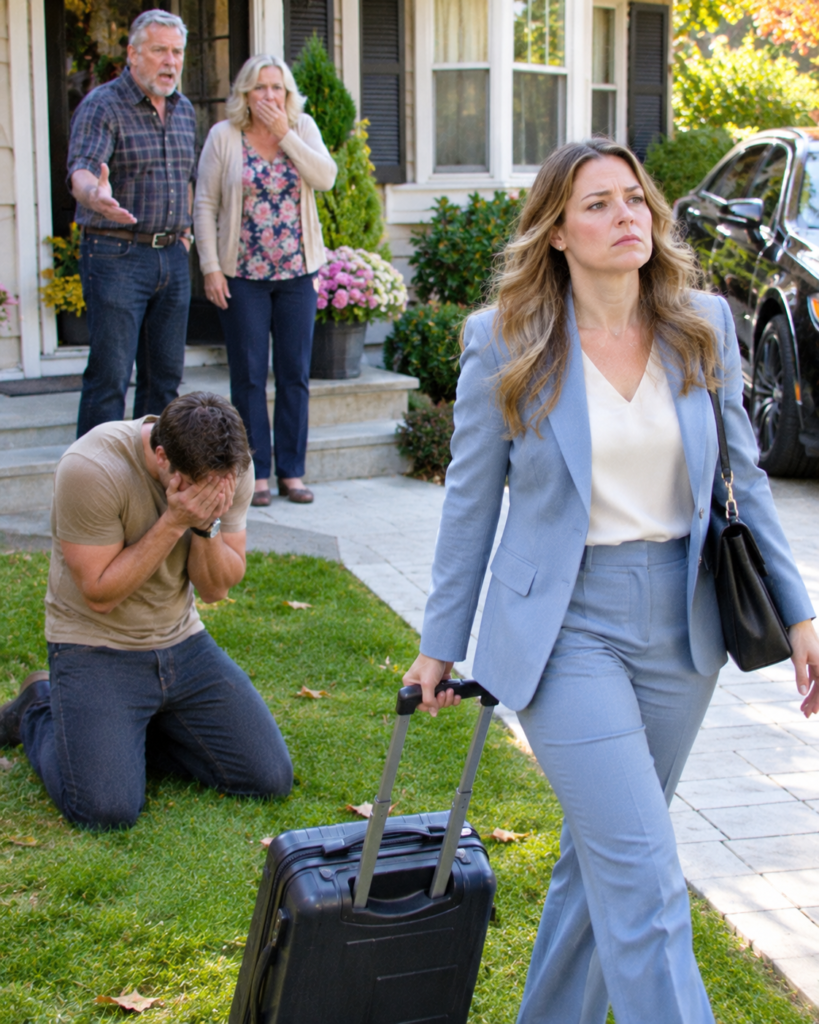
Two days later, I drove to Grandpa’s house and discovered that the deadbolt had already been replaced. Linda stood on the porch beside a cardboard box containing a few clothes, books, old notebooks, and the cedar chest Grandpa had built for me when I was ten.
“The house is part of the estate now. Robert and I are handling everything.”
She smiled before adding something that made my stomach tighten.
“It’s what your grandfather would have wanted.”
Behind the screen door, Dad held a coffee mug with a trembling hand and refused to meet my eyes. Across the street, Mrs. Bowden silently watched the entire exchange while watering her hydrangeas.
I loaded the box into my car and drove back to my tiny apartment in Harrisonburg. Linda believed she had locked me out of Grandpa’s life with one new deadbolt.
What she did not know was that six months before he died, Grandpa had called me into his workshop and told me a secret.
He had created an irrevocable trust fifteen years earlier. It contained nearly twenty million dollars. And I was the sole beneficiary.
“That’s my whole life, Tessa. I’m giving it to the only person who earned it.”
When I tried to object, he raised one trembling hand.
“Margaret Caldwell will contact you after I’m gone. Until then, tell no one.”
Then his eyes moved toward the cedar chest.
“You’ll understand the rest when it’s time.”
Now that same cedar chest sat beside me in my apartment.
And while my family rushed to claim an estate they believed belonged to them, I realized Grandpa had left me far more than money.
Part 2: The Numbers Grandpa Left Behind
Three days after the funeral, Linda filed a petition with the Augusta County Circuit Court claiming Grandpa had effectively died without a valid will. She swore that, to her knowledge, no trust or supplemental estate documents existed, and my father signed the same filing beneath her name.
Derek was already moving on the real estate. Court records later showed that months before Grandpa died, two parcels of land worth more than $400,000 had been transferred from Harold Palmer into Linda’s name.
Mrs. Bowden called me after seeing Linda at the courthouse.
“Honey, your mother filed some papers today. I thought you should know.”
Every professional instinct I had told me to challenge the filing immediately. Instead, I remembered Grandpa’s instructions and forced myself to wait for Margaret Caldwell.
While I waited, I started reviewing three years of Grandpa’s financial records. One year earlier, I had questioned two suspicious charges labeled Medicare supplemental processing fees, but Linda had produced convincing invoices and explanations, so I had reluctantly accepted them.
This time, I searched every transaction containing the word processing. Seventeen payments appeared over eighteen months, deliberately varied in size, and together they totaled $167,000.
No legitimate Medicare supplement worked that way.
Then I checked the authorization forms. Every one contained Robert’s signature, but something about them bothered me immediately.
My father’s hands had trembled badly for years. Yet each signature approving those payments was smooth, steady, and controlled.
On the sixth day after Grandpa’s death, the 540 number finally called.
“Tessa, I’m sorry for the delay. Your grandfather instructed me to wait seven days after his death before contacting you.”
It was Margaret Caldwell.
“Is this about the trust?”
“The trust is only the beginning.”
She told me to meet her in Richmond the following morning and asked me to bring the cedar chest. When I mentioned Linda’s probate petition, Margaret paused long enough to make it clear she already knew.
Her office occupied the second floor of an old townhouse filled with bookshelves and leather chairs. After I sat down, Margaret placed a forty-seven-page forensic accounting report in front of me.
“Two years before Harold died, he asked me to hire an investigator.”
The report traced $342,000 from Grandpa’s accounts into three destinations controlled by Linda and Robert. Fake vendors, falsified invoices, fictional medical fees, and payments disguised as estate-planning or nursing expenses had been used to move the money quietly.
One account belonged to Palmer Family Holdings LLC, with Linda listed as its sole member. Several suspicious payments even went to a post-office box linked to Derek’s real-estate office.
Margaret explained that Grandpa had discovered the scheme but his Parkinson’s had progressed too far for him to fight effectively in court. Instead, he had spent his remaining time preserving evidence.
Then she handed me a second folder. Inside was a DNA report. Robert Alan Palmer was not Harold Palmer’s biological son. Probability of paternity: 0.01%.
I stared at the page while Margaret explained that Grandpa had always known. My grandmother Gloria had been pregnant when she married him, and Harold had chosen to raise Robert as his own.
The darker part came next.
Robert had learned the truth when he was eighteen, and Linda had discovered it years later. She used the secret to pressure him whenever he resisted signing financial documents.
Margaret leaned forward.
“She convinced your father that exposing the truth would destroy his place in the family.”
Then she asked about the cedar chest.
“Check the bottom panel.”
Back at my apartment, I removed the childhood papers and photograph stored inside and ran my fingers across the cedar base. Eventually, I found a narrow seam running against the grain.
The panel shifted when I pressed it. Beneath the false bottom was a sealed envelope and a small brass key. The note inside contained only four lines.
“Bank of Clark County. Stunton Branch. Box 1147. Use the key.”
Grandpa had spent his life teaching me that numbers did not lie. Now he had left me a key to whatever truth he had been saving for last.
Part 3: The Box That Held the Truth
Linda moved quickly while I was still trying to understand what Grandpa had hidden. She asked the court to freeze the known estate assets, including his house and the two parcels already transferred into her name, while Derek filed an affidavit claiming those transfers reflected Grandpa’s wishes.
A certified summons soon arrived at my apartment giving me thirty days to challenge the estate. Margaret introduced me to Diana Walsh, an estate-litigation attorney who studied the forensic report for less than half an hour before looking up.
“This isn’t a family disagreement. This is financial exploitation of a vulnerable adult.”
Then she noticed the brass key.
“And what does that open?”
“I don’t know yet.”
“Then we find out.”
We subpoenaed bank records and spent days tracing Grandpa’s money. The deeper I looked, the clearer the pattern became.
Linda had repeatedly moved amounts just under $10,000 between accounts before routing them through fake vendors and Palmer Family Holdings LLC. Grandpa’s personal accounts had lost $342,000, another $78,000 had moved through the company, bringing the total suspicious transfers to roughly $420,000.
Every forged authorization carried Grandpa’s name.
When Diana asked whether I could trace the money to its final destination, I already had the answer.
“Every dollar.”
The next morning, I carried the brass key into the Bank of Clark County and was escorted into the vault. Box 1147 opened perfectly.
Inside was a thick envelope resting over a deliberate scattering of sawdust.
The envelope contained the original irrevocable trust, a certified copy of the DNA report, and four handwritten pages from Grandpa. His letter explained that he had always known Robert was not biologically his son and had raised him anyway because fatherhood, to him, was a choice rather than a blood test.
Then he wrote about Linda.
“She’s been taking from me for years.”
Grandpa admitted that he had delayed confronting her because he feared forcing Robert to choose between his wife and his father. By the time he understood how far the scheme had gone, Parkinson’s had already weakened his ability to defend himself.
His final instruction was simple.
“Use everything in this box to protect what I built. Not for revenge. For truth.”
That sentence changed the way I looked at the fight ahead.
Diana and I then examined the two land transfers Linda claimed Grandpa had approved shortly before his death. Medical records showed that on the dates those deeds were supposedly signed, Grandpa’s tremors were so severe that his neurologist documented he could no longer perform fine motor tasks independently.
Yet the signatures on both deeds were perfectly smooth.
A forensic handwriting examiner later confirmed they did not match Grandpa’s authentic signatures from the same period. The notary, Kevin Rudd, worked at the same real-estate company as Derek, and financial records showed Derek had received a $42,000 consulting payment from Linda’s company during the same quarter.
Three people were now connected to the scheme.
Linda appeared to have designed it. Derek helped move the property. My father had signed whatever she placed in front of him.
I drove to Grandpa’s old construction office and found Robert alone beneath faded photographs of himself working beside the man who had raised him.
“I know about the transfers, Dad.”
He stared at his beer.
“I signed what she told me to sign.”
“Did you know what she was doing?”
A long silence followed.
“I didn’t know how much.”
The wording told me everything. He had not said he knew nothing.
Before leaving, I looked at those old photographs and finally understood what Linda had taken from Grandpa. It was not only money.
She was erasing his decisions, his work, and his legacy.
Back at Diana’s office, she mapped the evidence across a whiteboard and explained our strategy. We would validate the trust, challenge the forged property transfers, trace the missing money, and send any criminal evidence to prosecutors.
Then she looked directly at me.
“When this reaches court, everything comes out. The money, the forged documents, and your father’s secret.”
Grandpa’s pocket watch ticked inside my jacket.
“I know.”
“Are you sure?”
I thought of his letter.
Truth, not revenge.
“I’m sure.”
Part 4: The Audit With a Gavel
Two weeks before the hearing, Diana and I reviewed every piece of evidence again. The binder now contained Grandpa’s original trust, bank records tracing $420,000, eleven forged authorization forms, the handwriting analysis, suspicious property deeds, the notary’s statement, DNA results, and Grandpa’s authenticated letter.
Diana closed the binder.
“This isn’t a family argument anymore. It’s an audit with a gavel.”
Linda had hired Philip Brock, an aggressive estate attorney who argued that I had manipulated Grandpa during his final years. His filing claimed the trust reflected undue influence from the granddaughter who had been his primary caregiver.
The problem with that theory was simple.
Grandpa had created the trust fifteen years earlier, while he was still fully competent and running his business. Independent witnesses had signed it, and medical records confirmed his capacity during every later update.
Linda still tried to control the story outside court. She told relatives and neighbors that I was stealing Grandpa’s estate from my own parents.
Mrs. Bowden called me after hearing the rumors.
“I watched you drive to Harold’s house every day for three years. I barely saw Linda there.”
Then she mentioned something even more useful.
“I saw her arrive twice carrying file boxes. She left without them. And I saw Derek measuring the property line months before Harold died.”
Mrs. Bowden volunteered to testify.
Derek called next.
“You really want to do this, Tessa? Think about Uncle Robert. Think about what comes out.”
He thought the secret about my father’s paternity could scare me into backing down. He had no idea I already knew the truth.
The night before the pretrial conference, Robert called me himself.
“If this goes to court, everything comes out.”
“I know.”
After a long silence, he asked the question he had probably feared his entire life.
“Grandpa knew, didn’t he?”
“Yes.”
My father’s breathing changed.
“He knew about me?”
“He knew from the beginning. And he chose you anyway.”
Robert said nothing for several seconds.
“I don’t deserve that.”
“Maybe not. But he gave it to you anyway.”
The evidentiary hearing began in October.
Margaret testified first and explained how Grandpa had established the irrevocable trust fifteen years earlier. She confirmed that I was the sole beneficiary and that he had been legally competent when he created it.
Then Ray Mitchell presented the forensic accounting.
He walked the judge through twenty-eight months of transactions showing $342,000 transferred from Grandpa’s accounts and another $78,000 routed through Palmer Family Holdings. Fake vendors, invented medical charges, false invoices, and payments linked to Linda appeared one after another on the screen.
Next came the property deeds.
The handwriting expert explained that Grandpa’s supposed signatures lacked the severe tremor documented in authentic samples from the same period. Kevin Rudd, the notary, admitted that Grandpa had never been present when the deeds were notarized.
Derek’s face lost its color.
Then Diana submitted the DNA report.
The courtroom went silent when she read the conclusion.
“Robert Alan Palmer is not the biological child of Harold James Palmer.”
My father seemed to collapse inward.
“He knew,” Robert whispered. “He always knew. And he still kept me.”
Linda immediately grabbed his arm.
“Don’t say another word.”
Her lawyer argued that the DNA did not change Robert’s legal status as Grandpa’s son.
Diana agreed.
“We’re not claiming it does.”
Then she turned toward the judge.
“We are showing that Harold Palmer understood better than anyone that blood did not define family. He chose Robert as his son, and years later, while fully competent, he chose Tessa to protect his legacy.”
Linda suddenly stood.
“That girl turned him against us! She sat in his house while he was sick and poisoned him against his own family!”
The judge ordered her to sit down. I finally spoke.
“He didn’t feel sorry for me.”
Linda stopped.
I looked directly at her.
“He felt sorry for you.”
For the first time since Grandpa died, she had nothing to say.
Then Judge Hensley looked down at the evidence and began delivering the ruling that would dismantle everything Linda had tried to build.
Part 5: What I Really Inherited
Judge Hensley ruled from the bench. The irrevocable trust was valid, the property transfers were void because of forged signatures and fraudulent notarization, and every misappropriated dollar had to be repaid.
Then she referred the evidence to the Augusta County Commonwealth Attorney’s Office for criminal investigation.
Linda sat motionless while the ruling was read. Derek had already slipped out of the courtroom during the DNA testimony.
I left carrying Grandpa’s cedar chest beneath my arm.
“Tessa.”
I turned and found Robert standing behind me in the courthouse hallway. His tie was loose, his eyes were red, and for the first time in years, he looked less like my father and more like a frightened man who had finally run out of places to hide.
“I signed everything she gave me.”
His voice cracked.
“I didn’t ask what the papers were. I just signed.”
“Why?”
Robert looked down.
“Because Linda said if I refused, she would tell everyone the truth about me.”
I held his gaze.
“Grandpa knew, Dad. He always knew.”
Robert’s face tightened.
“And he still called you his son.”
That broke him.
My father cried beneath fluorescent courthouse lights while I stood there holding the cedar chest Grandpa had made with his own hands. I did not hug Robert, and I did not forgive him, but I stayed until he stopped crying.
The criminal cases moved quickly after that.
Linda eventually accepted a plea that required full restitution of the $420,000 and left her with a felony record. Derek surrendered his real-estate license after resolving the charges connected to the forged documents, while Kevin Rudd lost his notary commission.
Robert cooperated with investigators and was not charged. He divorced Linda, moved into a small apartment, and began working maintenance jobs far from the life he had once pretended to control.
Grandpa’s house and both parcels of land returned to the trust.
I did not move into the house.
Instead, I stayed in my six-hundred-square-foot apartment above the dry cleaner because it was mine before the trust, before the courtroom, and before twenty million dollars changed the way everyone looked at me.
Six months after the hearing, I used part of the trust to create the Harold Palmer Community Foundation. We offered scholarships to trade-school students studying carpentry, electrical work, plumbing, and the kinds of practical skills Grandpa had respected his entire life.
The foundation operated from his old Route 250 workshop.
I renovated almost everything, but I left one wall untouched. The wood paneling remained scratched and stained, with decades of sawdust still buried in the grain.
Mrs. Bowden came to the opening carrying a peach pie.
“Your grandfather would be proud.”
I smiled.
“He’d probably say I spent too much.”
Grandpa’s silver pocket watch now sits on my desk beside the cedar chest. Every time I hear it ticking, I remember the sentence he left for me.
“Blood doesn’t make you family. What you do when nobody’s watching does.”
For a long time, everyone thought my inheritance was twenty million dollars.
They were wrong.
Grandpa had spent his life building houses, businesses, and financial security. But the most valuable thing he left me was a standard for deciding who deserved a place in my life.
Linda lost everything because she believed family entitled her to take. Robert nearly lost everything because fear made him surrender his judgment. And Grandpa protected what remained because he understood one simple truth.
Family is not proven by blood. It is proven by what you protect when no one is watching.