My eight-year-old son was gasping on my parents’ living-room floor when I realized every adult in that house had already decided whose future mattered.
It was not his.
His twelve-year-old cousin had beaten him badly enough to fracture a rib, but my mother’s first instinct was not to help him breathe.
It was to stop me from calling 911.
“Boys fight,” she said as she tore the phone from my hand. “Don’t ruin your nephew’s future.”
My father barely looked away from the television.
“You’re overreacting.”
My sister stood in the doorway with her arms crossed, watching her own nephew struggle for air while her son hid down the hall.
She smirked as though the whole thing had already been settled.
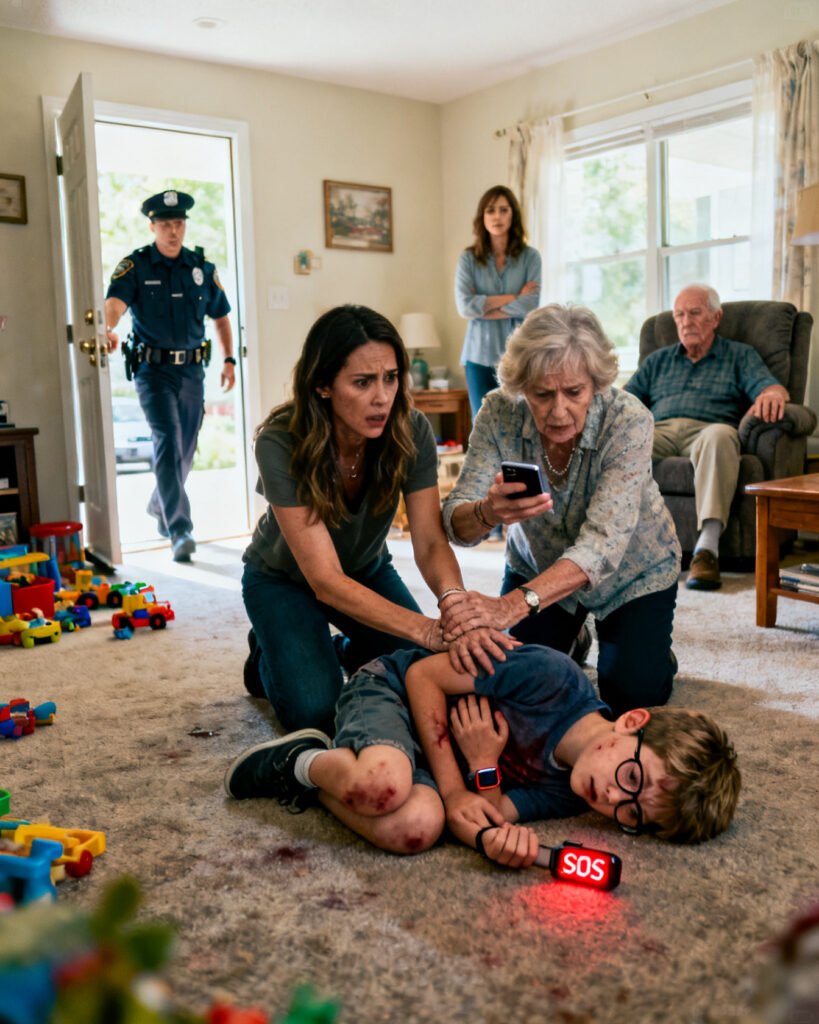
Then I saw the red SOS light blinking beneath my son’s hoodie sleeve.
His smartwatch had been listening for eleven minutes.
By the time my family understood what that meant, emergency dispatch had their words, our location, and the truth they were still trying to bury.
I had driven to my parents’ house expecting an ordinary family visit.
Nothing about the front of the house warned me.
The driveway looked the way it always did, the porch was quiet, and the living-room television was loud enough to hear before I reached the door.
Inside, the smell hit me first.
Burnt coffee had gone bitter in the pot, and the lemon cleaner my mother used before company came over sat sharp in the air.
A game show audience clapped from the television.
The sound was bright, canned, and completely wrong for the room.
My son lay on the beige carpet near the coffee table.
His glasses were crooked, one sneaker had come loose, and his body was curled slightly around his left side.
For half a second, I could not make the scene fit together.
My parents were in their usual places.
Dad sat in his recliner with the remote balanced on his stomach.
Mom stood near the couch.
My sister leaned against the doorway leading toward the hall.
Only my son was where he should never have been.
Then he tried to breathe.
The inhale stopped halfway and came out as a thin, broken sound.
I was beside him before I remember crossing the room.
His face had gone pale around his mouth.
One hand pressed hard against his ribs, and his fingers trembled against the fabric of his hoodie.
“It hurts,” he whispered.
Those two words stripped everything else away.
I did not ask who had started it.
I did not ask why nobody had called me sooner.
I did not ask where my nephew had gone.
I reached for my phone and started dialing 911.
My mother moved faster than I expected.
She caught my wrist, twisted the phone from my hand, and put it behind her back.
The gesture was so familiar in its authority that for one stunned second I felt eight years old myself.
She looked at me with the same expression she used when someone tracked mud across her clean floor.
“Boys fight,” she said.
My son made another shallow sound behind me.
“Give me the phone.”
“Don’t ruin your nephew’s future.”
The sentence did not make sense until I understood that she meant every word.
My son’s pain was not the crisis in her mind.
The possibility that her older grandson might face consequences was the crisis.
I looked toward Dad because some part of me still expected him to see what was happening and break the spell.
He glanced at my son, frowned, and pressed the volume button once.
The game show dropped by a single click.
“You’re overreacting,” he said.
Then he settled back.
My sister’s son had disappeared down the hall after the beating.
She had not followed him to demand an explanation.
She had not knelt beside my boy.
She had not asked whether he could breathe.
She watched me instead.
“He started it,” she said.
A small smile pulled at one side of her mouth.
My son tried to shake his head.
The movement hurt him so badly that he stopped almost immediately, squeezing his eyes shut as he held his ribs.
That should have ended every argument.
It should have sent every adult in the room toward the phone, the door, or the child on the floor.
Instead, the room seemed to divide itself around him.
Mom guarded my phone.
Dad guarded his comfort.
My sister guarded the story she wanted everyone to repeat.
The game show audience applauded again.
Ice shifted in Dad’s glass.
The ceiling vent clicked on and blew cold air across the carpet.
My mother tightened her fingers around my phone while my sister looked down at a chipped spot in her nail polish.
Nobody moved to help my son.
Anger surged through me so quickly that my hands began to shake.
I wanted to grab my phone back.
I wanted to shove past my sister and drag her son out of the hallway.
I wanted every adult in that room to look directly at the child they had decided was acceptable collateral.
Then my son made another sharp, breathless sound.
The anger did not disappear.
It changed direction.
I chose him.
I lowered myself beside him and slid one arm carefully behind his shoulders without trying to lift him.
“Look at me, buddy,” I said. “Small breaths. I’m right here.”
His eyes found mine through the crooked lenses.
He was trying so hard not to cry that it made the fear on his face worse.
My mother stepped closer.
“Stop making this dramatic.”
I kept my attention on my son.
I told him not to move.
I told him he had done nothing wrong by saying he was hurt.
I told him I was not leaving him.
Then a faint red flash appeared near his wrist.
At first I thought it was a reflection from the television.
It blinked again beneath the cuff of his hoodie.
I pulled the sleeve back just enough to see the face of his smartwatch.
The glass was scratched from the fall.
A red SOS icon glowed near the top of the screen.
Below it, a timer was still climbing.
11:07.
11:08.
11:09.
I knew exactly what the feature did because I had set it up myself.
When my son began walking home from the bus stop with a friend, I had shown him how to hold the side button if he was ever scared, lost, or unable to reach his phone.
The watch would contact emergency services.
It would send his location.
It would open the microphone.
I had explained it more than once because eight-year-olds forget instructions until the moment they desperately need them.
He had remembered.
He had activated the SOS before I reached the house.
That meant the call had not started with my mother taking my phone.
It had started during the beating.
Emergency dispatch had heard my nephew yelling.
They had heard my son cry out.
They had heard the room after he fell.
They had heard my mother telling people to keep quiet.
They had heard my father dismiss the injury.
They had heard my sister trying to decide what everyone should say when I arrived.
The watch had carried eleven minutes of that house beyond the walls my family controlled.
I looked down at my son.
He gave me the smallest nod.
It was not triumphant.
It was not clever.
It was the exhausted nod of a frightened child who had done the only thing he could think to do and was waiting to see whether help would actually come.
I stopped asking for my phone.
That was the first thing my mother misunderstood.
She took my silence as surrender.
Her shoulders loosened.
She handed my phone to Dad and told him to put it somewhere I could not reach.
My sister noticed the change and smiled wider.
“See?” she said. “He knows this doesn’t need police.”
I did not correct her.
I kept one hand near my son’s shoulder and watched the red timer continue to move.
My mother started talking about how children exaggerated.
My sister said her son had only defended himself.
Dad said everyone needed to calm down.
The words overlapped, each one designed to make the room feel ordinary again.
But the watch was still connected.
Every new excuse was traveling to the same place as the first eleven minutes.
Then tires crunched in the driveway.
The sound was low, almost easy to miss beneath the television.
Dad heard it.
He muted the game show.
The sudden absence of canned applause exposed the room.
My sister straightened away from the doorway.
My mother turned toward the front window, then back toward me.
“Who did you call?”
I did not answer.
Blue light moved across the living-room wall.
It was not loud or theatrical.
It passed over the framed family photographs in steady flashes, briefly cooling every smiling face behind glass.
One car door shut.
Then another.
Footsteps crossed the porch.
My mother dropped my phone onto the end table as if she had never touched it.
“Nobody says anything until we agree on what happened,” she whispered.
That sentence told me she still believed control was possible.
The knock hit the door hard enough to rattle the glass.
“Emergency services,” a man called. “Open the door.”
My sister moved first.
She stepped fully in front of the hallway leading to her son’s room.
Dad finally rose from the recliner.
The remote slid onto the cushion behind him.
Mom smoothed the front of her shirt and arranged her face into concern.
It was a convincing expression.
It was also the first worried-grandmother expression she had shown since I entered the house.
I opened the door.
The first officer looked past me before I could explain anything.
He saw my son on the carpet, pale and guarding his left side.
His focus changed immediately.
He called for the paramedics waiting outside and moved into the room without wasting time on the adults trying to speak over one another.
His partner entered behind him and took in the hallway, my sister’s position, and my father standing near the recliner.
The first officer crouched several feet from my son.
He did not touch him.
He introduced himself in a calm voice and asked whether he could breathe.
My son tried to answer and winced.
The officer looked toward the open door.
“Bring them in now,” he called.
Two paramedics crossed the threshold carrying their equipment.
My mother began talking before either of them reached the carpet.
“This is a misunderstanding,” she said. “The boys were roughhousing.”
My sister added that her son had been provoked.
Dad said the whole family was upset.
The officer did not argue with them.
He watched the paramedics position themselves beside my son.
One supported his head while the other asked where the pain was strongest.
My boy pointed to his left side.
When the paramedic checked the area carefully, my son flinched so hard that his loose sneaker shifted against the carpet.
“What happened?” the paramedic asked.
“My cousin kicked me,” he whispered.
My sister spoke at once.
“He’s confused. They were both fighting.”
The second officer turned toward her.
Before she could respond, the first officer’s radio crackled.
The sound cut through the room more effectively than a shout.
Dispatch confirmed an active SOS call from a registered smartwatch.
They confirmed the GPS location matched the house.
They confirmed the microphone connection had remained open.
Then came the detail my family had not prepared for.
An eleven-minute audio file had already been attached to the call record.
My mother blinked at the radio.
Dad looked toward the watch on my son’s wrist.
My sister’s arms dropped from their crossed position.
For the first time since I entered, none of them had a sentence ready.
The watch was no longer a gadget on a child’s arm.
It was a timeline.
It held the beating, the crying, the delay, the arguments, the order to stay quiet, and the attempt to block a 911 call.
It did not need to decide who sounded believable.
It had preserved what happened before anyone knew they were being heard.
My mother recovered first.
“This is a misunderstanding,” she said again, faster now. “Boys fight, and my son is upset—”
The officer looked up at her.
His expression remained controlled.
“Ma’am,” he said, “dispatch heard you say, ‘Boys fight. Don’t ruin your nephew’s future.’”
The words landed differently in his voice.
In my mother’s mouth, they had been an order.
In his, they were part of a record she could no longer erase.
My sister’s smirk disappeared.
Mom tried to explain that she had only wanted everyone to calm down.
The officer raised one hand.
He said dispatch had not heard a brief disagreement after harmless roughhousing.
They had heard a child in distress.
They had heard adults discussing what explanation to use.
They had heard someone physically interfere with an emergency call.
My father looked at the muted television as though the answer might be hidden in the blank movement of the contestants’ mouths.
My sister stepped backward from the hallway.
The paramedic beside my son asked him another question.
“Did anyone else hit or kick you?”
My son swallowed.
“My cousin kicked me,” he said again. “Then Grandma said not to tell.”
My mother protested immediately.
“I never said that.”
The officer touched the radio at his shoulder.
“You may want to stop making statements that the recording can confirm or contradict.”
That was not a dramatic speech.
He said it in the same level tone he had used from the doorway.
The calmness made it harder for anyone to pretend this was another family argument.
The second officer looked toward the closed bedroom door.
“Is the twelve-year-old in that room?” she asked.
Nobody answered.
My sister moved into the hallway again.
“He’s a child,” she said.
“So is the child on the floor,” I replied.
It was the only sentence I had given her since the officers arrived.
The paramedics began preparing to move my son without twisting his torso.
One of them quietly told me that his symptoms and pain pattern required immediate evaluation for a possible rib fracture and breathing complications.
I nodded and stayed where my son could see me.
My mother started saying we could drive him ourselves.
Dad said an ambulance was unnecessary.
My sister said involving police would traumatize both boys.
Their concern still moved in only one direction.
They kept talking about the cost to the child who had done the hurting.
Nobody asked what the last eleven minutes had cost mine.
The officer’s partner told my sister to step away from the hallway.
She did not move at first.
Her face tightened, and she glanced toward the bedroom door.
The first officer noticed.
He looked from her to my mother, then to the watch still blinking red on my son’s wrist.
“Before we arrived,” he said, “someone on that recording told the other child to stay out of sight.”
The room changed again.
My mother looked at my sister.
My sister looked toward Dad.
Dad stared at the floor.
The officer asked the question slowly.
“Who told him to hide?”
My son’s hand trembled against his chest.
Then he lifted one finger and pointed past me toward the hallway.