PART 1 – The People in the Fog
A new neighbor reported my 79-year-old father’s vegetable garden to the county and called it an eyesore.
The inspector gave Dad thirty days to remove it.
Dad didn’t argue.
He shook the inspector’s hand and asked him for one favor.
“Come back Saturday morning at six.”
The notice arrived on a Tuesday.
Dad sat at the kitchen table reading it with his glasses halfway down his nose.
“Unmaintained agricultural use within a residential zone.”
That was how the county described his garden.
It covered about half an acre.
Nine rows of green beans.
Nearly three hundred tomato plants.
Potatoes.
Squash.
Onions.
Beets.
More vegetables than one old man could possibly eat.
Dad lived alone.
And he ate about as much as a sparrow.
Years earlier, I had asked him why he planted so many beans.
“Who are all those for?”
Dad shrugged.
“People.”
That was the whole explanation.
The complaint had come from our new neighbor, Brent.
He built a large gray house on the old Swenson property the previous spring.
His back deck overlooked Dad’s fence.
Most mornings, I could see him standing there with a coffee cup, staring down at the rows of corn and vegetables.
He never seemed pleased.
The county inspector arrived Thursday.
He was young.
Polite.
Carried a clipboard.
“Mr. Lindqvist, I’m sorry,” he said. “Once somebody files a complaint, we’re required to investigate.”
Dad nodded.
“How long?”
“Thirty days.”
I was ready for a fight.
I already had the name of an attorney written on the back of an envelope in my purse.
And I was about ten seconds away from walking across the property line to tell Brent exactly what I thought of his complaint.
Dad did neither.
He simply held out his hand to the inspector.
The young man shook it.
“Could you do me one favor before you make anything final?” Dad asked.
“If I’m allowed to.”
“Come back Saturday.”
The inspector waited.
“Six in the morning.”
He looked at me.
I shrugged.
I had no idea what Dad was planning either.
Every Friday since Mom died, Dad’s pickup had been gone before daylight.
I always assumed he couldn’t sleep and went driving.
I never asked.
Saturday morning arrived cold and foggy.
At five minutes before six, the county inspector parked along the road.
Brent was already standing on his new deck wearing a robe with a mug in his hand.
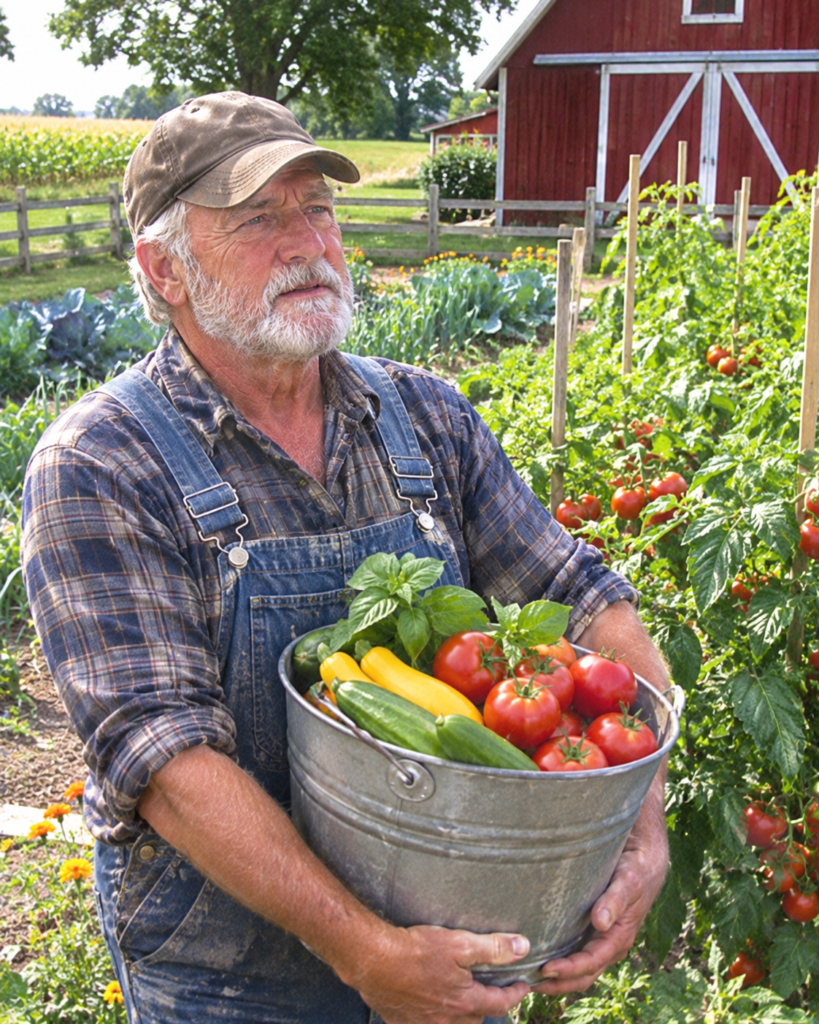
Dad was in the garden carrying his old bucket.
Just another morning to him.
Then, exactly at six, headlights appeared through the fog.
One pickup came down the road.
Then another.
Then a car.
Then four more vehicles behind them.
They parked one after another along the ditch.
Doors opened.
Men and women climbed out carrying empty cardboard boxes, grocery bags, and plastic buckets.
Nobody needed directions.
Nobody asked where to go.
They simply walked toward Dad’s garden.
The inspector lowered his clipboard.
He stopped writing.
Another truck arrived.
Then another.
Some people headed toward the beans.
Others toward the tomatoes.
Dad nodded to each person as they passed.
Like he had been expecting every one of them.
Then the final vehicle came through the fog.
A silver minivan.
It parked at the end of the line.
The side door slid open.
Three children climbed out first.
The youngest was a girl of perhaps six, wearing yellow rubber boots and a red coat two sizes too large. Behind them came a woman with dark hair pulled into a hurried knot. She carried two laundry baskets and looked exhausted in the way some people do when sleep is not enough to repair whatever life has been doing to them.
The little girl saw Dad.
“Mr. Gus!”
Dad’s face changed.
I had watched my father smile thousands of times in my life, but usually his smiles were small things—brief movements at the corners of his mouth, as though joy embarrassed him.
This one was different.
He set down his bucket.
The child ran between the rows, scattering drops of dew from the bean leaves.
Dad crouched as far as his knees allowed and caught her against his chest.
“You’re late, Sophie.”
She leaned back indignantly.
“Mom said it was foggy.”
“I noticed.”
The woman approached, slightly breathless.
“Morning, Gus.”
“Morning, Elena.”
Then she noticed me.
Her expression shifted.
Dad stood.
“This is my daughter, Laura.”
Elena looked surprised.
“You’re Laura?”
I smiled uncertainly.
“That depends what he’s told you.”
For the first time, Dad looked almost uncomfortable.
Elena laughed.
“Only good things.”
That was suspicious in itself.
Dad rarely told anybody anything.
The inspector, whose name I had finally remembered was Aaron Pike, stood near the garden gate watching people disperse among the rows.
There were perhaps thirty of them now.
An elderly man in suspenders.
Two young women speaking Spanish to each other as they picked tomatoes.
A middle-aged man wearing paint-stained work pants.
A grandmother with a cane directing two teenage boys toward the squash.
None looked like they were attending a demonstration.
No signs.
No angry speeches.
No television cameras.
They were simply harvesting food.
Aaron looked at Dad.
“Mr. Lindqvist, what exactly is happening here?”
Dad lifted his bucket.
“Saturday.”
Aaron waited.
Dad apparently believed that was sufficient.
I stepped closer to Elena.
“Do you come here every week?”
She looked at me as though I had asked whether the sun rose in the east.
“During the season.”
“For how long?”
“Four years.”
Four years.
Mom had died five years earlier.
The pickup disappearing before daylight every Friday suddenly felt less accidental.
I looked toward Dad.
He was showing Sophie how to twist a tomato from its vine without tearing the stem.
“What do you do with everything?” I asked.
Elena’s gaze moved over the garden.
“Some goes home with us. Some goes to the church pantry. Some goes to the senior apartments. Gus takes boxes to the motel on Highway Nine.”
“The motel?”
“The families staying there.”
I knew the place.
The Wayside Motor Lodge had once been for travelers heading north. Now half its rooms were rented weekly by families who had nowhere else to go.
I felt an uncomfortable pinch beneath my ribs.
“How did this start?”
Elena hesitated.
“You really don’t know?”
“No.”
Her expression softened.
“That sounds like Gus.”
Across the fence, Brent had left his deck.
He came down the steps and walked toward the property line wearing jeans now, his robe gone.
He stopped near the cedar posts.
“What’s all this?”
Dad didn’t look up.
“Morning, Brent.”
“I asked what’s going on.”
“People are picking vegetables.”
“I can see that.”
Dad nodded.
“Then we’re making progress.”
Under other circumstances I might have laughed.
Brent didn’t.
He looked at the parked vehicles lining the road.
“This is exactly the problem. Traffic. People coming and going. This is a residential neighborhood.”
One of the teenage boys looked over.
Dad gave him the slightest shake of his head.
The boy returned to the squash.
Aaron approached the fence.
“Mr. Hollis?”
Brent straightened.
“Yes.”
“I’m Aaron Pike. County land use.”
“I know. I filed the complaint.”
Aaron glanced at the garden.
“I’m aware.”
Brent gestured toward the people.
“You see what I mean now.”
Aaron did not answer immediately.
He watched Sophie carefully lower three tomatoes into a cardboard box.
“What I see,” he said, “is relevant to my inspection.”
Brent frowned.
“Relevant how?”
“I’ll need to review the ordinance.”
“It says agricultural use isn’t allowed.”
“It says unmaintained agricultural use may constitute a nuisance under certain conditions.”
Brent stared.
“That isn’t what I was told.”
Aaron’s voice remained polite.
“It’s what the ordinance says.”
Dad continued picking beans.
I began to understand why he had asked Aaron to come.
Not to embarrass Brent.
Not to prove he was charitable.
Dad wanted the inspector to see that the garden had a purpose.
But even then I did not understand all of it.
Around seven, the fog began to lift.
The garden changed beneath the rising light.
What had looked like tangled rows from the road became something orderly up close. Stakes had been repaired. Paths were mulched. Water barrels stood beneath gutters running from the shed. Every section had small wooden markers.
NORTH PANTRY.
MOTEL.
ELM STREET SENIORS.
SCHOOL.
I stopped beside the last one.
SCHOOL?
Dad came up behind me.
“You’ve been busy.”
I turned.
“You send vegetables to a school?”
He bent stiffly and pulled a weed.
“Summer lunch program.”
“How long?”
“Couple years.”
“And you never thought to mention any of this?”
He considered the weed in his hand.
“You never asked.”
I stared at him.
“That is the most Dad answer you could possibly give.”
His mouth twitched.
For a moment, irritation gave way to something warmer.
Then I saw the marker at the end of the next row.
It was older than the others.
Weathered gray.
The letters had almost faded away.
MARA.
I touched it.
“Who’s Mara?”
Dad’s expression closed.
Not dramatically.
Just enough.
“I need to check the potatoes.”
He walked away.
I watched him go.
Elena was filling her second basket nearby.
“Who is Mara?” I asked.
Her hands stopped.
That tiny hesitation told me more than any answer could.
“You should ask your father.”
“I just did.”
Elena resumed picking tomatoes.
“Then ask him again.”
Before I could, Aaron called Dad toward the gate.
“I spoke to my supervisor.”
Dad wiped his hands on his trousers.
“And?”
“The citation is still open. I can’t dismiss it today.”
Brent folded his arms.
Dad nodded.
“Fair enough.”
Aaron continued.
“But I’m suspending the removal deadline while we determine whether this qualifies for an exemption as a charitable community food plot.”
Brent’s head snapped around.
“A what?”
Aaron looked at him.
“The county adopted provisions for community food production three years ago.”
“This isn’t a community garden.”
“That’s what I’m determining.”
“They don’t own it.”
“Ownership isn’t necessarily the deciding factor.”
Brent opened his mouth, then closed it.
Dad merely said, “Thank you for coming.”
Aaron looked around the garden.
“No. Thank you for asking.”
By eight, most of the vegetables had been loaded into cars.
People shook Dad’s hand.
Some hugged him.
The teenagers waved.
Sophie presented him with a crooked cucumber she had apparently decided was unsuitable for anyone else.
“For you.”
Dad accepted it solemnly.
“My favorite kind.”
“There are kinds?”
“This kind.”
She grinned.
Elena loaded the last basket into the minivan.
Before leaving, she approached me.
“He helped us when my husband got sick,” she said quietly.
I looked toward Dad.
“He never told me.”
“He wouldn’t.”
“What happened?”
“Cancer. Daniel couldn’t work for almost a year. I had three children and eighteen dollars left after rent one week.”
She swallowed.
“Your father came to our apartment with groceries.”
“That sounds like him.”
“No,” she said. “Not groceries from a store. Vegetables. Eggs. Bread. He had made soup.”
I blinked.
“My father?”
Elena smiled.
“Terrible soup.”
“That sounds more like him.”
Her laugh broke the heaviness.
Then she touched my arm.
“He told me someone once did the same for your family.”
I looked at her.
“What?”
“When you were little.”
“No one did.”
Elena seemed puzzled.
“He said a woman brought food every week when your mother was ill.”
My skin went cold despite the sun.
“My mother wasn’t ill when I was little.”
Elena’s face changed.
“I’m sorry. Maybe I misunderstood.”
Dad was by the shed, stacking empty buckets.
I walked toward him.
“Dad.”
He kept working.
“Dad, who was Mara?”
His shoulders became still.
“And who brought us food when Mom was sick?”
He turned slowly.
For several seconds there was only the sound of car doors closing along the road.
Then he looked past me toward the gray wooden marker.
“Mara brought the food.”
“When?”
“A long time ago.”
“I don’t remember anyone named Mara.”
“You wouldn’t.”
“Why?”
His face seemed older suddenly.
Not seventy-nine.
Older than any number.
“Because you weren’t born yet.”
I stared at him.
Behind us, an engine started.
Elena’s silver minivan pulled away.
Dad picked up his bucket.
I caught his arm.
“Then why did Elena think it was when I was little?”
Dad looked down at my hand.
When he answered, his voice was quiet.
“Because I never told her the whole story.”
He started toward the shed.
I followed.
“Dad.”
He unlocked the door.
Inside were tools, seed bags, coils of hose and shelves lined with jars.
Then he moved aside a wooden crate.
Behind it sat an old metal box.
Blue once.
Mostly rust now.
Dad opened it.
Inside were dozens of envelopes tied with garden twine.
Every one was addressed to him.
Most were more than fifty years old.
On the top envelope, written in faded blue ink, were four words.
For Gustav. Please forgive me.
The handwriting was my mother’s.
But the name signed at the bottom was not hers.
It was Mara.
And suddenly the garden was no longer about vegetables.
PART 2 – The Name Beneath the Soil
Dad did not explain the letters that morning.
That would have been easier.
Instead he carried the metal box into the kitchen, set it on the table and made coffee.
My father had always treated emotional catastrophe as something improved by boiling water.
I sat across from him.
The box rested between us.
“Who was Mara?”
Dad measured coffee grounds.
“Someone we knew.”
“We?”
“Your mother and me.”
“Why did Mom sign Mara’s name?”
He stopped.
Only for a second.
Then he poured the water.
“Because Mara was her name.”
I stared at him.
“My mother’s name was Evelyn.”
“That was the name she used when you knew her.”
I laughed once.
It came out wrong.
“You can’t say something like that and then make coffee.”
“I already started it.”
“Dad.”
He sat.
The kitchen clock ticked above the sink.
Finally he put both hands around his mug.
“Your mother was born Mara Evelyn Novak.”
I searched his face for some hint that he had become confused.
There was none.
“She changed it?”
“Yes.”
“Why?”
Dad looked toward the window.
Outside, morning sunlight touched the garden where only a few hours earlier strangers had moved through the fog.
“She wanted a new life.”
“That sounds like something from a detective novel.”
“It wasn’t.”
“Then what was it?”
“Hard.”
That was all he gave me.
For ten minutes.
I knew better than to fill silence with questions when Dad had decided to retreat. Growing up with him had taught me that pressure made him quieter.
So I opened the first envelope.
The paper inside was brittle.
Dad did not stop me.
Gus,
I saw the house today. It has white siding and a porch too small for the chairs you bought. You looked happy. I hope you are.
I am sorry I cannot be the person I promised.
Mara
There was no date.
The next letter was longer.
Then another.
Some were unopened.
“Why didn’t you read these?”
“Some I did.”
“And the others?”
“I didn’t need to.”
“That makes absolutely no sense.”
“It made sense then.”
He stood and carried his mug to the sink.
“Dad, was Mom married before you?”
“No.”
“Was she running from someone?”
He looked out the window.
“Not someone.”
“What, then?”
“A mistake.”
I waited.
He did not elaborate.
I picked up another envelope.
The postmark read 1969.
By then Dad would have been twenty-two.
Mom—or Mara—twenty.
The letter mentioned a baby.
I read the sentence twice.
I still think of her every day.
My throat tightened.
“Dad.”
He turned.
“What baby?”
His expression answered before his words did.
“Your sister.”
The room seemed to tilt.
“I have a sister?”
“Had.”
A coldness opened in me.
“What happened to her?”
Dad sat again.
“She was adopted.”
The sentence landed softly.
That somehow made it worse.
“Why?”
“We were young.”
“You and Mom?”
He nodded.
“Before you were married?”
“Yes.”
I tried to imagine them young.
Dad without gray hair.
Mom before arthritis bent two fingers on her left hand.
Two people whose lives had existed long before mine.
“She got pregnant?”
“Yes.”
“You gave the baby away?”
Dad’s jaw tightened.
“Your mother did.”
“You didn’t want to?”
“No.”
The word arrived immediately.
Too quickly to misunderstand.
“What happened?”
Dad folded his hands.
“Her parents found out. They sent her away to stay with an aunt. That was what people did sometimes.”
“And you?”
“I wanted to marry her.”
“Did she know?”
“Yes.”
“Then why—”
“Because wanting something and being able to do it aren’t always the same.”
He told me slowly.
Mara’s father had been strict and proud and terrified of gossip. Her mother had cried more than she spoke. Dad, twenty-one and working at a sawmill, had owned one truck and forty-three dollars.
He proposed anyway.
Mara refused.
Not because she didn’t love him.
Because she thought love was not enough.
The baby was born in November.
A girl.
Mara held her for one hour.
Then she signed papers.
Dad never saw the child.
Afterward, Mara disappeared for nearly a year.
She began calling herself Evelyn.
When she returned, she was quieter.
They eventually married.
And they never spoke about the baby.
“Never?” I asked.
“Sometimes silence becomes a room you both agree not to enter.”
I looked down at the letters.
“Then why did she write these to you?”
“She wrote them while she was away.”
“You kept them for fifty years.”
“Yes.”
“And the garden?”
Dad’s gaze moved toward the window.
“That came later.”
He told me that after Mom returned, before they were married, she lived in a rented room above a hardware store.
Money was scarce.
She worked at a dry cleaner.
Dad worked the mill.
Every Friday morning, an older woman named Ruth Bell left a box outside Mara’s door.
Beans.
Tomatoes.
Potatoes.
Sometimes bread.
No questions.
No sermons.
Just food.
Mom never forgot it.
Years later, she found Ruth and tried to repay her.
Ruth refused.
“She told your mother something,” Dad said.
“What?”
“Feed the next person.”
I looked out at the garden.
Suddenly the scale of it made sense.
Not charity.
Inheritance.
A debt passed forward because no one wanted it repaid backward.
“Why didn’t you tell me?”
Dad shrugged.
“Wasn’t mine to tell.”
“Mom is gone.”
“Yes.”
“And you were going to die without telling me I had a sister?”
That hurt him.
I saw it.
But I did not take it back.
“I thought about telling you.”
“When?”
“Many times.”
“And?”
“I was afraid you’d ask the next question.”
“What next question?”
He looked at the blue box.
“Where she is.”
My pulse quickened.
“You said she was adopted.”
“Yes.”
“That doesn’t mean she died.”
“No.”
I stared.
“You said ‘had.’ You said I had a sister.”
Dad closed his eyes briefly.
“Laura—”
“You know where she is.”
“I know where she was.”
“How?”
“Your mother searched.”
“When?”
“After you went to college.”
I stood so quickly the chair scraped backward.
“She found her?”
Dad nodded.
“Did they meet?”
“Yes.”
“And you let me believe all these years—”
“She asked us not to tell you.”
“Who?”
“Your sister.”
The word sounded unreal.
“My sister asked you to pretend she didn’t exist?”
“No. She asked for time.”
“How much time?”
Dad looked at me.
“Apparently more than your mother had.”
That silenced me.
Mom had died suddenly.
A stroke at seventy-three.
She had gone to bed complaining of a headache and never woke.
There had been no goodbye.
No last confession.
No unlocking of old rooms.
Dad reached into the metal box and removed a photograph.
It showed Mom standing beside another woman outside a café.
The woman looked perhaps forty-five.
Dark hair.
Tall.
And unmistakably related to me.
Not because she resembled Mom.
Because she resembled me.
My eyes.
My mouth.
Even the strange way one eyebrow lifted slightly higher than the other.
On the back, Mom had written:
June 14.
Found her.
Her name is Rebecca.
I sat down.
“Rebecca.”
Dad nodded.
“Rebecca Hale.”
“Where does she live?”
“She used to live in Cedar Falls.”
“That’s two hours away.”
“Yes.”
“Do you have an address?”
Dad hesitated.
Then came a knock at the door.
Neither of us moved at first.
The knock came again.
I expected Aaron.
Or perhaps Brent.
Dad opened the door.
A man stood on the porch.
Late fifties.
Gray hair.
Canvas jacket.
He looked at Dad, then at me.
“Gus Lindqvist?”
“Yes.”
“My name is Thomas Hale.”
My fingers tightened around the photograph.
Dad’s face lost color.
The man noticed the picture in my hand.
His eyes closed briefly.
“So you know.”
“Know what?” I asked.
Thomas looked at Dad.
“I’ve been trying to find you for three months.”
Dad gripped the doorframe.
“Is Rebecca all right?”
Thomas’s expression changed in a way that answered us before he spoke.
“No.”
I stood.
“What happened?”
“She died in July.”
The kitchen seemed to empty of sound.
Thomas reached into his jacket.
“I’m her husband.”
He held out an envelope.
“She left this for Gustav Lindqvist.”
Dad did not take it.
So I did.
My hands shook.
On the front, in handwriting I had never seen before, were the words:
For my father.
Underneath, in smaller letters:
And for Laura, if he finally tells her.
I looked up.
“How did she know my name?”
Thomas gave me a sad smile.
“She knew a lot about you.”
Dad sat heavily in his chair.
Thomas stepped inside.
“There’s something else.”
He looked toward the garden.
“Rebecca had a daughter.”
My heart stumbled.
“A daughter?”
“Yes.”
“How old?”
“Thirty-one.”
“And does she know?”
Thomas nodded.
“She knows everything.”
Then he glanced through the window toward the road.
A black car had stopped near the mailbox.
A young woman was standing beside it.
Even at that distance, I could see her staring toward the house.
Thomas took a slow breath.
“That’s her.”
Dad rose.
The young woman did not move.
Neither did we.
For nearly sixty years, our family had lived with an empty place none of us knew was there.
Now someone was standing at the end of the driveway, looking directly into it.
PART 3 – What Rebecca Knew
Her name was Claire.
She did not walk toward the house immediately.
For nearly a minute, she remained beside the black car with one hand resting on its roof.
Dad stood at the kitchen window.
I stood beside him.
Neither of us knew what people were supposed to do in moments like that.
Perhaps there should be instructions.
When meeting the granddaughter you never knew existed, do not stare.
When discovering your niece at age thirty-one, offer coffee.
When sixty years of family silence arrives at your driveway, breathe first.
Thomas finally opened the front door.
Claire began walking.
She wore dark trousers, a blue sweater and boots dusted with road grit. Her hair was brown and straight.
When she reached the porch, she looked at Dad.
“You’re Gustav.”
Dad nodded.
“Yes.”
She looked at me.
“Laura?”
“Yes.”
For a moment we simply examined one another.
Then Claire smiled faintly.
“My mother said you looked like her.”
I almost laughed.
“I was about to say the same thing.”
That broke something.
Not the sadness.
Only the stiffness around it.
Claire stepped inside.
Dad offered coffee.
Of course he did.
She accepted.
Of course she did.
We sat around the kitchen table with the blue metal box between us like an additional relative.
Claire touched its lid.
“Mom talked about this.”
Dad looked surprised.
“She knew about the box?”
“She knew Grandma Evelyn kept letters.”
Thomas corrected her gently.
“Mara.”
Claire looked at him.
“Right.”
Dad stared into his coffee.
“Rebecca called her Evelyn.”
“Mostly.”
“Mostly?”
Claire reached into her purse and removed a small notebook.
“Near the end, Mom started writing things down. She said there were stories that had been hidden long enough.”
She placed the notebook beside the box.
I noticed Dad’s fingers tighten.
Claire saw it too.
“I’m not here to accuse you of anything.”
Dad looked at her.
“I wouldn’t blame you if you were.”
“My mother didn’t blame you.”
That seemed to hurt more.
“She should have.”
“No.”
Claire spoke calmly.
“She blamed the time. Her grandparents. Fear. Shame. A dozen adults who thought silence was kinder than truth.”
She paused.
“But not you.”
Dad looked toward the garden.
“I could have found her.”
“She knew.”
“I should have.”
“She knew that too.”
Silence.
Then Claire leaned toward him.
“Grandpa.”
Dad’s head turned.
The word had been almost casual.
Perhaps deliberately.
He stared at her.
Claire’s eyes filled.
“I’ve wanted to say that for seven years.”
Dad covered his mouth with one hand.
No one spoke.
My father rarely cried.
I had seen it only twice.
When his brother died.
And when Mom died.
This was quieter.
A tear slid down his cheek and disappeared into the crease beside his mouth.
Claire reached across the table.
Dad took her hand.
That was how sixty years closed.
Not completely.
But enough for people to begin crossing.
Later, we read Rebecca’s letter.
Dad asked me to read it aloud because his hands were shaking.
Dear Dad,
I spent most of my life imagining you.
When I was twelve, I imagined you were a pilot.
At seventeen, I decided you were probably a musician because that seemed romantic.
At thirty, I thought you might be dead.
At forty-eight, I learned you were a retired carpenter in Minnesota who grew too many tomatoes.
That was better than all my imaginary versions.
I had to stop reading.
Dad nodded for me to continue.
Rebecca wrote that Mom had found her through the adoption agency after laws changed enough to make contact possible.
Their first meeting had been awkward.
Their second lasted five hours.
After that came phone calls.
Christmas cards.
Occasional lunches.
Mom told Rebecca about me.
About Dad.
About the garden.
But Rebecca had not been ready to meet us.
She had loving adoptive parents.
She had children.
A life.
Finding Mom had already rearranged her sense of herself.
She feared another family might pull too hard at the threads.
Then Mom died.
Rebecca regretted waiting.
She began planning to contact Dad.
But she became ill.
Ovarian cancer.
By the time she finally decided to come, she was too weak.
So she wrote.
There was one passage Dad asked me to repeat.
I do not need you to apologize for 1967. I wasn’t there as the person I am now. I was only a baby, and babies do not remember paperwork or shame. I had a good childhood. I was loved. I want you to know that before anything else.
Dad bowed his head.
Rebecca ended with a request.
Meet Claire.
Tell her about the garden.
And tell Laura the truth.
She deserves to know where she comes from, even the pieces that hurt.
Afterward we sat quietly.
Claire finally looked through the window.
“So that’s the famous garden.”
Dad wiped his eyes.
“Famous?”
“My mother had pictures.”
“Of this?”
“Grandma sent them.”
I smiled.
“Apparently everyone knew more about my family than I did.”
Claire winced.
“I’m sorry.”
“I’m trying to turn it into a joke.”
“Is it working?”
“Not particularly.”
She smiled.
For the first time, I felt something startlingly familiar between us.
Not history.
Temperament.
That afternoon Dad walked Claire through the rows.
He showed her Mara’s marker.
“That row was your grandmother’s,” he said.
Claire touched the weathered wood.
“What grew here?”
“Whatever she told me to plant.”
“That sounds efficient.”
“She had opinions.”
“I’ve heard.”
Dad smiled.
The row currently held beans.
Claire crouched, picked one and snapped it between her fingers.
“She told Mom about Ruth Bell.”
Dad looked at her.
“Did she?”
“Yes.”
“And the food boxes.”
Dad nodded.
“She never forgot.”
Claire studied the garden.
“Mom said Grandma always believed feeding people was her way of paying something back.”
Dad shook his head.
“Not back.”
“Forward?”
“Yes.”
Claire smiled.
“That sounds like Mom.”
From the neighboring yard came the sound of a screen door.
Brent stepped onto his deck.
He had avoided us since Saturday morning.
Now he hesitated, then came down toward the fence.
“Gus.”
Dad looked up.
“Morning.”
“It’s afternoon.”
Dad glanced at the sky.
“So it is.”
Brent shifted awkwardly.
“I wanted to talk.”
I instinctively stiffened.
Dad noticed.
“Laura.”
One word.
A warning not to sharpen myself unnecessarily.
Brent rested both hands on the fence.
“I spoke to the county.”
“So did I.”
“They explained the exemption.”
Dad waited.
“I didn’t understand what you were doing here.”
Dad looked over the rows.
“You never asked.”
Brent absorbed that.
“No.”
It was not an apology.
Not yet.
But it was the beginning of one.
Brent glanced at Claire.
“I’m Brent.”
“Claire.”
He nodded.
Then his gaze returned to Dad.
“My wife says I should apologize.”
Dad raised an eyebrow.
“What do you say?”
Brent actually laughed.
“I say she’s usually smarter than I am.”
“That’s not an apology either.”
“No.”
He exhaled.
“I’m sorry.”
Dad nodded.
“All right.”
Brent seemed surprised.
“That’s it?”
“What else?”
“I thought you’d want me to withdraw the complaint.”
“I figured you would.”
“I did.”
Dad nodded again.
“Then we’re done.”
Brent remained there.
Finally he said, “Could I ask you something?”
“Yes.”
“Why didn’t you just explain this when I complained?”
Dad leaned against his hoe.
“You’d already decided what the garden was.”
Brent looked away.
Dad continued.
“Sometimes explaining yourself to a person who has already decided about you is just another way of begging.”
That landed harder than anger would have.
Brent nodded slowly.
Then he went home.
The following Tuesday, Aaron called.
The citation had been formally withdrawn.
The garden qualified as a charitable food-production plot.
Dad listened.
Said thank you.
Hung up.
Then returned to shelling peas.
I stared at him.
“That’s all?”
“What?”
“You nearly lost your garden.”
“But I didn’t.”
“You could celebrate.”
He pushed a bowl toward me.
“Shell peas.”
Apparently that was the celebration.
Claire stayed three days.
We talked late into the evenings.
She told me about Rebecca.
Rebecca had taught third grade.
Loved mysteries.
Hated bananas.
Collected sea glass despite living hundreds of miles from the ocean.
Claire showed me photographs.
In every one, I searched for pieces of myself.
It is strange to discover resemblance in a dead stranger.
Stranger was not the right word.
Sister was not yet comfortable either.
On Claire’s last evening, she and I sat on Dad’s porch.
“He’s afraid,” she said.
“Dad?”
“Yes.”
“Of what?”
“You leaving.”
I looked at her.
“Why would I leave?”
“Because he thinks telling the truth late is sometimes the same as lying.”
“That sounds like something he would believe.”
Claire watched fireflies move over the garden.
“Mom was afraid too.”
“Of meeting us?”
“Yes.”
“Why?”
“She thought there might not be room.”
I swallowed.
“For her?”
“For everyone.”
The next morning, Claire prepared to drive home.
Before she left, she handed Dad the notebook.
“Mom wanted you to have this.”
He looked down at it.
“I thought it was yours.”
“There’s something near the back.”
Dad opened it.
Several pages were filled with Rebecca’s handwriting.
Then one page contained a photocopied document.
Dad’s expression changed.
“What is it?” I asked.
He did not answer.
I took the notebook gently.
The document was a property deed.
Dated 1971.
It concerned a narrow strip of land along the eastern side of Dad’s property.
The strip beneath the garden.
The listed owner was Ruth Bell.
The woman who had once left boxes of food outside Mom’s rented room.
A handwritten note beneath the photocopy read:
Gus may not know this.
Ask him what happened to Ruth’s land.
I looked at Dad.
“Did you buy this property from Ruth?”
“No.”
“Then why is your garden on land she owned?”
Dad stared beyond the rows toward Brent’s new gray house.
Because the eastern boundary did not stop at Dad’s fence.
According to the old deed, it continued another seventy feet.
Straight beneath Brent’s yard.
Dad whispered something.
“What?” I asked.
He looked at me.
“Ruth didn’t own just the garden.”
He pointed toward Brent’s house.
“She owned part of that too.”
PART 4 – The Forgotten Boundary
I expected the discovery to become a battle.
Perhaps that was because once you learn there is an old deed beneath a neighbor’s house, your imagination becomes theatrical.
Lawyers.
Survey stakes.
Arguments at the fence.
Brent accusing Dad.
Dad defending land he never knew he owned.
None of that happened.
Dad’s first reaction was far more characteristic.
“Probably a mistake.”
He closed Rebecca’s notebook.
Claire looked at him.
“Mom didn’t think so.”
“Records get copied wrong.”
“Then why did she mark it?”
Dad frowned.
I took the notebook.
“Because she was searching family records.”
Claire nodded.
“After Grandma died, Mom started researching everything. Birth certificates. Adoption records. Property records. She said she wanted to understand what happened instead of just knowing the pieces people remembered.”
Dad glanced toward Brent’s house.
“I’ve paid taxes on the same parcel for fifty-two years.”
“Maybe Ruth kept the strip,” I said.
“Why?”
No one knew.
So we began looking.
Not dramatically.
There were no secret tunnels or hidden wills.
Just records.
Which, I discovered, can hold mysteries every bit as effectively as locked rooms.
The county archive occupied the basement of an administration building that smelled of dust and floor wax.
Dad refused to come.
“Waste of a good morning.”
“You’re retired.”
“I have beans.”
“You always have beans.”
“Exactly.”
So Claire postponed her trip home, and the two of us went.
Aaron met us downstairs.
When I showed him the copy from Rebecca’s notebook, his expression sharpened.
“Where did you get this?”
I explained.
He studied the deed.
“This legal description is old.”
“Is it real?”
“It looks real.”
“That wasn’t my question.”
He smiled.
“You sound like my supervisor.”
Within an hour, he found the original record.
Ruth Bell had purchased six acres in 1959.
In 1971 she sold most of it to a developer.
But she retained a narrow rectangular parcel.
A little less than one acre.
The parcel ran behind what later became three residential lots.
Including Dad’s.
Including the Swenson property.
“What happened to it?” Claire asked.
Aaron searched later records.
Nothing.
No sale.
No transfer.
Ruth died in 1983.
The parcel should have passed through her estate.
But no estate transfer appeared.
“So who owns it?” I asked.
Aaron leaned back.
“Legally?”
“Yes.”
“I don’t know.”
“That seems like a concerning answer from the county.”
“It concerns me too.”
We hired a title researcher.
Her name was Evelyn Park, which Dad considered evidence that the universe was mocking him.
She was sixty, efficient and completely uninterested in our family drama.
“I deal with land,” she told us. “Land is dramatic enough.”
Three days later she sat at Dad’s kitchen table with maps spread everywhere.
Brent came too.
Inviting him had been Dad’s idea.
“If his house is involved, he should hear it with us.”
Brent looked pale.
“I bought title insurance.”
Evelyn nodded.
“Good.”
“That doesn’t sound reassuring.”
“It should. That’s why title insurance exists.”
She traced a line across the map.
“The original Bell parcel remained legally separate. When surrounding lots were developed, fences were placed incorrectly.”
“How incorrectly?” I asked.
“About sixty-eight feet.”
Brent rubbed his forehead.
“So part of my backyard—”
“May belong to the Bell estate.”
“And Gus’s garden?”
“Same issue.”
Dad seemed fascinated.
“So technically I may have been trespassing on Ruth’s land for forty years.”
Evelyn smiled.
“Fifty, perhaps.”
“Ruth would have enjoyed that.”
Brent stared at him.
“You knew her?”
“Of course.”
“How well?”
Dad leaned back.
“She gave my wife food when we were broke.”
That was how Brent finally heard the story.
Not all of it.
Dad did not mention Rebecca.
But he told him about Ruth’s Friday boxes.
About Mom.
About the garden.
Brent sat quietly when Dad finished.
Then he asked Evelyn, “Did Ruth have children?”
“One son.”
“Alive?”
“No. Died in 1999.”
“Grandchildren?”
“One.”
Dad looked up.
Evelyn checked her notes.
“A woman named Anna Bell Mercer.”
“Where?”
“About forty miles south.”
Dad frowned.
“I know that name.”
I looked at him.
“From where?”
“The garden.”
Of course.
“Anna comes here?”
“Sometimes.”
“What does she look like?”
Dad described a woman in her mid-sixties who drove an old green Subaru and always picked onions.
I remembered her from Saturday.
The woman with the cane.
“You’ve known Ruth’s granddaughter this entire time?”
“I didn’t know she was Ruth’s granddaughter.”
“Have you considered asking people more questions?”
Dad thought about it.
“No.”
We found Anna the next Saturday.
She arrived shortly after six carrying two grocery bags.
Dad stopped her near the onions.
“Your grandmother was Ruth Bell.”
Anna looked startled.
“You figured that out?”
“You knew?”
“Of course.”
Dad stared.
“Why didn’t you tell me?”
Anna smiled.
“You never asked.”
I laughed so loudly three people turned around.
Dad gave me a look.
“Don’t.”
I couldn’t stop.
Anna leaned on her cane.
“My grandmother talked about you and Evelyn all the time.”
“Mara,” Dad said softly.
Anna’s expression gentled.
“Yes.”
That told me she knew more than I expected.
“Did Ruth own this land?” I asked.
Anna looked around.
“She did.”
“Why did she keep it?”
“For this.”
Dad frowned.
“This?”
“The garden.”
There was no garden when Ruth owned it.
Anna explained.
Ruth had once kept vegetables on the eastern strip.
Small rows.
Nothing like Dad’s operation.
After Mom and Dad bought their house, Ruth told them they could plant there.
Dad had forgotten the technical boundary because everyone treated the land as part of his yard.
When developers bought nearby lots, Ruth refused to sell the strip.
“Why?”
Anna looked at Dad.
“Because she didn’t trust developers.”
Brent coughed.
Anna glanced at him.
“No offense.”
“Some taken.”
She smiled.
Then her tone changed.
“But mostly she kept it because of Evelyn.”
Dad went still.
Anna continued.
“My grandmother knew what happened.”
“With the baby?”
“Yes.”
Dad lowered his eyes.
“She knew Evelyn might need somewhere to put her grief.”
No one spoke.
The garden moved around us.
Beans rustled.
Someone laughed near the tomatoes.
A cardboard box collapsed and had to be taped.
Ordinary sounds.
Anna looked across the rows.
“Grandma said some people pray in churches. Some people pray while kneeling in dirt.”
Dad stared down at his hands.
“She never said that to me.”
“She probably figured you already knew.”
I asked Anna about the deed.
She nodded.
“The land came to my father. Then to me.”
“So you own it.”
“Apparently.”
Brent looked toward his house.
“Part of my garage might be on it.”
Anna laughed.
“Then I suppose I own a very inconvenient corner of your garage.”
Brent did not laugh.
“Sorry,” she said. “Bad timing.”
“What do you want?”
Anna studied him.
“Nothing.”
He blinked.
“You own almost an acre of land.”
“I own a piece of paper saying I own almost an acre.”
“That matters.”
“Sometimes.”
She turned to Dad.
“I actually came here today because I heard about the complaint.”
Dad sighed.
“Everybody heard.”
“Small county.”
She handed him an envelope.
“What’s this?”
“A deed.”
Dad looked at her.
“To what?”
“The strip.”
He did not open it.
“No.”
Anna raised an eyebrow.
“I haven’t offered anything yet.”
“I know what you’re going to offer.”
“Do you?”
“Yes.”
“And?”
“No.”
“Gus.”
“I don’t need your land.”
“You’ve been gardening on it for fifty years.”
“Borrowing.”
“You can’t borrow land from a dead woman indefinitely.”
Dad folded his arms.
Anna smiled.
There was something almost Ruth-like in the way she regarded him, though I had never met Ruth.
“I’m not giving it to you.”
Dad relaxed slightly.
“I’m giving it to the garden.”
That silenced everyone.
“What does that mean?” Brent asked.
Anna looked at Claire.
“Your mother had an idea.”
Claire’s eyes widened.
“My mom?”
“She contacted me last year.”
Dad stared.
“Rebecca knew Anna?”
“Apparently,” Claire whispered.
Anna nodded.
“Rebecca wanted the land put into a small charitable trust. Permanently protected for food production.”
Dad looked overwhelmed.
“She planned this?”
“She was trying to.”
“Why didn’t she tell me?”
Anna’s expression softened.
“She wanted to tell you in person.”
That sentence seemed to visit every grief at once.
Mom.
Rebecca.
Lost time.
Missed meetings.
Dad removed his cap.
He stood in the garden with sunlight on his thin white hair.
“I don’t know anything about trusts.”
“I do,” Brent said.
We all turned.
He looked embarrassed.
“I’m an accountant.”
Dad considered him.
“You want to help?”
Brent looked over the garden.
Then at the people carrying vegetables toward their cars.
“Yes.”
It was the last answer I expected.
Over the next month, the complaint that might have ended the garden slowly transformed into something no one had planned.
Brent helped sort tax documents.
Aaron connected us with county planning staff.
Anna hired an attorney.
Claire traveled back twice.
I handled paperwork Dad refused to understand.
We named the trust Ruth’s Row.
Dad hated the name.
Everyone else voted for it.
The garden remained his to tend as long as he wished.
After him, it would continue as a community food garden.
No subdivisions.
No garages.
No ornamental lawn.
Vegetables.
That should have been the end.
But on the evening we signed the preliminary documents, Anna handed me another envelope.
“I found this among Grandma’s papers.”
It was addressed to Mara Lindqvist.
Never delivered.
Inside was a single sheet.
Mara,
You keep asking whether you did the right thing.
I cannot answer that.
But I can tell you something I learned too late.
A choice can be necessary and still hurt.
A choice can hurt and still lead somewhere good.
Do not spend your whole life punishing yourself for surviving the part you thought would break you.
There was one final paragraph.
I read it twice.
Then I looked at Dad.
“What?” he asked.
I handed him the letter.
He read.
His face changed.
Because Ruth had written:
Someday your first daughter may come looking.
If she does, tell her there was always a place here for her.
And beneath that sentence Ruth had drawn a tiny map.
A rectangle.
The garden.
In the far corner she had marked an X.
Beside it were two words.
For Rebecca.
Dad stared toward the northeast corner of the property.
There was nothing there now except an old apple tree and a section of ground he had never planted.
“Dad?”
He folded the letter.
“I know what’s there.”
Claire moved closer.
“What?”
Dad looked toward the tree.
“Something your grandmother buried fifty-seven years ago.”
PART 5 – The Box Beneath the Apple Tree
We waited until morning.
This was Dad’s decision.
Claire wanted to dig immediately.
So did I.
But Dad stood beneath the apple tree in the fading evening light and shook his head.
“Some things waited fifty-seven years. They can wait until daylight.”
At six the next morning, mist rested low over the garden.
It seemed fitting.
The garden had revealed its first secret in fog.
Now it offered another.
Dad brought a shovel.
Claire carried Rebecca’s notebook.
I carried Ruth’s letter.
Anna came.
Brent came too, though he remained respectfully near the fence until Dad waved him closer.
No crowd.
No county inspector.
No ceremony.
Just five people standing under an old apple tree.
Dad measured from the trunk.
Six feet east.
Three north.
Then he pushed the shovel into the soil.
After two attempts, Claire took it from him.
“Grandpa.”
He surrendered without argument.
That alone told me how nervous he was.
Twenty minutes later, the shovel struck metal.
Claire froze.
I knelt beside her.
Together we cleared away the earth.
The box was small.
Tin.
Wrapped in what remained of oilcloth.
Dad sat on an overturned bucket while Claire lifted it from the ground.
No one spoke.
The latch had rusted shut.
Brent went home for tools.
When he returned, Dad worked the hinge carefully.
The lid opened.
Inside were several objects protected in wax paper.
A hospital bracelet.
A baby’s knitted cap.
A photograph.
A folded document.
And a letter.
Claire touched the bracelet first.
The faded plastic strip bore one handwritten word.
BABY NOVAK.
She pressed it against her lips.
Dad looked away.
The photograph showed Mom at twenty.
I knew her immediately.
Younger.
Thinner.
Terrified.
She sat in a hospital bed holding a bundled infant.
Rebecca.
Dad had never seen the picture.
His hands shook when Claire passed it to him.
“That’s her,” he whispered.
“My mother,” Claire said.
Dad nodded.
“My daughter.”
He cried again.
This time no one looked away.
The document was a copy of Rebecca’s adoption record.
The letter was from Mom.
Not Evelyn.
Mara.
She had written it before giving birth.
To my daughter,
I do not know the name you will be given.
I do not know what your room will look like or who will teach you to tie your shoes.
I do not know whether you will hate me.
Maybe you should.
But if you ever find this, I want you to know that you were not unwanted.
You were wanted so badly that wanting you became painful.
Claire began crying.
I continued reading.
Your father wanted to keep you.
I did too.
I was afraid.
I wish I could tell you fear is a small thing.
It is not.
Sometimes fear chooses for us while we are still deciding.
I hope the people who raise you are kind.
I hope you laugh loudly.
I hope someone makes you soup when you are sick.
I hope you stand somewhere under the sun at fifty years old and feel glad you are alive.
And if you ever wonder whether there was a place you belonged before you knew your name, there was.
It was here.
With us.
Always.
Mara
No one spoke for a long time.
Finally Dad said, “She told me she destroyed everything.”
Anna wiped her eyes.
“My grandmother must have kept it.”
“Why bury it?”
“Maybe Evelyn asked her.”
Dad shook his head.
“I don’t remember.”
Memory becomes strange at seventy-nine.
Whole decades remain bright.
Entire years vanish.
Dad remembered the exact price of lumber in 1978 but could not remember whether Mom had ever mentioned a tin box under an apple tree.
Claire placed the photograph beside Rebecca’s notebook.
“She knew Grandma loved her.”
Dad looked at her.
“How?”
“Because they talked about it.”
He stared.
“Rebecca asked her?”
“Eventually.”
Claire opened the notebook.
“She wrote about their last conversation.”
She found the page.
Mom asked Grandma why she gave her away.
Grandma told her the truth.
Not a cleaned-up truth.
Not the version people tell when they want forgiveness.
She said she was scared.
She said Grandpa wanted to keep the baby.
She said she believed she was ruining everyone’s life.
Then Mom asked whether she regretted it.
Grandma said:
“Every day, and not every day.”
Dad closed his eyes.
Claire continued.
Mom understood.
Because she loved the parents who raised her.
She loved her husband.
She loved me.
None of those lives would have happened exactly the same way if the past changed.
“That,” Claire said, “was why she didn’t want anyone blamed.”
Dad touched the photograph.
“I wish I had met her.”
“I know.”
“I wasted too much time.”
Claire shook her head.
“You didn’t know where she was.”
“I could’ve looked harder.”
“Maybe.”
Dad looked at her.
Claire did not offer false comfort.
That was one reason I liked her.
“Maybe you could have,” she said. “Maybe Grandma could have. Maybe Mom could have called sooner.”
She sat beside him.
“But if everybody keeps calculating who should have moved first, nobody moves.”
Dad studied her face.
Then he nodded.
“All right.”
“All right what?”
“I’m moving.”
Claire smiled.
“Good.”
By late summer, Ruth’s Row Community Garden officially existed.
The legal process was ordinary and exhausting.
Forms.
Surveyors.
Meetings.
A planning hearing attended by seven people and one very bored clerk.
Nothing cinematic occurred.
Brent’s garage turned out to encroach six feet onto the trust parcel.
Anna signed an easement.
He offered to pay.
She declined.
He donated money to install a new irrigation line instead.
Dad complained that the old hose worked fine.
No one listened.
Brent also built a gate between the properties.
The first morning he came through carrying a bucket, Dad stared at him.
“What?”
Brent held up the bucket.
“My wife wants tomatoes.”
“Buy some.”
“She says yours taste better.”
“They do.”
“Then give me tomatoes.”
Dad pointed toward a row.
“Pick.”
That became their relationship.
Not friendship exactly.
Not at first.
Something built from repeated small permissions.
Brent repaired a broken fence post.
Dad showed him how to prune tomatoes.
Brent brought coffee.
Dad criticized it.
One morning Brent admitted why the garden had bothered him.
“My dad’s place looked like this.”
Dad glanced around.
“No, it didn’t.”
“You didn’t see it.”
“I mean this isn’t what bothered you.”
Brent looked at him.
Dad waited.
Eventually Brent said, “My father hoarded things.”
That was the word.
Old appliances.
Cars.
Broken lawn furniture.
Stacks of lumber.
Weeds waist-high.
Neighbors complained constantly.
Brent had spent his childhood embarrassed by his own home.
“When I saw your property,” he said, “I thought disorder.”
Dad nodded.
“And when you looked at my house,” Brent added, “you probably thought arrogant idiot.”
Dad considered.
“Something like that.”
Brent laughed.
Dad did too.
People are often mysteries to one another only because nobody asks the second question.
By September, Claire had begun visiting every other weekend.
She brought her husband, Michael, and their son, Noah.
Dad became a great-grandfather at seventy-nine.
Technically he had been one for twelve years.
He simply hadn’t known.
Noah was tall, quiet and suspicious of vegetables.
Dad put him to work.
“You ever picked beans?”
“No.”
“Good.”
“Why is that good?”
“No bad habits.”
Within an hour Noah had learned how to pick beans.
Within two, he had eaten three cherry tomatoes despite insisting he hated them.
I watched Dad and Noah kneeling beside the same row and thought about time.
How cruelly it removes things.
How strangely it sometimes returns them.
Not the same.
Never the same.
But enough to recognize.
In October, we held the final harvest.
Forty-three people came.
Aaron arrived without his clipboard.
Elena brought Sophie, who was now seven and deeply offended that the cucumbers had stopped growing.
Anna came with apple pie.
Brent brought coffee.
Dad declared it “almost drinkable.”
Near noon, I found him sitting beneath the apple tree.
The tin box had been cleaned and stored safely inside.
But Mom’s marker—MARA—had been moved.
It now stood beside the tree.
Next to it were two new markers.
RUTH.
REBECCA.
I sat beside Dad.
“You did that.”
“Yes.”
“You hate sentimental things.”
“I hate unnecessary sentimental things.”
“What makes this necessary?”
He looked toward the garden.
People moved through the rows.
Elena was teaching Sophie to pull onions.
Brent was arguing with Aaron about the proper size of zucchini.
Claire and Noah carried boxes toward the minivan.
Dad watched all of it.
“Names disappear if nobody says them.”
I leaned against the tree.
“For someone who claims not to like sentiment, you’re getting dangerous.”
“Age.”
We sat together.
After a while I asked, “Do you miss Mom?”
Dad looked offended.
“What kind of question is that?”
“A real one.”
“Every day.”
“Does learning all this change how you remember her?”
He thought for a long time.
“Yes.”
My chest tightened.
“How?”
“She’s bigger now.”
I looked at him.
He rubbed dirt from his palm.
“For years after she died, I remembered the version of her I knew at the end. Your mother making lists. Your mother complaining about my boots. Your mother falling asleep during television.”
He smiled.
“I forgot she was twenty once.”
The garden murmured around us.
“She was scared,” he continued. “She made choices. She regretted things. She kept secrets. She helped people. She hurt people without wanting to. She spent the rest of her life trying to make something useful out of what hurt.”
He looked at the markers.
“That’s bigger than the woman who fell asleep watching television.”
I took his hand.
He tolerated this for perhaps thirty seconds.
Then he pulled away.
“You should help with potatoes.”
“There he is.”
By the first frost, the garden was bare.
Only stakes remained.
Dad walked the rows every morning anyway.
Brent once asked what he was looking at.
“Next year.”
Winter came.
Snow covered Ruth’s Row.
The county installed a small sign near the road.
RUTH’S ROW COMMUNITY FOOD GARDEN
EST. 2026
Dad objected.
“The garden was here before 2026.”
Aaron explained that the trust was established in 2026.
Dad remained dissatisfied.
The following spring, someone added a smaller sign underneath.
FEED THE NEXT PERSON.
Nobody admitted doing it.
I suspected Claire.
She suspected Brent.
Brent blamed Aaron.
Aaron blamed Anna.
Anna smiled whenever anyone asked.
Dad pretended not to like it.
He never removed it.
On the first Saturday of planting season, I arrived before sunrise.
Dad was already outside.
Seventy-nine had become eighty.
He moved more slowly.
His back bothered him.
The doctor wanted him to stop lifting heavy buckets.
Dad interpreted this as a recommendation to buy smaller buckets.
At six, headlights appeared.
One pickup.
Then another.
Then a car.
Then more.
People stepped into the pale morning carrying gloves, seedlings and tools.
Claire arrived with Noah.
Elena brought Sophie.
Brent came through the side gate holding coffee.
Dad stood near the first row.
I watched him greet everyone.
A quiet nod.
A word.
A joke.
Nothing grand.
Then a vehicle I did not recognize stopped along the road.
An old green sedan.
A woman stepped out.
Perhaps sixty.
She remained beside the car, staring at the sign.
Something about her expression made me walk toward her.
“Can I help you?”
She looked toward Dad.
“Is that Gustav Lindqvist?”
“Yes.”
She pressed her lips together.
“My name is Diane Bell.”
Bell.
I glanced toward Anna.
Anna had gone completely still.
The woman continued.
“Ruth Bell was my aunt.”
Dad had noticed us now.
He began walking over.
Diane opened her purse.
“I found something after my mother died.”
She removed a small bundle of letters tied with blue ribbon.
“I think they belong here.”
Dad reached us.
Diane studied his face.
“Mr. Lindqvist?”
“Yes.”
“My aunt Ruth wrote these.”
Dad looked at the bundle.
“To who?”
Diane glanced toward the garden.
Then toward the three wooden markers beneath the apple tree.
“To a girl named Rebecca.”
Claire had joined us.
Her face changed.
“My mother?”
Diane nodded.
“But that isn’t the strange part.”
She untied the ribbon.
“The first letter was written in 1968.”
Claire looked confused.
“My mother was an infant.”
“Yes.”
Diane handed her the top envelope.
Across the front, in Ruth Bell’s careful handwriting, were the words:
To Rebecca, when you are old enough to understand why your mother chose the garden.
Dad inhaled sharply.
“The garden?”
Diane nodded.
According to the date on the envelope, Ruth had begun planning something decades before any of us understood what the land would become.
People continued arriving behind us.
Doors opened.
Buckets rattled.
Someone laughed.
Morning gathered over the rows.
And Dad, standing at the edge of the garden he had believed began with a box of beans, realized its story had started long before him.
Claire held Ruth’s unopened letter in both hands.
“Should we read it?”
Dad looked over the garden.
Then at the people waiting to plant.
He smiled.
“After the first row.”
And together, as the sun rose over Ruth’s Row, we walked back toward the soil.