Keaton was curled beneath the blanket on the second bed, his small body swallowed by clean hotel sheets. He had eaten only a few spoonfuls of broth before exhaustion pulled him under. Even in sleep, he looked frightened. His fingers clutched the edge of my sleeve, as though he feared I might vanish again. My mother reached toward my phone but stopped before touching it.
“I don’t understand,” she said. “We never sat at that table.”
I studied the image again.
In the photograph, my parents sat upright in front of plates of roasted chicken, fruit, warm rolls, and tall glasses of juice. My mother wore a blue sweater I had never seen before. My father’s face looked fuller than it was now. Their smiles were stiff, almost painted on.
Behind them was a dining room I recognized from Donald’s old messages—the room he claimed was in the house he had built with my money.
But something was wrong.
I enlarged the picture with two fingers. My pulse slowed, not because I was calm, but because fear had sharpened into focus.
The glass cabinet behind my father reflected a shadow.
Not a clear face. Not enough to identify.
Just the outline of a person holding a phone.
My mother sat down hard on the chair near the window.
“He found us,” she whispered.
I locked the screen and slipped the phone into my pocket before Keaton could wake and see my face.
“No,” I said, though I wasn’t sure I believed it. “He wants us to think he did.”
My father looked at the door. “We have to leave.”
“Where would we go?”
“Anywhere.”
His answer broke something in me. For five years, I had believed my sacrifice was building a life. Every sleepless night in Miami, every missed birthday, every time I swallowed my loneliness because Donald said our son was happy—I had believed I was carrying my family forward.
But my family had been right here, pushed into shadows, while someone arranged beautiful lies around them.
I sat beside Keaton and touched his hair. It was dry and thin between my fingers.
“Dad,” I said quietly, “who knew you were at the subway station?”
My father rubbed both hands over his face. “People saw us there. Hundreds passed by every day.”
“No. I mean who knew you were my parents?”
My mother and father exchanged a look.
“What?” I asked.
My mother folded her hands tightly in her lap. “There was a woman.”
My chest tightened. “What woman?”
“She came sometimes,” my mother said. “Not every week. Maybe once or twice a month. She brought food for Keaton. Apples. Crackers. Sometimes milk.”
“Why didn’t you tell me?”
“Because she told us not to trust anyone,” my father said. “And because she knew things.”
“What things?”
My mother looked toward the sleeping child. “She knew your name. She knew you were in Miami. She knew Donald had been taking your money.”
The room seemed to tilt.
“What was her name?”
“She never gave one,” my father said. “But Keaton called her Auntie Rose because she smelled like rose soap.”
“Older than you,” my mother said. “Maybe late thirties. Neat. Quiet. She wore a scarf most days, even when it was warm.”
My father added, “She had a small scar here.” He touched the side of his chin.
I pictured the reflection in the glass cabinet. A shadow. A hand. A phone.
“Did she ever take pictures of you?”
My mother’s eyes filled.
“Once,” she said. “She said she needed proof.”
“Proof of what?”
“That we were still alive.”
No one spoke after that.
Outside the window, Atlanta moved on as if my whole world had not cracked open inside a discount hotel room. Cars passed in bright streaks. Somewhere below, people laughed. A siren wailed and faded.
I wanted to scream Donald’s name. I wanted to call him and demand answers until my voice broke.
Instead, I called the lawyer.
Her name was Marisol Vega. She had handled immigration and employment paperwork for several caregivers I knew in Miami. I had spoken to her once about a contract dispute years ago, and she had told me then, “Keep every record. People who lie depend on you being too tired to save proof.”
I had saved everything.
When she answered, I nearly cried at the sound of a steady voice.
“Alisha? It’s late. Are you safe?”
I looked at my parents, at Keaton, at the deadbolt on the door.
“I don’t know.”
That was all it took.
Marisol listened without interrupting while I told her what I had found, what my parents had said, what Donald had sent. I could hear keys clicking in the background.
“Do not respond to him,” she said. “Do not threaten him. Do not tell him where you are.”
“He may already know.”
“Then we act as if he does. Screenshot everything. Send it to me. Banking records, messages, photos, dates. Do you have your parents’ names and dates of birth?”
“Yes.”
“Good. First priority is safety. Second is documentation. Third is legal action. In that order.”
My father whispered, “Ask her about the police.”
I repeated it.
Marisol paused. “Yes, but carefully. We need to go through the right channels. If someone previously interfered when your parents tried to report, we document that too. You’ll contact child protective services and law enforcement, but not alone and not from the hotel lobby.”
“I’m scared they’ll take Keaton.”
“They will not take him because you rescued him from danger. But you need to make a clear record before Donald builds another lie.”
Before Donald builds another lie.
The words landed hard because I knew he already had one waiting.
After I hung up, my mother came to sit beside me. For years, when I imagined seeing her again, I pictured myself running into her arms. I imagined her cooking rice in a bright kitchen, scolding me gently for losing weight, telling Keaton to give his mother a proper kiss.
Now her hands were rough from cold pavement, and she looked at me as if she was the one who had failed.
“I should have protected him better,” she whispered.
I took her hands. “No.”
“He cried for you at night. Some nights he wouldn’t stop. He thought you didn’t want him.”
My throat closed.
Across the bed, Keaton stirred. His eyes opened halfway, unfocused and frightened.
“Mama?”
I was beside him in an instant.
“I’m here.”
He stared at me as if testing whether I was real. Then his mouth trembled.
“You came back.”
I gathered him against me gently, afraid to hold too tightly. His bones felt too close to the surface.
“I came back,” I whispered. “I’m not leaving you again.”
He buried his face in my chest.
“Daddy said you liked your new job more than me.”
The sentence was small. Childlike. Almost confused.
But it sliced through me in a way Donald’s theft never could.
I closed my eyes and breathed through the pain before answering.
“Daddy said something that wasn’t true,” I told him. “I thought I was helping you. I sent money every month because I loved you. I came home because I love you. And now I’m staying because I love you.”
Keaton was quiet for a long time.
Then he whispered, “Grandma said not to say his name.”
My mother flinched.
“You don’t have to say anything,” I told him. “Not tonight.”
His fingers tightened in my shirt. “Is Auntie Rose coming?”
My parents looked at each other.
I kept my voice calm. “Who is Auntie Rose, sweetheart?”
Keaton lifted his head, heavy with sleep. “She gave me crackers. She said to be brave until the right person came.”
My skin prickled.
“What right person?”
He blinked slowly.
“You.”
Then he fell asleep again.
By morning, I had slept less than an hour.
I moved us before sunrise.
Marisol had arranged for us to meet a social worker she trusted at a community center across town. We left the hotel through a side exit, my father carrying the small bag of clothes I had bought, my mother holding Keaton wrapped in a gray hoodie. I kept my phone off except when I needed directions.
Every reflection felt suspicious. Every parked car looked too still.
But no one followed us.
The community center was inside an old brick building with murals painted along one wall—children holding books, women planting flowers, elders seated beneath a bright yellow sun. Inside, the air smelled of coffee and disinfectant.
A woman named Denise met us near the entrance. She was short, with silver-streaked hair and kind eyes that missed nothing.
“You’re Alisha,” she said.
I nodded.
Her gaze moved to Keaton. She did not gasp. She did not stare. She simply crouched a little and smiled softly.
“Hi, Keaton. I’m Denise. We have oatmeal, bananas, and hot chocolate inside. You don’t have to eat anything you don’t want, but it’s there.”
Keaton looked at me first.
I nodded.
Only then did he take one step forward.
That small act nearly broke me.
While my parents and Keaton sat with Denise’s assistant, I gave my statement in a private office. Marisol joined through video call. I showed every transfer: $35,000 sent monthly to Donald for five years. I showed the messages where he thanked me, praised me, called me his blessing, promised photographs of construction progress and school enrollment.
Denise’s expression remained composed until I showed her the photo from the night before.
She leaned closer to the screen.
“May I?”
I handed her the phone.
She studied the image, then zoomed in on the reflection.
“This dining room,” she said. “Do you know where it is?”
“I thought it was our house.”
“But you never saw it in person?”
“No.”
She looked at Marisol on the laptop. “This may not be a house at all.”
“What do you mean?” I asked.
Denise turned the phone toward me. “See this corner? The tablecloth, the lighting, the framed print on the wall. This looks staged. Not a family dining room. More like a private room in a restaurant or event space.”
Marisol’s eyes narrowed on the video. “Can you reverse-search the image?”
“I tried,” I said. “Nothing came up.”
Denise tapped the screen lightly. “The food is real. Their clothes look real. But look at their hands.”
I zoomed in.
My father’s right hand was clenched beneath the table. My mother’s sleeve had slipped back just enough to show her wrist.
There was a small ink mark on her skin.
Not a bruise. Not a scar.
A stamp.
Denise inhaled. “That’s from Harbor House Mission.”
My mother knocked softly and opened the office door. “Did you say Harbor House?”
Denise looked up. “You know it?”
My mother nodded. “That was the shelter we tried to enter last winter. They turned us away because they were full. But they stamped our wrists for the meal line.”
My mind struggled to keep up. “But this photograph was sent yesterday.”
My mother’s face tightened. “We didn’t go there yesterday.”
Denise stood. “Then someone else used that stamp. Or someone had access to people who did.”
Marisol spoke sharply from the laptop. “Alisha, send me that image right now. Full resolution.”
I did.
The day became a series of rooms, questions, and careful promises.
A pediatric nurse examined Keaton. She spoke gently, explained every step, and asked permission before touching him. He had lost weight. He was dehydrated. Some scratches were old, some fresh. None were life-threatening, but every word on the report felt like an accusation against the years I had been gone.
My parents gave their statements separately. My mother cried twice. My father did not cry at all; he stared at the floor, answering in a flat voice that frightened me more than tears would have.
When it was my turn to sit with Keaton during his interview, Denise told me the questions would be simple.
“Children often tell the truth in pieces,” she said. “Don’t push him to make a full story. Let him give us what he can.”
Keaton sat at a small table with a cup of hot chocolate between his hands. A stuffed dinosaur rested near his elbow.
Denise asked, “Who helped you when you were outside?”
Keaton looked at the dinosaur. “Grandma. Grandpa.”
“Anyone else?”
“Auntie Rose.”
“What did Auntie Rose do?”
“Brought food.”
“Did she ever talk about your mom?”
He nodded. “She said Mama was trying to get back.”
I swallowed a sob.
“Did Auntie Rose ever take you somewhere?”
Keaton’s fingers tightened around the cup.
“No.”
Denise waited.
His voice became very small. “One time she said we had to move. But Grandpa said no because Grandma’s feet hurt.”
My father, seated beside the wall, covered his eyes.
“What did Auntie Rose say then?” Denise asked.
“She said the station wasn’t safe anymore.”
“Why?”
Keaton looked at me.
“Because the picture man was coming back.”
The room went still.
Denise’s voice stayed soft. “Who is the picture man?”
Keaton shrugged one shoulder. “He doesn’t talk.”
“Did you see his face?”
He nodded.
“Do you know his name?”
Keaton thought for a long time.
Then he said, “He has a shiny tooth.”
It wasn’t much.
But it was something.
That evening, Marisol arrived in person.
She wore a navy suit and carried a leather folder thick with papers. She shook my parents’ hands, knelt to greet Keaton, and then turned to me with the expression of someone who had bad news and no intention of softening it into lies.
“Donald has accounts in your name,” she said.
I felt the floor drop beneath me.
“What kind of accounts?”
“Credit cards. A business line. At least one personal loan. I pulled what I could through preliminary checks, but we’ll need formal reports. Alisha, there may be debt attached to you.”
My mother whispered my name.
I sat down slowly.
“How could he do that?”
“Your documents, your signature, your Social Security number. You were married. You trusted him.”
The last sentence had no judgment in it, but shame rose in me anyway.
Marisol opened the folder.
“There’s more. The address attached to several accounts is not the house from the photographs. It’s a property in Decatur owned by Donald’s mother, Brenda.”
I looked at my father.
He nodded faintly. “That’s where she lives.”
“Has Donald been living there?”
“I don’t know,” my father said. “After he threw us out, we stayed away. Brenda told neighbors we had gone to stay with relatives.”
I remembered Brenda’s smile from the day I married Donald. She had worn lavender and cried during the ceremony. She called me daughter. She held Keaton the day he was born and said he had my eyes.
“That boy is a burden,” my mother had said Brenda told them.
I pressed a hand to my stomach.
“Donald sent me pictures of a white house,” I said. “A garden. A room full of toys.”
Marisol pulled out another sheet.
“I had an investigator do a fast property search. No house in Donald’s name. No recent purchase matching what he described. No building permits under his name. Nothing.”
Every month, $35,000.
Sixty months.
A life’s worth of work, turned into smoke.
“What did he do with it?” I asked.
Marisol’s face grew unreadable. “We don’t know yet.”
My father spoke from the corner. “Ashley.”
We all looked at him.
“The woman he brought home,” he said. “She wore expensive clothes. She drove a black car. Donald bought things for her. Jewelry. Shoes. A gold watch.”
“Do you know her last name?” Marisol asked.
He shook his head.
My mother said, “Brenda called her Ash sometimes. Once I heard Donald call her Ashley Bell.”
Marisol wrote it down.
“Good,” she said. “That helps.”
That night, we were placed in temporary housing arranged through the community center—a modest apartment above a closed bakery. It had two bedrooms, a small kitchen, and windows facing an alley. It wasn’t the home I had imagined, but when Keaton saw the bed with clean sheets and a blue blanket, he touched it like it was something precious.
“Is this ours?” he asked.
“For now,” I said.
He climbed onto the mattress and looked around.
“Can Grandma sleep near me?”
My mother smiled through tears. “Of course.”
I watched them settle, my mother humming softly, my father checking the window lock twice.
Later, when Keaton slept, I sat at the kitchen table with my father.
He looked smaller than I remembered. Not just thinner. Reduced by years of fear.
“Why didn’t you find a way to tell me?” I asked.
The question came out more wounded than accusing.
He accepted it anyway.
“We tried,” he said. “Donald changed your number in your mother’s phone. Then the phone disappeared. When we borrowed one, your old number didn’t work.”
“I kept the same number.”
My father looked up sharply.
I reached for my phone and opened my contacts. “I never changed it.”
He stared at me.
Then he said, “He must have changed yours in our phone.”
A small detail. A simple trick.
Enough to separate a family for five years.
My father’s lips trembled. “We went to the bank once. I thought maybe if we could find your transfers, someone could help us contact you. But we didn’t have identification. They asked us to leave.”
“And the police?”
He closed his eyes. “After Big Mike took Keaton, your mother couldn’t sleep. She kept hearing him crying even after we got him back.”
“How did you get him back?”
“Auntie Rose.”
The name settled between us.
“She brought him back?”
My father nodded. “Two days later. At dawn. She walked up with him in her arms. She told us not to ask where she found him.”
“Did Keaton say?”
“He wouldn’t talk for almost a week.”
I looked toward the bedroom.
The apartment was quiet, but not peaceful. Quiet could hide too much.
“Dad,” I said, “do you trust her?”
He was silent for a long time.
“I trusted her more than anyone else on the street,” he said. “But I don’t know who she is.”
At 11:43 p.m., Donald called again.
His name appeared on my screen like a stain.
I let it ring.
Then a message arrived.
Alisha, why aren’t you answering? I need to hear your voice. You’re worrying me.
Another message followed.
Keaton misses you. He cried today. I told him Mommy is working hard for his future.
My fingers hovered above the keyboard.
I wanted to write, You liar. You thief. You left our child hungry.
Instead, I did what Marisol told me.
I took screenshots.
Then one more message came through.
You came home, didn’t you?
I stopped breathing.
A photograph appeared beneath it.
This one was not staged.
It showed the outside of the community center where we had been that morning.
The mural of the children.
The yellow sun.
The front door.
No people in the frame. No threat written out.
Just proof.
My father entered the kitchen when he heard the chair scrape backward.
“What is it?”
I handed him the phone.
His face hardened in a way I had never seen before.
“We should leave now.”
“No,” I said, though my hands were cold. “That’s what he wants. He wants us running blind.”
“What if he comes here?”
“He doesn’t know this address.”
My father looked unconvinced.
I called Marisol. She answered on the second ring.
“Send it,” she said after I explained.
I did.
Her voice changed after she saw it. “Alisha, listen carefully. Tomorrow morning, we file emergency motions and a police report with all documentation. Tonight, keep the doors locked. Do not leave unless there is an immediate danger. I’m contacting Denise now.”
“Donald knows I came home.”
“Yes,” she said. “But that may help us.”
“How?”
“Because now he has to react. And people who build lies for years often make mistakes when they panic.”
I stayed awake on the sofa with a kitchen knife on the coffee table, though I knew it would do little against the kind of fear that had followed us.
At dawn, Keaton wandered out rubbing his eyes.
“Why are you awake?” he asked.
“I was thinking.”
“Grown-ups think too much.”
A laugh escaped me before I could stop it. It sounded strange in the little kitchen, rusty and unexpected.
“You’re right,” I said.
He climbed onto the sofa beside me, careful with his thin limbs.
“Can I ask something?”
“Anything.”
“Are Grandma and Grandpa in trouble because of me?”
I turned fully toward him. “No, baby.”
“Daddy said people had problems because I needed too much.”
My heart clenched.
“You are not too much,” I said. “You are a child. Children need food and hugs and bedtime stories and shoes that fit. That doesn’t make you a problem.”
He studied my face.
“Did you want me when I was a baby?”
The question almost took my breath.
I pulled my phone from my pocket and opened an old photo album. There he was, round-cheeked and laughing in a yellow onesie. There I was, younger, tired, glowing with pride.
“I wanted you before I even knew your name,” I said.
His eyes moved over the picture.
“You smiled.”
“I smiled all the time.”
“Daddy doesn’t have pictures like this.”
“No,” I said softly. “But I do.”
He leaned into me, and for the first time since I found him, he allowed his full weight to rest against me.
That morning, the legal process began.
It did not feel dramatic. There were no shouting confrontations, no doors bursting open, no instant justice.
There were forms.
There were copies.
There were statements under fluorescent lights.
There were patient professionals asking hard questions in calm voices. A detective named Harris took the report. He was middle-aged, with tired eyes and a notebook full of careful handwriting. He listened to my parents describe Big Mike. He listened to me explain the transfers. He examined Donald’s photographs, then asked for all message histories.
“Do you know anyone who might still be close to Donald but sympathetic to you?” he asked.
I thought of old neighbors. Church acquaintances. Donald’s cousins.
Then I thought of Auntie Rose.
“I don’t know her real name,” I said.
Detective Harris looked up. “Tell me anyway.”
When I described her, his pen slowed slightly.
“You recognize her?” I asked.
“I didn’t say that.”
“But you do.”
He closed the notebook. “There are people who help around shelters. Volunteers, outreach workers, former clients. We’ll look into it.”
His answer was careful.
Too careful.
By afternoon, Marisol had obtained temporary legal protections and emergency custody documentation. The words on paper did not erase what happened, but they gave shape to reality. They said Keaton was with me. They said Donald could not take him. They said there would be consequences for crossing certain lines.
For the first time in days, I felt something like ground beneath my feet.
Then Marisol placed another document before me.
“This is important,” she said. “Donald may claim you abandoned your family.”
I stared at her.
“He can’t.”
“He can try.”
“I sent money every month.”
“Yes. That helps you. But he may say you knew where they were. That you chose to stay away. That your parents are confused. That he was managing things responsibly.”
My mother made a small sound of disbelief.
Marisol looked at her gently. “I’m not saying anyone will believe him. I’m saying we prepare for every lie.”
I nodded slowly.
That was my new life now. Not grieving the lie, but preparing for the next one.
On the third day, Donald stopped messaging.
The silence was worse.
Keaton began eating a little more. He liked bananas sliced into oatmeal. He hated orange juice now because, he said, “it tastes like the shelter mornings.” He did not want to bathe unless my mother sat outside the bathroom door and sang. He startled at footsteps in the hallway.
But he also began to ask questions.
“Do I have toys somewhere?”
“We’ll get some,” I said.
“Did you bring my birthday presents?”
“I sent some,” I answered carefully. “I don’t know where they went.”
He nodded, as if this confirmed something he had already suspected.
“Daddy gave toys to the other boy.”
My spoon froze over the sink.
“What other boy?”
Keaton was sitting at the small kitchen table drawing with crayons Denise had given him. He pressed a brown crayon too hard against the paper, making the tip snap.
“The boy in the room.”
I dried my hands slowly. “What room?”
“The room from the pictures.”
I pulled out a chair and sat across from him.
“Keaton, did you go to the house from the pictures?”
He shrugged. “One time.”
My mother appeared in the doorway.
I kept my voice even. “Who took you?”
“Auntie Rose.”
My mother’s face went pale.
Keaton continued coloring. “She said we had to be quiet because the picture man was there.”
“When was this?”
He thought. “After Grandpa’s shoe broke.”
My father, hearing voices, came in. “That was last spring.”
“What happened there?” I asked.
Keaton drew a square with a triangle roof. “There was a pretty room. Toys everywhere. But I couldn’t touch them. Auntie Rose said just stand by the bed.”
My mouth went dry.
“Did someone take your picture?”
He nodded.
“Was Daddy there?”
“No.”
“Was Grandma Brenda?”
He paused. “I heard her voice.”
My father gripped the doorway.
“What did she say?”
Keaton kept his eyes on the paper.
“She said, ‘Make him look cleaner. His mother notices details.’”
For a long moment, none of us breathed.
Then my mother sat down beside me and whispered, “Brenda was part of it.”
I thought of the photographs Donald had sent over the years. Keaton in a bright bedroom. Keaton holding a toy truck. Keaton standing beside a birthday cake.
How many times had my hungry child been washed, posed, and returned to the street so I would keep sending money?
I called Marisol immediately.
She listened, then said, “We need to identify that location.”
“There’s a room full of toys.”
“Many families have rooms full of toys.”
“This one might belong to another boy.”
“Donald’s child?” she asked.
The word landed strangely.
Another child.
Ashley’s child?
Donald’s son?
A replacement life built with my labor?
“I don’t know,” I said.
Marisol exhaled. “Ask Keaton what he remembers, but gently. No pressure. Small details matter.”
So we asked small things.
What color was the house?
White.
Were there stairs?
Yes, outside and inside.
Did it smell like food?
No, like flowers.
Did he see a dog?
A little black one that barked from behind a gate.
Did he see a picture on the wall?
A big lady in a red dress.
My father suddenly straightened.
“What?” I asked.
“The big lady,” he said. “Brenda has a painting like that. In her front room. A woman in a red dress.”
“But Brenda’s house isn’t white.”
“No,” he said. “But her sister’s house is.”
My mother turned to him. “Loretta?”
He nodded slowly. “Loretta lives near Decatur. White house. Black dog.”
“Would she help Donald?” I asked.
My parents exchanged a look heavy with family history.
My mother said, “Loretta and Brenda haven’t spoken in years.”
“Then why would Donald use her house?”
My father’s voice dropped.
“Because Loretta died two years ago.”
The next morning, Detective Harris drove by the address connected to Brenda’s late sister. He did not tell us much, only that the property appeared occupied and that he would proceed carefully.
Carefully became the word everyone used when they meant slowly.
I understood why. I wanted things done right. I wanted records, warrants, proof.
But every slow hour felt like another chance for Donald to disappear.
So I did the one thing I could do.
I went through five years of photographs.
Marisol had warned me not to obsess, but obsession had kept me alive in Miami. I had cared for elderly patients who needed medications at exact times, meals prepared exact ways, sheets changed before skin broke down. I knew how to notice details because details could become the difference between comfort and crisis.
Now details might save my family.
I organized every picture Donald had sent.
Kitchen.
Bedroom.
Garden.
Birthday.
Holiday.
School uniform.
Dining room.
I zoomed in on reflections, shadows, background objects, mail on counters, window views, framed pictures. My mother sat beside me for some of it, identifying items that belonged to Brenda. My father recognized a rug. Keaton recognized the black dog.
Then, near midnight, I found something.
A photograph from two years earlier showed Keaton sitting at a small table with a birthday cake. Six candles had been stuck into the frosting, though he would have been only four at the time. At the edge of the image, partly cropped out, was a child’s backpack hanging on a chair.
The backpack had a name embroidered in yellow thread.
Milo.
I enlarged it until the letters blurred.
Milo.
I searched my memory for anyone in Donald’s family with a child named Milo.
Nothing.
I sent the image to Marisol with one word: Who?
Her reply came twenty minutes later.
Don’t contact anyone. I’m checking.
I did not sleep.
By morning, she called.
“Ashley Bell has a son named Milo,” she said. “He’s seven.”
I closed my eyes.
So it was true. There had been another family. Another child sleeping in a room decorated by my money, while my son slept on cardboard.
“There’s more,” Marisol continued. “Ashley Bell works in real estate staging.”
“Staging?”
“She prepares homes for sale. Furniture, lighting, decorative rooms. Temporary setups designed to photograph well.”
The truth rearranged itself in my mind with sickening clarity.
The perfect dining room.
The overflowing bedroom.
The white house with the garden.
Not a home.
A set.
A rotating stage built for my belief.
“Alisha,” Marisol said, “are you sitting down?”
“I am now.”
“I found a business registered eighteen months ago. Bell & Whitmore Home Styling. Ashley Bell is one owner.”
“And the other?”
A pause.
“Brenda Whitmore.”
For several seconds, I heard nothing except my own heartbeat.
Brenda.
Donald’s mother.
The woman who had held my baby and called him a blessing.
She had not simply watched.
She had helped build the illusion.
But Marisol was not finished.
“The business received large deposits. Not directly from your account, at least not from what I can see yet. But from accounts connected to Donald.”
“How much?”
“We need full records.”
“How much, Marisol?”
Her voice softened. “A lot.”
I gripped the table until my fingers hurt.
My mother entered quietly and placed a cup of tea before me. She did not ask what happened. She already knew from my face that another piece of the old world had fallen.
That afternoon, Detective Harris asked me to come to the station.
Not my parents. Not Keaton.
Just me and Marisol.
The room where we met smelled of coffee and paper. Detective Harris had placed several printed photographs on the table. Some were mine. Some were not.
He pointed to an image of a white house with black shutters.
“Do you recognize this?”
“Yes,” I said. “Donald sent it to me.”
“This property belonged to Loretta Whitmore, Brenda’s sister. After Loretta died, the house entered probate. It has been used intermittently by Brenda and by a staging company.”
I looked at the next photo.
It showed the same house from a different angle. The garden was less perfect. The porch paint was chipped.
Detective Harris tapped another image. “This was taken yesterday.”
A black car sat in the driveway.
Ashley’s car, maybe.
“Is Donald there?” I asked.
“We are working on that.”
I hated careful answers.
Marisol leaned forward. “Detective, why did you ask us here?”
He removed one final photograph from the folder.
It was printed in color, slightly grainy, likely from security footage.
A woman stood outside Harbor House Mission wearing a scarf and carrying a paper bag. Her head was turned, but the scar near her chin was visible.
My mother’s description came alive on paper.
Auntie Rose.
My breath caught.
“That’s her.”
Detective Harris nodded. “Her name is Rosalyn Carter.”
“Like the former first lady?”
“She goes by Rose.”
“Who is she?”
He was quiet a moment too long.
Marisol noticed. “Detective?”
He folded his hands.
“Rosalyn Carter filed a report about Donald Whitmore three years ago.”
The name Whitmore struck me. Donald had always used Donald Hayes with me. Hayes was his father’s surname. Whitmore was Brenda’s.
“What kind of report?” I asked.
“She alleged that Donald and Brenda were using staged photographs to obtain money from a woman working out of state.”
My mouth went dry.
“Me?”
“Yes.”
“Then why didn’t anyone contact me?”
Detective Harris’s face tightened with the frustration of someone who had asked himself the same question.
“The report lacked enough identifying information at the time. Rose did not know your last known address, your current phone number, or where in Miami you worked. She gave your first name and Donald’s connection to you. The case stalled.”
“She knew I existed.”
“She knew some of it.”
“How?”
He looked at Marisol, then back at me.
“Because she used to work for Brenda.”
I sat back slowly.
Marisol asked, “In the staging business?”
“No,” he said. “Before that. She cleaned houses for Brenda and Loretta. She saw Keaton at the property once. She became suspicious and started helping your parents when she realized they were the people from the photographs.”
I thought of Keaton whispering, She said Mama was trying to get back.
Rose had been a stranger standing between my child and complete abandonment.
“Where is she now?” I asked.
Detective Harris did not answer immediately.
My stomach sank.
“What happened to her?”
“We don’t know,” he said. “She stopped volunteering at Harbor House six weeks ago. Her phone has been disconnected.”
Marisol’s pen stilled.
“Do you believe she’s in danger?”
“We’re looking for her,” he said.
There it was again.
Careful.
Slow.
Not enough.
When I returned to the apartment, Keaton was sitting with my father, building a tower from empty cereal boxes. He had smiled twice that day, my mother told me. He had eaten half a sandwich. He had asked whether he could go to school someday.
Those ordinary hopes felt enormous.
I knelt beside him.
“That’s a strong tower.”
“It needs tape,” he said seriously. “Everything falls without tape.”
My father chuckled softly.
I touched Keaton’s hair. “You’re right.”
He glanced toward my bag. “Did you find Auntie Rose?”
“Not yet.”
His smile faded.
“She said if she didn’t come back, I should remember the song.”
“What song?”
He looked embarrassed. “It’s silly.”
“Sing it for me.”
“No.”
“That’s okay.”
He went back to his tower, then quietly hummed three notes under his breath.
My mother turned from the stove.
“What is that?” I asked.
Keaton shrugged.
“Auntie Rose said it was for remembering numbers.”
I stayed very still.
“Numbers?”
He nodded and began humming again. This time, after each small tune, he whispered digits.
“Four… two… nine…”
My father set down the cereal box.
Keaton continued.
“Six… one… eight…”
My mother’s eyes widened.
“Baby,” I said gently, “did Auntie Rose teach you those numbers?”
He nodded.
“She said don’t tell unless Mama asks about the song.”
My pulse began to pound.
“Do you remember all of it?”
Keaton frowned with concentration. “Maybe.”
I grabbed a pen and the back of an envelope.
He hummed.
Four. Two. Nine.
Six. One. Eight.
Zero. Three. Seven.
Nine. Nine. Two.
Twelve digits.
A code.
A phone number? Too many.
A bank account? Too few.
A storage unit? Maybe.
Marisol answered my call immediately when I sent it.
“Could be anything,” she said. “Don’t test it randomly. I’ll run possibilities.”
But I couldn’t leave it alone.
Numbers meant Rose knew something. Rose had expected to disappear. Rose had trusted my son, a hungry six-year-old, to carry a message until I came home.
That night, after everyone slept, I looked again at the old photographs.
Milo’s backpack.
The red-dress painting.
The dining room reflection.
The birthday cake with the wrong candles.
A staged life.
I opened Donald’s latest message thread and scrolled back through years of affection that now felt like ink spilled over poison.
My love.
Our boy misses you.
The house is almost finished.
Trust me.
Trust me.
Trust me.
Then I noticed something I had missed before.
In several messages, Donald used the same phrase whenever sending photographs.
Proof of progress.
Here’s proof of progress, babe.
More proof of progress.
Your money is making progress.
Proof.
Rose had told my parents she needed proof.
I opened the first photo Donald ever sent after I moved to Miami. It showed Keaton as a toddler seated on a rug, stacking wooden blocks. Behind him was a window with white curtains.
I zoomed in.
The glass reflected part of the room.
A woman stood near the doorway, half-hidden.
Not Ashley.
Not Brenda.
Rose.
She had been there from the beginning.
My breath caught.
Had Rose helped stage the lies before she tried to stop them?
The thought was painful, but I forced myself not to turn away from it.
People were complicated. Fear was complicated. Survival could make people silent before it made them brave.
Still, I needed to know.
At 2:16 a.m., an unknown number sent me a text.
No greeting.
No explanation.
Just a single sentence.
She left something for you where the trains go quiet.
I stared at it until the words blurred.
Then another message arrived.
Bring the song.
By morning, I had told Marisol and Detective Harris.
“No,” Marisol said instantly. “You are not going anywhere alone.”
“I wasn’t planning to.”
Detective Harris was more measured. “Where the trains go quiet could mean an abandoned platform, a maintenance tunnel, an old station—”
“Or the place where my parents begged,” I said. “There’s a closed entrance near the south side. The trains pass underneath, but you can barely hear them from the street.”
My father nodded. “That’s where Rose sometimes left food if she couldn’t stay.”
The detective studied me. “We’ll check it.”
“I’m coming.”
“No.”
“Yes,” I said. “If she left something for me, I may be the only one who recognizes it.”
Marisol touched my arm. “Alisha.”
I looked at her. “For five years, everyone else controlled what I knew. Donald, Brenda, Ashley, whoever took those pictures. I’m done being protected from the truth.”
In the end, I did not go alone.
Detective Harris arranged for two officers nearby but out of sight. Marisol came with me. My parents stayed with Keaton at the apartment under Denise’s supervision. Before I left, Keaton pressed the envelope with the numbers into my hand.
“In case you forget the song,” he said.
I knelt and kissed his forehead.
“I won’t forget.”
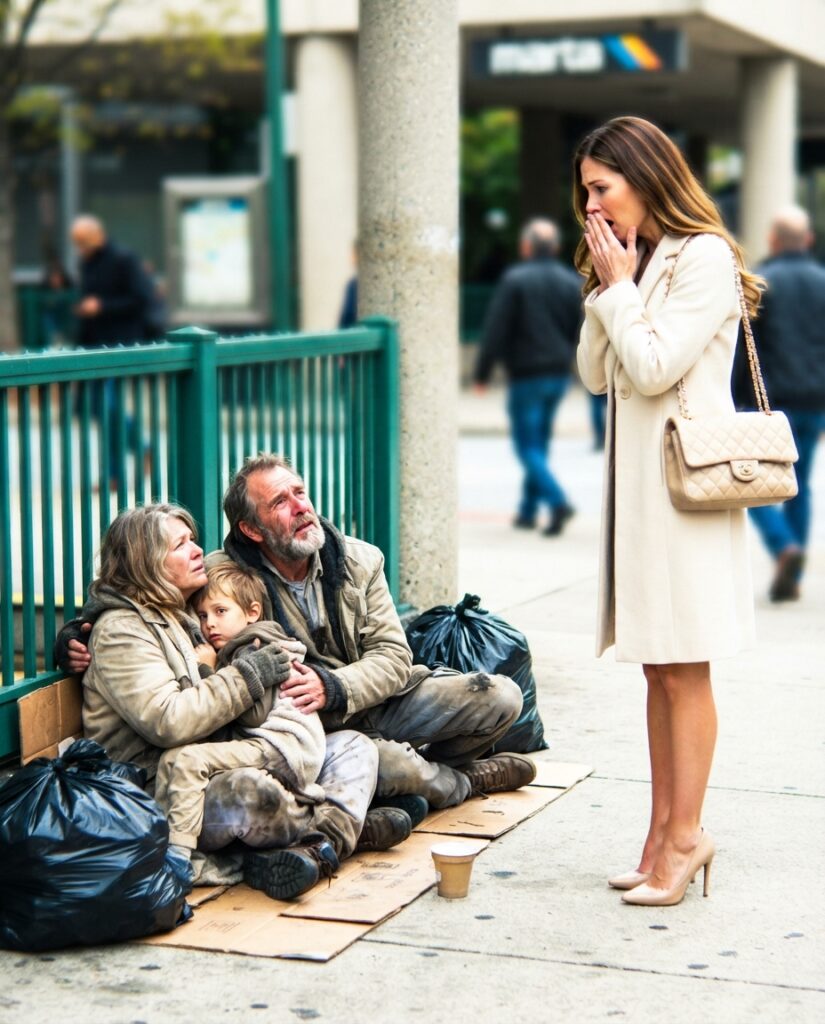
The south entrance of the subway station was half-hidden by construction fencing and old posters peeling from concrete walls. Rain had fallen earlier, leaving the pavement dark and reflective. The city sounded distant there, muffled by stone and steel.
My stomach twisted when I saw the patch of sidewalk where my parents had sat.
Cardboard stains remained like shadows.
Marisol walked close beside me.
“Where did Rose leave things?” she asked.
My father had drawn a rough map. I followed it to a rusted service gate near a stairwell blocked by a chain. Behind a loose brick at the base of the wall, he said, Rose sometimes hid small bags of food.
I crouched.
The brick shifted when I touched it.
Behind it was a plastic pouch wrapped in tape.
My hands trembled as I pulled it free.
Inside was a key.
A small silver key with a tag attached.
429-618-037-992
The song.
Marisol whispered, “Storage locker.”
Detective Harris stepped closer, scanning the area.
But there was something else in the pouch.
A folded photograph.
I opened it carefully.
It showed Rose standing beside a little boy I did not know. He had dark curls, serious eyes, and one hand gripping Rose’s skirt. On the back, written in blue ink, were four words.
Find Milo’s real mother.
I read it once.
Then again.
Milo.
Ashley Bell’s son.
The boy in the beautiful room.
The child whose backpack had appeared in Donald’s staged photograph.
Marisol took the photo from my hand, her face changing as she understood.
Before either of us could speak, my phone vibrated.
A new message from Donald.
For the first time since I came home, it was not sweet. It was not pretending.
It said:
You should have stayed in Miami.
A second photo came through.
It was not of my parents.
It was not of Keaton.
It was a picture of the apartment above the closed bakery.
Taken from across the street.
And in the window, small and clear, stood my son.
PART 3
“That’s us today.”
My father’s words seemed to pull all the air from the room.
The hotel television murmured quietly in the corner, playing a cheerful commercial about summer vacations, but none of us looked at it. The curtains were drawn. The paper bags from the clothing store sat folded by the door. Half-empty cups of soup cooled on the small table beside the bed.
And in my hand, Donald’s photograph glowed like a lie that had somehow learned to breathe.
My mother moved first.
She reached for Keaton, who had fallen asleep against the pillows with a slice of bread still clutched in his hand. Her fingers hovered above his hair, afraid even her touch might wake him from the first safe sleep he had known in too long.
“Alisha,” she whispered, “we need to leave.”
My father turned toward the window. “Don’t go near it.”
“I’m not,” she said, though she had already taken one small step back.
I lowered the phone slowly.
In the photograph, my parents were sitting at a table covered with food. My mother wore a pale blue blouse I recognized from the bag I had bought for her less than two hours earlier. My father wore the gray sweater I had picked out because he said the hotel air felt cold on his bones.
Behind them was the same beige wall.
The same crooked painting of a sailboat.
The same lamp with the chipped shade.
The photograph had not been taken somewhere else.
It had been taken here.
In this room.
I turned, my eyes sweeping every corner. The smoke detector. The television stand. The air vent. The mirror above the desk. The little plastic clock beside the bed.
My heartbeat grew louder than my breathing.
“Mom,” I said softly, “did anyone come in while I was downstairs?”
She shook her head, tears already gathering. “No. I was with Keaton. Your father was in the bathroom. We didn’t open the door.”
“Housekeeping?” I asked.
“No.”
My father was still staring at the window, his face tight. “Maybe it wasn’t from inside.”
I looked again at the photo. My parents’ faces were pale but smiling stiffly, like people trying not to cry. I remembered leaving them only briefly—twenty minutes, maybe less—while I went down to the lobby to buy bottled water and ask about extending the room.
During that time, someone had gotten close enough to see them.
Close enough to capture them.
Close enough to send Donald proof.
I stepped toward the desk and picked up the phone. My first instinct was to call the police, but my father moved quickly and placed his hand over mine.
“Alisha.”
His voice was quiet, but there was a plea inside it.
I stared at him. “Dad, someone is watching us.”
“I know.”
“They know where Keaton is.”
“I know.” His eyes shone with shame, fear, and something heavier—years of helplessness. “But the last time we tried to get help, Big Mike found us before the officer even finished taking our names. We walked out of the station, and he was leaning against a black truck, smiling like he had been invited.”
My mother closed her eyes.
“He knew every word we said,” Dad continued. “He knew which desk we sat at. He knew what your mother was wearing. He knew Keaton had cried.”
I pulled my hand free, but not angrily. Carefully.
“Then we need help that Donald doesn’t own,” I said.
My father swallowed.
I looked at the phone again. Donald’s message still sat above the photograph.
My love, your parents just finished dinner. Keaton is playing in his room. Everyone is doing great. Keep working. We love you.
We love you.
The words felt colder than any threat.
My mother sat on the bed beside Keaton and rested a trembling hand on his small shoulder. “He used those photos to keep you sending money.”
“I know.”
“And every month,” she said, her voice breaking, “I prayed you would stop believing him. Then I prayed you wouldn’t come, because I was afraid they would hurt you too.”
I knelt in front of her.
For five years, I had imagined coming home to my mother’s cooking, my father’s laughter, and my son rushing into my arms with a backpack full of school papers and missing teeth. I had imagined a porch swing. Birthday cakes. Family dinners. I had imagined the life my sacrifices were building.
Instead, my mother flinched when footsteps passed the door.
My father counted exits with his eyes.
And my son slept like a child who had learned rest was something that could be taken away.
“I’m here now,” I said.
My mother looked at me with the deep exhaustion of someone who wanted to believe but had forgotten how.
“I’m here now,” I repeated. “And I am not leaving any of you behind.”
Keaton stirred then, his lashes fluttering. His small fingers tightened around the bread.
“Mama?” he whispered.
The sound of that word nearly broke me.
I moved to him so quickly my knees hit the bedframe. “I’m right here, baby.”
His eyes opened halfway. For a second he looked confused, as if he wasn’t sure whether I was real. Then he reached for me with both arms.
I held him gently, afraid of how thin he felt beneath the clean pajamas I had bought him. His cheek pressed against my neck.
“You came back,” he murmured.
“I came back.”
“Grandma said you were working far away.”
“I was.”
“Daddy said you forgot.”
My breath caught.
My mother turned her face away, crying silently.
I closed my eyes and held my son closer.
“No,” I whispered into his hair. “Never. Not for one second.”
Keaton did not answer, but his small hands gripped the back of my shirt. After a moment, he reached down and tucked the bread into the space between us, as if saving it for later.
That little movement filled me with a grief so sharp I had to breathe through it.
My father cleared his throat softly. “We can’t stay here tonight.”
He was right.
I looked at the hotel room again, this time not as a place of refuge, but as a place already found. The photograph had turned the walls transparent.
I wiped my cheeks and stood.
“There’s a back stairwell?” I asked.
My father nodded. “Near the ice machine.”
“Good. We leave through there. No lobby. No front desk.”
My mother’s eyes widened. “Where will we go?”
I thought of my lawyer, Ms. Carrington, whose office I had called earlier. I thought of my banking records, the transfers, the messages, every promise Donald had made in writing. I thought of my friend in Miami, Tasha, who had once told me, “If trouble ever follows you home, don’t be proud. Call me.”
But this was bigger than pride.
It was bigger than Donald.
Someone had reached into our room without opening the door.
I grabbed my phone and texted Ms. Carrington one sentence.
Do not call. We are being watched. Need safe meeting location.
Then I turned the phone off completely.
My father watched me. “You think the phone…”
“I don’t know what I think.” I slid it into my bag. “But Donald has known too much for too long.”
We moved quickly.
My mother wrapped Keaton in the hotel blanket. He was awake now but silent, his eyes following every movement. My father gathered the new clothes and food into bags. I took my banking folder, the receipts, and the copy of Donald’s latest message.
At the door, we all stopped.
There were footsteps in the hallway.
Slow.
Unhurried.
They paused outside our room.
My mother’s grip tightened around Keaton.
A shadow moved under the door.
Then came a soft knock.
Not loud. Not threatening.
Just three gentle taps.
My father mouthed, No.
The knock came again.
A woman’s voice followed, low and calm. “Ms. Bennett? My name is Elaine Carrington. You texted me.”
I stared at the door.
My lawyer.
But I had turned off my phone less than two minutes ago. There was no way she could have arrived that fast unless she had already been nearby.
Or unless someone else was using her name.
“Slide your card under the door,” I said.
There was a pause.
Then a business card appeared in the gap beneath the door.
I picked it up.
ELAINE CARRINGTON
FAMILY LAW & CIVIL LITIGATION
It matched the website I had checked earlier. The same cream cardstock. The same navy lettering. But anyone could print a card.
“Where did we speak?” I asked.
“You called my office at 4:16 p.m.,” the woman said. “You told my assistant you had been sending money to your husband for five years and had just found your parents and son at a transit station. You were crying, but you asked for the earliest emergency appointment. I was leaving court, so I asked my assistant to get your hotel name from the number on your intake form.”
My father looked at me.
I had given the hotel name.
That was true.
“Why are you here?” I asked.
“Because after your call, someone contacted my office pretending to be you,” she said.
My skin prickled.
The hallway went silent except for the hum of the ice machine around the corner.
“What did they say?” I asked.
“That you no longer needed representation. That you had reconciled with your husband. That all complaints were a misunderstanding.”
My mother made a small sound.
Ms. Carrington continued, “My assistant thought the voice sounded wrong. She called the number you first used. It went straight to voicemail. Then your text came through. I came myself.”
I looked through the peephole.
A woman in a dark green suit stood alone in the hallway, holding both hands where I could see them. She had silver-streaked hair pinned neatly at the back of her head and a leather briefcase at her feet.
Behind her, near the vending machine, a man in a baseball cap pretended to study the snack display.
He did not buy anything.
He did not move.
His face was angled toward our door.
Ms. Carrington seemed to know he was there. Her eyes flicked once, barely, in his direction.
“Ms. Bennett,” she said quietly, “do not open this door unless you are ready to leave immediately.”
I stepped back.
“Dad, bags.”
My father lifted them.
I opened the door just enough for Ms. Carrington to enter, then shut it behind her.
She looked once at my parents, once at Keaton, and her expression changed. Not dramatically. Not with shock. With recognition.
Like she had seen families at the edge of collapse before.
And had learned how to pull them back.
“Hello, Keaton,” she said gently.
Keaton hid his face against my shoulder.
“That’s all right,” she said. “You don’t have to talk.”
She turned to me. “You need a safe place tonight. Not a hotel. Not a relative. Not anywhere tied to your name, your cards, or your phone.”
“You have one?” I asked.
“I know people who do.”
My father shook his head. “Police?”
“Eventually,” Ms. Carrington said. “But carefully. Through the right unit, with documentation and protective measures. Not by walking into the nearest precinct and hoping the wrong person isn’t listening.”
My mother stared at her. “You believe us?”
Ms. Carrington looked at the photograph on my phone, which I had turned back on only long enough to show her. “I believe evidence. And this is evidence.”
She held the phone without touching the screen too much, studying the image.
Then her eyebrows drew together.
“This reflection,” she said.
I leaned closer.
In the photograph, behind my parents, near the dark surface of the turned-off television, there was a blur. At first I thought it was just light from the lamp.
But then I saw it.
A hand holding a phone.
And beside it, part of a sleeve.
Not a hotel employee’s uniform.
Not Donald’s arm.
A bracelet hung from the wrist, silver and delicate, with three small charms.
A heart.
A key.
And a letter B.
My mother inhaled sharply. “Brenda.”
The name landed heavily.
Donald’s mother.
The woman who had called Keaton a burden. The woman who had watched my parents lose everything and not lifted a hand.
“She was here?” I said.
My father gripped the back of the chair. “I saw that bracelet before. She wore it every Sunday.”
“But why would Brenda take the picture herself?” I asked. “Why risk coming near us?”
Ms. Carrington’s gaze remained on the reflection. “Because whoever is controlling this wants you to know they can reach you. Or because she didn’t realize she was visible.”
My mother shook her head. “Brenda always realized everything.”
Keaton shifted in my arms.
“Grandma B,” he whispered.
We all turned toward him.
I sat slowly on the edge of the bed. “Baby?”
Keaton’s eyes remained on the blanket. “She came when Grandma went to get water.”
My mother’s face went white. “When? Today?”
He nodded.
“You were awake?” I asked.
“A little.”
My father closed his eyes. “Lord have mercy.”
“What did she say?” I kept my voice soft, though everything inside me was shaking.
Keaton rubbed one eye with the back of his hand. “She said smile for Mama.”
My mother covered her mouth.
“She said if I didn’t smile, you’d be sad,” Keaton continued. “But I couldn’t sit up. So she said just Grandma and Grandpa.”
I looked down at the photograph again. My parents’ smiles were strained because they were not smiling for Donald.
They were smiling because Brenda had told Keaton his mother would be sad.
My anger came like fire, but Keaton was watching me now, so I held it behind my teeth.
“Did she touch you?” I asked carefully.
He shook his head. “She smelled like flowers.”
My mother whispered, “That perfume. Gardenia.”
Ms. Carrington closed the phone. “We leave now.”
The man by the vending machine was gone when we stepped into the hall.
That frightened me more.
We moved through the back stairwell, Ms. Carrington leading with calm, practiced steps. My father carried the bags. My mother held Keaton’s hand, though Keaton kept looking back to make sure I was still there.
At the bottom of the stairs, Ms. Carrington stopped before opening the exit door.
“Listen to me,” she said quietly. “When we step outside, do not run unless I tell you to run. Walk like tired people leaving a hotel. Keep your faces turned away from the parking lot cameras. There’s a blue van across the street. The driver is someone I trust.”
“Who?” I asked.
“My sister.”
It was the first unexpected human detail she had given us, and somehow it steadied me.
Outside, Atlanta’s evening air was warm and heavy. Cars hissed along the wet street. Somewhere, thunder grumbled behind the city skyline. We crossed beneath a flickering streetlamp and reached the blue van.
The driver leaned over and opened the side door.
She looked like Ms. Carrington, but softer around the eyes, with a knitted purple scarf around her hair.
“Get in, babies,” she said. “No names out here.”
We climbed inside.
The van smelled faintly of peppermint and old books. There were folded blankets in the back, bottles of water, granola bars, and a small stuffed dinosaur tucked into the seat pocket. Keaton noticed it immediately but did not reach for it.
The driver saw.
“That dinosaur has been waiting for someone brave,” she said, starting the engine.
Keaton looked at me.
I nodded.
He picked it up and held it against his chest.
For the first time since I had found him, his shoulders lowered.
Not much.
But enough.
We drove without headlights for half a block, then turned onto a side street and disappeared into traffic.
No one spoke for several minutes.
My mother sat beside me, her hand wrapped around mine. My father stared out the window, blinking hard. Keaton leaned against my arm, the dinosaur under his chin.
Ms. Carrington sat in the passenger seat, making calls in clipped, careful phrases.
“No names yet.”
“Yes, a child.”
“Safe intake tonight.”
“No, not through the front entrance.”
“Documentation tomorrow.”
When she hung up, she turned to face me.
“Alisha, I need to ask you something uncomfortable.”
I braced myself. “Okay.”
“Did Donald ever have access to your email? Cloud storage? Bank passwords?”
I thought of the old family laptop. The shared phone plan from years ago. The password I had used for everything when money was tight and life felt simpler.
Our anniversary date.
I closed my eyes.
“Yes.”
Ms. Carrington nodded as if she had expected it. “That may explain how he tracked the hotel. It may also explain how he created the staged life he showed you. Did you save photos from your caregiving job? Homes you worked in? Dining rooms, children’s rooms, gardens?”
A cold realization spread through me.
The beautiful dining room.
The toy-filled bedroom.
The white house with the garden.
They had looked real because they were real.
Just not ours.
“Oh my God,” I whispered. “He used pictures from my clients’ homes.”
My mother looked confused. “What?”
“I used to send him little updates,” I said. “Not private things. Just… ‘Mrs. Whitaker’s garden bloomed today.’ ‘The little boy I helped care for got a new train set.’ I thought I was sharing my days with my husband.”
My father’s voice was heavy. “He built a fake life out of your loneliness.”
I looked out at the rain beginning to speckle the window.
Five years of photographs.
Five years of captions.
Five years of me zooming in to see if Keaton had grown taller, if my mother looked healthy, if my father had painted the fence.
And behind all of it, my own pictures had been used to keep me obedient.
Keaton’s small hand slipped into mine.
“Mama,” he said.
I looked down.
He held up the stuffed dinosaur. “Can he come too?”
My heart bent toward him.
“Yes,” I said. “He comes too.”
The safe place was not what I expected.
Not a shelter with fluorescent lights and rows of cots. Not a cold government office. It was a small church annex tucked behind a community garden, with yellow curtains in the windows and a mural of sunflowers painted along the hallway.
A woman named Mrs. Ruth met us at the side entrance. She was short, round-faced, and wore sneakers with bright orange laces. She did not ask questions at the door. She simply opened her arms wide enough to welcome all of us without forcing anyone to step into them.
“Come in,” she said. “You’re safe for tonight.”
Safe for tonight.
The words were not a miracle.
But they were enough to walk on.
Inside, there was a room with two twin beds and a foldout couch. Clean towels waited on a chair. A nightlight glowed near the outlet. On the dresser sat a basket with toothbrushes, crackers, applesauce cups, and a handwritten note.
You are not alone.
My mother picked up the note and held it like a letter from heaven.
Keaton ate half an applesauce cup, then another. Mrs. Ruth brought him warm oatmeal with honey, and he took careful bites, watching the spoon as if food might disappear if he trusted it too quickly.
My father sat at the little table and stared at his hands.
I sat across from him.
“Dad.”
He didn’t look up.
“I should have known,” he said.
“No.”
“I was his father-in-law. I should have protected your mother. I should have protected Keaton.”
“You were threatened.”
“I was afraid.”
“You stayed alive,” I said. “You kept Keaton alive. You and Mom carried him through something no one should have had to survive.”
His mouth trembled.
“I begged,” he whispered. “For food. For coins. For socks. Your mother would sing to Keaton at night so he wouldn’t hear me crying.”
I reached across the table and took his hands.
“They wanted you ashamed,” I said. “That shame belongs to Donald. Not you.”
My father looked at me then, and in his eyes I saw the man who had taught me to ride a bicycle, who had clapped the loudest at every school play, who had once worked double shifts so I could have books with my name written inside the cover.
For five years, Donald had stolen more than money.
He had stolen my father’s belief that he was still a father.
I squeezed his hands.
“You’re coming back to us,” I said.
He cried silently, and I let him.
Across the room, my mother was brushing Keaton’s hair with a small comb Mrs. Ruth had found. She hummed under her breath, the same lullaby she sang when I was little. Keaton sat very still at first, then gradually leaned back against her knees.
“Does that hurt?” she asked.
“No,” he murmured.
“You tell Grandma if it pulls.”
“It doesn’t.”
She smiled through tears. “Your curls are stubborn like your mama’s.”
Keaton looked at me. “Mama had curls?”
“I still do when the rain gets me,” I said.
For one fragile moment, we were not being hunted by lies.
We were three generations in a warm room, remembering how to belong to one another.
Later, after Keaton fell asleep with the dinosaur tucked beneath his arm, Ms. Carrington spread documents across the table.
Bank transfers.
Text messages.
Screenshots.
Donald’s photographs.
My call logs.
The latest picture, with Brenda’s bracelet reflected in the television.
“We start with emergency custody protections,” she said. “Then financial fraud, identity theft, coercion, and recovery of funds. But we need to move carefully. Donald may not be acting alone.”
“Big Mike,” my father said.
Ms. Carrington nodded. “Possibly. But there may be someone else.”
My mother frowned. “Who?”
Ms. Carrington pulled one of Donald’s old photographs from the folder. It showed Keaton standing in front of a school display board, smiling with a backpack on his shoulders.
I remembered that photo. Donald had sent it two years earlier.
First day of kindergarten, he wrote. Our boy is growing up.
I had cried for an hour after receiving it, grieving the milestone I had missed.
Ms. Carrington placed the newer photo beside it. “Look at the child.”
I did.
The backpack.
The smile.
The birthmark was hidden by the angle, but the eyes were similar enough to make my chest tighten.
Then I looked closer.
The ears were wrong.
Keaton’s left ear had a tiny notch at the top from birth. The boy in the school photo did not.
“That’s not my son,” I whispered.
My mother leaned forward, confused.
My father grabbed his glasses from his shirt pocket and put them on.
“That’s not Keaton,” he said.
My stomach turned.
Ms. Carrington laid out more photographs.
Keaton in a park.
Keaton blowing out candles.
Keaton sleeping under a blue blanket.
Except now, under the steady light, with the real Keaton asleep only a few feet away, I saw what grief and distance had hidden from me.
Some photos were my son.
Some were not.
Some were blurred just enough.
Some were angled just right.
Some showed only the back of a child’s head.
My hands went cold.
“Where did he get these?” I asked.
Ms. Carrington did not answer immediately.
My mother touched one photograph with a shaking finger. “This boy… I’ve seen him.”
We all turned to her.
“What do you mean?” I asked.
She closed her eyes as if searching through painful memories. “At Donald’s house. Not our old house—the other place. The one Brenda took him to after she said we weren’t allowed near the neighborhood anymore. Once, from across the street, I saw Ashley with a little boy. I thought…” She opened her eyes. “I thought my vision was bad. I thought hunger was making me confused. He looked like Keaton from far away.”
“Ashley’s child?” my father asked.
My mother shook her head slowly. “I don’t know.”
The room seemed to tilt.
Donald had not only abandoned my family.
He had created a replacement version of them.
A different wife smiling in my stolen dream.
A different child standing in for my son.
A different life funded by my sacrifice.
Ms. Carrington gathered the photos with care. “This matters. If another child is involved, we need to know whether that child is safe too.”
I looked at Keaton sleeping. His lips were parted slightly. His hand rested over the dinosaur’s head like he was protecting it.
“How many lives did Donald build with my money?” I whispered.
No one answered.
A soft knock came at the door.
My father stiffened.
Mrs. Ruth’s voice came from the hallway. “It’s me.”
Ms. Carrington opened the door only after checking through the small curtain.
Mrs. Ruth entered holding a sealed envelope.
“This was left in the donation box outside,” she said. “No one rang the bell.”
The envelope had no stamp.
No address.
Only one word written across the front in black marker.
ALISHA.
My mother reached for Keaton.
My father stood.
Ms. Carrington took the envelope and examined it. “No one touches this except by the edges.”
She opened it carefully with a butter knife from the kitchenette.
Inside was a single photograph.
Not printed on glossy paper like Donald’s staged images.
This one was old.
Faded.
Creased down the middle.
I knew it before I understood it.
It was a picture of me, Donald, Ashley, and Brenda standing outside a courthouse.
I looked younger. Donald had his arm around my shoulders. Brenda stood beside him, smiling proudly. Ashley stood slightly apart, wearing a pale pink dress and holding a bouquet.
At first, nothing made sense.
Then I saw the date printed in the corner.
It was taken four months before I married Donald.
I stared at Ashley’s face.
She was not just “the other woman” Donald brought into our home after I left.
She had been there before the beginning.
My mother whispered, “Alisha…”
There was writing on the back.
Ms. Carrington turned the photograph over.
Four words had been written in the same black marker.
Ask who married first.
For a long moment, the room was silent except for the rain tapping softly against the windows.
My father sank back into his chair.
My mother gripped my shoulder.
And I stood there, holding the edge of the table, feeling the past rearrange itself beneath my feet.
Donald had not simply betrayed me after I left.
The lie had started before I ever said, “I do.”
Ms. Carrington’s face hardened with focus. “Alisha, did Donald ever show you a divorce decree?”
“A what?”
“From Ashley.”
I shook my head. “He told me Ashley was his cousin’s friend. I barely remembered meeting her.”
Ms. Carrington looked down at the photograph again. “Then tomorrow, we search marriage records.”
A sound came from the bed.
Keaton had awakened.
He was sitting up, eyes wide, staring at the old photograph in my hand.
“Baby,” I said gently, “it’s okay.”
But he shook his head.
“That lady,” he whispered, pointing at Ashley. “She used to cry in the kitchen.”
My mother went still.
“What kitchen?” I asked.
Keaton hugged the dinosaur tightly.
“At the big white house,” he said. “The one Daddy said was ours.”
Every heartbeat in the room seemed to stop.
I knelt beside him, keeping my voice soft. “Keaton, you were inside that house?”
He nodded.
My throat tightened. “When?”
He looked from me to Grandma, then to the rain-dark window.
“Before Grandma B said I wasn’t allowed to remember.”
Mrs. Ruth crossed herself silently.
Ms. Carrington reached for her notebook.
My mother began to cry.
And I took my son’s small hand, realizing the house Donald had shown me in photographs had not been stolen from my clients after all.
It existed.
Keaton had been there.
Ashley had been there.
And somewhere inside that white house was the truth Donald had spent five years paying everyone to hide.