Part 1: The Sunday Everything Changed
On a Sunday morning, Grandma caught me carrying plates at the diner and asked why I needed a second job when Grandpa had supposedly cleared my student loans years ago. I told her I was still paying $412 every month. She didn’t even glance at a menu. She sat down, phoned her attorney, and said, “It’s about Elwood’s money.” Then she began asking questions about Dad…
“Halley, why are you waiting tables? Your grandfather paid off your student loans in 2019.”
For a moment I wondered if she had me confused with someone else. The guilt arrived almost instantly. Grandma had kept the peach orchard running for five years after his death, and she certainly didn’t need me explaining her own business to her.
She stood by the hostess station while the door swung closed behind the last of her friends. Something changed in her face, though she said nothing at all.
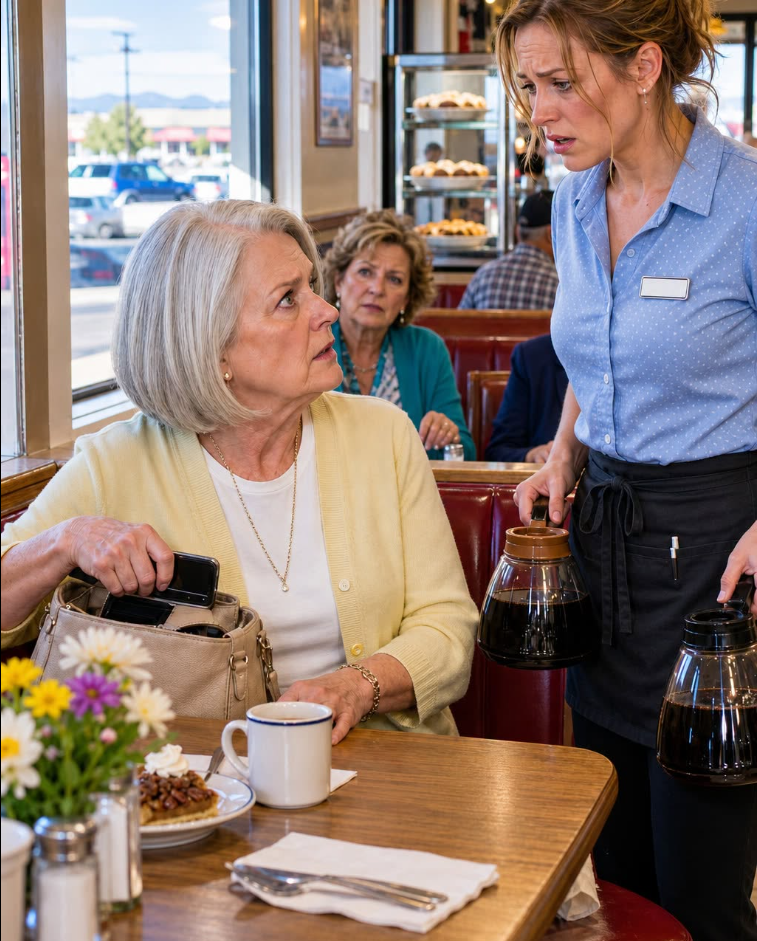
Then she walked to the window booth in my section and sat down. Her friends followed, setting their purses beside them and picking up menus with polite, careful smiles. Grandma went into her handbag instead and came out with the flip phone she refused to give up. She dialed using a single finger.
“Emmett, it’s June Overstreet. I know it’s Sunday. Call me back today. It’s about Elwood’s money.”
She snapped the phone shut and looked up at me. “Sit down a minute, honey.”
I had six tables and two coffee pots in my hands, and for the first time since I started working there, I couldn’t remember which customers needed me.
My name is Halley Overstreet. I was twenty-nine, a dental assistant on weekdays, and on weekends a server at a Grand Junction diner whose pie display was older than I was.
The dental office was a good place to work. I liked my coworkers, and I liked patients who greeted me by name. I had never pictured myself carrying breakfast plates on my days off, but the loan payments had started up again in 2023, and by the next spring I needed more income than one job could give me.
I finished my biology degree in May 2019 owing $41,200. What I really wanted was to become a veterinarian. Instead, I looked at what more school would cost and chose work I could start sooner.
I tried never to call it giving up. Some days that was a harder story to believe than others.
Two weeks before, Grandma had moved into town, close enough that we could share dinner every Thursday. I had meant to tell her about the diner shifts, but I couldn’t find a way to say it without sounding like I was hoping she would help.
Dad had given me one rule about my grandparents for as long as I could remember: never ask them about money. It embarrassed them, he said.
So I never did.
My parents split when I was fifteen. Mom remarried and moved to Arizona, while Dad stayed in our Grand Junction house with my younger brother Bryce and me.
Dad ran an RV repair shop that always seemed to be waiting for the month when things would finally ease up. I got used to collecting his signatures, packing lunches, and reminding him about unpaid bills.
“Halley always lands on her feet,” he used to say.
I liked being the person he could count on. I never noticed how often that meant putting my own needs off for everyone else’s.
Bryce was three years younger. He was athletic and funny, the kind of kid who could make nervous adults laugh before a conversation turned awkward. I adored him, even while I was packing his lunch and he was hunting for a missing shoe.
He went to a private college in California. Whenever I asked how Dad managed it, he told me he had arranged everything.
I stopped asking. Between classes, loan applications, and a father who sounded exhausted every time I needed help, I had plenty to carry.
My grandparents were a different matter.
Elwood and June grew peaches on forty acres near Palisade. I spent my summers there from the time I was small, wearing a picking bag and learning that ripe fruit wouldn’t wait just because I wanted another hour in bed.
Grandma taught me how to preserve fruit. Grandpa let me steer the orchard truck down the rows before I was tall enough to look convincing behind the wheel.
He kept track of everything in green fabric-covered account books. Crates, fertilizer, repairs, expenses, and income all went in pencil, in tidy, square letters.
When I asked why he didn’t just use a computer, he told me, “A computer can’t be wrong in pencil.”
Nobody enjoyed that joke quite as much as he did.
A whole shelf of those books sat in his little office, going back decades. I could still picture him there after supper, double-checking a number while Grandma called from the kitchen that the dishes weren’t going to wash themselves.
He died while pruning the orchard in March 2021.
A week after the funeral, Dad tried to carry the ledgers off to his shop. He told Grandma she had no reason to keep dusting old receipts.
She took the last volume right out of his hands.
“They’re his handwriting. Put them back.”
At the time, I assumed Dad meant well and Grandma simply couldn’t stand to lose one more reminder of Grandpa. I watched him return every book to the shelf without understanding why that scene stayed with me.
Now she sat beneath the diner window with her phone beside her and no interest in breakfast.
My manager, Vic, came over. After glancing between the two of us, he took the coffee pots from my hands.
“Take ten, kiddo. I’ve got these.”
I slid into the booth next to Grandma. The church ladies studied their menus with the determination of people trying to give us privacy in a room that had none.
Grandma covered my hand with hers. “Tell me about the payments.”
So I told her. I explained when the payments began, how long they had paused, and when they returned. I told her about the weekend job and the balance I checked each month, which was still almost thirty thousand dollars.
She listened to every word in silence.
“Your grandfather arranged to pay them in December 2019,” she said. “He wrote it in his book.”
“I never received anything like that, Grandma. There’s never been a payoff.”
Her eyes fell to the tabletop.
A memory rose up of my twenty-third birthday at the farmhouse. We had eaten fried chicken and peach upside-down cake, and Grandpa had watched me the whole time as if he expected me to remember something.
“Any good news in the mail, Halley girl?”
I had told him only bills had come, and that repayment had just begun.
His face had fallen. When Grandma touched his arm, I assumed he was simply tired.
I drove home that night without questioning it.
Now, in the diner, Grandma drew a breath.
“Your father brought him the letter showing what was owed. Elwood wanted it to be a birthday surprise.”
I stared at her in disbelief.
“Dad knew?”
“He told us you were embarrassed about accepting help. He said you’d thank your grandfather when you were ready.”
Behind the counter, the pie case hummed. Somebody nearby laughed, and a fork clattered to the floor.
Grandma kept holding my hand.
“He waited, honey.”
I looked down at the apron I had tied on that morning. Dad knew I worked here. He also knew my debt had never been paid.
And Grandpa had died believing I understood his gift.
I went back to my tables because I had no idea what else to do. For two hours I took orders and poured coffee, fumbling even the simplest customer questions.
That evening, Grandma had her kitchen table ready. There was no dinner on it. She had laid out her glasses, a legal pad, and Grandpa’s final ledger.
I pulled up my repayment history on my phone. There were my regular payments and the long gaps without them, but nothing that resembled the amount she described.
She turned the pages to December 2019.
“Halley’s college loans paid in full.”
Grandpa had drawn two lines beneath the entry. Beside the figure of $38,640.12, he had written an account number ending in 7730.
My account ended in 2219.
I checked the screen against the page twice before I could say anything.
“That isn’t my account.”
Grandma lifted her eyes from the paper and held mine.
“Then whose is it?”
Part 2: The Account Ending in 7730
I went out to the parking area and phoned Dad. When I asked whether Grandpa had paid off my loans, he laughed and said those last years had been confusing for him.
“Grandma has his ledger.”
His tone changed. He warned me not to upset Grandma so soon after her move, and he called her fragile. Stirring up old questions, he said, might make her sick.
When the call ended, I stayed in the dark for a long time. He had never called her fragile when she ran the orchard on her own.
The next afternoon, I stretched my lunch break and drove Grandma to Emmett Kirkland’s office. He had represented my grandparents for years.
After studying the ledger and my loan history, he explained that the bank could pull an archived copy of the original payment instrument. That record would show exactly where the money had gone.
“Can’t we ask Dad?” I said.
Emmett looked at me with sympathy.
“You did.”
While we waited, Dad started stopping by Grandma’s. One time he brought flowers, another time dinner. Each visit, he asked about her sleep, her forgetfulness, and whether living on her own was getting to be too much.
Over Thursday dinner, she told me about those visits.
“He never used to ask about my memory.”
We went back to the orchard as well. The neighbor who had taken it over let us walk the rows during harvest.
Grandma linked her arm through mine. She ran a hand along the trunks as we talked about which peach varieties she would replant.
Then she told me Grandpa’s eyesight had been far worse than I knew. Macular degeneration had clouded the center of his vision. By 2019, he needed a magnifying glass and a great deal of effort to read any financial paper.
His pride had kept him from ever mentioning it.
“Your father knew,” she said. “He drove him to the eye appointments.”
She remembered Dad arriving at Thanksgiving with the payoff letter. Grandpa had held it up toward the kitchen light, picked out the family name and the loan company, and trusted what he was told.
I looked down the row toward the packing shed. Nothing about that familiar place had changed enough to explain why I suddenly wanted to leave it.
When the archived copy came, it matched the amount in Grandpa’s book and the account ending in 7730.
My loan servicer confirmed that no such payment had ever lowered my balance. They would not discuss another borrower’s account, but they told us that number was not mine.
Emmett said that getting more answers meant taking formal legal action. We had to weigh whether we wanted to.
Before we could decide, Aunt Coralie called.
Dad had told her I was confusing Grandma and trying to get my hands on her money. Coralie demanded that I leave Grandma alone.
Two days later, Grandma phoned me from home.
“Your father took my car keys.”
Dad claimed she had gotten lost driving. He threatened to seek guardianship, supposedly for her own protection.
I left work and went straight to Emmett’s office, holding my phone out as if he needed to hear how her voice had sounded.
Emmett let me finish without interrupting. He knew Grandma well, and he did not wave away what even the threat of a guardianship could mean for her.
Even a failed attempt could bring evaluations, home visits, attorney fees, and relatives doubting her judgment. The possibility alone had frightened her.
That Saturday, she looked worn out at her kitchen table.
“Maybe we should let it go. He’s my son.”
I told her I would stop if that was what she wanted. I could keep paying my loans. Her peace mattered more to me than my balance.
She raised her head.
“No.”
She rested her hand on Grandpa’s book, and for a while we sat there quietly.
The next afternoon, Bryce showed up. Dad had recruited him too. He had driven in from Denver, believing he needed to stop me from taking advantage of Grandma.
He confronted me before he had even taken off his cap.
“Halley, what are you doing?”
“Sit down,” Grandma said.
I laid the documents in front of him: the ledger, the archived copy, and my loan history. I pointed out where the account numbers failed to match.
He read through them slowly, and I watched his anger drain away.
“That’s mine.”
I said nothing.
“The loan Dad took out for my college. I know the number.”
It was Dad’s parent loan, the one he had taken out for Bryce’s education. At Christmas 2019, Dad had told Bryce that Grandpa paid it off.
“He said not to mention it to you. You’d be jealous.”
Bryce struggled to swallow.
“And he said not to thank Grandpa because talking about money embarrassed him.”
Grandma put her hand over his.
He had kept the confirmation letter with his college papers, and he promised to send us a copy.
Before he left, we stood out on Grandma’s balcony while she washed the dishes. He looked out over Grand Junction without speaking.
“You used to pack my lunches.”
“Three years.”
“Peanut butter and honey. You’d put notes in.”
I remembered cutting off his bread crusts so he wouldn’t complain.
“I never thanked you for that, either.”
“You were twelve.”
“I’m twenty-six now.”
His voice cracked. All these years he had assumed Grandpa favored him and that I had simply been unlucky.
When he started to cry, I put an arm around his shoulders.
“We were raised not to ask.”
That did not settle everything between us. Still, I believed he had never understood whose debt the money was meant to cover.
He stayed another night, and the next morning the three of us went back to Emmett.
With Bryce’s confirmation letter, the papers told a clear story. Dad had submitted his own loan details while Grandpa thought he was paying mine. The payment had wiped out Dad’s debt.
Emmett went through the options. Grandma listened with her handbag balanced on her lap.
Then another memory surfaced for her.
After Grandpa’s funeral, Dad had asked her for $10,000 for my supposed veterinary-school applications, exams, and travel. He told her I was too proud to ask for it myself.
I stared at her in disbelief.
“I never applied.”
Her fingers tightened around her purse handles.
Emmett wrote that sum down beside the earlier payment. Together they came to $48,640.12.
Soon after, a letter arrived from Dad’s lawyer, expressing concern that I was influencing Grandma. It warned of legal objections if she changed her estate plans.
Emmett advised documenting her ability to make decisions and making sure her wishes were clearly on record.
Her doctor examined her and confirmed she was mentally capable.
Then she signed an amendment that would count the disputed amount against Dad’s eventual share, with the benefit going to me.
She read every page herself.
When she finished, she capped her pen and turned to Emmett.
“I want him to hear it from me.”
Part 3: Supper With Dad
Grandma invited Dad to Sunday supper. She cooked pot roast, carrots, little red potatoes, and gravy, and the familiar smell filled her apartment the way it once filled the farmhouse.
He arrived holding flowers.
His smile tightened when he saw me, and it hardened further when he spotted Bryce. My brother had driven over the mountains again.
“Well,” Dad said. “The whole gang.”
We ate. Dad talked about the shop and the weather, and Grandma passed the dishes without once rescuing him from the awkward silences.
When the meal was over, she cleared the plates herself. Then she came back carrying the folder.
She set the payment record beside the confirmation addressed to Dad, then slid both papers across the table toward him.
“Dwayne, which of my grandchildren has their name on that account?”
He glanced down at the documents.
“Where did you get these?”
“I asked you a question.”
Dad turned to Bryce. Bryce held his gaze and did not step in.
Dad began to argue that Grandpa had meant to help him too. They were family, after all, and Grandpa would have understood how hard his business was struggling, he insisted.
“Then he would have written that,” Grandma said. “He wrote Halley’s name.”
Dad covered his face with his hands.
His shop had nearly gone under in 2019. He was responsible for the payments on the loan for Bryce’s schooling, and he couldn’t keep up.
When Grandpa asked for my loan details, both sets of papers were lying on Dad’s counter.
He had known Grandpa could barely read them.
“I thought you’d be all right,” he told me. “You always manage. Bryce needed a break.”
I kept my hands under the table because I couldn’t hold them still.
“I wasn’t all right. I’ve been working weekends for two years.”
He truly looked at me then, and for the first time seemed to see what those weekends had cost.
Grandma spoke quietly.
“She didn’t land on her feet, Dwayne. She landed behind a coffee pot. I watched her.”
Dad had nothing to say.
Grandma explained the legal arrangement Emmett had drawn up. Dad would acknowledge the full amount in writing and begin scheduled repayments in October. If he refused, she would take the claim to court.
Her estate documents had also been changed to protect what she had directed.
I made no demands of my own. This was Grandma’s decision about what had been done to her and Grandpa, and she had worked hard to make it without being frightened into silence.
Dad read through the acknowledgment.
Behind him, the clock ticked. He ran his thumb along the edge of the page, then reread a paragraph.
He took her pen and signed.
His hand stayed steady while mine shook in my lap. I had imagined that confronting him would leave me feeling powerful. Instead, I was so tired that I wanted to lay my head on the table.
Dad stood and picked up his jacket.
At the doorway he turned around. I thought he might finally apologize without explaining why he needed us to understand.
Instead, he started asking about keys, stopped, and said he would bring Grandma’s car keys back the next day.
“Leave them on the hook.”
He didn’t move.
At last he reached into his pocket.
They had been with him the whole time.
After the door closed, Bryce sat back down. Grandma gathered the signed papers and slid them into the folder, careful to keep the edges even.
No one mentioned dessert.
I carried dishes into the kitchen with her, and for once she let me help.
At the sink, she let out a long breath and glanced at the hook beside the door.
“I’ll drive myself tomorrow.”
I nodded and handed her a plate to dry.
Grandma decided to help before Dad made his first repayment.
The next morning she asked me to drive her to the bank. We went over what she wanted to do, and she made sure the remaining balance matched my loan information.
I reminded her she didn’t have to settle it all at once.
“I know,” she said.
She said nothing more. She knew exactly which grandchild she was helping, and nobody was telling her what to do.
Four days later, I checked my loan account during a break at the dental office. The supply closet was the only quiet place, so I stood in there.
My outstanding balance read zero.
Beneath it was a notice confirming that the loan had been paid in full.
I stared until my vision blurred. Then I cried so hard that a hygienist knocked and asked if I was all right.
“Yes,” I managed.
I grieved for Grandpa and for the years that could never be restored. I felt relief at the canceled debt. I was angry that I had ever been taught to think needing help was something to hide.
All of it happened in a small room full of dental supplies, with someone outside waiting to see if I needed water.
Dad’s signature did not magically restore my trust. It gave us a written obligation where before there had only been explanations.
Bryce cut off contact with Dad for a while. He thought they might speak again someday, though he wasn’t ready to choose when.
He started calling me every Sunday.
Sometimes we talked about ordinary things, like the drive, his work, or what he had made for dinner. Other times, one of us remembered a conversation differently and asked about it instead of letting the old version stand.
One Sunday, Bryce asked whether veterinary school was still on my mind.
“I’m twenty-nine.”
“So?”
I laughed. He had brushed off my age as casually as a comment about the weather.
He offered to cover the application costs.
“Real applications,” he added.
I stayed undecided. The idea felt unfamiliar, and I wanted time to think about the work involved rather than turning it right away into another promise.
Still, I was seriously considering it.
September 19 was my last diner shift.
Vic understood why I was leaving. He didn’t make me explain it to everyone, though word traveled in the quiet, practical way it does among people who spend their weekends working side by side.
At 11:30, the bell over the entrance rang.
Grandma walked in wearing her familiar blouse and pearls, with the same three women from church beside her. She headed for the window booth.
I came over with coffee.
“What kind of pie today?”
“Peach. Palisade peaches.”
“Then bring one for the table. Four forks.”
I started back toward the counter.
“And one for you, honey. Sit down.”
Vic appeared before I even needed to call him. He took the pot and went to cover my tables.
This time, when I slid into the booth, nobody had to tell me why.
Grandma handed me a plate. One of her church friends asked about my dental job, and we chatted while customers came and went.
Near the register, Vic called someone kiddo. The pie display gave off its familiar hum.
That evening at Grandma’s apartment, she asked me to bring Grandpa’s ledger.
She turned to his December entry. The pencil strokes had faded a little, but his square handwriting was still easy to read.
“Halley’s college loans paid in full.”
Twice underlined.
Grandma took a pencil from her handbag. On the next line, she wrote the September date and repeated the words.
Then she added, “For real this time. J.O.”
She drew two lines beneath the entry, closed the ledger, and placed it in my hands.
“He’d want you to have it.”
I held its green fabric cover and traced the frayed corners with my palms.
“Somebody in this family needs to keep the books,” she said.
I carried it home with care, and I wondered what else those pencil pages might still be holding.
Disclaimer: This story is a work of fiction inspired by real-life themes. Names, characters, places and events are fictionalized, and any resemblance to real persons is purely coincidental. Images are for illustration purposes only.