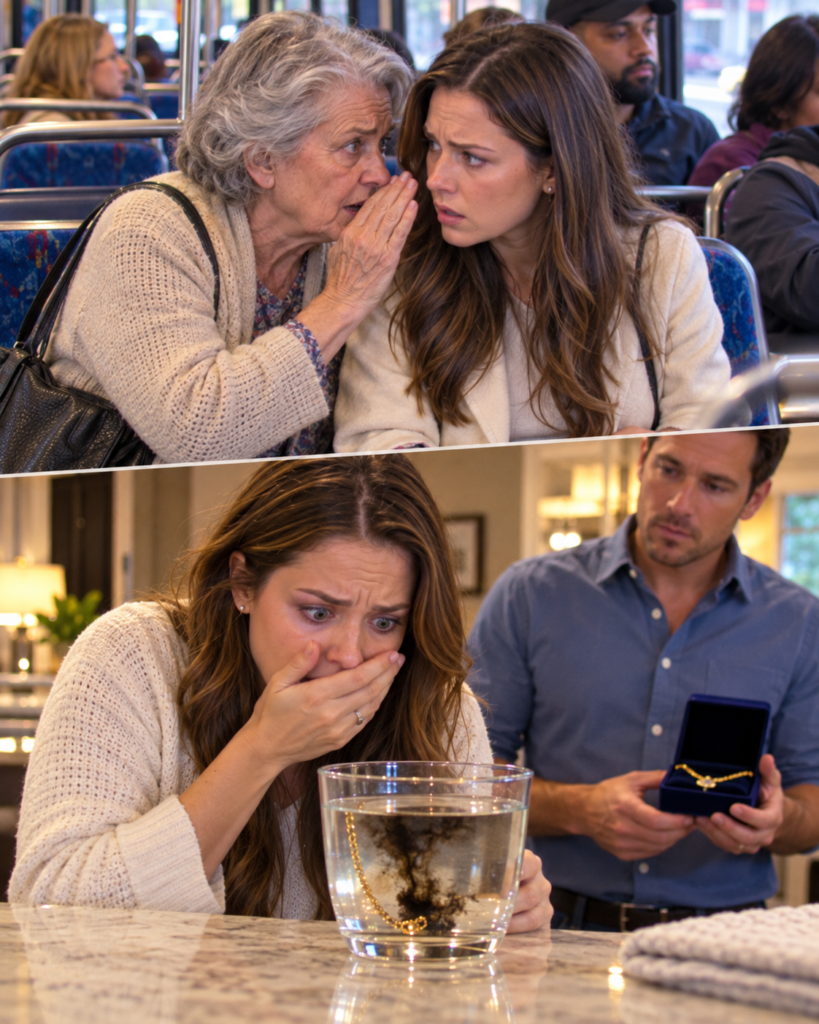
A week later, my husband showed up with a velvet box. I smiled, thanked him, and that night, I left the necklace soaking in a glass of water… By morning, the water had revealed something terrifying.
PART 1
“When your husband gives you a necklace, don’t wear it. Put it in a glass of water overnight.”
Morgan thought she had misheard.
The elderly woman who had just said it was sitting in the seat Morgan had given up for her on the CTA bus a few minutes earlier. She wore a grey trench coat and a green beret, smelling faintly of lavender.
“Excuse me?” Morgan asked.
The woman looked up, her gaze piercing. “Listen to me, child. A glass of water. All night.”
Morgan felt a sudden chill as the old woman added, “And don’t tell your husband.”
Before Morgan could ask how she even knew she was married, the bus announced her stop near Oak Park. Morgan stepped off almost on instinct. When she turned back, the woman was staring straight ahead as if they had never spoken.
Walking to the apartment she rented with her husband, Morgan tried to convince herself that she had just run into a eccentric stranger. At thirty-six, she was used to a predictable, routine life. She worked as an assistant accountant for a small construction firm in Chicago, commuted nearly an hour on public transit daily, and paid almost all the household expenses with her salary.
Her husband, Julian, had spent the last two years jumping from one failed business venture to another. First, it was selling auto parts online. Then it was day-trading, a logistics partnership, and “can’t-miss” import opportunities that just needed a little startup capital.
The money never came. Yet Morgan kept paying the rent, groceries, utilities, and even Julian’s credit card debts.
There was only one thing she had refused to compromise on: her grandmother’s cottage in Door County, Wisconsin.
It was a modest property with a fruit orchard and an old screened porch where Morgan had spent her childhood summers. Her grandmother, Clara, had left it to her in her will.
For months, Julian had been badgering her to sell it.
“We could easily get $450,000 for it,” he’d argue. “Why let a property sit empty?”
“Because it was my grandmother’s.”
“Memories don’t pay the bills, Morgan.”
Morgan always shut down the conversation right there.
A week after that strange encounter on the bus, she came home to find something even stranger. Julian was waiting for her—clean-shaven, wearing cologne, and dressed in a new button-down shirt.
“I have a surprise for you,” he said warmly.
From behind his back, he produced a small, navy blue velvet box. Morgan stopped breathing for a second. Inside lay a delicate, elegant gold chain necklace.
Instantly, that voice echoed in her head: “When your husband gives you a necklace, don’t wear it.”
“Put it on,” Julian smiled, stepping toward her. “I want to see how it looks.”
Morgan looked at him. There was an intense, overly eager glint in his eyes.
“Tomorrow,” she said gently. “I had a brutal day at work, and I just want to shower.”
For a fraction of a second, Julian’s smile vanished completely before he forced it back.
Late that night, while Julian was glued to his computer in the spare room, Morgan went to the kitchen. She filled a glass with water and carefully lowered the necklace into it. She hid the glass deep inside a corner cabinet behind a Dutch oven Julian never touched.
At six the next morning, Morgan opened the cabinet and pulled out the glass.
The water was no longer clear. It had turned a murky, yellowish tint. A thick, viscous film was seeping from the tiny latch clasp of the chain, as if something hidden inside the hollow metal was slowly dissolving into the liquid.
Morgan’s knees went weak. At that exact moment, she heard footsteps coming down the hall.
It was Julian.
PART 2
Morgan quickly covered the glass with a small plate and slipped it back into the dark corner of the cabinet.
Julian walked into the kitchen a few seconds later. “Why are you up so early?”
“Month-end financial reporting,” she said, keeping her voice steady. “I need to beat the rush hour traffic.”
Julian yawned, opened the fridge, and then looked directly at her bare neck. “Where’s the necklace?”
Morgan pretended to look through her purse. “The clasp felt a little loose. I thought I’d take it to a jeweler near my office to get it checked before I wear it.”
Julian’s face tightened. “There’s nothing wrong with it,” he said, a little too quickly. “It’s brand new.”
Morgan offered a faint smile. “Then it’ll only take them a minute.”
She left the apartment carrying the glass, sealed inside a leak-proof container in her tote bag. Instead of going straight to work, she took it to an independent toxicology lab in the city. The technician took a preliminary look and strongly advised her not to touch the liquid, taking both the container and the necklace for specialized chemical analysis.
“Put it in a glass of water.”
Julian was formally indicted on charges of attempted murder, dangerous poisoning, and financial fraud. Facing overwhelming forensic evidence and digital paper trails, his defense collapsed.
Morgan filed for divorce immediately. She packed Julian’s belongings into boxes and handed them over to his brother. She cleared his name off her lease, changed her bank accounts, and secured her grandmother’s cottage under an irrevocable land trust.
A month after the arrest, Morgan drove up to Door County.
The air was crisp and smelled of pine and lake water. She unlocked the front door of the cottage, opening the windows to let the breeze flow through the rooms. For the first time in years, the weight on her chest was gone.
She sat on the screened porch where her grandmother used to sew, holding a warm cup of coffee. She realized that she had survived not by luck, but because of a bond that spanned decades—a promise kept between two old friends long after one of them had passed away.
A mother or grandmother’s love doesn’t always end when they leave this world. Sometimes, it leaves behind guardians who remember to look out for us when we need it most.
PART 3
The trial of Julian Vance was swift, though to Morgan, every second felt like a drop of molten lead.
The independent toxicology lab’s report had painted a picture so chilling that even the prosecuting attorney had paused while reading it aloud in the courtroom.
The gold chain necklace—ostensibly a romantic gift—was hollowed out with microscopic precision. Sealed within its delicate links was a concentrated, highly volatile organic neurotoxin, a lethal compound engineered to leach slowly upon contact with human sweat or body heat, mimicking a sudden, catastrophic heart attack within forty-eight hours of wear.
There was no antidote, no trace of foul play suspected by standard medical examiners, and no survivors.
Julian sat at the defense table, his tailored suit hanging slightly loose on his frame, his expression shifting between cold defiance and feigned bewilderment.
His defense attorney tried desperately to paint the findings as a bizarre setup, arguing that Morgan had manufactured the evidence herself to escape their marriage and seize sole ownership of her assets.
But the digital forensics told a completely different story.
Investigators uncovered a labyrinth of dark web transactions linked directly to Julian’s secondary cryptocurrency wallets. There were encrypted forums where he had consulted underground chemists, asking specific questions about lethal dosages, transdermal absorption rates, and undetectable poisons.
Furthermore, financial records revealed that Julian had taken out a massive, multi-million-dollar life insurance policy on Morgan six months prior—naming himself as the sole irrevocable beneficiary. He had forged her signature with chilling precision.
When the jury returned with their verdict after less than two hours of deliberation, the word Guilty echoed through the solemn courtroom on all counts: attempted murder, aggravated poisoning, and wire fraud.
As the bailiffs placed the cold steel cuffs around Julian’s wrists, his eyes locked onto Morgan across the aisle.
There was no remorse in them—only a venomous, burning hatred that made her blood run cold.
As he was hauled away toward the holding cells, he whispered a final, soundless promise through gritted teeth:
“This isn’t over.”
Morgan closed her eyes, letting out a long, shuddering breath that she felt she had been holding for the last ten years of her life.
The nightmare of the city, of the suffocating apartment, of the constant dread, was finally over.
Or so she foolishly believed.
PART 4
Two years slipped by like shifting sand.
Morgan had rebuilt her life from the ashes. She resigned from the construction firm, taking on freelance accounting clients that allowed her to work remotely from the sanctuary of her grandmother Clara’s cottage in Door County.
The rustic wooden floors, the scent of blooming apple trees in the spring, and the gentle lapping of the lake waves against the shore became her therapy.
She walked the orchard paths every evening as the sun dipped below the horizon, feeling safe, anchored, and profoundly free.
Julian had been sentenced to thirty-two years at a maximum-security federal penitentiary upstate. The physical threat was locked behind concrete walls and razor wire.
Yet, trauma has a way of casting long, twisting shadows over the sunniest days.
Even with locks reinforced and security cameras installed around the perimeter of the cottage, Morgan occasionally woke up in the dead of night, heart hammering, convinced she could hear heavy footsteps crunching on the gravel driveway.
It was late October when the crisp autumn air turned fierce, stripping the last golden leaves from the apple trees and howling through the eaves of the old house.
A heavy storm had knocked out the local power grid, plunging the entire peninsula into pitch-black darkness.
Morgan lit a cluster of beeswax candles on the wooden dining table, the flickering flames casting long, dancing shadows across the vintage wallpaper.
She wrapped herself in a thick wool shawl, brewing a cup of chamomile tea on the gas stove, trying to soothe the inexplicable knot of dread tightening in her stomach.
Then, she heard it.
It wasn’t the wind.
It was the distinct, muffled crunch of heavy boots on the wet gravel outside the back porch screen door.
Morgan froze, her mug halfway to her lips.
Every instinct she possessed screamed at once.
She crept toward the hallway, her bare feet silent against the floorboards, and peered through the living room window into the gloom of the courtyard.
Parked near the edge of the tree line was a rusted, unmarked sedan, its headlights extinguished.
Standing right on the screened porch, silhouetted against the pale moonlight breaking through the storm clouds, was a tall, broad-shouldered figure.
It wasn’t Julian—he was behind bars.
But as the figure stepped closer to the glass pane, the lightning flashed, illuminating a face twisted in a feral, fanatical grin.
It was Julian’s younger brother, Aaron—the same man to whom Morgan had handed Julian’s packed boxes two years ago.
Aaron had spent the entire trial whispering threats in the courthouse corridors, blaming Morgan for destroying his family, defending Julian’s actions as “business desperation,” and vowing that the debt would be paid in full.
A heavy metallic thud echoed through the house.
Aaron was slamming a heavy crowbar against the old wooden frame of the back door. The ancient latch groaned under the assault.
Panic threatened to swallow Morgan whole, but years of surviving Julian’s psychological warfare had forged an inner resilience she didn’t know she possessed.
She didn’t run.
She didn’t cower.
Quietly and with deadly precision, Morgan bolted the heavy oak interior deadbolt, grabbed her grandmother’s heavy iron fireplace poker from the hearth, and dialed 911 on her cell phone, whispering her exact address to the dispatcher as the wooden door splintered inward with a deafening crack.
“Door County Sheriff’s Office, stay calm, deputies are three minutes away!” the dispatcher’s voice cracked through the receiver.
Aaron stepped into the dim kitchen, panting heavily, holding the iron crowbar like a weapon of execution.
His eyes scanned the darkened rooms until they locked onto Morgan standing near the hallway archway, holding her ground with the iron poker gripped tightly in both hands.
“You ruined everything!” Aaron snarled, taking a menacing step forward, spittle flying from his lips.
“My brother rotting in a cage while you live out here in paradise? Time to settle the ledger, bitch.”
He lunged forward with the crowbar raised high.
Time seemed to dilate.
In that split second, as Aaron rushed her, Morgan didn’t feel fear.
She felt the phantom scent of lavender in the air—a sudden, comforting warmth wrapping around her shoulders like a heavy woolen blanket.
It was the presence of her grandmother Clara, reminding her of the bus ride, the warning, and the strength that had carried her this far.
As Aaron swung the crowbar in a vicious arc aimed at her head, Morgan ducked fluidly beneath the blow, utilizing the momentum of her accountant’s training—precise, calculated, and uncompromising.
She swung the heavy iron poker upward with all her remaining strength, striking Aaron squarely across the wrist.
A sickening crack echoed through the kitchen as Aaron screamed out in agony, dropping the crowbar onto the hardwood floor.
Before he could recover his balance, Morgan delivered a swift, merciless kick to his knee, sending him crashing down hard onto the floorboards, gasping for air.
Sirens wailed in the distance, cutting through the howling storm, their red and blue emergency lights painting the kitchen walls in flashing hues.
Within moments, heavy boots pounded up the front steps, and the front door was kicked wide open by county deputies shouting commands.
“Sheriff’s Office! Don’t move!”
Aaron was pinned to the floor, handcuffed, and hauled away into the freezing autumn rain.
An hour later, the commotion had settled.
The deputies had taken Morgan’s statement, collected the broken door frame as evidence, and departed, leaving a security cruiser parked at the edge of the driveway to watch over the property through the rest of the night.
Morgan sat back down at the kitchen table.
The storm was finally beginning to pass, the wind subsiding into a gentle sigh among the branches of the apple orchard.
She picked up her lukewarm cup of chamomile tea, took a slow sip, and looked out the window toward the dark, starlit expanse of Lake Michigan.
The shadows of the past had finally been swept away by the morning light—not just of a new day, but of a new life entirely her own.
She was bruised, she was battle-scarred, but she was unbroken.
And as she touched the empty space around her neck where the poisoned gold chain had once threatened to end her story, Morgan smiled softly into the dark, whispering a quiet thank-you to the ghosts who still watched over her.