“Mommy… the little fish won’t stop swimming.”
Her pajamas were soaked with sweat, and strands of blond hair clung to her forehead while tears slid silently down her cheeks.
For one sleepy second, I thought she had suffered a nightmare.
Lily had always described dreams in strange, vivid ways, turning thunder into giant footsteps and shadows into animals hiding beneath her bed, so the little fish sounded like something her frightened mind had invented.
I pushed back the covers and held out my arms. “Come here, sweetheart.”
She took two unsteady steps before folding against me.
Her body felt damp and shaky, but when I touched her forehead, she did not seem feverish.
I carried her to the bed, tucked her against my chest, and tried to understand what she was telling me.
“Where are the fish?” I asked.
“In my tummy.”
She pressed her palm harder against her abdomen.
Then she screamed.
It was not the startled cry of a child waking from a bad dream or the sharp complaint that followed a scraped knee.
It was a deep, helpless sound that seemed to tear through her before it reached me.
I lifted her again immediately.
“Where does it hurt, Lily?” She pointed weakly toward the center of her stomach.
“The little fish keep biting me.”
That was when fear pushed the last of the sleep from my mind.
My husband, Daniel, was in Dallas for a business conference, and the quiet house suddenly felt much larger than it had a few minutes earlier.
I called his phone once while holding Lily against my shoulder, but the call went unanswered.
I did not wait for him to call back.
I wrapped Lily in a blanket, slid my feet into the first shoes I could find, grabbed my purse and keys, and carried her through the dark house toward the car.
Outside, the neighborhood was still, with porch lights glowing over empty driveways and parked family cars.
I buckled Lily into the back seat, arranged the blanket around her, and drove toward the nearest emergency room with both hands locked around the steering wheel.
During the entire drive, she stayed curled into a ball.
Every few minutes, I looked at her in the rearview mirror and asked whether she could hear me.
She always answered, but her voice became quieter each time.
“The fish are moving again,” she whispered.
I kept telling her we were almost there, even when I knew we still had several dark intersections ahead of us.
By the time I pulled beneath the bright emergency entrance, I was shouting for help before I had fully opened the car door.
A nurse brought a wheelchair, but Lily cried when anyone tried to straighten her legs, so I carried her inside myself.
The waiting room smelled of disinfectant and burnt coffee, and every sound seemed unnaturally clear—the squeak of rubber soles, the rattle of a cart, the low voice of someone speaking behind the intake desk.
The triage nurse took one look at Lily’s face and brought us through the double doors without asking us to sit down.
Within minutes, Lily was in a hospital bed with a paper wristband around her arm while medical staff asked me questions I struggled to answer.
Had she fallen?
Had she vomited?
Not that I had seen.
Had she eaten anything unusual?
No.
Did she have access to medication, batteries, coins, cleaning products, or small toys?
Not that I knew of.
I was her mother, the person who packed her lunches, checked her bathwater, cut grapes into smaller pieces, and woke whenever she coughed in the night, yet I could not explain what was happening inside her body.
A doctor examined her abdomen and ordered imaging almost immediately.
A technician dimmed part of the room and moved an ultrasound probe across Lily’s stomach while I stood beside the bed holding her hand.
At first, the technician spoke gently, explaining that the gel might feel cold and asking Lily to remain as still as she could.
Then her voice stopped.
Her eyes stayed fixed on the monitor.
She adjusted the probe, changed the angle, and stared again.
“What do you see?” I asked.
She did not answer directly.
“I need to get the physician.”
She set down the probe, wiped her hands, and left the room faster than she had entered it.
Lily looked up at me with exhausted eyes.
“Are the fish there?”
I forced myself to smile and squeezed her fingers.
“The doctors are figuring it out.”
The attending physician returned with another staff member and studied the monitor without speaking.
He asked for an X-ray and then stepped into the hallway.
Through the partly open door, I watched him walk to the nurses’ station and pick up the phone.
His voice was low, but the words carried through the quiet corridor.
“I need to report a suspected child abuse case,” he said.
My breath caught.
“We’ve found multiple foreign objects inside a minor.”
For a moment, I could not connect the sentence to Lily.
Foreign objects sounded like something from another room, another family, another emergency.
Then the doctor looked through the doorway at me, and the floor seemed to shift beneath my feet.
“What objects?” I asked when he returned.
“We need additional imaging before I explain further.”
His calm tone did nothing to calm me.
“Is she going to be okay?”
“We are moving quickly.”
It was the kind of answer that revealed urgency without offering comfort.
A nurse stayed with Lily while I followed another staff member into the hall to answer more questions.
They asked who lived in our home, who watched Lily, whether she attended school, whether she had siblings, and who had been with her during the previous several days.
I answered each question as clearly as I could.
Lily lived with Daniel and me.
Daniel was away at a conference.
I was her primary caregiver.
No, I had never seen her swallow anything unusual.
No, she had never complained about fish in her stomach before that night.
Less than fifteen minutes later, two police officers entered the emergency department.
One remained near the nurses’ station while the other approached me with a measured expression.
“Are you Lily’s mother?”
“Yes.”
“Are you her primary caregiver?”
“I am.”
He asked me to come with him to a private consultation room.
I looked toward Lily’s door.
“I’m not leaving the hospital.”
“You’re not being asked to leave,” he said. “We need to understand what happened.”
Surgeons were already preparing Lily for emergency treatment when I sat across from a detective at a small table.
The room contained two chairs, a box of tissues, and a wall clock whose second hand seemed louder than it should have been.
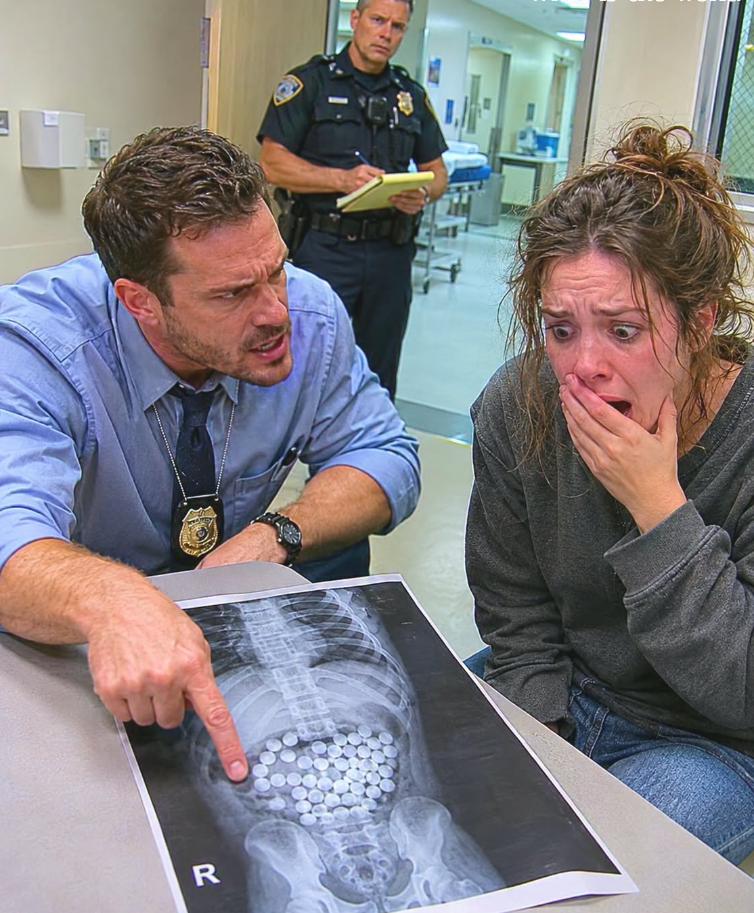
The detective placed an X-ray in front of me.
Lily’s tiny abdomen was filled with bright metallic circles clustered together in a pattern that looked impossible.
I leaned closer, waiting for the image to make sense.
It did not.
“What are those?”
“Magnets,” he said.
I looked from the X-ray to his face.
“How many?”
“Thirty-six.”
The number struck me harder than the word.
One magnet could have been a terrible accident.
Thirty-six demanded an explanation I did not have.
The detective pointed carefully toward the clustered circles.
“These appear to be high-powered magnets. When more than one is swallowed, they can attract each other through different sections of the intestines.”
He paused before continuing.
“That pressure can cut off blood flow, damage tissue, or cause a tear. It can become life-threatening.”
My eyes returned to the X-ray.
Thirty-six bright circles sat inside the outline of my daughter’s body while she was being taken toward surgery somewhere beyond the wall.
“Do you know how they got there?” he asked.
“No.”
“Does your family own magnets like these?”
“We don’t even have anything like that in the house.”
“Could they have come from a toy?”
“I don’t know.”
“Was Lily alone at any point yesterday?”
I tried to reconstruct the day, but panic kept breaking the timeline into disconnected pieces.
Breakfast.
Laundry.
Lily coloring at the dining room table.
A snack.
Her toys spread across the floor.
Nothing in those ordinary hours explained the objects inside her.
The detective watched me without raising his voice.
“You said you’re with your daughter most of the time.”
“Yes.”
“And your husband is currently out of town?”
“Yes. He’s in Dallas.”
The accusation had not been spoken, but it was already in the room.
I could feel it in the pauses between his questions and in the way every ordinary part of motherhood was being examined from a different angle.
Being Lily’s primary caregiver had always meant I was responsible for her meals, her safety, her routines, and the small problems she could not solve alone.
Now the same responsibility made me the person closest to an injury no one could explain.
I asked to call Daniel again.
This time, he answered.
I told him Lily was in surgery and that doctors had found thirty-six magnets inside her body.
For several seconds, he said nothing.
Then his breathing changed.
“I’m coming home.”
The call ended before either of us discussed how such a thing could have happened.
The hours that followed blurred together beneath fluorescent lights.
I moved between the consultation room and the surgical waiting area while officers continued asking questions and hospital staff gave me updates that were careful but incomplete.
I signed forms with a shaking hand.
I drank water without tasting it.
I stared at the doors through which Lily had disappeared and kept remembering the way she had described her pain.
Little fish swimming inside her.
Little fish biting her.
She had been trying to explain something no five-year-old had words for.
When a doctor finally came to speak with me, I stood so quickly that the chair scraped behind me.
He explained that the magnets required emergency treatment and that the medical team was doing everything necessary to protect her from further damage.
I asked whether she would recover.
He gave me the most reassuring answer he could without making a promise.
They had acted quickly, he said, and she was being closely monitored.
Relief came in a thin, fragile wave that never fully reached the fear underneath it.
The police remained at the hospital.
Their presence reminded me that saving Lily and determining what had happened were now two separate emergencies unfolding in the same building.
By the time Daniel arrived, morning light had begun pressing against the hospital windows.
He came through the corridor still dressed like a man who had traveled in a hurry, carrying the tension of the trip in his shoulders.
I stood when I saw him.
For one desperate second, I expected him to cross the space between us, put his arms around me, and ask about Lily.
I expected us to face the nightmare together.
He did not hug me.
He did not ask whether the surgery had worked.
He did not ask whether Lily had awakened or whether she was still in danger.
He stopped several feet away and looked directly into my eyes.
“What did you do to her?”
The words landed harder than any question the detectives had asked.
They were not cautious or procedural.
They came from my husband, the person who knew how closely I watched Lily, how often I checked locks and medicine bottles, and how quickly I woke when our daughter called from the next room.
“What did I do?” I repeated.
“You were with her.”
His voice was tight, controlled, and full of something I could not immediately name.
“They found thirty-six magnets inside her, and you were the one at home.”
I felt anger rise through the exhaustion.
I wanted to tell him that I had carried Lily to the car, driven through the dark while she cried, answered questions for hours, and stood outside an operating room believing I might lose her.
I wanted to ask why his first instinct was to accuse me instead of checking on his daughter.
I wanted to shout until every person in the corridor understood what his question had done.
Instead, I looked past him toward the detectives.
A memory surfaced from the ordinary afternoon I had struggled to reconstruct.
The small green light in the dining room.
The camera.
“We have a security camera at home,” I said.
Daniel’s expression changed slightly.
“It’s in the dining room,” I continued. “It records every afternoon while Lily eats and plays.”
One detective stepped closer.
“Is the footage stored?”
“Yes. The app keeps saved files.”
Daniel’s jaw tightened.
I noticed it because I was looking directly at him, waiting for him to welcome the one thing that might show exactly what had happened.
He said nothing.
“Please review all of it,” I told the detectives. “Don’t take my word for anything. Watch the footage.”
I believed the recording would prove that I had never handed Lily those magnets and had never watched her swallow them.
At that moment, proving my own innocence felt almost secondary to understanding how thirty-six dangerous objects had entered my daughter’s body inside a home where she was supposed to be safe.
One detective asked for access to the camera application.
I opened it with unsteady fingers and gave him the phone.
He scrolled through the saved recordings, checking dates and time markers while the second detective stood beside him.
Daniel remained across from me.
The hospital corridor continued moving around us, with nurses passing, carts rolling, and doors opening and closing, yet the small phone screen seemed to hold everyone’s attention.
The detective selected the recording from the afternoon before Lily became sick.
The dining room appeared on the screen.
There was the table where Lily colored and ate snacks.
There was the chair she usually pulled too close to the edge.
There was the ordinary room I had walked through countless times without imagining it would become evidence.
The detective increased the volume, enlarged the image, and began moving through the footage carefully.
Minutes passed on the recording.
Lily appeared in the frame, small and familiar, occupied with the quiet routines of an ordinary afternoon.
I watched her movements, searching for anything unusual.
Every time her hand moved toward the table, my stomach tightened.
Daniel shifted beside me.
The detective slowed the recording.
Then his hand stopped above the controls.
Someone had entered the dining room frame.
The figure moved into view with enough clarity that the detective leaned closer to the screen.
The second detective looked at him, then at Daniel.
I followed their gaze.
The expression on Daniel’s face was no longer the same one he had worn when he accused me.
The detective replayed the moment once, watching the person enter the room again.
Then he paused the footage.
He looked directly at Daniel, and the question in his eyes was different from every question the police had asked me that morning.
I had demanded that they watch the recording because I believed it would prove what I had not done.
I had never considered that it might reveal who had been close enough to Lily to do something none of us were prepared to explain.