My name is Megan Whitlock, and I’d spent most of my life being the daughter my parents never bragged about.
That evening, the Sea Pines Grand Club in Hilton Head glittered with crystal chandeliers, expensive flowers, and champagne glasses.
My mother stood beneath the lights, raising her glass before the string quartet had finished its first song.
“To Major Emily Whitlock!” she announced. “The pride of our family!”
More than a hundred guests applauded.
My younger sister stood beside the stage in her immaculate Army dress uniform, smiling as cameras flashed around her.
Her gold oak leaves gleamed beneath the chandeliers.
“Major before thirty,” a retired colonel remarked. “That’s impressive.”
“Washington will be hearing your name,” another guest added.
Emily laughed modestly.
“I’ve been fortunate to have wonderful mentors.”
I stood near the entrance wearing a dark blazer, black slacks, and simple heels.
Then my mother noticed me.
“Megan!” she exclaimed, hurrying over. “Thank goodness you dressed appropriately.”
I glanced at my clothes.
“What’s wrong with a blazer?”
“Nothing, sweetheart.” She lowered her voice. “But there are important people here tonight.”
Her fingers tightened around my forearm.
“Please don’t start explaining that little office job of yours.”
I stared at her.
“My little office job?”
She sighed.
“You know what I mean. People hear military paperwork and think you’re doing something important. I don’t want anyone confusing your work with Emily’s accomplishments.”
The words hurt more than I wanted to admit.
For years, Emily had been the brilliant daughter, the ambitious soldier, the one destined for greatness.
I was simply the older sister who worked somewhere in defense.
Nobody asked what my responsibilities involved.
Nobody seemed interested.
My mother glanced toward a table of defense contractors.
“Stay near the back, perhaps beside the service hallway. Smile politely, but remember, tonight belongs to Emily.”
I swallowed my response.
“Of course, Mom.”
She patted my arm and hurried away.
For the next forty minutes, I watched my parents introduce Emily to senators, judges, wealthy donors, and decorated officers.
Whenever someone asked about me, my father offered the same explanation.
“Megan does administrative work.”
Then he changed the subject.
I remained near the back, holding a glass of water and pretending their words didn’t sting.
Suddenly, the ballroom doors opened.
Several senior officers straightened immediately.
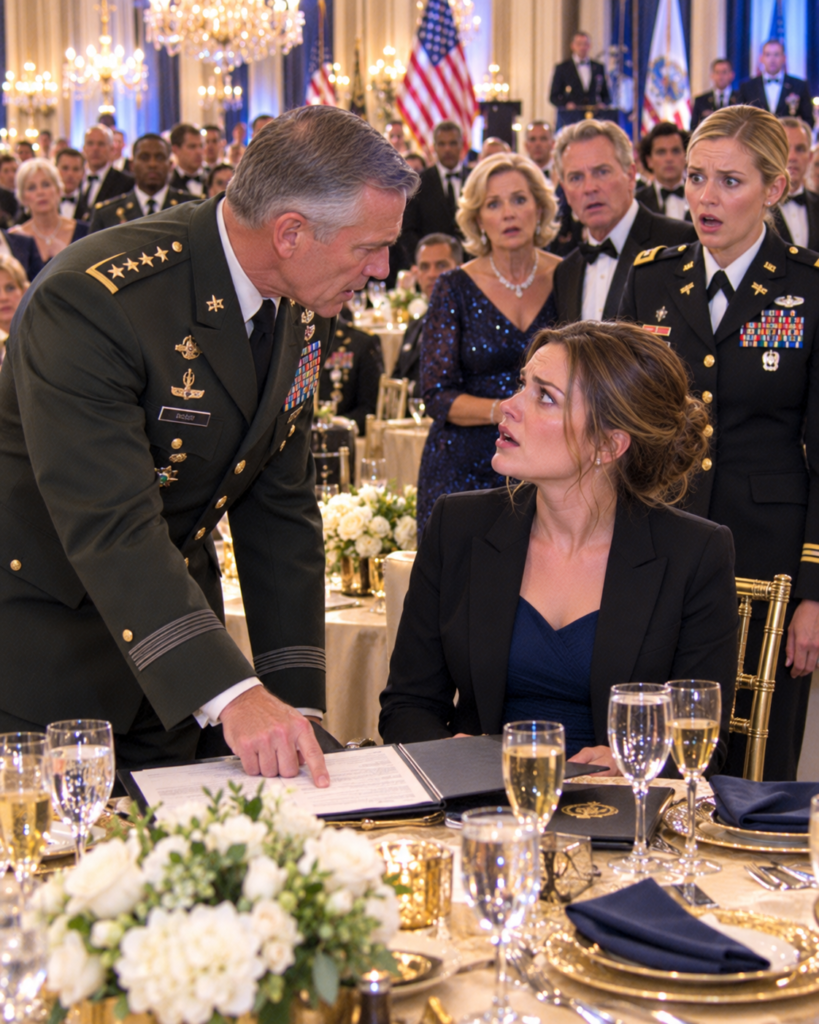
A four-star general entered, accompanied by an aide carrying a folder.
My mother’s face brightened.
Emily adjusted her posture and smiled confidently.
The general exchanged greetings with several guests before accepting the folder.
He opened it.
Read the first page.
Then turned another.
His expression grew serious.
“Major Whitlock,” he said, looking directly at Emily, “this promotion authorization crossed my desk this morning.”
The conversations around us faded.
Emily’s smile tightened.
“Yes, General.”
He studied another page.
“Interesting.”
My mother lowered her champagne glass.
The general looked around the ballroom.
“Who signed this authorization this morning?”
Nobody answered.
I watched Emily glance toward our parents, confusion replacing her practiced smile.
Then the general slowly surveyed the room.
His gaze passed the senators, the defense executives, and the decorated officers.
Finally, his eyes settled on me.
I stood motionless beside the service hallway, still holding my untouched glass of water.
And when the general closed the folder and started walking in my direction, I knew my family was about to discover something they’d never bothered to ask.
NEXT PART and the FULL ENDING are coming. Type ‘YES’ and press ‘LIKE’ so we can post full story. Your [LIKE] helps these honest stories reach the people who need them most. Thank you for the support.
PART 2: The general asked why my signature appeared inside Emily’s promotion file
PART 2: The general stopped several feet away from me.
Up close, he looked older than he had from across the ballroom, perhaps late sixties, with silver hair neatly trimmed above a face marked by years of responsibility. His uniform carried more decorations than I could identify at a glance, but it was his expression that held the room still.
He was not angry.
He was searching.
“Ms. Whitlock,” he said.
The title sounded strange in his voice, as though he had known it for years.
My mother’s champagne glass made a faint clicking sound against its saucer.
“General,” she said quickly, moving toward us, “Megan isn’t involved in Emily’s military career. She’s only—”
“Ms. Whitlock,” he repeated, without looking at my mother, “would you come with me for a moment?”
Every conversation in the ballroom had stopped.
I felt the weight of more than a hundred pairs of eyes turn toward us.
My first instinct was to glance at my parents for permission. It was an old habit, formed long before I understood what it was costing me.
My father’s face had gone pale.
Emily stood perfectly still beside the stage, one hand resting near the buttons of her jacket.
The general waited.
I set my water glass on a nearby table.
“Of course,” I said.
He turned, and I walked beside him.
We moved only a few steps, but the silence made them feel like a long distance. He led me toward an empty alcove near the ballroom windows, where moonlight lay across the polished floor and the dark Atlantic shimmered beyond the glass.
His aide followed, carrying the folder.
The general opened it again.
“Do you know what this is?”
I looked down.
The first page held Emily’s name, rank, unit, and promotion information. Below that were several blocks of text, some stamped and others initialed.
“I assume it’s Major Whitlock’s promotion authorization.”
“It is.” He turned one page. “Do you recognize this?”
My eyes moved over a paragraph of technical language.
It described a classified logistics modernization initiative, a joint Army and civilian defense project involving supply-chain security, deployment readiness, and emergency response systems.
I recognized the wording immediately.
Not because I had seen the file.
Because I had written much of the language myself.
My breath caught.
“That’s from the Sentinel North assessment,” I said.
The general’s eyes sharpened.
“You know the project?”
“I know the assessment. My office completed the civilian integration review last year.”
“Your office?”
I hesitated.
“My division at the Defense Systems Analysis Agency.”
The general looked toward the ballroom, where my father was now speaking urgently to an older colonel.
Then he looked back at me.
“Your official position?”
“Senior program analyst.”
The general’s aide made a small note.
I had the sudden, absurd awareness that my mother’s voice was still echoing in my mind.
Little office job.
Administrative work.
Stay near the service hallway.
The general tapped a signature at the bottom of the page.
“Is this yours?”
I leaned closer.
There it was.
My name, written in the slanted hand I had used since college.
Megan Elise Whitlock.
Beneath it appeared my title, followed by an authorization code.
My mouth went dry.
“I signed a review memo,” I said carefully. “Not a promotion authorization.”
“This document cites your review as the basis for Major Whitlock’s accelerated promotion.”
I looked at him.
“That can’t be right.”
“Why not?”
“Because I never recommended Emily for promotion.”
Behind us, someone inhaled sharply.
The general closed the folder halfway.
“Then perhaps you can explain why your name appears beneath a statement declaring that Major Emily Whitlock demonstrated exceptional leadership in the Sentinel North initiative.”
I read the paragraph again.
The words were polished, formal, and unmistakably flattering.
Major Whitlock had displayed unusual judgment under pressure.
She had coordinated competing agencies.
She had identified vulnerabilities before they became operational failures.
She had gained the confidence of senior civilian analysts.
I knew the project.
I knew Emily had been assigned to the military liaison team.
But I also knew she had not done those things.
At least, not alone.
And the sentence about civilian analysts unsettled me most of all.
“General,” I said, “I helped prepare the assessment, but I did not write this statement.”
The general studied my face.
“Did you sign any document connected to the assessment?”
“Yes. Several.”
“Did you authorize anyone to use your signature?”
“No.”
His aide looked up. “Ma’am, may I ask when you last reviewed your personnel access records?”
“Three months ago.”
“Did you report any irregularities?”
“No.”
The general exchanged a glance with him.
It was brief, but I saw it.
There was more in the folder than a mistaken citation.
My mother approached then, accompanied by my father.
“General,” she said, forcing a smile, “I’m afraid there’s been some confusion. Megan is very capable, but she’s not a decision-maker in matters concerning Emily’s promotion.”
The general turned to her.
“Mrs. Whitlock, I’m not discussing family opinions. I’m asking about a document bearing your daughter’s signature.”
My mother’s smile faltered.
“I’m sure Megan must have misunderstood something.”
“I rarely misunderstand my own signature,” I said.
My voice was quieter than I intended, but it carried.
My father stepped in.
“Megan, perhaps you should let the general speak with Emily. This is her evening.”
The words landed with familiar force.
This is her evening.
As if truth had an appropriate schedule.
As if my existence became inconvenient whenever Emily stood beneath a spotlight.
The general’s gaze shifted to him.
“Mr. Whitlock, your daughter’s name appears in a promotion file that I reviewed because of an unresolved discrepancy. Her explanation is relevant.”
My father stopped speaking.
For the first time that evening, nobody told me where to stand.
Emily crossed the room.
Her expression had changed completely. The confident smile was gone, replaced by a crease between her brows.
“What discrepancy?” she asked.
The general opened the folder to another page.
“Your authorization was submitted through a restricted review channel. The recommendation references an analyst who was not listed as a member of your command team.”
Emily looked at me.
I watched recognition move across her face.
“You,” she said.
“I didn’t submit this.”
“I know.”
Her answer came immediately.
That surprised me more than anything else.
The general studied her.
“You know?”
Emily nodded slowly.
“I know Megan didn’t recommend me.”
My mother stared at her.
“Emily.”
“No, Mom.” Emily kept her eyes on the general. “Megan and I worked on the Sentinel North project, but she never told me she was putting my name forward. In fact, she wasn’t involved in my promotion package.”
The room seemed to draw another breath.
My father’s face hardened.
“Emily, be careful.”
She finally looked at him.
“I am being careful.”
Something passed between them, some silent warning or plea. I couldn’t tell which.
The general turned a page.
“Major, your unit submitted this package six weeks ago. It was routed through the Office of Strategic Readiness. The recommendation was supported by three senior officers and one civilian reviewer.”
He looked at me.
“That reviewer was listed as Megan Whitlock.”
“I didn’t see this.”
“Then someone used your credentials or replicated your signature.”
Emily’s eyes widened.
“Are you saying my promotion might be invalid?”
“No,” the general said. “I’m saying the process may have been compromised. The distinction matters.”
A murmur passed through the ballroom.
The word compromised seemed to spread from table to table.
My mother lowered her voice.
“General, surely this can be handled privately.”
“It will be handled properly.”
“That’s all we want.”
“No,” I said.
The word escaped before I could stop it.
My mother turned toward me.
I felt my hands begin to tremble, so I folded them together.
“No,” I repeated. “What we want is the truth.”
The general said nothing, but his expression softened slightly.
Emily looked at me with something I hadn’t seen in years.
Not pity.
Regret.
The general’s aide removed a smaller envelope from the folder.
“We also found a discrepancy in the access log,” he said. “The recommendation was opened from a terminal assigned to the Defense Systems Analysis Agency.”
My stomach tightened.
“Which terminal?”
He glanced down.
“Terminal 4B-17.”
I knew that number.
It was assigned to my office.
Not my department.
My desk.
The room seemed to tilt.
“That terminal was in my old office,” I said.
“Old?”
“I transferred divisions two months ago. The terminal remained assigned to my profile until the system migration was completed.”
The aide looked at the general.
“Was anyone else authorized to use it?”
“Everyone in the unit had physical access to the room,” I said. “But not to my credentials.”
The general closed the folder.
“Ms. Whitlock, I’d like you to come to Washington tomorrow morning.”
My mother’s eyes widened.
“Tomorrow?”
“Yes.”
“General, she has a full-time position here.”
“So does the matter under discussion.”
My father took a step forward.
“She cannot simply leave in the middle of—”
“Mr. Whitlock,” the general said, still calm, “your daughter is not being accused of wrongdoing. She is being asked to clarify evidence associated with her identity.”
That sentence changed the air around us.
Until then, I had been the embarrassing daughter whose job nobody understood.
Now the general was speaking to me as though my work carried weight.
My father looked away.
Emily moved closer.
“General,” she said, “may I accompany her?”
He considered the request.
“You may attend the initial review if your commanding officer approves it.”
“I’ll obtain approval tonight.”
The general nodded.
Then he handed the folder to his aide.
“Before we leave, there is one more matter.”
He turned toward the assembled guests.
The room had become so quiet that the string quartet had stopped playing.
“My apologies for interrupting the celebration,” he said. “Major Whitlock’s promotion remains under review pending verification of the supporting documentation. Until that review is complete, no one should make assumptions about the validity of her service record.”
Emily’s shoulders stiffened, but she did not protest.
The general continued.
“And Ms. Megan Whitlock’s contribution to the Sentinel North assessment is not administrative. She served as the lead civilian analyst for the interagency risk review.”
A few people looked toward me.
The retired colonel who had praised Emily earlier stared openly.
My mother’s face lost what little color remained.
The general’s voice remained even.
“The assessment she led prevented a significant readiness failure during last year’s emergency exercise. Her work was recognized internally, though apparently not explained accurately this evening.”
Nobody spoke.
I thought of all the times my father had said, Megan does administrative work.
All the times my mother had smiled apologetically and changed the subject.
All the years I had accepted their description because arguing seemed more exhausting than being misunderstood.
The general nodded to me.
“We’ll see you in Washington at nine.”
Then he turned and walked toward the ballroom entrance.
His aide followed.
For several seconds, no one moved.
Then the quartet began playing again, softly and uncertainly, as if music could restore the evening to what it had been.
It couldn’t.
Guests returned to their conversations, but their voices carried a new caution. The celebration had not ended, exactly. It had become something else.
Emily stood beside me.
“I’m sorry,” she said.
I looked at her.
“For what?”
“For letting them describe you that way.”
Her voice was low enough that only I could hear.
“You didn’t describe me.”
“I didn’t correct them.”
“You were being celebrated.”
“That doesn’t excuse it.”
I wanted to tell her she had always been the favored one, that she had accepted the attention while I stood at the edge of every room.
But the accusation felt too simple now.
Emily had been raised inside the same family as I had. She had simply been given a different role.
Our parents had taught her that achievement meant keeping everyone proud.
They had taught me that love was easiest when I required nothing.
Neither lesson had been fair.
My father approached us.
“Emily, we need to talk.”
She did not move.
“So do you,” she said.
His eyes flickered toward me.
“This is not the time.”
“When is it?”
“Not in front of everyone.”
Emily glanced around the ballroom.
“Everyone already knows enough to ask questions.”
My mother joined us, her face carefully composed.
“Megan, I hope you understand that your father and I were only trying to protect the family.”
“From what?”
“From unnecessary attention.”
“By pretending my work was insignificant?”
“That isn’t what we meant.”
“It is what you said.”
My father’s jaw tightened.
“Your mother was trying to make the evening comfortable.”
“For whom?”
Neither answered.
Emily folded her arms.
“Did you know Megan led the Sentinel North review?”
My mother’s eyes moved away.
“We knew she worked on it.”
“That’s not what I asked.”
My father looked at Emily.
“Your sister has always been sensitive about her career.”
I felt something inside me go still.
Not hurt.
Not anger.
Recognition.
After years of being told I was too quiet, too private, too easily wounded, I finally understood the pattern. If I objected, I was sensitive. If I stayed silent, my silence became permission.
Emily seemed to understand it too.
“She isn’t sensitive,” she said. “She’s been dismissed.”
My father stared at her.
“You’re making a scene.”
“No. You made a scene when you turned her away from your guests and called her job insignificant.”
My mother’s lips parted.
“Emily.”
“I love you both,” Emily said. “But I’m not going to let Megan carry this alone.”
The words touched something in me that had been guarded for so long I had forgotten it was there.
My mother looked between us.
“We never intended to hurt either of you.”
“I believe you,” I said.
She looked relieved for half a second.
Then I continued.
“But intention doesn’t erase what happened.”
The relief vanished.
A waiter approached with a tray of champagne, hesitated, and moved past us.
The ordinary gesture seemed almost absurd.
Emily touched my arm.
“Can we talk somewhere quieter?”
I nodded.
We left the ballroom through a side door that opened onto a covered terrace. Warm coastal air moved through the palms, carrying the scent of salt and jasmine. Below us, lights reflected across the dark water.
For a while, neither of us spoke.
Then Emily removed the pins from her shoulders and held them in her palm.
“They feel heavier now,” she said.
“You earned your rank.”
“I don’t know if I earned this promotion.”
“That’s what the review will determine.”
She looked at me.
“Did I deserve the things in that letter?”
I thought about it.
“You worked hard. You stayed late. You learned the system quickly. You took responsibility when other people avoided it.”
She waited.
“But you didn’t design the integration model. You didn’t identify the vulnerability in the emergency routing system. You didn’t write the risk assessment.”
“No,” she said. “You did.”
“And several people helped me.”
“But you led it.”
I turned toward the water.
“I thought you knew.”
“I knew you were talented.”
“That’s not the same thing.”
“No.” She looked down at the pins in her hand. “It isn’t.”
The silence between us held years of things neither of us had said.
Finally, Emily spoke.
“Do you remember when we were teenagers and Dad asked what we wanted to be?”
“Yes.”
“You said you wanted to work in public service.”
“I said I wanted to solve problems that affected ordinary people.”
“Dad laughed.”
“He said it sounded vague.”
“He told me I should choose something impressive.”
I glanced at her.
“You chose the Army.”
“I chose the Army because I thought it was the only way to become someone they could respect.”
Her honesty unsettled me.
“You didn’t have to prove anything.”
“I know that now.”
The terrace doors opened behind us.
Our mother stepped outside.
She had removed her necklace and held it in one hand, as though even the jewelry had become too heavy.
“May I join you?”
Emily nodded.
Mother stood beside the railing.
For several seconds, she watched the water.
“When you were little, Megan,” she said, “you used to take apart every appliance in the house.”
I smiled despite myself.
“You were always afraid I’d electrocute myself.”
“I was afraid you’d put it back together incorrectly.”
“I usually did.”
“You did more than that. You kept trying until you understood why it worked.”
She looked at me.
“I should have recognized that.”
“Why didn’t you?”
Her eyes filled, but she did not cry.
“I was afraid.”
The answer was so unexpected that Emily turned toward her.
“Afraid of what?”
“That the world would be unkind to you. That people would overlook you because you were quiet. I thought if I pushed you toward something more conventional, you’d be safer.”
“So you praised Emily instead?”
Mother closed her eyes briefly.
“Emily was easier to understand. She had a clear path. Uniforms, medals, ceremonies. I knew how to explain those things to other people.”
“And me?”
“You frightened me.”
I stared at her.
“Why?”
“Because you were capable in ways I didn’t understand. You saw problems everyone else ignored. You asked questions that made people uncomfortable. I worried that the world would punish you for being right.”
The confession did not repair anything.
But it gave the old wound a shape.
My mother had not believed I was insignificant.
She had believed I was difficult to protect.
So she had made me smaller in public, hoping smallness would keep me safe.
It had only made me lonely.
“I didn’t need you to protect me from being seen,” I said. “I needed you to stand beside me.”
She nodded.
“I know.”
Emily looked toward the ballroom.
“What about the promotion file?”
Mother’s expression changed.
“I don’t know.”
“Dad does,” Emily said.
Mother stiffened.
“Why would you say that?”
“Because he kept asking whether Megan had access to the review system.”
I looked at her.
“What?”
Emily turned to me.
“Two weeks ago, Dad called me after my commander mentioned that the civilian recommendation had been difficult to verify. He asked whether you had reviewed my package.”
“I didn’t know there was a package.”
“He said you must have signed something.”
My mother’s face tightened.
“Your father was only trying to understand the process.”
“Did he know about the file?” I asked.
She looked down.
“I don’t know.”
It was not an answer.
The terrace door opened again.
My father stepped outside.
His face looked older than it had an hour before.
“Your mother should not have said anything.”
Emily faced him.
“Did you submit the recommendation?”
“No.”
“Did you ask someone to use Megan’s credentials?”
His expression changed—not outrage, but shock.
“Of course not.”
“Then what do you know?”
He looked at me.
“I received a call from a man at the Office of Strategic Readiness. He said Emily’s promotion package needed additional civilian support. He asked whether Megan had completed the Sentinel North assessment.”
“Who was he?”
“I don’t remember.”
“You don’t remember?”
“It was a brief call.”
“Did you give him my office information?”
My father hesitated.
The pause answered before he did.
“I told him where you worked.”
The ocean wind moved between us.
“Why?”
“He said he needed to confirm your involvement. I thought it would help Emily.”
“You gave a stranger information about my position?”
“I didn’t know he was a stranger. He used official channels.”
“Did you send him anything?”
“No.”
“Did you tell him how to reach my terminal?”
My father rubbed his forehead.
“I may have mentioned that your department still had the old workstation.”
Emily looked at him with disbelief.
“You may have mentioned it?”
“I was trying to help.”
“You were trying to make me look qualified using Megan’s work.”
“I never asked anyone to forge anything.”
“But you opened the door.”
My father looked at me.
“I thought you’d be pleased.”
I almost laughed, though nothing was funny.
“Pleased that my name appeared on a document I had never seen?”
“Pleased that your work was finally being recognized.”
“Then why did you tell everyone I did administrative work?”
He had no answer.
The ballroom music continued behind us, muted through the closed doors.
My father’s shoulders lowered.
“I didn’t know how to explain it,” he said. “I thought people would ask questions I couldn’t answer.”
“You could have said you were proud of me.”
His eyes glistened.
“I am proud of you.”
“Then why did I spend my entire life believing you weren’t?”
He looked away.
Mother reached for his hand, but he did not take it.
Emily stood between us, her promotion pins still resting in her palm.
A phone rang inside the ballroom.
The general’s aide appeared at the terrace door.
“Ms. Whitlock,” he said, “I’m sorry to interrupt. We received an update from Washington.”
My pulse quickened.
“What kind of update?”
He held out a tablet.
“The access review has identified the terminal session used to submit the recommendation.”
I took the tablet.
A report filled the screen.
The session had been opened under my credentials at 10:42 p.m. on a Thursday six weeks earlier.
I remembered that night.
I had been home in Virginia, recovering from a severe migraine. I had called my supervisor to say I would be unavailable the next morning.
The report displayed a second line.
Physical badge entry recorded at 10:39 p.m.
I stared at the name attached to the badge.
It was not mine.
It was my father’s.
For several seconds, the words refused to make sense.
My father stepped closer.
“What is it?”
I turned the tablet toward him.
His face went completely still.
Beneath his name was a visitor authorization issued by the Office of Strategic Readiness.
And below that, a notation that made my hands go cold:
Visitor escorted by civilian liaison Daniel Voss.
I knew the name.
Daniel Voss had been the program director who reviewed the Sentinel North assessment before it went to the Army.
He had also been the man who called me three months earlier, asking why I had withdrawn my recommendation from Emily’s project.
I had never withdrawn one.
I had never made one.
The general’s aide looked from the report to my father.
“Mr. Whitlock, do you know Daniel Voss?”
My father swallowed.
“Yes.”
“How?”
My father looked at me, and whatever answer he had prepared disappeared.
“I hired him,” he said.
The tablet seemed to grow heavier in my hands.
“For what?”
He glanced toward the ballroom, where Emily’s name still appeared on the celebration banner.
Then he looked back at me.
“To make sure Emily’s promotion went through before anyone had a chance to question how much of the work belonged to you.”
PART 3: The general asked why my signature appeared inside Emily’s promotion file
PART 3: “To make sure Emily’s promotion went through before anyone had a chance to question how much of the work belonged to you.”
The words remained between us, impossible to soften.
My father looked down at the tablet.
“I didn’t know he would use your credentials,” he said.
“You hired him to use my work,” I replied. “What did you think he would do?”
“I hired him to organize the documentation.”
“Documentation you didn’t have permission to access.”
“I thought the files were already part of the promotion process.”
“You thought?”
My voice had not risen, but my father flinched as though it had.
The general’s aide stepped closer, not intruding, but making it clear that the conversation had moved beyond family explanation.
“Mr. Whitlock,” he said, “who authorized your visit to the agency?”
“Daniel arranged it.”
“That wasn’t my question.”
My father rubbed both hands over his face.
“I don’t know. He told me the agency expected me.”
“Did you present identification?”
“Yes.”
“Did anyone explain why you were being given access to a restricted workstation?”
“No.”
The aide’s expression remained professional.
“Then why did you enter the room?”
My father looked toward the ballroom.
Through the glass doors, I could see the banner bearing Emily’s name, the floral arrangements, the champagne, and the guests who had come to celebrate a promotion that might now be built on a document created without my knowledge.
“Because I was afraid,” he said.
Emily’s eyes narrowed.
“Afraid of what?”
“That the board would reject your promotion.”
“Why would they?”
“Because there were questions about your operational record.”
Emily went still.
“What questions?”
My father looked at her, then at me.
“Your leadership evaluation from the emergency exercise was incomplete. The review committee wanted stronger evidence of interagency coordination.”
“I coordinated the military liaison team,” Emily said.
“Yes, but the civilian review described the successful integration model as Megan’s work.”
“That was because it was.”
“I know that now.”
“You knew then,” I said.
My father’s expression crumpled slightly.
“I knew you had done most of the analysis. I didn’t understand how much of it was yours.”
“You didn’t ask.”
“No.”
The admission was quiet.
It should not have mattered after everything else, but somehow it did. Not enough to excuse him. Enough to show that the truth had finally become harder for him to avoid than to acknowledge.
Emily looked at the tablet.
“Did Daniel tell you my promotion depended on using Megan’s assessment?”
“He said the committee needed a clear civilian endorsement. He said your career could be delayed for another year without it.”
“And you believed him?”
“He had worked with the office before. He knew the process.”
“He knew how to make you feel useful,” I said.
My father met my eyes.
“Yes.”
The general’s aide glanced at his watch.
“We need to preserve the tablet and document everyone’s account. The general will want a formal statement from each of you.”
My mother stepped forward.
“Will Megan be implicated?”
“No,” he said. “Not based on what we know. But her credentials were used, so her cooperation is essential.”
The phrase should have frightened me.
Instead, it steadied me.
For most of my life, I had assumed that being pulled into an official matter meant I had done something wrong. I had learned to avoid attention because attention seemed to bring consequences.
But I had not created this problem.
I had been left out of it, then used to conceal it.
There was a difference.
“I’ll give the statement,” I said.
The aide nodded.
“Tonight?”
“If necessary.”
“It would be better to begin now.”
My father took a step toward me.
“Megan—”
I held up my hand.
“Don’t ask me to protect you.”
His face tightened.
“I wasn’t going to.”
“You were.”
He lowered his eyes.
For a moment, I felt the old reflex rise in me—the desire to make the conversation easier, to reassure him, to say that I understood, that we would figure it out.
Then I let the reflex pass.
“I’m going to tell the truth,” I said. “All of it.”
My father nodded slowly.
“I know.”
The general’s aide led me inside to a private conference room near the club’s administrative offices. Emily followed, and after a brief hesitation, my mother came too. My father remained on the terrace, staring out at the water.
The room was small and practical, a sharp contrast to the ballroom. A round table stood beneath fluorescent lights, with a pitcher of water and four glasses arranged on a tray. The aide placed the tablet on the table and opened a secure recording application.
“My name is Captain Aaron Bell,” he said. “I’m recording this preliminary account at the direction of General Marcus Hale. Please state your full name and position.”
I did.
Then he asked me to describe my work on Sentinel North.
As I spoke, the room gradually changed.
The assessment had begun as a narrow review of supply routing during disaster response. Over time, we had discovered that several agencies used different tracking systems that could not communicate during a crisis. A shipment might exist in one database but appear delayed in another. A medical unit could request supplies that another agency had already dispatched, while a third system showed neither request nor delivery.
The problem was not incompetence.
It was fragmentation.
My team designed a shared verification structure that allowed agencies to compare information without exposing sensitive operational data. The system had been tested during a joint exercise and prevented a major delay in emergency medical shipments.
Emily had helped coordinate the Army participants.
She had been conscientious, energetic, and willing to listen.
But the architecture, the risk analysis, and the recommendations had been mine.
Captain Bell asked about my signature.
“I signed a technical review memo on March fourteenth,” I said. “The memo confirmed that the proposed system could function under emergency conditions, provided the agencies adopted the safeguards we listed.”
“Did the memo recommend Major Whitlock for promotion?”
“No.”
“Did it praise Major Whitlock?”
“It acknowledged the liaison team’s cooperation. It did not evaluate individual performance.”
“Did you give anyone permission to reproduce your signature?”
“No.”
“Did anyone ask you to provide a civilian endorsement for Major Whitlock?”
“Daniel Voss asked me whether I intended to recommend her. I told him I had not been asked to evaluate her performance and could not make such a recommendation.”
“What happened after that?”
“He seemed disappointed. I assumed the matter ended.”
“When was that?”
“Three months ago.”
Emily shifted in her chair.
I looked at her.
“I’m sorry. I should have told you.”
“You didn’t owe me a warning,” she said.
Captain Bell continued.
“Did you notice any unusual activity involving your credentials after that conversation?”
“Yes,” I said. “My access log showed several failed attempts to open the Sentinel North archive. I reported them to my supervisor.”
“Do you have a copy of that report?”
“It should be in my personnel file.”
“Who was your supervisor?”
“Dr. Lena Ortiz.”
He made a note.
“Did she respond?”
“She told me the attempts appeared to be routine system migration activity. My profile was being transferred to another division, so I accepted that explanation.”
“Did anyone else have access to your old office?”
“Physical access, yes. My credentials, no.”
“Did you know your father had visited the office?”
“No.”
Captain Bell looked toward Emily.
“Major, please describe your understanding of the promotion package.”
Emily straightened.
“I was told my commander had submitted a recommendation based on my performance during Sentinel North and the emergency exercise. I provided service records, evaluations, and a summary of my responsibilities.”
“Did you review the final package?”
“I reviewed the portions sent to me.”
“Did it include Ms. Whitlock’s endorsement?”
“No.”
“Did you ask why?”
“I didn’t know one existed.”
“Were you told your promotion might be delayed?”
“My commander said the package needed stronger documentation. That happens. I expected questions.”
“Did Daniel Voss contact you?”
“Once. He asked if I had spoken with Megan about the civilian review. I said I had discussed the project with her but did not know she was involved in my promotion package.”
“What did he say?”
“That he would handle the paperwork.”
Emily’s voice tightened.
“I assumed he meant he would coordinate with the office.”
Captain Bell wrote that down.
My mother sat with her hands folded in her lap.
When he turned to her, she seemed almost relieved to be asked something concrete.
“Mrs. Whitlock, what did you know about your husband’s involvement?”
“Only that he had spoken with someone about Emily’s promotion.”
“When did you learn this?”
“About two weeks ago.”
“What did he tell you?”
“That Emily’s file needed additional support and that Megan’s work could help establish it.”
“Did you know he planned to visit the agency?”
“No.”
“Did you see any documents?”
“No.”
“Did you question him?”
My mother’s mouth tightened.
“I asked whether Megan had approved it.”
“And what did he say?”
“He said everything was being handled through proper channels.”
I looked at her.
“You believed him?”
“I wanted to.”
The answer was not defensive.
It was tired.
Captain Bell finished with her and left the room briefly to consult the general. Emily reached across the table and touched my hand.
I nearly pulled away.
Not because I didn’t want her comfort, but because the gesture felt unfamiliar. For years, our relationship had been built around polite distance. She received applause; I offered congratulations. She asked for advice; I gave it. We rarely touched except for family photographs.
Now her fingers rested beside mine, uncertain and warm.
“I should have come to you,” she said.
“About what?”
“About the package. About everything.”
“You didn’t know.”
“I knew something didn’t fit.”
I looked at her.
“What do you mean?”
“When I received the draft evaluation, it described work I hadn’t done. Not completely, but enough that I noticed.”
“Why didn’t you correct it?”
“I thought the language had been prepared by my command team. Some of it referred to projects I had supervised indirectly.”
“That isn’t the same thing.”
“I know.”
She pulled her hand back.
“I was proud of the promotion. I wanted to believe the paperwork was accurate because I had worked hard. I didn’t want to look ungrateful or difficult.”
I understood that feeling too well.
“People think accepting praise is easier than questioning it,” I said. “Sometimes questioning it feels like accusing everyone who offered it.”
Emily gave a small, sad smile.
“Exactly.”
The door opened, and Captain Bell returned with another officer, a woman in her forties wearing the insignia of the Army inspector general’s office.
“This is Colonel Priya Shah,” he said. “She will continue the preliminary review.”
Colonel Shah greeted us and took the seat opposite me.
“We’ve located additional records,” she said. “The situation is more complicated than a single forged endorsement.”
My stomach tightened.
“What records?”
She placed three printed pages on the table.
“The first is a communications log between Daniel Voss and the Office of Strategic Readiness. The second is a draft promotion narrative. The third is a withdrawal notice associated with Ms. Whitlock’s original technical review.”
I picked up the last page.
The heading read: Withdrawal of Civilian Validation.
Below it was my name, my title, and the same authorization code that had appeared in the promotion file.
The document stated that I had withdrawn my support for the Sentinel North assessment after discovering significant errors in the implementation model.
I stared at it.
“I never wrote this.”
Colonel Shah nodded.
“We believe that document was created to explain why your name did not appear in the final project records.”
Emily leaned forward.
“Why would anyone need to explain that?”
“Because the promotion narrative relied on Ms. Whitlock’s work while attributing it to Major Whitlock.”
The room grew quiet.
Colonel Shah continued.
“Someone appears to have constructed a sequence of documents designed to make the transfer of credit appear legitimate. First, Ms. Whitlock was presented as having withdrawn her support. Then Major Whitlock was described as having completed the work independently. Finally, the forged endorsement was added to support the promotion.”
My mother covered her mouth.
My father had entered the room without my noticing.
He stood near the door, his face ashen.
Colonel Shah looked at him.
“Mr. Whitlock, we need to know whether Daniel Voss discussed any of this with you.”
He shook his head.
“He told me Megan had changed her mind about the project.”
I held up the withdrawal notice.
“Did he show you this?”
“No.”
“Did he tell you I had withdrawn my support?”
“He said you no longer wanted your name attached to the assessment.”
“That was a lie.”
“I know.”
The words came out broken.
Colonel Shah studied him.
“Why did you not ask your daughter?”
My father looked at me.
“Because I thought she was embarrassed.”
“Embarrassed by what?”
“By the project. By the attention. By being connected to Emily’s promotion.”
I almost answered sharply, but something in his face stopped me.
He had built a story from assumptions, then hired someone to manage the consequences. Every step had been wrong, but none had begun with the intention to harm me.
That did not make the damage smaller.
It only made it harder to place neatly into the category of betrayal.
“I wasn’t embarrassed,” I said. “I was excluded.”
My father nodded.
“I see that now.”
Colonel Shah turned to Emily.
“Major, we also found a discrepancy in your performance evaluations. One of the senior officers who signed your recommendation was not present during the emergency exercise.”
Emily frowned.
“Who?”
Colonel Shah named him.
Emily stared at the table.
“That officer was transferred before the exercise.”
“Correct.”
“Then his signature is false too?”
“It appears so.”
The revelation settled over us with a different weight.
This was no longer a family mistake or a single unauthorized visit. Someone had built a false record around Emily’s career, and the record extended beyond my signature.
Colonel Shah gathered the pages.
“We are placing the promotion on administrative hold while the investigation continues. Major Whitlock, that does not mean you are suspended or accused. Your current rank and duties remain unchanged pending review.”
Emily nodded, though her face had gone pale.
“And Megan?” my mother asked.
“Ms. Whitlock will be treated as a reporting witness and affected employee. We will secure her access records, review the migration logs, and interview Dr. Ortiz.”
I thought of my supervisor’s calm explanation about routine system activity.
“What if she knew?”
“Then the investigation will determine that.”
The answer was measured, but the implication was unsettling.
Colonel Shah turned to me.
“Did you receive any unusual message from Daniel Voss after you declined to recommend Major Whitlock?”
“Yes.”
“What did it say?”
“He asked me to reconsider. He wrote that Emily’s advancement would reflect positively on the entire Whitlock family.”
“Do you still have the message?”
“It may be in my archived email.”
“Please don’t access your account tonight. We’ll preserve it through the agency.”
I nodded.
Colonel Shah looked at my father.
“Did you pay Mr. Voss?”
“Yes.”
“How much?”
He gave the amount.
My mother closed her eyes.
“What did he promise to do?”
My father’s voice was barely audible.
“He said he could make sure the package received the right attention.”
“Did he call it consulting?”
“Yes.”
“Do you have a written agreement?”
“In my office.”
“Was the payment made from a personal account?”
“Yes.”
Colonel Shah wrote down the information.
“Please do not contact him.”
My father nodded.
“Does he know we’ve discovered this?”
“We don’t know,” she said. “His office has not responded to calls.”
A cold line moved down my back.
“Where is he?”
“We’re determining that now.”
The words were not dramatic, but they carried a new uncertainty.
Colonel Shah stood.
“We’ll continue tomorrow morning in Washington. Ms. Whitlock, your travel arrangements will be sent within the hour. Major, you may accompany her if your command approves it. Mrs. Whitlock, Mr. Whitlock, we may need formal statements from both of you.”
My mother rose.
“Will this become public?”
“Some portion may, depending on the findings. Our first responsibility is to establish the facts.”
Emily looked at me.
“I’m coming with you.”
Colonel Shah nodded.
“Your commander has already approved it.”
The general had planned ahead.
Within minutes, the conference room emptied. Captain Bell escorted Colonel Shah back toward the ballroom, leaving the four of us alone.
My father remained near the door.
My mother looked at me.
“I’m sorry.”
The apology was small, but it was not evasive.
I believed she meant it.
“I know.”
Emily gathered the documents into a neat stack.
“We should go back to the hotel.”
“I’m not staying here.”
My mother touched my arm.
“You can stay with us.”
I looked at her.
The invitation would once have seemed impossible. Our parents lived in a large house outside Savannah, filled with polished furniture and carefully preserved photographs. I had avoided sleeping there for years because every room seemed to contain a version of myself that had never been enough.
“Thank you,” I said. “But I’ll get my own room.”
My father nodded.
“You don’t have to leave tonight.”
“I need space.”
“I understand.”
The fact that he did not argue made the request feel more final.
Emily and I walked through the service corridor toward the hotel lobby. The ballroom doors remained open, and conversations fell silent as we passed. Some guests looked away. Others offered brief nods.
Near the entrance, the retired colonel who had earlier praised Emily approached us.
He held a champagne glass in one hand and seemed uncertain whether to speak.
“Ms. Whitlock,” he said to me, “I owe you an apology.”
I stopped.
“For what?”
“I repeated your father’s description of your work without asking whether it was accurate.”
“You didn’t know.”
“I could have asked.”
His words were simple, but they carried more respect than any compliment would have.
“Thank you,” I said.
He turned to Emily.
“Major, whatever happens, your record should be evaluated fairly. That includes the work you did and the work you didn’t do.”
Emily nodded.
“That’s what I want.”
The colonel stepped aside.
Outside, the night air had cooled. A light mist had begun to gather over the lawn, softening the edges of the lanterns.
We reached the hotel entrance.
Emily looked at me.
“Do you still want your own room?”
“Yes.”
“Then I’ll get one too.”
“You don’t have to follow me.”
“I’m not following you. I’m choosing to stand beside you.”
The sentence was almost too direct.
I looked away toward the driveway.
“I don’t know how to do this with you.”
“Neither do I.”
“That’s not very reassuring.”
“It’s honest.”
I glanced at her.
She smiled faintly.
“I can start there.”
We entered the lobby. While Emily spoke to the desk clerk, I stepped toward the tall windows overlooking the road.
A black sedan sat beneath the porte-cochère.
At first, I thought it belonged to one of the guests.
Then the rear door opened.
Daniel Voss stepped out.
He wore a dark suit, no tie, and carried a thin leather case under one arm. He paused beneath the hotel lights and looked directly through the glass toward me.
For an instant, neither of us moved.
Then his gaze shifted to the folder Emily had placed on the reception desk.
He knew.
He had come because he knew.
Daniel crossed the lobby with measured steps. Emily noticed him and turned.
“Mr. Voss,” she said.
He stopped several feet away.
His expression was composed, but his eyes moved quickly from Emily to me.
“I was hoping to speak with you privately,” he said.
“You should speak with the investigators,” I replied.
“I’ve already contacted the office.”
“Then you can wait for them.”
His jaw tightened.
“I made a mistake.”
“What kind of mistake?”
He looked at my father, who had just entered the lobby behind us.
For the first time, Daniel’s calm expression faltered.
“Your father didn’t tell me the full situation,” he said.
My father stopped.
“What does that mean?”
Daniel opened the leather case and removed a document.
“I was given authorization to prepare an endorsement based on your family’s understanding that Ms. Whitlock had delegated her project materials for use in Major Whitlock’s promotion file.”
I stared at him.
“I never delegated anything.”
“I know that now.”
“Then why did you forge my signature?”
“I didn’t forge it myself.”
The lobby seemed to contract around us.
“Who did?”
Daniel looked toward the elevator.
Before he could answer, a woman’s voice came from behind us.
“Daniel, you were not supposed to come here.”
We turned.
Dr. Lena Ortiz stood near the entrance, still wearing the navy suit she had worn to work. In one hand she held a small gray envelope.
Her face was pale.
Daniel took a step toward her.
“Lena—”
She shook her head.
“No. It’s over.”
I looked at the envelope.
“What is that?”
Dr. Ortiz met my eyes.
“Proof that your credentials were copied before your transfer.”
She held it out to me.
Inside was a printed access report and a handwritten note.
I read the first line.
The note was signed by Daniel Voss.
But the final sentence had been written in another hand.
A hand I recognized immediately.
My own.
Only I had never written it.
Dr. Ortiz’s voice trembled.
“Megan, your original Sentinel North assessment was not merely used to support Emily’s promotion.”
She glanced at the sealed envelope.
“It was altered before it was submitted to the Army, and the person who altered it had access to your private review comments.”
I looked at the handwriting again.
Then I saw the date.
The alteration had been made eleven days before my father ever met Daniel Voss.
And beside the access record was the name of the employee who had opened my file.
My father’s name was not there.
Daniel’s was not there.
It was someone inside my own division.
Someone I had trusted.
PART 4 – ENDING: The general asked why my signature appeared inside Emily’s promotion file
PART 4 – ENDING: For several seconds, no one spoke.
The lobby lights reflected against the glass doors, turning the night outside into a dark mirror. In that reflection, I saw four figures standing close together: my sister in her uniform, my father with his shoulders bent beneath the weight of what he had done, Daniel Voss holding an explanation that came too late, and me with a document bearing my own handwriting in someone else’s file.
Dr. Ortiz kept the envelope extended.
I took it.
The paper inside was a system access report. At the top appeared my employee identification number. Beneath it were timestamps, file names, and authorization codes.
The altered version of the Sentinel North assessment had been opened from a secure workstation eleven days before my father hired Daniel.
The employee listed beside the session was Claire Benton.
My deputy analyst.
For a moment, the name seemed impossible.
Claire had worked beside me for nearly three years. She had joined my team after graduate school, eager and thoughtful, with a habit of bringing coffee to early meetings because she knew I often forgot breakfast. I had recommended her for a departmental fellowship. I had signed the evaluation that helped her move into a higher-level position.
“She wouldn’t,” I said.
Dr. Ortiz lowered her voice.
“I know what you’re thinking. That’s why I brought the report myself.”
Daniel looked toward Claire’s name.
“I didn’t know about her.”
My father stared at the document.
“Neither did I.”
I folded the report carefully.
“Why was she in my file?”
Dr. Ortiz glanced at Daniel.
“That is what we need to determine.”
“No,” I said. “We need to determine more than that.”
All three of them looked at me.
“If Claire altered the report, she didn’t do it alone. Someone asked her to make those changes, or someone benefited from them. I want the whole record reviewed. Not just the part that makes my family look foolish.”
My father’s face tightened, but he nodded.
“That’s fair.”
Daniel shifted the leather case under his arm.
“I can explain my part.”
“You can explain it to the investigators.”
“I will. But you should know that I never intended for your signature to be used without authorization.”
“Then why did you possess a copy?”
He looked down.
“I was given a template.”
“By whom?”
He hesitated.
Dr. Ortiz answered for him.
“By Claire.”
The lobby seemed to grow quieter, though no one else had entered.
Daniel nodded.
“She told me the template had been approved by your office. She said you had authorized the civilian endorsement but wanted your involvement kept discreet because of a conflict-of-interest concern.”
I stared at him.
“What conflict?”
“She said you were Emily’s sister and had asked not to be identified publicly.”
The lie was carefully designed. It explained the absence of my name while preserving the value of my work.
“Did you believe her?”
“I had no reason not to.”
“You had my signature.”
“I assumed the document had passed through proper channels.”
“You assumed.”
He accepted the criticism without protest.
“Yes.”
Emily stepped forward.
“Where did the promotion narrative come from?”
Daniel opened the leather case again and removed a slim folder.
“I prepared the first draft from materials Claire sent me. She provided the technical descriptions and the language about Major Whitlock’s role.”
Emily took the folder.
“Did she say my work was being described?”
“She said the wording had been approved by your command.”
Emily opened the first page, then turned another.
Her expression changed as she read.
I watched her eyes move over phrases that had once made her proud.
Exceptional leadership.
Independent development of a cross-agency integration model.
Identification of critical vulnerabilities.
She closed the folder.
“None of this came from me.”
“I know that now,” Daniel said.
My father spoke quietly.
“Why did you keep going after you saw the final document?”
Daniel looked at him.
“Because by then the package had already been submitted. I believed the endorsement was legitimate, and I believed your daughter had approved it.”
My father’s gaze dropped.
“I told you she had done the work.”
“You told me she would support Emily’s advancement.”
“I thought she would.”
“That is not the same thing.”
The words landed gently, but they carried a truth my father could not avoid.
Dr. Ortiz moved closer to me.
“There’s another detail. Claire accessed your private review comments after your transfer request was entered. Those comments included your concerns about implementation weaknesses and the section explaining exactly which parts Major Whitlock had contributed.”
“Why would she remove that distinction?”
“Because the distinction made the promotion narrative difficult to support.”
Emily looked at her.
“Who asked her to support it?”
“We don’t know yet.”
I thought of Claire’s face across my office, her thoughtful questions, the way she had once said that good analysis required giving credit to the right people.
“Has she admitted anything?”
Dr. Ortiz’s eyes lowered.
“She came to my office this evening before I left for Hilton Head. She said she had made an error and wanted to correct the record. Then she gave me the envelope.”
“Why didn’t she come to me?”
“She was afraid.”
“Of me?”
“Of losing her position. Of the investigation. Of disappointing you.”
The answer hurt in a quieter way than anger would have.
Claire had not been a stranger searching for an advantage. She had been someone who knew better and stepped across a line anyway.
“Where is she now?” I asked.
“At the agency. Waiting to give a statement.”
I looked through the glass doors at the mist settling over the drive.
“Then I want to speak with her.”
Dr. Ortiz shook her head.
“Not tonight. The investigators need to preserve the process.”
I wanted to argue, but the exhaustion spreading through me made the wisdom of her answer clear.
The truth would not become cleaner because I demanded it immediately.
Colonel Shah had asked us not to contact Daniel. She had not mentioned Claire, but the same principle applied. This was no longer a conversation I could solve by asking the right question.
Emily touched my elbow.
“We should rest before Washington.”
I looked at her.
“Do you still want to come?”
“Yes.”
“You may be asked difficult questions.”
“I know.”
“You may be asked whether you saw anything unusual in the package.”
“I did.”
“Then say that.”
“I will.”
Her answer came without hesitation.
The lobby doors opened, and Captain Bell entered with two security officers. He spoke briefly to Dr. Ortiz, then approached us.
“General Hale has arranged rooms for everyone here tonight. Colonel Shah is on her way back to the club. She wants the original documents secured.”
He looked at Daniel.
“Mr. Voss, you’ll need to accompany us.”
Daniel nodded.
Before he left, he turned to me.
“I’m sorry.”
I believed that he was sorry.
I also believed that apology did not erase responsibility.
“Tell the truth,” I said. “That is the only useful thing you can do now.”
He nodded and followed the officers.
My father watched him leave.
“I thought I was helping Emily,” he said.
Emily closed the folder.
“You were trying to protect an image of me.”
He looked at her.
“What’s the difference?”
“The image could not survive the truth.”
My father stood very still.
She continued, “You were afraid that if people saw what I had actually done, it wouldn’t be enough. But I didn’t need you to make me look more accomplished. I needed you to trust that what I had done mattered.”
His eyes filled.
“I was proud of you.”
“Then you should have let me be honest.”
My mother reached for his hand this time, and he took it.
I watched them, feeling neither triumph nor satisfaction. Only a tired sadness for the years all of us had spent trying to become people we thought the others needed.
The next morning, Emily and I flew to Washington with Colonel Shah and Captain Bell.
The flight was quiet. Emily sat beside the window, her promotion pins stored in a small case on her lap. She did not wear them.
At thirty thousand feet, the clouds spread beneath us like a pale, unbroken field. For the first time since the party, there was no ballroom, no family audience, and no one waiting for an explanation.
Emily opened the folder again.
“I want to ask you something.”
“Go ahead.”
“If the promotion is denied, will you think less of me?”
I turned toward her.
“No.”
“Will you think I took something that belonged to you?”
“You didn’t take it.”
“I accepted it.”
“So did I, for years.”
She looked at me.
“What does that mean?”
“I accepted the way our parents described me. I accepted being introduced as the one with the ordinary job. I accepted being placed near the service hallway because I thought objecting would make me look bitter.”
“You weren’t bitter.”
“I was. Sometimes.”
“That’s understandable.”
“Maybe. But I’m done pretending I have no responsibility for my silence.”
Emily considered that.
“Do you regret not correcting them sooner?”
“Yes.”
“Why didn’t you?”
“Because I wanted them to ask.”
Her eyes softened.
“They should have.”
“Yes. But wanting them to ask kept me waiting. I gave them the power to define me because I was hoping they would eventually choose the right words.”
Emily looked down at the case in her lap.
“I’m glad you’re choosing them now.”
I smiled faintly.
“So am I.”
The formal review lasted most of the day.
Claire gave her statement first. I did not sit in the room, but Colonel Shah summarized it afterward.
Claire had been approached by a senior civilian contractor connected to Daniel’s office. He told her that the Army needed a revised version of the assessment before the promotion board met. He said the original document had been delayed because my transfer created a conflict-of-interest concern.
He offered her a temporary position on a prestigious modernization team if she helped prepare the revisions.
Claire changed the attribution language, removed sections identifying my lead role, and created the false withdrawal notice. She provided Daniel with a copy of my signature from an earlier approved memo.
She did not know my father had hired him.
She did not know the promotion file would contain a false endorsement.
But she knew the document was misleading.
When she realized the final package had been submitted under my name, she panicked. For two weeks, she tried to persuade the contractor to correct it. He told her that the board had already accepted the materials and that withdrawing them would damage everyone involved.
Then Dr. Ortiz discovered the access irregularities.
Claire went to her.
The contractor’s name was Malcolm Reeve, a consultant who had been trying to secure a long-term contract tied to the Sentinel North rollout. By making Emily appear responsible for the model, he could claim that the Army’s preferred implementation had been validated through her promotion record.
The motive was not simply to advance Emily.
It was to strengthen a contract.
That explanation made the situation more understandable, but no less wrong.
Daniel had accepted incomplete information because he wanted to be useful.
My father had crossed boundaries because he wanted Emily protected.
Claire had altered records because she wanted an opportunity.
Malcolm had manipulated all of them because he wanted influence.
No single motive explained the damage. It had been created by a chain of ordinary weaknesses: pride, fear, ambition, carelessness, and the belief that a small compromise would remain small.
Colonel Shah asked me to review the original Sentinel North assessment and identify every alteration.
I spent six hours at a secure workstation comparing versions.
The work was familiar, almost comforting. Paragraph by paragraph, I restored the missing distinctions. I identified which recommendations had come from my team, which decisions belonged to the Army liaison group, and which results had been shared.
When I reached the final page, I found the sentence that had started the entire unraveling.
The original conclusion stated:
The success of the Sentinel North exercise resulted from coordinated contributions across civilian and military teams. No single participant should be credited with the full development of the model.
I read it twice.
Then I showed it to Emily.
She smiled sadly.
“That sounds like you.”
“It sounds accurate.”
“It also sounds like the sentence that should have been on my promotion file.”
“It belongs in both places.”
She looked at me.
“Why?”
“Because leadership is not always about creating something alone. Sometimes it is about coordinating people who know different parts of the problem.”
She considered the words.
“Then maybe I did earn something.”
“You did.”
“What?”
“Your part.”
She looked away, and her eyes filled.
“I can live with that.”
By late afternoon, General Hale joined us in the review room.
The door closed behind him.
He took the chair at the end of the table and placed his hands together.
“Ms. Whitlock, Major Whitlock, the preliminary findings are clear enough for immediate action.”
Emily sat straighter.
“The promotion?”
“The promotion authorization is withdrawn pending a new evaluation.”
Emily nodded.
“And my current rank?”
“You remain a major until the review of your existing service record is complete. Nothing in the investigation suggests that your prior promotions or assignments were improperly granted.”
She exhaled slowly.
“What happens next?”
“You will submit a corrected promotion package based only on verified performance. The board will evaluate it without the altered materials.”
Emily looked at me.
“Will Megan’s work be included?”
“Her contribution will be accurately described,” the general said. “But the board will not treat it as evidence of work you performed.”
Emily nodded.
“That’s fair.”
General Hale turned to me.
“Your analysis is being formally credited in the agency record. We are also opening a review of the access controls that allowed your credentials to be copied and your files altered.”
“Will Claire be fired?”
“That decision belongs to the agency and will follow the investigation. She cooperated, but cooperation does not erase responsibility.”
I appreciated the answer.
“And Malcolm Reeve?”
“He is no longer associated with the contract. The matter has been referred for further administrative and legal review.”
The general leaned back.
“Ms. Whitlock, I want to say something that should have been said at the beginning.”
I waited.
“Your work was not administrative. It was analytical, consequential, and central to the success of the program. The fact that your title was civilian does not make your contribution secondary.”
The words pressed gently against the place in me that had remained sore for years.
“Thank you,” I said.
He nodded.
“More importantly, you do not need to borrow significance from your sister’s uniform. Your own work stands without it.”
Emily reached across the table and placed her hand over mine.
This time, I did not pull away.
The corrected promotion board met three weeks later.
Emily’s new package contained no inflated language, no borrowed accomplishments, and no signatures she had not earned. It described her actual role during the emergency exercise: she had coordinated Army units, resolved communication failures between commands, and kept the liaison team functioning when schedules changed and equipment arrived late.
The board asked difficult questions.
She answered them honestly.
When they asked whether the original package had overstated her role, she said yes.
When they asked whether she had known the civilian endorsement was false, she said no.
When they asked what she had learned, she paused.
“I learned that accepting praise without examining it can still cause harm,” she said. “I also learned that leadership includes giving accurate credit, especially when the truth makes your own contribution look smaller.”
The board approved her promotion.
Not with a celebration of a hundred guests.
Not with a banner or a champagne toast.
The notification arrived on an ordinary Tuesday morning while Emily and I sat in a small conference room at the agency. Rain moved across the windows, and someone had forgotten to refill the coffee.
She read the message twice.
Then she looked at me.
“It went through.”
I smiled.
“Congratulations, Major.”
She laughed, and tears gathered in her eyes.
“Thank you.”
This time, the words felt clean.
A month later, my parents hosted dinner at their home outside Savannah.
It was not a party. There were no distinguished guests, no string quartet, no carefully arranged introductions.
Only the four of us sat around a wooden table in the kitchen.
My mother served soup. My father sliced bread. Emily wore a simple sweater instead of her uniform.
On the wall behind her hung an old family photograph from when we were children. Emily stood in the center, smiling beneath a birthday crown. I stood beside her, holding a half-disassembled toy radio.
My father followed my gaze.
“I remember that radio,” he said.
“You told me I had ruined it.”
“I was wrong.”
“You were.”
He smiled sadly.
“I should have asked what you were trying to learn.”
I looked at him.
“It’s not too late to ask now.”
He nodded.
“What are you working on?”
The question was simple.
It was also the first time he had ever asked without an audience.
I told him about the revised emergency coordination model, the agency’s new safeguards, and the training program I had been invited to lead. My mother listened without interrupting. Emily added details when I forgot to mention them.
When I finished, my father said, “That sounds difficult.”
“It is.”
“And important.”
“Yes.”
He nodded.
“I’m proud of you.”
The old version of me would have rushed to accept the words, grateful for them.
The person I was becoming allowed a moment to consider whether they were enough.
They were not enough to repair everything.
But they were real.
“Thank you,” I said.
My mother set down her spoon.
“I’ve been thinking about that night,” she said. “About telling you to stay near the service hallway.”
I smiled slightly.
“I remember.”
“I wish I could take it back.”
“You can’t.”
“No.” She looked at me. “But I can stop pretending it didn’t happen.”
Emily reached for her glass.
“That’s a start.”
My mother nodded.
“Your father and I have been talking about how we describe both of you. We realized we spent years turning your lives into simple stories because simple stories were easier to tell.”
My father sighed.
“Emily was the brave one. Megan was the quiet one.”
“And neither was true,” Emily said.
“No,” my mother agreed. “You were both brave. You were both quiet in different ways. And you were both far more complicated than we allowed ourselves to see.”
The kitchen settled into a warm silence.
Outside, evening light stretched across the lawn.
I thought of the ballroom, the service hallway, the untouched glass of water in my hand. I thought of the general walking toward me while my family watched, and the strange feeling of being recognized before I had learned to recognize myself.
The promotion file had opened because someone forged my signature.
But it had changed because I finally stopped letting other people define what my signature meant.
Emily nudged my shoulder.
“What are you thinking?”
“That I’m glad the truth came out.”
“Even with everything it cost?”
I looked around the table.
My parents were still learning how to speak to me differently. Emily was still learning how to stand beside me without apologizing for being celebrated. I was still learning that being seen did not require permission.
“Yes,” I said. “Even with everything it cost.”
Emily smiled.
“Good.”
Later, after dinner, we stood together on the back porch.
The air smelled of wet earth and jasmine. Somewhere beyond the trees, the river moved in the darkness.
Emily held her promotion papers in one hand.
“I want to frame the corrected evaluation,” she said.
“You should.”
“And I want a copy of your original conclusion.”
“Why?”
“So I remember what the board should have seen from the beginning.”
I looked at her.
“You don’t need my words to remember who you are.”
“No,” she said. “But I want them.”
I nodded.
“Then I’ll send you a copy.”
She slipped her arm through mine.
For once, neither of us stood in the other’s shadow.
We stood together beneath the same evening sky, each carrying the truth of our own work.
And when my father called us inside, he did not ask us to smile for anyone.
He simply said dinner was ready.
That was enough.