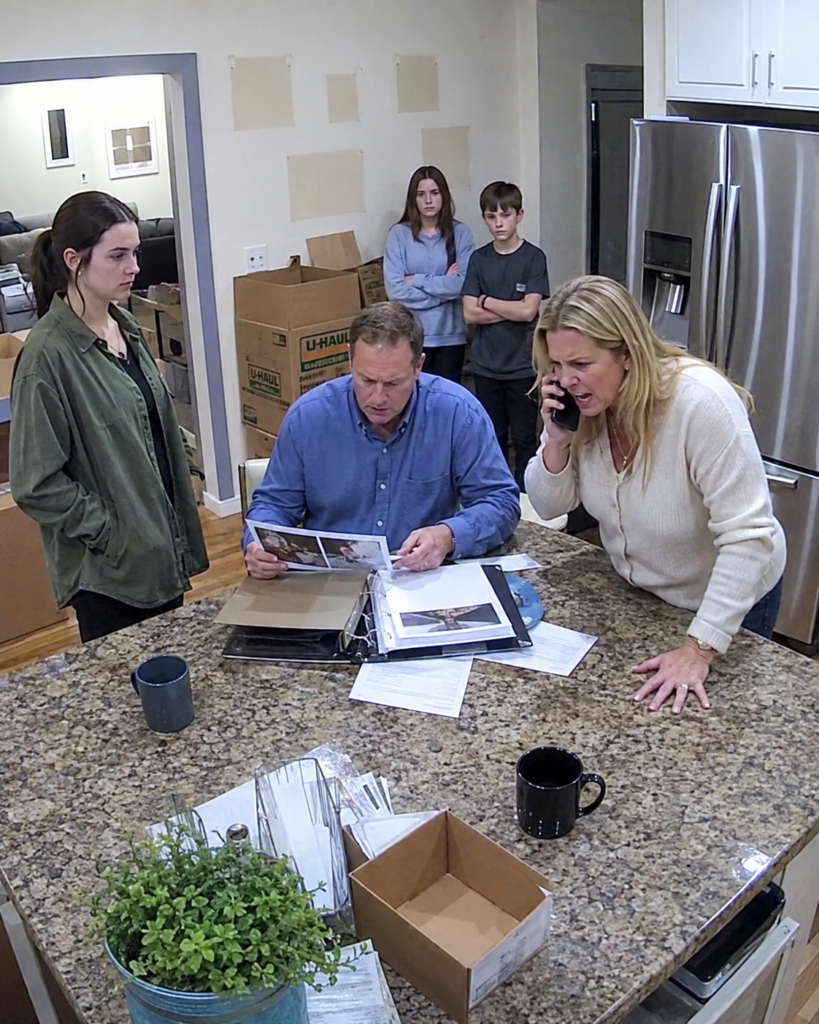
Dad held the first photograph with both hands, staring at the date and time printed beneath the image.
It showed my bedroom exactly as it had looked at 9:17 on Friday morning: bed made, closet full, desk untouched, my mother’s jewelry box resting on the shelf.
The next photograph showed the hallway wall with every frame still hanging.
Another showed the refrigerator covered with magnets, school schedules, and Emma’s family drawing.
Jennifer’s voice came from the phone on speaker.
“Yes, I need officers here.
Our daughter has emptied the house.
We may have been robbed.”
“Our daughter?” I asked quietly.
Her eyes snapped toward me.
“This is not the time for your attitude.”
Dad turned another page.
There were photographs of the living room, kitchen, bathrooms, laundry room, and garage.
Each was followed by a second image taken after I finished packing.
Nothing was broken.
Nothing was damaged.
The furniture had not moved.
Only my belongings were gone.
Beside the folder sat the box containing the photographs and frames I had removed from the walls.
I had wrapped each one in a clean towel and labeled the box FAMILY PROPERTY—NOT REMOVED FROM HOUSE.
Jennifer stared at it as though it had personally insulted her.
“You took them off the walls,” she said.
“Yes.”
“You had no right.”
“I didn’t take them from the house.”
“You erased us.”
I looked at the blank spaces behind her.
“No.
I erased myself.
I thought that was what you wanted.”
Emma stood near the garage door clutching a pink shell.
Tyler had left his suitcase in the entryway and was watching me with frightened eyes.
Dad closed the folder halfway.
“Winnie, what is this really about?”
The question nearly made me laugh.
Instead, I pulled out a chair and sat down.
“This is about you leaving me behind to clean while you took the family on vacation.”
“It was one weekend,” Jennifer said.
“It was ten years.”
She folded her arms.
“We fed you.
We housed you.
We treated you like one of our own.”
“Did you?”
Her mouth tightened.
Dad rubbed his forehead.
“Let’s calm down.”
That had always been his answer.
Jennifer would say something cruel, I would react, and Dad would tell the room to calm down as if the conflict had appeared from nowhere.
I opened the folder to a page near the back.
There were copies of my café schedules, bank statements, school records, and a handwritten inventory of the chores I had completed during the previous month.
I had not created that list for revenge.
I had started keeping it because Jennifer regularly accused me of doing nothing.
Thirty-one loads of laundry.
Fourteen dinners.
Nine school pickups.
Six soccer practices.
Three nights caring for Tyler while he had the flu.
Forty-two paid hours at the café.
Two major exams.
Dad read the page twice.
“You kept track of this?” he asked.
“I had to.”
Jennifer snatched the list from him.
“This is ridiculous.
Families don’t keep score.”
“Then why did you always remind me what my food and bedroom cost?”
Her cheeks reddened.
The dispatcher asked whether anyone was in immediate danger.
“No,” Dad said before Jennifer could answer.
She grabbed the phone.
“She has stolen property and is behaving aggressively.”
I had not moved from the chair.
Emma looked from Jennifer to me.
“Winnie isn’t being aggressive.”
Jennifer reached for her shoulder.
Dad caught her wrist.
“Don’t,” he said.
The single word changed the room.
For years, Dad had watched Jennifer correct me, order me around, inspect my work, and turn every objection into proof that I was ungrateful.
He had occasionally looked uncomfortable, but discomfort had never protected me.
This time, he stopped her.
Emma stepped closer to me.
“Is Winnie leaving because you said the trip was for family?” she asked.
Jennifer’s face hardened.
“You misunderstood.”
“No, I didn’t.
You said we needed quality family time.”
Tyler lowered his head.
“You said she would make everyone miserable if she came.”
Jennifer spun toward him.
“I said no such thing.”
“You did,” he whispered.
“In the garage.”
Dad looked at her.
She opened her mouth, then pointed toward me instead.
“This is exactly what she does.
She turns the children against me.”
“I wasn’t in the garage when you said it,” I replied.
“I was at work.”
Headlights moved across the front windows.
A patrol car stopped at the curb.
Jennifer appeared relieved.
She seemed to believe uniforms would restore the order she understood: she would speak confidently, Dad would stay quiet, and I would be treated like the unstable girl who had wrecked her family’s home out of spite.
Two officers approached the porch.
One was a middle-aged woman with silver threaded through her dark hair.
The other was a younger man carrying a small notebook.
Jennifer opened the door before they knocked.
“Thank goodness.
She emptied our house while we were away.”
The female officer looked past her at the spotless living room.
“Who is she?”
“Our daughter.
My stepdaughter.”
“And is she here?”
I raised my hand from the kitchen table.
The officers entered and asked everyone to remain separated while they established what had happened.
Jennifer began speaking immediately, describing missing photographs, an emptied bedroom, and personal belongings taken without permission.
The younger officer looked toward the labeled box beside the table.
“What is in there?”
“The photographs,” I said.
“I removed them from the walls, wrapped them, and left them here.
The frames belong to the household.”
The female officer opened the box and checked several frames.
None were damaged.
“Why did you remove them?”
“Because every photograph containing me was displayed as proof that I belonged here.
I wanted the house to look the way I had been treated.”
She studied my face for a moment, then asked whether I had taken anything else.
“Only my belongings.
They’re listed in the folder.
I photographed each room before and after.
I have the storage receipt and my car is still packed with one suitcase.”
Jennifer scoffed.
“Anyone can make a list.”
“That’s true,” the officer said.
“Do you have a list of items you believe belong to you?”
Jennifer looked around.
“She took towels.”
“I bought two blue towels with my employee discount,” I said.
“The receipt is behind the inventory.”
“She took detergent.”
“I purchased it last Tuesday.”
“My coffee mug.”
“It says Winnie on it.
Emma gave it to me for Christmas.”
Emma nodded quickly.
Jennifer’s certainty began to fray.
The officers checked the bedrooms and common areas.
They found no damage, no forced locks, no missing electronics, and no sign that I had entered Jennifer and Dad’s room.
My bedroom was almost empty, but the mattress and furniture remained because they belonged to the house.
When they returned, the female officer closed her notebook.
“This appears to be a family dispute, not a burglary.
Your adult stepdaughter removed her personal property from her residence.
Nothing presented to us suggests a crime.”
Jennifer’s voice rose.
“She cannot just leave.”
The officer glanced at me.
“How old are you?”
“Nineteen.”
“Then she can.”
That was when Jennifer stopped pretending the call was about stolen property.
“Who is going to watch the children after school?” she demanded.
“Who is going to get Tyler to practice? Marcus works late, and I have meetings.”
The younger officer looked down at his notebook, but I saw his expression change.
Dad heard it too.
Not Who will keep her safe?
Not Where will she sleep?
Who will do the work?
I reached for the storage receipt and the sealed envelope I had placed on top of the folder.
The return address belonged to the state university’s financial aid office.
Jennifer recognized it because she had intercepted the first envelope three weeks earlier.
“You weren’t supposed to have that,” she said.
Dad turned slowly toward her.
“What does she mean?”
Jennifer’s face emptied.
I opened the envelope.
Inside was a replacement copy of my financial aid package, requested after the original disappeared from the kitchen mail pile.
It confirmed a tuition grant, a work-study position, and a housing award beginning in the fall.
I had discovered the acceptance online while using a computer at the public library.
The university portal showed that the paper packet had been delivered to our address and signed for by someone with Jennifer’s initials.
When I asked her about it, she said no college mail had arrived.
I had wanted to believe it was a mistake.
Then I found the torn corner of the university envelope beneath old grocery coupons in the recycling bin.
Dad read the award letter.
“You got into college?”
“Six weeks ago.”
“Why didn’t you tell me?”
“I tried.
The envelope disappeared, and every time I brought up applications, Jennifer said we couldn’t afford for me to become selfish.”
Dad looked at his wife.
“Did you hide this?”
Jennifer straightened her shoulders.
“I was going to discuss it with you.
She has responsibilities here.
We cannot reorganize the entire household because she suddenly wants to run away to college.”
“I applied last fall,” I said.
“You knew?” Dad asked Jennifer.
“She needed to be realistic.”
The female officer placed the letter back on the table with unusual care.
“Do you have somewhere safe to stay tonight?” she asked me.
“Yes.
My coworker Marisol lives with her mother, and they have a spare room.
I’m paying weekly until the campus housing opens.”
I had arranged it while the family was at the beach.
Marisol had watched me work double shifts, arrive exhausted after school pickups, and eat dinner from paper cups over the café sink.
When I finally told her I was leaving, she did not ask whether I was overreacting.
She asked how many boxes I had.
Dad sat down heavily.
“You planned all of this in two days?”
“No.
I saved for years.
I just stopped using the money to survive this house.”
Jennifer laughed once, sharply.
“So now you’re abandoning Emma and Tyler.”
The accusation hit exactly where she intended.
I looked at my siblings.
Emma was crying silently.
Tyler stared at the floor.
I knelt in front of them.
“I am not leaving because of you,” I said.
“None of this is your fault.
I love you.
I will call, and I will visit whenever I’m allowed.
But loving you does not mean I have to stay somewhere that hurts me.”
Emma threw her arms around my neck.
Tyler joined her a second later.
Behind them, Jennifer said, “You’re upsetting the children.”
Dad stood.
“No, Jennifer.
We did that.”
It was the first honest sentence he had spoken all weekend.
The officers left after confirming no crime had occurred.
The female officer gave me a card and quietly told me to call if anyone prevented me from retrieving the rest of my belongings.
When the front door closed, Jennifer began listing everything I owed the family: food, utilities, rides, birthday gifts, school supplies.
She spoke faster as Dad’s face became more distant.
I let her finish.
Then I removed my house key from the ring and placed it on the folder.
“There,” I said.
“Now I owe you nothing.”
Dad flinched.
“You don’t have to leave tonight.”
“Yes, I do.”
“We can talk about this.”
“You had ten years to talk.”
He looked at the blank wall, then at the photographs wrapped inside the box.
“I didn’t know it was this bad.”
“You knew enough to look away.”
He had no answer.
I carried my final suitcase to the Honda.
Emma and Tyler followed me outside, still wearing their beach clothes.
I hugged them beside the porch flag and promised to call the next evening.
Dad stood in the doorway.
Jennifer remained in the kitchen, framed by the empty spaces on the wall.
As I drove away, I expected to feel triumphant.
Instead, I cried so hard at the first red light that I had to pull into a pharmacy parking lot.
Leaving did not erase the love I had wanted from my father.
It did not erase the years I had spent mothering children who were not mine to raise.
Freedom and grief arrived together, and neither one asked permission.
Marisol and her mother, Elena, were waiting when I reached their apartment.
Elena made tea while Marisol carried in my suitcase.
Nobody asked me to justify why I had left.
They cleared a shelf in the bathroom and handed me a clean key.
That small piece of metal felt heavier than the one I had returned.
Over the next several weeks, Dad called repeatedly.
At first, his messages were practical.
Where was Tyler’s permission form? Which detergent did Emma need for her uniform? What time did the dentist close?
I answered questions concerning the children, but I did not return to manage the household.
Without me, the invisible labor became visible.
Dad began leaving work early for school pickups.
Jennifer missed meetings.
Laundry piled up.
Tyler arrived late to practice twice.
Emma called one night because nobody had remembered her science project materials.
I helped Emma make a list over video chat, then told Dad where to buy the supplies.
I did not drive across town and solve it for him.
A month later, Dad came to the café alone.
He waited until my shift ended and asked whether we could sit outside.
He looked older than he had at the kitchen table.
“I kept telling myself Jennifer was stricter with you because you were older,” he said.
“I told myself you were responsible and independent.
That made it easy to accept everything you did for us.”
I listened without rescuing him from the silence.
“I failed you,” he continued.
“Not because I didn’t notice.
Because noticing would have required me to change something.”
It was not a perfect apology.
It did not give me back my adolescence.
But it was the first one that did not contain the word if.
I told him that contact would require boundaries.
Jennifer was not to handle my mail.
My college money was mine.
I would see Emma and Tyler, but I would not provide unpaid childcare.
He would not call me ungrateful for protecting myself.
Dad agreed.
Jennifer never apologized.
She sent one message accusing me of humiliating her in front of the police.
I saved it, blocked her number, and moved on.
In August, I entered my university dorm carrying two boxes, one suitcase, and my mother’s jewelry case.
Emma and Tyler helped me unpack while Dad assembled a small bookshelf by the window.
The first thing I placed on it was a photograph of my mother holding me at the beach when I was six.
The second was my honor-roll certificate.
The third was the purple family drawing Emma had made, now protected inside a new frame.
Dad noticed the drawing and looked away for a moment.
I did not remove myself from every family photograph forever.
I simply stopped allowing photographs to serve as substitutes for love.
The blank walls in that suburban house had frightened everyone because they made one truth impossible to ignore: I had been present in every picture and absent from every decision.
In my new room, I chose what went on the walls.
For the first time, the life surrounding me was not evidence that I belonged to someone else.
It belonged to me.