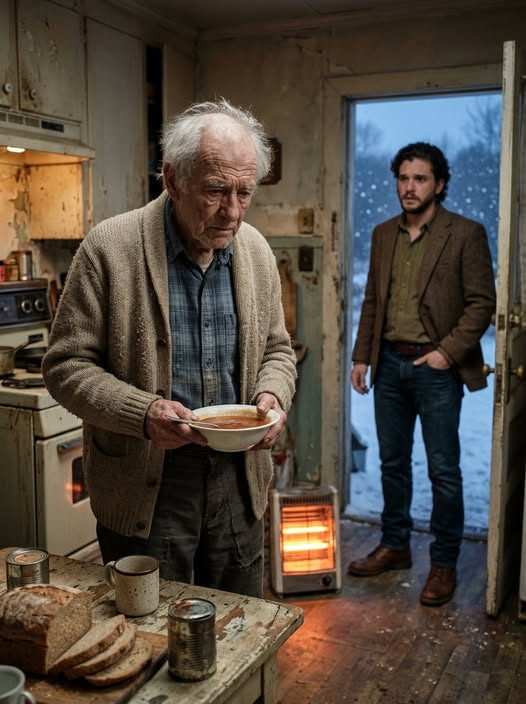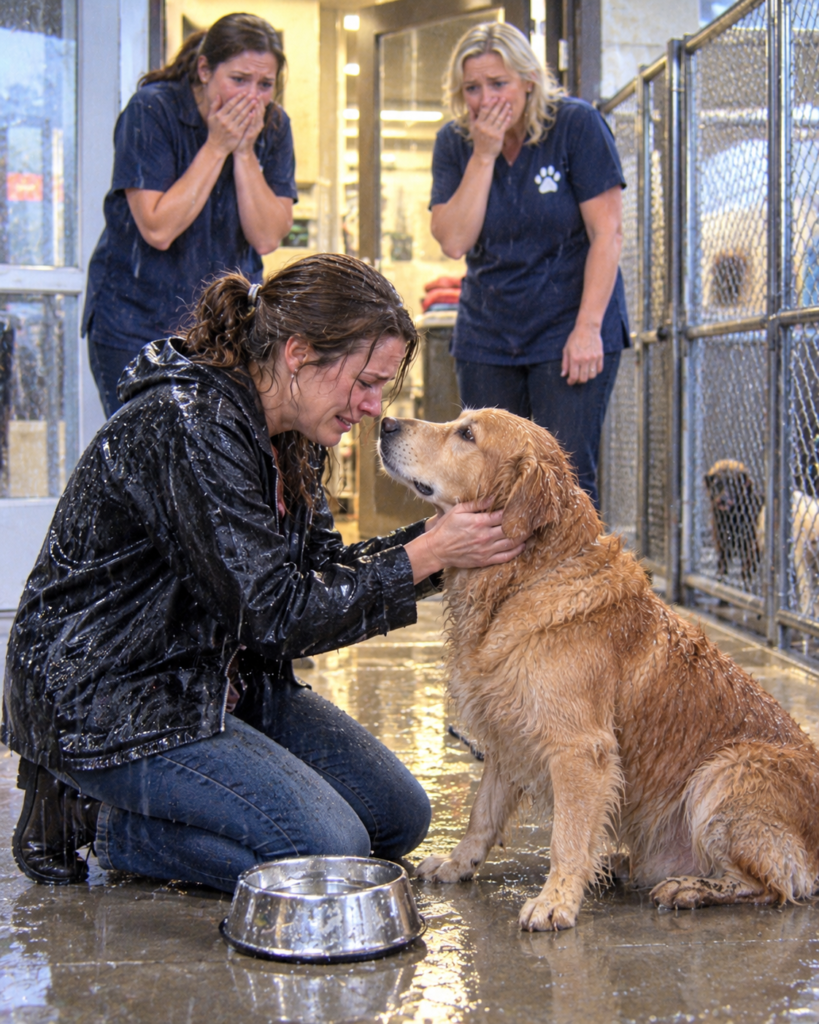
The sixty-third person Elliot tested dropped to her knees the moment she saw the dent in an old stainless-steel dog bowl.
For nine weeks, that seven-year-old Golden Retriever had carried the same empty bowl to people who came into our Nashville shelter hoping to adopt him.
Sixty-two people had tried to understand what he wanted, and every one of them had somehow given him the wrong answer.
Then a rain-soaked woman touched the dent, whispered two words, and Elliot reacted as though he had been waiting his entire life to hear them.
My name is Hannah Cole, and I had worked at Cumberland County Animal Center for nine years.
I had seen frightened dogs hide beneath benches, lonely dogs crawl into strangers’ laps, and stubborn dogs refuse good homes for reasons nobody could explain.
But I had never seen a dog interview potential adopters with an empty bowl.
Elliot did exactly that, and the strangest part was that he seemed to know precisely whom he wanted to test.
The bowl had belonged to Rosie, a fourteen-year-old black Labrador who arrived with Elliot on February 9.
Their owner, Margaret Bell, had died alone in a rental house on Lillian Street, and a neighbor finally called after hearing the dogs barking inside for two nights.
Rosie was weak, arthritic, and already seriously ill, but Elliot never left her side.
If she stopped walking, he stopped too; if she drank, he stood beside her; and every night he slept with his chin across her back.
Nineteen days after they entered our shelter, Rosie died with Elliot pressed against her body.
The next morning, we put breakfast into a clean shelter dish, but Elliot refused to touch it.
Instead, he somehow found Rosie’s old stainless-steel bowl inside a property bin near intake, lifted it carefully by the rim, and carried it into the adoption room.
He placed it beneath a woman’s shoes and stared directly at her mouth.
The woman laughed and said, “Are you hungry, sweetheart?”
Then she dropped a biscuit into the bowl, expecting Elliot to eat it.
He never touched the food.
He simply picked the bowl back up, carried it away, and ignored her for the rest of the visit.
At first, we assumed grief had created some strange new habit, but Elliot repeated it again and again.
He never brought the bowl to staff members, volunteers, delivery drivers, cleaners, or children.
He chose adults who had come specifically to adopt, and even among them, he ignored anyone who rushed toward the puppies or pulled impatiently on his leash.
If someone stopped near his kennel, noticed the gray beginning around his eyes, and spoke quietly, Elliot disappeared behind the desk and returned with Rosie’s bowl.
He would set it between their shoes and wait.
If they offered him food, he left.
If they reached straight for his ears, he backed away.
If they picked up the bowl, he watched their hands for a moment, but what interested him most was always the same thing—their mouths.
I started keeping a list on a yellow legal pad beneath the reception desk.
Eleven people were tested the first week, nine more the second, and by April the list had become so long that some of our volunteers started joking that Elliot was conducting job interviews.
Nobody laughed very hard, because every rejection meant another night in a shelter kennel.
What we could not understand was what answer Elliot expected.
Three families eventually completed adoption applications for him.
All three passed our screening, signed the paperwork, clipped on a leash, and genuinely wanted to give him a home.
Each time Elliot walked calmly through the lobby until he reached our glass front doors.
Then he planted all four feet against the floor and refused to take another step.
“Come on, buddy,” one man whispered. “We’re going home.”
Elliot looked back toward the reception desk.
Then he turned around, walked away from the family waiting to adopt him, and went back for Rosie’s bowl.
After the third failed adoption, I sat beside him after closing and traced one finger over the dent near the bottom.
The only word engraved on the side was ROSIE.
“What are you waiting for?” I whispered. “You can’t stay here forever looking for something we don’t even know how to find.”
At the word “find,” Elliot’s ear moved.
I noticed it, but I had no idea what it meant.
Nine weeks after Rosie died, on May 4 at exactly 10:38 in the morning, a woman entered our lobby wearing a rain-darkened denim jacket.
Her hair was wet, a folded photograph trembled in one hand, and she asked whether we still had records for two dogs removed from a house on Lillian Street.
Elliot had been asleep beneath the front window, completely uninterested in the people around him.
Then the woman said, “The owner was Margaret Bell. She was my sister.”
Elliot’s head snapped up.
He stood so quickly that his nails scraped across the tile.
The woman saw him and seemed to stop breathing.
“Is that Elliot?”
Before I could answer, he turned and disappeared behind my desk.
Click.
Click.
Click.
That familiar sound of metal against tile made every hair rise on my arms.
Elliot emerged carrying Rosie’s bowl, walked slowly toward the woman, and placed it directly between her shoes.
She stared first at the dent, then at the engraved name, and suddenly her knees gave way beneath her.
The photograph slipped from her hand and landed faceup on the floor.
She touched the dent with one finger.
Then she whispered, “Rosie-Roo.”
The bowl hit the tile.
Elliot froze.
His ears lifted, his eyes widened, and then his tail began swinging so violently that his entire body moved with it.
The woman covered her mouth as Elliot stepped forward, and a second later he threw all seventy pounds of himself into her arms.
“You remember me?” she cried. “Oh, Ellie, you remember?”
That was when I finally understood why Elliot had rejected sixty-two people.
He had never been asking who would feed him or even who would love him.
He had been waiting for someone who remembered Rosie.
I thought the mystery was finally over.
Then I bent down to pick up the photograph Claire had dropped.
It showed a much younger Margaret sitting on a porch beside Rosie and a Golden Retriever puppy who could only have been Elliot.
I turned the picture over and saw six faded words written across the back in blue ink.
Claire took one look at them, went completely pale, and whispered something that made the room feel suddenly cold.
“This wasn’t here before.”
PART 2
Claire remained on the shelter floor with Elliot pressed against her chest while I held the photograph in my hand.
She told me she had taken that picture almost seven years earlier, shortly after Margaret brought Elliot home. She had given Margaret the photograph herself, and she remembered one detail with absolute certainty.
The back had been blank.
The handwriting was unmistakably Margaret’s. Claire recognized the way her sister pressed hard enough with a pen to leave grooves in paper, but she would not tell me what the six words meant yet.
Instead, she looked down at Rosie’s bowl and began crying again.
Then she admitted something I had not expected.
Rosie had not originally belonged to Margaret.
She had belonged to Margaret and Claire’s mother, Evelyn, who adopted the black Labrador late in life. Claire had given Rosie the ridiculous family nickname “Rosie-Roo,” and Margaret used it too.
That was why Elliot had reacted so strongly when Claire said it.
When Evelyn became ill, both daughters helped care for her, and Rosie became part of their routine.
After Evelyn died, Margaret took Rosie because Claire’s husband Tom was undergoing cancer treatment. The arrangement was supposed to be temporary, but Tom became sicker, and Rosie settled permanently into Margaret’s house.
Later, Margaret adopted Elliot, who quickly became completely devoted to the older Labrador.
“They were inseparable,” Claire told me. “Rosie bossed him around like she owned him, and Elliot loved every second of it.”
Then something happened between the sisters.
It was not one enormous betrayal.
It was grief, exhaustion, arguments over their mother’s belongings, and two women who both believed the other should apologize first.
Claire was caring for a dying husband while Margaret had handled much of their mother’s final months, and eventually their resentment exploded over things that looked small from the outside.
One Christmas passed without a visit.
Then another.
Tom eventually died.
Margaret attended his funeral but stood near the back of the church and left before Claire could bring herself to speak to her.
After that, years passed with only a few calls and one Christmas card that Claire received months late after moving.
Neither woman crossed the distance between them.
“I haven’t seen Margaret in four years,” Claire whispered.
That sentence told me something even worse.
She had not known her sister was dead until the day before she walked into our shelter.
A property manager handling Margaret’s rental house had finally located Claire and mailed several personal items to her new address.
Inside the envelope was the photograph, a spare key, an old vaccination receipt, and the Lillian Street address.
Claire searched her sister’s name online and found the death notice.
That morning she drove to Margaret’s house and learned animal control had removed two dogs. Nobody there could tell her what happened afterward, so she came to us hoping Rosie and Elliot might still be here.
Now I had to tell her that she had arrived nine weeks too late for one of them.
“Rosie?” she asked.
I shook my head.
Claire closed her eyes.
I explained that Rosie had made it nineteen days after arriving, and she had not died alone. Elliot stayed pressed against her until the end, and one of our technicians remained with them too.
Only after Rosie was gone had Elliot begun carrying her bowl to strangers.
That was when I pulled out my yellow legal pad.
I showed Claire the notes beside sixty-two names: people who added food, people who read the engraved name aloud, people who tried to comfort him, and three families Elliot refused to leave with.
Claire ran her fingers down the list slowly.
Then she looked at the final entry.
#63 — Claire Dawson. “Rosie-Roo.”
“He wasn’t waiting for an adopter,” she whispered.
“No,” I said. “I think he was waiting for you.”
Claire looked again at the photograph.
Then she finally turned it toward me.
Beneath the faded date, Margaret had written six words:
Find Claire. She knows the promise.
Claire stared at the sentence as though her dead sister had spoken directly into the room.
She admitted that there had been a promise once, made many years earlier beside their mother’s bed. But she could not understand how Margaret expected Elliot—or anyone else—to lead us back to it.
Then Claire remembered something else inside the package.
“The property manager gave me a key to Margaret’s house,” she said.
Elliot raised his head.
Claire looked toward him, then at the message again.
“If Margaret wrote this because she knew something might happen to her, there could be something else in that house.”
And suddenly the six words on the photograph were no longer the answer.
They were instructions.
PART 3
Claire returned to the shelter the next afternoon carrying a cardboard box from Margaret’s house.
Elliot heard her car outside before any of us noticed it and ran toward the lobby doors.
The moment Claire entered, he pressed himself against her legs without waiting for the old bowl ritual.
Whatever test he had been performing was already beginning to change.
Inside the box were no hidden fortune, legal surprise, or dramatic confession.
There were dog brushes filled with black and gold hair, Rosie’s veterinary bills, an old potholder, grocery lists, a red leash, and three birthday cards Margaret had bought for Claire but never mailed.
One card said, “I keep waiting for us to stop being ridiculous.”
Another contained only four painful words: “I miss my sister.”
At the bottom was a spiral notebook Margaret had used to track Rosie’s medications.
Most entries were ordinary reminders about pills, appetite, slow walks, and veterinarian appointments.
Then Claire reached several pages near the back.
One sentence had been written twice.
Call Claire.
A few pages later, Margaret had written something more specific.
If anything happened to her, Claire had once promised their mother that Rosie would stay with family.
Margaret had also written Claire’s current address, proving she had somehow found her sister even though neither of them had made contact.
Claire stared at the page for a long time.
Then she finally told me about the promise.
On one of Evelyn’s final nights, both daughters had been sitting beside their mother while Rosie slept beneath the bed.
Evelyn worried that the elderly dog would be passed from home to home after she died.
She made both daughters promise that Rosie would always stay with one of them.
Then Evelyn added something the sisters had laughed about at the time.
“If one of you goes first, the other takes care of what’s left.”
Margaret had said, “Deal.”
Claire had said the same.
They were still in their fifties then, and neither imagined that Margaret would be dead at sixty-six or that four years of silence would separate them when it happened.
Now Elliot sat outside the office door while Claire held the notebook and realized Margaret had remembered every word.
Somehow, Elliot seemed to have remembered the family attached to that promise too.
“I should take him,” Claire said.
But her voice frightened me because it sounded like guilt rather than certainty.
Claire was sixty-three, lived alone, and had not cared for a dog since her husband became ill.
She wanted Elliot, but she was afraid she wanted him only because adopting him felt like the final apology she could no longer give Margaret.
So I offered her a different choice.
“Foster him for two weeks.”
Claire looked relieved.
We completed the paperwork that afternoon.
Elliot followed her through the lobby toward the exact front doors where he had refused three previous adoptions.
Claire pushed the door open, and he stepped outside without hesitation.
Then he stopped.
My heart sank.
Elliot suddenly turned around, pulled free from Claire’s loose grip, and ran straight back inside the shelter.
Seconds later, we heard the familiar sound from behind reception.
Click.
Click.
Click.
He came back carrying Rosie’s bowl.
But this time something was different.
Instead of returning it to the shelter, Elliot walked through the doorway and pushed the bowl against Claire’s leg.
She took it with trembling hands, placed it in her car, and Elliot climbed into the back seat beside it.
For the first time since Rosie died, Elliot willingly left our building.
The first night at Claire’s house was not peaceful.
Elliot paced between the bedroom, kitchen, and back door, searching every room as if another dog should have been there.
Eventually he carried Rosie’s empty bowl into the hallway and lay beside it.
Claire called me the next morning.
“He’s looking for her,” she whispered.
I told her not to take the bowl away.
For the next several evenings, Elliot carried it to the back door and waited.
Claire stopped trying to distract him and simply sat beside him instead.
On the fourth night she placed her hand on his back and whispered, “I miss Rosie too.”
Elliot lowered his head into her lap.
A few days later, Claire found something else inside Margaret’s linen closet—an old blue fleece blanket she had used years earlier while Tom was sick.
Elliot had slept on it whenever Claire visited Margaret.
The moment Claire brought that blanket into her own living room, Elliot sniffed it, circled twice, and collapsed onto it as though part of his old world had finally returned.
Then Claire called me with a realization.
“Rosie-Roo wasn’t the whole test,” she said. “It only proved I belonged to the memory.”
And the following week, when Claire brought Elliot back to the shelter for his foster check, we were about to find out whether he was still searching.
PART 4 — THE FINAL CHAPTER
Elliot came through the shelter doors carrying Rosie’s bowl.
For one terrible second, I thought we had misunderstood everything.
Claire stood behind him with the leash loose in her hand. Her denim jacket was dry this time, but her face had the same frightened stillness I remembered from the morning she first arrived.
“He picked it up when I told him we were coming here,” she said.
Elliot walked past me.
Past the reception desk.
Straight toward the adoption room.
A woman sat on the bench beneath the window, filling out an application. Elliot stopped beside her and lowered the bowl onto the tile.
Claire’s fingers tightened around the leash.
“Oh,” she whispered.
It was barely a sound.
But I heard everything inside it.
The sleepless nights. The afternoons spent sitting beside a grieving dog. The hope she had allowed herself to feel when he finally began following her from room to room.
The woman looked down.
“Well, hello there.”
She reached toward the bowl.
Elliot watched her hand.
I stepped forward, ready to explain.
Then Claire spoke behind me.
“Elliot.”
His head turned immediately.
She tried to smile.
“It’s all right, sweetheart.”
The woman lifted the bowl from the floor.
“Is he available?”
Claire looked at me.
And I saw her preparing to surrender him before anyone could tell her she had failed.
“He’s fostering with Claire,” I said.
“Oh.” The woman held out the bowl. “Sorry. I thought he was bringing me this.”
Elliot took it carefully.
Then he turned away from her.
He walked back across the adoption room, stopped directly in front of Claire, and pressed the dented metal against her knee.
She did not move.
Elliot pushed it against her again.
When she finally took it, he sat on her foot and leaned his full weight against her leg.
The woman smiled.
“I think he wants you to hold it.”
Claire stared down at him.
He was no longer watching the stranger.
He was watching her.
“Would you like to come into my office?” I asked.
She nodded without looking up.
Elliot followed her.
This time, he left the adoption room without a backward glance.
Inside my office, Claire placed Rosie’s bowl on the floor beside her chair.
“I thought…” she began.
Her voice broke.
“I know,” I said.
She pressed both hands together in her lap.
“What if I’m only familiar?”
I waited.
“What if I smell like a house he remembers? What if I know the right name, and I have the right blanket, but that’s all?”
Elliot lowered himself beside her chair.
Claire looked at him with tears gathering in her eyes.
“I don’t want him spending the rest of his life waiting for someone I can’t bring back.”
For a moment, the office was quiet except for the shelter sounds beyond the door.
A telephone ringing.
A kennel latch closing.
A dog barking once, then settling.
“Tell me about yesterday,” I said.
Claire looked confused.
“Yesterday?”
“An ordinary day. What did he do?”
She wiped beneath one eye.
“He woke me at six.”
“How?”
“Put his nose under my hand.”
“And then?”
“We went outside. He inspected the same hedge for about ten minutes.”
I smiled.
“What else?”
“He stole a dish towel.”
I looked down at Elliot.
He closed his eyes.
Claire gave a small, startled laugh.
“I was making lunch. He took it off the oven handle and carried it into the living room.”
“Did he destroy it?”
“No. He waited for me to come get it.”
“What happened when you did?”
Her mouth trembled.
“He ran.”
“For the first time?”
She nodded.
“Around the coffee table. Then back again.”
I let her sit with that memory.
After a while, she looked toward the bowl.
“He still misses her.”
“Yes.”
“So do I.”
“I know.”
Her shoulders began to shake.
“I wasted four years, Hannah.”
There was nothing gentle I could say that would make that untrue.
So I stayed beside her while she cried.
When Elliot lifted his head, she lowered her hand automatically.
He rested his chin in her palm.
“I kept thinking there would be another Christmas,” she whispered. “Another birthday. Some small thing that would make calling easier.”
Her fingers moved through the fur beneath his jaw.
“And now I’m buying dog food and wondering if Margaret used the same brand. I catch myself reaching for the phone.”
She laughed once through her tears.
“I finally have something I want to talk to her about.”
I slid the tissue box closer.
Claire took one.
Then she looked down at Elliot.
“I don’t know how to do this without her.”
He stood.
For a moment, I thought he wanted the bowl.
Instead, he pushed his head beneath her arm until she had no choice but to hold him.
Claire bent over him.
And whatever answer she had been searching for did not arrive in words.
It arrived in the weight of a warm body against her knees.
In the dog who had somewhere else to stand and had chosen to stand there.
After a while, she straightened.
“May I have the adoption papers?”
I opened the drawer beside my desk.
“They’re already printed.”
Her eyes lifted to mine.
“You were sure?”
“No,” I said. “I was hopeful.”
She read every page.
Asked about his arthritis screening.
Asked when his next vaccinations were due.
Wrote down the number for our veterinarian.
Then she reached the signature line and stopped.
Elliot was lying across both her shoes.
“Claire?” I asked.
She took a breath.
“I want him even on the days he’s sad.”
Her hand settled on his head.
“And on the days I am.”
Then she signed her name.
Three weeks later, Claire asked me to meet her at the cemetery.
Margaret had been buried beside Evelyn in a small family plot beneath an old maple tree.
Claire arrived carrying flowers.
Elliot walked beside her with the red leash from Margaret’s house clipped to his collar.
Under her other arm was a small wooden box.
We had kept Rosie’s ashes at the shelter while trying to locate family. When Claire learned they were still with us, she had gone so quiet I worried I had hurt her again.
Then she asked if she could take her home too.
Now she knelt in front of Margaret’s headstone and brushed a few fallen leaves from its base.
For a long time, she said nothing.
Elliot sat beside her.
Finally, Claire set the flowers down.
“I found the cards.”
The wind stirred the branches above us.
“The birthday ones. Even the one where you called us ridiculous.”
She swallowed.
“You were right.”
I stepped back toward the path, giving her what privacy I could.
Her next words reached me anyway.
“I should have called you after Tom’s funeral.”
She rubbed her thumb against the edge of the wooden box.
“I saw you at the back. I thought if you really wanted to talk, you would come to me.”
Her voice thinned.
“I suppose you thought the same thing.”
Elliot leaned against her shoulder.
Claire put an arm around him.
“He steals towels,” she told the stone.
“And he snores. You could have mentioned that somewhere in your very organized notebook.”
A laugh escaped her.
Then another sound followed it, rough and painful.
“I miss you.”
She bowed her head.
This time, she did not try to stop herself crying.
When she was ready, we walked to the cemetery garden where the groundskeeper had told her she could scatter Rosie’s ashes.
Claire opened the box.
Elliot stood quietly at her side.
“Here you are, Rosie-Roo,” she whispered.
Then she let the breeze carry them.
Summer arrived slowly.
Claire sent photographs.
Elliot asleep beneath her kitchen table.
Elliot standing beside a disastrously muddy flower bed.
Elliot holding a dish towel while looking directly into the camera with what Claire called “absolutely no remorse.”
Rosie’s bowl appeared in some of the pictures too.
Sometimes it sat beside the blue fleece blanket.
Sometimes it was beneath the hallway table.
Claire never hid it.
She never made him carry it either.
By July, he could go several days without picking it up.
Then one evening, during a thunderstorm, he brought it to her chair and lay down with his paw against the rim.
Claire sent me a message.
Hard night.
A minute later, another appeared.
For both of us. We’re all right.
I read those words twice.
Then I put my phone away and went back to work.
They visited again in September.
I heard Elliot before I saw him.
His nails clicked across the lobby tile, followed by Claire’s voice.
“Slow down. She’s not going anywhere.”
He came around the reception desk with his tail sweeping from side to side.
There was nothing in his mouth.
I crouched, and he pushed his face against my shoulder.
“Well, look at you.”
His coat had grown thick and glossy. He had lost the tense, watchful expression I remembered from his first weeks with us.
Claire stood nearby holding a canvas bag.
Inside were washed towels, unopened treats, and three bags of the food we used for senior dogs.
“He helped choose,” she said.
“Did he?”
“He attempted to eat one of the bags in the car.”
Elliot leaned harder against me.
We took him into the adoption room.
A young couple sat on the bench with an elderly beagle between them. The dog was trembling so badly that his tags rattled.
Elliot paused.
Then he walked over slowly and lay down a few feet away.
The beagle watched him.
After a moment, the rattling stopped.
Claire sat beside me.
We watched the couple lower their voices and let the little dog approach them in his own time.
“Margaret would have liked this,” Claire said.
I glanced at her.
Her eyes were wet, but she was smiling.
“Yes,” I said. “I think she would.”
Before they left, she noticed the yellow legal pad beneath my desk.
“You still have it?”
I pulled it out.
The pages were curled at the edges.
Sixty-two names.
Sixty-two careful attempts to understand a dog who could not explain what he had lost.
And the final entry.
#63 — Claire Dawson. “Rosie-Roo.”
Claire touched the page.
For a moment, she looked as she had that first morning, kneeling in wet clothes with the photograph at her feet.
Then Elliot nudged her hand.
She looked down.
“Ready?”
He wagged his tail.
I walked them to the doors.
Outside, the afternoon sun lay warm across the parking lot. Claire opened the back of her car, and Elliot climbed onto the blue blanket waiting on the seat.
Rosie’s bowl was there beside it.
He sniffed the rim, turned once, and settled down.
Claire rested a hand on the open door.
“For a while, I thought I had come too late for everything,” she told me.
I looked at Elliot.
His head was already sinking onto the blanket.
“You came,” I said.
Claire nodded.
Then she closed the door gently.
That evening, after the shelter grew quiet, I opened the yellow legal pad one last time.
Beside Claire’s name, I added the adoption date.
For nine weeks, I had filled those pages with everything Elliot refused.
I was grateful the last thing I wrote was simple.
Went home.