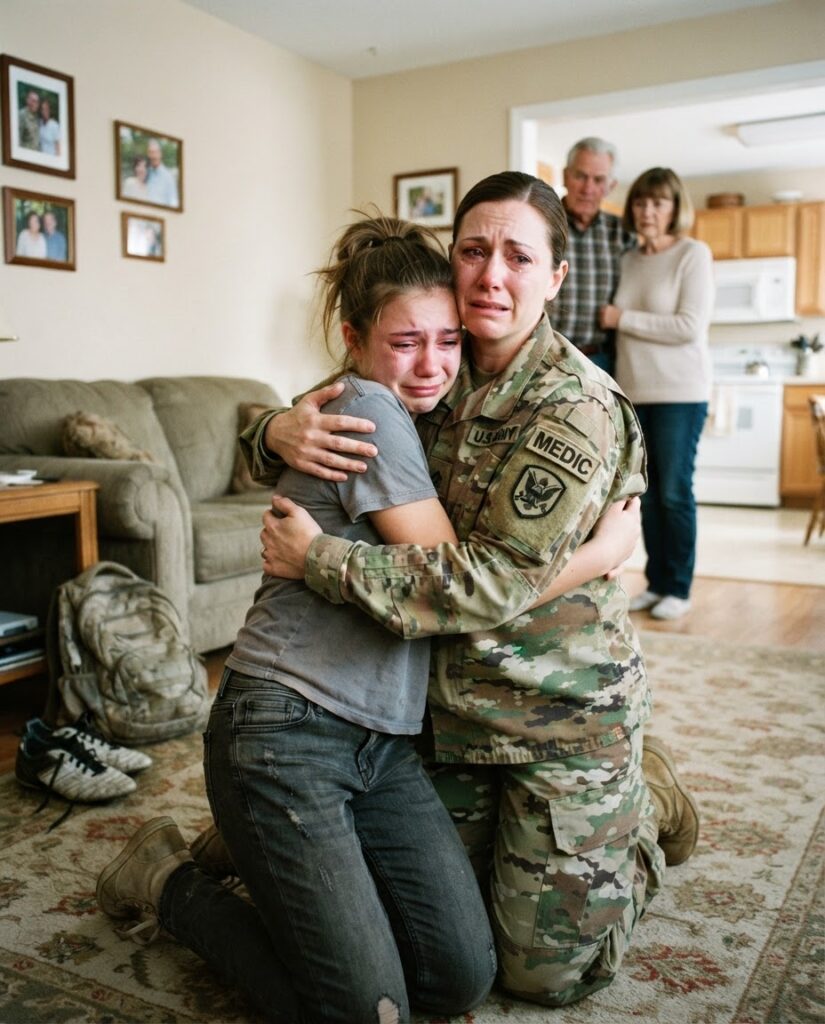
Then I asked her, “Did the $2,000 I sent every month take care of you?”
She looked at me with tears in her eyes.
“Mom… what money?”
My parents suddenly went pale.
I had sent them $18,000 to care for Emma while I was deployed.
Now I was about to discover where every dollar had gone—and why my daughter had been living like she had nothing.
PART 1
My name is Megan Carter. I’m 32, a combat medic in the U.S. Army, and a single mother.
For nine months, I was thousands of miles away from my daughter, counting down the days until I could hold her again.
Before I left, my parents promised Emma would be safe and cared for.
So every month, I sent them $2,000 for her food, clothes, school, sports, medical needs, and anything else she required.
I never asked for receipts.
They were my parents.
I trusted them.
Then I came home.
Emma ran into my arms, but something immediately felt wrong.
She was thinner.
Her clothes looked worn.
Her sneakers were falling apart.
Even her backpack had a broken zipper.
At dinner, I asked, “How’s soccer?”
She lowered her eyes.
“I don’t play anymore.”
“Why?”
Her voice was barely a whisper.
“I couldn’t afford the uniform.”
My fork stopped in midair.
I had been sending $2,000 every month.
So where had all that money gone?
And why had my daughter been living like she had nothing?
“What do you mean you couldn’t afford it?”
Before Emma could answer, my mother quickly interrupted.
“She just wasn’t interested in soccer anymore.”
I looked at Emma.
“Is that true?”
She stared down at her plate.
“Sort of.”
Something felt terribly wrong.
That night, after everyone went to bed, I opened my banking app.
Nine transfers.
$2,000 each.
$18,000 total.
Every payment had gone through.
Not one was missing.
Not one was returned.
I stared at the screen, my heart pounding.
Then one question kept running through my mind:
Where had all my daughter’s money gone?
And I was about to find out.
PART 2
I didn’t sleep.
At five in the morning, I was still sitting on the edge of the guest bed, staring at nine completed transfers.
From the hallway came a faint scraping sound.
I opened the door.
Emma stood in the kitchen wearing an oversized sweatshirt, pressing a piece of loose rubber back against the bottom of her sneaker.
There was a tube of glue beside her.
She looked up quickly.
“Sorry. Did I wake you?”
I stared at the shoe in her hands.
“How long has it been like that?”
She shrugged.
“Since September.”
It was February.
I pulled out a chair.
“Come sit with me.”
She set the shoe down carefully, as though she might get in trouble for leaving a mess.
I had treated frightened children in places where the windows shook at night.
I knew what it looked like when a child watched an adult’s face before deciding how much truth was safe.
Seeing it on my own daughter nearly broke me.
“Emma, I need to ask you something. And whatever the answer is, you are not in trouble.”
Her fingers disappeared inside her sleeves.
“Did Grandma and Grandpa buy you new school clothes?”
“A couple of shirts.”
“What about lunch money?”
“I usually packed something.”
“What kind of something?”
She looked toward the hallway.
“Emma.”
“Crackers. Sometimes a sandwich.”
I kept my voice steady.
“And soccer?”
Her chin began to tremble.
“Grandma said there wasn’t enough money.”
I turned my phone toward her.
“Did the two thousand dollars I sent every month take care of you?”
She stared at the screen.
Then she looked at me with tears in her eyes.
“Mom… what money?”
Behind us, a floorboard creaked.
My mother stood in the doorway in her bathrobe.
My father was behind her.
Both had gone pale.
For several seconds, nobody spoke.
Then my mother reached for the coffeepot.
“Well, obviously she wouldn’t know about household finances.”
I didn’t look away from Emma.
“What did they tell you?”
My daughter’s eyes filled.
“That the Army wasn’t paying you much while you were gone.”
“That is enough,” my father said.
I turned toward him.
“No. It isn’t.”
My mother put the coffeepot down too hard.
“We told her you had expenses. We didn’t want her bothering you every time she wanted something.”
Emma flinched at the word bothering.
I reached across the table and took her hand.
“You could never bother me by needing food or shoes.”
A tear slipped down her cheek.
“Grandma said if I complained, you might have to come home early.”
My mother shook her head.
“She misunderstood.”
“What else did she misunderstand?”
“Megan, lower your voice.”
I hadn’t raised it.
That seemed to frighten her more.
Emma’s hand tightened around mine.
“She said you could lose your job.”
I remembered every video call.
My mother sitting just outside the frame.
Emma saying school was fine.
Emma saying she was tired.
Emma saying she didn’t need anything.
I had mistaken short answers for a teenager who wanted to get back to her friends.
Now I understood why she had kept looking away from the screen.
I stood.
“Pack your things, sweetheart.”
My father moved into the doorway.
“You are not going to make some dramatic scene because she didn’t get expensive sneakers.”
I picked up the shoe from the table.
The sole hung loose beneath my fingers.
“Move.”
He looked at the shoe.
Then at me.
Finally, he stepped aside.
Nine months of her life.
As she folded her sweatshirt, I noticed a small notebook beneath her pillow.
She caught me looking at it.
“That’s mine.”
“Then it comes with us.”
She held it against her chest.
I didn’t ask to read it.
Downstairs, my mother had started crying.
“We opened our home to your child.”
I set the suitcase by the door.
“And I sent you eighteen thousand dollars to help care for her.”
“Food costs money. Electricity costs money.”
“Yes,” I said. “So you should be able to explain where it went.”
My father folded his arms.
“We don’t owe our daughter an audit.”
“Then explain it to someone else.”
His expression changed.
I took Emma’s hand and walked out.
Eggs. Toast. Fruit. Pancakes.
Emma studied the menu before looking at me.
“Is this too much?”
“No.”
“I can just have toast.”
I put the menu down.
“Order what you want.”
She chose pancakes, then ate slowly, glancing at the plate as though she needed permission to finish.
I went into the bathroom afterward and turned on the faucet.
For the first time since coming home, I let myself cry.
Then I washed my face.
There were things to do.
I stopped the recurring transfer.
I changed my banking passwords and removed my parents as emergency contacts wherever I could.
Then I called the legal assistance office on post and asked what I needed to do about the temporary caregiving documents I had signed before deployment.
By noon, I had an appointment.
By three, Emma had shoes that fit.
She walked around the store twice.
“Do they hurt?” I asked.
She shook her head.
“They don’t make that flapping sound.”
I had to look away.
She met with me the next morning while Emma waited in the library.
“I’m glad you’re back,” she said carefully.
Something in her voice made my stomach tighten.
“What happened?”
She opened a folder.
“Emma stopped eating lunch with her friends in October. Her teachers noticed she was tired. We helped her get meal assistance and some supplies.”
“Why didn’t anyone call me?”
“We used the contact information on her enrollment forms. Your mother was listed as the primary caregiver. She told us you had limited communication during deployment and asked us to route concerns through her.”
I closed my eyes.
“She could have reached me.”
Ms. Alvarez waited.
When I opened my eyes again, she slid a printed email across the desk.
My mother had written:
Megan cannot contribute financially at this time. We are doing our best on a fixed income. Please avoid making Emma feel different.
The date was November 6.
My November transfer had cleared on November 1.
I laid my bank confirmation beside the email.
Ms. Alvarez looked from one page to the other.
“Oh,” she said quietly.
There was another document.
An unpaid soccer fee.
One hundred and eighty-five dollars.
The coach had offered installments.
My mother had declined.
“She told us Emma had decided to quit,” Ms. Alvarez said.
I pressed my thumb into the edge of the desk until the room stopped blurring.
“May I have copies of the records I’m entitled to?”
“Of course.”
Before I left, she added, “Emma worked very hard to protect you.”
I looked back at her.
“She said you took care of hurt people. She didn’t want you worrying about her while you were doing that.”
Ryan had always been the one my parents worried about.
When I needed help, I was strong.
When Ryan needed help, he was family.
“What’s going on with Mom?” he asked. “She says you took Emma and threatened them.”
“Did they give you money while I was overseas?”
Silence.
“Ryan.”
“They helped with the shop.”
His auto repair business had been struggling before I deployed.
“How much?”
“I don’t know exactly.”
“Find out.”
“Megan—”
“How much?”
“Fourteen thousand four hundred.”
I sat down on the hotel bed.
Beside the window, Emma was doing homework with her headphones on.
“What did they tell you that money was?”
“Dad said they’d been saving.”
“Send me the transfer records.”
“You’re scaring me.”
“Your niece glued her shoes together yesterday.”
He said nothing.
“Send them.”
Ten minutes later, the screenshots arrived.
Nine payments.
Sixteen hundred dollars each.
Most had been sent within forty-eight hours of my transfers reaching my parents.
I studied the dates until I could hardly see them.
Then I called my father.
He answered on the second ring.
“Have you calmed down?”
“I have Ryan’s records.”
Silence.
“Fourteen thousand four hundred dollars.”
“We were going to put it back.”
There it was.
No confusion.
No misunderstanding.
“You took money meant for Emma.”
“We used some family money to keep your brother’s business alive.”
“She quit soccer over a hundred and eighty-five dollars.”
“He was about to lose everything.”
“She was fourteen.”
My father exhaled sharply.
“You had a guaranteed paycheck, Megan. Your brother needed a chance.”
I looked at my daughter.
She had stopped writing.
One side of her headphones had slipped off.
I ended the call.
Then I crossed the room and sat beside her.
“Is Uncle Ryan mad at me?” she asked.
“No.”
“Because I can get a job when I’m old enough. I could help pay—”
“No.”
The word came out too quickly.
I softened my voice and took both her hands.
“You are not paying for this. You don’t owe anyone money for taking care of you.”
Her face crumpled.
“I tried to be cheap.”
I pulled her into my arms.
For a long time, all I could do was hold her.
“You can read it,” she said.
“Are you sure?”
She nodded.
Most of the pages were ordinary.
Homework reminders.
Song lyrics.
A drawing of our old kitchen.
Then I found a list.
Things to ask Mom when she comes home.
New shoes.
Dentist.
Soccer next year?
Underneath, in smaller handwriting:
Ask if she is mad I cost so much.
I sat with that page open until Emma fell asleep.
My phone lit up beside me.
A message from my mother.
Come Sunday. We’ll explain everything as a family. Bring Emma. She needs to hear both sides.
I looked at my daughter sleeping beneath the hotel blanket.
Then I typed my answer.
Emma will not be there.
PART 3
I went to my parents’ house on Sunday with a folder and my friend Sergeant Leah Brooks.
Leah stayed beside me through deployments, ugly shifts, and the years when raising Emma alone seemed to require more hours than a day contained.
I had asked her to come because I wanted someone there who would remember exactly what was said.
My mother had made a roast.
The good plates were on the table.
She smiled when I walked in, then looked past me.
“Where’s Emma?”
“With a friend.”
“This is a family conversation.”
I set the folder on the table.
“Then let’s have it.”
Ryan was already there.
He stood when he saw me.
“Megan, I’m sorry.”
My father pointed at his chair.
“Sit down. We’re not starting with accusations.”
“No,” Ryan said. “We’re starting with an apology.”
For once, my father had nothing ready.
I opened the folder.
Nine transfers from me.
Nine transfers to Ryan.
The school email.
The soccer fee.
Photographs of the shoes.
My mother stared at the pictures.
“You photographed those?”
“Yes.”
“To make us look bad?”
“They were her shoes, Mom.”
She pushed the photographs away.
“We fed her. She had a bed. You’re acting like we left her on the street.”
“Why did you tell the school I couldn’t contribute?”
Her eyes shifted toward my father.
“Because we needed help.”
“You had just received two thousand dollars.”
“Ryan’s rent was due,” my father said.
“And Emma’s lunch was due every day.”
He leaned back.
“You always could make things sound ugly.”
I turned to Ryan.
“Did you know?”
He looked at the school email.
“No.”
“Did you ever ask why they were suddenly able to give you sixteen hundred dollars a month?”
His face reddened.
“No.”
That answer hurt almost as much.
He looked down at his hands.
“I should have.”
My mother reached for him.
“Don’t let her make you feel guilty. We chose to help.”
“With money I sent for my daughter,” I said.
“We meant to replace it before you got home.”
I looked at her.
“You knew when I was coming home.”
She began crying.
For most of my life, that would have ended the conversation.
I would have softened my voice.
Made coffee.
Found some way to make my hurt less inconvenient.
This time, I waited.
My father slapped his palm against the table.
“Your brother would have lost his livelihood.”
“And what would Emma have had to lose before you thought she mattered?”
Nobody answered.
Leah sat quietly beside me.
I was grateful she didn’t try to fill the silence.
Finally, my mother whispered, “She seemed all right.”
I opened the folder to the soccer form.
“She asked you for this.”
“She didn’t need it.”
“She needed one thing that was hers. Her friends. Her team. Something to look forward to while I was gone.”
My voice shook.
I let it.
“You made her believe asking for it could hurt me.”
My mother covered her mouth.
I closed the folder.
“I’ve spoken with an attorney. The temporary caregiving arrangements are being ended properly. You won’t collect her from school. You won’t arrange visits through relatives. Any contact will go through me.”
“You can’t keep our granddaughter from us,” my father said.
“She’s afraid to ask for lunch. Right now, I’m going to listen to what she needs.”
I placed one final sheet on the table.
A written request for a full accounting of the eighteen thousand dollars.
“You can send the records to my attorney.”
My father didn’t touch it.
“After everything we did for you?”
I stood.
“I came home expecting to thank you.”
That was the last thing I said before we left.
Anger had given me something to do.
Helping Emma feel safe required patience I couldn’t measure in appointments or receipts.
She asked before opening a yogurt.
She apologized when she needed poster board for school.
At the dentist, she whispered, “Can we do the cheap one?”
I sat beside her and held her hand.
“We’ll do the one you need.”
We moved back into our little rental near post, the one I had kept while deployed.
Emma stood in her bedroom doorway for nearly a minute.
Her old curtains were still there.
So was the crooked shelf we had put up together.
“Can I shut the door?” she asked.
“Of course.”
“Grandma didn’t like it.”
“You can shut your door, sweetheart.”
A moment later, she opened it again.
“Mom?”
“Yes?”
“Can we have dinner together?”
I set down the box in my arms.
“Every night I’m home.”
Some called.
Some sent messages about forgiveness.
I answered the ones I chose to answer.
“I sent money for Emma. They gave most of it away and told her I couldn’t afford her needs.”
A few apologized.
Others stopped calling.
I had too much to do to chase them.
My attorney reviewed the transfer messages, including my parents’ replies promising to use the money for Emma.
My parents eventually provided records.
The payments to Ryan accounted for fourteen thousand four hundred dollars. They documented some spending on Emma and her share of groceries and household expenses. Other withdrawals had no clear explanation.
The argument about those numbers went through the attorneys.
I didn’t ask Emma to sit through it.
I didn’t show her the letters.
When she asked whether we were in trouble, I told her the truth.
“The adults are sorting out money. You are safe.”
Ryan came to see me three weeks after the Sunday meeting.
He came alone.
I met him on the porch.
He handed me an envelope.
Inside was a cashier’s check for four thousand dollars.
“I sold the project truck,” he said.
I looked at him.
“The one outside your shop?”
He nodded.
“I can’t give you the rest today. I had an agreement drawn up for monthly payments. Your attorney can review it.”
He handed me the papers.
“I knew you were sending money,” he admitted.
My grip tightened on the envelope.
“I didn’t know how much. I didn’t know they were sending me most of it. But I knew you were helping them take care of Emma.”
“Why didn’t you ask?”
“Because I needed it, and I liked their answer.”
For the first time, I believed he understood what he had done.
That didn’t make it disappear.
“Thank you for telling me.”
He rubbed his hands together.
“Can I apologize to her?”
“I’ll ask her. You need to accept it if she says no.”
He nodded.
“And Ryan?”
He stopped at the bottom step.
“This doesn’t buy you a visit.”
“I know.”
Two days later, Emma agreed to read a letter from him.
She read it at the kitchen table.
Then she folded it and put it away.
“Do I have to write back?”
“No.”
She went outside to practice with her soccer ball.
I let her.
My mother’s first letter was mostly about how much she missed Emma.
The second explained how worried she had been about Ryan.
I kept both.
Then, almost two months after I came home, a third arrived.
I read it before giving Emma the choice.
There were no explanations about the business.
No mention of how hurt my mother felt.
Only a few plain sentences.
I had the money to buy your shoes and pay your soccer fee. I chose to send it to your uncle instead. I told you things that made you afraid to ask for help. Your mother was sending money for you the entire time. You did not cost too much.
Emma read that last sentence twice.
Then she cried.
I sat with her.
She didn’t ask to call my mother.
I didn’t suggest it.
Counseling on Tuesdays.
Takeout on Fridays.
A bowl of fruit on the counter that Emma slowly stopped asking permission to touch.
One Saturday, I found a permission slip beside my coffee.
A school trip.
Forty-two dollars.
Emma stood across the kitchen, pretending to look for a spoon.
“Is that something you want to do?” I asked.
She nodded.
I signed it.
“Okay.”
She watched me reach for my wallet.
Then she said, “I thought you’d say yes.”
It was such a small sentence.
I carried it with me all day.
The records made it difficult for my parents to keep calling the transfers unrestricted gifts. Eventually, a written settlement covered the money they had diverted or couldn’t account for, with Ryan’s repayments credited toward it.
I put the returned money aside for Emma.
My father made his first payment without a message.
My mother continued writing.
Sometimes Emma read the letters.
Sometimes she left them unopened on her dresser.
We let counseling help her decide what she wanted from that relationship.
There was no reunion dinner.
No photograph proving everything had been forgiven.
There was school.
There were ordinary arguments about homework and bedtime.
There was my daughter learning she could be upset with me and still expect dinner, clean clothes, and a hug.
Her first soccer game back was on a cold Saturday morning.
I arrived forty minutes early with a folding chair and a thermos.
Emma spotted me from the field.
She lifted her hand.
I lifted mine.
During the second half, she missed a pass and glanced toward the sideline.
I clapped.
“Keep going, Em!”
She turned back toward the ball.
A few minutes later, she made a clean pass to a teammate who scored.
Her whole face changed.
For one bright moment, she looked exactly like the girl I remembered.
Then she looked older.
Stronger.
Still mine.
After the game, she ran over with muddy socks and red cheeks.
“Did you see?”
“I saw.”
“All of it?”
“Every minute.”
She hugged me hard.
On the way home, she asked if we could stop for burgers.
“Absolutely.”
“And fries?”
I glanced at her.
She was smiling a little.
“Yes. And fries.”
At the restaurant, she ordered for herself.
She ate everything on her plate.
Then she stole one of my fries and grinned when I caught her.
I slid the basket between us.
That night, when I went to turn off the kitchen light, I noticed her soccer cleats by the door.
Mud on the sides.
Laces tangled.
Dropped carelessly in the middle of the mat because she knew she could put them on again tomorrow.
I left them there.