The bathroom tile was cold against my knees, and the hallway smelled faintly like baby shampoo from the twins’ bath the night before. Somewhere down the hall, their white-noise machine kept hissing softly through the baby monitor, that steady ocean sound I used every night to convince two toddlers the world was safe.
Then the pain hit so hard I could not stand up.
My name is Clara Martínez. I’m thirty-four, and I’m the mother of two-year-old twin boys, Lucas and Mateo.
Their cribs sat across from each other in the little bedroom I had painted pale blue during the only week of maternity leave when I still believed asking for help did not make me weak.
At 7:18 that Thursday morning, I crawled across the bathroom floor with one hand pressed to my stomach and called 911.
By 7:41, I was in the back of an ambulance, barefoot under a thin blanket, listening to the siren split open the neighborhood street while my phone shook in my hand.
The paramedic kept asking me if there was anyone who could come for the boys. I kept saying yes because I thought there had to be.
My parents lived twenty minutes away.
Rosa and Javier had keys to my house. They knew the garage code. They knew where I kept the extra diapers, the peanut-butter crackers, the dinosaur cups, the little orange medicine syringe Mateo hated.
For two years, I had made sure they never had to ask twice when rent was short, when a car repair came up, when my mother’s pharmacy bill “just this once” somehow became every month.
Family teaches you the word obligation before it ever teaches you the word limit. And some people hear love only as a payment plan.
At the hospital intake desk, a nurse put a plastic wristband around me and asked for my emergency contact.
I gave her my mother’s name without thinking.
By 8:06, a doctor was saying “internal bleeding” and “emergency surgery” in the same calm voice people use when they are trying not to scare you.
There was an IV in my arm, a clipboard on the rail, and a consent form sliding toward my hand while all I could see were Lucas and Mateo asleep in their cribs with nobody in the house but an emergency babysitter I had not yet found.
I called my mother first.
She answered on the fourth ring, annoyed before I even finished her name.
“Mom,” I said, and my voice came out thin. “I’m at the hospital. They’re taking me into surgery. I need you and Dad to go to the house and stay with the boys. Just a few hours. Please.”
There was silence, but not the kind that means shock. It was the kind that means someone is checking how much your emergency will inconvenience them.
Then she sighed.
“Clara, we can’t do this today.”
I stared at the ceiling tile above my bed.
“What?”
“We already have tickets tonight,” she said. “Taylor Swift. With Laura. You know how expensive those were.”
For a second, the hospital sounds around me went dull. The rolling cart. The monitor beep. The nurse tearing open a packet of gauze.
All of it seemed to move farther away.
“Mom,” I whispered, “I might die.”
My father took the phone then, or maybe she put me on speaker. His voice came through clean and cold.
“Clara, you always do this. You always turn everything into a crisis. We are tired of being expected to rescue you.”
“I’m asking you to watch your grandsons,” I said. “Not rescue me.”
“You’re a nuisance,” he said. “You have been a burden since the boys were born, and we are not canceling something important because you failed to plan.”
That was the moment something in me stopped begging.
Not because I was brave. Not because it did not hurt.
Because there is a certain kind of cruelty that is so clear it becomes useful.
My hand trembled so badly I almost dropped the phone. I looked at the IV taped to my skin, at the hospital consent form, at the blank line waiting for my signature, and I understood that the people I had been carrying for years had just refused to carry my children for one morning.
I hung up.
At 8:13, I called the emergency nanny service I had saved in my contacts after a neighbor once told me, “Single moms need a backup plan for the backup plan.”
My voice broke twice while I explained that two toddlers were asleep at my house and I was being wheeled toward surgery.
The woman on the line did not sigh. She did not make me feel dramatic.
She asked for the garage code, the boys’ names, their allergies, the pediatrician’s number, and whether there was a spare key.
By 8:29, I had paid the emergency deposit from my hospital bed.
By 8:34, the nanny texted me a photo of herself standing on my front porch beside the small American flag Lucas liked to poke with his finger every time we got the mail.
By 8:39, she sent a second photo: both boys awake, pajama feet on the carpet, each holding a sippy cup.
I signed the consent form after that.
Then I opened my banking app with one thumb and canceled every automatic transfer I had set up for my parents.
The monthly rent help. The utility payment. The little “grocery cushion” my mother called temporary for eleven months.
I screenshot every confirmation. I moved the receipts into a folder named simply: Done.
Then I blocked their numbers.
I went into surgery scared, yes. But beneath the fear was something quieter and harder.
Relief.
Two weeks later, I was home, moving slowly through the living room in sweatpants and a soft old T-shirt, one hand still resting carefully against my bandage when I bent to pick up toy trucks.
The boys were on the rug, crashing plastic dinosaurs into wooden blocks. A cup of coffee had gone cold on the end table. Sunlight came through the blinds in pale stripes.
For the first time in years, my phone was silent.
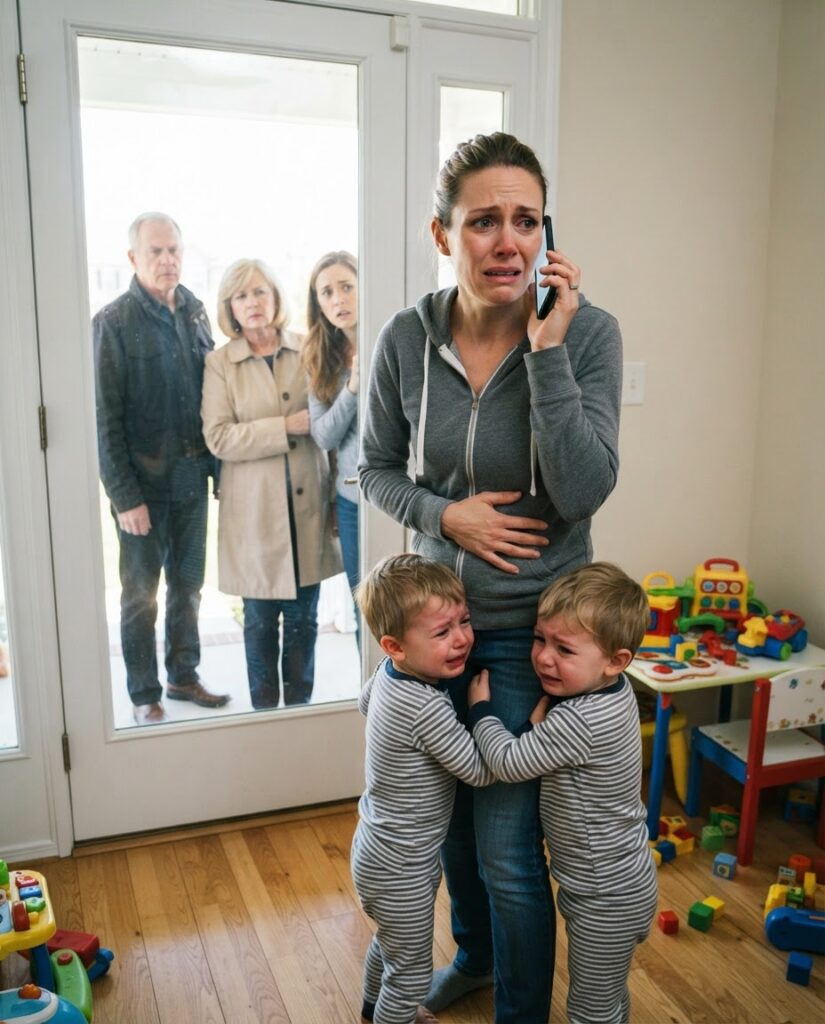
Then someone pounded on my front door.
Not a doorbell. Not a polite knock.
A hard, angry fist against wood.
Lucas froze with a dinosaur in his hand. Mateo crawled into my lap so fast his little fingers caught in my shirt.
Through the narrow window beside the door, I saw my father’s shoulder, my mother’s purse strap, and behind them, Laura’s bright concert hoodie.
My mother lifted one hand and knocked again, harder.
Then my father leaned close to the glass, saw me standing there, and shouted my name like I owed him an answer.
And when I looked down, I realized Mateo was still holding my phone—with the blocked-call screen glowing in his tiny hands…
The blocked-call screen showed eighteen missed calls from numbers I had not saved, all stacked under the same minute like they had passed my silence around the family and dared each other to break it.
My father hit the door again.
“Clara, open this door right now.”
I did not move quickly. I could not. The stitches pulled when I stood, and Mateo clung to my leg while Lucas started crying because he knew enough to understand that loud adults meant danger.
Through the glass, my mother’s face twisted when she saw me reach for the chain lock instead of the handle.
“You cut us off?” she shouted. “After everything we’ve done for you?”
I looked at the little entry table where the hospital discharge papers still sat under a bottle of children’s fever medicine. My wristband was beside them, cut open with scissors, the barcode curled like a shed skin.
Then Laura stepped forward, and that was the new part I had not expected.
She held up a printed bank notice with my name circled in blue ink.
My parents had brought proof of what they really came for, not the boys, not my surgery, not even an apology.
The rent payment had failed.
My mother saw me read it through the glass and suddenly her mouth shut.
Laura’s face changed too, the anger draining into something smaller and uglier, because she had clearly believed a different version of the story.
“Clara,” Laura whispered, looking from the notice to my bandaged stomach. “You were actually in surgery?”
My father turned on her so fast his shoulder blocked the window.
That was when I lifted my phone, opened the screenshot folder, and placed my thumb over the first receipt.
I looked through the glass at all three of them and said—
PART 2
“You’re right, Dad. I have been a burden.”
My father’s expression shifted. For the first time since he arrived, he looked almost satisfied.
Then I continued.
“But only because I spent years paying for people who never loved me enough to show up when I needed them.”
The satisfaction vanished from his face.
My mother stepped closer to the glass.
“Clara, don’t you dare talk to your father like that. We came here to discuss this like a family.”
“No,” I said quietly. “You came here because the rent payment failed.”
Laura lowered the bank notice.
“Wait,” she said, looking between us. “What rent payment?”
Neither of my parents answered.
I unlocked my phone and held it up so they could see the screenshots.
“Every month for the past two years, I transferred money to Mom and Dad. I paid part of their rent, covered their utilities, and sent extra money for groceries and medication. I did it because I believed my parents were struggling.”
My mother’s eyes narrowed.
“We never asked you to make such a scene about helping your own family.”
“You asked me last month to cover your electricity bill because you said you couldn’t afford it. You asked me to pay for Dad’s car repairs. You told me you couldn’t buy your prescriptions without my help.”
I paused.
“And when I told you I was being rushed into emergency surgery, you called me a nuisance.”
My father’s jaw tightened.
“That is not what I said.”
I stared at him through the glass.
“You said I was a burden. You said I had failed to plan. You said you weren’t canceling your plans because of me.”
He glanced at Laura.
For once, he seemed to understand that his words had followed him somewhere he couldn’t control.
Laura slowly turned toward my mother.
“You told me Clara was exaggerating. You said she had a stomachache and wanted you to babysit because she didn’t want to pay someone.”
My mother opened her mouth.
Nothing came out.
“You told me she was always asking you for favors,” Laura continued. “You said you were tired of being treated like free childcare.”
I almost laughed.
Not because it was funny, but because I had spent years listening to my parents describe themselves as generous people who had sacrificed everything for their children.
Apparently, in their version of the story, I was the one taking advantage of them.
Laura looked at the bank notice in her hand.
“Then why were you expecting her to pay your rent?”
Silence.
My father finally found his voice.
“This is between us. You don’t need to get involved.”
“I’m already involved!” Laura snapped. “You told me you couldn’t afford concert tickets until next payday, so I offered to cover dinner and parking. You said you had plenty of money coming in.”
She looked at me.
“Clara, how much have you been giving them?”
I hesitated.
Not because I wanted to protect my parents, but because saying the number aloud made the truth feel permanent.
“About twenty-two hundred dollars a month, on average. Sometimes more.”
Laura’s face went pale.
“Every month?”
I nodded.
She looked at our parents as if she were seeing strangers.
“You told me you were helping Clara.”
My mother immediately seized on the opening.
“We have helped her! We watched the boys before. We bought things for them. We—”
“When?” I interrupted.
My mother stopped.
“When did you last watch them without asking me for money afterward? When did you last come over just to see your grandsons? When did you last ask whether I was okay without turning the conversation into another bill?”
My voice trembled, but I did not stop.
“Do you know what Mateo does when someone raises their voice? He grabs my shirt and hides behind me. Do you know why? Because he has watched me cry after conversations with you more times than I want to admit.”
My father looked away.
I tightened my arm around Mateo.
“And Lucas still runs to the window whenever a car pulls into the driveway because he thinks Grandma and Grandpa might be coming to see him.”
For a moment, I could not speak.
That was the part that hurt the most.
Not the money.
Not even the rejection at the hospital.
It was the thought that my little boys were already learning to wait for people who had no intention of showing up.
My mother pressed her palm against the glass.
“Clara, please. We made a mistake. Everyone makes mistakes.”
I shook my head.
“A mistake is forgetting a birthday. A mistake is arriving late. You heard me tell you I might die, and you decided a concert was more important.”
“We didn’t know it was that serious!” she cried.
“The doctor said emergency surgery. I told you I might die.”
“You were emotional!”
“And you were comfortable enough to call me a burden.”
Her face crumpled.
For a brief second, I saw the mother I had spent my entire life trying to please.
The woman I had called when I got my first job. The woman I had hoped would hold my hand when I brought my twins home from the hospital. The woman whose approval I had chased long after I should have understood that love was never supposed to feel like an audition.
My heart still wanted to open the door.
That was the terrible thing about being hurt by your own parents.
Sometimes, even after they break you, a part of you still wants to comfort them.
But then Mateo whispered, “Mommy?”
I looked down.
His little face was pressed against my chest.
“Bad people?”
The question nearly destroyed me.
I kissed his forehead.
“No, baby. Mommy is just talking to Grandma and Grandpa.”
He nodded, but his fingers stayed tangled in my shirt.
I looked back at my parents.
“I am not opening this door today.”
My father stepped forward.
“You can’t just abandon us! We’re your parents!”
“And I’m their mother.”
I pointed toward the boys.
“My first responsibility is to the children who depend on me, not the adults who keep punishing me for having needs of my own.”
“You’re going to regret this,” he warned.
“Maybe,” I replied. “But at least I won’t be teaching my sons that love means accepting cruelty.”
I closed the curtain.
For a few seconds, I stood in the quiet living room, listening to my father shout my name from the porch.
Then I heard Laura say something I couldn’t make out.
The voices grew louder.
A door slammed.
And finally, the porch fell silent.
I didn’t look outside.
I carried Mateo to the couch, sat beside Lucas, and pulled both boys into my arms.
For the first time since the ambulance ride, I let myself cry.
Not because I wanted my parents to come back.
Because I was finally grieving the parents I had spent thirty-four years hoping they would become.
The following morning, Laura called me.
I almost ignored it.
Her number wasn’t blocked, but I had no obligation to answer.
Still, something made me pick up.
“Clara?”
Her voice sounded different. Smaller.
“I’m listening.”
“I owe you an apology.”
I said nothing.
“Mom told me you were constantly asking them for help. She said you expected them to drop everything whenever you wanted something. I believed her because I never thought she would lie about something like that.”
“She didn’t just lie to you, Laura. She made me sound selfish so she could look generous.”
“I know.”
There was a long silence.
Then she said, “I saw the photos you sent me last night.”
I frowned.
“What photos?”
“The ones of your boys at the hospital. The nanny sent them to you, and you forwarded them to me after we left. I didn’t see them until this morning.”
I remembered sending Laura the photographs of Lucas and Mateo sitting on the living room rug, still in their pajamas, holding their sippy cups.
Beneath them, I had written one sentence.
These are the children our parents refused to watch while I was being taken into emergency surgery.
Laura’s voice cracked.
“They look so little.”
“They are little.”
“I keep thinking about what would have happened if you hadn’t found that nanny.”
“So do I.”
“I could have gone,” she whispered. “If I’d known.”
“You could have.”
“I was home that morning. Mom told me you were fine.”
That revelation hurt in a different way.
My sister had been only a few miles away, preparing for the concert, while I had been lying in an ambulance wondering who would take care of my children.
But I also knew Laura hadn’t been given the truth.
“I can’t change what happened,” I told her. “Neither can you.”
“I know. But I want to help now.”
I closed my eyes.
“Laura, I don’t need you to fix our parents. I don’t need you to convince them they’re wrong. And I don’t need you to make me feel better about what happened.”
“Then what do you need?”
I looked toward the living room, where Lucas was trying to put a wooden block on top of Mateo’s head.
“I need people who mean what they say. If you want to be in my children’s lives, be there because you love them. Not because Mom and Dad tell you to visit. Not because you feel guilty. And not because you want me to pay for something.”
Laura began to cry.
“I can do that.”
“Then start by showing up.”
We ended the call without making promises about the future.
I didn’t forgive her that morning.
But I didn’t block her either.
Sometimes, a relationship doesn’t need another dramatic speech. It needs the chance to prove that things can be different.
My parents tried three more times to contact me over the following week.
First, my mother sent an email explaining that they were under tremendous stress and hadn’t understood how serious my condition was.
She wrote six paragraphs about their disappointment, their financial difficulties, and how hurtful it was that I had cut them off without warning.
She mentioned my surgery once.
In the final paragraph, she asked whether I could at least resume paying the electricity bill.
I deleted the email.
Two days later, my father left a voicemail from an unfamiliar number.
“You have made your point, Clara. Now stop this nonsense. Your mother is having trouble sleeping, and the landlord is asking questions. We’re your parents. You owe us some respect.”
I saved the voicemail.
Then I blocked the number.
The third attempt came through an aunt who had always believed family problems should remain private.
She called to tell me that my parents were struggling and that I should consider how much pain I was causing them.
I listened until she finished.
Then I asked one question.
“Did they tell you why I stopped helping them?”
She hesitated.
“They said there was a misunderstanding.”
“Did they tell you I was in an ambulance?”
Silence.
“Did they tell you a doctor had ordered emergency surgery?”
Another silence.
“Did they tell you I begged them to watch their grandsons because I thought I might die?”
My aunt’s voice softened.
“No, sweetheart. They didn’t.”
“Then please don’t ask me to repair a story you haven’t heard the truth about.”
I ended the call.
After that, I stopped explaining myself.
I had spent years presenting evidence to people who had already decided I was wrong.
I no longer needed their permission to protect my peace.
Three months later, I was finally strong enough to take the twins to the park without worrying that every step would pull at my healing incision.
It was a bright Saturday morning.
Lucas chased bubbles across the grass while Mateo sat beside me on a picnic blanket, trying to feed a cracker to a very unimpressed squirrel.
I was laughing when I heard someone call my name.
Laura stood near the playground with two small gift bags in her hands.
She hadn’t announced her visit. She hadn’t asked me to pay for anything. She had simply texted that morning to ask whether we were going to the park and whether it would be okay if she stopped by.
I had said yes.
She walked toward us slowly, as if she understood that being welcomed back into my life was a privilege rather than a right.
“Hi,” she said.
“Hi.”
She sat on the edge of the blanket and opened one of the bags.
Inside were two toy fire trucks.
Lucas immediately abandoned the bubbles.
“Truck!”
Laura smiled and handed him the toy.
Mateo reached for the second one, then looked up at her suspiciously.
“Mine?”
“Yours,” she said gently.
He accepted it.
For the next hour, Laura played with the boys. She pushed them on the swings, helped Lucas climb the little ladder, and let Mateo cover her shoes with sand.
She never once mentioned our parents.
When it was time to leave, she helped me gather the toys and fold the blanket.
Then she looked at me.
“I wanted to ask you something, but I don’t want you to feel pressured.”
“Okay.”
“Would it be all right if I came back next weekend?”
I studied her face.
“Are you asking because you want to see the boys, or because you want me to forgive you?”
She swallowed.
“Because I want to see the boys. And because I want to earn your trust back. But I know those are two different things.”
For the first time in months, I felt something loosen in my chest.
“Next Saturday works.”
She nodded, tears shining in her eyes.
“Thank you.”
As she walked away, Lucas waved his fire truck at her.
“Bye, Aunt Laura!”
She turned around and waved back.
I watched her go, understanding that forgiveness didn’t have to mean pretending nothing had happened.
It could mean leaving the door open a few inches while keeping the lock firmly in place.
Six months after my surgery, my mother sent me a letter.
A real letter, written on paper, with my name carefully printed on the envelope.
I almost threw it away.
Instead, I opened it after the boys had gone to bed.
The first page contained an apology.
A real one, at least in places.
She admitted that my financial support had become something she expected rather than appreciated. She admitted that she had repeated my father’s words without challenging him. She admitted that they had prioritized the concert because they didn’t believe I would stop helping them.
Then came the sentence that made my hands go cold.
Your father says we should never have called you a burden, but we still believe you were wrong to cut us off so completely.
I read it twice.
There it was.
Even in an apology, there was a condition.
They regretted the consequences more than the choice.
The letter ended with a request to see the boys and a reminder that Christmas was approaching.
I folded the pages and placed them in a drawer.
I didn’t reply.
A week later, my father sent a separate letter.
His was shorter.
He wrote that he had always believed parents deserved respect, regardless of their mistakes. He said I was making a difficult situation worse by refusing to reconcile. He insisted that my mother was heartbroken and that I had a responsibility to make things right.
There was no mention of the ambulance.
No mention of the surgery.
No mention of the two little boys who had needed someone to care for them.
I put his letter beside hers.
Then I went into the twins’ bedroom and watched them sleep.
Lucas had kicked off his blanket. Mateo was hugging a stuffed dinosaur against his chest.
I pulled the blanket over Lucas and kissed both boys on their foreheads.
I thought about the morning I had crawled across the bathroom floor, terrified that I might never see them again.
I thought about the way my parents had answered the phone.
And I finally understood something I should have understood years earlier.
I could love my parents without funding their lives.
I could miss them without inviting them back.
I could wish them well without allowing them access to my children.
And I could forgive them someday without pretending they had never hurt me.
Those things were not contradictions.
They were boundaries.
The following Christmas, I hosted a small dinner at my house.
There were no expensive decorations or elaborate dishes. Just a roast chicken, mashed potatoes, green beans, and a chocolate cake from the bakery down the street.
Laura came early to help me cook.
She brought a stack of children’s books and a bottle of sparkling cider. She spent the afternoon listening to the boys tell her stories that made absolutely no sense and laughing as if every word were precious.
For the first time, the house felt full without feeling heavy.
As we sat down to dinner, Lucas looked at the empty chair beside me.
“Grandma coming?”
The question stopped me.
I set down my fork.
“No, sweetheart. Grandma and Grandpa aren’t coming tonight.”
He considered that for a moment.
“Why?”
I took a breath.
“Sometimes grown-ups make choices that hurt other people. And sometimes, when they do that, we need a little space.”
He nodded, apparently satisfied.
Then he returned to his potatoes.
Children don’t always need every detail. They need honesty they can understand, reassurance they can trust, and adults who don’t make them responsible for problems they didn’t create.
After dinner, Laura helped the boys decorate cookies.
I stood in the kitchen doorway, watching flour dust the counter and frosting smear across Mateo’s nose.
My phone vibrated on the table.
An email from my mother.
The subject line read: Merry Christmas, Clara.
I opened it.
She wrote that she missed me. She missed the boys. She hoped we could put the past behind us and become a family again.
At the bottom, she added:
Your father and I are still having financial problems. If you could help us get through January, it would mean so much.
I stared at the screen for a long moment.
Then I closed the email.
I didn’t feel angry.
I didn’t feel guilty.
I didn’t even feel the familiar ache that used to send me reaching for my banking app.
I felt nothing that required me to act.
I placed my phone facedown and returned to the kitchen.
Laura looked up from the counter.
“Everything okay?”
I smiled.
“Everything is fine.”
And for the first time in a very long time, it was.
Two years later, I still remembered that Thursday morning.
I remembered the cold bathroom tile. The ambulance siren. The hospital lights. The doctor’s urgent voice.
Most of all, I remembered the moment I realized that my children could not depend on the people I had spent years depending on.
My parents never became the grandparents I had hoped they would be.
They sent occasional messages. Sometimes they apologized. Sometimes they blamed me. Sometimes they asked for money.
I never resumed the payments.
I also never told my sons that their grandparents were monsters. I told them the truth in age-appropriate ways, and I let them grow up surrounded by people who showed love through consistency rather than promises.
Laura remained in our lives.
She came to birthday parties, attended preschool celebrations, and learned which bedtime stories Mateo wanted read twice and which dinosaur Lucas insisted was actually a dragon.
She never asked me to forget what had happened.
She simply kept showing up.
And that mattered more than any apology she could have written.
One evening, when the boys were four, I tucked them into bed and stood between their little beds.
Lucas reached for my hand.
“Mommy, you’re staying home tomorrow, right?”
I smiled.
“Yes, baby. I’ll be here when you wake up.”
He closed his eyes.
Mateo was already asleep, his fingers wrapped around the tail of his stuffed dinosaur.
I watched them for a moment, then turned off the light.
In the hallway, I paused beside the pale blue bedroom door I had painted during the week of maternity leave when I still believed asking for help made me weak.
I understood now that I hadn’t been weak for needing help.
I had been a frightened mother in a medical emergency, doing everything she could to keep her children safe.
The people who failed me were responsible for their choices.
I was responsible for what happened next.
And I chose my children.
I chose my health.
I chose a home where love was not measured by how much money I gave away, how much disrespect I tolerated, or how many times I forgave someone who refused to change.
My parents once told me I was a burden.
For years, I had tried to prove them wrong by carrying everyone else.
Now, I understood the truth.
I was never a burden. I was their daughter. And I deserved to be loved without having to pay for it.
The next morning, sunlight filled the kitchen as two little boys raced in wearing mismatched pajamas, shouting for pancakes.
I laughed, reached for the mixing bowl, and began another ordinary day.
It was not the family I had imagined when I was young.
It was something better.
It was a family built on the people who stayed.
And this time, I knew exactly what that was worth.
THE END