I stared at the photograph until the edges began to blur.
My mother was younger in it. Her hair was still dark, pulled back from her face in the neat twist she wore whenever she wanted to look respectable. She was sitting in a hospital chair, holding a newborn wrapped in a pale yellow blanket.
On the back, in faded blue ink, someone had written:
September 1987.
Hannah and Douglas.
My fingers tightened around the photograph.
“I don’t understand.”
Lucas stood beside the chair, his face pale.
Douglas made a soft sound from the bed.
“Hannah…”
I looked at him.
“No.” My voice came out sharper than I intended. “Not yet. Lucas just said there was a reason you never stopped searching for me. Now I’m looking at a photograph of my mother holding a baby, and our names are written on the back.”
I held it up.
“Tell me what this means.”
Lucas glanced at his father.
Douglas closed his eyes.
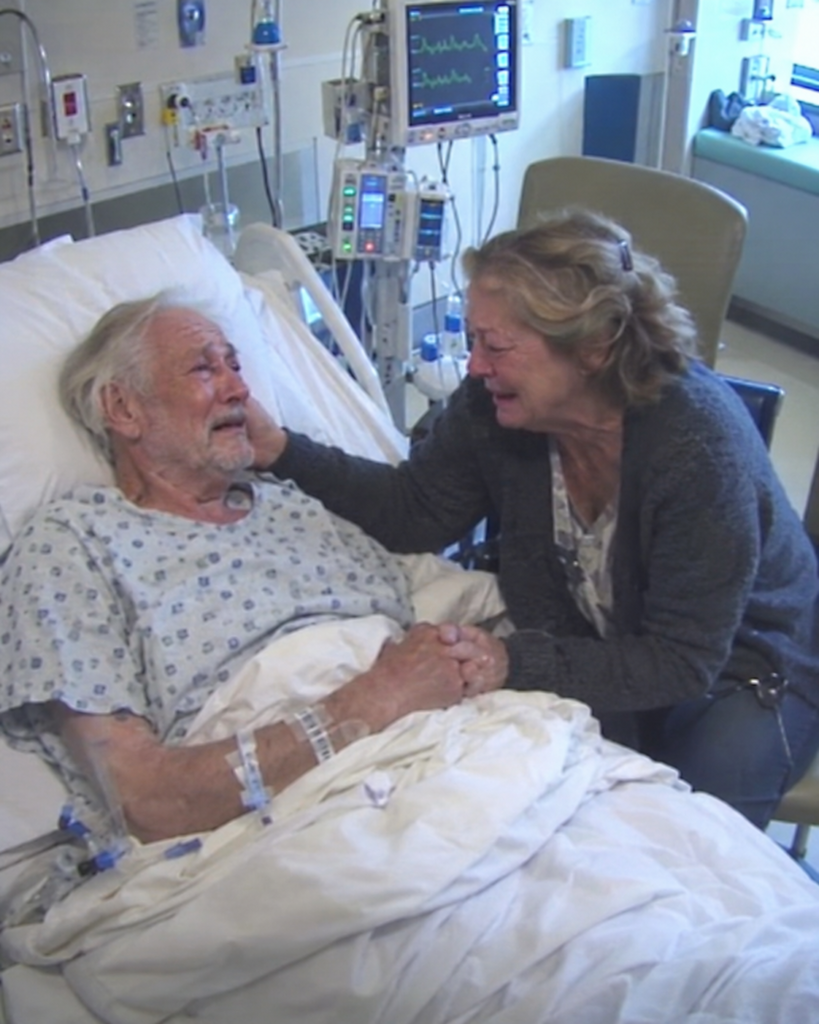
For several seconds, the only sound in the room was the steady rhythm of the monitor beside his bed.
Then he whispered, “I don’t know.”
I stared at him.
“What?”
“I’ve spent thirty-nine years trying to find out.”
That wasn’t the answer I had expected.
I sank back into the chair.
Lucas pulled another chair closer, but I couldn’t take my eyes off Douglas.
He looked exhausted. Older than sixty somehow, though we were the same age. Illness had hollowed his cheeks and thinned his hands, but his eyes were still the same.
Those eyes had followed me down school hallways.
Those eyes had watched me steal French fries from his plate.
Those eyes had looked at me beneath the football bleachers when we were nineteen and promised that if the rest of life failed us, we would find each other again.
And now those same eyes were filled with something I had never seen in them before.
Fear.
Not fear of dying.
Fear of what he was about to tell me.
Lucas sat across from me.
“My mother found that photograph in 2003.”
I looked at him.
“Margaret?”
He nodded.
“She and Dad had been cleaning out my grandmother’s attic after she passed away. There was an old box of papers that had somehow ended up with her things. Letters, receipts, photographs. Most of it meant nothing.”
Douglas gave a faint, bitter laugh.
“Until Margaret found Hannah’s name.”
Lucas continued.
“She knew who you were.”
I looked toward Douglas.
“You told your wife about me?”
He smiled weakly.
“On our third date.”
Despite everything, a tiny laugh escaped me.
“That must have gone well.”
“It didn’t.”
Lucas smiled too.
“My mother apparently told him that mentioning another woman on a third date was a terrible strategy.”
“It was,” Douglas murmured.
The smile vanished from his face.
“But Margaret also knew there was a part of me that never understood what had happened.”
I lowered my eyes to the photograph.
“So she found this.”
“Yes.”
“And?”
Lucas leaned forward.
“She recognized your mother’s face from another photograph Dad had kept.”
I glanced toward the blue suitcase.
My old suitcase.
The one I had believed lost decades ago.
Douglas followed my gaze.
“Your mother gave it to Margaret.”
I turned sharply.
“What?”
“In 1996.”
The room seemed to tilt again.
“My mother met your wife?”
Douglas nodded.
“I didn’t know until years later.”
Lucas reached inside the suitcase and removed a thick cream-colored envelope.
The paper had yellowed around the edges.
On the front was my mother’s handwriting.
For Margaret Ellis.
“My mother’s last name was Ellis,” Lucas explained.
I stared at the envelope.
“When Margaret opened it,” Douglas said, “she found the suitcase key, your letters, and a note.”
“What did the note say?”
Lucas hesitated.
Then he handed it to me.
I unfolded the paper.
My mother’s handwriting was unmistakable. Strong, precise, slightly slanted.
Dear Margaret,
You do not know me, although I suspect you know my name.
There are things I did many years ago that I convinced myself were necessary.
I was wrong.
I am returning something that should never have belonged to me.
Please do not tell Douglas I contacted you.
I am asking this not because I deserve your kindness, but because some truths arrive too late to repair anything.
The suitcase belongs to Hannah.
The letters belong to Douglas.
Perhaps someday you will decide what should be done with them.
I am sorry.
Evelyn Carter.
I read it twice.
Then a third time.
“When was this?”
“June of 1996,” Lucas said.
I looked at Douglas.
“You were married.”
“For ten years.”
“And she gave Margaret my letters.”
“Yes.”
“Why didn’t Margaret give them to you?”
Douglas’s face tightened.
“She tried.”
I waited.
“At first she thought your mother had simply hidden the letters because she disapproved of me. Margaret confronted her.”
My heart began beating faster.
“My mother?”
“Yes.”
“What did she say?”
Douglas looked at Lucas.
Lucas reached into the suitcase again.
This time he removed a small cassette tape.
I almost laughed.
It looked so ordinary.
A cheap plastic cassette with a white label.
On it were two handwritten words.
Evelyn — June.
“My mother recorded their conversation?” I asked.
“Margaret did.”
“Without telling her?”
Douglas shook his head.
“Your mother knew.”
I looked from the cassette to him.
“Why?”
“Because Margaret told her she wouldn’t leave until she understood what had happened.”
I sat very still.
“Have you listened to it?”
Douglas nodded.
“Once.”
Lucas added quietly, “Dad never wanted me to hear it. I only listened last month, after he became ill.”
I turned the cassette over in my hand.
A small plastic object.
A whole lifetime trapped inside it.
“What did my mother say?”
Douglas’s eyes filled.
“She said she had intercepted almost every letter between us after I left for college.”
That part no longer surprised me.
“She thought you would ruin your life waiting for me,” he continued. “She believed you were supposed to leave town, go to university, become someone important.”
I almost laughed.
“My mother had a very specific idea of important.”
“I remember.”
He looked toward the window.
“Apparently, she also thought I was going nowhere.”
“You were nineteen.”
“My father worked at the mill. I didn’t have money. I didn’t come from the family she wanted for you.”
I swallowed.
It sounded exactly like my mother.
She had never been cruel to Douglas directly.
That had almost made it worse.
She smiled at him.
Fed him dinner.
Asked about his grades.
Then, after he left, she would say things like, “He’s a nice boy, Hannah. Nice boys aren’t always men you build your future around.”
I used to roll my eyes.
I thought it was harmless.
I hadn’t understood what she was willing to do.
“So she forged that letter.”
“Yes.”
“And told you I was engaged.”
“Yes.”
“And told me you were getting married.”
Douglas looked at me.
“That part was true.”
The honesty hurt, but not in the way it might have forty years earlier.
“You met Margaret.”
“I did.”
“And loved her.”
He looked toward Lucas.
“Yes.”
There was no apology in the word.
I was grateful for that.
I did not want Margaret reduced to a mistake in somebody else’s love story.
Douglas’s fingers moved weakly across the blanket.
“She was good to me, Hannah. Better than I deserved sometimes.”
Lucas lowered his gaze, smiling faintly.
“My mother would have said the same thing about herself.”
I looked at him.
“You miss her.”
“Every day.”
“When did she die?”
“Four years ago.”
The sadness in his voice made something inside me soften.
“I’m sorry.”
“Thank you.”
Douglas took a slow breath.
“Margaret knew I had loved you. She also knew I loved her. Those things weren’t enemies in her mind.”
I found myself thinking that I might have liked her.
Probably very much.
“So why didn’t she contact me after my mother brought her the suitcase?”
“Because of what your mother told her next.”
The photograph remained in my lap.
The baby.
I had almost forgotten the baby.
Almost.
I lifted the picture.
“This.”
Douglas nodded.
“Yes.”
“What did she say?”
“She said the letters weren’t the worst thing she’d done.”
The room suddenly felt too warm.
I stood and walked to the window.
Outside, evening had settled over the hospital parking lot. Cars moved beneath the lamps. Somewhere below, a woman wearing blue scrubs hurried toward the entrance carrying two coffees.
Ordinary life continued.
It felt almost insulting.
I pressed my palm against the cold glass.
“What could be worse?”
No one answered immediately.
Then Lucas said, “Your mother told Margaret that in January of 1987, she received a telephone call.”
I turned.
“From whom?”
“She wouldn’t say.”
Douglas stared at me.
“But whoever called claimed you were pregnant.”
I stopped breathing.
For one absurd second, I almost looked down at my own body.
“That isn’t possible.”
“I know.”
“I have never been pregnant.”
“I know.”
“My mother certainly would have known that.”
“Yes.”
“Then why would someone tell her I was?”
Douglas swallowed.
“That’s the question Margaret kept asking.”
I walked back to the chair.
The photograph trembled between my fingers.
“My mother was holding a baby in September 1987.”
Lucas nodded.
“Yes.”
“And someone wrote our names on the photograph.”
“Yes.”
“Who?”
“We don’t know.”
I looked at Douglas.
“You’ve had this photograph for twenty-three years and you never found out?”
His expression twisted.
“I tried.”
“How?”
“I hired someone.”
“A private investigator?”
“Yes.”
That startled me.
Douglas had always been the sort of person who spent twenty minutes comparing prices before buying cereal.
The idea of him hiring an investigator seemed almost absurd.
“What did he find?”
“Very little at first. The hospital where the photograph was taken closed in the nineties. Records had been transferred twice. Some were destroyed in a flood. Others were incomplete.”
Lucas continued.
“The investigator eventually confirmed your mother volunteered there for about six months in 1987.”
I blinked.
“My mother?”
“Yes.”
“She never worked in a hospital.”
“Not officially. She volunteered with newborns whose mothers needed temporary assistance.”
Something clicked into place.
I remembered her disappearing two evenings a week that year.
She told me she was helping with a church program.
I had never asked questions.
At twenty-one, I was busy trying to become someone who didn’t think about Douglas every day.
“So the baby could have belonged to anyone.”
“Yes,” Douglas said.
Relief rushed through me.
Strangely powerful relief.
I leaned back.
“Then this photograph might mean nothing.”
Douglas didn’t answer.
I noticed.
“What?”
Lucas handed me another sheet of paper.
This one was much newer.
A photocopy of an old hospital intake form.
Most of the handwriting was difficult to read, but one line had been circled.
Infant’s temporary name:
Baby Hannah.
Beneath that:
Emergency contact:
Evelyn Carter.
I looked up.
“Why would my mother be listed as an emergency contact?”
“We don’t know,” Lucas said.
“And where does Douglas come into it?”
He reached back into the suitcase.
This time he removed a tiny hospital bracelet.
The plastic had turned cloudy with age.
A paper label sat beneath it.
The handwriting was faded but readable.
D. Carter.
My stomach tightened.
“My last name.”
“Yes.”
“But Douglas’s first initial.”
“Yes.”
I looked at Douglas.
“You think this baby was ours?”
“No.”
The answer came immediately.
Firmly.
“I know you weren’t pregnant. And I certainly would have remembered participating in the process.”
A strange laugh escaped me.
Douglas smiled.
For three seconds we were nineteen again.
Then his expression became serious.
“But someone wanted your mother to believe the child connected us.”
“Why?”
“That is what I’ve been trying to understand.”
I turned the hospital bracelet over.
There was a number printed beneath the name.
“Did your investigator trace this?”
“He tried.”
“And?”
“The number belonged to a sealed adoption file.”
I froze.
Lucas watched me carefully.
“The investigator couldn’t access it.”
“Of course not.”
Douglas nodded.
“Which should have been the end of it.”
“But it wasn’t.”
“No.”
He reached toward Lucas.
“Give her the newspaper clipping.”
Lucas did.
The clipping was brittle and folded twice.
A small local newspaper article dated September 18, 1987.
Nothing dramatic.
A piece about a charity fundraiser held at St. Matthew’s Community Hospital.
There were six photographs.
In one, my mother stood beside a table holding cupcakes.
Beside her was another woman.
I stared at the woman’s face.
Something about her felt familiar.
Not familiar like someone I’d known.
Familiar like a face seen in a dream.
“Who is she?”
Douglas whispered, “Turn it over.”
On the back someone had written:
Marianne Webb.
I looked at him.
The name meant nothing.
“Should I know her?”
“I didn’t.”
Lucas leaned forward.
“Dad’s investigator found her.”
“When?”
“2005.”
“What did she say?”
Douglas stared at the ceiling.
“She refused to speak with him.”
“Why?”
“She said the past belonged where it was.”
I almost laughed.
“People say that when they don’t have to live with the consequences.”
Douglas looked at me.
“That’s exactly what Margaret said.”
Again, I wished I could have known her.
“What happened next?”
“Nothing for almost a year.”
Lucas folded his hands.
“Then Marianne contacted my mother.”
“Why your mother?”
“She didn’t trust Dad.”
I glanced at Douglas.
“I can’t imagine why. You look terribly suspicious.”
His weak smile returned.
“Always have.”
Lucas continued.
“Marianne agreed to meet Mom at a restaurant outside Cleveland.”
“And?”
“She told my mother the baby in the photograph was her daughter.”
I stared at him.
“Marianne’s?”
“Yes.”
“Then why was my mother holding her?”
“Because Marianne was seventeen.”
My irritation vanished.
Lucas’s voice softened.
“She had hidden the pregnancy from almost everyone. Her parents were extremely strict. When she gave birth, she planned to place the baby for adoption.”
I looked again at the newborn.
The yellow blanket.
My mother’s careful arms.
“Mom was helping her?”
“Yes.”
That sounded like my mother too.
Which was the difficult thing.
People were never one thing.
She could intercept letters and break two young hearts.
She could also spend six months sitting beside frightened teenage mothers who had no one else.
“Marianne said your mother was the only adult who treated her kindly.”
I looked down.
For the first time since arriving, my anger became tangled with grief.
I remembered my mother at seventy.
Smaller then.
Moving slowly through our kitchen.
Asking whether I wanted tea.
There had been so much I hadn’t known about her.
So much she had never told me.
“Then why our names?”
Douglas answered.
“Marianne said she didn’t write them.”
“Did she know who did?”
“No.”
“Was the baby adopted?”
“Yes.”
“By whom?”
Douglas and Lucas exchanged a look.
I noticed immediately.
“What?”
Lucas cleared his throat.
“That’s where things became complicated.”
“More complicated?”
“Yes.”
I nearly laughed again.
Douglas moved his hand across the blanket until it rested close to mine.
I looked at it.
Then placed my hand over his.
His fingers were cold.
“Tell me.”
Lucas took a breath.
“The adoption never went through.”
I frowned.
“Why not?”
“Marianne changed her mind.”
That made sense.
“She kept the baby?”
“No.”
I stared at him.
“Then what happened?”
“No one knows.”
I removed my hand from Douglas’s.
“What do you mean, no one knows?”
“According to Marianne, the day before she was supposed to leave the hospital with the baby, your mother came to see her.”
“My mother.”
“Yes.”
“They argued.”
“About what?”
“Marianne wouldn’t say.”
I closed my eyes.
Of course she wouldn’t.
“Later that evening, Marianne fell asleep. When she woke up the next morning, your mother was gone.”
“And the baby?”
“Gone too.”
I opened my eyes.
The monitor beside Douglas seemed suddenly deafening.
“No.”
“Hannah—”
“No. My mother would never steal a baby.”
“We don’t know that she did,” Douglas said quickly.
“You just told me she disappeared with one.”
“Marianne never claimed Evelyn took the child.”
“Then who did?”
“No one knows.”
I stood again.
This time I began pacing.
There were too many pieces and none of them fit.
“My mother lived in the same house for thirty-seven years. I lived with her in 1987. If she’d brought home a newborn baby, I would have noticed.”
“Exactly,” Lucas said.
“So she couldn’t have taken her.”
“We don’t think she did.”
“Then why disappear?”
Lucas looked toward the suitcase.
“Because she was afraid.”
“Of what?”
He said nothing.
I stopped.
“Lucas.”
“My mother asked Marianne the same question.”
“And?”
“Marianne gave her a name.”
I waited.
The hesitation on his face frightened me more than anything else had.
“What name?”
Douglas whispered it.
“Thomas Carter.”
I laughed from sheer confusion.
“My father?”
“Yes.”
“No.”
I shook my head.
“That makes even less sense.”
My father had died when I was twenty-four.
A heart attack while repairing the fence behind our house.
He had been gentle, quiet, almost painfully predictable.
He made pancakes every Saturday.
Read mystery novels in his recliner.
Fell asleep during the evening news.
He had adored Douglas.
More than my mother did.
Sometimes, when Douglas left our house, my father would grin at me and say, “That boy is going to figure it out eventually.”
“What does my father have to do with any of this?”
Douglas’s voice became quiet.
“Marianne said Thomas came to the hospital twice.”
I sat down.
“My father knew her?”
“She believed so.”
“How?”
“We don’t know.”
“You keep saying that.”
“I know.”
Frustration rose in my chest.
“You’ve had decades.”
“And I lost decades before I even knew there was a mystery.”
The words stopped me.
He wasn’t angry.
Just tired.
I looked at him.
For years, I had imagined him living a complete life somewhere else.
I imagined him forgetting me.
Having Christmas mornings and family vacations and ordinary arguments about bills.
I had never once imagined him sitting at a kitchen table after his wife went to bed, staring at a photograph of a baby and wondering whether the past had lied to him.
“I’m sorry,” I whispered.
He squeezed my fingers.
“So am I.”
Lucas stood.
“There is something else you need to understand about my grandmother—Dad’s mother.”
I looked at him.
“What?”
“She knew your father.”
Douglas turned toward his son.
“Lucas.”
“What?”
“You said you weren’t going to—”
“She deserves to know.”
A silence passed between them.
“What does your mother have to do with my father?” I asked Douglas.
He sighed.
“Our parents grew up in the same town.”
“I knew that.”
“They knew each other before either of us was born.”
“I knew that too.”
Douglas looked uneasy.
“There was more to it.”
“How much more?”
Lucas answered.
“They were engaged.”
The room went silent.
I stared at him.
“My father and Douglas’s mother?”
“Yes.”
“No.”
Douglas closed his eyes.
“They were nineteen.”
The coincidence almost made me dizzy.
“Nineteen,” I repeated.
“The same age we were.”
“Yes.”
“What happened?”
“My mother broke it off.”
“Why?”
“She never told me.”
My mind raced backward through childhood memories.
Our families had always known each other.
Not closely.
But there were holiday greetings.
Church picnics.
Occasional conversations outside grocery stores.
I remembered Douglas’s mother once standing in our kitchen beside my father.
I must have been eleven.
They were laughing about something.
When my mother entered the room, both of them stopped.
At the time I hadn’t thought anything of it.
Now the memory felt different.
Everything did.
“Did my mother know they had been engaged?”
“Yes.”
“How?”
“Small town,” Douglas said.
I laughed softly.
“Of course.”
Lucas picked up the photograph.
“Marianne told my mother that the night before the baby disappeared, your father came to the hospital.”
My heartbeat quickened.
“Did she speak to him?”
“Yes.”
“What did he say?”
“She wouldn’t tell Margaret.”
“Why not?”
“Because she was afraid of him.”
I stared at Lucas.
“My father?”
“I know that’s difficult to hear.”
“No.”
I stood.
“You don’t know what you’re talking about.”
“Hannah,” Douglas said softly.
“My father was the gentlest man I knew.”
“I remember him.”
“He wouldn’t hurt anyone.”
“I never said he did.”
“Then what are you implying?”
“Nothing.”
Douglas struggled to sit higher.
Lucas immediately adjusted the bed.
I felt guilty the second I saw the effort it cost him.
He caught me looking.
“Still stubborn,” he whispered.
“So are you.”
“Good.”
Lucas poured water into a paper cup.
Douglas took only a tiny sip.
Then he looked at me.
“Your father helped me once.”
“What?”
“When we were nineteen.”
I frowned.
“The summer before college.”
He breathed slowly.
“I went to him because I wanted to ask whether he thought I should tell you how I felt.”
My throat tightened.
“You asked my father?”
“Yes.”
“What did he say?”
Douglas smiled.
“He told me I was an idiot.”
A laugh escaped me before I could stop it.
“That sounds more like him.”
“He said everybody in town knew except the two of us.”
My eyes filled.
“And then?”
“He told me not to wait too long.”
The irony was almost unbearable.
“Two weeks later I bought the ring.”
I looked toward the velvet box.
“So my father encouraged you.”
“Yes.”
“Then why would he become involved in separating us?”
“I don’t know that he did.”
Lucas sat again.
“There may be another explanation.”
“Which is?”
“My mother believed your parents were protecting someone.”
“Who?”
“Marianne.”
“From what?”
“She never found out.”
The exhaustion on Lucas’s face told me how long his family had lived with these questions.
“After Margaret met Marianne,” he said, “she wanted to contact you immediately.”
I looked at Douglas.
“But she didn’t.”
“No.”
“Why?”
“Because Marianne begged her not to.”
“Why would Marianne care whether I knew?”
Lucas hesitated.
“She said finding you could put the child at risk.”
I almost objected.
Then the words caught up with me.
“The child?”
Lucas nodded.
“The baby.”
“But this was 2005.”
“Yes.”
“She wouldn’t have been a baby.”
“No. She would have been eighteen.”
I looked at the photograph again.
A baby born in September 1987.
Thirty-nine years old now.
Somewhere.
Perhaps.
“What risk?”
“Marianne wouldn’t explain.”
I rubbed my forehead.
“This is impossible.”
Douglas watched me.
“I know.”
“No, you don’t. I walked in here expecting…” I stopped.
Expecting what?
A final goodbye?
An old love?
A simple explanation for an old heartbreak?
“I don’t even know what I expected.”
“I wanted to see you.”
Douglas’s voice was barely audible.
“Whatever else happened, that part was simple.”
I looked at him.
He smiled.
“I promised I’d find you when we were sixty.”
My tears returned.
“You cut it close.”
“I always was bad with deadlines.”
“You once turned in a history paper six weeks late.”
“It was excellent.”
“It was four pages.”
“Four excellent pages.”
Lucas laughed softly.
The sound changed something in the room.
For a moment, the mystery loosened its grip.
I saw Douglas again.
Not the dying man.
Not the boy frozen in my memory.
The whole person between them.
The seventeen-year-old who taught me how to drive a stick shift.
The nineteen-year-old who bought a ring and never gave it to me.
The husband who stayed beside his sick wife.
The father whose son was sitting across from me.
The man who had remembered every birthday.
I moved closer to the bed.
“What do the doctors say?”
Lucas looked down.
Douglas answered.
“Not enough time.”
My chest tightened.
“How much?”
He gave a tiny shrug.
“Days. Maybe less.”
I reached for his hand.
“You couldn’t call me sooner?”
“I didn’t know where you were.”
“You said you searched.”
“For years.”
“And?”
“I found three Hannah Carters, two Hannah Whitmores, and one Hannah Carter who turned out to be a seventy-eight-year-old beekeeper in Oregon.”
I laughed through my tears.
“Maybe you should have married her.”
“She sounded interesting.”
“Douglas.”
His smile faded.
“Margaret found you.”
I stared at him.
“When?”
“2019.”
My hand went still.
“She found me?”
“Yes.”
“How?”
“A high school reunion page.”
I remembered joining it briefly.
Uploading one photograph.
Deleting the account months later.
“Why didn’t she contact me?”
Douglas’s eyes moved to Lucas.
Again.
That look.
There was something else.
“What happened?”
Lucas’s voice softened.
“My mother did contact you.”
I stared at him.
“No, she didn’t.”
“She mailed you a letter.”
“I never received one.”
Douglas whispered, “We know.”
A cold feeling moved through me.
“What does that mean?”
Lucas stood and went to the suitcase.
He removed an envelope.
Unlike the others, this one looked relatively new.
My name and address were written across it.
The address was correct.
My childhood home.
The house where I still lived.
Across the front, in large red letters, were two words.
RETURN TO SENDER.
I took it.
“Why was this returned?”
“No idea.”
“I’ve lived at that address my entire life.”
“I know.”
“The post office wouldn’t return it.”
“That’s what we thought.”
I looked closer.
There was no postal marking.
No barcode.
No stamp cancellation.
Nothing.
Only those red words.
“These weren’t stamped by the post office.”
“No.”
My heart began beating faster.
“Then who returned it?”
Lucas didn’t answer.
I opened the envelope.
Inside was a letter from Margaret.
Dear Hannah,
You do not know me.
My name is Margaret Ellis.
I am Douglas’s wife.
I imagine that sentence alone might make you want to stop reading, but I hope you won’t.
There are things you deserve to know about the past.
Douglas doesn’t know I am writing.
Not because he wouldn’t want to hear from you, but because he has spent many years convincing himself that contacting you would interfere with your life.
I believe he is wrong.
I have been wrong before too.
There is a suitcase in our home that belongs to you.
There are letters inside it that belong to both of you.
There is also a story neither of you knows completely.
If you are willing, please call me.
My number is below.
Whatever happens after that is your choice.
But I have come to believe that silence is not kindness when it is built on a lie.
Margaret.
I lowered the paper.
A tear fell onto it.
I wiped it away quickly.
“Your mother was remarkable.”
Lucas smiled sadly.
“Yes.”
“She tried.”
“She did.”
I looked at the envelope again.
“Who returned this?”
Lucas pulled something else from the suitcase.
A second envelope.
This one had been mailed two months later.
Then a third.
Then a fourth.
All addressed to me.
All returned.
All with the same handwritten words across the front.
RETURN TO SENDER.
Margaret had tried four times.
Four.
I stared at them.
“The handwriting.”
Douglas nodded.
I knew before he said it.
“It wasn’t the post office.”
“No.”
“Was it my mother’s?”
“No.”
“Then whose?”
Lucas placed one final envelope on my lap.
It was older than Margaret’s letters.
Much older.
Postmarked July 1987.
Addressed to my mother.
The return address belonged to someone named Marianne Webb.
Across the back was a single handwritten sentence.
Evelyn, Thomas cannot know where she is.
I read it twice.
“Where who is?”
“We assumed the baby.”
“But you don’t know.”
“No.”
The air in the room felt different now.
Not dangerous.
Crowded.
As though people who had been dead for years had entered quietly and were standing around us, waiting for their turn to speak.
My mother.
My father.
Margaret.
Their secrets crossing decades.
Their decisions shaping lives they could no longer explain.
I turned the envelope over.
Something was written faintly beneath the flap.
A name.
Almost erased.
I tilted it toward the light.
Then I saw it.
Ruth.
My body went cold.
Douglas must have seen my face.
“What?”
I couldn’t speak.
“Hannah?”
I pointed.
He squinted.
Lucas came closer.
“What does it say?”
Douglas read it.
“Ruth.”
He looked at me.
I stared at him.
“Ruthie.”
The nickname.
The name only Douglas called me.
The name he’d whispered when I answered the phone.
Lucas looked between us.
“Why would Marianne write that?”
“She wouldn’t.”
I turned the envelope over and over.
“That nickname didn’t exist outside Douglas and me.”
Douglas’s face had gone pale.
Not the pallor of illness.
Something else.
“Hannah.”
“What?”
“There was one other person who knew it.”
I stared at him.
“Who?”
“Your father.”
I remembered immediately.
A summer afternoon.
Douglas calling through our kitchen window.
“Ruthie!”
My father laughing behind me.
“Ruthie?”
I had thrown a dish towel at Douglas.
He’d ducked.
My father had repeated the name for weeks just to annoy me.
I closed my eyes.
“Oh, God.”
Lucas sat down slowly.
“So your father knew.”
“Knew what?”
I snapped.
“No one has answered the simplest question in this room. Who was that baby?”
Douglas watched me for a long moment.
Then he looked toward his son.
“Give Hannah the report.”
Lucas didn’t move.
“What report?” I asked.
Douglas spoke again.
“The one you found after Margaret died.”
Lucas’s jaw tightened.
“Dad.”
“You promised.”
“I promised I would give it to her if you were sure.”
“I am.”
Lucas remained still.
“Lucas,” I said.
He looked at me.
There was kindness in his face.
And fear.
Not of me.
For me.
He reached into the inner pocket of his jacket.
Unlike everything else in the suitcase, this document wasn’t old.
It was printed on white paper.
A laboratory report.
Dated six weeks earlier.
My eyes moved across numbers and words I didn’t understand.
Then I saw one phrase.
Probability of parent-child relationship.
I looked at Lucas.
“Whose test is this?”
He swallowed.
“Mine.”
“And whose else?”
He handed me the second page.
There were two samples listed.
Sample A: Lucas Ellis.
Sample B: Marianne Webb.
I frowned.
“You tested Marianne?”
“After my mother died, I tried to continue what she started.”
“You found her?”
“Yes.”
“Where?”
“Ohio.”
“She agreed to a DNA test?”
“Eventually.”
I looked at the report.
“Why?”
“Because I had a question.”
“What question?”
His eyes met mine.
“Whether she was my grandmother.”
The room seemed to become utterly still.
I read the conclusion.
Not a match for a grandparent relationship.
My breath escaped.
“So she wasn’t.”
“No.”
“Then what does this have to do with me?”
Lucas took the report back.
“There was another match.”
“What?”
He placed a second page in front of me.
This wasn’t a laboratory report.
It was a family-tree diagram generated from a genealogy database.
Several names had been removed for privacy.
One branch was highlighted.
“We uploaded my DNA with Marianne’s permission,” Lucas said. “We were hoping to find the baby.”
“Did you?”
“No.”
The disappointment in his voice sounded genuine.
“But three weeks later, I received a new relative match.”
I stared at the chart.
“Who?”
“A man named Benjamin Hale.”
“Who is that?”
“I didn’t know.”
“Did you contact him?”
“Yes.”
“And?”
“He’s thirty-nine years old.”
Exactly the age the baby would be.
I leaned forward.
“Thirty-nine.”
“Yes.”
“But the baby in the picture was a girl.”
“So we believed.”
“Marianne called her daughter.”
“She did.”
“Then Benjamin can’t be the baby.”
“No.”
I looked at the report again.
“How is he related to you?”
Lucas hesitated.
Douglas closed his eyes.
I suddenly knew I didn’t want to hear the answer.
But there was no going backward now.
“Lucas.”
He took a breath.
“The database estimated that Benjamin and I were half brothers.”
I stared at him.
Silence.
Douglas’s hand tightened around mine.
I looked at him.
“No.”
“Hannah—”
“No.”
Lucas’s voice was gentle.
“The estimate was wrong.”
I let out the breath I hadn’t known I was holding.
Then he continued.
“It wasn’t close enough.”
“What does that mean?”
“It means the relationship was nearer than half brothers.”
I felt my heartbeat in my throat.
Lucas placed another document on my lap.
“We did a private test.”
I didn’t touch it.
“What did it say?”
Lucas looked at Douglas.
Douglas looked at me.
Then Lucas said, “Benjamin isn’t my brother.”
I waited.
“He’s my uncle.”
The words meant nothing for several seconds.
Then everything rearranged itself.
If Benjamin was Lucas’s uncle…
He would have to be Douglas’s brother.
I looked at Douglas.
He was crying.
“I don’t have a brother,” he whispered.
I stared at him.
The photograph.
The baby.
September 1987.
My mother.
My father.
Douglas’s mother.
An old engagement between our parents.
A sealed adoption file.
A child who disappeared.
I stood so quickly the chair scraped across the floor.
“Your mother.”
Douglas nodded slowly.
“She died believing she had one son.”
“You.”
“Yes.”
“But the DNA says Benjamin is your brother.”
“Yes.”
“Then one of your parents had another child.”
“Yes.”
I looked toward Lucas.
“Which one?”
His answer was almost inaudible.
“We don’t know.”
I laughed once, but there was no humor in it.
“Of course you don’t.”
Douglas reached for me.
I took his hand.
For several minutes, nobody spoke.
My anger had vanished.
So had my confusion.
What remained was something deeper.
A realization that the story I had always believed about my life was incomplete.
Maybe everyone’s was.
We believed our parents began when we were born.
We forgot they had entire lives before us.
Promises.
Heartbreaks.
Mistakes.
People they loved.
Things they regretted.
Secrets they carried until they died.
“What happened when you contacted Benjamin?” I asked.
Lucas looked uncomfortable.
“At first, he thought I was trying to scam him.”
“Reasonable.”
“Eventually I convinced him to talk.”
“Does he know he’s connected to your family?”
“Yes.”
“And?”
“He didn’t know he was adopted.”
My heart sank.
“Oh.”
“He confronted his parents. They admitted it.”
“Were they able to tell him where he came from?”
“Only a little.”
Lucas took out his phone.
“The adoption wasn’t handled through the hospital.”
“But the file—”
“The hospital started the paperwork. Something changed. Benjamin’s adoptive parents received him privately through an attorney three weeks later.”
“Which attorney?”
“A man named Charles Greer.”
The name meant nothing.
“Is he alive?”
“No.”
“Of course.”
“But his daughter is.”
That was the first hopeful thing I’d heard in half an hour.
“You contacted her?”
“This morning.”
Douglas turned his head.
“You didn’t tell me that.”
“I wanted to verify it first.”
“Verify what?” I asked.
Lucas unlocked his phone.
“She found one of her father’s old ledgers.”
My pulse quickened.
“There was an entry from October 1987. It lists an infant placement.”
“Benjamin?”
“We think so.”
“Who arranged it?”
Lucas looked directly at me.
“Your father.”
Everything stopped.
“My father?”
“Yes.”
I shook my head.
“No.”
Lucas handed me the phone.
There was a photograph of a ledger page.
The handwriting was cramped.
October 2, 1987.
Private infant placement.
Then a payment.
Then a name.
Thomas Carter.
I sat down slowly.
“He arranged the adoption.”
“It appears that way.”
“But why?”
“We don’t know.”
I looked at Douglas.
“Did your father know mine?”
“Yes.”
“Were they friends?”
“Not especially.”
“Could Benjamin be your father’s son?”
Douglas swallowed.
“Possibly.”
“Or your mother’s?”
“Possibly.”
My thoughts moved faster.
Then stopped.
There was another possibility.
One I didn’t want to say.
But Lucas saw it in my face.
“Yes,” he said quietly.
I looked at him.
“My father.”
He nodded.
Benjamin could have been my father’s child.
Which would make him my half brother.
But it couldn’t also make him Douglas’s brother.
Unless—
I stood.
“No.”
Douglas stared at me.
“What?”
“The DNA.”
I looked at Lucas.
“You said Benjamin is your uncle.”
“Yes.”
“But you haven’t tested him against Douglas.”
“No.”
“Why not?”
Lucas glanced at his father.
“Dad was too ill when the results came back. I didn’t want to overwhelm him.”
“So you only know Benjamin is closely related to you.”
“Yes.”
“Then your assumption might be wrong.”
Lucas frowned.
“How?”
I stepped toward him.
“Because you’re assuming the connection comes through Douglas.”
His face changed.
Douglas looked between us.
I heard myself say the words before I fully understood them.
“What if it comes through Margaret?”
Silence.
Lucas slowly lowered his phone.
“My mother?”
“You said Benjamin is genetically close enough to be your uncle. Your mother’s brother would also be your uncle.”
Lucas went pale.
“We ruled that out.”
“How?”
“My mother’s parents had no other children.”
“That they knew of.”
He stared at me.
The room was suddenly filled with another possibility.
Another door.
Douglas whispered, “Margaret never knew her biological father.”
Lucas turned.
“What?”
I looked at Douglas.
“You never told him?”
“Margaret asked me not to.”
Lucas stepped closer to the bed.
“Mom told me Grandpa Ellis was her father.”
“He raised her. He was her father in every way that mattered.”
“But biologically?”
Douglas shook his head.
“No.”
Lucas stared at him.
“Who was?”
“She never knew.”
I looked at the blue suitcase.
At my letters.
At the ring.
At the photograph.
Then at the ledger entry bearing my father’s name.
What had seemed like one secret was becoming something else.
A web connecting our families long before Douglas and I had ever met.
My phone rang.
All three of us jumped.
I almost ignored it.
Then I saw the number.
My home phone.
The landline.
I stared at the screen.
Lucas noticed.
“What is it?”
“That’s impossible.”
“What?”
I showed him.
“My landline is calling me.”
Douglas’s expression changed.
“Answer it.”
I pressed the button.
“Hello?”
For several seconds, there was only silence.
Then breathing.
Soft.
Uneven.
“Hello?”
A man’s voice spoke.
Older.
Careful.
“Is this Hannah Carter?”
Every hair on my arms rose.
“Yes.”
“My name is Benjamin Hale.”
I looked at Lucas.
His mouth fell open.
Benjamin continued.
“Lucas gave me your number this morning.”
Lucas immediately shook his head.
“No,” he whispered. “I didn’t.”
I gripped the phone tighter.
“Benjamin, where are you calling from?”
There was a pause.
“I’m at your house.”
I stopped breathing.
“What?”
“I know this sounds strange.”
“How did you get there?”
“Your mother’s attorney gave me the address.”
“My mother’s attorney died years ago.”
Another pause.
“No, Hannah.”
Benjamin’s voice became quieter.
“Not that attorney.”
I looked at Douglas.
“What are you talking about?”
Benjamin took a breath.
“Three months ago, I received a letter that had been held in trust for me since 1987.”
The date hit me like a bell.
“What letter?”
“From Evelyn Carter.”
My mother.
My knees nearly gave way.
“She wrote to you?”
“Yes.”
“What did she say?”
Benjamin hesitated.
“That I was not to open it until my thirty-ninth birthday.”
His thirty-ninth birthday.
September.
Only weeks earlier.
I looked at the photograph again.
“What did my mother tell you?”
“That if I ever wanted to know why I was adopted, I should find three people.”
“Who?”
“Douglas Ellis.”
Douglas closed his eyes.
“Hannah Carter.”
My throat tightened.
“And the third?”
Benjamin said nothing.
“Benjamin?”
When he answered, his voice had changed.
“She wrote another name.”
“What name?”
“Margaret Ellis.”
Lucas stepped closer.
“My mother?”
Benjamin heard him.
“Is that Lucas?”
Lucas stared at my phone.
“How do you know my name?”
“Because Evelyn wrote about you too.”
Lucas went completely still.
“That doesn’t make sense. I wasn’t born until 1990.”
“I know.”
No one moved.
My mother had supposedly written the letter in 1987.
Three years before Lucas was born.
I forced myself to speak.
“Benjamin, are you sure the letter was written in 1987?”
“That’s what I thought.”
“What do you mean?”
“I had the paper examined.”
My fingers tightened.
“And?”
“The paper is old. The envelope is old. Most of the letter was written in 1987.”
“Most?”
“There was a second page added later.”
“When?”
“The handwriting expert couldn’t be exact.”
I could barely hear myself.
“How much later?”
“Years.”
I looked at Douglas.
“So my mother continued updating the letter.”
“Yes.”
“Why?”
“I think she was waiting for something.”
“What?”
Benjamin was silent.
Then I heard movement on his end.
A door creaked.
“Benjamin?”
“I’m inside the house.”
My heart leapt.
“You broke into my house?”
“No.”
“The door was unlocked.”
“I locked it before I left.”
“I know.”
“How could you know that?”
“Because someone was here when I arrived.”
The room seemed to shrink around me.
“Who?”
“They were gone before I got through the door.”
“Did you see them?”
“No.”
“Then leave. Go outside and call the police.”
“Hannah.”
“Benjamin, listen to me.”
“I found something.”
I stopped.
“What?”
“In the hallway.”
I knew that hallway.
The old narrow corridor between the kitchen and my mother’s bedroom.
“What did you find?”
“A photograph.”
My eyes went to the one in my hand.
“Of what?”
“A football field.”
Douglas looked at me.
I couldn’t speak.
Benjamin continued.
“There are two teenagers sitting under some bleachers.”
My chest tightened painfully.
Douglas and me.
“On the back there’s a date.”
“Which date?”
“August 14, 1985.”
The night of the promise.
I remembered it.
The terrible dates.
The football bleachers.
Douglas’s pinky wrapped around mine.
If we’re both still single when we’re sixty…
Benjamin’s voice trembled now.
“There’s writing underneath.”
I closed my eyes.
“What does it say?”
He read slowly.
Douglas kept his promise.
Now Hannah must keep hers.
My eyes opened.
Douglas stared at me.
Lucas had gone pale.
The room fell completely silent.
Then Benjamin whispered one last thing.
“Hannah, there’s someone else in this photograph.”
“What?”
“I didn’t notice at first because they’re standing far behind you.”
My hand shook around the phone.
“Who is it?”
“I don’t know.”
“Describe them.”
“It’s a woman.”
I looked at Douglas.
Benjamin continued.
“She looks young. Maybe twenty.”
My pulse quickened.
“And she’s holding something.”
“What?”
Benjamin fell silent.
“Benjamin?”
When he finally spoke, his voice was barely more than a whisper.
“A baby.”
I looked down at the faded photograph of my mother holding a newborn.
September 1987.
Two years after the night beneath the bleachers.
Two years after the promise.
“That can’t be.”
“I know.”
“August 1985 was two years before the baby was born.”
“I know.”
“Then it isn’t the same baby.”
“I didn’t think so either.”
“Didn’t?”
“Hannah…”
I heard paper rustling.
“There’s another photograph underneath the first one.”
My mouth went dry.
“What photograph?”
“This one is dated September 1987.”
“Benjamin—”
“And the woman is in this one too.”
I looked at Lucas.
“Who is she?”
“I don’t know.”
“Is it Marianne?”
“No.”
“My mother?”
“No.”
“Douglas’s mother?”
“No.”
“Then who?”
Benjamin took a long breath.
“There’s a name written on the back.”
Douglas tightened his grip around my hand.
Lucas leaned toward the phone.
I could hear my own heartbeat.
“Read it.”
Benjamin did.
The first name meant nothing to me.
But the last name did.
Because it was Lucas’s last name.
“Anna Ellis.”
Lucas stumbled backward.
Douglas’s eyes opened wide.
“Anna?”
I looked at him.
“You know her?”
For the first time since I had walked into that hospital room, Douglas looked genuinely terrified.
Not confused.
Not sad.
Certain.
“Hannah,” he whispered.
“Who is Anna Ellis?”
Douglas stared at the photograph in my hand as if forty years had vanished in an instant.
Then he said five words that changed the mystery completely.
“Anna was Margaret’s older sister.”
Lucas shook his head.
“My mother didn’t have a sister.”
Douglas looked at his son.
“Yes, she did.”
“What happened to her?”
Douglas’s eyes returned to mine.
“She disappeared in September 1987.”
The same month the baby vanished.
The same month my father arranged a private adoption.
And the same month my mother had been photographed holding a newborn beneath two names that belonged to Douglas and me.
Douglas’s voice fell to a whisper.
“No one ever found her.”
On the phone, Benjamin suddenly inhaled sharply.
I gripped the receiver.
“What happened?”
For a moment he didn’t answer.
Then I heard a sound from inside my house.
A floorboard creaking.
Benjamin whispered, “Hannah…”
“What?”
“The woman in the photograph.”
My fingers went numb.
“What about her?”
“There’s a mirror behind her.”
I waited.
“In the reflection,” Benjamin said, “someone is taking the picture.”
“Who?”
He went silent.
Then he said, “I think it’s your mother.”
I stared at the hospital wall.
That didn’t make sense.
If my mother was taking the photograph, then someone else had been holding the newborn in the picture I had assumed showed my mother.
Someone who looked enough like her that none of us had questioned it.
Douglas stared at me.
And suddenly I remembered something I hadn’t thought about since childhood.
A locked cedar box in my mother’s bedroom.
A photograph I had once found inside it when I was eight.
Two teenage girls standing beside each other.
Identical faces.
I had asked my mother who the other girl was.
She had snatched the photograph from my hand.
Then she told me something I had completely forgotten until this moment.
“That was my sister.”
My mother’s sister.
A woman no one in our family ever mentioned.
A woman I had been told died before I was born.
I slowly lowered the phone.
Douglas saw the answer on my face.
“What is it?”
“My mother had a sister.”
Lucas stared at me.
“What was her name?”
I remembered the writing beneath that childhood photograph.
Two names.
Evelyn and…
My voice shook as I answered.
“Ruth.”
The room fell silent.
Douglas’s face lost all color.
Ruthie.
The nickname I had always believed belonged only to me.
And suddenly, for the first time in forty-one years, I wondered whether Douglas had invented it at all.
PART 3
For several seconds, I couldn’t hear anything except the soft mechanical hum coming from somewhere behind Douglas’s bed.
The photograph trembled between my fingers.
My mother stood in front of a pale hospital wall, younger than I remembered her at the end of her life. Her hair was pinned back. She wore the navy wool coat she used to save for church and funerals.
And in her arms was a newborn baby.
September 1987.
Beneath the date, in my mother’s unmistakable handwriting, were two names.
Hannah and Douglas.
I looked at Lucas.
Then at Douglas.
Then back at the photograph.
“What does this mean?”
Neither of them answered immediately.
“Lucas?”
His face tightened.
“My father didn’t find that photograph until eleven years ago.”
“Where?”
“In your mother’s house.”
I stared at him.
“My mother’s house?”
Douglas opened his eyes.
His breathing had become shallow, and for one terrifying moment I wondered whether the effort of telling me all of this was too much.
I leaned toward him.
“Douglas, you don’t have to—”
“Yes,” he whispered. “I do.”
Lucas pulled the visitor’s chair closer for me.
I sat, although I barely felt it beneath me.
Douglas’s hand searched across the blanket.
I took it.
His fingers were cold, but when they closed around mine, I remembered those same hands throwing pebbles at my bedroom window when we were seventeen because my mother had grounded me for sneaking home after midnight.
I remembered those hands passing me notes in algebra class.
I remembered the pinky he had held out beneath the football bleachers.
Sixty.
We had thought sixty was impossibly old.
Now it had arrived like the final page of a book we’d forgotten we were writing.
Douglas looked toward Lucas.
“Show her the other side.”
“The other side?”
Lucas nodded toward the photograph.
I turned it over again.
At first, I saw only the date and the names.
Then Lucas pointed toward the lower corner.
There was something else written there in faded blue ink.
So small I hadn’t noticed it.
I brought the photograph closer.
Three words.
Forgive me someday.
My throat closed.
My mother’s handwriting.
I knew every curve of it.
She’d written my birthday cards that way.
Shopping lists.
Permission slips.
Little notes tucked into lunches when I was a child.
Don’t forget your sweater.
Good luck on your test.
Love, Mom.
Now those familiar letters formed a sentence that felt as though it had crossed nearly forty years to find me.
Forgive me someday.
I whispered the words aloud.
Douglas turned his face away.
Lucas sat beside the suitcase.
“There’s more.”
I couldn’t imagine how there could possibly be more.
But there was.
He reached beneath the bundles of letters and removed a large brown envelope.
Unlike everything else in the suitcase, it looked newer.
On the front was written:
FOR HANNAH RUTH BENNETT
IF SHE EVER COMES.
My middle name.
Ruth.
Ruthie.
Douglas had been the only person who called me that.
My mother hated it.
“Her name is Hannah,” she’d correct him whenever he came to our house.
Douglas would wait until she walked away and whisper, “Yes, Mrs. Bennett.”
Then he’d grin at me.
“Ruthie.”
I touched the envelope.
“When did she write this?”
“We don’t know,” Lucas said.
“You said you found it in her house.”
Douglas shook his head.
“Not exactly.”
The effort of speaking brought a cough from him. Lucas immediately poured a little water and helped him drink.
I waited.
Every instinct in me wanted to demand answers.
But watching Lucas lift the glass to his father’s lips reminded me that this wasn’t merely my story.
Lucas was losing his father.
Whatever mysteries had been buried in that blue suitcase, he had carried them into a hospital room while preparing himself for the worst day of his life.
When Douglas settled again, Lucas continued.
“After your mother died, her house was sold.”
“I know.”
The words sounded strange coming from me.
Of course I knew.
I’d been the one who’d sold it.
Or at least I’d thought I had.
After the funeral, I had spent six miserable weeks sorting through fifty years of accumulated life.
Christmas decorations.
Old tax returns.
My father’s tools.
My mother’s recipe cards.
Boxes of photographs.
I remembered standing in my childhood bedroom and deciding what pieces of my past were worth keeping.
I’d cried when the new owners changed the mailbox.
I thought that had been the last secret the house could keep from me.
Lucas said, “The couple who bought it renovated the basement last year.”
My heart began beating faster.
“They found a space behind a paneled wall.”
I stared at him.
“A space?”
“A narrow storage compartment. Maybe two feet wide. Someone had built shelving inside.”
I shook my head.
“We never had anything like that.”
“It wasn’t supposed to be found.”
Douglas’s voice was barely more than breath.
Lucas nodded.
“The owners found three boxes. Your mother’s name was on two of them.”
“And the third?”
Neither man spoke.
I already knew I wasn’t going to like the answer.
“Douglas’s,” Lucas said.
The room seemed to tilt again.
“My mother had a box with his name on it?”
“Yes.”
“Why?”
“That’s what we’ve been trying to understand.”
Douglas squeezed my fingers.
“The owners contacted the estate attorney listed in the sale documents. He found you first.”
I blinked.
“No one contacted me.”
“I know.”
Lucas’s voice lowered.
“The number they had for you was disconnected. The attorney sent a letter to your old apartment in Chicago. It came back.”
That made sense.
I’d left Chicago three years earlier and returned to the little town where I’d grown up.
Returned, strangely enough, to the very house I’d once been so determined to escape.
Not my mother’s house.
A smaller place six streets away.
Close enough to drive past the old football field sometimes.
Close enough to remember.
Lucas continued.
“The attorney then searched for my father because his full name was written on the third box.”
I looked at Douglas.
“You’ve had these things for a year?”
“Eleven months.”
“And you never called me?”
His eyes filled.
“I tried.”
My anger came quickly.
It surprised me.
Forty-one years of longing had softened so many things that I had almost forgotten anger belonged among them.
“You tried?”
“I hired someone to find you.”
“You had my mother’s letters. You had my name. I’ve been living twenty minutes from here for three years.”
“I know that now.”
“Then how did it take eleven months?”
Lucas interrupted quietly.
“Because Dad was diagnosed two weeks after he got the boxes.”
The anger left me almost as quickly as it had arrived.
Douglas looked smaller beneath the hospital blanket.
“I thought I had time,” he whispered.
Those five words broke something in me.
How often had we thought that?
At nineteen, we thought sixty would wait forever.
At twenty, I thought there would always be another letter.
At thirty, I thought someday I’d stop wondering about him.
At forty, I imagined perhaps we’d meet accidentally in an airport.
At fifty, I decided some doors were meant to remain closed.
And Douglas had received three boxes of our missing past and thought he had time.
“I got sick fast,” he said. “Treatments. Hospitals. Margaret was already gone. Lucas had his own family. I kept thinking I’d get stronger first.”
Lucas looked at him.
“Dad.”
“I know.”
Something passed between them.
An old argument softened by love.
Then Douglas looked back at me.
“I didn’t want your first sight of me after forty years to be this.”
He gestured weakly toward the hospital room.
I almost laughed.
Not because it was funny.
Because it was so painfully Douglas.
At nineteen he’d refused to let me visit him when he had chickenpox because, according to him, no human being should ever see another human being “looking like a furious strawberry.”
“You idiot,” I whispered.
A tiny smile appeared.
“There she is.”
I wiped my eyes.
“Forty-one years, and you’re still an idiot.”
“Consistent.”
Lucas laughed softly.
It was the first laugh in the room that didn’t hurt.
Then I looked at the photograph again.
“The baby.”
The warmth vanished.
Lucas lowered his eyes.
“Yes.”
“Who is the baby?”
Douglas’s gaze moved to his son.
Lucas took a slow breath.
“Me.”
I stared at him.
“No.”
“I believe so.”
“No, you don’t believe so. Either that’s you or it isn’t.”
“We’re almost certain.”
Almost.
The word bothered me.
I looked at the photograph.
Then at Lucas.
There was something about the shape of his eyes.
Not familiar exactly.
But there was a softness around them that made an old memory move somewhere just beyond my reach.
“My mother held you?”
“Apparently.”
“But why?”
“That’s the part Dad and I couldn’t answer.”
Douglas swallowed.
“Margaret and I adopted Lucas when he was nine days old.”
My head snapped toward him.
“You adopted him?”
Lucas gave a sad smile.
“Surprise.”
“I thought—”
“Most people did,” Douglas said. “We never hid it from him. We just didn’t announce it to everyone.”
Lucas nodded.
“My parents told me when I was little. They always said my birth mother wanted me to have a stable family and that the adoption was private.”
“Who arranged it?”
Douglas looked toward the blue suitcase.
“An attorney.”
“Which attorney?”
“A man named Walter Pierce.”
The name struck something in my memory.
I frowned.
“Pierce?”
Douglas watched my expression.
“You know the name.”
“I think so.”
I closed my eyes.
Then it came back.
“My father.”
“What about him?”
“When I was little, there was a Walter who used to come to the house.”
Lucas leaned forward.
“How often?”
“I don’t know. Once or twice a year, maybe. My mother always made me go upstairs when he visited.”
Douglas and Lucas exchanged a look.
“What?”
Lucas asked, “Did your mother ever say who he was?”
“She said he handled family business.”
My mouth went dry.
“I assumed she meant insurance or my father’s will.”
Lucas reached into the suitcase again.
This time he removed a business card protected inside a plastic sleeve.
WALTER PIERCE
FAMILY LAW
ADOPTIONS — ESTATES — PRIVATE MATTERS
The address was from the town where we’d grown up.
I had walked past that office a thousand times.
I handed it back.
“Why would my mother be involved in your adoption?”
“That’s what Margaret wanted to know.”
Douglas’s voice weakened on his wife’s name.
For the first time, I really thought about her.
Margaret.
For most of my life, she’d been almost imaginary.
The woman who had gotten the life I believed I’d lost.
The wife.
The reason Douglas had become untouchable.
I had resented her without knowing her.
But now I knew she had learned the truth.
She had wanted Douglas to find me.
And she had raised Lucas.
“What was she like?” I asked suddenly.
Douglas seemed surprised.
“Margaret?”
I nodded.
His expression changed.
Grief moved through it, quiet and familiar.
“Kind.”
He looked toward Lucas.
“Stubborn.”
Lucas smiled.
“Extremely stubborn.”
“Terrible singer.”
“Criminally terrible.”
Douglas’s smile grew.
“But she sang constantly.”
He looked at me again.
“She deserved better than the situation I gave her.”
“Did you love her?”
It was a difficult question.
But after forty-one years of unanswered ones, difficult questions felt like a luxury.
Douglas didn’t hesitate.
“Yes.”
The answer hurt.
And strangely, it also healed something.
“I loved her differently,” he said. “But truly.”
I nodded.
“Good.”
He studied me.
“Good?”
“Yes.”
I wiped my cheek.
“If you couldn’t be with me, I’m glad your whole life wasn’t miserable.”
His eyes closed for a moment.
“When Margaret discovered that your letter was fake, she cried harder than I did.”
I frowned.
“How did she discover it?”
Lucas reached into the suitcase.
“Because your mother contacted her.”
I stopped breathing.
“When?”
“1998.”
My mother had contacted Margaret twelve years after destroying my letters to Douglas.
“Why?”
“No one knows for certain.”
Lucas handed me another letter.
This one wasn’t addressed to Douglas.
It was addressed to:
MRS. MARGARET HALE
PRIVATE
I looked at Douglas.
“May I?”
He nodded.
I opened it.
My mother’s handwriting filled three pages.
I read the first line.
Dear Margaret,
There are mistakes a person commits because she is cruel, and mistakes she commits because she is afraid. I have spent years trying to decide which kind mine was.
I covered my mouth.
Douglas watched me.
“Keep reading.”
My eyes moved over the page.
My mother confessed that she’d intercepted my letters.
She admitted writing the false letter telling Douglas I’d found someone else.
She admitted lying to me about Douglas.
But then the letter changed.
I read aloud.
“Douglas was nineteen years old and convinced that love could solve every difficulty. Hannah was nineteen years old and even more convinced.”
A small sound escaped me.
That sounded exactly like my mother.
Even her confession had opinions.
I continued.
“I believed I was protecting my daughter from a life of struggle.”
I stopped.
Douglas whispered, “There’s more.”
I read.
“I did not understand then that choosing pain for another person is not the same as protecting them from pain.”
The words blurred.
I had spent years imagining what I would say if my mother were ever forced to admit what she’d done.
I had imagined shouting.
Accusing.
Demanding.
Instead I sat beside the man I had loved since I was seventeen and listened to the echo of a dead woman’s regret.
The next paragraph was harder.
“I cannot repair what I took from Hannah and Douglas. But there is another truth connecting our families, and I have become increasingly afraid that silence will cause even greater harm.”
I looked up.
“Another truth.”
Lucas nodded.
“That’s when Margaret started asking questions.”
I went back to the letter.
But the next lines were maddeningly vague.
My mother told Margaret to speak with Walter Pierce.
She wrote that documents existed.
She said a promise had been made in 1987.
Then:
I was told the arrangement was for the best. I no longer know whether I believe that.
And finally:
If Hannah ever learns the full truth, tell her that the worst thing I ever did began with believing I knew what was best for everyone.
I folded the letter.
“She never says who Lucas’s birth mother was.”
“No.”
“Did Margaret speak with Walter Pierce?”
“She tried,” Douglas said.
“And?”
“He’d retired.”
“Then find him.”
“We did.”
Lucas reached for another paper.
“He died in 1996.”
Two years before my mother wrote to Margaret.
“Then she knew he was dead.”
“We think so.”
“Why tell Margaret to speak to a dead man?”
Lucas answered quietly.
“Because Walter Pierce left records.”
I stared at him.
“Where?”
“That’s the mystery.”
Douglas looked exhausted.
I could see it in the grayness around his mouth.
Yet his eyes remained fixed on me.
He had been carrying this story alone for too long.
“Margaret searched for years,” he said.
“Without telling you?”
“At first.”
“Why?”
“She wasn’t sure your mother’s confession was true.”
That made sense.
If a stranger had written to me claiming my entire marriage had been built partly on forged letters, I wouldn’t have known what to believe either.
“Eventually she showed me.”
“When?”
“2003.”
Seventeen years after we’d stopped speaking.
“What did you do?”
Douglas gave a humorless laugh.
“I drove to your mother’s house.”
My body went cold.
“You came there?”
“I sat outside for an hour.”
“Did you knock?”
“No.”
“Why?”
“Because you were there.”
Everything inside me stilled.
“What?”
“I saw you through the front window.”
I remembered 2003.
My father had died that spring.
I had come home for nearly two months to help my mother.
“You saw me.”
“You were carrying boxes into the living room.”
I could almost see the scene.
The cardboard boxes from my father’s office.
The curtains my mother refused to replace.
A stranger’s car parked across the street.
Maybe Douglas had been sitting in it.
“Why didn’t you get out?”
His eyes filled.
“Your mother came outside.”
I gripped the letter.
“What did she say?”
“She recognized me immediately.”
Of course she did.
“She told me you’d finally recovered from me.”
A tear slipped down his temple.
“She said you’d built a good life. She said dragging the past back into it would only hurt you again.”
I shook my head.
“And you believed her?”
“No.”
“Then why—”
“Because you came to the door.”
I stopped.
“She turned around and you were standing there.”
A memory surfaced.
A summer afternoon.
My mother outside near the curb.
A dark sedan on the opposite side of the street.
I’d opened the screen door and called, “Mom?”
She had turned quickly.
Too quickly.
I hadn’t thought anything of it.
“She came back inside,” I whispered.
Douglas nodded.
“I watched you put your arm around her.”
My eyes burned.
“You should have crossed the street.”
“I know.”
“You should have knocked.”
“I know.”
“You should have called my name.”
“I know, Ruthie.”
I stood.
I couldn’t sit anymore.
I walked to the window.
Below us, headlights moved along the hospital entrance.
People were living ordinary evenings.
Someone was buying coffee.
Someone was bringing flowers.
Somewhere, another sixty-year-old woman probably thought she understood the shape of her own life.
“I waited for you,” I said.
Behind me, Douglas didn’t speak.
“I didn’t know I was waiting. That’s the stupid part.”
My hands pressed against the windowsill.
“I dated. I traveled. I worked. I had friends. I built a life. A good one, mostly.”
I looked over my shoulder.
“But every time the phone rang late at night, some ridiculous part of me wondered.”
Douglas was crying openly now.
“I’m sorry.”
“I don’t want your apology.”
His face fell.
I returned to his bedside.
“I want the truth.”
He nodded.
“All of it.”
“All of it.”
I sat.
Then, after forty-one years, I did something so simple that it nearly broke me.
I rested my head against his hand.
For a while, none of us spoke.
Lucas quietly moved to the window.
He gave us privacy without leaving.
Douglas brushed his thumb across my knuckles.
“Do you remember the meteor shower?”
I laughed through my tears.
“You told me it was going to happen at eleven.”
“It was supposed to.”
“It happened at three in the morning.”
“You stayed.”
“I froze.”
“You complained for four hours.”
“I was wearing shorts.”
“I gave you my jacket.”
“You gave me one sleeve of your jacket because you were still wearing the other half.”
He smiled.
“Efficient.”
We sat there smiling like two teenagers hiding beneath bleachers.
Then Douglas whispered, “I bought the ring the next morning.”
I looked at the gold band in my palm.
“This one?”
“That one.”
“Why didn’t you give it to me?”
“Cowardice.”
I raised an eyebrow.
“At least you’re consistent there too.”
He laughed.
It turned into a cough.
Lucas immediately came over, but Douglas waved him off.
When the coughing passed, I noticed how tired he had become.
“Enough for tonight,” I said.
“No.”
“Douglas.”
“One more thing.”
He looked at Lucas.
His son understood.
From the suitcase, Lucas removed a small cassette tape.
I stared at it.
“A cassette?”
“Your mother’s.”
“Of course it is.”
Even our family secrets were analog.
Lucas almost smiled.
“The basement box contained six tapes.”
“Have you listened to them?”
“Five.”
“Why only five?”
He looked at his father.
“The sixth has your name on it.”
My heart thudded.
He showed me the label.
HANNAH — ALONE.
I swallowed.
“Do you have anything that can play this?”
Lucas pointed toward the cabinet.
On top sat a small portable cassette recorder.
I stared at him.
“You came prepared.”
“Dad has spent eleven months preparing.”
Douglas closed his eyes.
“I just didn’t know whether I’d get the chance.”
I put the cassette down.
“Not tonight.”
Both men looked surprised.
I’d surprised myself.
“Why?” Douglas asked.
“Because I’ve spent forty-one years letting my mother decide when I get to hear the truth.”
I placed the tape beside the ring.
“She can wait until morning.”
Something shifted in Douglas’s expression.
Pride, perhaps.
Or relief.
For the first time since entering the room, I felt less like the nineteen-year-old girl who had lost something.
I felt sixty.
Not old.
Not defeated.
Sixty years built from choices, mistakes, friendships, jobs, grief, laughter, loneliness, courage.
I had survived not knowing.
I could choose how I learned the rest.
Lucas stepped into the hallway to call his wife.
I stayed.
Douglas drifted in and out of sleep.
At one point, sometime after midnight, he opened his eyes and found me still there.
“Ruthie?”
“I’m here.”
“You should go home.”
“I just found you.”
His mouth curved.
“Fair point.”
Then he looked at the ring.
“You don’t have to wear it.”
I picked it up.
The little gold band was simple.
No diamond.
No engraving.
Exactly the sort of ring a nineteen-year-old boy with a part-time job at a hardware store could afford.
“I know.”
“I bought it because I thought fancy rings were stupid.”
“They are.”
“And I only had eighty-seven dollars.”
“I would’ve complained if you’d spent more.”
“I knew that.”
I slid the ring onto my smallest finger.
It didn’t fit anywhere else.
Douglas stared at it.
“It’s not a proposal,” I said.
“No.”
“It’s evidence.”
“Of what?”
“That we were both idiots.”
His laugh was weak but genuine.
“Then it’s priceless.”
I leaned forward and kissed his cheek.
“Sleep.”
This time he listened.
***
At four in the morning, a nurse brought me a blanket.
At six, Lucas returned carrying three coffees and a paper bag.
“My wife says feeding people is how our family handles crisis.”
I took the coffee.
“I like your wife already.”
“Her name is Elena.”
“How long have you been married?”
“Fourteen years.”
“Children?”
His face changed instantly.
Two dimples appeared.
“Two girls.”
He took out his phone.
Of course he had pictures.
The oldest, Sofia, was eleven.
The youngest, Mia, was eight.
I stared at one photograph far longer than necessary.
They were standing beside Douglas at a lake.
Douglas looked healthier.
Older than the boy I remembered, but unmistakably himself.
His arms were around his granddaughters.
He was laughing.
Something inside me ached.
Not jealousy.
Not exactly.
It was grief for all the ordinary pieces of his life I hadn’t known.
Birthday cakes.
School concerts.
Christmas mornings.
Broken appliances.
Family arguments.
Sunday dinners.
A thousand unremarkable things that make a life remarkable when gathered together.
“They adore him,” Lucas said.
“I can see why.”
He watched me.
“They know about you.”
I nearly dropped the phone.
“What?”
“Not everything.”
“Lucas.”
“Dad started talking about you after Grandma Margaret died.”
Grandma Margaret.
The name made her suddenly real again.
“How long ago?”
“Eight years.”
“I’m sorry.”
“She’d been sick for a long time.”
I remembered what Douglas had told me.
He couldn’t abandon her.
Some younger version of myself might have resented that.
The woman I had become understood it completely.
“You loved her very much.”
“She was my mother.”
“Yes.”
Lucas looked at his father.
“Dad took care of her every day.”
There was no accusation in his voice.
Only admiration.
“He cooked terribly.”
“Still?”
“Catastrophically.”
“Good to know some things survived.”
Lucas smiled.
Then his expression grew serious.
“She asked him to find you before she died.”
My fingers tightened around the coffee cup.
“She did?”
“Her last good day.”
I looked at Douglas.
He was asleep.
“She told him she didn’t want the lie to outlive her.”
I blinked away tears.
“I wish I could have met her.”
Lucas nodded slowly.
“She wished that too.”
We sat in silence.
Then I remembered something.
“Lucas.”
“Hmm?”
“You said there were six tapes.”
“Yes.”
“What was on the other five?”
His expression changed.
That was enough.
“Lucas?”
“Mostly your mother’s memories.”
“Mostly?”
“She talks about you. Your father. Her childhood.”
“And?”
He set down his coffee.
“She talks about me.”
There it was again.
The mystery beneath the mystery.
“What does she say?”
“Not enough.”
“Tell me.”
He hesitated.
“She says she held me before my parents did.”
I looked toward the photograph.
“Why?”
“She doesn’t explain.”
“What else?”
“She apologizes.”
“To you?”
“Yes.”
“For what?”
“That’s the problem.”
Lucas took out his phone and found something.
Then he read from a note he’d made.
“She says, ‘Lucas was innocent. They were all innocent. I told myself the child would be loved, and he was. But love does not make a lie harmless.’”
A chill ran through me.
“The child.”
“Me.”
“Presumably.”
“Presumably?”
Lucas looked uncomfortable.
“There’s another issue.”
Of course there was.
“What issue?”
“We requested my original adoption records.”
“And?”
“They don’t match.”
I stared at him.
“Don’t match what?”
“The records my parents were given in 1987.”
The hospital room seemed suddenly too small.
“What does that mean?”
“The birth date matches. The weight matches. The hospital matches.”
“But?”
“The name of the agency is different.”
“How can that happen?”
“It shouldn’t.”
“And the birth mother?”
Lucas didn’t answer.
“Was her name different too?”
His jaw tightened.
“My parents’ copy lists her as confidential.”
“And the official record?”
“Sealed.”
“Can you open it?”
“I’m trying.”
Douglas stirred.
His eyes opened.
“Don’t.”
Lucas turned.
“Dad.”
“Don’t start that without me.”
“You were asleep.”
“I was pretending.”
I smiled despite myself.
“Still nosy.”
Douglas looked at me.
“Still loud.”
The nurse came in a few minutes later and checked his monitor.
She spoke quietly with Lucas near the door.
I couldn’t hear everything.
But I heard enough.
Stable.
Doctor coming.
Rest.
Not today.
Those two words stayed with me.
Not today.
I had entered the hospital believing I might be saying hello and goodbye in the same hour.
Now, for the moment at least, we had been given another day.
Douglas seemed to read it on my face.
“Don’t celebrate yet.”
“I’m celebrating every minute I get.”
He stared at me.
Then nodded.
“So am I.”
***
The doctor arrived shortly after eight.
He asked Douglas several questions, checked his chart and explained that his condition was serious, but the night had gone better than expected.
No miracles.
No promises.
Only time.
Maybe days.
Maybe more.
For once in my life, “maybe” sounded beautiful.
After the doctor left, Lucas went downstairs to call Elena.
I found myself alone with Douglas again.
Morning light filled the room.
It made everything less frightening.
The machines were still there.
The illness was still there.
The forty-one missing years were still there.
But so was he.
“Tell me something good,” I said.
Douglas thought.
“Lucas was terrified of ducks until he was nine.”
I laughed.
“Why?”
“A duck stole his sandwich.”
“I was expecting trauma. That’s just good judgment.”
“He still doesn’t trust them.”
“Understandable.”
“Your turn.”
I thought.
“I learned to drive a motorcycle at forty-seven.”
His eyes widened.
“You did not.”
“I did.”
“You hated motorcycles.”
“I hated your motorcycle.”
“My motorcycle was excellent.”
“Your motorcycle had to be pushed downhill before it would start.”
“It had personality.”
“It had tetanus.”
For ten minutes, we traded pieces of our lives.
He told me about becoming an architect.
I told him about teaching high school literature for twenty-eight years.
He told me Margaret loved old movies.
I told him I’d lived in Rome for six months.
He told me Lucas once broke a window with a frozen turkey.
I stopped him.
“You cannot say that and move on.”
“Thanksgiving. Long story.”
We laughed until I cried.
Then the laughter became tears without warning.
Douglas watched me.
“I missed everything.”
“So did I.”
“Your wedding.”
He looked down.
“My father’s funeral.”
“I know.”
“Your son growing up.”
“I know.”
“Margaret.”
“I know.”
He reached for my hand.
“But we’re here now.”
I hated how simple that sounded.
And I loved it.
“Is that enough?”
“No.”
His answer surprised me.
“No?”
“No. It isn’t enough.”
His grip strengthened.
“But it’s what we have.”
I looked at him.
“And I don’t want to spend what we have mourning what we don’t.”
Something inside me settled.
Not completely.
Maybe it never would.
But enough.
I nodded.
“All right.”
“All right?”
“We start here.”
His eyes filled.
“At sixty?”
“At sixty.”
He smiled.
“Better late than never.”
“Don’t get sentimental. I can still leave.”
“You waited forty-one years. You’re terrible at leaving.”
I squeezed his hand.
And for the first time since I was nineteen, the future did not feel like something that had happened without me.
***
Near noon, Lucas returned with Elena.
She was a warm-eyed woman with dark curls, and the moment she walked through the door, she hugged me.
No hesitation.
No awkwardness.
Just a hug.
“I’ve wanted to meet you for years,” she said.
I looked at Lucas.
“Exactly how many people know about me?”
Elena smiled.
“Less than you’d think. More than he’d admit.”
Douglas groaned.
“Traitors.”
Elena kissed his forehead.
“How are you?”
“Surrounded.”
“Good.”
Then she handed me a small envelope.
“Lucas forgot this at home.”
He looked startled.
“What is it?”
“You left it on the kitchen table.”
Lucas took it.
His face drained of color.
“What?”
Elena frowned.
“I thought it was part of the hospital paperwork.”
Lucas stared at Douglas.
“What is it?” I asked again.
He opened the envelope carefully.
Inside was a photocopy of an old ledger page.
“Lucas?”
“I requested this months ago.”
“From where?”
“The county archive.”
Douglas pushed himself slightly higher.
“You said they couldn’t find anything.”
“They couldn’t. Until yesterday.”
I stepped closer.
The page contained handwritten entries.
Dates.
Names.
File numbers.
At the top:
PIERCE & ASSOCIATES — PRIVATE PLACEMENTS
My pulse began pounding.
Lucas traced a line with his finger.
“There.”
September 1987.
Male infant.
The placement number matched the number on Lucas’s adoption paperwork.
Then I saw another column.
Referring party.
The name written there was:
Eleanor Bennett.
My mother.
No one spoke.
Elena reached for Lucas’s arm.
“Oh, Lucas.”
He stared at the paper.
“My adoption was arranged by your mother.”
I struggled to understand.
“She knew your birth mother.”
“Or knew of her.”
“Why wouldn’t she tell anyone?”
Douglas’s expression had changed.
“What?”
I knew that look.
He had remembered something.
“Douglas.”
He stared at the ledger.
“Your mother came to see me once before the wedding.”
My heart stopped.
“What?”
“In 1986.”
“You never told me that.”
“I forgot about it until now. Or maybe I convinced myself it didn’t matter.”
“What did she want?”
“She asked me whether Margaret and I wanted children.”
Lucas went completely still.
“When?”
Douglas squeezed his eyes shut, searching through memory.
“Late November. Maybe early December.”
Lucas was born the following September.
Nine months later.
“What did you tell her?” I asked.
“I told her it was none of her business.”
Despite everything, that sounded like Douglas.
“Then?”
“She said something strange.”
“What?”
He looked at me.
“She said, ‘Sometimes life replaces what we lose.’”
The room fell silent.
My skin prickled.
Lucas sat down.
“Nine months before I was born.”
Elena held his shoulder.
“That could be coincidence.”
“Maybe.”
But none of us believed coincidence had much room left in this story.
I looked toward the cassette tape.
HANNAH — ALONE.
My mother’s voice was waiting inside it.
Maybe the answer was there.
I walked to the cabinet.
“Are you sure?” Lucas asked.
I picked up the tape.
“No.”
Then I put it into the recorder.
“But I’m done letting fear choose for me.”
Douglas watched.
I pressed PLAY.
Static filled the room.
Then a click.
A breath.
And my mother’s voice.
Twelve years dead.
Yet suddenly so near I nearly turned around expecting to see her.
“Hannah.”
My knees weakened.
Elena pulled a chair toward me.
I sat.
The tape continued.
“If you are hearing this, then one of two things has happened. Either I finally became brave enough to give this to you…”
A pause.
“…or I died a coward.”
I closed my eyes.
My mother breathed shakily on the recording.
“I hope it was the first.”
It hadn’t been.
“I have already written down some of what I did to you and Douglas. There are no words that can make those choices acceptable. I thought youth was a disease people recovered from. I thought love at nineteen could not possibly know itself.”
Douglas looked at me.
I couldn’t look back.
The recording continued.
“But this tape is not about the letters.”
A long hiss of silence.
“It is about September 1987.”
Lucas leaned forward.
My mother’s voice changed.
Softer.
Afraid.
“A child was born on September seventeenth.”
Lucas covered his mouth.
That was his birthday.
“I was there.”
My fingers tightened around the armrest.
“I held him.”
The photograph.
“The woman who gave birth to him was young, frightened, and completely alone.”
Lucas’s eyes filled.
Elena took his hand.
“She asked me to promise that the baby would go to people who would love him.”
Another pause.
“I knew of two people who desperately wanted a child.”
Douglas whispered, “Margaret and me.”
The recording continued.
“I told myself I was doing one good thing after doing so many bad ones.”
My mother’s voice cracked.
“But good intentions do not erase hidden truth.”
Lucas stood.
“What hidden truth?”
Of course the tape couldn’t answer him.
Not yet.
“I contacted Walter Pierce. He arranged everything. Douglas and Margaret were never told my involvement.”
Douglas shook his head slowly.
“No.”
“They believed the placement came through an agency.”
Lucas stared at the recorder.
“So she chose my parents.”
My mother’s voice came again.
“Margaret loved that child before she ever held him. Douglas loved him the moment he saw him. I watched from the end of the hospital corridor when they carried Lucas away.”
Lucas began crying.
Elena wrapped both arms around him.
I sat frozen.
Then my mother said something I did not expect.
“For many years, I told myself that was enough.”
A breath.
“It wasn’t.”
The cassette clicked softly.
“I should have told Hannah.”
My entire body went cold.
Douglas whispered, “What?”
“I should have told Hannah who the baby’s mother was.”
The tape hissed.
For three seconds.
Four.
Five.
Then my mother’s voice lowered almost to a whisper.
“But Walter made me promise never to speak her name.”
Lucas moved closer to the recorder.
“Come on.”
My mother continued.
“I broke that promise once.”
The room seemed to shrink around us.
“I wrote the name down.”
I looked at the blue suitcase.
Where?
“I put it somewhere Hannah would eventually find it if she ever learned enough to know she should look.”
The tape suddenly warped.
Her voice stretched unnaturally.
Then cleared.
“The answer is in the summer we were happiest.”
I frowned.
“What does that mean?”
Douglas looked at me.
Neither of us knew.
My mother continued.
“If you find it, Hannah, you will understand why I was so afraid of you and Douglas finding each other again.”
I couldn’t breathe.
Not ashamed.
Not angry.
Afraid.
Why?
The tape clicked.
I thought it was over.
Then my mother’s voice returned for one final sentence.
“And when you learn who Lucas’s mother was, please remember that he had no part in any of this.”
The tape ended.
Silence.
No one moved.
Lucas looked devastated.
“I need to know.”
“We’ll find out,” I said.
“How?”
I looked at Douglas.
The answer is in the summer we were happiest.
He frowned.
“Summer we were happiest.”
I whispered, “Seventeen.”
Douglas’s eyes widened.
The year we’d met.
The year of summer camp.
The blue suitcase.
All four of us turned toward it at once.
Lucas knelt beside it.
“We emptied it.”
“No,” I said.
He looked up.
“What?”
I walked over.
“I carried that suitcase to camp when I was seventeen.”
I touched the faded blue lining.
“My father repaired it the night before I left.”
Douglas seemed to remember.
“The ripped corner.”
“Yes.”
“He said the lining was loose.”
My hands began to shake.
Lucas understood first.
“A hidden pocket?”
“Maybe.”
We removed the letters.
The ribbon.
The envelopes.
The velvet ring box.
Then Lucas lifted the fabric lining.
Nothing.
He checked the sides.
Elena found a small seam near the bottom.
“Here.”
It had been stitched shut.
Lucas carefully worked one finger beneath the edge.
Something crackled.
Paper.
My heart began pounding.
He pulled gently.
A narrow envelope slid from beneath the lining.
It was yellow with age.
On the front, in my mother’s handwriting:
THE SUMMER OF 1984
ONLY HANNAH.
Douglas looked at me.
1984.
The year we were seventeen.
My hands shook so badly I couldn’t open it.
Lucas handed me a letter opener from the bedside table.
I slid it beneath the flap.
Inside were two things.
A folded sheet of paper.
And another photograph.
I pulled out the photograph first.
It had been taken at summer camp.
I recognized the lake immediately.
The wooden dock.
The red canoes.
The line of cabins.
And myself.
Seventeen years old.
Standing beside Douglas.
His arm thrown casually around my shoulders.
Both of us sunburned and laughing.
I had seen that photograph before.
It had sat on my bedroom dresser for years.
But this wasn’t the same photograph.
This one had been taken only seconds later.
Someone else had stepped into the frame.
A young woman.
Maybe twenty.
Maybe twenty-one.
Dark hair.
Thin face.
One hand resting on my shoulder.
The other holding Douglas’s.
I stared at her.
Something about her face made my skin turn cold.
Lucas leaned closer.
His breath caught.
Elena whispered his name.
Because he had seen it too.
The eyes.
His eyes.
Lucas’s eyes.
He took the photograph with trembling fingers.
“Who is she?”
“I don’t know.”
But that wasn’t entirely true.
I knew I had seen her.
Somewhere.
Long ago.
Then Douglas spoke.
His voice was barely audible.
“I remember her.”
I turned.
“Who?”
His face had gone white.
“She worked at the camp.”
“What’s her name?”
He stared at Lucas.
“Ruth.”
The word landed strangely.
I almost laughed.
“My middle name?”
Douglas shook his head.
“No.”
His expression had become one of pure disbelief.
“Ruth Bennett.”
I stopped breathing.
“That’s impossible.”
Lucas looked between us.
“Why?”
Because Bennett was my mother’s married name.
And Ruth—
Ruth was the name of the sister my mother had told me died when she was a baby.
The aunt I had never met.
The aunt I had been named after.
I stared at the photograph again.
At the young woman standing between Douglas and me in the summer of 1984.
Alive.
Smiling.
My mother’s supposedly dead sister.
Lucas’s face reflected in hers.
With trembling fingers, I unfolded the paper that had been hidden beside the photograph.
It wasn’t a letter.
It was a birth certificate.
Old.
Folded twice.
At the top was a date.
September 17, 1987.
Lucas’s birthday.
My eyes raced downward.
Mother:
Ruth Elaine Bennett.
Lucas gripped the edge of the table.
Elena whispered, “Oh my God.”
My aunt.
The woman who had supposedly died as an infant.
Was Lucas’s mother.
But there was one more line.
One I hadn’t yet read.
Father.
My eyes moved toward it.
And everything inside me stopped.
Because the name written there was not blank.
It wasn’t unknown.
It wasn’t anyone I had ever expected to see.
Douglas watched my face.
“Hannah?”
I couldn’t answer.
He tried again.
“What does it say?”
I looked at Lucas.
Then at Douglas.
Then back at the document.
The man listed as Lucas’s biological father was someone whose funeral I had attended twenty-three years earlier.
Someone whose photographs had filled my childhood home.
Someone whose name I had written every year on Father’s Day cards.
My hands began to shake.
“No.”
Lucas stepped toward me.
“Hannah, who is it?”
I heard my mother’s voice in my memory.
The worst thing I ever did began with believing I knew what was best for everyone.
I finally understood why she had hidden the birth certificate.
Why she had hidden Ruth.
Why she had feared Douglas and me comparing our pasts.
Why she’d built a wall in the basement.
Why she’d written forgive me someday on the back of a photograph.
But one thing still made no sense.
If this document was real, Lucas wasn’t only connected to me through my mother’s missing sister.
He was connected to me in another way.
A much closer way.
I looked up at him.
His eyes searched mine.
“Hannah?”
I could barely force the words out.
“The father listed here…”
Douglas pushed himself upright.
“Who?”
I turned the certificate toward them.
And Lucas read the name himself.
His face went completely still.
Because according to the hidden birth certificate, Lucas’s biological father was—
my father.