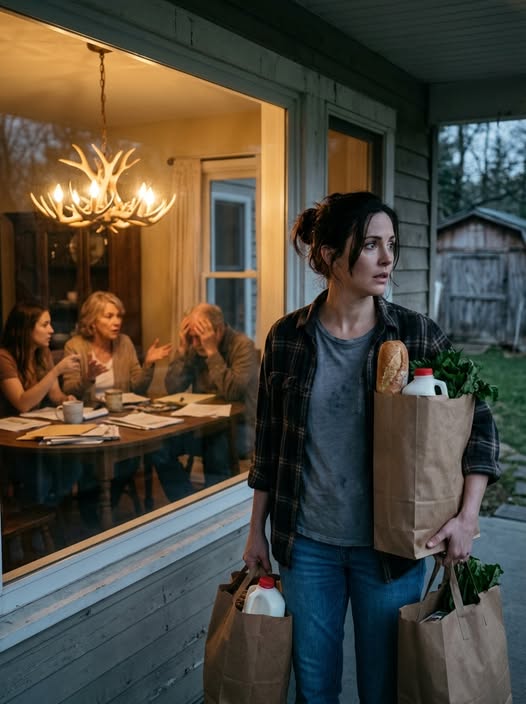
She thought the quiet sister she had used as a backdrop would hand over the keys.
She did not know I had already locked the door, signed a legal rental contract, and hired a property manager who carried every receipt in a blue folder.
I found out about the wedding while standing in my kitchen in sweatpants, eating leftover pasta from the pot.
My cousin Trent called and said, “Marissa’s wedding is going to look amazing at your place.”
My fork stopped halfway to my mouth.
“What place?”
“Your beach house. The invitations arrived yesterday. Your address is printed right under the ceremony time.”
I opened Instagram before he finished speaking.
There was Marissa in a white linen dress, leaning against my chipped blue porch railing as if she had spent her childhood watching sunsets there.
Her caption said the wedding would be held at a “family-owned beach house full of memories.”
Marissa had never slept there.
She had visited once for twenty minutes, complained that the guest bathroom was too small, and asked whether I planned to repaint the shutters before she took engagement photos.
That house had taken me six years, three jobs, and nearly every weekend I could have spent resting.
I rewired rooms by flashlight. I replaced cracked tiles myself. I learned how to patch a roof after a storm ripped away half the shingles.
No one in my family helped with the down payment.
No one carried a box.
No one even brought flowers when I closed.
But Marissa had always believed anything near her could become part of her story.
She sparkled. I repaired.
She demanded. I adjusted.
And because I rarely caused a scene, everyone treated my silence like an unlocked door.
I asked Trent to send me the invitation file.
At 7:46 p.m., the PDF landed in my inbox.
Seafoam paper. Gold lettering. My full address. Directions for vendors. A note telling guests to respect the “private family property.”
Then I opened the seating spreadsheet.
Influencers. College friends. Brad’s golf partners. Brand representatives. Distant cousins Marissa barely remembered.
Beside my name were three words.
Rose — not invited.
They were planning to use my home for the ceremony, reception, photographs, catering, parking, and an overnight bridal party.
But I was not welcome inside it.
Something in me became very still.
I did not call Mom. I did not argue in the family chat. I did not give Marissa the chance to cry, rewrite the story, and make my boundary sound like jealousy.
I took screenshots.
I downloaded the invitations, guest list, vendor schedule, and a catering diagram showing twelve tables across my lawn.
Then I called Denise, a local property manager known for strict contracts and immaculate towels.
“Is the house available next weekend?” she asked.
“Yes.”
“Any special circumstances?”
I looked at the wedding invitation glowing on my screen.
“Family realignment.”
By Thursday morning, the house had been legally rented to Mike and Susan Harper from Ohio, a kind couple celebrating their twenty-fifth anniversary.
Their signed agreement prohibited outside events, unauthorized guests, tents, amplified music, commercial photography, and entry by anyone not listed on the booking.
Denise changed the keypad code, activated the cameras, posted the rental notice in the foyer, and mounted a plaque beneath the mailbox.
PRIVATE RENTAL. NO UNAPPROVED ENTRY. NO EXCEPTIONS.
Marissa still said nothing to me.
Neither did Mom or Dad.
They had all decided permission was a detail they could handle later.
Saturday afternoon, while I folded towels at my apartment, my phone began vibrating across the table.
Mom called twice.
Dad called once.
Brad sent, “Please tell me you didn’t rent the house.”
Then Marissa filled the family chat with seventeen messages.
“There are strangers inside.”
“The doors are locked.”
“My florist is being turned away.”
“Rose, answer me right now.”
Trent sent a photograph.
Mike and Susan stood on my porch beneath the string lights, holding wine glasses and smiling beside the rental plaque.
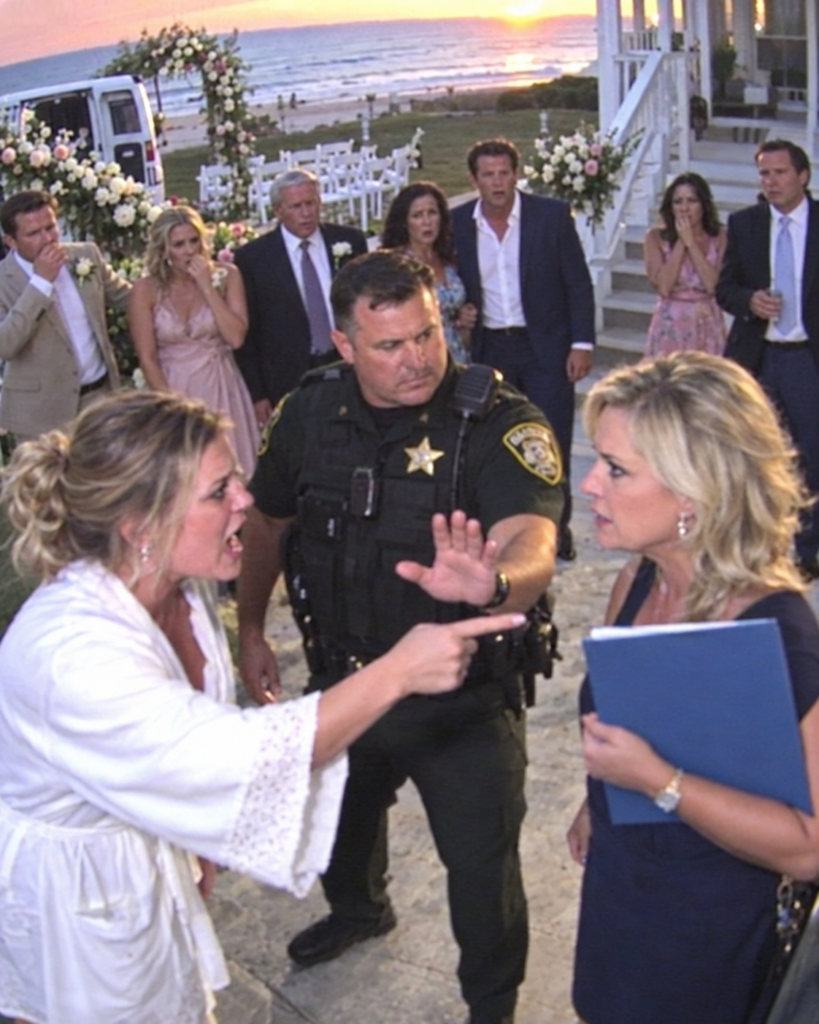
Behind them, Marissa stood in her silk robe with six bridesmaids, two caterers, a florist, and a truck carrying folded white chairs.
Her face was red with fury.
Then she sent the message that silenced the entire family chat.
“Rose, what did you do to MY wedding?”
I typed one sentence.
“I rented my house to people who asked.”
Mom replied immediately.
“This is your sister’s wedding day. Stop being difficult and give her the code.”
Before I could answer, another photograph began loading.
This one showed Denise standing at the gate with a sheriff’s deputy beside her. Marissa was pointing toward the house while Brad stared at a document in his hands.
Denise held a blue folder against her chest.
Then Trent called me on video.
The moment I answered, Denise opened the folder, lifted a vendor contract toward the camera, and said, “Rose, your sister didn’t just print your address. She signed your name.”
Marissa lunged for the contract, but the deputy stepped between them.
“That is not her signature,” Denise said. “It is an ownership authorization submitted to the caterer, florist, rental company, and event insurer.”
Brad looked from the page to Marissa. “You told me Rose offered the house as our gift.”
“She would have eventually,” Marissa snapped. “She always gives in.”
Mom whispered my name like I was the one humiliating the family.
Then Denise removed a second document from the folder. It showed a temporary locksmith request submitted that morning under my identity, authorizing the front lock to be drilled if the code failed.
The deputy’s expression changed.
“Ma’am,” he said to Marissa, “step away from the property.”
She went pale, but Denise was not finished. She turned to Brad and slid one final sealed envelope across the hood of the patrol car.
“Before you marry her,” Denise said, “you should see what she promised the vendors would happen after Rose transferred the deed.”
PART 2
Brad stared at the sealed envelope as if it were something alive.
Marissa reached for it.
“Don’t you dare open that.”
For the first time in the five years they had been together, Brad didn’t immediately do what she told him.
He looked at Denise.
“What is this?”
“Copies of the documents your fiancée submitted to several wedding vendors,” Denise replied. “And a copy of the proposal she sent to a real estate investor three weeks ago.”
Brad slowly tore open the envelope.
I watched through Trent’s phone as he pulled out a printed email, a draft property transfer agreement, and several pages of messages.
His face changed with every line he read.
“What does this mean?” he finally asked.
Marissa crossed her arms.
“It means nothing. Denise is trying to ruin my wedding because Rose is being spiteful.”
Denise remained calm.
“Then you shouldn’t have any trouble explaining why you told a property investor that your sister had agreed to transfer ownership of her beach house to you before the wedding.”
The deputy glanced at the documents.
Brad looked up sharply.
“Transfer ownership?”
Marissa swallowed.
“Rose and I talked about it months ago.”
I nearly laughed.
Months ago, Marissa had asked me whether I would ever consider selling the beach house.
I had told her no.
She had laughed and said, “Relax. I’m just asking.”
That was the entire conversation.
There had been no promise. No agreement. No discussion about transferring the deed.
But apparently, Marissa had decided my refusal was merely the beginning of a negotiation.
Brad turned another page.
The email was addressed to a real estate investor named Gregory Mills.
In it, Marissa claimed that I had agreed to sign the property over to her as a wedding gift. She described the house as an underused family asset that would soon be legally transferred into her name.
She had even included an estimated market value.
$1.35 million.
Below that was her proposed plan.
She intended to use the property as collateral for a business loan after the wedding, renovate the house, and eventually sell it to an investor.
The final paragraph made my stomach tighten.
Once the wedding is over, Rose will have no reason to interfere. She has always been emotionally dependent on our family’s approval, so the transition should be easy.
Brad read that sentence twice.
Then he looked at Marissa.
“You told me we were going to live here.”
“We were!”
“You told me your sister was giving it to you.”
“She would have!”
“You told my parents that the house was already part of our future.”
Marissa’s voice rose.
“Because it was supposed to be!”
The deputy stepped forward.
“Ma’am, I need you to lower your voice. We have a report concerning a disputed signature and an attempted unauthorized entry.”
Marissa turned toward him, suddenly crying.
“This is a family misunderstanding. Rose is my sister. We share everything.”
Denise tilted her head.
“Apparently, except the wedding invitation.”
Nobody spoke.
Then Brad noticed another page near the bottom of the envelope.
It was a message Marissa had sent to the wedding planner.
Don’t worry about the ownership paperwork. My sister will sign whatever we need after the ceremony. She always caves when Mom gets involved.
Brad’s hands began to shake.
“You used my money to pay the deposits,” he said quietly.
Marissa froze.
“What?”
“The wedding deposits. The money I transferred to you. You told me the venue was free because your family owned the property.”
“It is free!”
“No, Marissa. Your sister owns it.”
He pulled out his phone and opened their banking application.
“I gave you thirty-eight thousand dollars for this wedding. You told me that covered the catering, rentals, flowers, and insurance.”
“It does!”
“Then why does the caterer have a contract saying Rose authorized the event? Why did the florist receive a document claiming the property was yours? And why did the insurance application list you as the owner?”
Marissa’s mouth opened.
Nothing came out.
For the first time that afternoon, I felt something other than anger.
I felt relief.
Not because Brad was confronting her.
Not because her wedding was falling apart.
But because I was no longer the only person who could see what she had done.
For years, my family had treated every disagreement as a personality flaw of mine.
If Marissa wanted something, I was selfish for refusing.
If I objected, I was dramatic.
If I stayed quiet, they assumed I had agreed.
Now there were documents.
Dates.
Signatures.
Emails.
And a property manager who had kept every receipt.
Denise looked directly into Trent’s phone.
“Rose, I’ve secured the property. Mike and Susan are staying inside under their valid rental agreement. You don’t need to come here unless you choose to.”
I nodded.
“Thank you.”
Then I heard my mother’s voice from somewhere behind Marissa.
“Rose, sweetheart, let’s not make this worse.”
I closed my eyes.
There it was.
Not What did Marissa do?
Not Why did she sign your name?
Not even Are you okay?
Just the same old request.
Make yourself smaller so everyone else can remain comfortable.
I looked into the camera.
“Mom, she tried to take my house.”
“She was planning a wedding!”
“She signed my name.”
“She made a mistake!”
“She tried to have my locks drilled out.”
Mom fell silent.
I continued.
“And you knew she was using my address. You knew I wasn’t invited. You knew she expected me to surrender my property because she thought I wouldn’t dare embarrass her.”
“That’s not fair.”
“No,” I said. “It isn’t.”
Then I ended the call.
For the first time in my life, I didn’t wait for her permission to leave a conversation.
By late afternoon, the wedding had collapsed.
The caterer refused to proceed without valid authorization.
The florist packed up the arrangements.
The rental company collected the chairs.
The event insurer suspended the disputed coverage pending an investigation into the submitted documents.
Brad’s parents, who had driven four hours to attend the wedding, stood near their car while Brad spoke to his attorney on the phone.
The deputy documented the incident and explained the appropriate process for reporting the suspected forgery and attempted unauthorized entry.
No one was arrested at the gate that afternoon.
But Marissa was no longer free to pretend that the situation was merely a family argument.
Every vendor had copies of the documents.
Every disputed authorization had been preserved.
And Denise had already sent the evidence to my attorney.
Marissa finally called me at 6:12 p.m.
I almost let it go to voicemail.
Almost.
“Rose,” she said, her voice trembling. “You have to fix this.”
I stood beside my apartment window, watching the evening light fade over the rooftops.
“Fix what?”
“My wedding!”
“You don’t have a wedding venue.”
“You know what I mean!”
I waited.
She took a shaky breath.
“Brad is talking about postponing everything. His parents are furious. The vendors want their money. Mom is crying. Dad says I have embarrassed everyone.”
“And what do you think you’ve done?”
Silence.
Then she whispered, “I made a mistake.”
“Which one?”
“What?”
“Which mistake, Marissa? Printing my address on the invitations? Leaving me off the guest list? Signing my name? Or trying to get my locks drilled out?”
“You are enjoying this.”
“No,” I replied. “I’m finally understanding it.”
She began to cry harder.
“You’ve always hated me.”
I almost recognized the girl I had grown up with in that sentence.
The little sister who could break a lamp and somehow convince our parents that I had startled her.
The teenager who borrowed my clothes, ruined them, and accused me of being possessive when I asked her to replace them.
The adult who had learned that tears were often more effective than apologies.
“No, Marissa,” I said. “I spent most of my life trying to make you happy.”
“Then help me now!”
“I can’t help you escape the consequences of your choices.”
“You could tell everyone you gave me permission!”
“And commit fraud to protect you?”
She stopped crying.
I lowered my voice.
“My house is not your wedding gift. My signature is not yours to borrow. And my silence is not permission.”
“Rose, please.”
“I hope you figure out who you are without taking something from me.”
Then I hung up.
My hands were shaking.
I had expected to feel triumphant.
Instead, I felt exhausted.
Because setting a boundary with someone who had hurt you was one thing.
Setting it with someone you had spent your entire life loving was something else entirely.
Three days later, Brad came to my apartment.
I found him standing outside my door in the same suit he had worn to the beach house.
He looked as though he hadn’t slept.
“I owe you an apology,” he said.
I let him speak.
“I believed her when she said you were giving us the house. I should have asked you directly. I should have verified everything before spending money on a wedding at a property I didn’t own.”
“Yes,” I said.
He looked down.
“I also owe you the truth. This wasn’t the first time she told me something about your house.”
My stomach tightened.
“What do you mean?”
“Last month, she showed me a spreadsheet. She said you were struggling to maintain the property and that you wanted her to take it over. She claimed you were too embarrassed to ask for help.”
I stared at him.
I had never struggled to maintain the house.
I had a dedicated savings account for repairs, a property manager, and a separate emergency fund.
“Why would she say that?”
“She said you had debts.”
I almost laughed.
“I don’t.”
“I know that now.”
He rubbed his face.
“She also told me your parents had agreed that the house should eventually go to her because she was planning to have children and needed a stable place to raise them.”
That one hurt more than I expected.
Not because I believed my parents had any right to decide what happened to my property.
But because Marissa had apparently built an entire future around something she had never owned.
“What did you tell her?” I asked.
“I told her that if you wanted to give us something, we should be grateful. I never imagined she would forge your signature.”
He paused.
“I’ve canceled the wedding.”
I nodded slowly.
“I’m sorry things ended this way.”
He looked surprised.
“You don’t hate me?”
“I don’t know you well enough to hate you, Brad. But I hope you learn to ask questions before you build your life around somebody else’s promises.”
He accepted that without arguing.
Before he left, he handed me a small envelope.
Inside was a check for $2,400.
“That’s the amount I personally owe you for the unauthorized locksmith appointment and the administrative costs Denise had to handle. My attorney is also working with yours on the other financial issues.”
I looked at the check.
“You don’t have to do this.”
“Yes, I do. I should have been more careful.”
For the first time since the entire disaster began, someone had acknowledged their responsibility without asking me to comfort them afterward.
I thanked him.
Then I closed the door.
The legal process took several months.
My attorney sent formal notices to the vendors, preserving the evidence and making it clear that I had never authorized the event.
Denise provided the rental agreement, access logs, camera footage, and every message she had received concerning the property.
The disputed documents were referred for investigation.
The locksmith confirmed that the request had come from someone claiming to be me, and the vendor records helped establish the sequence of events.
The wedding deposits became a separate dispute between Marissa, Brad, and the businesses involved.
I refused to become the person responsible for untangling every financial consequence.
I had my own attorney.
I had my own records.
And I had no intention of paying for an event I had never agreed to host.
My family, however, struggled to accept that the matter would not simply disappear.
Dad called me first.
“Your mother thinks you’re taking things too far.”
“Is that what you think?”
He sighed.
“I think your sister has suffered enough.”
I looked down at the documents on my desk.
“Did you tell her she had gone too far when she signed my name?”
He said nothing.
“Did you tell her she had gone too far when she tried to enter my house?”
“She was desperate.”
“So was I when I spent six years working to buy that property. Nobody offered to help me then.”
“That’s different.”
“Why?”
He had no answer.
I let the silence remain between us.
Then he said something I would never forget.
“You’re the strong one, Rose. We thought you’d understand.”
I closed my eyes.
There it was.
The family compliment that had always been a disguised demand.
You’re strong, so you can endure more.
You’re responsible, so you can fix this.
You’re quiet, so you can be hurt without making us uncomfortable.
I spoke carefully.
“Being strong doesn’t mean I owe everyone unlimited access to my life.”
Dad exhaled.
“Your mother says you won’t come to Thanksgiving.”
“She’s right.”
“You’d miss the whole family over one argument?”
“No, Dad. I’m stepping away because this wasn’t one argument. It was a pattern.”
He started to respond, but I ended the call.
That evening, I sent one message to the family group chat.
My beach house is my private property. No one has permission to make reservations, invite guests, contact vendors on my behalf, or represent themselves as an owner. Any future attempt to use my identity or access the property without authorization will be documented and handled through the appropriate legal channels.
Then I muted the conversation.
I didn’t block everyone.
I simply stopped participating in the endless courtroom where my family expected me to defend my right to say no.
Six months later, I returned to the beach house.
The weather was cool, and the ocean was rough enough to send white foam rolling across the sand.
Mike and Susan had left a handwritten card on the kitchen counter after their stay.
They thanked Denise for the beautiful property and told me they had spent their anniversary watching sunsets from the porch.
At the bottom, Susan had added:
Thank you for sharing your home with us. We hope it brings you as much happiness as it brought us.
I stood there for a long time, holding that card.
A stranger had thanked me for something my own sister had tried to take.
I walked through the rooms I had repaired myself.
The kitchen where I had installed the cabinets.
The hallway where I had replaced cracked tiles.
The guest bedroom where I had spent an entire weekend painting the walls after a storm damaged the window frame.
Every imperfection reminded me of the life I had built without anyone’s permission.
I stepped onto the porch and sat beside the chipped blue railing.
I had considered replacing it many times.
Marissa had once called it ugly.
But I liked it.
It reminded me that a thing didn’t have to be perfect to be worth keeping.
My phone buzzed.
A message from Mom.
Your sister has been having a difficult time. She says she misses you. Could you please meet her for coffee? She wants to apologize.
I read it twice.
Then I typed:
If Marissa wants to apologize, she knows how to contact me. I will listen when she is ready to take responsibility without asking me to fix anything.
I sent the message and put my phone away.
The ocean kept moving.
The wind lifted the loose strands of my hair.
For the first time in months, I didn’t feel as though I were waiting for the next accusation.
I was simply sitting in my own house.
And that was enough.
Marissa eventually sent me a letter.
Not a text.
Not a voice message filled with tears.
A letter.
She admitted that she had convinced herself the beach house would become hers because she had spent years believing that whatever she wanted was only a matter of time.
She admitted that she had lied to Brad.
She admitted that she had signed my name because she thought I would forgive her before the consequences became serious.
But the sentence that mattered most came near the end.
I kept telling myself that you would give in because you always had before. I never stopped to consider that every time you gave in, you were losing a little more of yourself.
I read the letter several times.
It was the closest thing to an honest apology I had ever received from her.
I wrote back that I appreciated her honesty, but trust would take time to rebuild.
I did not offer her money.
I did not offer her the house.
I did not promise that everything would return to normal.
And for once, she didn’t demand any of those things.
We eventually met for coffee.
The conversation was awkward.
There were long pauses, uncomfortable truths, and moments when both of us wanted to return to the easier version of our relationship—the one where I swallowed my hurt and she pretended nothing had happened.
But we didn’t.
I told her that loving her had never meant surrendering my life to her.
She told me she was trying to understand that.
It wasn’t a magical reconciliation.
It was a beginning.
And beginnings, I had learned, did not require me to abandon my boundaries.
My parents needed longer.
Mom eventually apologized for pressuring me to hand over the code. Dad never fully admitted how much his silence had hurt, but he stopped asking me to sacrifice my peace for family gatherings.
Some relationships improved.
Others remained distant.
I learned to accept that forgiveness did not guarantee closeness, and sharing the same last name did not automatically make someone safe.
The beach house remained mine.
I kept Denise as my property manager.
I updated the access procedures, strengthened the authorization requirements, and made sure no one could mistake my kindness for consent again.
Every summer, I still sat on the porch beneath the string lights.
Sometimes I rented the house to couples celebrating anniversaries.
Sometimes I kept it empty and spent weekends there alone.
I never held the wedding Marissa had imagined.
But I did something more important.
I reclaimed the meaning of home.
It was no longer the place where my family expected me to prove my love by giving things away.
It was the place where I could finally decide who belonged in my life—and under what conditions.
One evening, as the sun disappeared beneath the horizon, I received another message from Marissa.
I’m glad you didn’t give me the house.
I stared at the screen.
Then another message appeared.
I wouldn’t have known how to deserve it.
I didn’t know whether she fully understood what she had done.
Maybe she never would.
But I knew something she was only beginning to learn.
A gift given freely is an act of love.
A gift demanded through guilt is a theft dressed up as family.
I set my phone on the table, poured myself a glass of wine, and watched the waves roll toward the shore.
For years, I had mistaken silence for peace.
Now I understood the difference.
Peace wasn’t everyone being happy with me.
Peace was no longer being afraid of what would happen when I finally said no.
And as the last light faded over the water, I smiled at the house I had built with my own hands.
The house my sister had tried to claim.
The house my family had assumed I would surrender.
The house that had taught me the most important lesson of my life:
You can love your family without handing them the keys to everything you have worked to become.