I almost drove past her.
She did not bark or chase my truck. She simply lifted her head and watched me pass.
I drove another fifty yards before something made me look in the rearview mirror. She was still standing in the exact same place, alone beneath the brutal afternoon sun—as if lying down would mean finally admitting nobody was coming for her.
I stopped the truck, sat there with both hands on the steering wheel, and argued with myself. She might bite, she might be sick, she might belong to someone, and maybe animal control was the smarter choice.
But I backed up anyway.
When I stepped onto the shoulder, she flinched so hard that I stopped immediately. I approached sideways and spoke softly, trying not to frighten her, and the closer I got, the worse she looked. The wound near her hindquarters was swollen and untreated, and her back legs shook whenever she tried to shift her weight.
Then she lowered her body as though she expected me to hit her.
That broke something inside me.
“I’m not going to hurt you,” I told her.
I crouched several feet away and held out one hand. For almost a minute, neither of us moved, and I could hear nothing except the dry wind and an occasional vehicle passing behind me.
Then she took one trembling step toward me, then another. She sniffed my fingers and suddenly pressed her forehead into my palm.
The dog who looked too weak to stand had decided to trust me.
I lifted her carefully. She weighed almost nothing, and instead of fighting, she let her head fall against my chest as though she had run out of strength to be afraid.
I placed her on an old moving blanket behind the passenger seat and drove toward the nearest veterinary clinic. Three separate times during that drive, I reached back just to make sure she was still breathing.
At the clinic, a technician rushed outside with a stretcher.
“What happened?” “I found her on County Road Nine.” “Is she yours?”
I looked at the dog, her eyes barely open.
“No.”
The technician started pushing her inside, then stopped.
“We need a name for the intake form.”
I had not thought about that. I looked at the dog again. She had survived heat, starvation, pain, and whatever had happened to her before I saw her beside that road.
“Hope,” I said.
Twenty minutes later, Dr. Elena Ramirez came into the waiting room and told me Hope was severely dehydrated, dangerously underweight, and fighting an infection. They had started fluids, antibiotics, pain medication, and bloodwork.
When I asked if she would live, Dr. Ramirez did not give me the answer I wanted.
“I don’t know yet.”
Then she added something that sounded like good news.
“We checked for identification.”
I stood up. “And?”
“She has a microchip.”
For the first time since I found the dog, I felt relief. “That’s good, right?”
Dr. Ramirez did not answer. She looked down at the tablet in her hands, read something again, and then looked back at me. The expression on her face changed so completely that the relief disappeared as quickly as it had come.
“What?” “The chip is registered.” “To who?” “A woman named Margaret Wilson.” “That’s good. Call her.”
Dr. Ramirez hesitated.
“There’s something attached to the registration.”
I felt my stomach tighten. “What?”
“A missing-pet report.”
I waited. Dr. Ramirez looked toward the treatment room.
“It has been active for twenty-two months.”
I stared at her. “Twenty-two months?”
She nodded.
Suddenly the dog in the treatment room was no longer just a starving stray I had found beside the highway. She had a real name, a home somewhere, and someone who had apparently refused to stop searching for almost two years.
“What’s her name?” “Daisy.”
Dr. Ramirez called the phone number attached to the chip and put it on speaker. After several rings, an older woman answered.
“Hello?” “May I speak with Margaret Wilson?” “This is Margaret.” “My name is Dr. Elena Ramirez. I’m calling from Red Creek Animal Clinic.”
There was a pause. Then the woman said something that made everyone near the desk stop moving.
“Is this about Daisy?”
Dr. Ramirez glanced at me. “Yes.”
On the other end, Margaret inhaled sharply. “Did somebody find her?”
Dr. Ramirez explained where Daisy had been found, and Margaret sounded confused.
“That’s impossible.” “Why?” “Because I live one hundred and sixty-three miles away.”
Dr. Ramirez began asking questions to confirm the dog’s identity.
Red leather collar.
White patch on her chest.
Crooked tooth.
Tiny scar over her right eye.
Every detail matched.
Then Margaret told us Daisy had disappeared during a storm twenty-two months earlier. Her husband had searched until three in the morning, and they kept searching for months afterward. Six months after Daisy vanished, Margaret’s husband died.
“He kept saying we would find her,” she whispered.
Then came the question none of us wanted to answer.
“Doctor… is she alive?”
Dr. Ramirez looked through the treatment-room window. “Yes.”
Margaret began crying. She asked if she could come immediately. Dr. Ramirez explained how sick Daisy was, and Margaret said she would find someone to drive her.
Then one of the technicians suddenly called from the treatment room.
“Dr. Ramirez.”
We both turned. The technician’s face had changed. Another monitor began sounding.
Dr. Ramirez rushed inside, and through the glass I watched two technicians surround the dog while oxygen equipment was pulled closer.
After twenty-two months of waiting, Daisy’s family had finally learned she was alive.
And at that exact moment, her body began giving up.
PART 2
Daisy’s blood pressure had suddenly dropped.
For the next several minutes, I stood outside the treatment room feeling completely useless while Dr. Ramirez and her staff worked around her. I was used to fixing things with tools, parts, and patience, but there was nothing I could tighten or replace here.
All I could do was watch the dog I had carried in from the road disappear beneath moving hands, tubing, blankets, and machines.
Finally, Dr. Ramirez came out.
“She stabilized.”
I leaned against the wall.
Daisy was still in serious condition. Her blood sugar was low, she was severely anemic, and the infection had placed enormous stress on a body already weakened by starvation. Dr. Ramirez explained that even feeding had to be done carefully because giving too much nutrition too quickly could create dangerous complications.
That night, I paid enough toward Daisy’s care to cover the emergency treatment. Nobody asked me to do it, and technically Margaret was her owner, but leaving without doing something felt impossible.
Before I went home, I stood beside Daisy’s kennel and told her the one thing I thought mattered.
“Your person is coming.”
One of her eyes opened slightly.
The following morning, Margaret arrived. She was a small gray-haired woman in her early seventies, and the moment she entered the clinic, she asked only one question.
“Where is she?”
Before Dr. Ramirez took her back, Margaret noticed me sitting across the waiting room.
“You found her.” “Yes, ma’am.”
She crossed the room and hugged me.
“My husband died believing she was still alive.”
I did not know what to say. So I told her the truth.
“She was waiting for somebody.”
Then we went into the treatment room.
Daisy was curled beneath a blanket when Margaret stopped several feet away and whispered her name.
“Daisy?”
One ear lifted. Margaret stepped closer.
“Daisy girl?”
The dog’s head slowly rose. Her nose began moving. Then Daisy tried to stand.
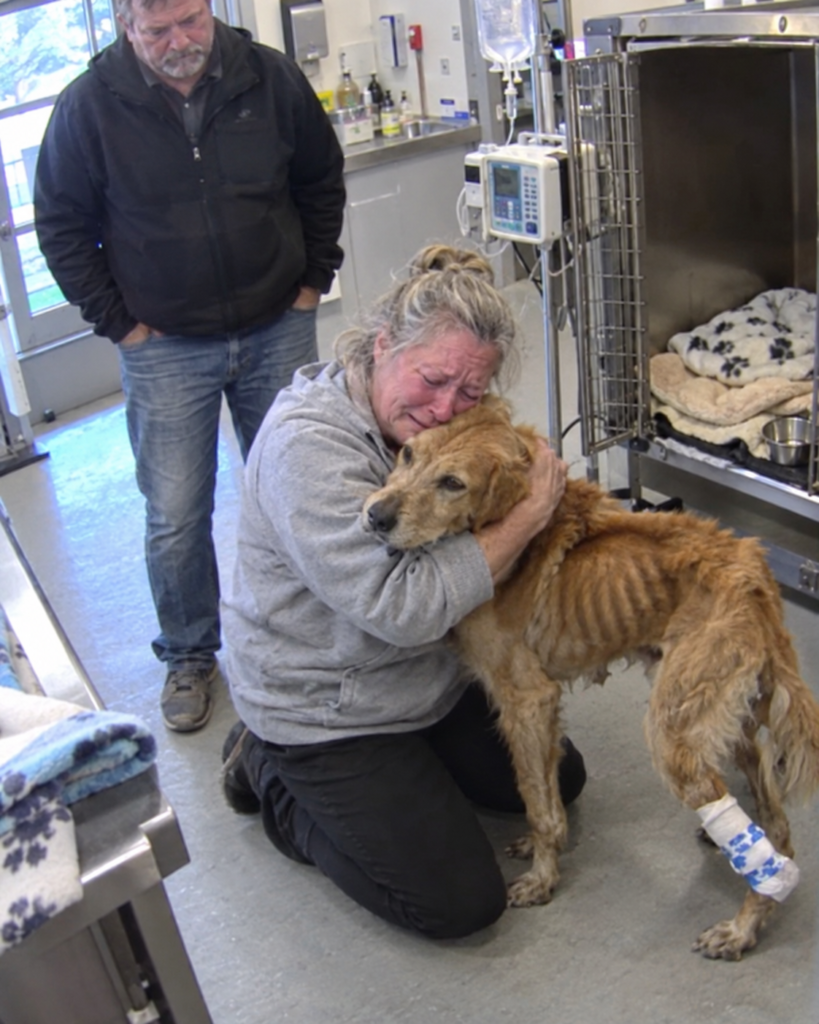
Dr. Ramirez quickly stopped her from putting too much pressure on her weakened legs, but Daisy kept pushing forward until Margaret dropped to her knees and reached into the kennel.
Daisy pressed her head against Margaret’s chest. Her tail began hitting the blanket.
Once.
Twice.
Again.
Margaret buried her face against Daisy’s neck.
“You came home.”
That was when I learned how much history was inside that reunion.
Margaret and her husband, Thomas, had adopted Daisy as a puppy. She had disappeared when a storm damaged their back gate. Thomas searched for her until the middle of the night, and even after he became seriously ill, he continued checking missing-dog pages from his hospital bed.
During the last week of his life, he made Margaret promise she would never deactivate Daisy’s microchip.
“Promise me somebody will still be looking,” he told her.
Margaret kept that promise for twenty-two months.
But finding Daisy did not mean the danger was over.
Dr. Ramirez examined the infected wound more closely and discovered the infection was deeper than she had hoped. Daisy also had an old pelvic injury that had healed badly, which explained why her back legs shook when she walked. Nobody could tell exactly what had happened to her during those missing months.
The immediate concern was the infection.
“She’ll need surgery,” Dr. Ramirez told us.
Margaret’s face went pale. “When?”
“Not yet. She isn’t strong enough.”
That became the terrible contradiction of Daisy’s recovery. She needed surgery to remove the dead, infected tissue. But she needed to survive long enough to become strong enough for the surgery.
For several days, every tiny improvement felt enormous:
A few spoonfuls of food.
Better bloodwork.
A tail wag.
A few seconds standing with support.
Then Dr. Ramirez finally said Daisy might be ready. The surgery was scheduled for the following morning.
And for the second time since Margaret learned her dog was alive, all any of us could do was wait and hope Daisy’s exhausted body had one more fight left in it.
PART 3
The waiting room of Red Creek Animal Clinic was suffocatingly quiet the next morning. Margaret sat beside me on the vinyl couch, her small frame swallowed by her oversized coat. Her hands, worn with age and worry, were clasped tightly around a worn leather leash—the very one Daisy had worn twenty-two months ago.
Hours dragged on. Every time a door swung open, both of our heads snapped toward it.
Finally, around noon, Dr. Ramirez walked out. Her surgical mask hung around her neck, and her eyes looked heavy with fatigue. She stood before us for a long second, silent, as if choosing her words carefully.
“The surgery was complicated,” Dr. Ramirez began softly. “The infection had spread deeper into the muscle tissue than the scans showed. We managed to remove all the dead tissue, but her body took a massive hit during the procedure.”
Margaret’s knuckles turned white around the leash. “Is she…?”
“She survived the operation,” Dr. Ramirez said, holding up a hand before we could celebrate. “But she hasn’t woken up properly yet. Her heart rate is dangerously low, and she isn’t responding to stimuli the way we hoped. The next twelve hours will tell us everything.”
She looked at Margaret with gentle eyes. “You can go back and sit with her now.”
The treatment room smelled of antiseptic and cold steel. Daisy lay on a heated pad, wrapped in warm blankets, with IV lines running into her front paw and a monitor rhythmically prove-beeping her weak pulse. She looked so small, fragile, and motionless.
Margaret sank into the metal chair beside the kennel. She didn’t cry this time. Instead, she reached inside, gently laid her trembling hand over Daisy’s head, and leaned down close to her ear.
“Daisy,” Margaret whispered, her voice cracking with a mix of heartbreak and desperate devotion. “Thomas is waiting for you to come home… but not yet, sweetheart. Not yet. I still need you here.”
I stood near the doorway, feeling a lump rise in my throat. I watched a woman who had lost her husband, carrying two years of grief on her shoulders, fighting with every breath to pull her dog back from the edge.
“Thomas told me you’d find your way back,” Margaret continued, tears finally spilling over her cheeks. “You did your part, Daisy. You held on for twenty-two months. Just give me a little more time. Please.”
For hours, Margaret spoke to her. She told Daisy about the garden back home, about the sunny spot on the living room rug, and about how Thomas never stopped loving her until his last breath.
I stayed in the clinic until nightfall, unable to leave them alone in that quiet battle.
Around midnight, the steady beep of the heart monitor suddenly stumbled—then began to speed up slightly.
Daisy’s chest heaved with a deep, shuddering breath.
Margaret froze.
Slowly, painfully, Daisy’s eyelids fluttered open. Her dark eyes, cloudy with medication and exhaustion, searched the room until they rested on Margaret’s face.
A faint, raspy breath escaped the dog’s snout. Then, beneath the heavy blanket, her tail gave one tiny, feeble twitch against the pad.
Dr. Ramirez rushed over, checking the monitors and shining a small light into Daisy’s eyes. A soft, genuine smile finally broke across the doctor’s tired face.
“Her vitals are stabilizing,” Dr. Ramirez whispered, looking at Margaret. “She’s waking up. She’s coming back.”
Margaret lowered her forehead against Daisy’s, letting her tears soak into the dog’s graying fur. Daisy let out a quiet sigh, resting her chin on Margaret’s arm, as if she had finally found the safe harbor she had been searching for across a hundred miles and two long years.
Three weeks later, I stood outside the Red Creek Animal Clinic under a bright morning sun.
Margaret was helping Daisy into the back seat of a sedan driven by her neighbor. Daisy was still thin, and a long shaved patch covered her side, but her eyes were clear and bright. She wore a shiny new collar with her old tags jingling proudly.
Before getting into the car, Margaret turned to me. She walked over and took both of my hands in hers.
“I spent twenty-two months praying for a miracle,” Margaret said, her voice steady and filled with a quiet strength. “I thought the miracle was finding her microchip. But now I know… the miracle was a stranger who chose not to drive past a piece of trash in the weeds.”
She pulled me into a tight embrace.
“You gave me back the last piece of my husband, young man. I can never repay you for that.”
“You don’t owe me anything, ma’am,” I said, feeling a warmth in my chest I hadn’t felt in a long time. “Just take her home.”
As the car pulled away down County Road Nine, I watched through the rear window. Daisy had her snout pressed against the glass, her tail gently thumping against the seat. I waved until the car disappeared over the horizon, knowing that for the first time in a very long time, neither of us was lost anymore.
From inside my truck, the starving dog beside County Road Nine looked less like an animal and more like a dark piece of trash caught in the dry weeds. Her ribs showed through her coat, her hips jutted sharply beneath the skin, and an infected wound near her hindquarters was covered with matted fur and flies.