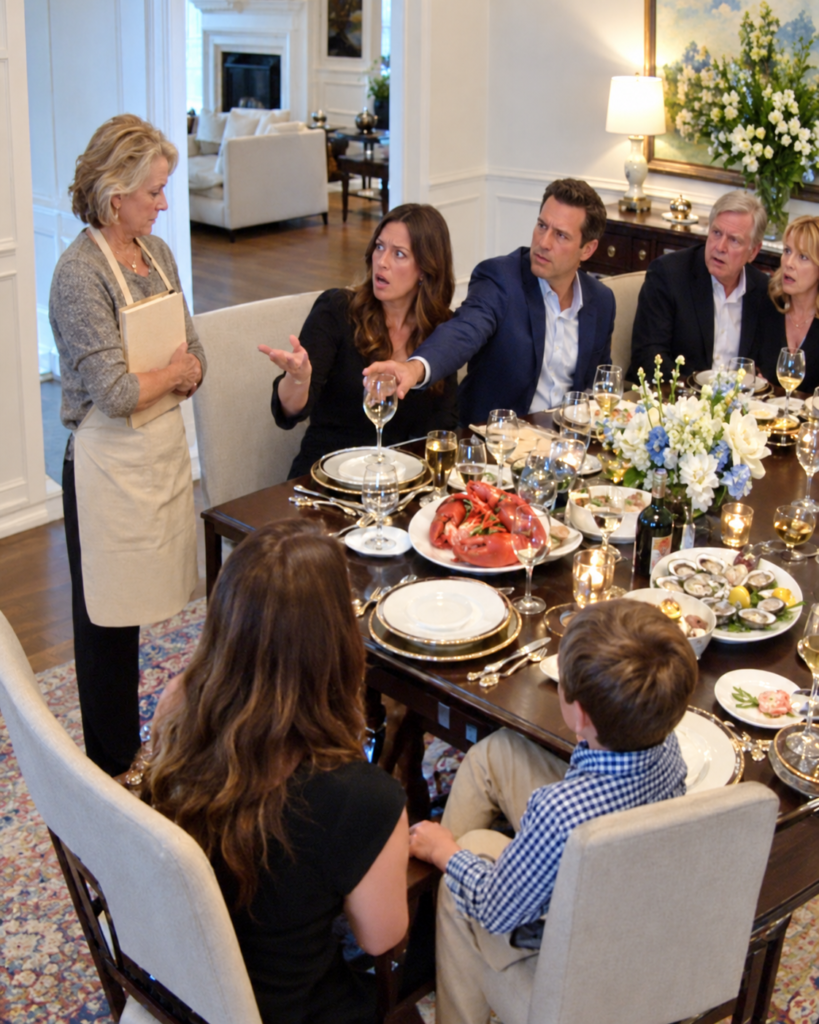
Megan’s face lost its color the moment she saw the name on the deed.
HELEN MARSHALL.
Sole owner.
For several seconds, nobody at the table moved.
The only sound was the faint hum of the refrigerator from the kitchen and Leo tapping absently on his tablet, too young to understand why every adult had suddenly stopped breathing normally.
Ryan leaned over the table.
“Mom, let me see that.”
I closed the folder halfway.
“No.”
His eyebrows lifted.
I could not remember the last time I had refused him something so simply.
Megan reached out next.
“Helen, don’t be dramatic.
It’s a deed, not a state secret.”
I pulled it completely out of her reach.
“Then you shouldn’t be worried.”
Her hand remained suspended over the table before she slowly withdrew it.
Arthur’s old recorder sat between the wine bottle and the shrimp platter, its tiny red light finally dark.
For thirty minutes it had collected every word: the comments about my pension, the jokes about my age, Ryan telling me I should be grateful for the roof over my head.
My roof.
That was the part they had never bothered to confirm.
Ryan rubbed his forehead.
“Dad always said the house would stay in the family.”
“It has.”
“You know what I mean.”
“Yes,” I said.
“I do.”
Arthur and I had bought the house thirty-two years earlier, when Ryan was still small enough to fall asleep in the back seat after Little League games.
We had refinanced twice, replaced the roof once, renovated the kitchen ourselves, and spent years paying down the mortgage.
When Arthur’s health began failing, he insisted that we meet an estate attorney.
I had resisted.
At the time, talking about deeds and beneficiaries felt like admitting he would die.
Arthur had been more practical.
“Helen,” he told me in the attorney’s office, “grief makes people vulnerable.
Paperwork keeps vulnerable people from being cornered.”
I thought he meant strangers.
Now, sitting across from my son, I understood he had meant anyone.
The attorney structured the ownership so Arthur’s interest passed directly to me when he died.
No probate dispute.
No automatic share for Ryan.
No ambiguity.
The house had been mine alone for five years.
Ryan had apparently assumed something very different.
Megan gave a short laugh.
“Okay.
So the paperwork says the house is yours.
What does that change? We’re still the ones paying for everything.”
That made me look at her.
“You are?”
“Obviously.”
I opened the folder again and removed another sheet.
Property tax receipts.
My name.
Homeowner’s insurance statements.
My name.
Utility payments from my checking account.
My name.
Then grocery receipts, bundled by month.
Megan’s confidence faltered.
Ryan stared at the stack.
“Why do you have all that?”
“Because after your father died, I started keeping records.”
That was not entirely true.
I had always kept records.
Arthur had teased me for saving receipts in labeled envelopes.
At the time it had seemed like a harmless habit.
Now those envelopes were evidence.
Megan’s father finally lowered his phone.
“Megan,” he said slowly, “you told us you and Ryan were carrying Helen financially.”
Megan snapped her head toward him.
“We are.
In other ways.”
“Which ways?” I asked.
She ignored me.
Her mother shifted uncomfortably in her chair.
Earlier, she had spoken
about my “situation” as though I were some elderly dependent whose care required a family council.
Now she studied the receipts in silence.
Ryan tried another approach.
“Mom, nobody said you were a burden.”
I touched the recorder.
“Should we listen?”
He stopped.
Megan’s eyes narrowed.
“You recorded us without telling us?”
“I recorded a conversation in my own dining room.”
Her father looked toward her.
“What exactly did you say?”
“Nothing.”
I pressed PLAY.
Megan’s recorded voice filled the room.
“We think you should start giving us most of your pension.
In exchange, you can stay here.”
Then Ryan’s voice.
“You don’t need much money.
We cover the roof over your head.”
Then Megan again.
“If Helen can still do it, she should hurry up and be useful while she can.”
I stopped the recording.
Nobody touched their food.
Megan’s father looked furious now, but not at me.
“You told us Helen depended on you.”
“She does,” Megan said.
“Emotionally.
Practically.
We’re the family here.”
I almost laughed.
For five years I had cooked breakfast before sunrise.
I had packed Leo’s lunches, sat with him through fevers, collected him from school, waited for repairmen, cleaned the house, paid for groceries, contributed toward utilities, and quietly covered household expenses whenever Ryan complained that money was tight.
Apparently that was dependence.
My dependence on them.
I slid the sealed envelope from the folder.
Ryan recognized the attorney’s name.
“What’s that?”
“A letter Arthur instructed Mr.
Collins to give me if I ever felt pressured about the house.”
Ryan stared at me.
“Dad wrote something about me?”
“About the house.”
“Open it.”
Megan shot him a look, but it was too late.
I broke the seal.
Inside was a short typed letter and a handwritten note beneath it.
The typed letter confirmed that I held sole title and full authority to sell, lease, occupy, or otherwise dispose of the property.
It also reminded me that no adult occupant held a tenancy interest beyond whatever permission I had granted.
In plain English: Ryan and Megan lived there because I allowed them to.
Not because they owned it.
Not because Arthur had promised it to them.
Not because having a child turned them into permanent residents.
Because I said yes.
Ryan read the page twice.
“But we’ve been here five years.”
“Yes.”
“We renovated the upstairs bathroom.”
“With money I reimbursed you for.”
His eyes dropped.
Megan folded her arms.
“So what? Are you threatening to evict your own family because your birthday wasn’t celebrated properly?”
That sentence clarified everything.
Even now, she thought this was about cake.
“No,” I said.
“I am responding to five years of being treated like staff in my own home.”
Ryan’s voice hardened.
“Mom, that’s unfair.”
I looked at him.
“Who made your breakfast this morning?”
He said nothing.
“Who bought tonight’s lobster?”
Silence.
“Who waited for the plumber?”
Silence again.
“Who watches Leo whenever you work late?”
Megan interrupted.
“You’re his grandmother.
Grandmothers help.”
“Help is given,” I said.
“It is not assigned.”
Her mother put down her glass.
“Helen has a point.”
Megan’s face tightened.
“Mom, stay out of this.”
“You invited us into it when you told us she was financially dependent on you.”
Megan’s father leaned back.
“And you certainly never mentioned she owned
the house.”
“I thought Ryan did.”
Everyone looked at Ryan.
His face reddened.
“I never said that exactly.”
Megan stared at her husband.
“You told me this was basically your inheritance.”
“I said eventually.”
“Eventually?”
“Dad always talked about keeping it in the family.”
I unfolded Arthur’s handwritten note.
The handwriting shook in places.
By then, his heart condition had made even holding a pen difficult.
Helen,
Home is supposed to be where you are safe.
If anyone ever makes you feel like a guest in the place we built together, remember this: the house is yours.
Not Ryan’s.
Not anyone else’s.
Yours.
Do not trade peace for guilt.
Live for yourself.
Arthur.
My voice broke on the final line.
For the first time that evening, I did not care who noticed.
Ryan looked down at the table.
Megan looked annoyed rather than moved.
“He was sick when he wrote that.”
Ryan snapped his head toward her.
“Megan.”
“What? He was.
Maybe he was paranoid.”
The room changed.
Even Leo looked up.
Ryan pushed back from the table.
“Don’t talk about Dad like that.”
Megan stared at him, astonished.
“Oh, now you have a backbone?”
Her father closed his eyes briefly.
“Megan, stop.”
But she was cornered, and cornered pride does not usually become humble.
It becomes reckless.
She stood.
“Fine.
Helen owns the house.
Helen pays some bills.
Helen cooks.
Congratulations.
But without us, what does she have? She’s sixty.
She barely goes anywhere.
Her friends have their own lives.
She needs this family more than this family needs her.”
For five years, that sentence had been my greatest fear.
That morning, I might have believed it.
Then I remembered Ruth at the market.
Willow Creek.
The community kitchen.
People laughing in the park.
A life that did not begin and end at my stove.
I reached into the folder one final time.
This paper was newer than the others.
A preliminary agreement from a local real estate agent.
Ryan recognized the logo.
“What is that?”
“I called someone this afternoon.”
His mouth opened.
Megan stopped breathing for a beat.
“You’re selling the house?”
“I am considering it.”
“You can’t.”
“I can.”
“Where are we supposed to live?”
The irony was so sharp that Megan’s mother actually looked away.
An hour earlier, Megan had proposed taking most of my pension in exchange for allowing me to stay in my own house.
Now she was asking what would happen if I stopped allowing her to stay.
Ryan stood beside her.
“Mom, please.
Don’t make some huge decision because tonight got emotional.”
“This decision didn’t start tonight.”
I looked at him carefully.
“It started every morning you walked into my kitchen and spoke to me like an employee.
Every time Megan insulted me and you decided keeping peace with her mattered more than protecting me.
Every time Leo copied what he heard and you corrected him softly enough that he knew you didn’t mean it.”
Ryan’s eyes filled.
I had imagined this moment many ways.
In some versions I screamed.
In others I demanded apologies.
But standing there, I realized I did not need to punish him.
I needed boundaries.
“I’m not selling tomorrow,” I said.
“And I’m not putting anyone on the street tonight.”
Megan relaxed too quickly.
“But things
change now.”
Her expression froze again.
“Starting tomorrow, I do not cook separate breakfasts.
I do not clean your rooms.
I do not provide automatic childcare.
I do not buy your groceries.
And you do not get my pension.”
Megan laughed nervously.
“This is ridiculous.”
“You and Ryan will contribute a fair monthly amount toward household expenses while you arrange your own place.”
Ryan stared at me.
“Our own place?”
“Yes.”
“How long do we have?”
“Ninety days.”
Megan exploded.
“Ninety days? With a child?”
Her father spoke before I could.
“You’re two employed adults.”
She turned on him.
“Whose side are you on?”
“I’m on the side of reality.”
Megan grabbed her purse.
“This family is unbelievable.”
She stormed toward the hallway.
Leo hesitated, looking between his mother and the shrimp on his plate.
Then he looked at me.
“Grandma?”
“Yes?”
“Is it really your birthday?”
I swallowed.
“Yes, sweetheart.”
His small face changed.
“Why didn’t we get you a cake?”
No adult answered.
Then Leo slid off his chair, disappeared into the living room, and returned with a sheet of printer paper and a blue marker.
He wrote slowly, tongue pressed between his teeth.
HAPY BIRTHDAY GRANDMA.
The spelling was wrong.
It was the only gift I received that day.
And it nearly broke me.
Megan stood by the doorway watching him.
For once, she said nothing.
Her parents left soon after.
Before leaving, Megan’s mother hugged me awkwardly and apologized for participating in a conversation she had not understood.
Her father shook my hand and told me the salmon was excellent.
I almost laughed at that.
Of course it was excellent.
I had spent forty years learning how to feed people.
After they were gone, Ryan found me in the kitchen putting leftovers into containers.
“Mom.”
I kept working.
“Mom, please look at me.”
I did.
He looked younger suddenly.
Not like the impatient man asking for coffee, but like the boy who used to make crooked birthday cards from construction paper.
“I forgot,” he said.
“I know.”
“I don’t mean just your birthday.”
I waited.
“I forgot you had a life before us.”
That hurt more than any insult Megan had delivered.
He sat at the kitchen table.
“When Dad died, you did everything.
I think I got used to it.
Then Megan got used to it.
Then Leo saw all of us doing it.”
“Yes.”
“I should have stopped it.”
“Yes.”
He nodded, accepting the answer.
“I’m sorry.”
I believed he was sorry.
That did not erase five years.
“An apology can be real,” I told him, “and still not be enough to make things go back to how they were.”
He rubbed his eyes.
“So the ninety days are real?”
“Yes.”
He gave a sad little laugh.
“You sound like Dad.”
“No,” I said.
“I finally sound like me.”
The next morning, I woke at 5:00 out of habit.
For several minutes I lay in bed listening to the silence.
Then I began to get up.
My feet touched the floor before I remembered.
I did not have to make three breakfasts.
I climbed back beneath the blanket.
At 7:10, I woke to cabinet doors opening downstairs.
When I entered the kitchen in my old fleece robe, Ryan was standing over the griddle burning
pancakes.
Leo was eating cereal.
Megan was nowhere to be seen.
Ryan looked at the blackened pancake, then at me.
“Don’t say it.”
“I wasn’t going to.”
He smiled reluctantly.
“Happy birthday, one day late.”
He placed a small grocery-store cake on the counter.
It was not enough to repair us.
But it was a beginning.
Three days later, I visited Willow Creek with Ruth.
I expected beige hallways and television rooms full of lonely people.
Instead I found gardens, exercise classes, a woodworking room, book clubs, and a kitchen filled with residents arguing cheerfully over whether cinnamon belonged in chili.
The kitchen manager discovered I had worked for years feeding a family and immediately asked whether I would consider helping with weekend cooking workshops.
I laughed.
“You don’t even know if I can cook.”
Ruth grinned.
“I told her.”
For the first time in years, somebody wanted my cooking without treating it as an obligation.
I signed up for a class the following Saturday.
I also joined the line-dancing group I had watched from the park.
I was terrible.
I loved it.
Over the next three months, the house changed.
Ryan and Megan cooked their own meals.
They arranged childcare.
They paid household expenses.
Megan spoke to me less, but when she did, her tone was careful.
Not warm.
Careful was enough.
Leo stopped calling me names within weeks once he realized the adults no longer laughed when he did it.
One afternoon, he asked if he could help me bake cookies for my Willow Creek class.
I handed him an apron.
“Wash your hands first.”
He looked embarrassed.
“Because I have germs?”
“Everybody has germs.”
He smiled.
Then he washed them twice.
At the end of ninety days, Ryan and Megan moved into a townhouse fifteen minutes away.
Megan wanted Ryan to fight me for the house.
He refused.
There was nothing to fight over anyway.
The paperwork was clear.
I did not sell.
Not then.
The house felt different after they left.
Bigger.
Quieter.
For the first week, the silence frightened me.
Then it became peaceful.
I turned the upstairs room into a sewing space.
I put flowers on the dining table instead of serving platters.
I stopped setting my alarm for five.
And on Sundays, Ryan brought Leo over for lunch.
Sometimes Megan came.
Sometimes she did not.
When she did, she carried a dish.
Six months after my birthday, I played Arthur’s old recorder one last time.
I skipped past the dinner conversation and found an older file I had forgotten existed.
Arthur’s voice came through, thin from illness but unmistakably amused.
“Helen, if you’re listening to this, you’re probably organizing something that doesn’t need organizing.”
I laughed before I could stop myself.
Then his voice softened.
“You spent your whole life taking care of everyone.
Promise me you’ll save some of that care for yourself.”
I sat alone at the kitchen table, sunlight falling across the place where I used to wait for someone to need me.
For most of my life, I had mistaken being needed for being loved.
They are not the same thing.
Love can include service, sacrifice, cooking, childcare, patience, and forgiveness.
But love does not require disappearing.
I turned off the recorder, put on my shoes, and headed toward
the community center.
Ruth was waiting for me.
So was the music.
And this time, nobody was calling from the kitchen for me to hurry up.