Arthur sat behind the wheel watching the house where his grandson was still trapped, then made a call that revealed the quiet older man Marcus had mocked was not who he appeared to be. The voice on the phone changed everything. The grandfather who had walked away without a fight was preparing to fight in a completely different way. For years, Marcus Sterling had built his power inside the walls of his home. To everyone outside, the expensive house looked like success. The polished rooms, the confident attitude, and the way Marcus spoke about himself created the image of a man who had everything under control.
Inside that same house, a twelve-year-old boy lived with fear.
Marcus had turned the basement into a place the child dreaded. The worst moments were not only what happened behind that door. It was the knowledge that someone upstairs knew enough to stop it and chose not to.
Sarah, the boy’s mother, had learned how to pretend. When Marcus raised his voice, she looked away. When something terrible happened downstairs, the television suddenly became louder. The noise was not accidental. It was a choice.
Her son needed protection, but Sarah protected the life she had built with Marcus instead.
The child learned something no kid should ever have to learn: sometimes the person standing closest to you is the person who refuses to stand beside you.
Then Arthur arrived on a Saturday morning.
Marcus expected an easy visit. He saw an older man wearing a worn tweed coat and carrying a wooden cane. To him, Arthur looked harmless. Someone to impress. Someone who would admire the expensive house and leave with no questions.
Marcus walked him through the rooms like he was giving a tour of a victory lap.
Arthur barely paid attention.
He was watching the boy.
He noticed the bruise along the child’s jaw. He noticed the way the boy tracked Marcus’s hands instead of his face. He noticed Sarah’s reaction every time Marcus spoke too loudly.
Those small details told Arthur more than any explanation could have.
When Arthur said he needed the bathroom, Marcus assumed he was simply wandering around an unfamiliar house.
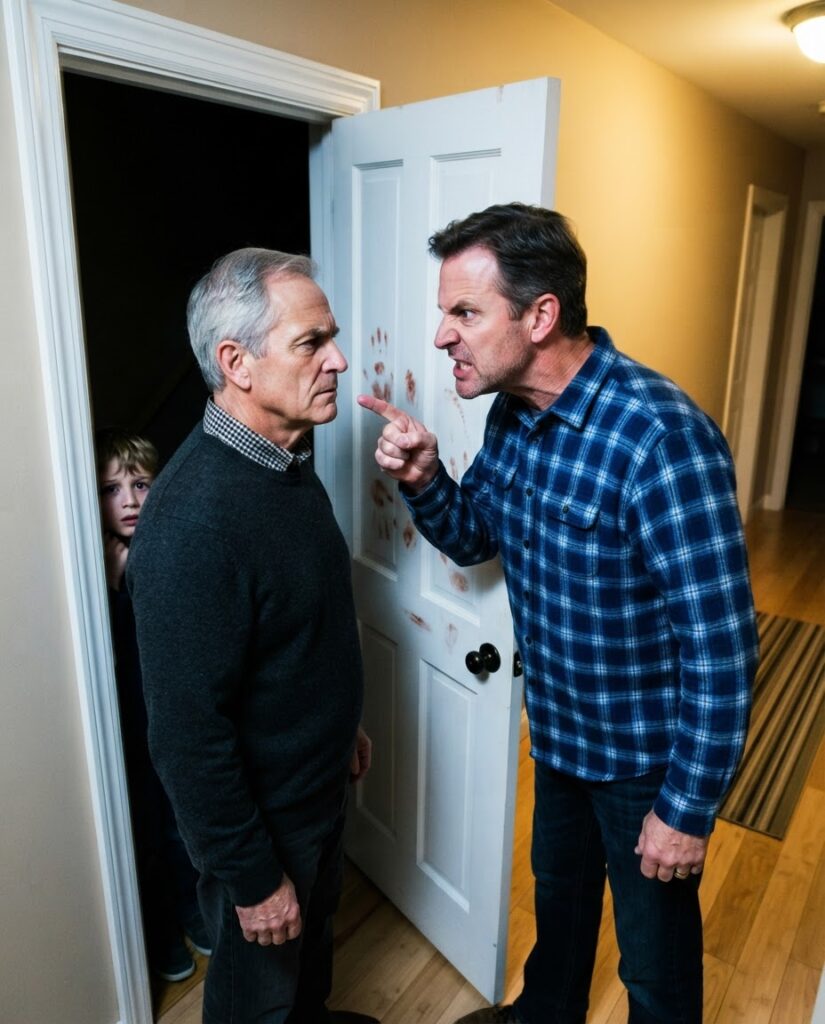
But Arthur stopped at the basement door.
The lock looked wrong.
The door opened slightly.
And there it was.
Five dried handprints marked the white-painted wood.
They were not random stains. They were proof of a child desperately trying to get out.
Arthur understood immediately who had made them.
Before he could say anything, Marcus appeared behind him.
The confident homeowner was suddenly exposed. Instead of explaining, instead of asking why Arthur was there, Marcus chose intimidation.
He grabbed Arthur and shoved him backward.
He warned him to stay out of the family business.
He believed the threat would work because it had always worked before.
Sarah watched her husband put his hands on her own father.
She still did nothing.
Arthur looked at the basement door. Then he looked at Marcus. Then he looked at his daughter.
A different person might have reacted immediately. They might have shouted. They might have created a scene.
Arthur knew something Marcus did not.
Anger was not always the same as justice.
A rushed confrontation could leave the child alone with the same danger after everyone went home. Marcus would deny everything. Sarah would likely support him. The situation would become another secret buried inside that house.
So Arthur changed his approach.
He lowered his voice.
He apologized as if he had made a simple mistake.
Marcus believed he had won.
He told Arthur to leave and never return.
Arthur walked outside, got into his ordinary sedan, and closed the door.
Marcus thought the problem was gone.
It was not.
Arthur did not drive home.
He opened the glove compartment and pulled out a secure phone that did not match the image Marcus had seen.
The quiet grandfather disappeared.
The purpose behind him remained.
Arthur had spent decades pursuing dangerous criminals and bringing hidden truths into the light. The man Marcus dismissed as weak had spent a lifetime understanding how people hide what they do.
The call he made was not about revenge.
It was about uncovering facts.
He requested a complete investigation into Marcus Sterling’s life, finances, and digital history. He wanted to know who Marcus was when nobody was watching.
Because Arthur understood that people like Marcus often depend on one thing: the belief that no one will ever look closely enough.
That night, the storm arrived.
Rain hit the house while Marcus prepared to go back toward the basement.
He still believed he controlled every room, every conversation, and every person inside those walls.
Then the power disappeared.
The television went silent.
The house changed.
Marcus called for Sarah, but there was no answer.
For the first time in a long time, he was not the person creating fear.
He was the person wondering who was nearby.
Then came a sound behind him.
A boot moving across the hardwood floor.
Close.
Too close.
Marcus tightened his grip and turned toward the noise.
He did not know that the man he had pushed aside earlier was no longer simply a grandfather asking questions.
He was someone who had spent thirty years learning how to find people who believed they could hide forever.
The story inside that house was about to change because one person finally decided that silence was no longer acceptable.
Arthur’s greatest weapon was not his phone, his contacts, or his experience.
It was patience.
He had waited long enough to understand the danger. He had waited long enough to make sure the child would not be left alone after the confrontation began.
And now Marcus was about to discover that the person he underestimated was the one person he should have feared.
PART 3
The dark house was entirely, suffocatingly quiet.
Without the dull roar of the television to mask the rain hammering against the roof, every sound became magnified. Marcus stood in the hallway, his flashlight beam slicing through the gloom. His breath hitched as he stared at the shape emerging from the shadows.
It wasn’t a squad of federal agents. It wasn’t a tactical unit.
It was Arthur.
The old man was still wearing his worn tweed coat, but he was no longer leaning on his wooden cane. He held it casually at his side, his posture straight, his shoulders broad. The frail, stooped figure Marcus had shoved earlier that morning was gone. In his place stood a man whose pale grey eyes were as cold and unyielding as granite.
“How the hell did you get in here?” Marcus spat, his voice laced with a sudden, sharp tremor of fear that he desperately tried to mask with anger. He took a step forward, raising his flashlight like a weapon. “I told you to get out, old man. I’m calling the cops. I’ll tell them you broke in!”
“You could try,” Arthur said softly. His voice wasn’t loud, but it possessed a strange, heavy weight that filled the corridor. “Except the phone lines are down, Marcus. The cellular tower at the end of your street is currently undergoing a localized blackout. And as for breaking in… a lock is only as strong as the person who designed it.”
Marcus’s chest heaved. He raised his fist, stepping in aggressively, intending to put the old man down once and for all. “You crazy old bastard—”
Marcus swung a violent, heavy right hook aimed directly at Arthur’s jaw.
Arthur didn’t flinch. He didn’t step back. With a motion so fast and fluid it seemed unnatural for a man of his age, Arthur stepped inside the arc of the punch. He caught Marcus’s wrist, redirected the momentum, and drove the heavy wooden knob of his cane directly into Marcus’s solar plexus.
Air exploded from Marcus’s lungs in a violent gasp. He doubled over, gasping for breath, his flashlight tumbling to the hardwood floor and rolling away, its beam casting long, terrifying shadows across the room.
Before Marcus could recover, Arthur’s hand gripped the back of his collar, forcing him down to his knees. The grip was like an iron vise.
“Thirty years, Marcus,” Arthur whispered, leaning down close to Marcus’s ear. “Thirty years I tracked men who thought power was built on inflicting pain on the helpless. Men who hid behind money, behind titles, behind locked doors. Do you know what every single one of them had in common?”
Marcus wheezed, clutching his stomach, tears of shock streaming down his face. “Fuck… you…”
“They all thought they were clever,” Arthur said coldly. “And they all died or rotted in a cell, completely alone.”
Arthur didn’t strike him again. Instead, he reached into his coat pocket, pulled out a pair of heavy steel zip-ties, and secured Marcus’s hands tightly behind his back with practiced, terrifying efficiency. He pulled Marcus up by his shirt collar and shoved him into a dining chair, binding his ankles to the wooden legs.
Marcus slumped, defeated, panting in the darkness, looking at his grandfather-in-law as if he were a ghost.
Arthur turned his back on Marcus, ignoring his quiet, panicked curses. He walked down the dimly lit hallway toward the stairs leading upstairs.
I was sitting in the corner of my bedroom, my knees pulled tightly against my chest. I had heard the power go out. I had heard the strange silence, and then the dull thud from downstairs. I was trembling so hard my teeth chattered, terrified that Marcus was coming for me, furious about the storm, furious about the lights.
Then the door to my room opened slowly.
A faint light flickered. It was Arthur, holding a small tactical penlight. He dropped to one knee in front of me, bringing himself down to my eye level. The terrifying aura that had just brought Marcus to his knees vanished completely. His face softened, his eyes warming with a deep, crushing sorrow.
“Hey, kiddo,” Arthur said, his voice trembling slightly.
I shrank back into the corner, afraid to hope. “Is… is Marcus coming?”
Arthur reached out slowly, giving me time to flinch, but he didn’t touch my bruises. He gently placed his hand on top of my head, his fingers threading softly through my hair.
“Marcus isn’t going to touch you ever again,” Arthur said, and for the first time in my twelve years of life, I believed a promise. “It’s over, Leo. You’re safe now.”
Tears spilled over my cheeks, hot and fast. I leaned into his hand, letting out a ragged, trembling sob that had been trapped in my chest for years.
“Where’s Mom?” I choked out.
Arthur’s face darkened for a split second, a profound sadness settling into the lines of his face. “She’s downstairs.”
When Arthur led me down the stairs, I saw my mother, Sarah. She was standing near the entrance of the living room, frozen. She hadn’t been tied up. She didn’t need to be. She was staring at Marcus bound to the chair, and then at Arthur, and finally at me.
Her face was pale, her lips trembling. “Dad… what have you done? What is this?”
Arthur stopped at the bottom of the stairs, keeping me behind him. He looked at his daughter—not with anger, but with a hollow, gut-wrenching disappointment that was far more painful than any rage.
“I spent thirty years bringing monsters to justice, Sarah,” Arthur said quietly. “But the hardest part was always looking at the people who stood by and watched them do it.”
“You don’t understand!” Sarah cried out, tears bursting from her eyes as she took a desperate step forward. “He… he provided for us! He paid for this house! If he goes away, we have nothing! I was trying to protect our future!”
“You traded your son’s blood for a roof over your head,” Arthur said, his voice flat, razor-sharp, and absolute. “You turned up the television so you wouldn’t have to hear him beg for help. You didn’t protect him, Sarah. You sacrificed him.”
Sarah choked on a sob, dropping to her knees, burying her face in her hands. She couldn’t look at me. And for the first time, I realized I didn’t need her to look at me anymore. The desperate, aching need for her love that had hollowed out my chest for years simply died right there in the dark hallway.
Outside, blue and red lights began to flash through the rain-streaked windows. Sirens wailed in the distance, growing louder.
Arthur hadn’t just called his old military contacts to cut the power. He had delivered an encrypted file directly to the State Police and the Department of Children and Families—a file containing medical records, financial audits showing Marcus’s money laundering schemes, and high-resolution photographs of the basement door, including the blood evidence.
When the police burst through the front door, heavy boots echoing in the foyer, they didn’t find a crime scene of vigilantism. They found a restrained criminal, an accomplice mother broken on the floor, and a retired federal agent standing quietly beside a young boy, wrapping his own dry tweed coat around the child’s shoulders.
The months that followed were a blur of courtrooms, depositions, and healing.
Marcus Sterling was sentenced to twenty-five years in maximum security, his financial empire crumbling under federal fraud charges alongside his child abuse convictions. My mother, Sarah, received a lesser sentence for child neglect and endangerment, but part of her plea deal required her to relinquish all parental rights to me. The day she signed those papers was the last time I ever saw her.
I didn’t go into foster care. Arthur fought for full custody, and within three months, I moved into his quiet, modest house near the coast.
It was a small house filled with old books, the smell of pipe tobacco and rain, and absolute safety. There were no locked doors. There was no loud television to cover up screams.
For the first few months, I still flinched whenever someone walked behind me. I still hid food under my mattress, terrified that I would be thrown into a dark room again. But Arthur never pushed me. He didn’t ask me to be strong. He just stayed there—fixing breakfast every morning, teaching me how to restore old wooden furniture, sitting on the porch in silence while I did my homework.
One evening, about a year later, the sky opened up into a violent autumn thunderstorm. Thunder shook the windowpanes, and the power flickered once, twice, and then went completely dark.
Instantly, my heart slammed against my ribs. My breath caught in my throat, and I froze in the middle of the living room, paralyzed by the sudden memory of that terrible house, of the basement, of the dark.
A moment later, a warm glow illuminated the room.
Arthur walked in carrying a brass lantern. He placed it gently on the coffee table between us, setting down two mugs of hot chocolate next to it.
He didn’t say “don’t be scared.” He didn’t tell me to grow up.
He just sat down in the armchair next to me, pulled his old tweed coat over his lap, and looked at me with those same grey eyes that had once faced down the worst criminals in the world—eyes that now held nothing but warmth.
“It’s just rain, Leo,” Arthur said softly. “The house is strong. And nobody is coming through that door.”
I looked at the light flickering on the wall, then down at my hands. The bruises were long gone. The scars on my fingers from clawing at the basement door were faint white lines now.
I took a sip of the hot chocolate, sat back against the couch, and closed my eyes. For the first time in my life, I listened to the rain fall against the roof, and I didn’t feel afraid.