The heat above Joint Expeditionary Base Little Creek was already bending the air when Vice Admiral Harrison Cole walked up to the podium. Eight thousand service members stood in formal formation beneath a washed-out sky, their white caps arranged in flawless rows. Cole loved ceremonies like this. Everything appeared controlled. Everything appeared spotless
Three hundred yards away, I was neither. My scrubs were hardened with sweat and iodine. My hair had been twisted into a messy knot, and after almost forty-eight hours inside a medical tent, my gray eyes looked as if sleep had become optional.
Then the Blackhawk swept in low. Rotor wash sent dust and loose gravel flying across Cole’s inspection just as he was delivering his speech. Heads turned. Perfect formation lines began to shift.
Cole saw chaos.
I saw the stretcher.
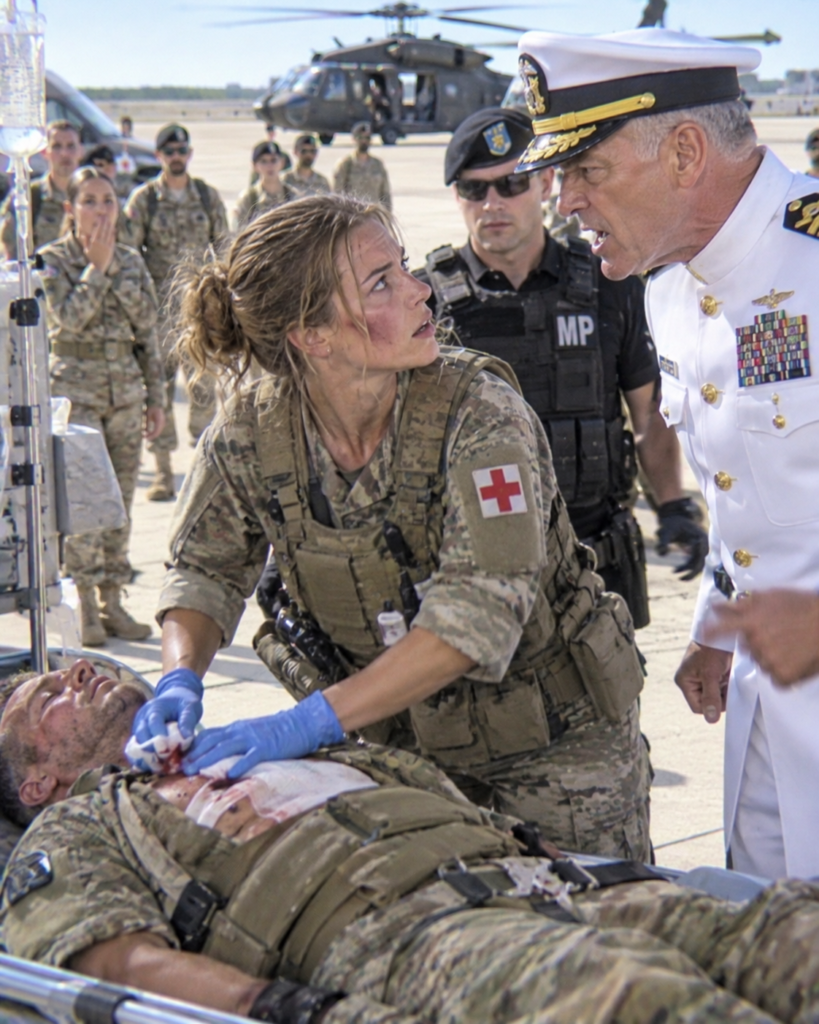
I was already running before the helicopter door had fully opened. The wounded man was struggling desperately for air. The young corpsman beside him looked only seconds away from panicking.
I dropped onto my knees on the scorching concrete and pulled open my trauma bag.
“Scalpel. Betadine. Bag him when I tell you.”
Cole marched across the tarmac with two MPs following close behind him. His polished shoes stopped only inches from the stretcher.
“Who gave permission for this?”
I didn’t respond. My fingers were already working around the patient’s throat.
“I asked you something,” Cole snapped. “You’re interrupting a fleetwide inspection. Get this mess out of my sight.”
I continued working.
Tube secured.
Airway established.
Chest rising again.
Only then did I rise to my feet.
I was shorter than Cole, covered with dust, and exhausted enough that most people would have struggled simply to remain standing. But my voice stayed perfectly steady.
“Sir, you’re standing inside my triage area. Step back.”
Thousands of service members were standing close enough to understand exactly what had just taken place. A lieutenant had just ordered a vice admiral to move.
Cole’s jaw went rigid.
“You disrespectful little girl.”
I stared directly back at him.
“Move.”
His hand lifted. The slap echoed sharply across the tarmac.
My head snapped sideways from the impact, but my boots never moved. I didn’t cry. I didn’t raise my hand to the red mark spreading over my cheek. I didn’t give Cole the response he clearly expected from me.
Instead, I turned back toward the stretcher. That was what disturbed the people watching. Not the slap itself. My priorities.
Cole shouted, “Detain her. Gross insubordination. Put her in restraints.”
I ignored him long enough to check the patient one last time.
“Package the patient. Surgical bay one. Tell Houseman the airway is secure.”
The stretcher immediately began rolling toward the medical doors. Only after I saw it moving safely away did I turn toward the MPs and hold out both wrists.
Sergeant Collins hesitated. He had heard the slap. He had watched me save the casualty. And now he had been ordered to restrain the nurse who had refused to leave that wounded man behind. Collins secured the zip ties loosely enough to make his discomfort impossible to miss.
“I’m sorry, Lieutenant,” he murmured.
I glanced once toward the stretcher disappearing through the medical doors, then looked back at Cole.
“Don’t be,” I said. “He just wrote his own ending.”
Cole ordered the MPs to remove me. Collins reached carefully for my restrained arm, and the three of us began walking away from the tarmac.
Collins had barely taken three steps with me when every monitor inside the command tent suddenly went dark. Cole stopped mid-order and stared toward the officers rushing around the screens.
One of them looked at me, hesitated, then leaned close to the admiral and whispered, “Sir… Cyber Command says this came from above us.”
Cole’s expression changed instantly. I said nothing as Collins loosened his grip on my arm, but before anyone could ask another question, a senior officer came running across the tarmac holding a secure tablet—and the moment Cole saw what was on the screen, he went completely still.
Part 2: The Fall of an Empire
The quiet on the tarmac was absolute.
Vice Admiral Harrison Cole stood frozen, his eyes glued to the secure tablet held by the breathless communications officer. The high-contrast glare reflected off Cole’s pale face, revealing a expression of rising panic that none of his junior officers had ever seen before.
I remained still, wrists loosely bound by Sergeant Collins’s zip ties. Collins didn’t pull my arm. Neither did the other MP. Everyone was staring at the man who, only thirty seconds ago, held total authority over thousands of lives.
“What is the meaning of this?” Cole’s voice cracked, losing its thunderous bite. “Who authorized a blackout of my command tent?”
The senior officer holding the tablet swallowed hard. “Sir… it’s not just the command tent. Cyber Command has locked down the entire Norfolk complex. All fleet communications are suspended. And… you have an incoming directive.”
“By whose authority?” Cole demanded, reaching out to snatch the tablet.
“The Chief of Naval Operations,” the officer whispered. “And the Office of the Inspector General.”
Cole’s hand trembled as his fingers swiped across the encrypted screen. I couldn’t see the text from where I stood, but I knew what it said. Every action taken on a modern military base—from flight manifests to medical dispatches—is logged in real-time. The moment Cyber Command flagged the unauthorized delay of a critical medevac, the live feed from the tarmac’s surveillance towers was automatically pulled to the top of the pentagon’s priority queue.
They had seen everything.
They saw the Blackhawk land. They saw a combat nurse fighting to save a dying soldier. They saw a Vice Admiral step onto a active triage zone. And they saw his hand strike my face.
Cole’s face drained of color. He looked up from the screen, his gaze sweeping across the thousands of service members standing in formation. The silence was deafening. Eight thousand witnesses had seen the strike. Eight thousand men and women now realized that their fearsome admiral was unraveling right before their eyes.
“This is a mistake,” Cole stammered, his eyes darting frantically toward me. “She was insubordinate. She breached security protocols!”
“Sir,” Sergeant Collins said quietly, his voice carrying a steady, unyielding edge. “Lieutenant Vance was responding to a Category Red casualty. Standing orders grant medical personnel absolute authority over the triage perimeter.”
Cole turned on Collins, his chest heaving. “Are you questioning me, Sergeant?”
“No, Admiral,” Collins replied, pulling a pair of shears from his vest pocket and cleanly snipping the zip ties from my wrists. “I’m obeying the CNO’s standing order.”
I rubbed my wrists lightly, never breaking eye contact with Cole. The red stain on my cheek burned, but the cold satisfaction inside me was far hotter.
“Get her off my tarmac!” Cole barked, a desperate attempt to regain control. “Get all of them out of here!”
Before anyone could move, two black SUVs tore across the tarmac, their sirens muted, leaving dark rubber marks on the scorching concrete. They screeched to a halt between the podium and the command tent. Four agents in civilian suits stepped out, accompanied by an officer wearing the stars of a Rear Admiral from the Judge Advocate General’s Corps.
Rear Admiral Vance—my father’s younger brother, though neither Cole nor anyone else on this base knew our connection—stepped out of the lead vehicle. He didn’t look at me. He kept his professional composure entirely intact.
“Vice Admiral Cole,” Rear Admiral Vance announced, his voice amplified by the quiet tarmac. “By order of the Secretary of the Navy and the CNO, you are hereby relieved of command, effective immediately.”
A low murmur rippled through the ranks of the eight thousand troops.
“On what grounds?” Cole spat, stepping back toward his podium as if it could protect him. “I am conducting a fleetwide inspection!”
“You are under investigation for assault, abuse of authority, and gross negligence resulting in the endangerment of active-duty personnel,” Vance replied calmly. He motioned to the federal agents. “Hand over your sidearm and your access badges.”
“You can’t do this!” Cole roared, his composure completely shattering into ugly desperation. “I built this fleet! I gave thirty years to this uniform! She is a nobody! A low-ranking nurse who disrespected my rank!”
“She is an officer of the Medical Corps who did her duty,” Rear Admiral Vance said softly, stepping closer so only Cole, the MPs, and I could hear. “And you forgot the first rule of command, Harrison: the uniform doesn’t give you the right to destroy the people who wear it.”
The agents stepped forward. Cole looked around wildly for support, but the officers who had spent the morning bowing to his every whim stepped back, lowering their heads. No one moved to defend him. No one spoke for him.
With shaking hands, Vice Admiral Harrison Cole unclipped his sidearm and handed it over. As the agents escorted him toward the rear seat of the SUV, he turned his head to look at me one last time.
I stood straight, shoulders back, sweat and dried blood still staining my scrubs. I didn’t smile. I didn’t gloat. I simply offered him a crisp, textbook salute—the ultimate reminder of the military honor he had just traded away for his own pride.
Cole’s eyes filled with venomous humiliation as he was shoved into the back of the car. The door slammed shut, cutting off his disgrace from the world.
Part 3: What Remains
An hour later, the tarmac was empty.
The eight thousand troops had been dismissed to their quarters. The silence that settled over Joint Expeditionary Base Little Creek was vast and heavy, broken only by the distant hum of the ocean breeze.
I stood inside Surgical Bay One, watching through the glass observation window. Inside, Dr. Houseman and the surgical team were finishing up. The vital monitors blinked in a steady, reassuring rhythm: green lines pulsing with life.
The young soldier from the Blackhawk was alive. His airway was secure; his chest was rising and falling steadily under the respirator.
The door to the observation room hissed open. Sergeant Collins walked in, carrying two paper cups of black coffee. He handed one to me.
“Houseman says he’s going to make a full recovery,” Collins said quietly, leaning against the glass next to me. “A few minutes later on that tarmac, and his brain would have been starved of oxygen. You saved him, Lieutenant.”
“We saved him,” I corrected, taking a sip of the bitter coffee. “If you hadn’t slowed down those zip ties, I wouldn’t have been able to give Houseman the handoff notes.”
Collins gave a faint, rare smile. “Just following protocol.” He looked at the deep bruise forming along my jawline. “Does it hurt?”
“Only when I think about how close that admiral came to destroying a man’s life over a speech,” I said.
The door opened again, and Rear Admiral Vance walked in. He dismissed Collins with a brief nod. Once Collins left and the door clicked shut, the formal tension in the room dissolved.
“You always did have your mother’s stubbornness, Maya,” my uncle said, his voice dropping its formal tone. He leaned against the railing, looking at the young patient in the bay below. “You could have stepped aside. You could have waited two minutes for him to finish his speech.”
“He was dying, Uncle Thomas,” I said, turning to face him. “Two minutes meant brain death. You know the oath I took.”
Thomas sighed, rubbing his temples. “I know. And that’s why Cyber Command stepped in. When your trauma bag’s telemetry stream hit the network alongside the base command feed, the flag went straight to Washington. They saw him hit you, Maya. On live satellite relay.”
“What happens to Cole now?”
“Court-martial,” Thomas replied coldly. “Stripped of his command, forced retirement at a reduced rank, and potential confinement. He thought his rank made him invincible. He forgot that power without purpose is just tyranny.”
He looked at me closely, examining the dark violet bruise on my cheekbone. “The CNO wants to award you a Navy and Marine Corps Medal for your actions today. For upholding the highest standards of medical care under pressure.”
I looked down at my hands—stained with iodine, nicked by medical tools, tired from forty-eight hours of non-stop effort.
“I don’t want a medal,” I said softly.
Thomas raised an eyebrow. “No?”
“Give the commendation to the young corpsman on that chopper,” I said, looking back through the glass at the sleeping patient. “He stayed with that kid when the air was filling with shrapnel. I just finished what he started.”
My uncle looked at me for a long moment, a quiet sense of pride softening his stern eyes. He reached into his pocket and pulled out a small tube of burn salve, setting it gently on the counter beside my coffee cup.
“You’re a damn good officer, Maya,” he whispered. “Your father would have been proud.”
When he left, I was alone in the quiet observation room.
I picked up the salve, applied a small amount to my cheek, and looked at my reflection in the dark glass. The mark was there, red and swollen, a temporary reminder of a Vice Admiral’s fragile ego. But through the glass, reflected right beside my bruise, was the steady rhythm of a beating heart on the monitor.
I took a deep breath, adjusted my scrubs, and walked back toward the emergency doors.
There were still forty-eight hours left on my shift, and somewhere out there, another helicopter was coming in.