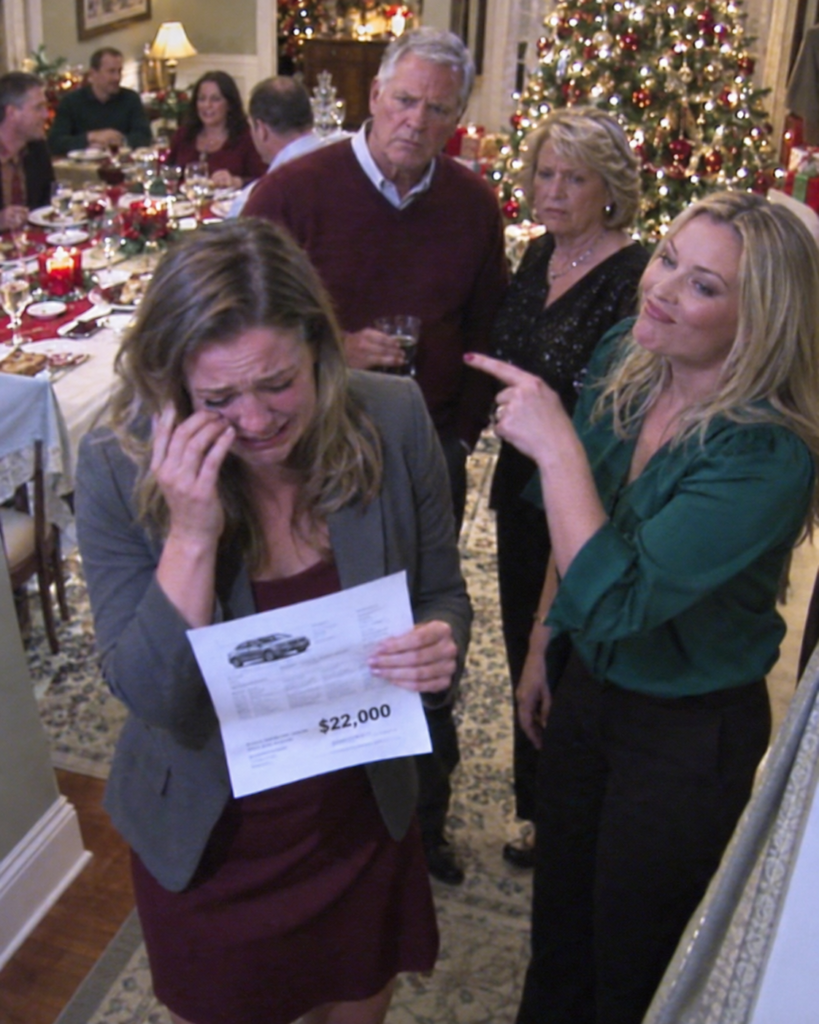
Mom Smirked, “You’re Nothing but Our Bank.” Dad Added, “You Haven’t Earned a Place at Our Table.” They Had No Idea What I Was About to Do.
My family held their Christmas celebration without me. I discovered it through a picture on Facebook.
Mom was smiling in a bright red sweater. Dad stood beside the dining table carving the holiday ham. My younger sister, Amber, posed with a glass of champagne in front of a Christmas tree so heavily decorated with gold ornaments that it looked like it belonged in a luxury hotel.
My cousins had been invited.
My aunt had traveled all the way from Denver.
Even Warren, one of Dad’s golfing buddies, was there.
But I was not.
I stood alone in my Chicago apartment, still dressed in my winter coat as melting snow dripped from my boots onto the hardwood floor.
For most of the evening, I had tried to believe there had been some misunderstanding.
Maybe someone had forgotten to text me the time.
Maybe Mom assumed Dad had called.
Maybe Amber had accidentally left me out of the family group chat.
Then my phone buzzed. An email from Mom appeared on the screen.
Subject: Amber’s Vehicle Payment Plan
Attachment: Invoice for $22,000
I stared at it before opening the file, convinced she must have sent it to the wrong person. She had not.
The invoice came from an expensive dealership in Ohio. It showed the down payment required for a pearl-white BMW convertible Amber had apparently decided was essential to her happiness.
At the bottom of the document, Mom had typed a short message:
“Transfer the money by Friday, please. This is Amber’s dream car, and we already told her you would contribute.”
I called her at once. She answered while laughing. Through the phone, I could hear Christmas music, loud conversations, glasses clinking, and silverware hitting plates.
“Merry Christmas, Mom,” I said.
She went quiet for a second. “Oh. Hello, Claire.”
“Why wasn’t I invited?”
There was another pause. Then I heard Dad’s voice in the background: “Is that Claire?”
Mom released a tired sigh, as if my call had ruined the mood. “Claire, please don’t start causing drama tonight.”
“You sent me a bill for twenty-two thousand dollars so Amber can buy a car.”
“Yes,” Mom replied casually. “She needs reliable transportation for her job.”
“Amber works three days a week at the clothing store Dad owns.”
Mom laughed. It was not nervous laughter. It was not embarrassed laughter. She was genuinely entertained.
“Oh, honey,” she said. “You’re basically our bank. Stop trying to turn everything into an emotional issue.”
“You Don’t Deserve a Place”
My fingers tightened around the phone. A moment later, Dad took it from her.
“You were not invited because your presence makes everyone uneasy,” he said. “You sit silently, staring at people as though you’re better than them.”
“I covered your mortgage payments last year.”
“And we appreciated it.”
“I paid off Amber’s credit-card debt twice.”
“She’s still learning.”
“I paid for Mom’s operation.”
Dad’s voice hardened:
“You don’t deserve another place setting at Christmas, Claire. But you are useful when you stay in your proper role.”
Then I heard Amber laughing behind him: “Ask her if she can pay extra for the custom wheels!”
At that moment, something inside me went completely quiet. It did not break. It did not collapse. It simply became still.
I looked again at the dealership invoice displayed on my screen. Then I opened my online banking history.
After that, I pulled up my legal records and clicked on a folder labeled:
📁 Henderson Family Loans
For six years, I had kept everything:
Every receipt.
Every bank transfer.
Every text message in which they promised to repay me.
Every email acknowledging the money as a loan.
And every signed agreement Dad had once mocked as worthless paperwork.
My family thought I had been quietly giving them money because I was desperate for their approval. They did not realize I had been documenting everything.
And they had absolutely no idea what I was going to do next.
Part 2: The Audit of Betrayal
The silence in my apartment was no longer heavy with grief; it was sharp, cold, and clear.
I sat at my glass dining desk, the glow of two monitors illuminating the dark room. On the left screen, the Ohio dealership’s invoice sat idle—a demanding, arrogant summons for $22,000. On the right screen, six years of meticulous financial bookkeeping lay spread out like a battle map.
When I was twenty-two, freshly graduated and struggling to climb the corporate ladder in Chicago, my family had treated me as a burden. But the moment I secured a high-paying position at a global asset management firm, their perception shifted overnight. I wasn’t their quiet, awkward Claire anymore. I became their insurance policy.
At first, it started with small requests. A late utility bill here, a balance on Amber’s store credit card there. But over the years, as my career flourished, their demands inflated exponentially.
The Mortgage: When Dad’s boutique clothing business hit a slump, I wire-transferred $48,000 directly to their lender to save their four-bedroom suburban house from foreclosure.
The Medical Expenses: When Mom needed elective spinal surgery that wasn’t fully covered by insurance, I paid the $35,000 clinic bill out of my personal investment account.
Amber’s Debts: Twice, I wiped out Amber’s luxury retail cards, totaling over $19,000, under Dad’s strict promise that “she would pay me back as soon as she matured.”
They thought these were gifts. They thought my silence was the compliance of a daughter desperate for a seat at their holiday table.
They were wrong.
My background in financial audit had taught me one fundamental truth: Never trust promises; trust executed contracts.
Every time Dad asked for money, I insisted on sending formal promissory notes. I drafted simple, legally binding loan agreements with interest terms, payment deadlines, and default clauses. When Dad signed them, he always chuckled, calling me a “bureaucratic weirdo” who took life too seriously. He thought those papers were meaningless family formalities. He never imagined I had every single document notarized digitally, stamped, and archived alongside bank remittance receipts, text messages, and recorded voicemails.
By 2:00 AM on Boxing Day, my spreadsheet revealed the final number. Total Principal Loan Balance: $142,500
Accrued Interest & Late Fees: $31,200
Grand Total Owed: $173,700
I opened my email and composed a reply to Mom’s message—the one containing the $22,000 invoice for Amber’s BMW.
I attached a single PDF document titled: Notice_of_Loan_Acceleration_and_Demand_for_Payment.pdf
In the body of the email, I typed:
“Dear Mom and Dad,
I have reviewed your request regarding Amber’s vehicle payment. Unfortunately, I am unable to extend further credit to the Henderson family.
Pursuant to the six signed Promissory Notes executed between 2020 and 2025, your loan accounts are currently in severe breach of payment terms. As per Section 4 (Acceleration Clause) of our agreements, your explicit refusal to acknowledge these obligations during our phone call on December 25th constitutes an anticipatory repudiation.
Therefore, I am declaring the full balance of $173,700 immediately due and payable within 14 calendar days.
Failure to remit the full amount by January 8th will result in immediate legal action, including the filing of a lien against the primary residential property at 142 Elmwood Lane.
Merry Christmas.
Claire Henderson”
I clicked Send.
The reaction was immediate.
At 7:00 AM the next morning, my phone started ringing endlessly.
First came Mom. I let it go to voicemail.
“Claire! What is the meaning of this childish joke? A legal demand? Are you out of your mind? Call me back right now!”
Then came Dad. His tone was no longer cold and condescending; it was laced with fury. “Claire! You listen to me very carefully! If you think you can intimidate your mother and me with fake legal papers, you’ve got another thing coming! We raised you! You owe us everything! You cancel this email right now or you are dead to this family!”
Finally, Amber texted me a series of crying emojis followed by:
“You’re ruined my life! I already posted on Instagram that I was getting the BMW today! You are the worst sister in the world!”
I didn’t answer a single call. I forwarded the entire file to Marcus Vance, a senior partner at Chicago’s top debt litigation firm, whom I had retained three weeks prior when I first noticed they had quietly removed me from the family group chat.
“Claire,” Marcus said over the phone later that morning, reviewing the files. “These contracts are bulletproof. Notarized, clear terms, documented transfers. They don’t have a leg to stand on. If they don’t pay within two weeks, we file in state court.”
“Do it,” I said quietly. “No settlement. No reductions.”
Part 3: The Price of Redemption
Two weeks passed. The deadline of January 8th came and went without payment.
On January 12th, Marcus formally filed a lawsuit in the District Court and served a pre-foreclosure lien against my parents’ house.
The illusion of their wealthy, flawless suburban life crumbled instantly. To the outside world, Dad was a successful boutique owner and a generous country club member. In reality, his business was bleeding money, kept afloat solely by my secret injections of cash. Without my financial buffer, the lien froze their ability to refinance their home or take out business loans.
On a rainy Tuesday evening in late January, there was a sharp, desperate knocking at the door of my Chicago apartment.
I opened it to find Mom and Dad standing in the hallway.
They looked completely unrecognizable. Mom was wearing an old coat, her hair unstyled, without the polished jewelry she usually wore to show off to the neighbors. Dad looked exhausted, his shoulders slumped, holding a thick leather folder in his trembling hands.
“Claire…” Mom choked out, her eyes red and swollen. “Please. Let us in.”
I stood at the doorway, keeping my expression entirely neutral. “You have five minutes.”
They walked into my bright, quiet living room—the same room where I had stood alone on Christmas night while they celebrated without me.
“Claire, son,” Dad started, his voice crackling, stripped of all its former authority. “We… we got the court summons. The bank called us today. They froze our business credit line because of your lien. If this goes to trial, the story will get into the local paper. My business will collapse. We’ll lose the house.”
“I know,” I replied calmly, leaning against the counter.
Mom burst into tears, dropping to her knees right on the hardwood floor. “Claire! How could you do this to your own mother? We are family! Family doesn’t sue each other over money!”
“Family doesn’t charge their daughter $22,000 for a car while banning her from Christmas dinner,” I said, my voice razor-sharp. “Family doesn’t tell their child she’s nothing but a bank and doesn’t deserve a place at the table.”
Dad flinched as if he had been physically struck. The memory of his own words, spoken so callously on Christmas night, hung in the air like poison.
“I was angry, Claire,” Dad stammered, looking down at his shoes. “I… I was proud and stupid. You always made so much money, so quickly… it made me feel small as a father. I wanted to exert control over you. It was wrong. It was terrible. Please, drop the suit. We can’t pay $173,000. We don’t have it!”
“Then you sell the house,” I said without hesitation. “Or sell the clothing store. Or Amber can sell her designer bags and get a real full-time job.”
“Claire, please!” Mom sobbed, reaching out to touch my hem, but I took a step back. “Amber had to return the BMW! Everyone at the country club is gossiping! We are ruined!”
“You ruined yourselves the moment you decided my love was quantifiable in dollars,” I said, staring directly into my father’s eyes. “For six years, I paid for your comfort, waiting for a single token of genuine affection. A text checking if I was okay. An invitation that wasn’t accompanied by an invoice. But you didn’t see a daughter. You saw an account balance.”
Dad closed his eyes, tears finally slipping down his weathered cheeks. “What do you want us to do?”
“My lawyer has prepared a settlement agreement,” I said, picking up a document from the counter and placing it between them.
“Here are the terms: You will sell the Elmwood Lane house immediately. The proceeds will be used to pay off the $173,700 debt in full to my firm’s escrow account. Whatever is left over, you can use to downsize into a small apartment. Furthermore, Amber will sign a legal release relinquishing any expectation of financial support from me forever.”
“And… and what about us?” Mom whispered, looking up in despair. “Will you come home for Thanksgiving? For next Christmas?”
I looked at them—two people who had spent years taking my kindness for granted, who had left me standing alone in the cold while they feasted.
“There is no home to come back to,” I said softly. “You sold my place at your table a long time ago. Now, you’re just paying the bill.”
Three months later, the house was sold.
The wire transfer of $173,700 hit my investment account on a sunny Friday afternoon in April.
I sat by the window of my apartment, watching the spring sunshine warm the Chicago streets below. My phone screen lit up with a notification from my bank confirming the funds had cleared.
Shortly after, a message popped up from Mom.
“The money has been sent. We moved into the two-bedroom rental today. Amber had to take a job at a local diner. We hope you are happy.”
I didn’t feel malicious joy. I didn’t feel triumphant.
I simply felt free.
I blocked their numbers, closed the ledger file on my desktop, and permanently deleted the folder labeled Henderson Family Loans.
For the first time in my life, my table was empty—but it was finally mine.