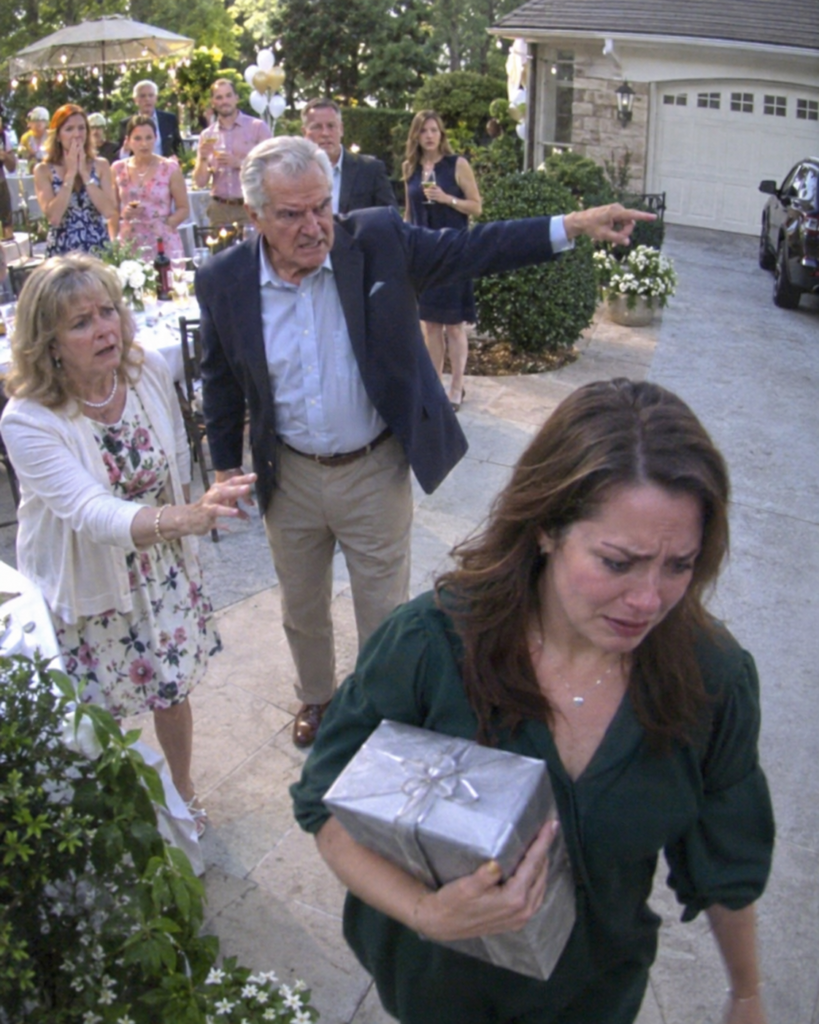
My name is Iris, and at 34, I learned that my chair came with conditions.
At my parents’ 35th anniversary party, my dad pointed me toward the garage and said it was just for extended family. He had a smirk on his face when he said it.
Every cousin, every uncle, every in-law had a gold seat at the main table, including the one who’d stolen from my grandmother.
I was the only one standing in a doorway that smelled like motor oil.
But here’s what none of them knew.
The slim package I was holding under my arm, the one wrapped in silver paper, was worth more than every centerpiece on that table combined.
And what I did with it emptied their house in three weeks.
Welcome back to Hidden Family Revenge, where quiet people finally set the table on their own terms, and the ones who took them for granted learn what that table was worth.
If a story like this has ever been yours, you already know the feeling. Drop a comment and be sure to subscribe.
I should tell you who I am before I tell you what I did.
I’m a CPA, forensic accounting specifically, the kind of work where you sit in a windowless conference room with 14 months of bank statements and find the lie on page nine.
I built that career from a community college night program, two part-time jobs, and a library card I used until the barcode wore off.
Nobody handed me anything. Nobody co-signed. Nobody called to check if I’d eaten dinner.
That part is important because in the Foster family, I was never the daughter who needed checking on.
I was the one who checked.
If a bill was overdue, I caught it. If a holiday needed coordinating, I built the spreadsheet. If Grandma Ruth needed her prescription refilled or her furnace inspected before November, I drove the 40 minutes and handled it.
Not because anyone asked.
Asking would imply they noticed.
I just did it the way I’d always done it, the way I’d been doing it since I was 19.
And my mother looked at me across a pile of unopened mail and said, “You’re good at this kind of thing.”
That was the job offer.
No title, no salary, no review, just a permanent seat at the operations desk of a family that only called when something broke.
My therapist once told me that over-responsibility is a trauma response dressed in competence.
She said it like it was a warning.
I heard it like a job description.
So when the anniversary party came around, I was the obvious choice to make it happen.
I booked the venue.
I called the caterer. I arranged Grandma Ruth’s wheelchair transport. I handled every detail down to the napkin color.
I just didn’t know I was also booking my own exile.
The party had been my mother’s idea.
Diane Foster loved milestones the way some people love trophies. Not for what they meant, but for what they proved.
Thirty-five years of marriage, two kids, a three-bedroom colonial with a wraparound porch, and a family photo wall that could make a Hallmark producer weep.
She wanted the whole neighborhood to see it.
“Something elegant,” she told me over the phone in March, five months before the August date. “Gold chairs, not white. Real linens. And make sure the photographer gets the porch.”
She never said please. She never said thank you.
She said “make sure,” which in our house meant Iris will handle it.
I started a binder: venue quotes, caterer menus, a seating chart I built in Excel with color-coded dietary notes.
I spent 11 evenings on it.
I also started working on the gift.
It was something I’d been thinking about for two years, a project that required three phone calls to a photo restoration studio in Richmond and a fourth to a framing shop that specialized in archival-quality work.
My parents had exactly one photograph from their wedding day.
It was a Polaroid, sun-bleached and cracked down the middle, taped to the inside of a kitchen cabinet for as long as I could remember.
I had it scanned, restored pixel by pixel, and printed on cotton rag paper in a handmade walnut frame.
Beside it, in the slim silver-wrapped folder, I placed something else, a set of documents I’ll tell you about later.
For now, just know that the gift sitting on my passenger seat as I drove to the venue that Saturday afternoon was the most expensive, most personal, most carefully assembled thing I had ever made for two people who had never once asked what I wanted for my birthday.
Let me walk you through a Tuesday in the Foster family.
At 7:14 a.m., I text Brett.
That’s my younger brother, 31. Golden Retriever energy without the loyalty to remind him it’s Aunt Carol’s birthday.
He doesn’t reply.
At 7:45, I check the Foster Fam group chat to confirm Grandma Ruth’s Thursday podiatrist appointment.
I’m the admin. I’ve always been the admin.
Nobody voted. Nobody asked.
I just started posting the calendar links in 2014 and never stopped.
At 9:00 a.m., I call the venue to confirm the August deposit.
At 11:00 a.m., I email the caterer about my dad’s shellfish allergy, which he will deny having, and my mother will confirm with a sigh.
At 2 p.m., my mother calls.
She doesn’t say hello.
She says, “The florist wants to know about the arch.”
I tell her I already handled it.
She says, “Good. Oh, and your father wants crab cakes.”
I remind her about the allergy.
She pauses.
“You always understand, Iris.”
That sentence. Eight syllables.
She’d been saying it my whole life, and every time it sounded like a compliment until you held it up to the light.
“You always understand.”
It meant you won’t complain.
It meant, “I don’t have to explain.”
It meant, “You are the path of least resistance, and I will walk it every single time.”
By 5:00 p.m., I had coordinated a vendor, managed a medical disclosure, resolved a catering conflict, and reminded a 31-year-old man about a birthday he’d known about for 31 years.
None of it was in my job description.
All of it was in my blood.
The Foster family ran on Iris, and Iris ran on the quiet certainty that if she stopped, everything would break.
I was about to test that theory.
My father, Gerald Foster, is 63 years old and has never entered a room without counting heads.
Not because he’s anxious.
Because he’s measuring.
Gerald needs an audience.
He coached Little League for nine years, even though Brett quit after two. He ran for town council twice, lost both times, and still introduces himself as civic-minded.
At his retirement dinner from the county clerk’s office, he gave a 14-minute speech.
The man does not fear a microphone.
He fears an empty chair.
My mother is different.
Diane grew up poor. Appalachian poor. Seven kids in a trailer poor.
And she carried that scarcity into everything.
In her math, love is a finite resource. You allocate it where the return is highest.
Brett was the return.
Handsome, social, effortlessly liked.
I was the infrastructure.
You don’t celebrate infrastructure. You maintain it.
Then there’s Brett himself.
My brother has never organized a single family event, paid a single vendor invoice, or driven Grandma Ruth anywhere.
He’s never had to.
He showed up, smiled, and got the best plate.
The system worked for him, so he never questioned it.
And finally, Cody Marsh, my cousin on my mother’s side, 29, unemployed on and off, and the proud owner of a rap sheet that includes pawning Grandma Ruth’s garnet earrings while she was in the hospital for a hip replacement.
My aunt Deborah begged Diane to forgive him.
Diane did because family is family.
Cody sat at Thanksgiving that year, three seats from the grandmother he’d robbed, eating her sweet potato casserole and asking for seconds.
Nobody blinked.
That was the architecture.
Gerald needed witnesses. Diane allocated love by ROI. Brett collected dividends, and Cody got pardoned.
I got the spreadsheet.
There’s a cabin on Lake Monacan about 90 minutes west of our house.
It belonged to my grandfather Harold before he died in 2011.
Cedar walls, a stone fireplace that pulled slightly to the left, and a dock that creaked in a way that sounded like a song if you were nine years old and didn’t know any better.
Every Foster holiday worth remembering happened there.
Fourth of July, sparklers on the dock. Thanksgiving with the windows steamed from Ruth’s cornbread. Christmas morning with the lake frozen gray behind the tree.
When Harold died, the cabin passed to Gerald and Ruth jointly and then mostly to Gerald when Ruth moved into assisted living.
Mostly because Gerald forgot to do the one thing Harold told him to do: pay the property taxes.
By 2019, the cabin was three years delinquent.
The county had mailed two notices. Gerald threw them away.
In 2020, a tax lien notice arrived.
I found it in the recycling bin under a pizza box.
I didn’t ask permission.
I called the county assessor, set up a payment plan, and over the next four years cleared the full amount plus the penalty and the special assessment for the septic system.
$11,400 total, paid from my own account in quarterly installments.
I kept every receipt.
I sent Gerald a certified letter documenting each payment, return receipt requested, and kept the green cards in a folder with the canceled checks.
He never signed for one of them.
Diane did twice.
Neither of them called.
I didn’t tell anyone because nobody asked.
And in the Foster family, not asking was the same as not caring.
The cabin stayed open. The dock kept creaking.
Every Christmas, Gerald stood by the fireplace and told the same story about Harold building it with his own hands.
He never once mentioned who kept it standing.
It was one of those details I carried quietly, like a deed folded into a wallet pocket, waiting for the day it mattered.
The Wednesday before the party, I sat at my kitchen table and slid the last piece into the silver folder.
The restored wedding photo, crisp, color-corrected, mounted on acid-free backing.
And beneath it, the cabin documents, paid-in-full tax certificate, copies of every canceled check and certified mail receipt, and a handwritten card.
The card said:
“35 years of the Foster family. Here’s 35 more. The cabin is clear, free, and yours. Love, Iris.”
I sealed the folder, wrapped it in silver paper, and tied it with a linen cord.
The whole thing was flat enough to sit on my lap.
I held it for a moment and imagined my father’s face when he opened it.
Not the smirk, the other face, the one I’d seen twice in my life.
Once when Harold died, and once when Brett scored the winning goal at a JV game in 2009.
The soft face. The face that said, “I see you.”
I thought this gift might unlock it.
I thought 35 years of marriage and four years of quiet tax payments and one impossible photo restoration might add up to enough.
Enough for what?
I couldn’t have told you then.
A seat, maybe. An introduction that went beyond, “And this is our daughter Iris. She’s the organized one.”
A moment where my name didn’t come with a job title attached.
I put the gift on the passenger seat of my car and drove to the venue the next morning with the windows down and a feeling in my chest that I hadn’t earned yet.
Hope.
The kind that sits on top of 15 years of evidence and still manages to float.
If you’ve ever walked into a family event carrying something you made with your whole heart, you know exactly how fragile that walk is.
The venue was the back garden of the Elks Lodge on Sycamore, the one with the white pergola and the parking lot that smells like honeysuckle in August.
I’d chosen it because my mother wanted elegant but not pretentious, which in practice meant expensive but with a parking lot.
Sixty-four guests, gold Chiavari chairs with ivory cushions, round tables dressed in white linen, a string quartet I found on Thumbtack for $600.
The photographer was already circling the porch when I pulled in, shooting the floral arch I designed with the florist over four emails and a Pinterest board.
It looked exactly right.
I carried the gift under my arm and walked through the side gate, past the bar setup, past the catering tent, past the guest book station I’d assembled the night before.
Everything was in place.
Everything I had touched was running.
I scanned the seating chart pinned to the easel near the entrance.
Table one: Gerald, Diane, Brett, Aunt Deborah, Uncle Martin, Grandma Ruth.
Table two: the Marshes, including Cody.
Tables three through eight: neighbors, church friends, colleagues.
I moved my finger across every card.
Table four, table five, table six.
My name wasn’t on any of them.
I checked again.
I checked the back-row seats, the overflow section by the pergola, the children’s table that didn’t have children assigned to it yet.
Nothing.
My name did not appear on the seating chart I had built.
I stood there with the silver gift under my arm, the photographer clicking behind me, the string quartet warming up 30 feet away, and a seating chart that didn’t know I existed.
Then my father walked up, smiled the way you’d smile at a delivery driver, and pointed toward the garage.
The garage was attached to the lodge by a breezeway that smelled like old concrete and WD-40.
It wasn’t part of the event space.
It was where they stored folding tables, traffic cones, and a riding mower with a flat tire.
My father walked me to the entrance like it was perfectly normal, his hand on the small of my back in that half-guiding, half-pushing way he did when he wanted to move you without being seen doing it.
Inside there was one chair, white plastic, the folding kind with the metal legs that pinch your thighs if you sit wrong.
It was positioned between a paint-stained workbench and a stack of orange traffic cones.
No table, no place setting, no name card.
The fluorescent tube overhead buzzed at a frequency that made my teeth ache.
There was a water stain on the ceiling shaped like a mitten.
I noticed things like that because I wasn’t looking at my father.
If I looked at him, I would have seen the smirk.
And if I saw the smirk, I would have had to decide what to do about it right then.
And I wasn’t ready.
“It’s just for extended family,” he said.
Five words.
He said them the way you’d explain a seating upgrade on an airplane. Like it was policy, not personal. Like the garage was business class and the garden was first, and I simply hadn’t earned the points.
I could hear the quartet starting up through the wall.
Vivaldi.
I’d picked that piece. I’d emailed the quartet leader three versions of the set list before settling on it.
And now I was hearing it through cinder block, standing next to a lawn mower, holding a gift I’d spent two years making, while my father adjusted his cufflinks and walked back to his gold chair.
I sat down.
The chair pinched immediately.
I set the gift on my lap and looked through the open breezeway toward the garden.
From that angle, I could see about half the tables.
I could see Aunt Deborah adjusting her shawl.
I could see Brett arriving late with a bottle of wine he definitely did not pick out himself.
I could see Grandma Ruth in her wheelchair at table one, her hands folded in her lap, her eyes scanning the garden the way she always did, looking for me.
And I could see Cody Marsh at table two, leaning back in a gold Chiavari chair with his legs spread wide, laughing at something Uncle Martin said.
Cody, who had taken Grandma Ruth’s garnet earrings, the ones Harold gave her in 1974, and pawned them at a shop on Route 9 for $215.
Cody, who had never apologized because Diane told everyone to let it go.
“He’s been through a lot.”
Cody had a gold chair.
Cody had a place card.
Cody had a champagne flute and a cloth napkin and a view of the floral arch I designed.
I had a folding chair next to a can of Rust-Oleum.
The quartet played through the wall.
Guests clinked glasses.
Someone made a toast I couldn’t hear.
The party I had built from a binder and 11 late nights and $600 worth of string quartet was happening 30 feet away from me.
And I was watching it through a breezeway like a stagehand behind a curtain.
I sat there for 11 minutes.
I counted.
And in those 11 minutes, exactly zero people came to check on me.
Not one.
That was the answer to a question I’d been afraid to ask for 15 years.
I want to be clear about what happened next because people always expect the explosion.
They expect the thrown plate, the shouted speech, the dramatic exit with mascara running.
That’s not what happened.
What happened was arithmetic.
I sat on that plastic chair and did the math.
Fifteen years of vendor calls, prescription refills, holiday coordination, and crisis management.
Four years of quarterly tax payments on a cabin my father claimed as his legacy.
$11,400.
Two years of photo restoration, five months of party planning, and one garage.
The numbers didn’t add up to anger.
They added up to clarity.
I wasn’t uninvited. I was just never a guest.
I had confused being needed with being wanted.
And that confusion had cost me a decade and a half of Tuesday afternoons and Sunday mornings, and every holiday I’d ever organized but never enjoyed.
The chair pinched my thigh again.
I shifted and looked down at the silver gift on my lap.
Inside it was the most thoughtful thing I’d ever created, a restored memory and a secured future wrapped together in linen cord.
I had made it for people who put me next to a lawn mower.
And the worst part, the part that made my jaw tighten instead of my eyes water, was that they expected me to stay.
They expected me to sit there quietly, hear the toast through the wall, and show up afterward to help clear the tables because I always did.
Because I always understood.
That was when the arithmetic turned into a decision.
Not a dramatic one. Not the kind you make with your heart racing.
The quiet kind.
The kind that sounds like a lock turning in a door you didn’t know you had the key to.
I stood up.
The folding chair scraped against the concrete, and the sound echoed off the garage walls like a period at the end of a sentence.
I picked up the silver gift, tucked it under my arm, and walked through the breezeway into the garden.
I didn’t run. I didn’t stomp.
I walked the way I walk into an audit: steady, measured, with my shoulders level and my eyes forward.
The quartet was between pieces.
The garden was in that held-breath moment where everyone is mid-conversation and nobody is looking at anything in particular.
I crossed the edge of the seating area.
My mother noticed first.
She always noticed movement, not people.
Movement.
Gerald looked up from his chair.
Brett paused mid-laugh.
I walked past table one, past table two, where Cody was picking at a crab cake with his fingers, past the guest book I’d assembled, past the floral arch I’d designed, past the bar setup I’d coordinated, and toward the gate.
I didn’t stop.
My mother’s chair scraped.
I heard her heels on the flagstone behind me.
“Iris.”
I kept walking.
“Iris, wait. Don’t do this in front of everyone.”
I reached the gate, turned around, and looked at her.
She was three steps behind me, her face arranged in the expression she wore when someone was about to make her look bad at church.
Half smile, tight eyes, hands slightly raised like she was calming a horse.
“You always understand, Iris,” she said, like a password, like the magic word that had always made me sit back down.
I held up the silver gift so she could see it clearly.
Then I said two words.
“Extend this.”
I turned around and walked to my car.
She did not follow.
That night, I sat on my couch with a glass of water and my phone face down on the cushion beside me.
I didn’t want to look at it.
I looked at it anyway.
The Foster Fam group chat had 47 new messages.
I scrolled past the surface noise—“great party” and “love you guys” and a blurry photo of the cake—and found the thread underneath.
It was a side conversation from six days earlier, buried below the main chat.
I’d missed it because my phone filters admin messages to a separate tab and I hadn’t checked.
The thread started with my mother.
“Seating update. Iris can sit in the side area. She won’t mind. She’ll probably be running around helping anyway.”
My father replied, “Put her in the garage. More room for the Hendersons.”
Brett’s response was a laughing emoji and three words:
“She’ll understand, LOL.”
Cody hadn’t said anything.
He didn’t need to.
The thread continued for nine more messages.
Logistics about folding chairs, whether to tell me in advance.
“No, she’ll make it weird.”
And a note from Diane that said, “She’s already handling the caterer, so she’ll be too busy to notice.”
Nine messages, six days, a coordinated plan to seat me in a garage discussed openly in a chat I administered.
And nobody thought to delete the thread because nobody thought I mattered enough to check.
I read it twice.
I didn’t screenshot it. I didn’t save it.
I didn’t need evidence.
This wasn’t a case I was building.
It was a fact I was finally reading.
The family I’d been running for 15 years had never considered me a member.
They’d put it in writing, and the writing was sloppy because it was never for my eyes, because my eyes were never on their minds.
I put the phone down.
I finished my water.
I went to bed.
In the morning, I made coffee, sat at my desk, and opened a new spreadsheet.
Old habits.
The column headers were simple: task, frequency, last completed, replacement, status.
I listed everything I did for the Foster family.
Grandma Ruth’s medical coordination, appointments, pharmacy, insurance calls, the family calendar, birthdays, holidays, RSVPs, travel logistics, the lake cabin, tax payments, maintenance contacts, winterization schedule, my parents’ household overflow, the bills Diane forgot, the prescriptions Gerald ignored, the warranty claims nobody filed, Brett’s life administration, the dentist appointments I booked because he kept forgetting, the car registration I renewed because he didn’t know how.
Event planning.
Every holiday, every birthday dinner, every graduation party for the last 15 years.
The list ran to 41 items.
Forty-one recurring tasks, none of which had ever been assigned, acknowledged, or compensated.
I looked at that list the way I look at a balance sheet when the client insists everything adds up but the numbers say otherwise.
The numbers always say otherwise.
I wasn’t going to slam doors.
I wasn’t going to send a manifesto.
I wasn’t going to post anything, announce anything, or explain anything.
I was going to do something much simpler and much more devastating.
I was going to stop.
Not dramatically, not all at once. Just stop.
Remove myself as admin. Cancel the recurring reminders. Let the voicemails go to the family members whose names were actually on the accounts.
If the Foster family ran on Iris, then the Fosters were about to find out what happens when the engine walks away and the car keeps rolling toward the intersection.
Monday morning, I removed myself as admin of the Foster Fam group chat.
I didn’t announce it. I just changed the settings and left the thread.
By Tuesday afternoon, the chat had devolved into three unanswered questions about Grandma Ruth’s Thursday podiatrist appointment.
Nobody knew the address. Nobody knew the time. Nobody knew that Ruth needed the wheelchair ramp entrance on the west side because the east side had a two-inch lip that caught her front wheel.
I knew all of that because I’d driven her to that office 11 times.
Wednesday, I called Grandma Ruth directly.
Not through the chat, not through Diane.
I told her I’d still visit her. I told her I loved her.
I told her I was stepping back from the family coordination, and if she needed anything, she could call me, but the scheduling would need to go through Gerald or Diane now.
Ruth was quiet for a moment.
Then she said, “I wondered when you’d figure it out.”
She didn’t ask me to reconsider. She didn’t guilt me.
She said Harold used to say, “The fence post that holds the most wire is the first one they forget to paint.”
I hung up and cried for six minutes.
Then I stopped and called the venue to redirect the remaining invoice to my mother’s name, then the caterer, the photographer, the string quartet.
One by one, I transferred every vendor contact, every outstanding balance, every follow-up item to the people whose party it actually was.
I didn’t explain why.
I just said, “I’m no longer the point of contact.”
Most of them paused.
One, the caterer, said, “Oh, I thought you were the one in charge.”
The Foster Fam group chat went silent for three days.
Nobody posted. Nobody asked where I went.
The calendar just stopped updating like a clock with no one to wind it.
The first crack appeared on a Thursday.
Diane called the podiatrist’s office to reschedule Ruth’s appointment and was told the account was under a different name.
Mine.
She didn’t know the login. She didn’t know the insurance authorization code.
She called me at work.
I let it go to voicemail.
The second crack came Saturday when the venue emailed Diane about the post-event cleaning deposit refund.
Diane didn’t know there was a deposit. She didn’t know the amount, the account number, or the refund timeline.
She called Gerald. Gerald called Brett.
Brett texted me, “Hey, can you handle the venue thing?”
I didn’t reply.
The third crack was quieter and deeper.
The family calendar—the shared Google calendar I’d maintained for six years with color-coded entries for every birthday, every appointment, every school event—stopped updating.
Aunt Deborah’s birthday passed without a single text from the Foster side.
Uncle Martin’s colonoscopy prep was missed because nobody sent the reminder.
A plumber I’d scheduled to fix the kitchen faucet at my parents’ house showed up on Monday, and Gerald answered the door in his bathrobe, having no idea who the man was or why he was holding a wrench.
For 15 years, I had been the reason things never fell apart.
And nobody noticed because that’s the whole point of invisible work.
If you’ve ever been the one who always handles it, you know exactly what I mean.
Stay with me. This is where it gets quiet, then loud.
And if this hits home, subscribe.
So the algorithm sends it to someone who needs it tonight.
Three weeks after the anniversary party, the Foster family still had not called to apologize.
They had called 11 times for tech support.
The calls changed tone in week four.
The first three weeks were logistical: passwords, account numbers, appointment details.
By week four, the calls sounded different.
Annoyed. Entitled.
“Iris, why didn’t you handle the caterer refund? They’re saying we owe an additional $200.”
That was Diane on a Tuesday evening, her voice carrying the particular sharpness she used when she was embarrassed but unwilling to say so.
I listened, then I said, “I’m not the office anymore. I’m just family now.”
Silence.
Then: “What does that even mean?”
“It means the caterer’s number is on the invoice. The invoice is in your email.”
She hung up.
Gerald’s version came two days later.
Louder and less precise.
“Your mother is stressed. The house is falling apart. The calendar is gone. What exactly are you trying to prove?”
“I’m not trying to prove anything, Dad. I’m just not doing it anymore.”
“After everything we’ve done for you—”
He stopped himself.
Not because he realized what he was about to say, but because he couldn’t finish the sentence with specifics.
What had they done for me?
He couldn’t list it.
He couldn’t point to a single investment, a single sacrifice, a single decision made on my behalf because there wasn’t one.
The sentence just dangled in the air like a wire with no post.
Brett didn’t call.
Brett texted one message.
“This is kind of dramatic, don’t you think?”
I typed three different responses and deleted all of them.
Then I put my phone in a drawer and went for a walk around the block.
When I got back, I had six unread messages in a new group chat Diane had created without me as admin.
The thread was titled “Family Coordination.”
It had zero calendar entries and 14 complaints.
I drove to see Ruth on a Sunday.
She was in her room at Meadowbrook, the assisted living facility off Route 12, sitting in the chair by the window with a crossword and a cup of tea that had gone cold.
She looked up when I walked in, and her face did the thing it always did, a kind of slow brightening, like a lamp on a dimmer being turned up.
“There’s my girl,” she said.
I sat on the edge of her bed and told her everything.
The garage, the chat thread, the spreadsheet, the withdrawal.
She listened without interrupting, which is something Ruth has always been good at.
When I finished, she set down her crossword pen and said, “Your mother was the same, you know.”
I looked at her.
“Diane, when she married your father, she took over everything for my side of the family. Holidays, thank-you cards, the whole operation.”
My sister Peggy used to call her “the secretary.”
Diane hated it.
She swore she’d never let her own daughter feel that way.
Ruth paused.
“Then she had you. And you were so good at it. And I think she forgot what it felt like.”
It was the closest anyone had come to explaining Diane.
Not excusing, explaining.
Diane had been the Backup Chair once.
She’d escaped by handing the chair to me.
That didn’t make it right. That didn’t undo the garage or the chat thread or the 15 years of unpaid coordination, but it made her human.
And I needed her to be human because the alternative, that she was simply cruel, was a door I wasn’t ready to open.
Ruth reached over and squeezed my hand.
“You keep that cabin in good shape, you hear me? Harold would have wanted you to have it.”
I squeezed back.
Ruth was 88 and sharper than any of them.
The cabin problem arrived on a Monday in September, six weeks after the party, in the form of an envelope from the county assessor’s office.
It was addressed to Gerald Foster.
I know this because Gerald called me furious at 7:40 in the morning.
“There is a special assessment on the cabin. $4,000. Did you know about this?”
I knew about it.
I’d been tracking it for two years.
The county was upgrading the sewer line along the lake road, and every property owner on that stretch owed a proportional share.
I’d set aside the funds in a separate savings account.
I’d flagged the deadline in the family calendar, the one nobody looked at anymore.
“The deadline is October 15th,” I told him. “You have six weeks.”
“Six weeks? Iris, you can’t just— Why didn’t you tell us?”
“It was on the calendar.”
“What calendar? The one you deleted?”
“The one nobody checked.”
He was quiet for a moment.
Then: “You need to handle this.”
“No.”
The word sat there.
I’d said it before to clients, to colleagues, to strangers. But I’d never said it to my father about a family task.
It felt like setting down a box I’d been carrying so long my arms didn’t know what to do without it.
“No, I’m not going to handle it. The cabin is in your name. The assessment is in your name. The county office is on Miller Street, and they’re open nine to four, Monday through Friday.”
He hung up.
I sat at my kitchen table and stared at my hands.
They were shaking, not from fear, but from the unfamiliar weight of nothing.
I had just set down the last box, and my arms were finally, terrifyingly empty.
It started with a conversation at my friend Margot’s house.
Margot is a family therapist with a private practice in Charlottesville, and she’d been listening to my story over wine and crackers.
At one point she said, “You know, there are thousands of women like you.”
She meant it clinically, but I heard it personally.
Women who ran their families’ operations without credit. Women who were the first call for every crisis and the last name on every seating chart. Women who had mistaken being essential for being valued and were only now learning the difference.
I asked Margot if she’d ever considered a support group for them.
She looked at me over her glass and said, “I’ve been waiting for someone to ask.”
We held the first meeting on a Wednesday evening in October in the back room of a coffee shop on Main Street.
Seven women showed up.
Two were daughters, three were sisters, one was an aunt, one was a grandmother who had been managing her son’s household for 22 years and had never been invited to his wedding anniversary.
We didn’t call it therapy.
We called it the Backup Chair because every one of us had been seated somewhere out of sight while the people we carried celebrated without us.
The first woman who spoke, Karen, 51, an office manager from Wesboro, said something I’ll never forget.
“You mean I’m allowed to just sit down?”
She said it like she was asking permission to breathe.
The room went quiet, and then someone laughed, and then someone cried, and then we all sat there holding paper cups of cold coffee and feeling something I hadn’t felt in a long time.
Seen.
The Backup Chair met every other Wednesday after that.
By December, we had 19 members and a waiting list.
Diane’s campaign started in November.
She didn’t call. She wrote a letter, handwritten on cream stationery, the kind she used for thank-you notes to the pastor.
“Dear Iris,
I don’t understand what happened. You’ve always been the strong one, the one who holds this family together. Without you, things are falling apart. Your father won’t say it, but he’s struggling. Brett can’t manage the calendar. Nobody knows how to coordinate Grandma’s appointments. You’re tearing this family apart, and I don’t think that’s who you are.”
She signed it, “Love, Mom.”
It was the most she’d written to me in 34 years, and every word of it was a job listing disguised as affection.
She didn’t ask how I was. She didn’t mention the garage. She didn’t say sorry.
She said, “Things are falling apart.”
Which meant, “The machine is broken.”
Which meant, “Come back and be the machine.”
Gerald’s approach was louder.
He showed up at my office on a Thursday afternoon, stood in the reception area, and said, loud enough for my assistant to hear, “After everything we did for you, this is how you repay us?”
I walked him to the parking lot.
“What did you do for me, Dad?”
He opened his mouth, closed it, opened it again.
“We raised you.”
“You raised me to run your household. That’s not the same thing.”
He left.
I went back inside, closed my door, and sat in my chair for 10 minutes without moving.
Here’s what they called tearing the family apart: I stopped doing the work for free.
That’s it.
If a boundary feels like an attack to someone, it’s usually because your service felt like love to them.
And only to them.
Tell me in the comments if you’ve heard, “After everything we did for you.”
I read everyone.
By late November, the scope of my absence was becoming visible to the extended family.
Aunt Deborah mentioned to my mother that nobody had sent the Thanksgiving coordination email.
Uncle Martin’s wife, Linda, called Diane to ask why Ruth’s November appointments hadn’t been updated in the shared system.
The shared system was gone.
Linda didn’t know that.
Nobody had told her because nobody had figured out how to tell her without admitting that one person had been running it all.
Brett tried. I’ll give him that.
He actually tried to take over the family calendar.
He created a Google calendar, invited everyone, and populated it with six entries: Thanksgiving, Christmas, his own birthday, two entries labeled TBD, and a recurring weekly reminder that said “check in with Grandma,” with no time, no location, and no phone number.
It lasted nine days.
On day 10, he double-booked Thanksgiving dinner with a gym session and sent a group text that said, “Can someone else do this? I’m drowning.”
He’d been doing it for nine days.
I’d been doing it for 15 years.
Cody, meanwhile, had resurfaced.
Aunt Deborah had given him access to the family’s new group chat, and he’d immediately posted a link to a GoFundMe for his car repair, the car he’d bought with money nobody could account for.
Two people donated.
Brett was one of them.
The Foster family was now a machine running without its engineer.
Appointments were missed. Bills went to the wrong address.
The Thanksgiving turkey was picked up on the wrong day because nobody confirmed the order.
Gerald carved it in silence.
Diane smiled through the meal the way she smiled through everything.
Like the house was on fire, but the curtains were still hanging straight, and that was the part that mattered.
Ruth’s 89th birthday was December 14th.
Diane planned it, which meant Diane called the same restaurant Ruth had been going to for 30 years and booked a table for 12.
She didn’t check Ruth’s dietary restrictions. She didn’t coordinate transportation. She didn’t call the grandchildren.
She just made a reservation and posted the date in the new group chat.
I found out because Ruth told me, “Your mother says there’s a dinner.”
She didn’t ask what I wanted.
Ruth wanted the lake cabin.
She wanted cornbread and the stone fireplace and the sound of the dock.
She didn’t want a restaurant, but the cabin was locked in a different kind of limbo now.
Gerald hadn’t paid the special assessment.
The October 15th deadline had passed. A second notice had arrived. The county had applied a 12% penalty.
Gerald had ignored it the way he ignored everything that required effort without an audience.
Diane called me three days before the birthday dinner.
“Your grandmother wants you there. Will you come?”
I said yes.
Not for Diane. Not for Gerald.
For Ruth, who had never put me in a garage, who had never called me the organized one, who had never expected me to understand without being understood first.
I agreed to sit at that table one more time.
But I wasn’t walking in empty-handed, and I wasn’t walking in unaware.
I spent the next two days preparing.
Not a gift this time.
A folder.
A plain manila folder with tax records, vendor invoices, and a printed timeline of every coordinated task I’d completed for the Foster family from January 2009 to August of this year.
Forty-one items, 15 years, zero acknowledgments.
If they wanted a family meeting, they were going to get one.
The restaurant was called Birch and Barrel, a farm-to-table place on the old highway with exposed brick and Edison bulbs, and the kind of menu that uses the word foraged without irony.
Twelve Fosters and Marshes around a long oak table.
Gerald at the head. Diane beside him. Brett next to Diane. Aunt Deborah and Uncle Martin. Cody, somehow. Linda, two of Ruth’s friends from Meadowbrook, and me at the far end next to Ruth’s wheelchair.
I’d brought something with me.
Not the manila folder that was in my bag.
I’d brought the white plastic folding chair from the garage.
I’d gone back to the Elks Lodge the week before and asked the manager if I could buy it.
He said I could have it for free. They were throwing them out.
I carried it into Birch and Barrel and set it next to my assigned seat, which was predictably the chair closest to the kitchen door.
I didn’t unfold it.
I just leaned it against the wall behind me, white and scuffed and impossible to miss.
Diane saw it first.
Her eyes went to the chair, then to me, then back to the chair.
She didn’t say anything.
Gerald didn’t notice because Gerald only noticed things that reflected well on him.
Brett glanced at it and looked away.
Ruth reached over and touched my arm.
“Good,” she whispered.
The table filled. The waiter took drink orders. The Edison bulbs threw soft amber shadows across the oak.
And I sat at the end of that table with a folding chair behind me and a folder in my bag, waiting for the moment I knew was coming.
Because in the Foster family, it was never a question of whether someone would ask me to fix something.
It was only a question of when.
It took 23 minutes.
Gerald waited until the appetizers were cleared, and the table was in that warm mid-dinner lull where everyone is full enough to be comfortable and loose enough to say things they shouldn’t.
He leaned forward, looked down the table at me, and said, “Iris, we need to talk about the cabin.”
The table went quiet.
Not because the topic was sensitive, but because Gerald used the voice.
The patriarch voice.
The one that sounds like a request but lands like an order.
“The assessment is past due. There’s a penalty now. And nobody can get into the tax account because apparently it’s all in your name.”
“It is in my name,” I said. “Because I set it up. Because I’ve been paying it.”
“Well, we need you to transfer it back.”
“Transfer what back?”
“The account, the login, whatever you did with the taxes. The cabin is a family property, Iris. It belongs to all of us.”
I looked at him.
He was doing the thing he always did, rewriting history in real time, turning my labor into his inheritance.
The cabin belonged to all of us.
But the taxes had belonged only to me.
“You’ll always be family,” Gerald said.
And here it came, the sentence that revealed the architecture.
“When we need you.”
He said it like a compliment.
He said it the way you’d thank a handyman for showing up on short notice.
Around the table, faces shifted.
Aunt Deborah looked at her plate. Linda looked at Uncle Martin. Brett looked at his phone. Cody looked at the bread basket.
And Diane.
Diane looked at me with the expression she always wore when she knew something was about to go wrong but hoped that if she smiled hard enough, it wouldn’t.
I reached into my bag and set the manila folder on the table.
I didn’t stand up. I didn’t raise my voice.
I opened the folder and turned it so the table could see.
“This is a list of every task I’ve done for this family since 2009,” I said.
Forty-one recurring items.
Medical coordination for Grandma Ruth. Appointments. Insurance. Prescriptions. The family calendar. Every birthday, every holiday, every RSVP, event planning for every party, every dinner, every graduation, vendor management, household overflow, Brett’s car registration, Dad’s prescriptions, Mom’s warranty claims.
I turned the page.
“This is the cabin. In 2020, I found a tax lien notice in the recycling bin. You owed three years of back taxes plus penalties. I paid $11,400 over four years. I sent certified letters documenting every payment, return receipt requested. Your mother signed for two of them. The receipts are here.”
I turned the page again.
“And this—this was your anniversary gift.”
I pulled the silver folder from the bottom of the bag.
It was still wrapped, the linen cord slightly wrinkled from four months in my closet.
I untied it and opened it on the table.
The restored wedding photograph: Gerald and Diane, 1989, standing on the courthouse steps in clothes they’d clearly borrowed, young and terrified and holding hands.
Beneath it, the paid-in-full tax certificate, the canceled checks, and the certified mail receipts with Diane’s signature on the green cards.
The card that said, “35 years of the Foster family. Here’s 35 more. The cabin is clear, free, and yours. Love, Iris.”
The table was silent.
Ruth’s hand was on my arm.
Deborah’s hand was on her mouth.
I looked at my father.
“You put me in a garage on the night I was going to give you this. You sat me on a folding chair between a lawn mower and a can of spray paint. You planned it in a group chat. You laughed about it. And you did it because you thought I’d understand.”
I let the silence hold.
“I do now.”
Gerald’s face went through three phases.
Surprise, then calculation, then fury.
The calculation was the part that mattered.
That half second where he was deciding whether to apologize or attack.
And the needle swung to attack because apologizing would mean admitting the garage was wrong.
And admitting the garage was wrong would mean admitting the system was wrong.
And the system was Gerald.
“You’re twisting this,” he said, his voice rising. “You were supposed to be part of the setup, Iris. You were helping. Nobody put you in the garage as punishment. You were in the garage because that’s where the extra chairs were, and you always pitch in.”
“There was one chair, Dad. And you smirked.”
His neck went red.
“This is exactly why you take everything personally. Everything has to be about you. I’ve spent 35 years building this family, and you’re going to blow it up over a chair.”
I didn’t raise my voice.
I didn’t have to.
“You didn’t build anything. I built it. You showed up.”
The table flinched.
Gerald stood. His chair scraped against the hardwood.
Diane started to cry.
The kind of tears that arrive preloaded, already composed, designed to pull focus.
“Iris, please. You always understand. We never meant to—”
“I finally do.”
The three words landed like a door closing.
Diane’s script had run out.
She had no next line after “You always understand,” because no one had ever refused the cue before.
Brett stared at the tablecloth.
Cody shifted in his seat, and Aunt Deborah turned to him with a look that said she’d been saving something for a long time.
“While we’re at it, Cody, where are my mother’s earrings?”
The table cracked open, not into chaos, but into honesty.
And I sat there at the end of the oak table next to the woman who had always seen me, with a folding chair leaning against the wall behind me.
“It’s just for extended family,” I said to Gerald.
“So, extend this.”
He didn’t smile.
For the first time in 63 years, the patriarch had no audience.
I closed the folder.
I placed the silver-wrapped gift, the photo, and the documents in front of Ruth.
“This was always for you,” I said.
Ruth looked at the restored photograph of Gerald and Diane on the courthouse steps.
She touched the edge of the frame with one finger, the way you touch something that belongs to a time you can still feel.
Then she looked up at me and said, “Harold would have put you at the head of the table.”
I stood up, not in anger, not in triumph, in the same steady, measured way I’d walked out of the garage four months ago.
Except this time, I wasn’t carrying a secret.
I was setting it down.
“I’m not going no contact,” I said to the table.
“I’m not disappearing. I’m just going home to my own table.”
I looked at my mother.
“If you want a relationship with me, it starts with my name on a real chair. Not a job title, not a to-do list. My name.”
Diane didn’t answer.
Gerald didn’t answer.
Brett looked like he wanted to say something but couldn’t find the language.
Ruth wheeled her chair back from the table, and I pushed her toward the door.
Nobody stopped us.
The night air was cold and sharp. The parking lot smelled like pine mulch and exhaust.
I loaded Ruth’s wheelchair into the back of my SUV and helped her into the passenger seat.
She buckled herself in and said, “I’d like cornbread tomorrow.”
“I’ll make cornbread tomorrow.”
We drove home through the dark with the heater on and the radio off.
Ruth hummed something I didn’t recognize.
An old song, maybe Harold’s.
The folding chair was still leaning against the wall inside Birch and Barrel.
I didn’t need it anymore.
I had my own chair now.
The fallout was measurable.
Within two weeks, Diane hired a part-time home care coordinator for Ruth, a service that cost $1,400 a month.
The caterer from the anniversary party sent a collections notice for the cleaning deposit that nobody had processed.
Brett’s car registration lapsed, and he got pulled over on Route 7 with an expired tag.
The cabin’s special assessment, now at $4,480 with the penalty, sat unpaid on Gerald’s kitchen counter next to a stack of unopened mail.
He paid it in January after a second threatening letter from the county.
Cody’s GoFundMe raised $300.
Aunt Deborah blocked him on the new group chat after the earring question led to a text exchange that included the phrase, “They were just sitting in a drawer.”
The Foster family was learning for the first time what it costs to run a household when the person who ran it stops volunteering.
It cost money.
It cost time.
It cost the easy, unexamined comfort of never having to think about who filled the gaps.
Most of all, it cost them the story they’d been telling themselves, that things just worked, that the machine was self-sustaining.
The machine had a name.
The name was Iris.
By February, the Backup Chair had 26 members.
We’d outgrown the coffee shop and moved to the community room at the Unitarian Church on Cedar Avenue.
Karen, the office manager from Wesboro, brought homemade banana bread to every meeting and called it “the only bread I bake for people who actually notice.”
Margot facilitated.
I listened mostly.
I was learning how to sit in a room without running it.
My practice grew.
I took on three new forensic accounting clients.
I repainted my kitchen.
I went on a date with a man named Owen who did not ask me to organize anything, not even dinner.
He picked the restaurant, made the reservation, and pulled out my chair.
I almost cried.
Ruth came to my apartment for Sunday dinners.
I made cornbread every time.
She sat at my table, the real one, the oak one I bought at an estate sale in Staunton, and told me stories about Harold and the lake and the sound the dock made in June.
I sat at the head of that table.
Nobody assigned me there.
I just pulled up a chair.
On a Sunday in March, Ruth and I sat at my kitchen table after dinner.
The restored wedding photo, the one from the silver gift, was hanging on my hallway wall.
Ruth had insisted.
“Your parents can have it when they earn it,” she’d said with the quiet authority of a woman who had outlived almost everyone who had ever underestimated her.
The frame caught the afternoon light.
Gerald and Diane, 1989, courthouse steps, borrowed clothes, holding hands.
Two people who had once been young enough to be terrified and brave at the same time.
I looked at it every morning on my way to the door.