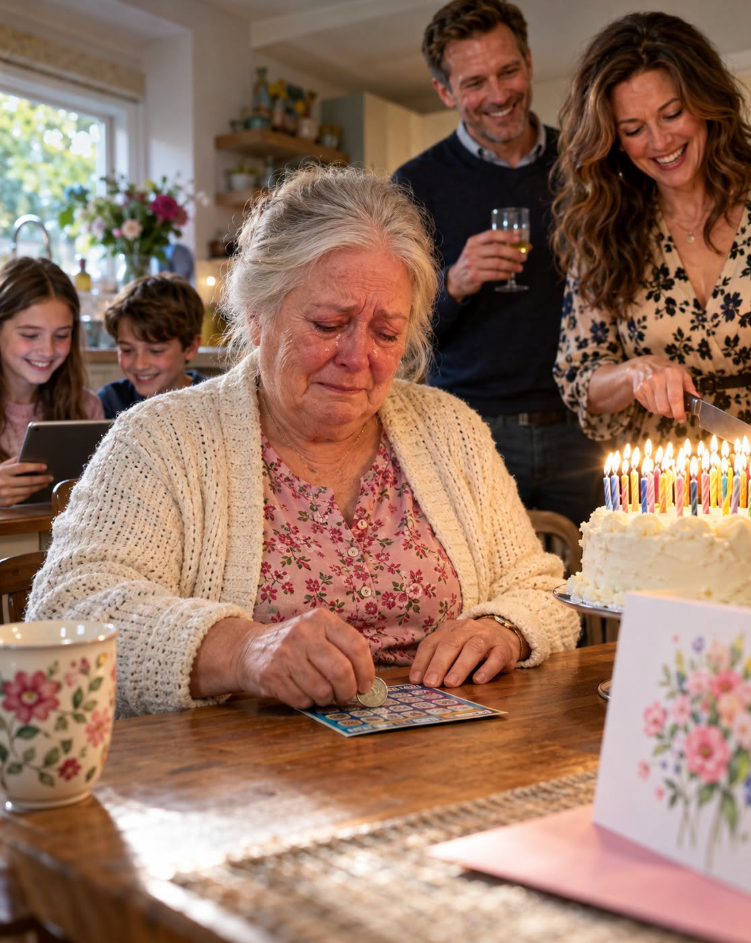
My daughter-in-law handed me a two-dollar scratch-off card for my seventy-third birthday and laughed while I scratched it. Ten months later, my own son placed a glossy brochure in front of me for a senior living facility he and his wife had already selected for me, as though my life were a piece of furniture they could simply remove from the house whenever it became inconvenient.
The scratch-off was the only gift I received that birthday. The store price tag was still stuck to the back.
Colin, my son, immediately burst into laughter. My grandchildren laughed too—mostly because their parents were laughing, not because they understood the joke.
Then I saw the symbols.
Then a second time.
My heart began pounding against my ribs.
No one noticed anything. Colin was pouring wine. Jessica continued criticizing the cake. The children remained focused on their tablets.
I carefully folded the ticket and slipped it into the pocket of my beige cardigan.
“Nothing?” Colin asked.
I smiled.
“Not even for bus fare.”
Jessica laughed again.
I thanked her for the birthday card and stood up to clear the dishes.
That night, I understood just how much a woman could conceal behind a composed face.
My name is Margaret Vance. I am seventy-three years old. I moved in with Colin and Jessica nearly four years ago, after my husband, Arthur, passed away. At first, Colin was the one who insisted.
“You shouldn’t be living alone, Mom.”
I believed him.
As the years passed, I stopped feeling like a guest and began feeling useful. I cooked because Jessica worked late at her law firm. Then I cleaned the kitchen because I had cooked. I bought groceries, folded laundry, picked up the children, and changed my plans whenever someone needed something.
Nobody ever handed me a chore list. The tasks simply appeared, one after another, until my entire life fit neatly around whatever they needed from me.
One evening, as I carried a basket of folded towels, I overheard Jessica speaking to Colin in the kitchen.
“Your mother is becoming a burden.”
There was a pause.
Then Colin sighed.
“What do you want me to do? She’s my mother.”
That hurt more than Jessica’s words.
I had spent decades caring for him. Now, caring for me sounded like a sentence.
That was why, after my birthday, I told no one what I had discovered beneath the silver coating of that ticket.
The following Monday, I went out by myself. I drove downtown and met with an attorney named Richard Sterling. I placed the ticket on his desk.
He stared at it for several seconds.
Then he looked at me.
“Does anyone else know?”
“No.”
“Then don’t say a word just yet.”
For the next few months, nothing about my routine appeared to change. I continued making dinner, clipping coupons, folding towels, and smiling whenever Jessica spoke to me like an employee who should be grateful simply for having a roof over her head.
But something inside me was different.
For the first time since Arthur died, I began making plans that did not depend on Colin.
Then, two weeks before December, my son made the decision I had been delaying for months.
During dinner, he placed his fork down on his plate.
“Mom, Jessica and I have been talking.”
Jessica gave me that same tense, familiar smile.
Colin pushed a glossy brochure across the table toward me.
*Oakridge Estates.*
On the cover, a white-haired couple was playing pickleball.
“We went to check it out,” Jessica said. “We think you’re going to love it.”
I looked up.
“You went without me?”
“We knew you’d stress over all the details,” Colin replied. “We only put down a refundable deposit.”
“When do you want me to leave?”
He looked at Jessica.
“January first.”
It was the middle of November.
Eventually, they confessed the real reason: Lucas wanted my ground-floor bedroom. He was beginning middle school and, according to them, needed his privacy.
Jessica gently patted my hand.
“You’ll be so much better off around people your own age.”
I looked at my son.
“It’s for the best, Mom,” he said.
Something inside my chest became completely still.
Then I smiled.
“I agree.”
The relief that crossed their faces was immediate.
That same night, I closed my bedroom door and called a number I already knew by heart.
“Richard,” I said when he answered. “I’m ready.”
On the night of November 30, I left a packed suitcase beside the door.
At 8:27 the next morning, the doorbell rang.
Colin came downstairs wearing his bathrobe and accepted a manila envelope delivered by certified mail.
A minute later, he entered the kitchen and tore it open with his fingers.
“A&M Property Holdings…” he muttered.
He frowned as he started reading.
Then he froze.
“What on earth is this?”
Jessica appeared at the top of the stairs.
I continued sipping my coffee.
Colin read the first page again, more slowly this time, as though the words might somehow change if he gave them another chance. The letter notified him that his month-to-month lease would end in thirty days and that the house was being placed on the market.
Jessica snatched the document from his hands. “This can’t be legal,” she said. “The property only changed hands a few months ago.”
Then Colin pulled a second sheet of paper from the envelope. It was a letter in my own handwriting.
The color disappeared from his face. Jessica looked at me first, then back at the paper. Richard had purchased the property in my name through the holding company I had established months earlier, shortly after the previous landlord decided to sell. Colin had been paying rent to an entity that ultimately belonged to me.
“For now, yes,” I replied. “And I no longer wish to be your landlord—or your burden.”
Jessica dropped the envelope onto the kitchen island. “You did all of this behind our backs?” she demanded, her voice rising.
“Yes,” I said calmly. “Just like the two of you toured a retirement facility, picked out a room, and set the exact date I was supposed to vanish from here.”
Colin tried to speak. “It wasn’t like that—”
“It was exactly like that,” I answered. “You just had the courtesy to give me a few weeks’ notice.”
He lowered his eyes.
I reached into my handbag and took out a small clear protective sleeve. Inside was the scratch-off ticket from my birthday, fully validated and officially processed.
Jessica recognized it immediately. “That’s impossible.”
“It’s very possible,” I said.
I told them that the two-dollar scratch-off had won eleven million dollars before taxes and the lump-sum adjustment. I didn’t receive the entire advertised jackpot amount, but it was more than enough to secure my retirement, purchase a home of my own, and establish protected educational trusts for the children.
Colin’s head snapped up. “The kids have money?”
“Their education is taken care of,” I replied. “Neither of you can touch a single cent of it.”
It was the first time I had ever seen Jessica completely speechless.
Colin looked more wounded than angry. “Why didn’t you tell me?” he asked softly.
“Because I heard your wife say I was becoming a burden, and I heard you reply, *‘What do you want me to do? She’s my mother.’* You didn’t say you wanted me here. You said you didn’t know what to do with me.”
The silence that followed was so heavy that the hum of the refrigerator could be heard. Colin lowered himself into a chair, buried his face in his hands, and whispered, “Mom, I… I had no idea you heard that.”
“You didn’t have to know for it to hurt.”
Jessica attempted to take control of the situation again. “So this is revenge? You’re kicking us out on the street over a conversation?”
“No,” I answered. “This is a separation of accounts. You have thirty days according to the lease terms. Your security deposit will be refunded in full, and the property will be sold. I don’t want my money, my peace of mind, or my relationship with my son tied to this house. Besides, you two were already making plans for my room on January first. Now every adult in this house simply has to take responsibility for their own plans.”
At 9:05 AM, I went upstairs to retrieve my suitcase. Colin followed me into the hallway. When he saw it was already packed, he understood this wasn’t an impulsive threat.
“Where are you going?” he asked.
“To my house. I bought a little yellow craftsman home near your Aunt Helen—it has a porch and a kitchen that gets the morning sun.”
“Since when?”
“Since June.”
He looked at me as though he were suddenly discovering that I had been living a secret double life beneath his roof. The truth was, I had simply reclaimed a life I had stopped sharing with him because he had stopped asking about it.
Before I stepped through the door, Jessica appeared with glossy eyes and her arms folded across her chest. “This is going to destroy our family.”
“No,” I told her. “What destroys a family is treating someone like a domestic service when it’s convenient and an obstacle when they no longer fit your plans. I’m not keeping your children from you, nor am I leaving you homeless today. I am simply handing the responsibility of your own household back to you, just as you wanted to hand the responsibility of mine back to me.”
Colin opened his mouth, but nothing came out.
The taxi arrived at 9:15 AM. Colin carried my suitcase down the walkway without me asking. Before he closed the trunk, he wrapped his arms around me. At first, it was an awkward, almost childish embrace.
“I’m sorry,” he whispered into my shoulder. “I don’t know at what point I stopped seeing you as my mother and started seeing you as someone who was just always there to fix everything for us.”
“Neither do I,” I replied softly. “But at least we both see it now.”
I drove away without yelling, without breaking anything, and without turning around to look through the window.
Months later, Colin and Jessica found another house, and the property was sold. Our relationship never completely returned to what it had once been, but it didn’t vanish either. Colin started calling me without asking for favors—sometimes simply to ask how my day was. The children visited my yellow house during school breaks, and they knew their grandfather Arthur was still present in the name of A&M and in the trusts that would one day open doors for them.
The scratch-off ticket remained framed in a box beside a photograph of Arthur. Not because the money had changed who I was, but because it reminded me of something I had nearly forgotten: I was still entitled to decide how I wanted to live my own life.
PART 3
The first few weeks in my new yellow craftsman house felt almost strangely quiet. For four years, my mornings had been ruled by the harsh beep of Jessica’s coffee maker at 5:30 AM, the frantic rush of preparing school lunches, and the constant hum of everyone else’s demands.
Now, the only sounds were the gentle rustling of wind through the oak trees in my front yard and the whistle of my own tea kettle.
“You look ten years younger, Margaret,” Helen said one afternoon, handing me a freshly baked blueberry muffin. “Your face doesn’t look so tired anymore.”
Meanwhile, across town, Colin and Jessica were being forced to confront the reality of their own lives.
It didn’t take long for the cracks in their polished lifestyle to become visible.
Three weeks after I moved out, Colin called me on a Tuesday evening.
“Mom?” His voice sounded strained, weighed down by exhaustion. “Do you… do you have a minute?”
“I always have time for you, Colin,” I said calmly.
There was a long silence on the other end before he spoke again. “We signed a lease on a townhouse today. It’s smaller, but it’s close to the kids’ school. We start moving this weekend.”
“That sounds like a sensible choice, Colin.”
“Mom…” He hesitated, his voice cracking slightly. “Jessica and I had a huge fight last night. She was complaining about having to order takeout every night because neither of us had time to cook, and… I just lost it.”
I remained silent, allowing him to continue.
“I looked at her and said, ‘My mother did this every single day for four years while we barely said thank you, and you called her a burden.’ She didn’t have anything to say to that.” Colin took a shaky breath. “I’m so sorry, Mom. I was so blind. I let her make you feel small in your own family, and I went right along with it because it was easier than standing up to her.”
Tears stung the corners of my eyes, but I kept my voice steady. “Thank you for saying that, Colin. It takes courage to admit when you’ve lost your way.”
“Can… can I come visit you this weekend?” he asked, sounding like the little boy who used to bring me bruised dandelions from the yard. “Just me and the kids?”
“The porch is always open,” I told him.
FINAL PART
Spring arrived in Austin with a sudden burst of bluebonnets and warm, golden sunshine. My yellow house was completely settled—the kitchen smelled of cinnamon and fresh coffee, and Arthur’s old oak desk stood proudly in the sunroom overlooking the garden.
On Saturday afternoon, Colin’s car pulled into the driveway. Lucas and my granddaughter, Chloe, rushed out of the doors and ran across the lawn, wrapping their arms around my waist.
“Grandma! Your house is awesome!” Lucas shouted as he ran inside to inspect his favorite guest room. “And it smells like cookies!”
Colin walked up the porch steps carrying a small wooden crate. He looked thinner, but the heavy, distracted tension that had once seemed permanently fixed to his shoulders had eased.
“These are for your garden,” Colin said, placing the crate down. Inside were fresh tomato plants and lavender—Arthur’s favorites.
“Thank you, son,” I said, giving him a warm, firm hug.
We spent the afternoon planting the garden together. The children ran around the yard with Helen’s dog, their laughter filling the clear spring air. Jessica hadn’t come—she and I had settled into an unspoken, polite distance—and honestly, it was better that way. Respect didn’t mean pretending the past had never happened; it meant creating boundaries where everyone could breathe.
Later that evening, after the children had settled in the living room to watch a movie, Colin sat beside me on the porch. He watched the sunset spread across the sky in shades of violet and gold.
“The educational trusts came through in the mail last week, Mom,” Colin said quietly. “The attorney sent over the paperwork. Lucas and Chloe are completely covered for college. Every dime.”
“Good,” I said, taking a sip of my tea. “Arthur and I always wanted to make sure they had a strong foundation.”
Colin looked down at his hands before turning toward me. “You know… when Jessica bought you that two-dollar scratch-off, she thought it was a joke. She thought she was giving you a worthless piece of paper.”
I gave a soft, gentle laugh. “It was a joke to her, Colin. But life has a strange way of flipping the script.”
I reached into my pocket, took out my small key ring, and held it in my palm. A tiny metal charm shaped like a ticket was attached to it.
“That ticket didn’t give me my value, Colin,” I told him, meeting his eyes. “It just gave me the freedom to walk away from people who had forgotten what I was worth.”
Colin slowly nodded, his eyes shining with deep respect and quiet understanding. He leaned toward me and kissed my cheek. “I’ll never forget again, Mom.”
As the stars began twinkling above the quiet street, I leaned back in my rocking chair, listening to the joyful sounds of my grandchildren playing inside my warm, bright house.
I was seventy-three years old. I was independent, I was loved, and for the first time in a very long time, I was completely, undeniably free.