The room went quiet before I understood how much the sentence had hurt me.
It was not a dramatic quiet.
No one gasped.
No one dropped a glass.
No one stood up and said my father had gone too far.
It was the kind of quiet that settles when everyone in a room knows something cruel has happened and immediately calculates whether reacting will cost them anything.
We were sitting in the private dining room at The Waverly Room, a restaurant my mother had been talking about for three months.
She loved saying the name.
The Waverly Room.
She said it to neighbors, to ladies at church, to the woman who cut her hair, to the grocery store cashier who made the mistake of asking whether she had plans for the weekend.
It was their fortieth wedding anniversary, and she wanted the kind of night that looked expensive from across the room.
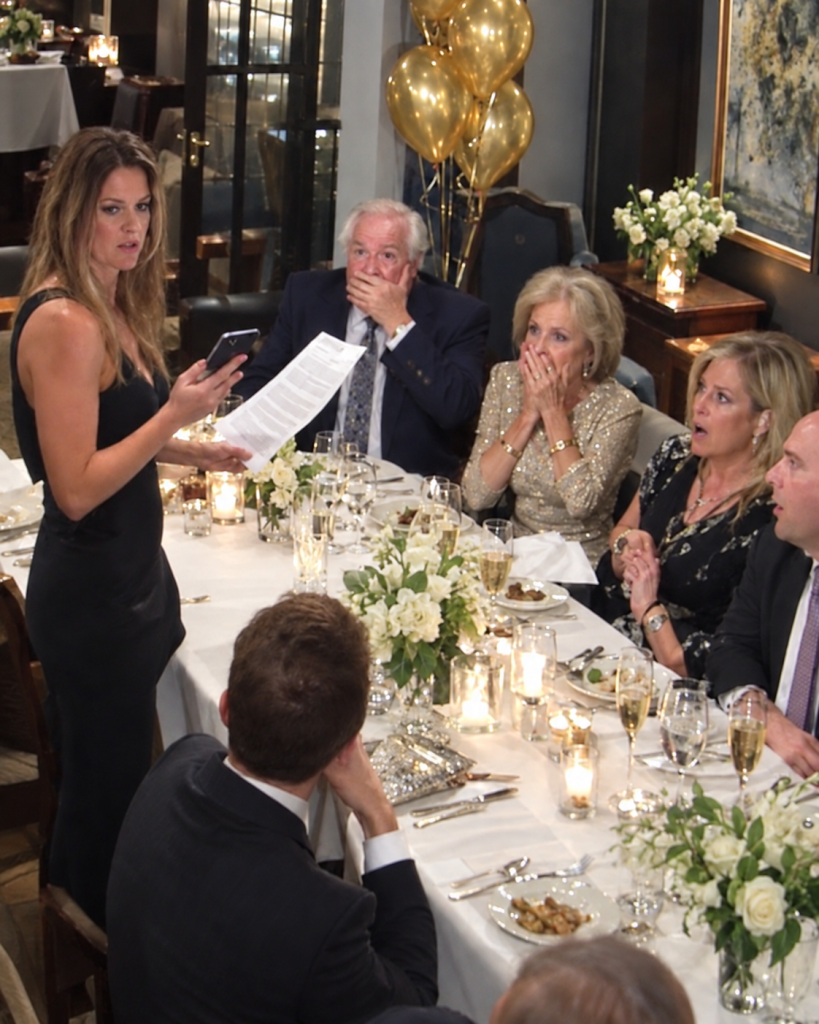
Golden balloons floated above the long table.
White linen fell in clean folds over the sides.
Crystal glasses caught the candlelight every time someone moved.
The air smelled like butter, charred steak, perfume, and chilled champagne.
My mother sat at the head of the table in an ivory dress, smiling as if she had personally invented marriage.
My father sat beside her in a dark suit he only wore for funerals, weddings, and nights when he wanted to look like a man who had never needed help from anyone.
My brother Cameron was there with his wife.
My younger sister Madison sat two seats down from me, taking pictures of the centerpiece and herself beside it.
Several cousins filled out the rest of the table, laughing too loudly and drinking too quickly because my parents had announced that everything was covered.
I was the one who had covered it.
No one knew that yet.
At least, no one at that table knew it in any way that mattered.
They knew I was useful.
That had always been the word they never said.
Useful.
I picked children up from school.
I drove people to appointments.
I sent money when emergencies happened.
I called insurance companies.
I found plumbers.
I filled out forms.
I showed up with soup, diapers, cash, and extra patience.
When my nephews were sick, they called me.
When Madison’s card got declined at the mechanic, she called me.
When Cameron and his wife forgot a teacher conference, they called me.
And when my father’s construction company nearly collapsed three years earlier, I was the one who quietly kept it alive.
He never knew how.
That was partly my fault.
I had built a life around privacy.
After college, I wrote logistics software that started as a late-night project and became the kind of thing people with real money wanted to buy.
When I sold it, I did not buy a sports car or move into a glass house with a view.
I started Apex Ventures, a private investment firm, and learned quickly that people treated money like a mirror.
They smiled at whoever held it.
They forgave whoever controlled it.
They listened harder when they thought a check might follow.
So I stayed quiet.
I kept my apartment simple.
I drove an ordinary SUV.
I wore jeans to school pickup lines and kept my name off glossy event pages whenever I could.
I told myself I valued privacy.
That was true.
But another part of me wanted to know what my family would do if they thought I had nothing to offer except myself.
The answer had been arriving for years, one favor at a time.
I just refused to read it.
That night, my father made sure I could not ignore it anymore.
He tapped his spoon against his crystal glass.
The little ringing sound floated over the table, clean and bright.
Everyone turned toward him.
My mother tilted her head toward him like she already knew the announcement and wanted credit for enjoying it.
Dad smiled.
“We are all going to the Bahamas next week for another family celebration,” he said.
The room erupted.
Cameron kissed his wife on the cheek.
Madison squealed loud enough that the waiter paused at the doorway.
One cousin raised both hands like he had won a prize.
My mother laughed softly and looked around the table, collecting their excitement like flowers.
I smiled too.
For one small, stupid second, I thought the word all included me.
I should have known better.
“What time does the flight leave?” I asked.
My father’s eyes came to me with no hesitation.
That was what made it worse.
Not the words alone.
The comfort.
The certainty.
The way he said it like he was reminding me of something obvious.
“You wouldn’t know because you’re not part of us,” he said.
A few people laughed.
He lifted his glass slightly, as if turning cruelty into a toast.
“You can stay behind and watch all the kids.”
There are sentences that do not sound loud when they enter the room.
They do not have to.
They land in the place where you have been making excuses for people, and suddenly all the excuses go quiet.
Madison leaned back in her chair.
“Come on, Harper,” she said. “You don’t even like the beach.”
“I don’t mind the beach,” I replied. “I mind being treated like free childcare.”
My mother moved then.
Not sharply.
Not dramatically.
She simply reached beside her plate, picked up a folded sheet of paper, and slid it across the table toward me.
“Don’t make a scene tonight,” she said.
The paper stopped beside my bread plate.
I looked down.
Eight names were printed in a neat column.
My nieces and nephews.
Ages four through twelve.
Under each name were notes.
Food allergies.
Bedtimes.
School schedules.
Soccer practice.
Medication instructions.
A reminder that one nephew needed his inhaler before running.
Another note said one little girl got scared if the hallway light was off.
Beside my youngest nephew’s name, my mother had written, prefers grilled cheese cut diagonally.
That was the detail that almost broke me.
Not because it was cruel by itself.
Because it proved how long she had been planning.
This was not a misunderstanding.
This was not a last-minute assumption.
They had built a vacation around my absence and assigned me the leftovers.
I lifted the sheet slowly.
The table froze around me.
Forks paused above plates.
Champagne glasses hovered near mouths.
Madison’s phone was still raised, catching the golden balloons, the centerpiece, maybe the corner of my face.
One cousin stared at the butter dish.
Another looked down at his lap.
Cameron cleared his throat but did not speak.
Nobody moved.
I read the list twice.
Eight children.
Four households.
One week.
No question mark anywhere on the page.
That was when the last fifteen years lined up behind me.
The urgent calls.
The favors dressed up as emergencies.
The birthdays I planned because someone else forgot.
The school pickups that became routines.
The bills I paid and pretended not to remember.
The apologies I offered just to keep peace with people who never considered peace their job.
Three years earlier, my father had sat across from me at my kitchen table with both hands wrapped around a paper coffee cup.
He looked smaller than I had ever seen him.
His construction company was bleeding money.
A supplier had pulled credit.
A bank had delayed a decision.
Payroll was coming due.
He never asked me for money directly.
He only said, “I don’t know how a man comes back from this.”
I knew what that meant.
The next morning, at 8:12 a.m., I called my operations director at Apex Ventures.
By 4:18 p.m. that Friday, my father’s company had a rescue loan approved through a private investment structure clean enough that he would never connect it to me unless he bothered to look past the first page.
He signed the documents and told everyone he had worked something out.
He said it with pride.
I let him.
I told myself dignity mattered more than credit.
Maybe it did.
But dignity and silence are not the same thing.
Silence can become permission when the wrong people benefit from it.
My father lifted his champagne glass again.
“Family takes care of family,” he said.
That was the line he always used.
When Cameron needed money.
When Madison needed a ride.
When Mom needed help setting up a party.
When Dad needed paperwork handled.
Family takes care of family.
It sounded noble only because I was the one doing the taking care.
I folded the childcare list once.
The crease ran through the printed names.
I folded it again.
The paper made a small, dry sound against the linen.
My mother watched my hands.
For a second, her expression softened into relief.
She thought I was surrendering.
She had seen me do it too many times not to expect it.
“You’re absolutely right,” I said.
Her shoulders lowered.
Cameron leaned back.
Madison gave a tiny little laugh through her nose.
I placed the folded paper beside my mother’s champagne glass.
“In that case,” I said calmly, “I’m canceling the Bahamas trip.”
The sentence sat there between the candles.
No one laughed that time.
Cameron frowned first.
“You can’t cancel our vacation.”
I looked at my father.
“Yes,” I said. “I can.”
His glass lowered slowly until the base touched the table.
There was no clink.
Just a soft meeting of crystal and linen.
“What are you talking about?” he asked.
I opened my purse.
My hand was steady in a way I did not feel.
Inside, beneath my wallet and keys, my phone held every confirmation.
Flights.
Resort deposit.
Private dining extension.
Transportation.
The anniversary dinner.
Apex Ventures had paid every charge at 9:06 that morning because my mother had sent the invoice to an account she thought belonged to my “office friend.”
She had no idea the office friend was my assistant.
She had no idea the assistant had forwarded it to me with a single note.
Are you sure you want to cover the entire family itinerary again?
Again.
That word had stared at me from the screen for almost a full minute.
I should have stopped then.
Instead, I paid it because some part of me still wanted the night to go well.
Some part of me still wanted to be wrong about them.
Now I turned the confirmation file toward the table.
My mother’s eyes dropped to the screen.
Apex Ventures.
Paid.
Bahamas family package.
The color drained from her face in layers.
Dad stared at the phone like it had insulted him.
“Where did you get that?” he asked.
“From my company.”
Madison blinked.
“Your company?”
I did not answer her first.
I looked at Dad.
“Apex Ventures is mine.”
The words were quiet.
They still changed the room.
Cameron’s wife whispered his name.
A cousin put his glass down too hard.
The waiter at the doorway took one careful step back.
My father looked from me to the phone and back again.
“That’s not possible.”
“It is.”
“You handle paperwork.”
I almost laughed.
It would have been ugly if I had.
“I handle a lot of things,” I said.
My mother reached for the folded childcare list, then stopped as if the paper had become hot.
I saw the moment she understood that the dinner, the trip, and the private celebration were all tied to the daughter she had just excluded.
I saw Cameron understand something else too.
The emergency checks.
The loan.
The quiet rescues.
The way money appeared when pride needed saving.
Madison’s face had gone still.
Her phone lay faceup beside her plate now.
The red recording dot blinked on the screen.
7:42.
She had started filming when Dad stood to make his toast.
She had caught the announcement.
She had caught his sentence.
You are not part of us.
She had caught my mother’s list sliding across the table.
My father saw the phone at the same time I did.
“Turn that off,” he snapped.
Madison flinched.
She had always been the baby of the family, even at twenty-eight.
People forgave her quickly.
People cleaned up after her even faster.
That had often meant me.
“I didn’t mean to record that part,” she whispered.
“Turn it off,” Dad said again.
I reached across the table and gently turned the phone a few inches so the screen faced up more clearly.
“No,” I said. “Leave it.”
My mother’s eyes flashed.
“Harper, stop this.”
“Stop what?”
“Punishing us.”
That was when I felt the first real anger of the night.
Not hot.
Not wild.
Clean.
“You told me I was not part of this family,” I said. “You handed me a printed childcare schedule for eight children and told me to make myself useful. Now you’re upset because I believed you.”
Cameron rubbed both hands over his face.
“This is insane. Can we just talk about it?”
“We are talking about it.”
“Not here.”
“Here is where it happened.”
The waiter appeared fully in the doorway then, looking like he would rather be anywhere else.
He held a small black folder in one hand.
“Ma’am,” he said carefully, eyes on me, “the manager asked me to confirm whether Apex Ventures would still like the private anniversary charge processed tonight.”
The room turned toward me.
That was the second time all night I heard ice shift in a glass.
I looked at my mother.
Then at my father.
Then at the folded childcare list between the candle and her champagne glass.
For years, I had mistaken endurance for love.
I had thought being the one who stayed useful meant I was being loyal.
But loyalty without respect is just labor with prettier lighting.
“No,” I said to the waiter. “Please bring me the itemized bill. Only my meal stays on my card.”
My mother made a small sound.
Not a sob.
Not quite a gasp.
A sound of someone watching a door close.
The waiter nodded and left quickly.
Dad leaned forward.
“You will not humiliate your mother on our anniversary.”
“I didn’t humiliate her. I returned her list.”
His jaw tightened.
“After everything we’ve done for you—”
“Name it.”
The words came out before I planned them.
He stopped.
I leaned back slightly.
“Name what you’ve done for me that did not come with a job attached.”
No one spoke.
The candle closest to Madison flickered.
Cameron’s wife looked down at her lap.
My mother stared at me with wet eyes, but even then I could tell she was not grieving what she had done.
She was grieving that it had consequences.
The manager returned with the bill and a printed payment adjustment form.
Behind him came a second folder.
My assistant had emailed the resort cancellation authorization directly to the restaurant office because she knew I was attending the dinner.
She always thought three steps ahead.
That was why I paid her better than most executives paid themselves.
The manager placed both folders beside me.
Dad’s eyes locked on the top page.
Bahamas Family Package.
Cancellation Authorization.
Primary Account Holder: Harper Lane.
My mother whispered, “Harper, please.”
It was the first please I had heard all night.
That should have mattered.
Maybe, years earlier, it would have.
But there are some words people only learn when power moves across the table.
I picked up the pen.
The whole room watched my hand.
“You don’t have to do this,” Cameron said.
“I know.”
That was the point.
I signed the restaurant adjustment first.
Only my meal remained on my card.
The anniversary dinner my mother had paraded around town was now divided by household, just like any other bill.
Cameron stared at his portion.
Madison looked like she might cry.
A cousin began quietly checking his banking app.
Then I opened the second folder.
The cancellation form was simple.
Trip name.
Dates.
Authorized signature.
I paused before signing it.
Not because I was uncertain.
Because I wanted one of them to say the right thing before the pen touched paper.
Not ask for the trip.
Not defend the list.
Not tell me I was overreacting.
Just one sentence.
We hurt you.
We were wrong.
You are family even when you are not useful.
No one said it.
My father said, “Think about the children.”
There it was.
The last door.
The final proof.
Even in that moment, he reached for the softest weapon.
I loved those kids.
They were not responsible for their parents’ entitlement.
I had tied shoes, packed snacks, braided hair, checked homework, and sat through school concerts where the microphones squealed and the folding chairs hurt my back.
I loved them enough not to teach them that women in families exist to absorb everyone else’s convenience.
“I am thinking about them,” I said.
Then I signed.
The manager took the folder gently, as if it were evidence.
In a way, it was.
My mother covered her mouth.
Madison finally stopped the recording.
Cameron pushed back from the table and walked out into the hallway, where I could see him through the glass panel, one hand braced against the wall.
My father did not move.
He looked smaller than he had when his company was failing.
That surprised me.
The company had only threatened his money.
This threatened the story he told about himself.
“So that’s it?” he asked.
“No,” I said.
He looked up.
I reached back into my purse and pulled out one more envelope.
This one had nothing to do with the Bahamas.
It held a copy of the Apex Ventures loan file for his construction company.
Not the whole thing.
Just the parts he should have read three years ago.
The date.
The approval line.
The guarantor disclosure.
My name.
I slid it across the table.
He did not touch it.
“Open it,” I said.
His hand hovered for several seconds before he picked it up.
My mother watched him tear the flap.
His eyes moved over the first page.
Then the second.
Then he stopped breathing like a man who had reached the edge of something and found no floor.
“You?” he whispered.
I nodded.
“I saved your company.”
The room was silent again, but this silence was different.
The first silence had protected him.
This one exposed him.
Madison started crying then.
Quietly at first.
Then with one hand over her mouth.
“I didn’t know,” she said.
I believed her.
That did not make her innocent.
Ignorance is easy to maintain when someone else keeps paying the price of it.
Cameron came back from the hallway and saw the loan file in Dad’s hands.
“What is that?”
Dad did not answer.
He kept staring at my name.
I stood.
My chair legs scraped softly against the floor.
Every face turned toward me.
I placed my napkin on the table.
My meal had not even arrived yet.
That seemed fitting.
I had been invited to the table, but never really fed by it.
“The children will be fine,” I said. “Their parents can take care of them. Or stay home. Or hire someone. Those are choices adults make.”
My mother lowered her hand from her mouth.
“Harper, we didn’t mean it like that.”
“You printed it.”
That ended the argument.
Some things cannot be softened once they have been put on paper.
I picked up my purse.
The manager waited near the doorway with the careful posture of someone pretending not to witness a family breaking open.
I thanked him.
Then I walked out of The Waverly Room alone.
Outside, the evening air was cooler than I expected.
My SUV was parked near the side entrance.
A small American flag hung beside the restaurant doorway, stirring slightly in the breeze.
For some reason, that tiny ordinary movement almost made me cry.
Not inside.
Not at the table.
Not while they watched.
But there, under the porch light, with the noise of traffic beyond the parking lot and my phone buzzing in my hand, I finally had to stand still for a moment.
The first message was from Madison.
I’m sorry.
The second came immediately after.
I really didn’t know about the loan.
Then Cameron.
Can we talk tomorrow?
Then my mother.
No apology.
Just this:
You ruined our anniversary.
I looked at the message for a long time.
Then I typed back one sentence.
No, Mom. I stopped paying for the version of it where I didn’t matter.
I muted the thread after that.
The next morning, I woke up before sunrise.
For the first time in years, there were no emergency messages I felt responsible for answering.
No one asking for a ride.
No one needing a check.
No one telling me family takes care of family when what they meant was Harper takes care of everyone.
I made coffee in my own kitchen.
I sat at my small table.
I opened the document folder on my laptop and reviewed every automatic payment connected to my relatives.
School extras.
Sports fees.
Small subscriptions.
Emergency cards.
A utility bill Cameron had sworn he would take back over six months earlier.
I did not cancel anything that would hurt the children immediately.
I did document everything.
I made a spreadsheet.
I noted dates.
I sent each adult a clean email with what I had been covering, when my support would end, and what they needed to transfer into their own names.
No insults.
No speeches.
No threats.
Just facts.
Facts are powerful because they do not beg to be believed.
By noon, Cameron called.
I let it go to voicemail.
By 1:30, Madison sent another message.
She apologized properly that time.
Not perfectly.
But properly.
She said she had watched the recording twice and hated how normal everyone looked while Dad said I was not part of them.
That line stayed with me.
How normal everyone looked.
That was the part people outside a family never understand.
Cruelty does not always arrive screaming.
Sometimes it sits at a decorated table, wearing a good suit, with champagne in its hand.
My father did not contact me for three days.
When he finally did, he left a voicemail that began with anger and collapsed into something close to confusion.
He said I had blindsided him.
He said I should have told him about Apex.
He said a daughter should not keep secrets like that.
He did not say thank you for saving my company.
He did not say sorry for excluding you.
He did not say I was wrong.
So I did not call back.
A week later, my mother invited me to lunch.
I almost said no.
Then I decided I could sit across from her in public once without becoming the daughter who folded first.
We met at a diner halfway between our houses.
Not The Waverly Room.
No balloons.
No champagne.
Just vinyl booths, coffee in thick mugs, and a waitress who called everyone honey without making it sound fake.
My mother looked tired.
For the first time in a long time, she had not dressed like she was preparing to be admired.
She stirred her coffee for almost a full minute.
“Your father is embarrassed,” she said.
“He should be.”
Her mouth tightened.
Then she surprised me.
“I am too.”
I waited.
She looked down at her cup.
“I told myself you liked being needed.”
That sentence hurt because there was a little truth in it.
I had liked being trusted.
I had liked being the safe place.
I had liked hearing small voices yell Aunt Harper from school sidewalks and backyards.
But being needed and being used can wear the same coat until someone checks the pockets.
“I liked being loved,” I said. “I confused the two.”
My mother cried then.
Quietly.
I did not reach across the table right away.
That was new for me.
I let her feel it.
Not because I wanted revenge.
Because I had spent too many years rescuing people from the first consequence of their own behavior.
Finally, she said, “I should not have made that list.”
“No.”
“And your father should not have said what he said.”
“No.”
She nodded.
It was not enough to fix everything.
But it was the first honest brick in a wall that had always been painted to look solid.
I told her the truth about Apex.
Not all of it.
Enough.
I told her I had money, but my money was not a family utility.
I told her I loved the kids, but I would not be assigned to them like staff.
I told her any help from me going forward would be asked for, not assumed.
And I told her Dad would need to apologize without defending himself if he wanted a relationship with me.
She listened.
For once, she did not interrupt.
My father took longer.
Men like him often do.
Pride had been holding him upright for so many years that he did not know how to set it down without falling.
Two weeks after the anniversary dinner, he came to my apartment.
He stood outside my door with a grocery bag in one hand and the Apex loan copy in the other.
I almost did not open it.
But I did.
He looked older in the hallway light.
“Your mother said I need to apologize,” he said.
“Do you agree with her?”
He swallowed.
That one took effort.
“Yes.”
I leaned against the doorframe.
He looked down at the paper in his hand.
“I read it,” he said. “All of it this time.”
I said nothing.
“You saved my company.”
“I did.”
His eyes lifted.
They were wet, though he was trying hard to make them seem otherwise.
“And I made you feel like you didn’t belong at my table.”
That was the first sentence that mattered.
Not because it erased anything.
Because it named the thing correctly.
I let out a breath I had been holding for fifteen years.
“Yes,” I said.
He nodded once.
“I’m sorry, Harper.”
No but.
No excuse.
No mention of stress, money, age, misunderstanding, or tradition.
Just sorry.
I did not hug him right away.
He did not demand it.
That mattered too.
The Bahamas trip never happened.
Some relatives complained for a while.
A few stopped calling when they realized my boundaries were not temporary weather.
Cameron and his wife learned how expensive childcare actually was.
Madison became the first person in the family to ask before assuming.
She also sent me the recording from the anniversary dinner.
I have never watched it all the way through.
I do not need to.
I remember the important part.
I remember the way everyone laughed.
I remember the paper sliding across the table.
I remember folding it once, then again.
I remember my mother’s smile disappearing when she realized the daughter she had treated like free labor was the one paying for the room.
And I remember walking out without raising my voice.
For years, I thought love meant staying useful enough that no one could leave me out.
Now I know better.
Love does not require you to earn a chair at the table by serving everyone seated around it.
Sometimes the most loving thing you can do for yourself is stand up, leave the list behind, and stop paying for a family that only remembers you when something needs to be handled.