The officer held the frozen security image between us while the ambulance doors remained open behind him.
A woman’s hand filled the screen.
Emerald ring.
Pearl bracelet.
Rachel stared at it through the clear oxygen mask covering her mouth and nose.
Her face, already drained by dehydration and heat, seemed to lose what little color remained.
“That’s her,” she whispered.
The officer looked from Rachel to me.
“Who?”
Rachel swallowed painfully.
“Helen.
Tyler’s mother.”
For several seconds, I could hear nothing except the ambulance engine and Lily’s faint cry from inside another emergency vehicle.
Helen Mercer had held my granddaughter at her christening luncheon and called her “our little miracle.” She had brought casseroles after the birth.
She had sat beside Rachel on the sofa and told visitors how worried the family was about Rachel’s emotional state.
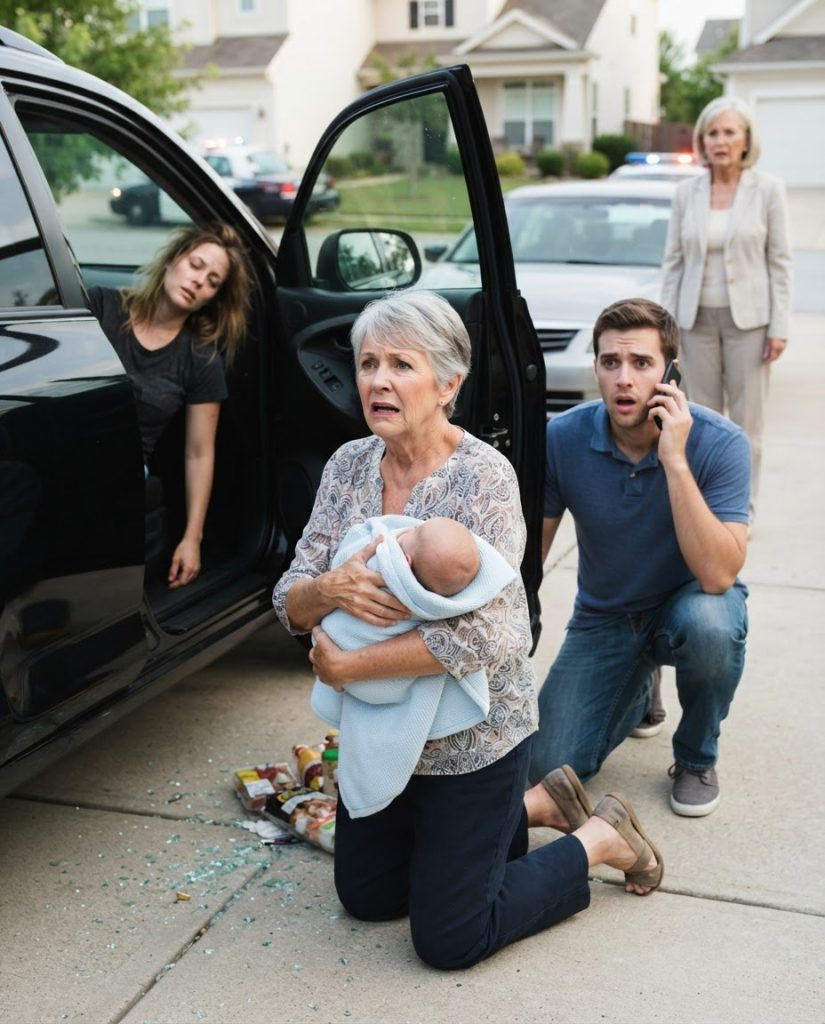
Now a camera appeared to show that same woman taking Rachel’s keys and locking her inside a car with a newborn on one of the hottest afternoons of the summer.
The officer replayed the footage from the beginning.
Rachel’s car entered my driveway at 2:41 p.m.
She got out with Lily’s diaper bag over one shoulder.
A silver SUV stopped behind her less than thirty seconds later.
Helen stepped out.
This time, once we knew who we were looking at, the shape of her body and the way she moved were unmistakable.
Rachel remembered more as she watched.
“She said Tyler wanted Lily,” Rachel murmured.
“She said I was making things difficult.”
The paramedic told her not to strain herself, but Rachel shook her head.
“I need them to know.”
The officer began recording her statement.
Rachel explained that she had discovered Tyler was having an affair two weeks earlier.
She had seen messages on a shared tablet between Tyler and a woman named Camille, someone from his office.
The messages were not merely romantic.
They discussed apartments, lawyers, and what Tyler called “the custody problem.”
Rachel had quietly taken photographs of the messages because Tyler had spent months building a different story around her.
After Lily’s birth, he told family members Rachel was forgetful.
If she misplaced a bottle, he mentioned it at dinner.
If she cried from exhaustion, he called his mother.
If she asked him to take a night feeding, he sighed and later told friends she was “not coping.”
Rachel had initially blamed herself.
Then she noticed the pattern.
Tyler wasn’t helping her recover.
He was collecting examples.
Three days before I found her in the car, Rachel overheard Tyler speaking to Helen in his home office.
“If she looks unstable, everything gets easier,” he had said.
Rachel froze outside the door.
Helen answered too quietly for her to hear the full sentence, but Rachel caught four words.
“Leave it to me.”
That was when Rachel decided to come to my house.
She packed a small bag for herself and Lily, photographed several documents from Tyler’s office, and waited until he left for work.
But Tyler apparently realized what she was doing.
Or Helen did.
The security footage showed Helen arriving immediately after Rachel.
Rachel told the officer what happened beside the car.
Helen demanded that she return home.
Rachel refused.
Then Tyler’s black sedan appeared at the end of the street.
He was not at work.
Camille sat in his passenger seat.
“That’s what I was trying to tell Mom,” Rachel said.
“My husband and his mistress.
They drove past together.”
She had run toward the sidewalk, shouting Tyler’s name.
Behind her, Helen picked up the keys Rachel had dropped.
When Rachel returned to the car, Helen changed tactics.
“She said Lily looked sick,” Rachel recalled.
“She told me to check her breathing.”
Rachel climbed into the driver’s seat and twisted around toward the baby.
Helen shut the door.
Then she reached through the still-open window, pressed the central lock, raised the glass, and took the keys.
Rachel thought Helen was trying to frighten her.
She shouted through the window.
Helen simply walked back to her SUV.
“I kept thinking she’d turn around,” Rachel said.
“She didn’t.”
The paramedic interrupted.
Rachel’s heart rate was climbing again, and the ambulance needed to leave.
Before the doors closed, Rachel caught my hand.
“Mom.
Tyler’s office.
There’s a blue folder in the bottom drawer.
I photographed it, but the originals are there.”
“What’s in it?”
Her eyes filled with tears.
“Plans.
About me.”
Then the doors shut.
I followed the ambulance to the hospital while police units went in two directions: one toward Helen’s address and another toward the home Rachel shared with Tyler.
At the emergency department, Lily was taken immediately for evaluation.
Doctors treated both her and Rachel for dangerous heat exposure and dehydration.
Lily needed fluids and close monitoring, but within hours her temperature stabilized.
Rachel remained weak and nauseated, though alert.
I sat between their rooms feeling as if the world had tilted.
Tyler arrived just after six.
He came running through the emergency entrance with his shirt untucked and panic arranged perfectly across his face.
“Where are they?”
A nurse stopped him.
“Sir, who are you?”
“I’m Rachel’s husband.
That’s my daughter.”
Then he saw me.
His expression changed for half a second.
Not grief.
Calculation.
“Diane,” he said.
“What happened?”
I stood.
“You tell me.”
He blinked.
“What does that mean?”
“It means I saw the video.”
His face tightened.
“What video?”
I watched him carefully.
If he had truly known nothing, I expected confusion.
Instead, his first question was, “Did Rachel say something?”
That was enough to make the officer standing near the nurses’ station step closer.
Tyler noticed him and immediately softened his voice.
“My wife has been under enormous stress since the baby was born.
She gets confused.
I don’t want anyone misunderstanding something she says while she’s sick.”
There it was again.
The same story.
Unstable Rachel.
Confused Rachel.
Emotional Rachel.
Only this time, a camera had been watching.
The officer asked Tyler to accompany him to a private room.
Tyler resisted at first.
“I need to see my daughter.”
“You’ll have an opportunity to speak with medical staff,” the officer replied.
“First, we need to clarify your whereabouts this afternoon.”
Tyler’s jaw flexed.
“I was working.”
I almost laughed.
The officer didn’t.
“Your vehicle appears on residential security footage at approximately 2:43 p.m.”
Tyler stopped moving.
“Then I must have been coming back from lunch.”
“With Camille Reeves in your passenger seat?”
The silence that followed was extraordinary.
Tyler looked at me as though I had betrayed him by surviving his explanation before he could give it.
“This is a family matter,” he said.
The officer opened the interview-room door.
“Not anymore.”
An hour later, another detective came to speak with Rachel and me.
Police had located Helen.
She initially denied being at my house.
When told there was video, she changed her story.
She claimed Rachel had locked herself in the vehicle during an argument and that Helen left because Rachel was “hysterical.”
Then investigators showed her the frame of her hand operating the window controls.
Helen asked for a lawyer.
The blue folder made everything worse.
Police obtained legal access to the house that evening as part of the investigation.
Rachel directed them to the bottom drawer of Tyler’s office.
Inside was a folder labeled with dates rather than a name.
It contained printed text messages, notes from family conversations, copies of financial records, a draft custody proposal, and a handwritten timeline of moments Tyler apparently intended to use against Rachel.
“Cried during dinner.”
“Forgot pediatric appointment time.”
“Called Diane twice in one day.”
“Left laundry in machine overnight.”
Ordinary signs of an exhausted new mother had been converted into exhibits.
But one document mattered more than the rest.
It was an email chain between Tyler and Helen.
Tyler wrote that Rachel was preparing to leave and that if she took Lily to my house, “we lose control of the situation.”
Helen replied, “Then don’t let her establish herself there.”
Another message from Tyler read, “I need something undeniable, not just crying and mistakes.”
Helen’s response consisted of one sentence.
“She’ll give us something if she’s frightened enough.”
Rachel stared at the printed page from her hospital bed.
“He planned this?”
The detective was careful.
“We’re still determining exactly what each person intended and knew.”
That distinction mattered.

The video proved Helen physically trapped Rachel and Lily.
It also proved Tyler drove past during the incident with Camille in his car.
The messages established that he and Helen were discussing how to undermine Rachel’s fitness as a parent.
What investigators did not yet know was whether Tyler had specifically instructed Helen to lock the car.
Camille answered that question more quickly than anyone expected.
The following morning, after learning police wanted to interview her, Camille hired a lawyer and gave a statement.
She admitted the affair.
She also admitted she had been in Tyler’s car.
According to Camille, Tyler received three calls from Helen while they were together that afternoon.
During the final call, Helen told him Rachel had “finally lost it” and that she had created a situation that would “prove Rachel couldn’t handle the baby.”
Camille said she asked Tyler what that meant.
Tyler told her, “Mom’s handling it.”
Then they drove past my house.
Camille saw Rachel running toward the road and told Tyler to stop.
He didn’t.
“He said his mother would calm her down,” Camille told investigators.
Minutes later, she said, Tyler received another call.
His expression changed.
He turned the car around but stopped two streets away.
He never approached the house.
Instead, he argued with Helen over the phone.
Camille remembered one sentence clearly because it frightened her.
“You weren’t supposed to leave them there that long.”
That statement transformed the case.
Whatever Tyler had expected Helen to do, the evidence now suggested he knew his mother was staging some kind of incident involving Rachel and the baby.
He had seen Rachel in distress.
And he had driven away.
By the end of that day, both Tyler and Helen had lawyers.
Prosecutors later filed serious charges connected to the unlawful confinement and endangerment of Rachel and Lily, with additional allegations arising from the planning and attempted cover-up.
The exact accusations against Tyler and Helen differed because their actions differed, but neither could dismiss the case as a misunderstanding anymore.
There was video.
There were messages.
There was Camille’s statement.
And there was Rachel.
For months, Tyler had treated her emotions as evidence against her.
Now her careful habit of saving screenshots became evidence against him.
Rachel remained in the hospital for two nights.
Lily stayed longer for observation, mostly because no one wanted to take chances with a baby so young.
I stayed with them.
Tyler was not allowed into Rachel’s room after she requested that hospital security bar him.
Temporary protective orders followed, and family-law proceedings began almost immediately.
The transformation in Rachel was slow but visible.
At first, she apologized constantly.
For needing water.
For asking me to hold Lily.
For crying.
For falling asleep.
One night, I finally asked, “Why do you keep saying you’re sorry?”
She looked down at her hands.
“Tyler said I made everything harder for everyone.”
I pulled my chair closer.
“Needing help after having a baby does not make you dangerous.
Locking a mother and newborn in a hot car does.”
Rachel covered her face and cried.
This time, nobody wrote it down as proof of instability.
Nobody used it against her.
She was simply allowed to cry.
Weeks later, the family-court hearing was nothing like the version Tyler had apparently imagined when he began collecting his little notes.
His attorney tried to emphasize Rachel’s postpartum exhaustion and emotional distress.
Rachel’s lawyer placed the security footage into evidence.
The room became silent as Helen’s SUV appeared on the screen.
Everyone watched Rachel enter the car.
Everyone watched Helen lock it.
Everyone watched Tyler’s sedan roll past.
Then came the messages.
Then Camille’s statement.
Tyler’s handwritten list about Rachel’s forgotten laundry and tears suddenly looked very different beside evidence that a planned campaign had been built around portraying her as an unfit mother.
The judge did not need a speech from Rachel.
The documents spoke clearly enough.
Temporary custody arrangements kept Lily with Rachel, with strict limits placed on Tyler’s contact while the criminal case proceeded.
Helen was barred from contact with both Rachel and Lily.
Rachel filed for divorce soon afterward.
Tyler fought it publicly at first, telling relatives that Rachel and I had “turned everyone against him.”
But families are harder to manipulate once they have watched the video themselves.
Several relatives who had quietly believed Tyler’s warnings apologized to Rachel.
One aunt admitted Helen had been calling people for weeks before the incident, asking whether they had noticed Rachel behaving “strangely.”
Another relative produced messages in which Helen suggested that Lily might eventually be safer living primarily with Tyler.
The campaign had begun long before the driveway.
What failed was the assumption beneath it.
Helen and Tyler believed Rachel’s vulnerability made her powerless.
They mistook exhaustion for weakness.
They mistook silence for surrender.
And they never thought about the small black camera above my garage.
Months later, Rachel and Lily moved into a small house ten minutes from mine.
It wasn’t glamorous.
The kitchen cabinets needed repainting, and the backyard fence leaned slightly to the left.
Rachel loved it anyway.
The first thing she installed was a security camera.
The second was a bright yellow sunshade for Lily’s bedroom window.
By then, Lily was thriving, round-cheeked and loud enough to make us laugh whenever we remembered how terrifyingly quiet her cry had become inside that car.
Rachel returned to counseling, not because Tyler had been right about her, but because surviving betrayal leaves injuries no camera can record.
She learned to trust her own memory again.
She stopped apologizing every time she asked for help.
And she kept one photograph from that terrible afternoon.
Not the broken car window.
Not the ambulance.
Not Helen’s hand on the lock.
It was a picture Mrs.
Alvarez had taken after the hospital released Lily.
Rachel sat in my living room holding her daughter against her chest.
Her hair was unwashed.
Her face was tired.
One wrist still carried a hospital band.
But Lily was safe.
Rachel was safe.
And for the first time in months, no one in the room was asking Rachel to prove that she deserved to be called a good mother.
The people who had tried to turn her weakest days into a weapon had finally been forced to answer for their own choices.
The last time Rachel and I watched the driveway video together, she stopped it just before Helen reached through the window.
“I used to hate this recording,” she said.
“I know.”
She looked at the frozen image for a long moment.
“Now I think it saved us.”
I understood what she meant.
The camera had not stopped Helen.
It had not cooled the car or opened the doors.
But it had preserved the truth during the exact minutes when three people were preparing to tell a different story.
And sometimes that is what survival requires after the danger has passed.
Not revenge.
Not a perfect ending.
Just evidence strong enough that no one can lock you inside someone else’s lie again.