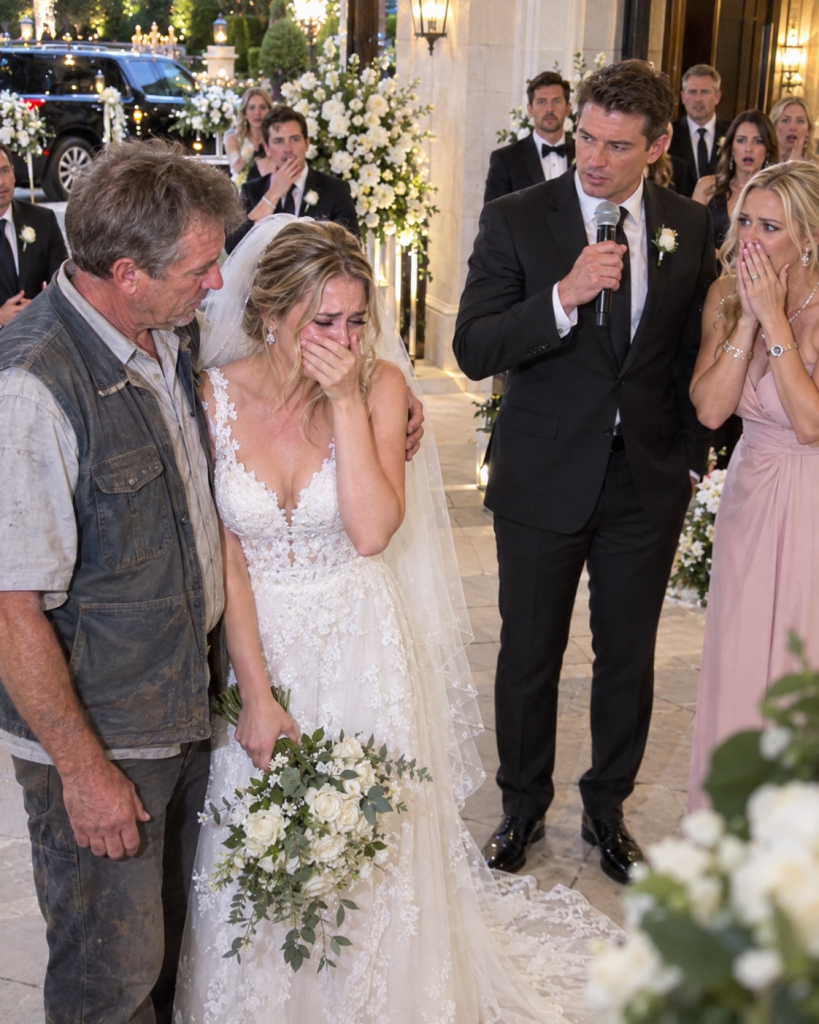
“There will be no wedding today. I only came so everyone could see that I would never marry a gardener’s daughter.” Tristan’s voice rang out clearly through the microphone, his lips curved in a smile that still makes my stomach twist with humiliation. One hundred and twenty guests sat frozen in their seats.
I stood there in my white wedding dress beside the makeshift altar at the Oakridge community center, my heart hammering so violently I thought it might shatter. My father, James, seemed to shrink inside the clean button-up shirt he had bought on installments just for this day. His shoulders slumped as the weight of the moment crushed him.
My mother had passed away when I was nine. From that day on, my father became my entire world. He mowed lawns across the residential developments of Silver City, hauled heavy sacks of dirt under the blazing sun, and drove an old pickup truck that rattled and shook every time the engine turned over. He came home each evening with raw, calloused hands and a back that grew more hunched with every passing year, yet he never uttered a single word of complaint.
When I turned twenty-four, one quiet night he pulled a rusty tin coffee can from beneath his old bed. Inside were neatly folded twenty-, fifty-, and one-hundred-dollar bills, carefully saved over more than twelve long years.
“It’s for your wedding, Maisie,” he told me, his eyes shining with quiet pride. “I may not have a big house or valuable land, but I never want you to feel ashamed of your father.”
Tears streamed down my face as I learned he had sacrificed tips, spare coins, and portions of his daily wages for over a decade just to give me this one special day.
When Tristan proposed, my father poured every last cent of those savings into renting the community center, buying food, and filling the hall with beautiful flowers. Neighbors lovingly sewed the tablecloths, the local boys strung up bright lights, and my aunt prepared a generous feast for everyone.
Tristan had pretended to accept the simple arrangements at first. But three days before the ceremony, he showed up with his parents. His mother, Mara, scanned our modest living room with visible disgust, as though she feared she might catch something just by standing there.
“My son cannot get married in a cheap public hall,” she declared coldly. “Businessmen, officials, and important clients will be attending.”
Humiliated, my father immediately offered to sell his truck and lawnmowers to pay for a luxury hotel venue. I refused outright. “No, Dad. I’d rather cancel everything than let you lose your livelihood.”
Tristan apologized profusely afterward and swore he would show up. I wanted so desperately to believe him.
On the day of the wedding, he arrived forty minutes late, flanked by his parents and several wealthy relatives. He wasn’t nervous at all — he had come fully prepared to destroy us.
After announcing the cancellation to the stunned crowd, he pointed his finger straight at my father.
“I have no intention of spending my life with a father-in-law who cuts grass for pocket change,” Tristan sneered into the microphone.
Some guests looked away in discomfort, while others whispered that Tristan was simply protecting his social standing. Mara smiled arrogantly and added that families should always know their proper place in society.
My father staggered backward. I rushed forward and wrapped my arms around him tightly before he could collapse. He began to cry softly against my shoulder, his tears soaking through the delicate fabric of my wedding dress.
“Forgive me, daughter,” he whispered in a broken voice. “If I had made enough money, no one would have treated you this way.”
Then, with heartbreaking courage, he walked to the center of the room, bowed his head, and apologized to every guest for making them attend a wedding that would never happen.
Watching this man — who had worked honestly his entire life — feel ashamed of who he was broke my heart far more than losing the man I thought I loved.
At that very moment, loud sirens suddenly wailed outside the building.
A long procession of official black SUVs and military vehicles rolled into the crowded parking lot. A man in full dress uniform, his chest gleaming with medals, stepped out of the lead vehicle. He strode purposefully into the hall without sparing a glance at Tristan or his wealthy family.
He stopped directly in front of my father, stood ramrod straight, and delivered a crisp, formal military salute.
“Mr. James Evans,” he said, his deep voice cracking slightly with emotion. “I finally found you after all these years.”
No one in the room could possibly imagine what was about to unfold.
PART 2
My father stared at the officer in confusion, searching his memory for a face he couldn’t quite place.
“Excuse me, Commander, I think you’ve mistaken me for someone else,” he said softly.
The man shook his head slowly, a warm smile breaking across his stern features. He introduced himself as Shawn Fitzgerald, a commander in the United States Army.
Twelve years earlier, as a young cadet, the vehicle he was traveling in had overturned on a highway near Greenwood. While many people simply stood by and watched the flames grow, a humble gardener had stopped his old truck, pulled Shawn from the burning wreckage, and rushed him to the hospital.
“That man handed over every single dollar he had earned that week so I could receive immediate treatment,” Shawn told the silent crowd. “Then he disappeared without ever giving his name.”
My father closed his eyes tightly as the memory finally surfaced — the bloodied young man he had carefully loaded into his rattling pickup.
“Anyone would have done the same in that situation,” my father replied with genuine modesty.
“No, sir,” Shawn said firmly. “Many people watched, but only you took action.”
Shawn explained that he had spent years searching for his savior without success. Recently, one of his soldiers had spotted my wedding invitation at a local stationery store and recognized the distinctive last name from an old hospital report. That was why he had come with several comrades — to thank my father in person on what was supposed to be his special day.
Then Shawn’s gaze swept over my white dress, the empty altar, and Tristan laughing arrogantly in the background.
“But instead, I arrived to find the brave man who saved my life apologizing for simply being a hardworking man,” Shawn said, his eyes flashing with quiet fury.
He turned to me, his expression filled with deep respect.
“Maisie, I won’t take advantage of your pain or demand an impulsive answer right now,” he said clearly so everyone could hear. “But in front of all these witnesses, I want to say something important.”
He drew a steady breath.
“A woman who defends her father with such dignity deserves the highest respect. If you ever allow me the honor of meeting you properly, my true intention is to marry you and honor your entire family.”
The entire room fell into stunned silence.
Tristan burst into loud, mocking laughter, trying to mask his growing discomfort.
“Are you picking up what I left behind, Commander?” he sneered.
Shawn remained perfectly calm, his voice cold and steady.
“I am not collecting anything,” he replied. “I am simply acknowledging the true value you were too blind to see.”
Tristan boasted loudly about his family’s powerful political connections, lucrative municipal contracts, and expensive lawyers. He claimed no one in the city could touch them.
Shawn listened without flinching.
“Tomorrow, your life will be completely different,” he said quietly.
“Is that a threat, soldier?” Tristan demanded, narrowing his eyes.
“No,” Shawn answered calmly. “It’s simply information you don’t understand yet.”
Tristan stormed out of the hall with his parents, convinced he had won.
I thanked Shawn for his kindness but was completely honest with him.
“I cannot marry a stranger just hours after suffering such a terrible betrayal,” I told him gently.
Shawn accepted my words immediately, without any pressure.
“Then let me start with something simpler,” he suggested warmly. “Let me accompany your father home safely.”
That night, we shared the leftover feast with the kind neighbors who had stayed by our side. For the first time that day, my father managed a small smile.
Shawn spoke to him with genuine warmth and familiarity, as though twelve years of unspoken gratitude had turned our humble kitchen table into something sacred.
The neighbors, still furious about Tristan, told Shawn how my father had quietly helped widows, the sick, and struggling families for years — never charging a single dollar.
PART 3
At six o’clock the next morning, every phone in the neighborhood began ringing nonstop.
The morning news was filled with reports of a massive federal operation targeting several construction companies across the state. One of the largest and most prominent belonged entirely to Tristan’s wealthy family.
Bank accounts had been frozen. Offices were swarming with agents. Tristan’s father was under investigation for embezzlement and fraudulent contracts.
But the most devastating detail wasn’t shown on television. It was the name clearly written on the very first confiscated folder.
The name was Tristan Dixon.
He was not listed as some distant son uninvolved in the business, nor as a minor employee. He appeared explicitly as the main representative of three shell companies used to systematically inflate urban maintenance contracts.
They used these fake companies to collect payment for work that never existed and to divert public money that was supposed to go toward parks, schools, and community centers.
One of those very contracts was for the green space rehabilitation program where my father had worked for years as a humble subcontractor. He and the other honest gardeners were always paid late by Tristan’s company. Tool costs were unfairly deducted from their already small wages, and they were forced to sign receipts for amounts they never actually received. The rest of the stolen money flowed directly into bank accounts controlled by the Dixon family.
As I scrolled through the shocking news on my phone, a storm of conflicting emotions washed over me — feelings so complex they are still hard to fully describe. I took no pleasure in watching a family collapse, yet the deep irony of the situation was impossible to ignore.
Tristan had publicly humiliated my father for earning an honest living with a lawnmower, while he himself had built his wealth and status by stealing money that was meant for hardworking people like my dad.
Shawn arrived at our house shortly after the news broke. He was dressed casually in civilian clothes and carried a warm bag of fresh sweet bread. My father greeted him with a hot cup of coffee, though we both had many burning questions.
“Did you cause this sudden downfall?” I asked him directly.
Shawn set the bag down on the old wooden table and met my eyes.
“No, Maisie,” he answered gently. “The federal investigation actually began almost two years ago.”
He poured himself some coffee and continued explaining.
“My military unit only assisted with security and document transfer because corrupt officials were involved,” he said. “I knew the operation would happen today, but I couldn’t reveal any classified information.”
“So when you told Tristan that his life would change dramatically…” I began.
“It was never a threat,” Shawn interrupted softly. “It was simply the absolute truth.”
He explained that authorities had been tracking the transfers, shell companies, and rigged contracts for a long time. The massive operation had absolutely nothing to do with my failed wedding. Tristan and his arrogant family had brought this ruin upon themselves through their own illegal actions.
My father remained silent as he watched the television screen, his eyes fixed on images of the secured corporate offices.
“I truly hope justice is done,” he said quietly. “But I do not want to celebrate anyone’s misfortune.”
That profound statement made me understand exactly why Shawn respected him so deeply. Even after being publicly humiliated, my father sought no revenge. He simply wanted other honest workers to stop being exploited by powerful men.
The following hours were pure chaos for the Dixon family. News reports revealed that Tristan’s father had paid massive bribes to secure contracts. Mara was exposed as a main partner in a company that bought cheap materials and then invoiced them as luxury goods. Tristan had personally authorized transfers and signed false reports every month. Leaked messages showed him mocking the poor workers and ordering payments to be delayed.
“Those low people always end up accepting anything we give them,” Tristan had written in one of the texts.
The same wealthy friends who had attended my wedding to flaunt their connection to the Dixons now desperately denied ever knowing them. Business partners stopped answering their urgent calls. Two major banks demanded immediate repayment of overdue loans, and several clients canceled their projects.
At noon, a plain van pulled up abruptly in front of our modest house. Tristan stepped out completely alone. He was no longer wearing the impeccable designer suit from the day before. His shirt was badly wrinkled, his eyes were bloodshot, and he walked as if he had aged ten years in a single morning.
“I need to talk to you, Maisie,” he said desperately as I opened the door.
Shawn stood up immediately, but my father gave him a calm look, silently asking him to let us handle it.
We sat together in the small outdoor courtyard. Tristan began crying intensely before he could even finish his first sentence.
“Maisie, I made the worst mistake of my entire life,” he sobbed.
I stayed perfectly quiet.
“My family lost everything in a single morning,” he cried frantically. “The accounts, the offices, the contracts — they’re all gone.”
He wiped his face and looked at me with desperate, pleading eyes.
“My dad is giving a statement to the police, my mom won’t stop screaming, and the lawyers say they can charge me too,” he said. “I truly didn’t know it would go this far.”
“Yes, you did,” I replied coldly. “You knew exactly what you were signing.”
He lowered his head in deep shame.
“I thought it was normal because everyone in our circle did it,” he confessed. “I thought money and connections would protect us forever.”
Then he took a shaky breath and revealed his real reason for coming.
“We can start over together, Maisie,” he pleaded. “I can change completely.”
He grabbed his knees and looked at me expectantly.
“You were always so good to me,” he said. “If you tell the media that I was just upset yesterday and didn’t mean to humiliate you, maybe people will stop seeing me as a monster.”
I realized then that even his sudden repentance came with selfish conditions. It wasn’t because of my pain or my father’s tears — it was because his once-powerful last name no longer opened any doors.
“You don’t want to win back our love,” I told him calmly. “You just want to recover the prestigious image you lost.”
Tristan tried desperately to take my hand, but I pulled it away.
“Yesterday you said you were ashamed to have a gardener for a father-in-law,” I reminded him. “Today you’ve come begging for help from that very gardener’s daughter.”
I stood up and looked down at him.
“You’re doing this not because you’ve learned to respect him, but because you have absolutely no one else left.”
My father stepped out into the patio to see what was happening. Tristan stood up and, without hesitation, dropped to his knees before him.
“James, please forgive me,” Tristan cried out. “I was incredibly cruel, and you didn’t deserve what I did to you.”
My father watched him silently for several seconds, then gently told him to stand up from the dirt.
“Do not kneel before me, young man,” my father said softly. “Kneeling is very easy when you are afraid.”
He looked Tristan straight in the eye with quiet dignity.
“The hard part is getting up and answering properly for what you did.”
Tristan cried silently, unable to look away.
“I mow lawns, carry soil, and clean gardens every day,” my father said proudly. “None of those jobs makes me less of a man.”
He pointed to his chest with his calloused hand.
“What makes a person poor is not having little money,” he explained. “It is believing that money gives them the right to trample on others.”
Tristan had no words left.
“I forgive you so I do not carry hatred in my heart,” my father said calmly. “But forgiving you does not mean helping you escape federal justice.”
Those quiet words carried far more power than any angry shout ever could.
Tristan left our house with his head bowed in total defeat. It was the last time I ever saw him outside of a formal courtroom.
In the following months, the federal investigation moved swiftly. Tristan’s father officially admitted to paying massive bribes to city officials. Mara was successfully prosecuted for money laundering through her fake businesses. Tristan provided critical information to prosecutors in exchange for a reduced sentence, but it did not spare him from facing serious charges of fraud and criminal conspiracy.
PART 4
Part of the recovered money was used to repay the wages that had been stolen from the exploited maintenance workers. My father received a large compensation check for years of illegal deductions from his hard-earned pay.
When the officials handed him the check, he held it carefully, as if it weighed a ton. “This money does not bring back my lost time,” he said softly to the officer. “By God, maybe it will help others not to go through the same thing.”
Shawn continued visiting our home regularly during this time. In the first few weeks, he never once mentioned marriage again. Instead, he happily accompanied my father to the local market, helped repair the old truck, and listened patiently to his long stories. He was incredibly gentle and patient with me as I healed from the betrayal.
He always asked how I was feeling mentally, never pressuring me for a decision. I soon discovered that behind the decorated military uniform was not a flawless hero, but a disciplined, reserved, and deeply grateful man. He had grown up in a humble family of schoolteachers in Fairview and had entered the Military College because he genuinely wanted to serve his country. The terrible accident that nearly took his life had happened when he was barely twenty years old. Since then, he had kept a faded copy of the hospital receipt in his wallet — the only trace of the brave stranger who had saved him.
One sunny Sunday afternoon, he brought that framed receipt and gave it directly to my father.
“For twelve years I thought this paper represented a debt,” Shawn told him, his voice thick with emotion. “Now I finally understand that it represents a great example.”
My father didn’t know what to say. He simply pulled Shawn into a tight hug, embracing him like a son.
Our romantic relationship blossomed naturally, without grand promises or dramatic gestures. We took peaceful walks through downtown Silver City, shared local food, and talked for hours. I openly shared my deepest fears with him.
“I worry that your marriage proposal in the hall was born purely out of intense emotion,” I told him one evening. “I fear that one day you might see me as an obligation or as part of a debt to my father.”
Shawn listened to every word without interrupting. Then he took my hand gently.
“Your father saved my life, Maisie,” he replied softly. “But I fell in love with you because of the brave way you defended him when everyone else was watching.”
He looked into my eyes with complete sincerity. “I do not want to pay you back for anything. I want to build a real life with you — if you want that too.”
Six months later, he asked me to marry him again. This time there were no wealthy guests, no official motorcades, and no formal dress uniforms. We stood together in the small green garden of our own house. My father was watering the beautiful flowers nearby, pretending not to listen.
Shawn knelt down on the grass and held up a simple gold ring.
“Maisie, I am not asking you this in front of a loud crowd or in the midst of fresh pain,” he said softly. “I am asking you after truly getting to know you: do you want to share your life with me?”
I glanced over at my father, who was watching us with happy tears in his eyes and a wide smile he couldn’t hide.
“Yes, Shawn,” I replied joyfully. “I do.”
We got married three months later in the exact same community center where Tristan had tried to humiliate us. We deliberately chose not to change the venue. For me, that simple hall no longer represented terrible humiliation — it now stood for absolute truth.
The kind neighbors once again prepared beautiful flowers. My aunt cooked a massive feast. The local workers who had finally received their stolen back pay attended with their happy families.
Shawn arrived without any military convoy, accompanied only by his loving parents, his sister, and a few close coworkers. My father wore the exact same white shirt as before, but this time he walked tall and upright, filled with pride.
Before leading me to the altar, he took my hand gently.
“Daughter, for years I thought my greatest obligation was to give you money so no one would despise you,” he whispered. “Today I understand that I should have taught you not to accept anyone’s contempt.”
I hugged him tightly, crying tears of pure joy. “That is exactly what you taught me all my life, Dad.”
When we reached Shawn, he did not take my hand as if I were property being transferred. First, he shook my father’s hand with immense respect.
“Thank you for trusting me with her life, sir,” Shawn said.
“I am not losing a daughter today,” my father replied happily. “I am gaining a wonderful son.”
The wedding ceremony was incredibly simple. There were no expensive crystal chandeliers or lavish tables, yet I had never seen my father look so radiant and happy in my entire life.
During the wedding toast, Shawn stood up and told the moving story of the man who stopped his old pickup truck to save a dying stranger. He didn’t focus on the money given or the miles driven. He spoke only of the brave decision to help when no one else wanted to get involved in the fire.
Everyone in the room rose to their feet and applauded my father loudly. Overwhelmed by the attention, my father hid his blushing face in his hands.
I cried as I watched him, finally understanding that his greatest legacy was not in that rusty coffee can. It was in the kind of person he had chosen to be — even when no one was watching.
With the federal compensation money, my father was finally able to retire comfortably. However, he firmly refused to sell his old pickup truck. He restored it lovingly and parked it proudly in front of our house.
“It is to remember exactly where we come from,” he always says.
Every morning he sits on the front porch with his hot coffee, tends to his beautiful plants, and chats happily with the neighborhood kids. When Shawn returns from the base, the first thing he does is greet my father warmly and ask if he has eaten. Sometimes I find them sitting together, passionately debating plant fertilizers or soccer games, just like a real father and son.
I changed in many ways too. For a long time, I believed love meant enduring pain to prove loyalty. Tristan taught me — in the most painful way possible — that someone who truly loves you does not force you to be ashamed of your humble roots. Shawn taught me that true respect is not just declared; it is shown consistently, both in public and in private.
The sudden downfall of the Dixon family was not the result of a magical curse or military revenge. It was simply the natural consequence of years of despising the law and those they considered beneath them.
My first wedding happened just one day before their empire of lies began to crumble completely. Sometimes I still remember my father apologizing in that crowded room, and it hurts my heart. But I also remember the formal military salute, the stunned silence of those who had mocked him, and the beautiful way he raised his head when someone finally acknowledged his courage.
Good deeds do not always receive immediate rewards. Sometimes they stay hidden for years, like seeds buried deep in the soil. No one sees them growing. No one applauds them. They may even seem completely forgotten. But when the right time comes, they sprout beautifully in the most unexpected places.
My father was never a poor man. The truly poor were those who could only measure human dignity by money. And on the fateful day they tried to shame him for cutting gardens, we all discovered that he had spent his entire life planting something far more valuable.
THE END.