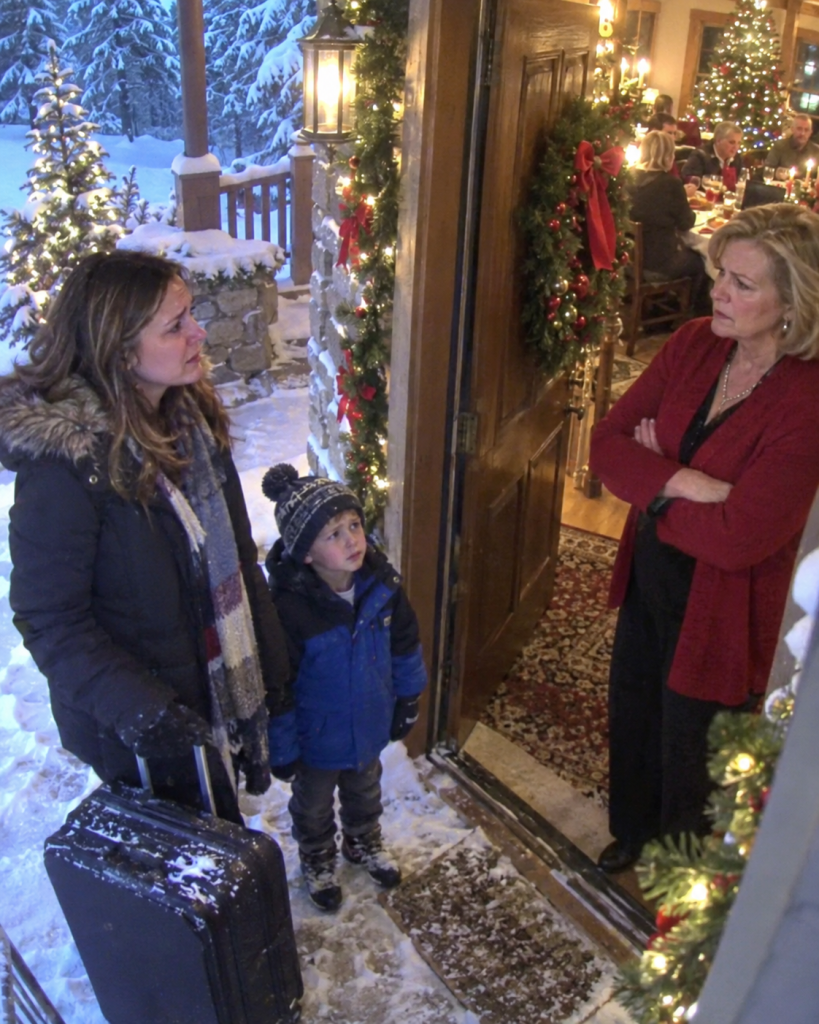
The cold on Christmas Eve cut through my red velvet coat before my mother even opened her mouth.
Behind her, Cedar Ridge Lodge glowed with amber firelight. Laughter floated through the doorway, mixed with the smell of roasted turkey, cinnamon, and fresh pine.
Somewhere inside, glasses clinked beneath the soft music of a string quartet.
My six-year-old son, Eli, squeezed my hand.
“Mommy, can we go in now?”
We had driven almost two hours through thick snow to reach the lodge outside Pinehaven, Michigan.
Eli wore the navy suit my father had once said made him look like “a proper young man.”
He had spent the entire drive talking about decorating cookies with his cousins.
My mother, Denise, did not step aside.
Instead, she planted one hand against the heavy oak door and looked at us as though we were delivery workers who had arrived at the wrong address.
“I’m sorry, Natalie,” she said. “We have a strict capacity limit this year. Fire marshal regulations.”
For a moment, I thought she was joking.
I glanced past her shoulder.
The entrance hall was crowded with distant relatives, neighbors, my father’s business acquaintances, and several men I recognized as my brother Grant’s old college friends.
Most of them were holding drinks and laughing beneath a chandelier large enough to light a theater.
“Mom, it’s freezing,” I whispered. “We’ve been driving for two hours.”
“You weren’t included on the final guest list.”
Her voice was deliberately loud.
Several people near the coatroom turned toward us.
Eli shifted closer to my leg.
“But you asked me to help plan the menu,” I said. “I paid for the flowers and sent the champagne.”
“That doesn’t change the capacity.”
“There are people inside who aren’t even family.”
My mother’s mouth tightened.
“Natalie, do not make this embarrassing.”
I almost laughed at the cruelty of that sentence.
I was standing outside in the snow with her grandson, yet somehow I was the one embarrassing her.
“Can Eli at least come inside while we figure this out?”
“No.”
The word came so quickly that even she seemed surprised by it.
Eli’s fingers tightened around mine.
My mother looked past us toward the driveway, checking whether anyone else was arriving.
“You need to go home,” she said. “We’re already behind schedule.”
Then she closed the door.
The warmth vanished.
The music became muffled.
A second later, the lock clicked.
I stared at the dark oak grain inches from my face.
Snow collected in my hair and melted against my scalp.
Eli made a tiny sound beside me, not quite a sob, and that sound hurt more than anything my mother had said.
I walked him down the icy porch steps without looking back.
Near our sedan, he stopped.
“Did I do something bad?”
I knelt in the slush.
Cold water soaked through my tights as I held both sides of his face.
—
Part 2
I knelt in the slush.
Cold water soaked through my tights as I held both sides of his face.
“No, sweetheart. You did nothing wrong.”
“Then why doesn’t Grandma want me?”
My throat closed.
“She has too many guests.”
“But family makes room.”
He said it plainly, the way children say truths adults spend years avoiding.
I pulled him against my chest and felt him trembling through his little coat.
“You’re right,” I whispered. “Family should make room.”
After buckling him into the back seat, I turned the heater as high as it would go.
Warm air coughed weakly from the vents while I sat behind the wheel, staring at the glowing windows.
This was not the first time my family had made me feel unwanted.
It was simply the first time they had done it in front of my child.
Through one window, I saw my brother Grant lift a glass while several guests laughed around him.
He wore a new charcoal suit and the silver watch my father had bought him after his latest business failure.
He looked comfortable, celebrated, completely at home.
I looked down at the dress my mother had told me to buy because “deep red photographs beautifully at Christmas.”
I had spent thirty years trying to earn a place in that house.
I had brought expensive gifts, solved last-minute problems, paid bills no one thanked me for, and smiled while my parents praised Grant for doing half as much.
That night, something inside me finally went quiet.
I shifted the car into reverse.
“We’re going home,” I told Eli. “We’ll make hot chocolate, wear pajamas, and have our own Christmas.”
“Just us?”
“Just us.”
The tires crunched over fresh snow as I backed away from the porch.
I did not know then that my mother had a reason for keeping me outside—one far uglier than simple favoritism.
And ten minutes later, a phone call from my grandmother would force me to turn around and discover it.
The road away from Cedar Ridge Lodge wound between tall pine trees, their branches heavy with snow.
My headlights carved a narrow tunnel through the darkness while the heater hummed and Eli sniffled in the back seat.
I kept both hands locked around the steering wheel.
My mother’s voice repeated in my mind.
“You weren’t included on the final guest list.”
Grant had never needed a list.
Growing up, my brother existed at the center of our family, and the rest of us adjusted ourselves around him.
When Grant brought home a poor report card, my parents blamed the school and hired a tutor.
When I earned straight A’s, my father said, “That’s what we expect from you.”
On Christmas mornings, Grant received bicycles, expensive electronics, and instruments he lost interest in within weeks.
I received socks, winter boots, and coats purchased one size too large so they would last.
“You’re practical,” my mother always said. “You don’t need attention the way Grant does.”
For years, I believed being low-maintenance was a virtue.
Eventually, I understood that it merely made me easier to neglect.
Part 3
I had just passed the old wooden bridge when my phone rang.
Grandma.
I almost didn’t answer.
Then I saw her name flashing across the screen again.
I pulled the car onto the snowy shoulder.
“Hello?”
“Natalie, where are you?”
Her voice was sharp.
Not confused.
Not sleepy.
Furious.
“I’m driving home.”
“Turn around.”
I froze.
“What?”
“Turn around right now.”
“Grandma, Mom said there was no room. Eli and I don’t want to cause a scene.”
“You are not causing a scene.”
Her voice dropped into something colder.
“Your mother is.”
I looked into the rearview mirror.
Eli was curled against the window, his eyes half-closed.
“Grandma, I don’t understand.”
“You will when you get back here.”
“Why?”
There was a pause.
Then she said something that made my stomach drop.
“Because I never told Denise to remove you from the guest list.”
I stared through the windshield.
“What?”
“I personally added your name and Eli’s.”
My fingers tightened around the steering wheel.
“Then why did Mom—”
“I don’t know yet,” Grandma interrupted. “But I intend to find out.”
“Grandma, maybe we should just go home.”
“No.”
Her answer was immediate.
“You have spent thirty years walking away whenever your mother made you feel unwanted.”
Her voice softened.
“Not tonight.”
I looked at my sleeping son.
Then I looked back at the lodge glowing in the distance.
“Okay.”
I turned the car around.
Ten minutes later, Cedar Ridge Lodge appeared through the snow again.
But something had changed.
Several cars were parked crookedly near the entrance.
People were standing outside.
And Grandma was waiting on the porch.
She was seventy-eight years old, but that night she stood straighter than anyone I had ever seen.
She wore a long emerald dress and held a wooden cane in one hand.
When I stepped out of the car, she walked directly toward me.
She hugged Eli first.
“My sweet boy.”
Then she looked at me.
“I am sorry.”
Two words.
That was all it took to make my eyes burn.
“I didn’t know,” I whispered.
“I know.”
Grandma turned toward the lodge.
“Come inside.”
My heart pounded as I followed her.
The moment the doors opened, every conversation stopped.
My mother stood near the fireplace.
My father, Robert, was beside her.
Grant was holding a glass of champagne.
All three of them stared at us.
My mother went pale.
“Mom…”
Grandma raised one hand.
“Don’t.”
The entire room fell silent.
Grandma looked around at the guests.
“I invited everyone in this room because I wanted us to celebrate Christmas together.”
Then she looked directly at my parents.
“But apparently someone decided my invitation wasn’t enough.”
My father cleared his throat.
“Mom, there was a capacity issue.”
Grandma smiled.
A very small, very cold smile.
“Interesting.”
She reached into her handbag and pulled out a folder.
“I spoke with the lodge manager this afternoon.”
She opened it.
“The fire marshal approved a maximum occupancy of one hundred and twenty-four people.”
Everyone looked around.
Grandma continued.
“We currently have eighty-nine.”
Silence.
My mother looked at my father.
Grandma slowly closed the folder.
“So, Denise, explain to me again why my granddaughter and great-grandson couldn’t come inside.”
My mother said nothing.
Grant suddenly stepped forward.
“Grandma, this is ridiculous. It’s Christmas.”
Grandma turned toward him.
“No, Grant.”
She pointed at him with her cane.
“What is ridiculous is watching my granddaughter apologize for existing while everyone applauds you for surviving mistakes you should have been responsible for.”
Grant’s face hardened.
“That’s not fair.”
“Fair?”
Grandma laughed once.
“Do you know who paid the overdue taxes on your first company?”
Grant went silent.
My father looked down.
“Do you know who paid for the apartment after your second company failed?”
Silence.
“And do you know who has been quietly paying the property insurance on this lodge for the last eleven years?”
My mother suddenly whispered,
“Mom, please.”
Grandma looked at her.
“Tell them.”
My mother didn’t move.
So Grandma did.
“Natalie.”
Every face turned toward me.
“This lodge has been yours since the day your grandfather died.”
My breath caught.
“What?”
Grandma handed me the folder.
Inside was a copy of the original deed.
My name was printed clearly beneath the ownership transfer.
I stared at it.
“This can’t be right.”
“It is.”
My father finally spoke.
“Your grandfather wanted you to have it.”
“Then why did I never know?”
Grandma looked at my parents.
“Because your father convinced me to wait.”
I turned toward him.
“Dad?”
He couldn’t meet my eyes.
My mother stepped forward.
“We were protecting you.”
“From what?”
No one answered.
Grandma did.
“From them.”
She pointed toward my parents.
“Your parents borrowed against this property years ago to cover Grant’s business debts.”
My stomach turned.
“What?”
“They were supposed to repay everything before you ever learned about it.”
I looked at my father.
“How much?”
Grandma’s expression hardened.
“More than six hundred thousand dollars.”
The room erupted in whispers.
Grant’s champagne glass slipped from his hand and shattered across the floor.
He stared at me.
“Natalie…”
I stepped backward.
Suddenly, every Christmas memory made sense.
Every time my parents asked me for money.
Every emergency.
Every request to “help the family.”
Every time Grant failed and somehow I was expected to understand.
They hadn’t simply neglected me.
They had been using me.
And the worst part?
They had been doing it while knowing that one day this entire lodge would belong to me.
I looked down at Eli.
He was standing beside Grandma, holding her hand.
Then Grandma said the words that silenced everyone.
“And tonight, Natalie is going to decide what happens to this lodge.”
—
Part 4
Nobody spoke.
I looked around the room.
The same people who had watched my mother shut the door in my face were now watching me as if I had suddenly become a stranger.
My father finally stepped forward.
“Natalie, let me explain.”
I shook my head.
“No.”
He stopped.
“You had thirty years to explain.”
My mother began crying.
“I never wanted to hurt you.”
I looked at her.
“You looked my six-year-old son in the eyes and told him to go home on Christmas Eve.”
She covered her mouth.
“That wasn’t about Eli.”
“That’s exactly the problem.”
My voice trembled, but I didn’t raise it.
“Everything in this family has always been about Grant.”
Grant looked furious.
“Don’t put this on me.”
I turned toward him.
“You didn’t put yourself at the center of this family.”
I paused.
“They did.”
He had no answer.
Grandma stepped beside me.
“The lodge is debt-free now,” she said.
I looked at her.
“Now?”
She nodded.
“I paid off the remaining loan this morning.”
My father stared at her.
“You what?”
“I sold one of my investment properties.”
She smiled.
“I wanted Natalie to receive this place without anyone else’s debt hanging over it.”
My mother shook her head.
“You can’t do this to us.”
Grandma’s eyes narrowed.
“I am not doing anything to you.”
She pointed toward me.
“I am finally doing something for her.”
Then she handed me another envelope.
Inside was a letter from my grandfather.
My hands trembled as I unfolded it.
Natalie,
If you are reading this, then you are finally old enough to understand something I learned too late.
The quiet child is often the one everyone assumes will forgive them.
Don’t confuse forgiveness with permission.
I want this lodge to be a place where you never have to wonder whether you belong.
Your family may share your blood.
But home is something people earn by making room for you.
I had to stop reading.
Tears blurred the page.
Eli wrapped his arms around my waist.
“Mommy?”
I knelt and hugged him.
Grandma crouched beside us.
“Your great-grandfather would have loved you.”
I wiped my eyes.
Then I stood.
My father looked at me.
“So what are you going to do?”
I looked around the lodge.
For years, I had imagined finally being accepted into this room.
Now I realized I didn’t need their acceptance.
I owned the room.
I owned the land beneath it.
And more importantly, I owned the decision.
“I’ll keep the lodge,” I said.
My mother exhaled shakily.
“Thank you.”
“But there are conditions.”
Her expression changed.
“What conditions?”
“No more borrowing against it.”
My father nodded.
“No problem.”
“No more asking me to rescue Grant from his mistakes.”
Grant looked away.
“And no one will ever use this place to make Eli feel unwanted again.”
My mother began to cry.
“I understand.”
I looked at her for a long moment.
“I hope you do.”
Then I took Eli’s hand.
We walked toward the Christmas tree.
There was a small empty space beneath it.
I noticed one present with Eli’s name written across the tag.
He looked up at me.
“Can I open it?”
I smiled.
“Yes, sweetheart.”
He tore the paper open.
Inside was a wooden train set.
His eyes lit up.
“Mommy! Look!”
I laughed through my tears.
For the first time that night, the lodge felt warm.
Not because of the fire.
Not because of the Christmas lights.
Because my son was smiling.
Grandma came over and sat beside us.
Across the room, my parents stood silently.
Grant had lost his confident smile.
And nobody knew what to say.
I didn’t need them to say anything.
I had spent my entire life waiting for my family to make room for me.
That Christmas Eve, I finally understood something my grandfather had known all along.
Sometimes you don’t need to beg for a seat at the table.
Sometimes you need to build your own table.
And when the people who once shut the door finally realize you hold the key—
you don’t have to slam it in their faces.
You simply decide who gets invited inside.
That night, Eli fell asleep beside the Christmas tree while snow covered Cedar Ridge Lodge.
Grandma placed a blanket over him.
I stood by the window and watched the snow fall.
For the first time in thirty years, I didn’t feel like the unwanted daughter.
I felt like I was finally home.