My husband offered me $50 million to disappear from his life so he could marry the woman carrying his twins.
I signed the divorce papers, left our Beacon Hill home, and flew to California without begging him to stay.
His mother thought the twins had finally solved the one problem she had blamed on me for twelve years.
I sent Cordelia Stanhope one message.
Because the problem was no longer simply whether those babies were Charles’s.
It was whether my husband had spent years lying to his own family—and whether he had used my name to push through a hotel transaction worth hundreds of millions of dollars before getting rid of me.
PART 1 – The $50 Million Goodbye
My name is Hannah Stanhope.
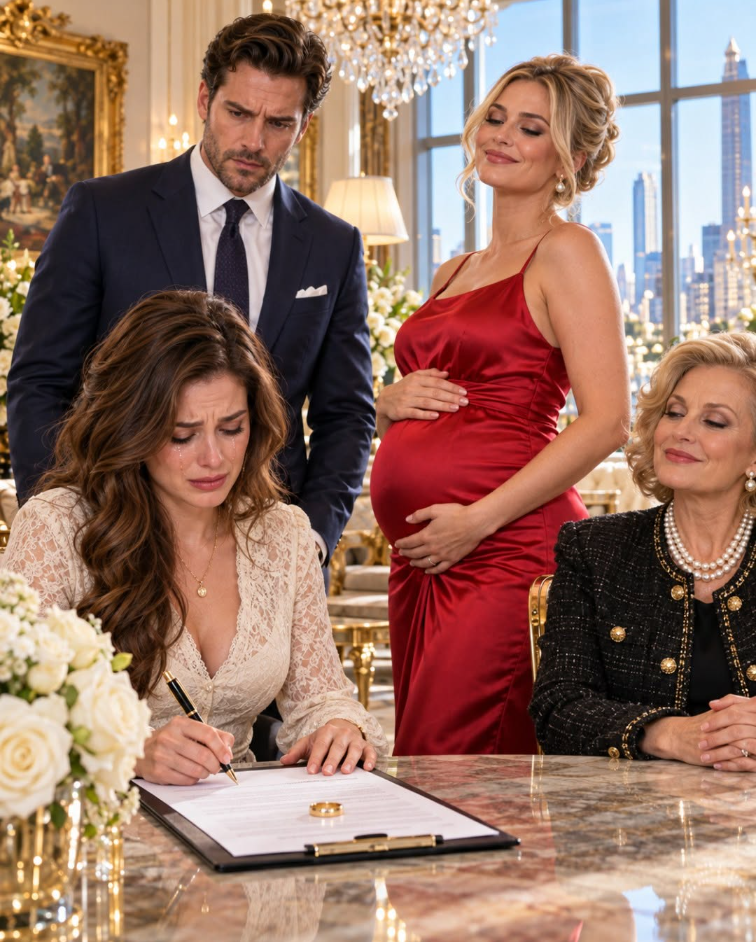
I had been married to Charles for twelve years when he placed a $50 million divorce agreement beside my dinner plate.
We were sitting in the formal dining room of our Beacon Hill home in Boston.
The room had been designed to intimidate people.
Twelve-foot ceilings.
Dark wood.
An antique chandelier.
Portraits of dead Stanhopes staring down from the walls as if every dinner required approval from several generations.
Charles sat across from me.
His mother, Cordelia, was at the head of the table.
And standing near the windows was Phoebe Bennett.
Twenty-six years old.
Former communications director for Stanhope Heritage Hotels.
Seven months pregnant.
With twins.
Charles spoke calmly.
“Phoebe and I want to marry before the girls are born.”
I looked at her stomach.
Then at him.
“How long?”
He hesitated.
“Eighteen months.”
That meant the affair had begun while he and I were still attending fertility appointments together.
I looked down at the paperwork.
Fifty million dollars.
Our Boston house would remain with Charles.
I would resign from the board of Stanhope Heritage Hotels.
I would waive most additional marital claims beyond property already classified as mine.
There was a broad confidentiality clause covering private details of the marriage.
Cordelia leaned forward.
“Hannah, this is more than generous.”
I looked at her.
She continued.
“Charles wants to handle this with dignity.”
Dignity.
The word almost made me laugh.
Phoebe was wearing a gold-and-pearl pin at the collar of her cream dress.
I recognized it.
Charles had given me that pin on our tenth anniversary during a weekend in Nantucket.
Six months later, I noticed it missing.
Charles told me it had probably disappeared during a hotel renovation when our luggage was moved between rooms.
I had believed him.
Now it was sitting on Phoebe’s chest.
I looked at Charles.
“You gave her my pin too?”
His jaw tightened.
“Hannah, stay focused.”
Phoebe touched it instinctively.
For the first time that evening, she looked uncomfortable.
Cordelia tapped the agreement.
“The important thing is that everyone can move forward.”
Then she looked at Phoebe’s stomach.
“And the family finally has a future.”
There it was.
For twelve years, Cordelia had blamed me for our lack of children.
Sometimes quietly.
Sometimes not.
At our sixth anniversary dinner, she said:
“Hotels are easier to replace than heirs.”
At Christmas two years later:
“Maybe if Hannah spent less time on spreadsheets and more time thinking about motherhood…”
At a charity event:
“Charles always wanted a large family. Life doesn’t always give us the woman suited to the dream.”
Charles heard most of it.
He always told me later:
“Don’t engage.”
Or:
“She doesn’t know the medical details.”
Exactly.
She didn’t.
Because Charles had asked me not to tell her.
During our fourth year of marriage, fertility testing had shown that the most serious problem was not mine.
It was Charles’s.
His sperm count was extremely low.
Motility was poor.
Additional testing showed a genetic issue that made natural conception extraordinarily unlikely.
Not impossible.
Our specialist was careful about that.
But very unlikely.
Charles had sat in the clinic parking garage afterward with both hands over his face.
Then he looked at me and said:
“Please don’t tell my mother.”
I had understood.
Cordelia had built the entire Stanhope identity around legacy.
Grandchildren.
Bloodline.
Names engraved on buildings.
Charles was ashamed.
So I protected him.
For eight years.
While Cordelia blamed me.
While relatives whispered.
While I underwent procedures, hormones, retrieval cycles, and failed embryo transfers.
I said nothing.
Now Charles’s pregnant mistress was standing in my dining room.
And apparently the Stanhope fertility problem had miraculously resolved itself.
I could have exposed him right there.
I could have looked at Cordelia and said:
Ask your son what his doctor told us.
Instead, I picked up the pen.
Charles frowned.
“You should read everything.”
“My attorney already has.”
His expression changed.
“You sent it out?”
“Yes.”
“When?”
“Yesterday.”
Cordelia looked irritated.
“Why would you involve another attorney if the terms are this favorable?”
“Because I’m signing away a marriage, not accepting a restaurant check.”
I signed the first marked page.
Then the second.
Charles watched.
I signed the board resignation.
The confidentiality acknowledgment.
The property settlement.
Then I removed my wedding ring.
I placed it on top.
“My bags are packed.”
Charles stared.
“You knew this was coming?”
“I knew enough.”
Phoebe looked down.
Cordelia said:
“You’re really leaving tonight?”
“Yes.”
“You don’t want to discuss anything?”
“No.”
Charles leaned back.
For the first time, he seemed offended.
I think he had expected grief.
Maybe bargaining.
Maybe some final proof that he still controlled the emotional center of the room.
Instead, I stood.
“Congratulations.”
Phoebe flinched.
Charles said:
“Hannah.”
I looked at him.
“What?”
He opened his mouth.
Nothing came out.
Three days later, I was in California.
I owned a small house outside Santa Barbara that had belonged to my aunt.
Charles knew about it but had never spent more than one weekend there.
It became my escape.
No staff.
No portraits.
No Stanhope crest on the stationery.
I woke to ocean air and the sound of a neighbor’s dog barking every morning at six.
It was wonderful.
My attorney, Maya Chen, handled the divorce from Boston.
The $50 million settlement was substantial.
But not remotely everything Charles’s family had.
Stanhope Heritage Hotels was a private hospitality group worth several billion dollars.
Charles controlled a significant stake through family trusts and personal shares.
Cordelia controlled another voting block.
I had served on the board for nine years, including four years chairing the audit and transactions committee.
That mattered later.
At the time, I wanted out.
I did not fight for the Boston house.
I did not call Phoebe.
I did not speak to reporters.
Charles’s family quickly formed its own story.
Cordelia told relatives that Charles and I had “amicably chosen different futures.”
She told one cousin that I had always been “more interested in work than motherhood.”
Charles announced a temporary leave from public events while preparing for the twins.
Phoebe resigned from the hotel company officially, though she had already stopped working months earlier.
I remained silent.
Then a box arrived from Boston.
It contained the last personal items from my study.
Old photographs.
Two silk scarves.
A set of fountain pens.
And a medical folder.
I almost threw it into a closet.
Then I saw the clinic logo.
Massachusetts Reproductive Medicine.
I sat at my kitchen table and opened it.
Inside were copies of Charles’s fertility results.
One report was eight years old.
Another was newer.
Much newer.
A test Charles had apparently repeated eleven months before our divorce.
I had never seen it.
The conclusion was nearly unchanged.
Severe male-factor infertility.
The specialist had written:
Natural conception remains highly improbable. If pregnancy occurs without assisted reproduction, confirm paternity before making irreversible medical or legal assumptions.
I read that sentence three times.
Then noticed a handwritten note in Charles’s file.
Patient requests results not be shared with spouse at this time.
My hands went cold.
He had retested himself while sleeping with Phoebe.
He knew.
He had known the twins deserved a question.
Yet he was preparing to marry her before they were born.
I photographed the page.
Then sent one message to Cordelia.
Before you call those twins Charles’s heirs, ask him why I took the blame for our fertility diagnosis—and why he repeated the test last year without telling anyone.
I turned off my phone.
The next afternoon, someone knocked.
Cordelia Stanhope was standing on my porch.
Alone.
Holding a cream envelope.
And she looked more frightened than I had ever seen her.
PART 2 – What Cordelia Brought From Boston
“What did your message mean?”
Those were Cordelia’s first words.
No hello.
No criticism of my house.
No comment about my clothes.
I stepped aside.
“Come in.”
She walked into the living room and remained standing.
Cordelia Stanhope rarely looked uncertain.
She had been married to Charles’s father for thirty-eight years.
After his death, she became the unofficial guardian of the family name.
She chaired the foundation.
She knew senators.
Bankers.
Hospital presidents.
She could reduce a hotel executive to silence by lifting one eyebrow.
That afternoon, her hands were shaking.
I put the medical report on the coffee table.
“Read.”
She sat.
Her eyes moved across the first page.
Then the second.
She reached the diagnosis.
Her face changed.
“This is Charles?”
“Yes.”
“You knew?”
“For eight years.”
“And you never told me?”
“He asked me not to.”
Cordelia stared at me.
I almost laughed.
For years she had called me defective in every polite way available.
Now she had discovered I had been protecting her son.
She whispered:
“The problem was Charles?”
“The most serious problem, yes.”
“Could he have children?”
“Our doctors never said impossible.”
I pointed at the newer report.
“They said highly improbable naturally.”
Her eyes moved to the date.
“This was last year.”
“Yes.”
“Why was he retested?”
“I assume because Phoebe told him she was pregnant.”
Cordelia looked up.
“And he didn’t tell you?”
“No.”
She read the final note.
Confirm paternity before irreversible medical or legal assumptions.
Her lips tightened.
“Are you saying those babies aren’t Charles’s?”
“No.”
I shook my head.
“I’m saying I don’t know.”
“But he says—”
“Charles says many things.”
Cordelia flinched.
I continued.
“A diagnosis is not a paternity test.”
“So what are you suggesting?”
“That people stop talking about heirs until they establish basic facts.”
She sat quietly.
Then said:
“Phoebe refused testing.”
I looked at her.
“What testing?”
“Our family attorney suggested a noninvasive prenatal paternity test.”
That surprised me.
“Why?”
Cordelia seemed embarrassed.
“Because of the trusts.”
Of course.
Several Stanhope family trusts defined future beneficiaries by biological descent.
Before changing beneficiary schedules or shifting certain voting rights, counsel wanted confirmation.
“What did Phoebe say?”
“That the request was insulting.”
“And Charles?”
“He defended her.”
“Did you know about his fertility diagnosis then?”
“No.”
Cordelia looked furious now.
“He told me the testing request was old-fashioned and humiliating.”
“Maybe it was humiliating.”
I paused.
“But that doesn’t answer the question.”
She stared at the medical report.
Then I noticed the cream envelope in her lap.
“What is that?”
Her fingers tightened.
“This is why I came.”
She handed it to me.
The first page carried the logo of Stanhope Heritage Hotels.
Title:
Seabright Portfolio Acquisition – Independent Governance Certification
My name appeared underneath.
Hannah Stanhope, Chair, Special Transactions Committee
I frowned.
“I resigned.”
“This predates your resignation.”
I kept reading.
Stanhope Heritage Hotels had been negotiating the acquisition of Seabright Hospitality Group.
Twenty-two hotels.
Florida.
Georgia.
The Carolinas.
Transaction value:
$612 million.
I knew the deal existed in broad terms.
I had recused myself from early discussions because one of Seabright’s communications vendors had ties to Phoebe.
Then negotiations supposedly paused.
According to the document in my hand, they had not.
The certification stated that the independent committee chaired by me had reviewed the related-party conflicts and approved the acquisition structure.
My heart began pounding.
“I never approved this.”
Cordelia said nothing.
“I never chaired a final vote.”
“I know.”
“How?”
“The board secretary called me yesterday.”
“Why you?”
“She found the certification while preparing updated lender materials.”
I turned to the final page.
Charles’s signature.
Underneath a statement:
I certify that the foregoing summary accurately reflects the approval of the Special Transactions Committee and its chair, Hannah Stanhope.
My name.
His signature.
Not a forged signature from me.
Something potentially worse for him.
A false certification that I had approved something I never approved.
Cordelia whispered:
“The acquisition financing closes in three weeks.”
I looked up.
“How much debt?”
“Four hundred and twenty million.”
“And the rest?”
“Cash and seller equity.”
“Who is financing?”
“East Harbor Bank and a syndicate.”
I knew East Harbor.
Conservative.
Painfully conservative.
They would care enormously about governance representations.
“Who owns the related-party vendor?”
Cordelia hesitated.
“Phoebe’s uncle.”
Of course.
Bellweather Communications.
A firm that stood to receive a $6.8 million branding and transition contract if Seabright closed.
I felt sick.
“Did Charles disclose his relationship with Phoebe when the committee first reviewed the deal?”
“No.”
“Because he was sleeping with her.”
“Yes.”
“And I recused because I thought she was merely a former employee connected to a vendor.”
Cordelia nodded.
“Charles later told counsel the conflict had been cleared.”
“By me?”
“That’s what this says.”
I put the document down.
“Why didn’t the board secretary contact me?”
“She believed you were still involved through the transition.”
“My resignation was effective immediately.”
“I know.”
“So somebody created paperwork that made it appear I approved a deal I never saw.”
Cordelia whispered:
“Yes.”
I stood.
She watched me.
“What are you going to do?”
“Call my lawyer.”
Her face tightened.
“Hannah, please.”
I looked at her.
“Please what?”
“If this becomes public—”
I laughed.
There she was.
Cordelia.
Even terrified, she still thought first about the family name.
“I am not calling a newspaper.”
“I know.”
“I’m calling counsel because my name is on a $612 million transaction I did not approve.”
She lowered her head.
Fair.
I called Maya.
She listened without interrupting.
Then said:
“Do not contact Charles directly.”
“I wasn’t planning to.”
“Send me scans.”
“I will.”
“Do not destroy anything.”
“Obviously.”
“And Hannah?”
“Yes?”
“Your divorce confidentiality clause does not require you to conceal suspected corporate misconduct, respond falsely to lenders, or refuse cooperation with regulators or the board.”
“I know.”
“Good.”
Cordelia heard that.
Her face changed.
Charles had believed $50 million bought my silence.
It hadn’t.
It bought a marital settlement.
Those were not the same thing.
Then Cordelia’s phone buzzed.
Charles.
She stared at his name.
I said:
“Answer.”
She did.
“Mother, where are you?”
Cordelia looked at me.
Then said:
“California.”
Silence.
“What?”
“I’m with Hannah.”
Another silence.
Then Charles’s voice changed.
“What did she tell you?”
Cordelia replied:
“Enough.”
He exhaled.
“Whatever she showed you, there’s context.”
I looked at Cordelia.
She looked back at me.
Then asked:
“Does Phoebe know about your fertility diagnosis?”
Charles stopped speaking.
That was the first answer.
Then Cordelia asked:
“Did Hannah approve Seabright?”
A longer silence.
“Hannah isn’t on the board anymore.”
“That wasn’t my question.”
“Mother—”
“Did she approve it?”
Charles’s voice hardened.
“We don’t discuss company matters with outsiders.”
I almost admired the arrogance.
Cordelia’s face changed.
“She was not an outsider when you used her name.”
Then she ended the call.
For the first time in twelve years, Charles’s mother and I were sitting on the same side of a problem.
Neither of us trusted him.
PART 3 – The Deal That Was Supposed to Close After I Was Gone
Maya flew to Santa Barbara the next morning.
Not because I needed emotional support.
Because the Seabright file was bigger than either of us wanted to discuss over video.
Cordelia stayed at a hotel nearby.
We met in my dining room with laptops, legal pads, and enough coffee to make sleep impossible.
First, Maya separated the problems.
“Marriage is one issue.”
She pointed to the divorce documents.
“Corporate governance is another.”
Then the medical file.
“Paternity is another.”
She looked at both of us.
“Do not mix them.”
That advice saved us repeatedly.
Cordelia wanted to.
Every ten minutes she said some version of:
“If the twins aren’t Charles’s, then—”
Maya stopped her.
“Then that affects the family and perhaps trusts after proper proof. It does not determine whether Charles falsified corporate approval.”
Cordelia nodded reluctantly.
Maya turned to me.
“What exactly did you know about Seabright?”
I explained.
Six months earlier, Charles presented the potential acquisition.
Seabright owned a portfolio of aging upscale hotels that needed renovation.
Strategically, it made sense.
The problem was valuation.
Charles wanted to pay too much.
The second problem was Bellweather Communications.
Phoebe had once worked there before joining Stanhope.
Her uncle, Gregory Bennett, owned it.
At the time, I knew Phoebe and Charles worked closely.
I did not know they were having an affair.
Still, the relationship created enough appearance risk that I recommended an independent review of vendor contracts.
Two weeks later, Charles told the board Seabright negotiations were paused.
I believed him.
Apparently they continued through a smaller executive group.
Then Charles revived the acquisition after Phoebe became pregnant.
Why?
Cordelia thought she knew.
“He wanted it closed before announcing the second marriage.”
“That doesn’t explain anything.”
“The Seabright deal would make him look untouchable.”
That sounded like Charles.
The largest acquisition in company history.
Then a glamorous second marriage.
Then twin daughters.
A perfect succession story.
Maya reviewed the certification.
“Your name isn’t signed.”
“No.”
“That’s important.”
“So he didn’t forge my signature.”
“Correct.”
She tapped Charles’s certification.
“But if he knowingly represented that you approved a transaction when you did not, that is still serious.”
“How serious?”
“Potential breach of fiduciary duty. False representations to lenders. Governance violations. Possibly more depending on what was submitted and whether money moved.”
Cordelia whispered:
“Could he go to prison?”
Maya looked at her.
“We do not know enough to answer that.”
Good lawyer.
No drama.
Facts first.
We learned more that afternoon.
Stanhope’s board secretary, Evelyn Price, agreed to speak with outside counsel after Cordelia authorized an independent committee.
Evelyn had maintained detailed records.
She remembered the actual Special Transactions Committee meeting.
I had participated by video.
We approved preliminary diligence.
Nothing else.
No final acquisition.
No Bellweather contract.
No authorization to borrow $420 million.
Yet the later certification described the meeting as final approval.
The minutes had been revised.
Not simply corrected.
Rewritten.
A paragraph had been added:
Chair Hannah Stanhope confirmed satisfaction with all related-party disclosures and recommended proceeding to definitive documentation.
I had never said that.
Evelyn had objected when she first saw the revised minutes.
Charles’s general counsel at the time, Peter Lang, told her:
“Hannah reviewed the language separately.”
She had assumed I did.
I had not.
Maya asked:
“Who gave Lang that instruction?”
Evelyn produced an email.
From Charles.
Hannah and I discussed this privately. She’s comfortable. Update the record and move forward.
I stared.
Cordelia whispered:
“Oh, Charles.”
There was more.
The draft lender package represented that the audit chair had approved the Bellweather relationship after disclosure that Phoebe Bennett was a former employee.
Former employee.
Not current mistress.
Not pregnant partner.
No mention of that.
The lender’s conflict analysis was therefore incomplete.
Then Maya found the clause that explained my $50 million exit.
The financing required any director with a material conflict issue pending at signing to either certify approval or leave the board before closing.
If I resigned, Charles could reconstitute the committee.
My resignation removed the person most likely to challenge the false minutes.
I stared at the divorce agreement.
“He wanted me off the board before Seabright closed.”
Cordelia looked shaken.
“That was part of it?”
“Maybe.”
Maya held up one hand.
“We don’t know motive yet.”
Fair.
But the timing was ugly.
Charles had presented the divorce agreement three weeks before the intended financing close.
The agreement required my immediate board resignation.
The same day, Stanhope counsel circulated lender drafts relying on a certification that claimed I had approved the deal before leaving.
In other words:
Use Hannah’s reputation for independence.
Then remove Hannah before she can contradict the record.
Maya called the independent directors.
By evening, the board formed a special committee.
Charles was instructed not to alter files.
The Seabright closing was paused.
East Harbor Bank was notified that a governance review was underway.
No public announcement yet.
No accusation of fraud.
Just a pause.
Charles called me six times.
I did not answer.
Then he emailed.
You are jeopardizing the company because you’re angry about Phoebe.
I forwarded it to Maya.
She replied:
Do not engage.
Then another email came.
You signed a release.
Maya actually laughed.
“A divorce release does not give him a license to put words in your mouth.”
Cordelia looked at me.
“He really thought you would stay quiet.”
“Yes.”
“Why?”
I looked at her.
“Because I always did.”
That shut us both up.
For twelve years, I had protected Charles’s fertility diagnosis.
His mother’s ego.
The family image.
The marriage.
Silence had become part of how Charles understood me.
He believed it was my nature.
It wasn’t.
It had been a choice.
Choices can end.
That night Cordelia returned to her hotel.
Before leaving, she stood in my doorway.
“Hannah.”
“Yes?”
“I owe you an apology.”
“For which year?”
She almost smiled.
Then didn’t.
“For blaming you.”
I waited.
“I said cruel things about you not giving Charles children.”
“Yes.”
“I believed you were choosing career over treatment.”
“I underwent five retrieval cycles.”
She closed her eyes.
“I know that now.”
“Please don’t make my treatment another way to praise me.”
She looked confused.
“I’m not asking to be called brave.”
“What do you want?”
“The truth.”
I looked at her.
“Your son had a fertility diagnosis. He asked me to keep it private. I agreed. You chose to blame me without knowing the facts.”
Cordelia nodded slowly.
“I did.”
“That’s enough for tonight.”
She left.
The next morning, Phoebe called me.
That I did answer.
Her first words were:
“Charles says you’re trying to prove the babies aren’t his.”
“No.”
She sounded surprised.
“I’m not trying to prove anything.”
“Then why did you send Cordelia those records?”
“Because your children were being discussed as confirmed biological heirs when there is a known medical reason to verify that assumption.”
Phoebe went quiet.
Then:
“They are Charles’s.”
“Okay.”
“You don’t believe me.”
“My belief is irrelevant.”
She became angry.
“I have not slept with anyone else.”
I said nothing.
Too quickly, she added:
“Not during the pregnancy.”
Interesting wording.
I asked:
“Phoebe, why did you refuse prenatal paternity testing?”
Silence.
Then:
“Because I found it humiliating.”
“That is your right.”
Another silence.
Then:
“Are you going to tell the board about Charles and me?”
“They already know.”
Her breathing changed.
“He promised he disclosed it.”
“To whom?”
“Legal.”
That caught my attention.
“When?”
“Months ago.”
“Before the Seabright certification?”
“Yes.”
I wrote the answer down.
Then Phoebe said something that opened another door.
“He said you knew too.”
I stared at the wall.
“Knew what?”
“About us.”
Charles had apparently told his mistress that I knew about the affair and had agreed to stay married until the company completed Seabright.
I almost laughed.
Another version of reality.
Charles had not just lied to me.
He had been manufacturing different truths for different women.
And somewhere inside those versions was the reason Phoebe had refused to prove whose children she was carrying.
PART 4 – The Secret Charles Told Phoebe
Phoebe agreed to meet me three days later.
Not because I asked.
Because she called again and said:
“I need to know what he told you.”
We met at a hotel restaurant in Santa Barbara.
Public.
Neutral.
She arrived wearing loose linen pants and a long cardigan.
Seven months pregnant with twins made every movement slow.
For the first time, she did not look like the woman standing confidently near my dining-room windows.
She looked tired.
Scared.
Twenty-six.
I hated that I noticed.
It would have been easier to hate a caricature.
Phoebe sat down.
“I know what you think of me.”
“No, you don’t.”
“You hate me.”
“I don’t know you well enough.”
That seemed to hurt more.
She looked at the table.
“I knew he was married.”
“Yes.”
“I’m not pretending otherwise.”
“Good.”
“He said the marriage was already over.”
I almost smiled.
“Of course he did.”
“He said you lived separate lives.”
“We slept in the same bed.”
She closed her eyes.
“He said you had an agreement.”
“We did not.”
“He said you stayed because of the board and money.”
I laughed softly.
“What else?”
Phoebe swallowed.
“That you knew about me after six months.”
“No.”
“That you agreed he could be with me privately until the divorce.”
“No.”
“That you didn’t want children.”
I stared at her.
“What?”
“He said fertility treatment had been your idea at first, but you eventually decided you cared more about the company.”
I sat very still.
Phoebe’s eyes filled.
“Was that not true?”
“No.”
She looked sick.
I told her enough.
Not every needle.
Not every loss.
Not every embryo transfer.
Just the truth.
We tried for years.
The most serious diagnosed problem was Charles’s.
He asked me to protect his privacy.
I did.
Phoebe stared at me.
“He told me doctors never found a reason.”
“That was false.”
“Why would he—”
“You know why.”
Legacy.
Pride.
Masculinity.
Control.
She wiped her eyes.
Then I asked:
“Why did you refuse the paternity test?”
Her face closed immediately.
“I told you.”
“You were insulted.”
“Yes.”
“Anything else?”
“No.”
I watched her.
Then said:
“Charles repeated fertility testing after you became pregnant.”
She froze.
“He did?”
“You didn’t know?”
“No.”
That surprised me.
The new test had been done eleven months before our divorce.
Around the time Phoebe would have been newly pregnant.
“So he doubted me.”
“Maybe.”
Her face changed from fear to anger.
“He never said.”
“What did he say when you told him you were pregnant?”
Phoebe looked toward the window.
“He went quiet.”
“How quiet?”
“Like he couldn’t breathe.”
Reasonable.
“Then?”
“He asked if I was sure.”
“About being pregnant or paternity?”
She looked at me.
“Both.”
There it was.
“What did you say?”
“That he was the only man I was with.”
I waited.
Phoebe looked down.
Then corrected herself.
“At the time.”
I said nothing.
She began crying.
Three months before her affair with Charles became physical, Phoebe had been dating a man named Noah Grant.
They broke up.
Then briefly reconciled once.
One night.
Two weeks before she first slept with Charles.
Her doctor’s estimated conception window fell close enough that either man could theoretically be the father.
Phoebe believed Charles was because of the dates she remembered.
But she knew there was uncertainty.
“Did you tell Charles?”
“Yes.”
That surprised me.
“When?”
“Two days after I found out I was pregnant.”
“What did he say?”
“He said it didn’t matter.”
I stared.
“What?”
“He said the babies were his.”
“Without testing?”
“He said the timing favored him.”
“Did he mention his fertility problem?”
“No.”
Of course not.
Phoebe continued.
“He told me not to contact Noah because it would create a scandal.”
There it was.
Charles knew.
Not certainty.
Uncertainty.
And rather than resolve it, he chose the answer he wanted.
Why?
Phoebe answered without realizing.
“He said his mother had been waiting for grandchildren forever.”
I almost laughed.
Not from humor.
From exhaustion.
Charles had built his life around not disappointing Cordelia.
Then used everyone else to support the illusion.
I asked:
“Why didn’t you insist on testing?”
“I was afraid.”
“Of what?”
“If they were Noah’s…”
Her voice broke.
“Charles would leave.”
Maybe.
“And if they were Charles’s?”
“I thought everything would be okay.”
That was the tragedy.
She wanted certainty without the test.
Charles wanted heirs without the question.
Cordelia wanted grandchildren without knowing the medical history.
Everyone wanted the conclusion more than the process.
I asked:
“Does Noah know you’re pregnant?”
“No.”
“That needs to change.”
Phoebe looked panicked.
“I can’t.”
“I’m not telling you what legal steps to take.”
I softened my voice.
“But two children are about to be born. They deserve accurate medical history and parentage.”
Tears streamed down her face.
“Charles will hate me.”
“That is not the most important issue anymore.”
She looked at me for a long time.
Then whispered:
“You’re not trying to take him back.”
I almost laughed.
“No.”
“Then why are you helping me?”
“I’m not helping you keep Charles.”
I paused.
“I’m helping prevent two babies from growing up inside a lie adults were too afraid to test.”
That was different.
Before we left, Phoebe said:
“There’s something else.”
I waited.
She pulled out her phone.
An email from Charles.
Sent four months earlier.
Subject:
Seabright / Hannah
The body:
Once Hannah signs out of the board, the old committee record controls. Do not worry about Bellweather. After the wedding and the twins, no one will want to reopen family issues.
I read it twice.
Phoebe whispered:
“He sent that because I was worried about my uncle’s contract.”
I forwarded it to Maya.
The corporate problem had just become harder for Charles to explain as a misunderstanding.
PART 5 – The Board Asked Charles to Step Aside
The special committee investigation lasted seven weeks.
That felt fast.
It was not.
It felt like living inside a slow-moving avalanche.
Outside counsel interviewed seventeen people.
Reviewed emails.
Board minutes.
Text messages.
Lender drafts.
Vendor contracts.
Phoebe’s communications.
My calendar.
Charles’s calendar.
Nobody relied on memory when documents existed.
That mattered.
The conclusions were ugly but specific.
Charles had not forged my signature.
He had done something more subtle.
He directed internal counsel to revise committee minutes to reflect an approval I had never given.
Then he personally certified those revised minutes as accurate.
He failed to disclose that Phoebe—the former employee linked to Bellweather Communications—was his romantic partner.
He approved Bellweather for a $6.8 million transition contract without full independent review.
He accelerated the Seabright financing while negotiating my divorce and required my immediate board resignation.
And he told lenders that the governance review was complete.
It wasn’t.
The committee found no evidence that Charles personally stole corporate cash.
No secret offshore account.
No $100 million embezzlement.
Reality was less theatrical.
But governance failures at a multi-billion-dollar private company can still be catastrophic.
East Harbor Bank refused to close the $420 million financing until the deal was reviewed from the beginning.
Seabright demanded an extension.
Bellweather’s contract was suspended.
Charles was placed on administrative leave from his CEO role.
Cordelia cried when the board voted.
Then voted yes.
That mattered.
For most of her life, she had protected the Stanhope name by protecting the men carrying it.
Now she protected the company by letting one face consequences.
Charles called me the night of the vote.
I answered this time.
“Happy?”
His voice was cold.
“No.”
“Don’t lie.”
“I’m not.”
“You got what you wanted.”
“What exactly did I want?”
“You wanted me embarrassed.”
“I wanted my name removed from a certification I never approved.”
“That could have been handled privately.”
“It is being handled privately.”
The company had still made no public accusation.
He laughed bitterly.
“You flew my mother across the country.”
“I sent her one message.”
“You turned Phoebe against me.”
“I told Phoebe your medical diagnosis existed.”
“You had no right.”
I went quiet.
He was correct about one thing.
Medical information is private.
I had shared it with Cordelia because paternity and trust changes were being discussed.
But Charles’s anger was not really about privacy.
It was about control.
“You let your mother blame me for eight years.”
He stopped.
“You asked me to protect you.”
“I was ashamed.”
“I know.”
“You don’t understand what it was like growing up with her.”
“Then you should have set a boundary with her.”
He laughed.
“Easy for you to say.”
“No.”
My voice stayed calm.
“You made me the boundary.”
Silence.
“What?”
“Instead of telling your mother, ‘My fertility is private,’ you let her believe I was defective.”
He said nothing.
“You protected yourself with my reputation.”
That was exactly what he later did at the company too.
Protect himself with my name.
Different context.
Same pattern.
Charles whispered:
“You think I planned all this?”
“No.”
That surprised him.
“I think you kept choosing whatever version of the truth was most useful in the moment.”
I continued.
“With me, you were a husband ashamed of infertility.”
“With Phoebe, you were a man trapped in a dead marriage.”
“With Cordelia, you were the son finally producing heirs.”
“With the board, you were a CEO who already had independent approval.”
“With the lender, you were the executive whose governance paperwork was complete.”
He breathed heavily into the phone.
“Every version worked until people compared notes.”
Silence.
Then he said:
“The twins are mine.”
“Maybe.”
His voice hardened.
“They are.”
“Then testing will confirm it.”
“Phoebe doesn’t want testing.”
“She told me why.”
That stopped him.
“What did she tell you?”
“Ask her.”
He hung up.
Two days later, Charles flew to California.
I did not see him.
He went to Phoebe.
Their argument lasted hours.
I know because Phoebe later told Cordelia.
Charles accused her of humiliating him.
She reminded him that she had disclosed Noah from the beginning.
Charles apparently shouted:
“You said the timing was mine.”
Phoebe answered:
“I said I believed it was.”
Those are different statements.
Then Charles did something that shocked even Cordelia.
He asked Phoebe to marry him immediately anyway.
Before the babies were born.
Before testing.
Before the board investigation ended.
Phoebe said no.
For the first time, the woman he had left me for refused to help preserve the picture.
The twins were born twelve days later.
Two girls.
Healthy but small.
Phoebe named them Grace and June.
Charles was at the hospital.
So was Cordelia.
Noah Grant was not.
Not yet.
Three days after delivery, with attorneys involved and everyone consenting, samples were collected for a legally recognized paternity test.
No social-media kits.
No secret swabs.
Proper chain of custody.
Then we waited.
Charles did not call me.
I did not ask.
The answer belonged to the babies first.
But when Cordelia called ten days later, I knew before she spoke.
Her voice sounded empty.
“Hannah.”
“Yes?”
“Charles is not their biological father.”
I closed my eyes.
Not victory.
Not revenge.
Just two newborn girls waking up inside a much more complicated story than the adults had planned.
PART 6 – The Twins Had a Father Nobody Had Told
The test excluded Charles.
Not ninety-eight percent uncertainty.
Not “probably.”
Excluded.
Cordelia called me from the hospital parking garage.
She cried for five minutes before she could speak normally.
“I bought them matching silver cups.”
I almost laughed.
“What?”
“For their christening.”
“Cordelia.”
“I had their names added to the preliminary family genealogy.”
“They’re still babies.”
“I know.”
“Phoebe still needs support.”
“I know.”
“But they are not Charles’s biological descendants.”
Her voice broke.
“I know.”
That was the part she was grieving.
Not Grace and June.
The future she had already assigned to them.
I said carefully:
“Please do not make those children feel like they lost value because a laboratory result changed.”
Cordelia stopped crying.
That sentence reached her.
“You’re right.”
“Yes.”
“I hate when you’re right.”
“I’ve noticed.”
Phoebe had to tell Noah.
That conversation was not mine.
But its consequences became part of the larger story.
Noah Grant was thirty-one.
He worked in software sales and lived in Providence.
He had no idea Phoebe was carrying twins who might be his.
When she called, he initially thought she was trying to reconnect romantically.
Then she told him.
According to Phoebe, he sat silent for almost a full minute.
Then asked:
“Are they healthy?”
That was his first question.
Not:
How could you?
Not:
What about Charles?
Healthy.
A second test confirmed Noah was the biological father.
Then came the harder part.
Biology did not instantly make him Dad.
The babies knew Phoebe.
Charles had attended prenatal appointments.
He had expected to parent them.
Noah had missed the entire pregnancy because he did not know.
Family-law counsel helped establish legal paternity and a parenting plan gradually.
No one handed newborns to a stranger because of DNA.
No one erased Charles overnight either.
He had no automatic parental status once biological paternity was established because he and Phoebe were not married at birth and he had not yet completed a legal acknowledgment that superseded the issue.
His lawyer advised him not to sign anything until the results were clear.
For once, delay helped.
Charles surprised everyone.
He did not try to fight Noah.
He did not claim the twins as his anyway.
He simply disappeared from Phoebe’s hospital room for two days.
Then returned with two stuffed rabbits.
He placed them beside the bassinets.
Phoebe asked:
“What are you doing?”
He answered:
“Saying goodbye to the version I thought was mine.”
That sentence made me feel something I did not want to feel.
Compassion.
Charles had behaved terribly.
That did not mean grief became fake.
He had spent months imagining fatherhood.
Nursery plans.
Names.
Christmas mornings.
Then lost that future in ten lines of laboratory results.
He was allowed to hurt.
He was not allowed to turn the hurt into someone else’s punishment.
For a while, he managed that.
Cordelia did too.
She visited Phoebe once after the paternity results.
Phoebe expected anger.
Instead Cordelia held Grace.
Then June.
She cried.
“I said terrible things about women who didn’t give me grandchildren.”
Phoebe looked confused.
Cordelia continued.
“I built these babies into a family symbol before they were even born.”
Then she handed June back.
“That was unfair to them.”
Phoebe began crying.
Cordelia did not promise lifelong grandmotherhood.
That would have been another impulsive role.
But she did say:
“I cared about you before the test came back. I need to decide what that means now without pretending blood is the only thing that made you real to me.”
That was more thoughtful than the Cordelia I had known.
Meanwhile, Charles’s corporate life was collapsing.
The special committee completed its report.
He had materially violated company governance policies.
He had provided inaccurate certifications to lenders.
He had failed to disclose the relationship with Phoebe during a related-party review.
Outside counsel recommended removal as CEO.
The board voted.
Charles lost his position.
He remained a shareholder.
He remained a beneficiary of family trusts.
He did not lose everything.
That mattered.
Consequences should match facts.
Stanhope Heritage Hotels appointed interim CEO Marcus Hale, the longtime CFO.
Seabright was renegotiated.
The new committee concluded the portfolio could still be attractive—but not at Charles’s price and not with Bellweather’s undisclosed contract.
The company reduced the offer by nearly $70 million.
Bellweather was removed from the transition package.
Seabright accepted after weeks of negotiation.
The acquisition eventually closed nine months later with cleaner governance and less debt.
The company survived.
Maybe improved.
Charles’s legal problem remained.
East Harbor Bank referred the false certification to federal regulators because lender documents had crossed state lines and involved a syndicated financing process.
That did not mean immediate arrest.
Months passed.
Lawyers negotiated.
Investigators interviewed people.
I gave a statement.
So did Evelyn Price.
Peter Lang.
Phoebe.
Charles.
The final resolution was narrower than headlines would have made it.
Charles admitted causing materially inaccurate governance representations to be transmitted during the financing process.
He entered a negotiated plea to one federal false-statement-related count.
Because the financing had been halted before funds were advanced under the false certification, the monetary harm was limited.
He received twelve months and one day in federal custody, followed by supervised release, a substantial fine, and a multi-year bar from serving as an officer or director of certain regulated entities.
Cordelia nearly collapsed when the plea was entered.
I did not celebrate.
Charles had been my husband for twelve years.
I knew the man who made me laugh in airport lounges.
The man who sat beside me after failed embryo transfers.
The man who once drove three hours at midnight because I left my father’s watch at a hotel.
People are not reduced to their worst act.
But neither are their worst acts erased by their best moments.
Both were Charles.
That became easier to understand once I stopped needing him to be a villain in order to leave him.
PART 7 – The Divorce Money Was Not the Thing That Saved Me
The divorce became final before Charles entered custody.
Our settlement remained intact.
The $50 million payment had already transferred into accounts managed under my name.
Contrary to what half of Boston society apparently believed, the corporate investigation did not invalidate the divorce.
Nor did Charles’s affair automatically entitle me to the Stanhope empire.
The company was mostly protected by family trusts and premarital ownership structures.
I had my settlement.
My own investments.
My California house.
Enough.
More than enough.
The media eventually learned Charles had stepped down.
The company issued a restrained statement citing governance failures connected to an acquisition review.
My name did not appear.
Phoebe’s did not either.
There were rumors.
Boston always has rumors.
Cordelia wanted to issue a family statement explaining that the twins were not Charles’s.
I told her that would be monstrous.
She stared at me.
“People are assuming.”
“Let them.”
“But—”
“They are babies.”
I leaned forward.
“They are not public-relations corrections.”
Cordelia went quiet.
She never issued the statement.
Phoebe did not marry Charles.
That relationship ended three months after the twins were born.
Not because the babies belonged biologically to Noah.
Because once the fantasy collapsed, Phoebe saw how much of their relationship had been constructed from Charles’s promises.
He told her the marriage was over before it was.
He told her I knew.
I didn’t.
He told her my fertility was the problem.
It wasn’t.
He told her Seabright had independent approval.
It didn’t.
He told her paternity uncertainty did not matter.
It did.
Phoebe told me later:
“I kept thinking each lie was the one exception.”
I understood.
That is how people stay inside systems built on dishonesty.
One exception.
One complicated situation.
One thing he was ashamed of.
One thing he would fix later.
Eventually the exceptions become the relationship.
Phoebe and Noah did not suddenly become a romantic couple.
That would have been too neat.
They co-parented.
Slowly.
Noah attended pediatric visits.
Took parenting classes because he had never held a newborn before.
Spent short supervised afternoons with the babies while they adjusted.
Then longer visits.
By the time Grace and June were three, they spent alternate weekends with him and one overnight during the week.
Phoebe dated nobody seriously for several years.
She built a small communications consultancy.
Not glamorous.
Stable.
I did not become her friend.
People love endings where the wife and mistress unite over the terrible man.
Life does not owe symmetry.
Phoebe and I became civil.
Occasional messages.
Birthday photographs Cordelia forwarded.
Nothing more.
My relationship with Cordelia was stranger.
She kept calling.
At first every week.
Then every two weeks.
One afternoon she said:
“I suppose you enjoy watching me discover how wrong I was.”
“No.”
She sounded irritated.
“Why not?”
“Because your humiliation doesn’t improve my life.”
That silenced her.
Then she said:
“I blamed you for twelve years.”
“Yes.”
“I told people you were too ambitious to have children.”
“Yes.”
“I suggested Charles should find someone younger.”
“Yes.”
She began crying.
“I thought I was protecting the family.”
“No.”
“What was I doing?”
“Protecting your idea of the family.”
That was different.
Cordelia eventually apologized publicly in the only place that mattered.
Not newspapers.
Family.
At Christmas, she gathered the relatives who had heard years of jokes about me and said:
“I allowed all of you to believe Hannah was responsible for the fact that Charles had no children.”
Charles was already in custody.
She continued:
“That was not true.”
Then:
“I do not intend to discuss his private medical information. I will say only that I blamed Hannah for something I did not understand, and she carried that blame because my son asked her to.”
A cousin later called me.
“Did you know Cordelia was going to say that?”
“No.”
“How did you feel?”
“Hungry.”
“What?”
“I was making dinner.”
That confused her.
Good.
My life had stopped revolving around the Stanhope family’s understanding of me.
That was the real freedom.
Not the money.
Though the money certainly helped.
I used part of the settlement to create a private investment firm focused on independent hotels and adaptive reuse.
Not because I wanted to compete with Stanhope Heritage.
Because I had spent fifteen years evaluating hotels and knew I was good at it.
For the first time, my work had my own name on the door.
Hannah Mercer Capital.
Mercer was my mother’s maiden name.
I did not return to my pre-marriage last name.
I chose a new one.
Mine.
Within three years, we owned minority interests in seven boutique properties.
Small compared with Stanhope.
Intentional.
I liked businesses where I knew the general managers’ names.
Where decisions did not require family mythology.
Where nobody used “legacy” as a synonym for control.
PART 8 – Charles Asked Me the Question He Should Have Asked Twelve Years Earlier
Charles wrote to me from prison.
The first letter arrived three months into his sentence.
I almost threw it away.
Then opened it.
He did not begin with apology.
That surprised me.
He wrote:
I spent the first six weeks furious at you.
I laughed.
Classic Charles.
Then:
I blamed you for Seabright, Mother for the paternity test, Phoebe for Noah, and the board for removing me. It took a counselor here asking one question to make me realize how stupid that sounded.
The question was:
Which of those people wrote the false certification?
Charles did.
The letter continued.
He described the moment he received the second fertility diagnosis.
Phoebe had just told him she was pregnant.
His first feeling was joy.
His second was suspicion.
He went to the specialist alone.
The result frightened him.
Then Phoebe told him about Noah.
Charles wrote:
I had two choices. Ask for certainty or choose the answer I wanted. I chose the answer I wanted.
Why?
Cordelia.
Legacy.
His own shame.
But also something else.
He wanted to prove the doctors wrong.
If the twins were his, then perhaps the diagnosis had never defined him.
He could erase eight years of feeling defective.
He could erase the reason I had taken the blame.
He could become the man he thought he was supposed to be.
So he did not test.
He told himself love made certainty unnecessary.
In reality, fear did.
Then Charles wrote about Seabright.
He admitted he had not started with a plan to fabricate approval.
It happened incrementally.
I challenged the valuation.
He resented it.
Phoebe worried her uncle’s contract would look improper.
Charles promised to handle it.
Then I began asking questions about late-night calls and unexplained travel.
He realized the affair might surface.
He pushed the deal forward.
When counsel asked whether the old committee review covered the final structure, Charles said yes.
Then the minutes needed to match that answer.
One adjustment created another.
That is how many serious lies develop.
Not from one dramatic morning where someone decides:
Today I will commit corporate misconduct.
From small decisions made to protect the previous one.
Charles wrote:
By the time I put the divorce agreement beside your plate, I had convinced myself fifty million dollars made me generous.
Then:
I never asked what twelve years of your silence had cost you.
I stopped reading there.
For a day.
Then finished.
The final page contained one question.
Why did you protect me for so long?
That one stayed with me.
Why had I?
Love.
At first.
Then habit.
Then pride.
If I exposed Charles’s diagnosis after Cordelia blamed me, it felt like betraying a vulnerable part of my husband.
So I remained silent.
Eventually, though, my silence became less noble.
I also liked being the calmer person.
The private person.
The one who did not humiliate her spouse.
I built part of my identity around carrying pain elegantly.
That made it harder to admit the arrangement was hurting me.
I wrote back once.
I protected you because I loved you. Later, I kept protecting you because I had forgotten that marriage does not require one person to absorb humiliation so the other can keep dignity.
Then:
You deserved medical privacy. You did not deserve to use me as the explanation.
I expected a response.
Months passed.
None came.
Then Charles was released.
He served just under eleven months with credit for good behavior.
He moved into a small apartment outside Boston.
Not small by normal standards.
Small by Stanhope standards.
He could not return to executive leadership immediately.
He worked with a hospitality investment adviser in a non-officer role after clearing restrictions with counsel.
He attended therapy.
Cordelia told me.
I did not ask.
Then, almost two years after the divorce, Charles came to California.
He requested the meeting through Maya first.
That told me he had learned something.
We met at a public garden in Montecito.
He looked older.
Not dramatically.
Just less polished.
He sat across from me.
“Thank you for coming.”
“You asked.”
Silence.
Then:
“I’m sorry.”
I waited.
Not because apologies require punishment.
Because I wanted to know what followed.
“I’m sorry I let my mother blame you.”
Good start.
“I’m sorry I lied to Phoebe about our marriage.”
Good.
“I’m sorry I used your board reputation after removing you.”
Very good.
“I’m sorry I treated fifty million dollars like it purchased the right not to face you.”
I almost smiled.
He looked down.
“And I’m sorry about the pin.”
That one surprised me into laughing.
“What?”
“The anniversary pin.”
“That made the list?”
“It was terrible.”
“Yes.”
“I told Phoebe it was family jewelry.”
I stared.
“Charles.”
“I know.”
Despite myself, we both laughed.
Then he became serious.
“I loved you.”
“I know.”
“I think I still do.”
That did not frighten me.
It did not tempt me either.
“I love parts of who we were.”
His eyes filled.
“Is there any chance?”
“No.”
The answer came gently.
Immediately.
He looked away.
I continued.
“I forgive you.”
That surprised him.
“But I will not rebuild the marriage.”
“Why?”
“Because I do not want to spend the next decade checking whether your honesty survives pressure.”
He nodded slowly.
Fair.
Then he asked:
“Do you hate me?”
“No.”
“Phoebe?”
“No.”
“My mother?”
“Sometimes before coffee.”
He smiled.
Then cried.
We sat together for another hour.
Two people who had once built a marriage.
Now simply finishing a conversation that should have happened years earlier.
PART 9 – Cordelia Changed the Trust
Cordelia was seventy-two when she changed the Stanhope family trust structure.
She called me beforehand.
“I need your opinion.”
“That sounds dangerous.”
“I’m serious.”
“So am I.”
The old trust placed too much voting authority into one future descendant line.
Charles had been positioned to inherit expanded control if he had biological children.
Cordelia now saw how dangerous that assumption could be.
Not because Charles was infertile.
Because a corporate governance structure should not depend on whether one man produces heirs.
She worked with independent estate counsel.
The revised structure separated economic inheritance from operational control.
Family descendants could remain beneficiaries.
But voting control would increasingly sit with professional trustees and independent directors.
No future grandson—or granddaughter—would automatically inherit management power because of birth.
I approved.
Not legally.
Morally.
Cordelia said:
“Your influence is irritating.”
“I learned from you.”
She ignored that.
Then she surprised me.
“I am leaving part of my personal estate to Grace and June.”
I stared.
“They are not Stanhopes.”
“I know.”
“Why?”
“Because I loved them before I knew.”
That was a good answer.
Not family-trust assets restricted by lineage.
Her personal money.
Her choice.
She set up education trusts for both girls.
Moderate by Stanhope standards.
Generous by anyone else’s.
Phoebe cried when she learned.
Noah initially resisted.
Then accepted after counsel confirmed the gifts carried no control over custody or parenting.
Cordelia’s relationship with the twins became unusual.
They called her “Cora.”
Not Grandma.
Not Mrs. Stanhope.
Cora.
She visited a few times a year.
Bought too many books.
Was forbidden from buying ponies.
Repeatedly asked.
Phoebe and Noah co-parented well.
Not perfectly.
No one does.
By age six, Grace knew Charles had once believed he might be her father.
The explanation was simple.
Before you were born, adults did not know exactly who your biological father was. Testing helped everyone understand. Noah is your dad. Charles was someone who cared about you before we knew.
No villains.
No shame.
Medical truth without turning children into evidence.
That mattered to me.
Charles eventually remarried.
Not Phoebe.
A woman named Julia Reyes.
Forty-one.
Corporate mediator.
Divorced.
No children.
The irony was almost too much.
Cordelia apparently asked once whether Julia wanted children.
Charles immediately said:
“Mother.”
Cordelia stopped.
That was progress.
Charles told Julia about his infertility diagnosis before their relationship became serious.
He also told her about me.
Phoebe.
Seabright.
The conviction.
Everything.
He let her choose with accurate information.
She chose him.
I was glad.
Not romantically.
Humanly.
A person becoming better does not owe their improvement to the person they hurt.
And the person they hurt does not have to reclaim them as a reward.
Charles and I exchanged Christmas cards.
That was enough.
My own life became unexpectedly full.
Hannah Mercer Capital grew.
Not enormous.
By design.
I bought a historic inn north of Santa Barbara with two partners.
Restored it.
Kept the old tile.
Added accessible rooms without making them feel medical.
We won an architectural preservation award.
Cordelia sent flowers.
Charles sent a note:
You were always better at hotels than I admitted.
I framed that one.
Not because I needed validation.
Because it was funny.
At forty-eight, I started dating someone.
His name was David Kim.
Widower.
Environmental engineer.
Terrible dancer.
Excellent cook.
On our fifth date, he asked:
“Do you want children?”
I almost laughed.
Not because the question was wrong.
Because once, it would have cracked something open.
Now it was simply a question.
“I don’t think so.”
He nodded.
“Me neither.”
Then we ordered dessert.
That was it.
No bloodline.
No diagnosis.
No legacy crisis.
Just two adults answering honestly before building anything.
It felt revolutionary.
PART 10 – What the $50 Million Never Bought
Six years after Charles placed the divorce agreement beside my dinner plate, Stanhope Heritage Hotels opened a new property in Santa Barbara.
I was invited.
Not as Charles’s ex-wife.
As an investor whose firm had participated in a neighboring redevelopment.
I almost declined.
Then thought:
Why?
I wore a white suit.
No symbolism intended.
Cordelia complained that I looked better in blue.
Some things never change.
Charles attended with Julia.
Phoebe did not.
There was no reason for her to.
Grace and June were seven and spending the weekend with Noah.
Cordelia showed me a photograph anyway.
Two girls missing front teeth.
One holding a soccer trophy.
The other wearing a purple cape.
“Grace hates dresses.”
“Good.”
“June wants to be a veterinarian.”
“She’s seven.”
“I believe in planning.”
“Of course you do.”
We laughed.
During the hotel opening, the new CEO gave a speech about the company’s governance changes after “a difficult period.”
No names.
No public self-flagellation.
Just systems.
Independent committees.
Transparent related-party review.
Stronger lender certifications.
Professional trustees.
The kind of boring reforms that prevent exciting disasters.
Charles stood in the audience.
He was not on stage.
Years earlier, that would have destroyed him.
Now he seemed comfortable.
Afterward, he approached.
“Nice property.”
“It isn’t mine.”
“Your firm owns twelve percent.”
“Still not mine.”
“You always hated sloppy ownership language.”
“Growth.”
He smiled.
Then we stood quietly near the terrace.
Six years.
It felt both enormous and tiny.
Charles said:
“Do you remember the dinner?”
“Yes.”
“I thought you’d fight.”
“I know.”
“I had a whole speech prepared.”
That made me laugh.
“What speech?”
“About how we had grown apart.”
“We had.”
“About how Phoebe gave me something you couldn’t.”
I looked at him.
He winced.
“Yes. I know.”
“That would have gone badly.”
“Extremely.”
Then he said:
“When you signed, I thought you didn’t care.”
I looked toward the ocean.
“I cared.”
“I know that now.”
“I just didn’t want to audition for a marriage that had already replaced me.”
He nodded.
Then:
“Was the money why you left so easily?”
“No.”
He looked surprised.
“The money made leaving easier.”
I paused.
“It did not make the decision.”
“What did?”
“The pin.”
He stared.
“The pin?”
“Yes.”
“Not the affair?”
“That too.”
“But the pin?”
I smiled sadly.
“You gave another woman something you had given me, then told me it was lost.”
He looked ashamed.
“That tiny lie explained the larger one.”
“How?”
“You didn’t want to confront what you were doing, so you created a version of reality where the object simply disappeared.”
I looked at him.
“That was our marriage by the end.”
The pin disappeared.
The fertility diagnosis disappeared.
The affair disappeared into a story that I already knew.
My board objections disappeared into rewritten minutes.
Paternity uncertainty disappeared into certainty without testing.
Charles had not been a man who loved lies.
He was a man who hated the moment before truth created consequences.
So he kept skipping it.
That was more precise.
And somehow sadder.
Later that evening, Cordelia found me alone near the garden.
She handed me a glass of sparkling water.
“I still think fifty million was too much.”
I stared at her.
She smiled.
“Joke.”
“Therapy is working.”
“Slowly.”
Then she became serious.
“Do you regret keeping Charles’s diagnosis private?”
I thought for a long time.
“No.”
She looked surprised.
“I regret letting your blame define me.”
That was different.
“Medical privacy was his.”
“Yes.”
“Your insults were yours.”
Cordelia nodded.
“My silence was mine.”
She looked at me.
“What would you do differently?”
“I would say: ‘Charles’s medical information is private. Stop discussing my body.’”
Simple.
A boundary.
No betrayal required.
Cordelia sighed.
“I wish I had known how to hear boundaries without treating them like attacks.”
“So do I.”
We stood quietly.
Then she asked:
“Do you know what I thought when your message arrived?”
“What?”
“That you were trying to destroy the twins.”
I frowned.
“In what sense?”
“I thought you wanted revenge.”
“By asking a question?”
“Yes.”
She looked ashamed.
“I was so committed to the story I wanted that I thought anyone asking for facts was attacking it.”
That line stayed with me.
Because it described all of us at different moments.
Phoebe feared testing because certainty might cost Charles.
Charles feared testing because certainty might cost the heir story.
Cordelia feared testing because certainty might cost the family future she imagined.
And I, years earlier, feared telling the truth about Charles’s diagnosis because it might cost him dignity.
Every one of us had confused avoiding pain with protecting people.
The twins were the ones most at risk of paying for that.
Fortunately, they did not.
They grew up knowing Noah from infancy.
Knowing Phoebe loved them.
Knowing Cora was a strange honorary grandmother with too much money and no understanding of reasonable birthday presents.
Knowing Charles as a man in an old photograph who once expected to be their father and later chose not to make their lives more confusing by demanding a role that did not belong to him.
Children can survive complicated origins remarkably well when adults stop making them carry adult shame.
That was perhaps the best outcome of the whole disaster.
A year later, David and I married.
Thirty-six guests.
Outside.
No Stanhopes.
Cordelia complained until I invited her.
Then she cried through the entire ceremony.
Charles sent a bottle of champagne.
Phoebe sent flowers.
Grace and June drew a card with four stick figures, three dogs, and something that might have been a horse.
David asked:
“Why is there a horse?”
“Cordelia.”
He accepted that explanation.
My marriage to David felt nothing like my marriage to Charles.
Not better because David was morally perfect.
He wasn’t.
He left cabinet doors open.
Forgot birthdays unless his phone reminded him.
Believed every home project required buying a new tool.
But he asked questions.
Real ones.
Then waited for answers.
When we disagreed, he did not create a more convenient version of what I had said.
That turned out to be one of the most romantic things in the world.
On our second anniversary, I found the old divorce agreement in a storage box.
Fifty million dollars.
My resignation.
The confidentiality clause.
The line requiring me to vacate Beacon Hill.
I sat on the floor and read it.
Charles had believed that agreement would close the story.
Pay Hannah.
Remove Hannah.
Marry Phoebe.
Welcome twins.
Complete Seabright.
Continue the Stanhope line.
Everything clean.
Everything controlled.
Instead, the agreement became the first document in a completely different life.
I did not destroy it.
I put it back.
Not as evidence.
Not as a trophy.
As a reminder.
Money is powerful.
Fifty million dollars gave me extraordinary freedom.
Anyone pretending otherwise is lying.
It gave me lawyers.
Time.
Choices.
A house.
Capital to build something new.
But it never bought what Charles thought he was purchasing.
My silence.
That had never been for sale.
I had given it voluntarily for years because I confused protecting someone’s dignity with accepting my own humiliation.
When that ended, no amount of money could put it back.
Charles once told me:
“Phoebe and I want to marry before the girls are born.”
He believed the twins were the future.
Cordelia believed they were the answer.
I believed my marriage was the thing ending.
We were all wrong about something.
The twins were not Charles’s.
Phoebe did not become Mrs. Stanhope.
Seabright did not close on Charles’s terms.
Charles did not remain CEO.
Cordelia’s definition of legacy changed.
And I discovered that losing a twelve-year marriage did not mean losing the life built around it.
Six years later, I understood the strangest part.
The $50 million had never been Charles’s most valuable offer.
The most valuable thing he gave me was accidental.
He gave me an exit before I realized how badly I needed one.
And the most valuable thing I gave myself was even simpler.
I stopped protecting stories that required me to disappear.