I was supposed to be in Germany until the first week of January.
Instead, at 11:30 on New Year’s Eve, I stood inside my dark apartment in Brooklyn listening to my newborn son cry from somewhere beyond the living room.
I had imagined that moment differently for eleven days.
I thought Maya would be asleep when I came through the door.
I thought I would quietly set down my suitcase, walk into the bedroom, and finally see my son outside the photographs and video calls that had carried me through the last week and a half.
Maybe Maya would wake up and call me an idiot for spending so much money changing my flight.
Maybe my mother would complain that I had ruined the surprise dinner she claimed she was planning.
Maybe Chloe would laugh when she saw the expensive perfume I had brought back for her.
Instead, the apartment was cold enough that I could see my breath near the front window.
“Where is my wife?”
Nothing.
“Where is my son?”
Then I heard Liam.
Not the strong newborn cry I had heard through my phone from Germany.
This was weaker.
Thin.
Coming from the kitchen.
I abandoned my suitcase in the hallway and followed the sound.
For three days, I had been inspecting industrial equipment outside Stuttgart.
The trip had been scheduled months earlier, long before Maya’s pregnancy became complicated and long before an emergency C-section put her in the hospital eleven days before New Year’s Eve.
I had tried to cancel.
My company told me the project could not be moved without risking a major contract.
Maya was the one who convinced me to go.
“Your mom will be here,” she had said from her hospital bed. “Chloe said she’ll help too. It’s three days, David. We’ll be okay.”
I hated leaving.
So I tried to remove every practical problem I could think of before I boarded the plane.
I stocked the refrigerator.
I arranged prepared meals.
I ordered broth, fruit, salmon, lean meat, vitamins, and everything Maya’s discharge instructions recommended.
Liam needed a prescription formula that was not always easy to find, so I ordered extra and paid for priority delivery.
I transferred fourteen thousand dollars into the household account.
Not because I expected them to spend all of it.
Because I wanted there to be no argument about money if Maya needed a doctor, additional medication, transportation, nursing assistance, food, or anything for the baby.
My mother, Eleanor, promised she would handle the house.
My sister Chloe promised Maya would not have to lift a finger.
Chloe’s husband, Mark, said he would take care of errands.
I believed them.
That belief lasted until I stepped into my kitchen.
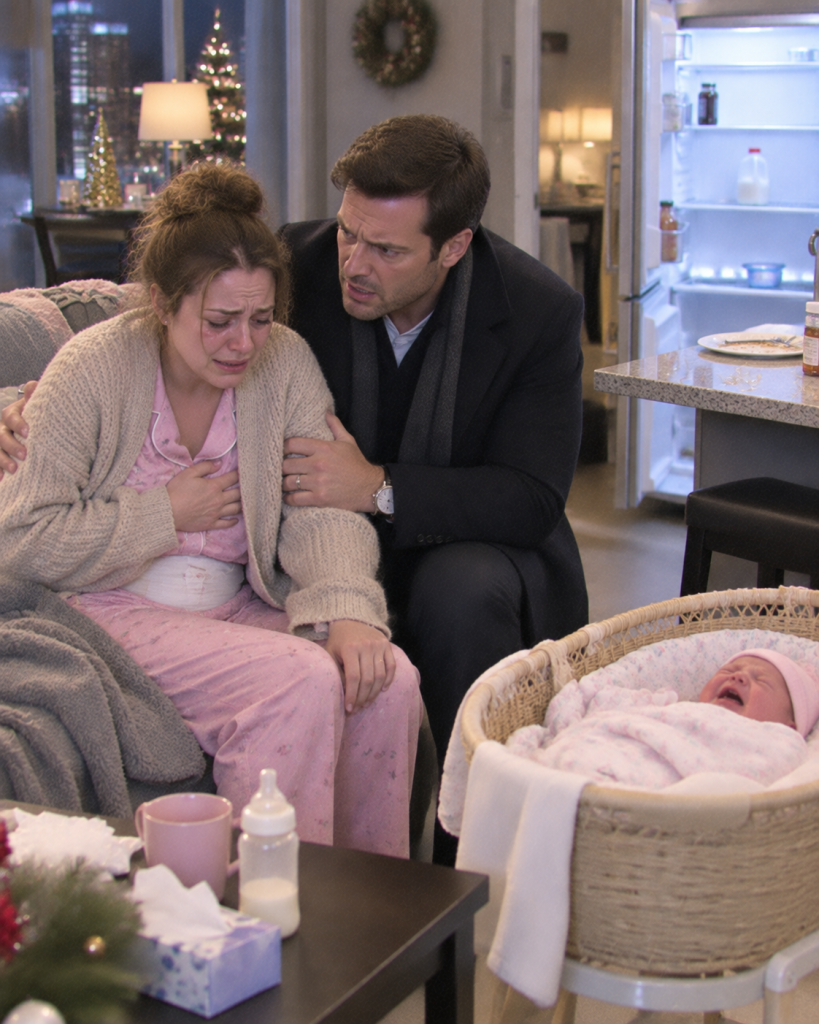
Maya was bent forward on a cheap plastic chair beside the table.
For one second, I thought she was asleep.
Then I saw her face.
Gray.
Dry lips.
Hair stuck against her forehead.
One hand was pressed across her lower abdomen.
A dark stain had spread through the fabric covering her incision.
On the table in front of her was a paper cup of instant noodles.
The broth had gone cold.
Liam was in his bassinet nearby.
He was wrapped in one thin blanket.
That was all.
“David…”
Maya’s voice was so faint that I almost did not recognize it.
I crossed the room.
“Jesus, Maya.”
She looked at me as though I were the one who needed help.
“Why are you home?”
“I changed my flight.”
She immediately tried to stand.
“I’ll make you something.”
Her knees folded beneath her.
I caught her before she hit the floor.
That movement alone told me how bad things were.
Maya had always hated appearing helpless.
After surgery, she had apologized to nurses for needing assistance getting out of bed.
Now she could not support her own weight.
I lowered her carefully back onto the chair.
“Where’s Mom?”
Maya looked away.
“Where are Chloe and Mark?”
Nothing.
I felt the first hard edge of fear become anger.
“Maya.”
“They went to Miami.”
I thought I had heard her wrong.
“Miami?”
She nodded.
“For what?”
“A vacation.”
There are moments when your brain rejects information because accepting it would require changing your understanding of people you have known your entire life.
That was one of them.
My mother had gone to Miami.
My sister had gone to Miami.
They had left my wife alone eleven days after major surgery with a newborn.
I looked toward Liam.
Then back at Maya.
“Where’s the food?”
She tried to smile.
“I didn’t need much.”
That answer made my chest tighten.
“What have you eaten today?”
She looked at the noodles.
I looked at them too.
Instant noodles were not part of the recovery meals I had ordered.
“I asked for soup,” she said.
“Asked who?”
“Your mother.”
“And?”
Maya hesitated.
“She said women recovering from surgery should eat lightly so their bodies can cleanse.”
I stared at her.
My mother had never studied medicine.
She had never expressed any interest in postpartum nutrition.
But she had apparently decided she knew enough to restrict food from a woman recovering from abdominal surgery.
I walked to the refrigerator.
When I opened it, cold light fell across empty shelves.
For several seconds, I simply stood there.
The salmon was gone.
The steaks were gone.
The containers of broth were gone.
The fruit.
Milk.
Yogurt.
Prepared meals.
Juices.
Vitamins.
Even the prescription formula I had ordered for Liam.
I checked the freezer.
Almost empty.
Then I noticed a piece of paper taped inside the refrigerator door.
My mother’s handwriting was unmistakable.
Sharp letters.
Straight lines.
The kind of note that looked like an instruction before you even read it.
We went to South Beach to celebrate New Year’s with Chloe, Mark, Ethan, and his family.
There should be something in the pantry if you are hungry.
Do not call David and pretend you are being mistreated. He is working hard for all of us.
I read it twice.
Then a third time.
The sentence that disturbed me most was not the part about Miami.
It was the warning.
Do not call David.
That meant my mother had considered the possibility that Maya would tell me what was happening.
She had anticipated it.
And she had tried to stop it before she left.
Maya reached for my sleeve.
“Please.”
I turned.
“Please what?”
“Don’t call her.”
I could barely believe the request.
“She left you here like this.”
“She’ll say I turned you against them.”
“Maya—”
“She always says that.”
The words stopped me.
Always.
Not once.
Not after one argument.
Always.
I had been away for three days.
But Maya’s fear sounded older than seventy-two hours.
I looked around the room again.
Used diapers.
Empty glasses.
Cheap formula.
Cold noodles.
No heat I could feel.
And my wife trying to protect the feelings of the people who had abandoned her.
I did not call my mother.
Not because Maya asked.
Because I suddenly understood that a phone call would accomplish nothing.
My mother would explain.
Chloe would minimize.
Mark would claim he had no idea.
Then the three of them would coordinate their stories before I had even figured out what happened.
So I took photographs.
The refrigerator first.
Every empty shelf.
The note.
The pantry.
The noodles.
The formula container.
The apartment thermostat.
Then Maya’s clothing.
I was careful not to make her feel like evidence.
She was my wife.
But I knew enough from years of dealing with industrial failures that when something goes wrong, you document the condition before anyone has time to alter it.
“What are you doing?” she asked.
“Making sure nobody tells you later that this didn’t happen.”
Her eyes filled.
That was the first time she cried.
Not when I found her.
Not when she nearly fell.
When I told her I believed her.
I went to Liam.
His hands felt cold.
I took off my winter coat and wrapped it around him over the thin blanket.
Then I returned to Maya.
“We’re going to the hospital.”
“I’m okay.”
“No.”
“David, it’s New Year’s Eve.”
“I don’t care.”
“The emergency room will be crowded.”
“I don’t care.”
She tried to argue again.
I bent down and lifted her.
She weighed less than I remembered.
That scared me too.
I carried her downstairs while holding Liam carefully against my chest.
My suitcase remained in the apartment.
So did the chocolates.
So did Chloe’s perfume.
I no longer cared about any of it.
Outside, the city was already beginning to celebrate.
People in coats hurried toward parties.
Cars moved slowly through the streets.
Somewhere in the distance, someone shouted Happy New Year hours too early.
I got Maya and Liam into a taxi.
As we crossed toward the hospital, fireworks began flashing above the Manhattan skyline.
Maya leaned against me.
She was shaking.
I could feel the heat of fever through her clothing even while her hands remained cold.
Liam’s face was tucked against my chest.
I kept one hand against the side of his head.
With the other, I opened my banking app.
Four authorized users appeared beneath my primary account.
Me.
My mother.
Chloe.
Mark.
I removed three.
No speech.
No warning.
No final chance to explain.
I simply canceled their access.
The first declined purchase came less than ten minutes later.
I noticed the notification but did not open it.
Not yet.
First I checked the account activity.
The fourteen thousand dollars I had transferred was no longer fourteen thousand.
There were purchases I recognized.
Pharmacy.
Grocery delivery.
A meal service.
Then charges I did not.
Retail stores.
A restaurant.
Airport purchases.
Several transactions clustered around travel dates.
I felt something tighten behind my ribs.
Maybe there were explanations.
Maybe some charges belonged to expenses they had fronted for Maya.
Maybe.
But I had stopped accepting assumptions.
I needed records.
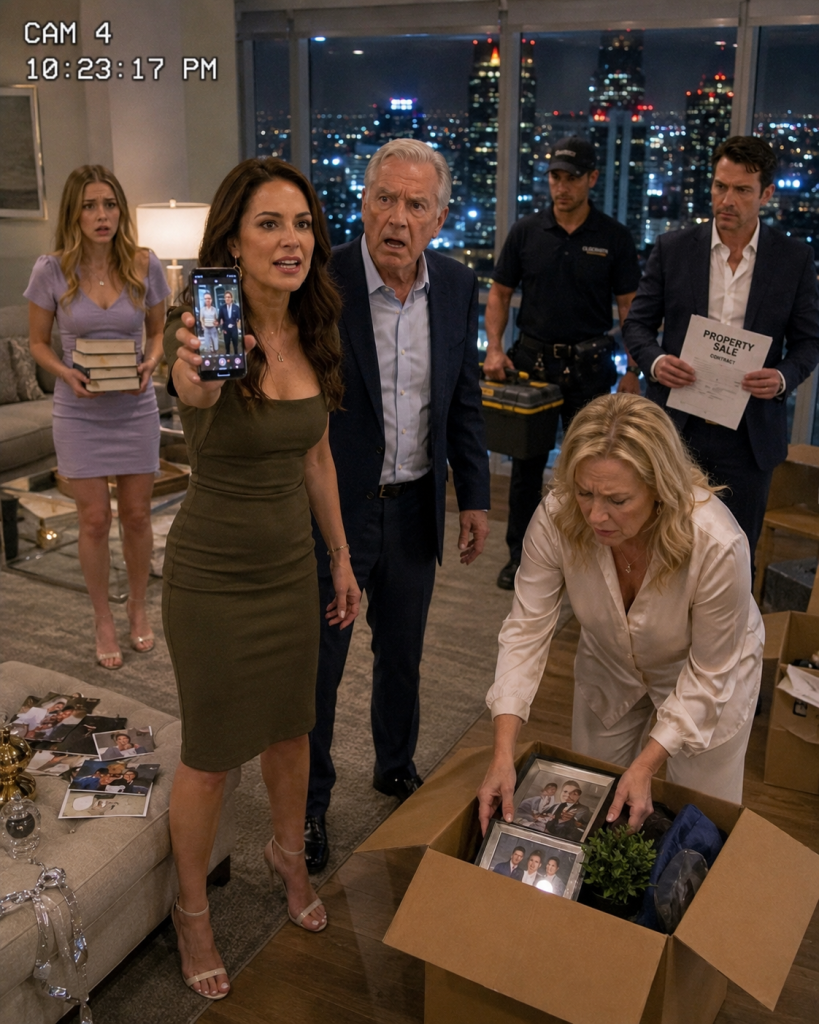
Then I remembered the cameras.
Our apartment had a basic security system.
Front door.
Hallway.
Living room entry.
We had installed it after packages repeatedly disappeared from the building.
I opened the app.
The first clip showed my mother leaving.
Eleanor wore the long cream coat I had bought her the previous Christmas.
She pulled a suitcase behind her.
Chloe came next.
Another suitcase.
Mark followed with luggage of his own.
They looked cheerful.
Not hurried.
Not guilty.
Just people leaving for a holiday.
I almost closed the app.
Then something caught my eye.
Eleanor had a shopping bag in her left hand.
I knew that bag.
It came from the specialty grocery store where I had ordered Maya’s prepared food.
I replayed the clip.
Paused.
Zoomed in.
The bag was full.
I switched cameras.
The hallway angle was better.
That was when I stopped thinking of their trip as simple selfishness.
They had not merely left the apartment.
They had carried things out.
One insulated grocery bag.
Then another.
Mark appeared with a cardboard box under one arm.
I recognized the printed shipping label.
Baby supplies.
Liam’s.
My jaw tightened.
I went backward through the recordings.
Earlier that afternoon, Chloe carried containers from the kitchen toward the entryway.
My mother followed.
Mark made another trip.
They loaded the bags beside their luggage.
Not leftovers.
Not garbage.
Not random groceries.
Items I had specifically purchased because my wife had just undergone emergency surgery and my son was eleven days old.
I watched the recording again.
Slower.
Maya appeared once in the background.
She was standing near the hallway in her cardigan.
One hand against the wall.
She said something the camera did not capture clearly.
My mother turned toward her.
Then pointed back toward the bedroom.
Maya disappeared from view.
My breathing changed.
I wanted to hear audio that did not exist.
I wanted to know exactly what had been said.
But the image was enough to establish one thing.
Maya had been there.
They knew she was there.
They knew the baby was there.
And they removed the supplies anyway.
I looked down at my wife.
She had fallen into an exhausted sleep against my shoulder.
For the first time, I noticed how loose the sleeve of her cardigan looked around her wrist.
How had I missed it on video calls?
Because she always positioned the camera above her shoulders.
Because she always told me she had eaten.
Because every time I asked whether my mother was helping, she said, “Everything’s fine.”
And because I had wanted to believe it.
That realization was harder to accept than the money.
I had built an entire safety plan around people Maya was afraid to contradict.
At the hospital, the staff took one look at her and moved quickly.
I gave them the timeline.
Emergency C-section eleven days earlier.
Poor intake.
Weakness.
Fever.
Possible incision complication.
Then I explained Liam had also been in a cold apartment with limited supplies.
A nurse took him for assessment.
Another helped Maya onto a bed.
When they wheeled her away, she reached for my hand.
“Don’t leave.”
“I’m not going anywhere.”
That was the easiest promise I had made all week.
I sat outside the treatment area with the security footage playing silently on my phone.
Then another declined-card notification appeared.
Miami Beach.
A luxury hotel.
I opened it.
A second declined transaction followed.
Then a third.
Within minutes, my mother called.
I watched her name on the screen.
I did not answer.
She called again.
Chloe called next.
Then Mark.
I let every call go unanswered.
Finally a text arrived from Eleanor.
David, your card isn’t working. Call me immediately.
No question about Maya.
No question about Liam.
No Happy New Year.
The card.
I took a screenshot.
Another message appeared.
We are in a very embarrassing situation at the hotel.
I saved that too.
Then Chloe texted.
Why did you cancel everything? Mom is freaking out.
Still nothing about my wife.
I opened the hallway footage again.
This time I started taking notes.
Time.
Person.
Object carried.
Direction of movement.
I had spent years documenting mechanical failures where millions of dollars could depend on whether a technician remembered the order of events correctly.
So I treated the footage the same way.
12:41 p.m.
Chloe leaves carrying two insulated food bags.
12:46.
Mark carries a baby-supply box and one suitcase.
12:51.
Eleanor exits with another suitcase and a tote.
12:53.
Maya appears briefly at the apartment door.
Eleanor turns back.
Maya retreats inside.
12:57.
Eleanor returns to the apartment alone.
1:06.
Eleanor exits again.
This time she is carrying something smaller.
A white envelope.
I paused.
Zoomed.
The image was not sharp enough to identify it.
I did not invent an answer.
I simply wrote down what I could prove.
White envelope.
Removed from apartment.
Then I backed up to the living-room camera.
At 12:55, my mother walked toward the desk where Maya and I kept household paperwork.
The camera angle did not show exactly what she touched.
Only that she remained there for several minutes.
My anger sharpened.
But anger was not evidence.
So I kept watching.
That was when a doctor came through the doors and sat beside me.
He told me Maya was being treated.
He told me they were concerned about her condition.
He told me I had done the right thing bringing her in when I did.
I asked about Liam.
He was being warmed and monitored.
Stable.
That one word nearly broke me.
Stable.
I put both hands over my face.
For several minutes, I did nothing.
No cameras.
No accounts.
No notes.
I just sat there and understood how close I had come to returning home later.
My original flight would not have landed for days.
Days.
The thought made me physically sick.
When I could think clearly again, I opened the security app one final time.
I downloaded the recordings instead of relying on cloud access alone.
Then I backed them up.
I saved the photographs.
The account records.
The card notifications.
My mother’s note.
Every text.
I still did not call them.
That bothered Eleanor more than anger would have.
By 1:00 a.m., the messages changed.
At first she demanded an explanation.
Then she accused Maya.
I know she told you some dramatic story.
Then Chloe.
We only left because Maya said she was fine.
Then Mark.
This is being blown way out of proportion.
Each message contradicted something visible in the apartment or on the recordings.
I saved all of them.
The next morning, when Maya was awake enough to talk for more than a few minutes, I sat beside her bed.
She looked embarrassed.
That alone told me how much damage had already been done.
“Why didn’t you call me?”
Her eyes filled.
“I tried once.”
My chest tightened.
“What happened?”
“Your mom heard me.”
I said nothing.
“She told me you were under enough pressure.”
Maya stared at the blanket.
“She said if I ruined your work trip because I couldn’t manage three days with my own baby, you would eventually get tired of me.”
For a moment, I could not speak.
“Did you believe her?”
“I didn’t want to.”
That answer was worse.
Maya told me she had asked for food.
She told me she had asked Eleanor not to take the prepared meals.
She told me Chloe said the groceries would go bad while they were away anyway.
She told me Mark carried out the baby supplies because Ethan’s family had forgotten things for their own trip and “we could replace them later.”
Later.
That word stayed with me.
My wife needed food now.
My son needed formula now.
But every decision had been made around the comfort of people leaving for Miami.
I showed Maya the footage.
Not all of it.
Only enough to ask whether she wanted copies preserved.
“Yes,” she whispered.
Then she looked at me.
“David, I don’t want revenge.”
“I know.”
“I just don’t want them to say I’m lying.”
“They won’t be able to.”
That was the line I cared about.
Not punishment.
Not humiliation.
Truth.
For years, my mother had controlled family conflict by controlling the story afterward.
What she said became what “really happened.”
If someone disagreed, they were emotional.
Ungrateful.
Dramatic.
This time there were timestamps.
There were images.
There were purchases.
There was her handwriting taped inside my refrigerator.
And there was a woman in a hospital bed who no longer had to argue alone.
I spent the rest of New Year’s Day organizing records.
The fourteen-thousand-dollar transfer.
Subsequent charges.
Food purchases.
Travel charges.
Card activity.
The camera clips.
I separated what I knew from what I suspected.
That distinction mattered.
I could prove supplies were removed.
I could prove authorized cards were used during the trip.
I could prove Maya was left at home while recovering.
I could prove my mother wrote the note.
Anything beyond that would need documentation.
By afternoon, Eleanor’s messages had become pleading.
Please call me.
Then:
We can explain everything when we get back.
Then:
Do not involve outsiders in a family issue.
That final message told me she understood exactly what the records looked like.
I stared at it for a long time.
Family issue.
As though family were a private court where consequences could be negotiated away.
I looked through the glass toward Maya’s room.
Liam was beside her.
For the first time since his birth, I was sitting close enough to watch my son sleep.
His tiny mouth moved occasionally.
One hand rested beside his cheek.
Maya looked exhausted, but there was more color in her face.
That was my family.
The definition became very simple.
Not blood.
Not obligation.
Not whoever demanded the most loyalty.
The people you protect when they cannot protect themselves.
That evening, I reopened the hallway footage.
The same clip.
The same luggage.
The same bags.
The same box.
But I saw it differently now.
On my first viewing, I had seen proof that my mother and sister were selfish.
After hearing Maya explain what happened, I saw something else.
Intent.
They knew the supplies were for her.
She had asked them not to take them.
They took them anyway.
I froze the frame showing Chloe carrying the insulated bags.
Then another showing Mark with the baby-supply box.
Then Eleanor returning from our desk area before leaving with the white envelope.
I could not yet say what was in it.
So I did not.
But I preserved that clip too.
The story would not be built on assumptions.
It did not need them.
What they had already done on camera was enough to destroy the version they were trying to tell.
My phone buzzed again.
This time, my mother did not call.
She sent one sentence.
You are going to regret embarrassing this family.
I read it once.
Then saved it with everything else.
For most of my life, Eleanor had believed the most powerful person in a family was the one willing to create the biggest scene.
That was why she expected me to shout.
Expected me to call.
Expected me to threaten.
Expected me to give her something she could point to later and say, See? David lost control.
Instead, I gave her silence.
And records.
When I finally put the phone down, Maya was watching me.
“What happens now?”
I moved my chair closer to her bed.
“First, you get better.”
“And your mother?”
I looked at Liam.
“Second, nobody gets access to you or him just because they share my last name.”
Maya closed her eyes.
A tear ran toward her temple.
I reached for her hand.
Outside the hospital windows, New York was cleaning up from another New Year’s Eve.
Confetti still clung to sidewalks.
People were waking with headaches and photographs from parties.
Hundreds of miles south, my mother, sister, and brother-in-law were inside a luxury hotel wondering why their cards no longer worked and why I refused to answer.
They still believed the worst thing waiting for them was an angry son.
They were wrong.
I had stopped being angry enough to argue.
I was documenting.
The empty refrigerator.
The fourteen thousand dollars.
The handwritten warning.
The condition I found Maya in.
The supplies carried down the hallway beside their vacation luggage.
The transactions.
The messages.
The camera footage.
Everything had a time.
Everything had a record.
And whatever explanation they eventually offered would have to survive all of it.
That was the moment their New Year’s vacation stopped being a family argument.
It became a timeline.
And I had every frame.