Three military academy cadets shattered my nineteen-year-old daughter’s jaw in six places, then laughed because they thought their uniforms and powerful families made them untouchable.
What they did not know was that the quiet father standing beside her hospital bed had once commanded one of the most feared classified special operations units in the U.S. Army.
And they had just dragged me out of retirement.
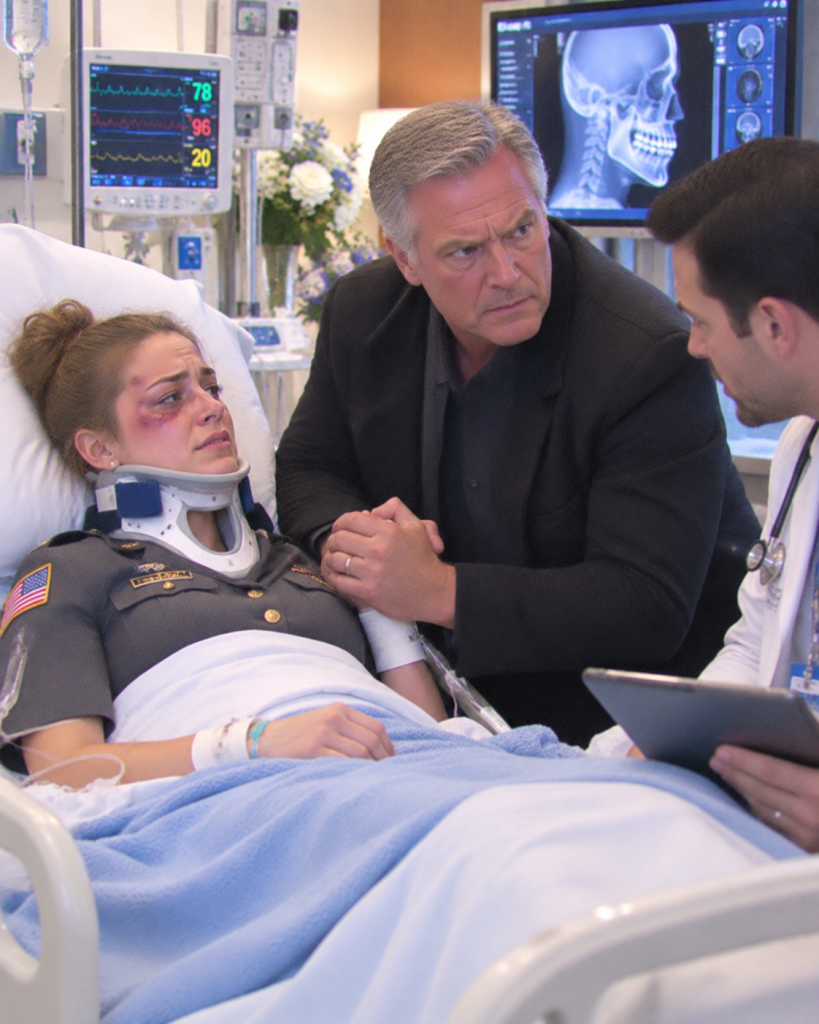
The Army surgeon stood beside a glowing X-ray, studying the fractures for another few seconds before he finally turned toward me.
His expression had the careful restraint of a man who had delivered bad news many times and still hated doing it.
“Colonel Walker,” he said quietly, “this wasn’t meant to frighten her. Whoever did this wanted to destroy her.”
Destroy her.
Those two words stayed with me longer than any battlefield memory ever had.
I had heard men describe ambushes, casualties, failed missions, and impossible odds with less weight in their voices.
But this was Lily.
My daughter.
Behind the curtain, she lay beneath harsh hospital lights with her jaw wired shut.
Purple bruising surrounded her eyes, and swelling had changed the shape of the face I had known since the day she was born.
A monitor kept up its steady rhythm beside the bed.
When I reached for Lily’s hand, her fingers barely moved against mine.
That tiny movement almost broke something inside me that decades of military service never had.
I pulled the chair closer and wrapped both hands around hers.
“Daddy’s here,” I whispered.
Her eyelids fluttered.
She could not answer.
For nineteen years, I had hidden who I really was.
To Lily, I was Daniel Walker, a widowed father and retired Army logistics officer who lived an intentionally ordinary life.
I burned pancakes often enough that she had started keeping cereal nearby as a backup plan.
I forgot birthdays unless I put reminders in my phone.
I bought the wrong laundry detergent, complained about grocery prices, and had a habit of checking every door twice before bed.
Whenever Lily asked about my deployments, I gave her the safest pieces.
Long flights.
Bad coffee.
Too much paperwork.
People I missed.
I never told her there had been another version of me.
Inside certain rooms at the Pentagon, people had once called me the Ghost Commander.
I had led a classified joint task force whose assignments rarely appeared in records ordinary soldiers would ever see.
Our photographs disappeared from files.
Our movements were buried beneath layers of authorization.
Our orders stayed sealed.
The people on my team were not legends, no matter what younger operators sometimes called them.
They were disciplined professionals who understood that the most important missions were usually the ones nobody ever heard about.
Marcus Reed had been my intelligence officer.
There were others whose names I had trained myself not to say outside secure rooms.
For years, my life had been measured in windows of opportunity, incomplete information, controlled risk, and the quiet understanding that one overlooked detail could cost someone everything.
Then Lily was born.
The first time I held her, she wrapped a hand around one of my fingers and refused to let go.
I remember staring at that tiny hand and understanding, with uncomfortable clarity, that there was finally something in my life I could not place beneath duty.
Her mother died years later, and after that, the choice became even simpler.
Lily deserved a father.
Not a shadow who vanished for months and returned unable to explain where he had been.
Not a name whispered inside secure rooms.
Not a man who spent every family dinner calculating exits without realizing he was doing it.
So I walked away.
I let Daniel Walker, retired logistics officer, become the only version of me my daughter knew.
And eventually, I almost believed that was all I was anymore.
Standing beside Lily’s hospital bed, I realized the old instincts had never disappeared.
They had simply been sleeping.
The hospital had called me at 11:47 that night.
I remembered the exact time because I had been standing in my kitchen with a glass of water when my phone rang.
The voice on the other end asked whether I was Daniel Walker, father of Lily Walker.
There are questions that divide your life into before and after.
That was one of them.
Lily had been found behind the science building at Franklin National Military Academy.
Campus police claimed there were no witnesses.
The security cameras had supposedly failed.
Nobody could explain how three patrols missed an injured nineteen-year-old lying less than fifty yards from the commandant’s residence.
Individually, any one of those details could have had an innocent explanation.
Together, they formed a pattern.
I had spent too much of my former life studying patterns to ignore one simply because I wanted the truth to be less ugly.
The campus police officer who first spoke to me kept repeating the same phrases.
Ongoing review.
Technical malfunction.
No confirmed witnesses.
Every answer sounded polished enough to have been rehearsed before I arrived.
I did not accuse him of anything.
People reveal more when they believe you are accepting their explanation.
So I listened.
I asked short questions.
I remembered every answer.
Then a military police captain approached me carrying Lily’s torn academy sweatshirt inside an evidence bag.
“Sir, this is everything recovered from the scene.”
He held it out with both hands.
He would not meet my eyes.
His shoulders were rigid.
That alone proved nothing.
The evidence seal did.
I turned the bag slightly beneath the corridor light.
Someone unfamiliar with evidence handling might never have noticed it.
But I knew what a compromised seal looked like.
I had seen enough of them overseas to recognize the smallest disturbance around the edge.
The adhesive had been lifted and reseated.
Not enough to tear the label.
Enough to open the bag.
I looked at the captain again.
“Has anyone else handled this?”
His answer came too quickly.
“Not since it was logged, sir.”
I said nothing.
Silence was useful when somebody had already decided to lie.
He shifted his weight.
I accepted the bag.
Inside was Lily’s sweatshirt, torn along one side and stained from the attack.
She had worn it the last time we spoke.
I remembered teasing her because she owned nicer clothes but seemed determined to live in that sweatshirt whenever academy rules allowed it.
She had rolled her eyes and told me it was comfortable.
Now I was holding it inside an evidence bag that someone had already opened without explanation.
I examined the lining carefully.
Something was caught inside the torn fabric.
A small scrap of paper.
Bloodstained.
Folded once.
I eased it free.
Three names were written on it.
Ethan Cole.
Brandon Hale.
Tyler Whitmore.
I read them twice.
Then a third time.
Not because I had forgotten them.
Because I wanted to make sure anger was not making me see something that was not there.
It wasn’t.
These were not ordinary cadets.
Even before Lily was attacked, I knew the names in the vague way people around military institutions knew certain families.
Money.
Influence.
Military history.
Connections that made people become careful about what they said and who might hear them saying it.
That did not make the young men guilty.
The scrap of paper alone did not prove who had attacked Lily.
But it changed the question.
Why had Lily written their names down?
And why had someone opened the evidence bag before handing it to me?
The answers began to take shape from what little Lily had been able to communicate and from the pieces already surrounding the attack.
She had seen something involving the three cadets that they wanted hidden.
She had threatened to report them.
Whatever happened afterward had not been random.
The surgeon’s words returned to me.
Whoever did this wanted to destroy her.
Not frighten her.
Not warn her gently enough to leave doubt about the message.
Destroy her.
They had expected the footage to disappear.
They had expected witnesses to forget what they saw or decide they had seen nothing at all.
They had expected complaints to be buried beneath procedure and uncertainty.
And they had expected my daughter to wake up afraid enough to stay silent.
That assumption was the part I understood best.
Power becomes dangerous when people stop thinking of it as power and start thinking of it as immunity.
Someone had apparently decided that the right last name, the right uniform, and the right family connections could turn violence into an administrative inconvenience.
Maybe they expected Lily’s father to arrive angry, frightened, and confused.
Maybe they expected me to demand answers from people who had already prepared answers for me.
Maybe they expected me to accept a failed camera system, invisible witnesses, missed patrols, and a disturbed evidence seal as four unrelated pieces of bad luck.
I looked through the glass toward Lily’s room.
Her hand rested motionless against the white sheet.
Something in me became very calm.
That calm had frightened people before.
Not because it meant I was going to hurt someone.
Because it meant I had stopped reacting and started thinking.
There would be no threats.
No shouting in hallways.
No dramatic confrontation with three cadets whose families might already be expecting one.
Anger was easy to anticipate.
Questions were harder.
Records were harder.
Patterns were harder.

People who believed themselves protected often became careless because everyone around them had learned not to look too closely.
I intended to look closely.
I stepped into the hallway outside Lily’s room and reached into my coat.
For nineteen years, a small black phone had stayed locked away with possessions from a life I had promised myself was over.
I had kept it for reasons I never explained, even to myself.
Maybe part of me knew that certain doors, once opened, never truly disappeared.
The phone was old.
Its casing was worn smooth at the corners.
I turned it on.
The battery still held a charge.
There was only one encrypted number stored inside.
For a moment, my thumb hovered over it.
Calling that number meant crossing a line I had spent nineteen years refusing to approach.
I thought about Lily learning to ride a bicycle while I ran beside her pretending I wasn’t terrified she would fall.
I thought about high school graduation photographs.
I thought about her first week at the academy, when she called me annoyed because I had texted three times before lunch to ask whether she had eaten.
Then I looked through the glass again.
The hesitation disappeared.
I pressed call.
A man answered after one ring.
For several seconds, neither of us spoke.
There are voices you can go decades without hearing and still recognize before the first full word.
“Commander?”
Marcus Reed.
My former intelligence officer.
He sounded older.
So did I.
But the way he said that one word pulled nineteen years into a single breath.
“I need three cadets investigated.”
There was no reunion in his response.
No surprise wasted on questions that could wait.
His tone changed instantly.
“How deep?”
I looked through the glass at Lily.
Her hand remained still against the white sheet.
The bruising around her eyes looked almost black beneath the hospital lights.
I remembered the X-ray.
Six fractures.
I remembered the captain refusing to meet my eyes.
The disturbed evidence seal.
The three names.
The cameras that failed.
The patrols that somehow saw nothing.
“Everything,” I said. “Bank accounts. Communications. Deleted footage. Academy complaints. Witness transfers. Every person who helped keep this quiet.”
Marcus did not ask me why.
That was one of the reasons he had once been very good at his job.
He understood context before other people finished explaining it.
And he knew me well enough to understand something else.
If I had called that number after nineteen years, then whatever had happened was already far beyond an ordinary disciplinary problem.
I could hear him moving on the other end of the call.
Not rushing.
Working.
The sound brought back memories I had spent years teaching myself not to revisit.
Maps spread across tables.
Names connected by lines.
Information that meant nothing until one small inconsistency turned it into a pattern.
But this was not a battlefield.
That distinction mattered.
I was not calling Marcus to wage a private war.
I was calling him because someone had relied on darkness, missing records, intimidated witnesses, and family influence to keep the truth buried.
Truth could be uncovered without becoming the thing you were fighting.
That was the line I intended to hold.
For Lily.
For myself.
For the father I had chosen to become nineteen years earlier.
The Ghost Commander was supposed to be gone.
Maybe in every way that mattered, he still was.
The man standing outside that hospital room was not looking for revenge.
He was looking for the truth about why his daughter had been left broken behind a science building while an entire institution somehow failed to see anything.
And somewhere inside that academy were three young men who believed their names could protect them.
They believed a failed camera could erase what happened.
They believed witnesses could be persuaded to forget.
They believed complaints could disappear into the right hands.
They believed Lily would wake up too frightened to speak.
Most of all, they believed her father was simply Daniel Walker, retired logistics officer, worried parent, ordinary man.
They were right about one part of that.
I was her father before I was anything else.
That was exactly why I had made the call.
Marcus went quiet for a moment.
Then he asked one final question.
“Do you have anything to start with?”
I looked down at the torn academy sweatshirt still inside the evidence bag.
At the disturbed seal.
At the bloodstained scrap of paper concealed inside its lining.
At the three names Lily had managed to leave behind.
“Yes,” I said.
Because Lily had left behind more than a torn sweatshirt.