I had helped bring down trafficking networks, interrogated hardened criminals, and stepped through crime scenes that would leave most people sleepless for the rest of their lives.
He was calling from the holding area of the Franklin County Police Department.
“Natalie, please help me,” he whispered. “Your sister-in-law is lying about me. She told the police I attacked her with a baseball bat.”
I sat upright, the sheets sliding into my lap.
“And Eric?” I asked. “Where is your son?”
“He stood there,” Dad said. “He watched everything and didn’t say a word.”
A cold pressure settled into my stomach.
But my training took over before panic had a chance to.
Fear only matters if you turn it into action.
“Dad, listen carefully,” I said. “Do not answer another question. Do not sign anything. Do not agree to an evaluation. Do not let them separate you from legal counsel. I am coming.”
I threw on my tactical jacket, fastened my badge to my belt, and grabbed my keys.
The streets through Columbus were almost deserted, glowing beneath amber streetlights. While I drove, I forced myself to analyze the situation exactly as I would any federal investigation.
Eric’s silence didn’t sound like uncertainty.
It sounded planned.
If my father had genuinely attacked someone, my brother would have been terrified, defensive, or furious. Instead, he had remained silent while his wife constructed a story around an elderly man.
That meant this wasn’t simply a family dispute.
It was a setup.
And the motive seemed obvious.
Dad owned his home outright. He had retirement funds, investments, and a modest but valuable estate. If they could establish that he was dangerous, unstable, or mentally incompetent, they could gain control of everything.
They had overlooked one thing.
His daughter spent her career investigating people who thought they were smarter than the law.
The station smelled like stale coffee and disinfectant when I walked through the glass doors.
My father was hunched over in a plastic chair near the opposite wall. His skin appeared gray beneath the fluorescent lighting, and his shoulders looked smaller than I remembered them.
Across the room, my sister-in-law, Vanessa Brooks, stood near the front desk putting on a performance for the officers.
I went straight to the counter.
“I want that man moved into a private interview room,” I told the duty officer. “No further questions until a public defender is present.”
The officer looked up from his clipboard.
His nameplate said Samuel Porter.
Before he could answer, Vanessa turned to face me.
She held a crumpled tissue beneath one eye and let out a dramatic sob.
“You don’t understand,” she cried. “He snapped. He came at me with a bat. He is dangerous. He needs to be committed tonight before he hurts someone.”
She gestured toward a faint reddish mark on her shoulder.
I didn’t look at her.
I kept my attention fixed on Porter.
My phone started vibrating inside my pocket.
The caller was my aunt, Carol.
“Natalie, what is happening?” she asked the second I picked up. “Eric says your father has dementia. He says he became violent and attacked Vanessa.”
Uncle Raymond was muttering somewhere in the background.
Eric had already begun contacting relatives.
He was establishing a medical explanation before anyone had the opportunity to ask legal questions. If enough relatives repeated that Dad was confused or unstable, it would become much easier to frame every objection he made as further proof of mental decline.
“I have it under control,” I told Carol.
Then I hung up.
I turned back toward the desk.
“Officer Porter, dispatch a unit to my father’s house and preserve it as a potential crime scene. Record every additional statement Vanessa makes. Do not allow anyone to remove property from that residence.”
Porter let out a heavy breath.
“Ma’am, sit down and wait. This is a domestic matter. Local police can handle it without someone interfering.”
“I am not asking casually.”
I opened my credential case and set it on the counter.
The federal shield reflected the overhead lights.
Porter immediately straightened.
“I am directing you to preserve evidence connected to possible elder abuse, financial exploitation, false reporting, and unlawful restraint,” I said. “If you refuse, your name will appear in every report that follows.”
His expression shifted.
The irritation disappeared.
He picked up his radio and requested a patrol unit at the address.
I crossed the room to my father and placed a hand against his back.
“Come on, Dad. We are getting you out of here.”
He attempted to stand.
His knees gave way.
I caught him by the arm before he could fall.
The sleeve of his sweater slipped toward his elbow.
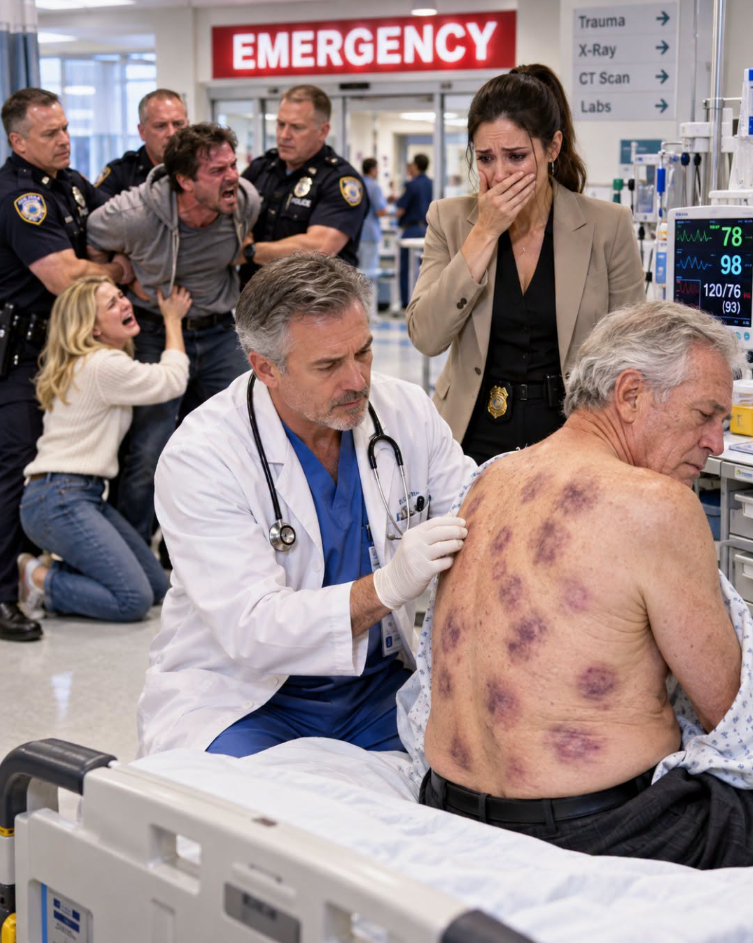
Dark purple bruises completely encircled both wrists.
They formed full rings.
Not random bruising.
Not injuries from a brief struggle.
Restraint marks.
Dad noticed me looking and quickly tugged his sleeve back down.
That tiny gesture told me everything.
He felt ashamed of what someone had done to him.
I immediately abandoned the plan to take him home.
Instead, I helped him into my government-issued SUV and drove directly to Riverside Medical Center.
The triage nurse took one look at him and moved him into a private trauma bay.
A physician named Dr. Hannah Price arrived only minutes later.
She checked his heart, blood pressure, hydration, and neurological responses while I stood beside the bed, fighting to keep my hands steady.
The findings were alarming.
Dad was severely dehydrated.
His heart rhythm was unstable.
Bloodwork indicated that he hadn’t received his prescribed cardiovascular medication for several days.
Dr. Price carefully lifted his arms and inspected the bruises around his wrists. She examined the damaged skin with a penlight.
Then she looked at me.
“Agent Brooks, these marks are not new,” she said quietly. “The color and tissue changes suggest they are between four and seven days old. They are consistent with prolonged pressure from narrow plastic restraints, most likely heavy zip ties.”
Anger surged through me so quickly that I became lightheaded.
I kept my voice steady.
“Photograph everything. Include measurements and a full medical report.”
I walked into the hallway and called Officer Porter.
“The hospital has confirmed prolonged restraint injuries,” I said the moment he picked up. “My father was likely bound with plastic ties and deprived of medication.”
Porter tried to respond.
I cut him off.
“You dismissed visible evidence of elder abuse while he sat in your lobby. If that house is not secured and your report is not corrected immediately, I will contact Internal Affairs and the county prosecutor before sunrise.”
His tone shifted.
“A sergeant is already there,” he said. “They are documenting the property now.”
I ended the call and went back into the trauma bay.
The IV fluids had brought some color back into Dad’s face.
He reached out and took my hand.
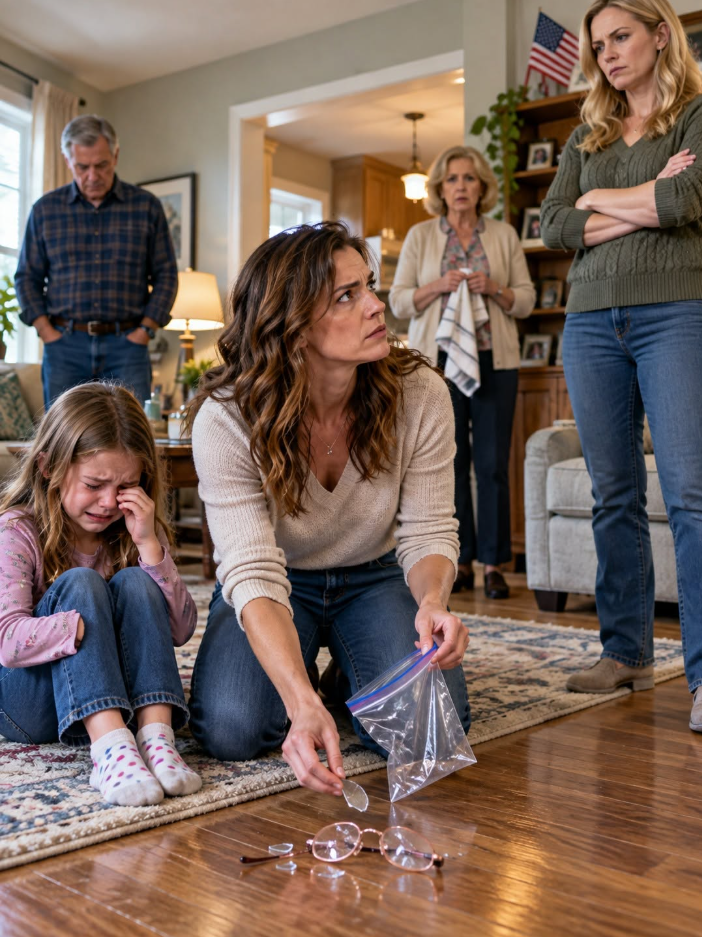
“Do not take me back there,” he whispered. “They locked me in the guest room. They shut off the water. They kept bringing me papers. I couldn’t read them because Vanessa took my glasses.”
His words came slowly, as though saying each one caused pain.
“How long?” I asked.
“I don’t know. Days. Eric said I had to sign everything or they would tell people I was losing my mind.”
I kissed his forehead and assured him that he was safe.
But my thoughts had already moved into investigative mode.
This wasn’t neglect.
It was coercion.
They had isolated him, withheld his medication, restrained him, and tried to force him to sign documents.
There would be records.
There always were.
I arranged for two officers I trusted to remain outside his hospital room.
Then I drove to the house where I had grown up.
When I unlocked the front door, the hallway was dark.
Someone stepped out from the shadows.
“What are you doing here?”
Eric was standing near the entrance to the living room.
He still wore the same clothes he’d had on at the station. Irritation showed on his face, but beneath it, I could see panic.
“This is Dad’s property,” I said. “I have his key and his permission.”
“You have no right to come in and start searching,” he snapped. “Vanessa and I are managing his affairs. His mind is gone.”
“I am preserving evidence.”
I moved past him.
“Interfere with me, and I will have you removed for obstruction.”
The house smelled stale.
Fast-food containers and wrappers covered the kitchen counter. Empty medication bottles sat near the sink, but none matched my father’s current prescriptions.
I opened the trash bin and removed the entire liner.
Eric stared at me from the doorway.
“You are digging through garbage now?”
I ignored him.
Near the bottom, buried beneath coffee grounds and discarded food containers, I discovered strips of shredded paper.
I spread the fragments over the kitchen island and started piecing them together.
Twenty minutes later, the pieces formed part of my father’s original will.
The pages had been ripped through the signature lines and sections identifying beneficiaries.
My name had been cut into pieces.
Underneath the shredded will, I discovered another document.
A General Power of Attorney.
The signature looked wrong immediately.
My father’s handwriting had always been smooth and exact.
This signature was shaky and uneven.
I checked the notary information using a secure state database.
The commission had expired three years before.
I placed the documents inside an evidence envelope.
Eric’s face turned pale.
“What is that?” he asked.
“You already know.”
By seven that morning, I was inside the federal digital forensics unit with our lead analyst, Maya Reynolds.
She scanned the Power of Attorney and confirmed the notary information.
“The seal is fraudulent,” she said. “The commission was invalid when this document was created.”
“I need the bank activity,” I told her. “Savings, retirement, investment transfers. Everything.”
We prepared an emergency subpoena request.
Within an hour, the bank’s fraud division provided the records through a secure channel.
Maya and I examined the transactions.
Three days earlier, $250,000 had been withdrawn from Dad’s retirement savings.
The money passed through a shell company, was divided into smaller transfers, and eventually reached several online gambling sites.
Maya highlighted the transaction path on her screen.
“The intermediary account is connected to Eric’s Social Security number,” she said. “They split the funds to avoid reporting thresholds.”
They hadn’t simply stolen his money.
They had tried to conceal the theft.
“Run Vanessa nationally,” I said. “Aliases, marriages, civil cases, property disputes.”
The results came back quickly.
Vanessa had used three different surnames across three states over the previous decade.
In each place, she had become involved with a man connected to elderly property owners.
There had been lawsuits involving deeds, inheritance papers, and access to bank accounts.
“She has a pattern,” Maya said. “She moves into a family, isolates the vulnerable person, gains control of the assets, and creates conflict when anyone challenges her.”
“Check the property listing database.”
Maya typed in Dad’s address.
The house had been listed for sale.
The listing had gone live less than forty-eight hours earlier.
The authorization paperwork contained the same forged signature.
They were trying to sell his house while keeping him confined inside it.
I collected the records and drove to County Prosecutor Elaine Harper’s office.
I placed the evidence file on her desk.
Forged documents.
Illegal transfers.
Previous civil cases.
The property listing.
Medical records.
Elaine reviewed it all without speaking.
“This is enough for elder exploitation, forgery, unlawful confinement, and financial conspiracy,” she said. “I am taking it directly to a judge.”
Two hours later, we had a signed no-knock warrant.
A state financial-crimes team assembled alongside federal digital specialists.
Our convoy headed toward Eric’s downtown Columbus office.
Officers covered the exits while I entered the glass-fronted building.
Eric was seated at his desk with real estate transfer documents displayed across two monitors.
He froze when he saw my badge and the officers standing behind me.
“Secure every computer, server, phone, and file,” I ordered.
Vanessa emerged from a private office.
She watched as agents began placing electronic devices into evidence boxes.
Then she smiled.
“You won’t find proof that I touched that old man,” she said. “The cameras in the house have been broken all week.”
“I am not interested in the camera recorder,” I replied.
Her smile faded slightly.
“I am interested in the router logs.”
The color drained from her face.
Modern home networks retain evidence far beyond what someone can see on a physical hard drive. Devices connect, transmit packets, upload data, and leave timestamps behind.
The team sealed laptops and phones inside signal-blocking evidence bags.
The property listing disappeared from the real estate portal as soon as we gained control of the office network.
Eric started crying in his chair.
The transaction was finished.
But I still needed evidence showing how Vanessa had manufactured the assault allegation.
Back at the forensics lab, Maya extracted the home router’s network records.
Hours went by.
Then she discovered an unfamiliar device.
“There is a hidden wireless camera connected to the network,” she said. “It appears to be disguised as a picture frame in the living room.”
The device operated on battery power and synchronized with the cloud.
Vanessa had disabled the visible cameras but apparently never realized the decorative unit remained active.
Maya requested the backup recording from the manufacturer’s server.
Video appeared on the monitor.
The timestamp showed 2:18 a.m.
Dad was sitting at the kitchen table with his face buried in his hands.
Vanessa entered carrying an aluminum baseball bat.
She approached him and leaned close to his ear.
Whatever she said caused him to recoil.
Then she backed away.
She slammed the bat against the granite countertop, leaving a visible dent.
Afterward, she lifted it and struck her own shoulder.
She fell to the floor and started screaming.
Eric entered the frame.
He stood in the hallway with his arms folded.
He watched his wife manufacture the injury they would use to accuse his father.
He did nothing.
The recording captured everything clearly.
The fabricated injury.
The staged damage from the weapon.
Dad’s confusion.
Eric’s participation.
I stared at my brother on the screen.
“You stood there,” I whispered. “You watched her do it.”
The case was complete.
Six months later, the courtroom fell silent while the prosecution presented the evidence.
The defense tried to portray the situation as a family conflict complicated by an elderly man’s declining health.
That argument collapsed when the video was shown.
The judge watched Vanessa hit herself while Eric stood nearby.
The defense attorney stopped talking.
The jury returned guilty verdicts on every major charge in under three hours.
At sentencing, Vanessa received up to eighteen years in state prison for elder exploitation, aggravated forgery, unlawful confinement, and abuse.
The judge characterized her conduct as planned, predatory, and cruel.
Eric received eight years for conspiracy, financial laundering, forgery, and failing to protect a vulnerable dependent.
He was ordered to repay the entire $250,000, along with additional restitution and court costs.
Officer Samuel Porter faced consequences as well.
Internal Affairs determined that he had ignored visible injuries, failed to preserve evidence, and tried to dismiss a mandatory elder-abuse report as an ordinary domestic dispute.
He was suspended without pay and later removed from duty.
Every fraudulent property document was invalidated.
The bank reversed the transfers that could still be recovered.
Dad’s house and remaining assets were returned to his legal control.
But he didn’t want the house anymore.
Too much had taken place inside those walls.
He said the rooms seemed smaller now.
The hallway reminded him of locked doors.
The guest room reminded him of thirst, terror, and plastic restraints cutting around his wrists.
We hired a legitimate broker and sold the house.
I updated his estate protections with an independent attorney, removing Eric from every will, trust, beneficiary designation, and future claim.
We packed only the things that mattered.
Family photographs.
Several books.
My mother’s old watch.
Dad’s favorite coffee mug.
Then I helped him settle into the passenger seat of my car.
He looked lighter than he had in months.
We left Columbus and headed east toward a quiet coastal town in North Carolina, where he could recover far from the people who had treated him like an account waiting to be drained.
As we crossed the state line, my phone rang.
Aunt Carol.
I stared at her name for a moment.
She had accepted Eric’s story without question.
She had repeated his claims about dementia.
She had pressured me to “keep the family together” before ever asking whether Dad was safe.
I declined the call.
Then I blocked her number, along with those of the relatives who had helped preserve the lie because believing it was easier than facing the truth.
Some bridges aren’t meant to be repaired.
Some families turn forgiveness into another instrument of control.
We continued driving.
The city disappeared behind us, together with the house, the forged paperwork, the courtroom, and the people who had mistaken my father’s age for weakness.
For the first time in a long while, he leaned back against the seat and closed his eyes without being afraid.
The road ahead was quiet.
And everything we had left behind stayed exactly where it belonged—in the rearview mirror.