For ten years, I lived with questions that had no answers.
What happened to my daughter?
Where had she gone?
Was she alive?
Did she remember me?
And, perhaps most painfully of all, what would she look like if I ever saw her again?
I had learned how to live without answers because there was no other choice.
Then, one ordinary afternoon, a new family moved in next door.
They introduced themselves politely. We exchanged smiles. We talked about the neighborhood, their move, and the new job that had brought them to town.
Everything was painfully normal.
Until their teenage daughter stepped outside.
I looked at her for three seconds.
Three seconds was all it took.
Then I whispered a name that nobody had used around her in ten years.
“Margot?”
The girl stopped halfway up their driveway.
She turned toward me.
“What?”
My husband, Greg, immediately looked at me.
“Nicole?”
I couldn’t answer.
Our new neighbors, Joan and Thomas, had come over that afternoon to introduce themselves. They had moved into the house three days earlier because Thomas had accepted a new job nearby.
Until that moment, the afternoon had been completely ordinary.
There were moving boxes scattered across their yard. Joan had apologized for the mess. Thomas had joked about how long it would take to unpack everything. Their teenage daughter, they had told us, wasn’t exactly thrilled about moving.
Then Joan called toward their house.
“Mia?”
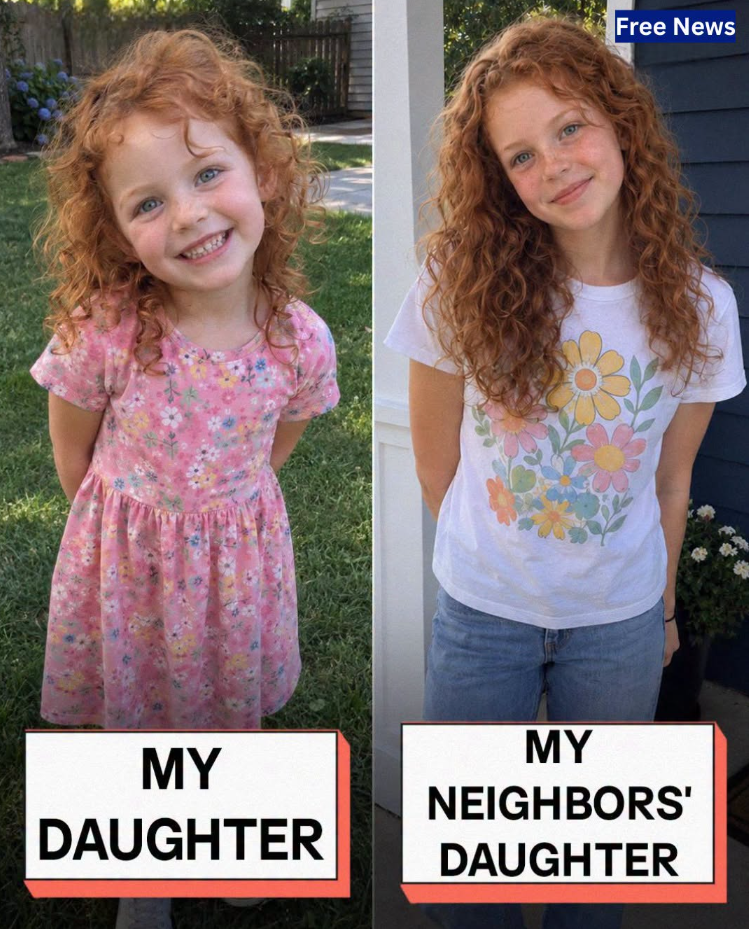
A fourteen-year-old girl appeared.
And for a moment, I forgot how to breathe.
It wasn’t simply her face.
It wasn’t even her eyes.
It was what she did with her hand.
Mia pressed her thumbnail against the side of her index finger.
Then she rubbed it twice.
Then she curled her fingers into her palm.
My heart slammed against my chest.
Margot had done that.
She had done it whenever she was nervous.
When she was four, I used to tease her about it. She would hide her hands behind her back because I kept telling her she was going to rub a hole straight through her finger.
Now, ten feet away, this fourteen-year-old girl was doing exactly the same thing.
“Margot?” I whispered again.
The girl took a step backward.
Thomas immediately moved between us.
“What’s going on?”
Greg grabbed my arm.
“Nicole, look at me.”
“Look at her hand.”
“What?”
“She’s doing it.”
“Doing what?”
Joan looked from me to her daughter.
Mia pulled both hands against her chest.
“What are you talking about?”
Then Joan’s face went completely white.
She looked at Thomas.
And she said something that changed our lives forever.
“We knew this day might come.”
Greg released my arm.
I stared at her.
“What did you just say?”
Thomas turned sharply toward his wife.
“Joan.”
I stepped off the porch.
“What does that mean?”
Joan swallowed hard.
“We didn’t take anyone’s child,” she said quickly.
Greg’s entire body stiffened.
“Then how do you know we had one?”
Joan looked at Mia.
Mia looked back at her mother.
“Mom?”
Joan took a shaky breath.
“Three weeks ago, I found Margot’s picture online.”
I felt as if the ground had disappeared beneath me.
Because ten years earlier, on an ordinary Saturday, my four-year-old daughter had vanished from our backyard.
And suddenly, the nightmare we’d lived with for a decade was standing ten feet away.
Ten years earlier, that Saturday had begun like any other.
I was inside making lunch.
Greg was outside playing hide-and-seek with our four-year-old daughter.
Their laughter drifted through the kitchen window.
I could hear Margot squealing as she ran around the yard.
“Eight!”
“Nine!”
“Ten!”
Then everything became quiet.
A few minutes later, Greg burst through the back door.
“Nicole, Margot’s gone.”
I actually laughed.
“She’s hiding, babe. She’s gotten really good at finding new places.”
His expression didn’t change.
“I’m serious.”
“Greg—”
“Nicole, Margot’s gone.”
Something inside me changed.
We searched the house first.
Then the shed.
Then the backyard.
Under the porch.
Behind the bushes.
Inside every place a four-year-old could possibly squeeze herself into.
Greg called her name until his voice became hoarse.
“Margot!”
“Margot!”
“Baby, where are you?”
Then I saw the back gate.
It wasn’t standing wide open.
It was resting against the latch.
“Greg.”
He followed my gaze.
Across the road was a bus stop.
I’d used that bus stop with Margot dozens of times.
And suddenly, every terrible possibility became real.
Within hours, police officers were everywhere.
Neighbors came outside.
Volunteers searched the surrounding streets.
People walked through parks, alleys, yards and fields.
Posters appeared with Margot’s smiling face.
Her photograph was everywhere.
For days, we barely slept.
For weeks, we waited for the phone to ring.
Then the weeks became months.
And slowly, the calls stopped coming.
Eventually, people stopped telling us, “They’ll find her.”
Instead, they started telling us that we needed to keep living.
I hated hearing those words.
How could I “keep living” when my child was somewhere in the world and I didn’t know where?
Eventually, Greg and I moved.
We couldn’t breathe normally in that house anymore.
Every room held a memory.
Every corner reminded us of what had been taken from us.
But moving didn’t make me stop searching.
I searched everywhere.
Stores.
Airports.
Playgrounds.
Crowded streets.
Whenever I saw a child who was close to Margot’s age, I automatically counted.
Every year on Margot’s birthday, I wondered what her face would look like.
Would she still have the same eyes?
Would she still rub her finger when she was nervous?
Would she remember me?
Would she know that I’d never stopped looking?
For ten years, I carried those questions.
Then a fourteen-year-old girl named Mia moved next door.
And she rubbed her finger exactly the way my little girl used to.
Joan took a breath.
“Thomas got work here,” she said. “So before we moved, I started reading about the area. Schools, neighborhoods, local history.”
She paused.
“That’s when I found the article.”
I stared at her.
“And you saw my daughter?”
“I saw her photograph.”
Joan’s voice trembled.
“The little girl looked so much like you did at four. The age matched. The timing matched.”
Thomas stepped closer to Mia.
“We thought it could be a coincidence.”
“We were going to get advice once we’d settled in,” Joan added.
Greg stared at them.
“You waited three weeks?”
“We didn’t know what to think.”
Thomas nodded.
“We had a photograph. We weren’t going to tell Mia she might be a missing child simply because two little girls looked alike.”
“Then we moved here,” Joan said.
Her eyes met mine.
“And you opened the door.”
Mia suddenly interrupted.
“And you opened the door.”
Everyone went silent.
She looked directly at us.
“Could everyone stop talking about me like I’m not standing here?”
Her voice wasn’t angry.
It was confused.
And she was right.
I swallowed.
“You’re right. I’m sorry.”
She folded her arms.
“And my name is Mia.”
The words hurt.
Not because she said them cruelly.
She didn’t.
They hurt because she was telling me something important.
She had a name.
A life.
A history.
Fourteen years that existed without me.
“Okay,” I said quietly.
“Mia.”
She studied my face.
Then Greg pulled me inside.
The door hadn’t even closed behind us before he spoke.
“We need proof.”
“I know.”
“Then we need proof now.”
He began thinking out loud.
“A glass. A hair. Anything.”
I looked at him.
“We are not secretly taking her DNA.”
His face tightened.
“Nicole, that’s our daughter twenty yards away.”
“We don’t know that.”
“Then let’s find out.”
“We are not secretly taking her DNA.”
“Then how?”
“By asking her.”
He stopped.
“She’s fourteen.”
“Exactly.”
For ten years, I would have sworn there was nothing I wouldn’t do for an answer.
But then I remembered Mia standing in our driveway while four adults talked about her like she was a mystery waiting to be solved.
“She’s not evidence,” I said.
Greg looked at me.
“What if she says no?”
That question stopped me.
I picked up my keys.
“Then we live with it until she’s ready.”
I walked next door before fear could convince me otherwise.
Joan opened the door.
“I need to ask Mia if she wants testing,” I said. “If she says no, this conversation ends.”
Joan stepped aside.
Mia was sitting on the couch with one leg tucked beneath her.
Thomas stood nearby.
I remained standing.
“Do you want to know whether there’s a connection?” I asked.
Mia studied me.
“You already think I’m her.”
“I think you might be.”
“But I don’t know.”
She stared at me.
“What’s the difference?”
I looked around the room.
Her shoes were kicked beneath a chair.
A backpack leaned against the wall.
A framed photograph showed Mia and Joan laughing beside a birthday cake.
This wasn’t temporary.
This was her life.
Then she asked the question that I wasn’t prepared for.
“If I am Margot, what happens?”
My first thought came immediately.
You come home.
I almost said it.
Instead, I looked at the room again.
“We figure it out.”
“Who decides?”
“You do.”
She looked at me.
“You get a say. In everything.”
Mia narrowed her eyes.
“You mean that?”
“Yes.”
“Even if you don’t like what I decide?”
“Yes.”
She was quiet for several seconds.
Then she agreed to proper testing.
While we waited, I asked Joan for every early record she had from before Mia came into their lives.
The following evening, Joan brought a folder to our dining room table.
“I’ve looked at these a hundred times,” she said.
“Then let’s look again.”
Mia stayed upstairs by choice.
I respected that.
Halfway through the folder, I found a report describing a young girl discovered asleep near the end of a bus route on the same afternoon Margot disappeared.
I pushed the paper toward Greg.
“Margot wouldn’t have gotten on a bus,” he said.
“There was a stop across from our house.”
I looked at him.
“But over the years, they stopped using it.”
“She was four, Nicole.”
“She’d ridden it with me.”
I remembered Margot once asking whether buses slept at night.
“She knew that bus, Greg.”
The report said the little girl had apparently boarded with several other passengers and was later found asleep near the end of the route.
She knew her first name.
She called her parents Mommy and Daddy.
But when authorities asked where she lived, her directions belonged to a four-year-old’s world.
The yellow house.
Across from the bus.
Near the tree with the swing.
Joan slid another page across the table.
“Her identifying information wasn’t consistent in the earliest records.”
I stared at the dates.
“And nobody connected her to Margot?”
Thomas shook his head.
“Not then.”
The records didn’t give us one clean explanation.
They gave us fragments.
Pieces.
Somewhere early in the process, wrong or incomplete information had followed the child from one record to another.
And somehow, the connection between the missing girl named Margot and the found girl who would become Mia had been missed.
Greg suddenly stood so quickly his chair scraped across the floor.
“So she was there?”
I looked at him.
“Greg.”
“She was somewhere safe while we were searching?”
His voice cracked.
“I was counting.”
I knew what he meant.
While Margot had walked through the gate, Greg had been standing in the yard counting to ten.
I reached for his wrist.
“You didn’t send her away.”
“I didn’t see her leave.”
“Neither did I.”
The records showed temporary care.
Then foster placement.
Eventually, Joan and Thomas became Mia’s legal parents.
Nobody at our table could explain how a missing child and a found child had remained separate for so long.
Nobody had stolen Margot.
Nobody had hidden her.
Something that should have been caught simply hadn’t been.
And another family had spent years loving the child on the other side of that failure.
That truth was harder to hate.
A few nights later, Joan and I sat together while Greg and Thomas compared copies of the records.
“I lost ten years,” I said.
Joan lowered her eyes.
“I know.”
“No.”
The word came out harder than I intended.
“You don’t.”
She looked at me.
After a moment, she nodded.
“You’re right.”
I hadn’t expected that answer.
Then she continued.
“But I had them.”
Her voice broke.
“Ten birthdays. Ten first days of school. I taught her to ride a bike. I stayed beside her when she was sick. I listened when she cried over friendships.”
She wiped her cheek.
“She calls me Mom.”
I didn’t know what to say.
“So please don’t ask me to pretend I’m not terrified too,” she whispered.
Jealousy hit me first.
Then something else.
Understanding.
Joan wasn’t afraid of me.
She was afraid of losing her daughter.
The same way I had been afraid of losing mine.
Mia came downstairs just as Greg held out an old stuffed bear.
“Do you remember this?”
Mia looked at it.
“No.”
“You slept with it every night.”
Greg turned the bear over.
“See this seam? Nicole repaired it three times.”
Mia stepped backward.
“I don’t remember.”
“Just look at it.”
Her thumbnail dug into her finger.
“Margot, please.”
Her face changed immediately.
“Don’t call me that.”
Greg froze.
“It is your name.”
“Greg,” I said quietly.
“If she’s ours—”
I stepped between them.
“She isn’t failing a test.”
He looked at me.
“I’m trying to help her remember.”
“No.”
My voice was firm.
“You’re asking her to make you feel remembered.”
The words landed hard.
Greg’s face crumpled.
I turned toward Mia.
“You don’t have to remember anything for us.”
She nodded once.
Greg sat down.
“I’m sorry.”
Mia didn’t answer immediately.
Then she said:
“Okay.”
Not forgiveness.
Not rejection.
Just enough.
The confirmation came two days later.
Mia was biologically ours.
Margot was alive.
Greg sat down.
Thomas put an arm around Joan.
Mia began crying.
Then she reached backward and grabbed Joan’s hand.
Pain went through me so quickly that, for a moment, I hated myself for feeling it.
Joan had been there for scraped knees.
School mornings.
Nightmares.
Birthdays.
Illnesses.
Every ordinary moment that I had missed.
Then Mia looked at me.
Slowly, she held out her other hand.
I took it.
I didn’t pull her toward me.
I didn’t tell her she was coming home.
I simply held on.
Finding Margot didn’t erase Mia.
And being her biological mother didn’t erase Joan.
My family struggled with that more than I did.
A week later, we held a small gathering at our house.
One relative pulled me aside near the porch.
“When does she come home?”
I looked at her.
“She lives next door.”
“You know what I mean.”
“When do you get her back?”
I looked over.
Mia was close enough to hear.
So was Joan.
“Don’t talk about her like she’s something that was borrowed.”
The relative lowered her voice.
“Nicole, they’re not her real parents.”
“They raised my daughter.”
“But she’s yours.”
“She is.”
I glanced toward Joan and Thomas.
“And she’s theirs.”
The room behind us went quiet.
“You don’t get to erase ten years of their love because I lost those years.”
Later that evening, Mia found me alone on the porch.
“Did you mean it?”
“Every word.”
She sat beside me.
“You really think they’re still my parents?”
“They are your parents, honey.”
She looked down.
Then came the question I’d been trying not to think about.
“Do you want me to live with you?”
Every selfish part of me screamed yes.
I wanted every day I’d lost.
Every birthday.
Every school morning.
Every scraped knee.
Every bedtime.
Every ordinary moment.
But I knew those years weren’t waiting for me somewhere.
They were already gone.
“I want every day I lost,” I admitted.
Mia looked at me.
I forced myself to continue.
“But those days aren’t yours to give back.”
She turned toward me.
“What does that mean?”
“It means you already have a life.”
I swallowed.
“You have parents. Friends. Memories. A name. I don’t want finding me to become another way you lose everything.”
Her eyes filled with tears.
“So I don’t have to choose?”
“No.”
“Even if I call Joan Mom?”
“Especially then.”
Mia rubbed her thumb against her finger.
This time, I didn’t tell her to stop.
Instead, I asked her what she wanted.
“So I don’t have to choose?”
She shook her head.
Then she looked at me.
“What do I call you?”
I smiled through my tears.
“Nicole works until you decide otherwise.”
Months later, Mia sat cross-legged on my living room floor while I opened Margot’s memory box.
Inside were the little things I had convinced myself were proof that she had existed.
A plastic bracelet.
A picture book.
One tiny shoe.
Mia picked up the shoe.
“My foot was that small?”
I laughed softly.
“Yes.”
Then she pulled out a ruffled dress and held it at arm’s length.
Her face twisted.
“No.”
I laughed again.
“What?”
“My foot was that small?”
“No. The dress.”
She looked at me.
“You hated it.”
I caught myself.
“Margot hated it.”
Mia smiled.
Then she looked back down at the dress.
“No. You were right the first time.”
I went still.
She smoothed the fabric across her knees.
“What happened when I wore it?”
For a moment, I couldn’t speak.
I looked at the fourteen-year-old sitting beside me.
Not the little girl I had spent ten years trying to preserve in my mind.
Not the stranger who had walked up my driveway.
My daughter.
Mia.
“You really want to know?”
She leaned against the couch.
“Tell me.”
So I did.
I told her about the shoes she’d kicked off under the table.
How she’d hidden behind Greg because she hated having her picture taken.
How she’d spilled juice on the dress twenty minutes later.
And how she’d looked absolutely delighted about it.
Mia laughed.
Then she asked another question.
And another.
For ten years, I had imagined getting Margot back exactly as I had lost her.
Four years old.
Running through the gate.
Calling me Mom.
Life hadn’t given me that miracle.
It had given me something harder.
A daughter who had grown up.
A daughter who loved another mother.
A daughter who had memories I wasn’t part of.
A daughter who had a name she had chosen to keep.
And somehow, once I stopped trying to drag her backward, there was finally room for us to move forward.
Mia handed me the dress.
“Keep going.”
“With what?”
“The stories.”
So I did.
Because I wasn’t waiting for Margot to come home anymore.
I was finally getting to know Mia.