THE WOMAN THEY LEFT OUTSIDE
“Mom, please stay out here.”
For a moment, I thought I had misheard my daughter.
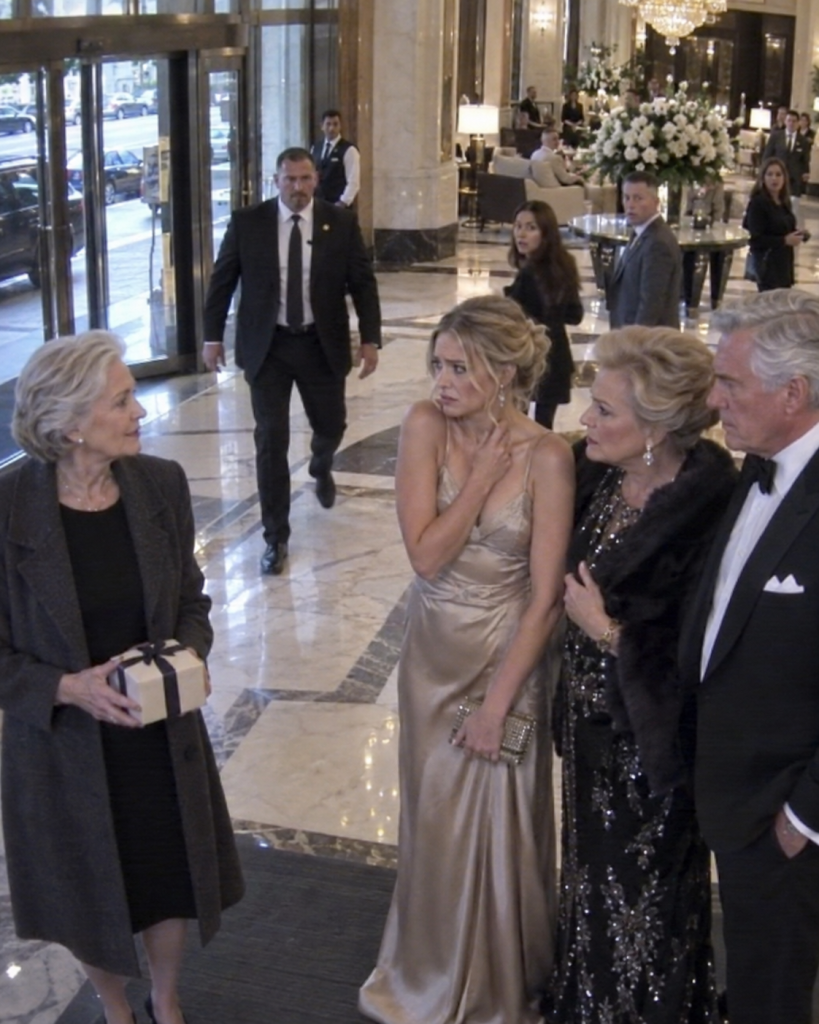
The wind had picked up between the downtown buildings, tugging at the lapels of my old charcoal wool coat and carrying the smell of rain across the hotel’s marble entrance.
Behind Valeria, the revolving glass doors turned slowly beneath a canopy of warm golden light. Inside, I could see polished brass, winter flowers, and guests crossing the lobby in evening clothes.
My daughter stood less than three feet from me.
She was twenty-nine years old, beautifully dressed in a midnight-blue gown I had helped her choose two weeks earlier. Her dark hair was swept back from her face, and the small diamond earrings I had given her on her wedding day caught the light whenever she moved.
I searched her expression for some sign that this was a joke.
There was none.
“Stay outside?” I repeated.
Valeria glanced toward the people standing behind her.
Her husband, Mauricio.
His parents, Humberto and Beatriz Vega.
And two couples I recognized from the anniversary dinner guest list.
Beatriz drew her faux-fur wrap closer around her shoulders and smiled with the satisfaction of someone who believed an awkward problem had finally been solved.
“Elena,” she said, “we’re simply trying to avoid embarrassment.”
I looked at her.
“Whose?”
Her smile sharpened.
“Everyone’s.”
Humberto adjusted the cuff of his tuxedo.
“This is one of the most exclusive hotels in Denver,” he said. “The rooftop restaurant doesn’t exactly operate like a neighborhood café.”
“I’m aware.”
That answer seemed to amuse him.
Beatriz looked at my coat, then my flat leather boots.
“You may not realize how expensive tonight is.”
I said nothing.
“The dinner alone costs more than most people make in a week,” she continued. “Possibly more than you make in a month.”
Mauricio gave a small uncomfortable laugh.
Not because it was funny.
Because he did that whenever his mother said something unkind and he wanted the room to believe it was harmless.
I turned to my daughter.
I expected her to stop this.
That expectation lasted until she stepped closer and touched my sleeve.
“Mom.”
Her voice dropped.
“Please.”
I looked into her eyes.
She would not quite meet mine.
“Please what?”
“Don’t make this difficult.”
The cold wind moved between us.
Valeria glanced toward the glass doors.
“Mauricio’s parents reserved the rooftop for their anniversary. Their friends are coming. People from his father’s business circle. It’s formal.”
“I know what formal means.”
“That’s not what I meant.”
“Then say what you meant.”
Her face tightened.
Behind her, Beatriz exhaled impatiently.
Valeria lowered her voice another degree.
“You don’t fit here tonight.”
There it was.
Not my coat.
Not the invitation.
Not a misunderstanding.
Me.
You don’t fit here.
I had spent sixty-two years learning that the most revealing sentences often arrived quietly.
People raised their voices when they wanted to win.
They lowered them when they wanted to say something they knew was shameful.
I looked at my daughter for several seconds.
Then I nodded.
“I understand.”
Relief appeared on her face so quickly that it almost hurt more than the sentence itself.
“Thank you.”
I stepped backward.
Beatriz smiled.
“That’s probably best.”
Humberto opened the door for his wife.
Mauricio touched Valeria’s lower back and guided her toward the lobby.
My daughter looked over her shoulder once.
I do not know what she expected to see.
Tears, perhaps.
Anger.
A sixty-two-year-old woman standing on a downtown sidewalk wondering where she could find a cheaper restaurant.
Instead, I smiled faintly.
“Enjoy your dinner.”
Then I turned away.
They entered the hotel laughing.
I walked twelve steps toward the curb.
Stopped beneath a streetlamp.
And took out my phone.
My name is Elena Morales.
For most of my life, I have preferred comfortable shoes, simple coats, and cars I can park without worrying about who is watching.
That preference has confused people.
They assume wealth has a costume.
It does, sometimes.
So does insecurity.
I learned the difference early.
I was twenty-one when I started working as an assistant bookkeeper for a small apartment-management company in Albuquerque.
I had a community-college accounting certificate, one navy skirt suitable for an office, and a toddler who refused to sleep through the night.
Valeria was not that toddler.
Her older brother, Tomas, was.
I had children young, worked young, divorced young, and discovered very quickly that nobody was coming to build security for me.
So I built it.
Not all at once.
One duplex.
Then another.
A worn four-unit building nobody wanted because two bathrooms needed rebuilding and the roof leaked into the upstairs hallway.
I learned mortgages.
Insurance.
Taxes.
Tenant law.
Renovation budgets.
The price of copper pipe.
The difference between a cosmetic problem and a structural one.
I learned to sit across from men twice my age while they explained my own spreadsheets to me.
I learned to wait until they were finished.
Then I corrected the math.
By thirty-five, I owned interests in twenty-seven residential units.
By forty, I had moved into small commercial properties.
At forty-three, after a recession pushed several hospitality assets into distress, I bought my first small hotel with two partners.
People told us we were crazy.
Maybe we were.
The lobby carpeting was burgundy.
The plumbing belonged in a museum.
Half the rooms had televisions with boxes deep enough to function as furniture.
But travelers still needed beds.
Businesspeople still needed meeting rooms.
Families still attended weddings.
Buildings could be repaired.
Bad numbers could not.
Our numbers worked.
The hotel became profitable in three years.
We bought another.
Then another.
By my mid-fifties, Northgate Hospitality and Property Group had become a private company with apartment buildings, mixed-use developments, three boutique hotels, two conference properties, and minority positions in several restaurants.
My personal wealth grew far beyond anything I had expected when I was twenty-one balancing rent receipts during lunch.
Very few people outside my professional circle knew the full extent of it.
That was intentional.
Northgate had executives.
General managers.
Property directors.
A chief financial officer whose picture appeared in business magazines more often than mine.
I preferred boardrooms to interviews.
Contracts to charity galas.
Ownership to recognition.
My children knew I had done well.
They knew I invested in property.
They knew I could help when necessary.
But I never gave them a number.
Tomas understood me.
He became an engineer, moved to Seattle, and seemed mostly relieved that my money did not require him to become part of my company.
Valeria was different.
She loved beauty.
Style.
Rooms where everyone seemed to know which fork to use.
There was nothing wrong with that.
The problem began when she started confusing appearance with character.
Mauricio Vega accelerated it.
She met him at twenty-six.
He was handsome, polished, and extremely good at moving through social settings without ever appearing uncertain.
His father, Humberto, owned a regional import business that had been successful fifteen years earlier and had become increasingly dependent on borrowed money as competition changed.
I knew that because I looked.
Not because I planned to interfere in my daughter’s marriage.
Because I had spent forty years reading balance sheets, and Humberto spent too much time telling strangers how wealthy he was.
Truly secure people rarely led with numbers.
Humberto led with restaurants.
Cars.
Watches.
Private clubs.
Which families he knew.
Which neighborhoods he considered respectable.
Beatriz was the same.
The first time we met, she asked me where I lived before asking what I did.
“Outside Golden,” I said.
“Oh.”
Her eyes dropped to my boots.
“Do you have land?”
“A little.”
“How charming.”
I smiled.
She assumed I had a modest house in the foothills.
I did.
She did not ask about the apartment complex I owned twelve miles away.
Or the downtown office building.
Or the hotel group.
So I did not volunteer the information.
At dinner, Humberto asked, “What line of work were you in, Elena?”
“Property.”
“Residential?”
“Some.”
He nodded with the indulgence of a man who thought I might own a rental condo.
“Real estate is difficult at a small scale.”
“Yes.”
I almost laughed.
Valeria heard it.
She kicked my ankle under the table.
Later, in the car, she said, “Why didn’t you explain?”
“Explain what?”
“What you actually do.”
“They didn’t ask.”
“Mom.”
“What?”
“You let them think you manage little rentals.”
“I do manage rentals.”
“That’s not all.”
“No.”
“So why not say it?”
I looked at her.
“Why does it matter?”
She became frustrated.
“Because they judge people.”
“Then telling them I have money wouldn’t make them judge less.”
She looked out the window.
“It would make them respect you.”
That sentence worried me.
“Valeria.”
“What?”
“If someone needs my financial statement before offering basic respect, I don’t want the upgraded version.”
She did not answer.
Two years later, she stood outside one of my own hotels and asked me not to enter because my coat embarrassed her.
Life has a sense of humor.
The hotel was called the Marlowe House.
Northgate had purchased it four years earlier through a holding company.
It occupied a restored stone building near Union Station, with seventy-eight rooms, a rooftop restaurant, a small ballroom, and one of the prettiest winter terraces in the city.
I loved the property.
Not because it was our most profitable.
It was not.
Because the renovation had been difficult enough to become personal.
We preserved the original marble staircase.
Restored brass elevator doors that another owner wanted to replace.
Kept the old carved molding in the lobby even though contractors complained for months.
I knew which boiler had been replaced.
Which suite had a plumbing issue during reopening week.
Which rooftop heaters failed whenever wind came from the west.
The staff did not all know me.
They did not need to.
But Raymond Ramirez did.
Raymond had been general manager for fifteen years.
He had managed two properties before the Marlowe and had the rare ability to make a dissatisfied guest feel heard without promising anything unreasonable.
I trusted him completely.
I tapped his name.
He answered quickly.
“Ms. Morales?”
“Good evening, Raymond.”
A pause.
“You’re here?”
“Yes.”
“Where?”
“Front sidewalk.”
Another pause.
“What?”
I looked through the glass.
Beatriz and Humberto were crossing the lobby toward the elevator.
Valeria stood beside Mauricio.
“I seem to have encountered a misunderstanding regarding the rooftop anniversary reservation.”
Raymond’s voice changed.
“Are you all right?”
“I’m fine.”
“Did the front desk fail to recognize—”
“No.”
I kept my eyes on my daughter.
“I haven’t made it to the front desk.”
Raymond waited.
That was one of his strengths.
He never filled silence merely because it existed.
I said, “Would you come downstairs?”
“I’m on my way.”
“Raymond.”
“Yes?”
“Alone is fine.”
Another pause.
“Understood.”
I put my phone away.
I did not want a spectacle.
The evening had already contained enough performance.
Two minutes later, the elevator doors opened in the lobby.
Raymond crossed the marble floor.
Dark suit.
Silver tie.
Hotel pin at his lapel.
The concierge manager followed several steps behind, apparently because Raymond had been in a meeting when I called.
He saw me outside.
His face tightened.
The doorman opened the door.
Raymond stepped onto the front landing.
“Ms. Morales.”
I smiled.
“Good evening.”
“I wasn’t told you were attending tonight.”
“Neither, apparently, was I.”
He frowned.
Before he could ask more, Beatriz’s voice carried from inside.
“Mr. Ramirez?”
She and Humberto had stopped near the elevators.
Humberto walked back toward us.
Valeria followed.
Mauricio came last.
Raymond turned.
Humberto smiled with strained confidence.
“Good evening. We’re the Vega anniversary party.”
“Yes, Mr. Vega.”
Humberto looked at me.
Then at Raymond.
“There seems to be some confusion. This woman was trying to join our private event.”
Raymond did not immediately respond.
That tiny pause changed the atmosphere.
Humberto continued.
“We explained that our reservation was exclusive.”
Beatriz approached.
“Elena is our daughter-in-law’s mother. She misunderstood the nature of the evening.”
Valeria’s face had gone pale.
She knew Raymond’s name.
Everyone who planned a major event at the Marlowe knew the general manager’s name.
But she did not yet understand why he had walked outside for me.
Raymond looked at me.
“Ms. Morales, would you like to handle this, or would you like me to?”
Silence.
Beatriz blinked.
“Handle what?”
I could have answered.
Instead, I looked at Raymond.
“Would you clarify?”
“Of course.”
He turned toward the group.
“Ms. Morales is principal owner of Northgate Hospitality, which owns the Marlowe House.”
Nobody moved.
The revolving door continued turning behind us.
Somewhere near the front desk, a guest laughed.
A suitcase rolled across marble.
Ordinary sounds became strangely loud.
Beatriz’s face emptied.
Humberto looked at Raymond.
Then me.
Then the hotel.
Mauricio whispered, “What?”
Valeria did not say anything.
Her eyes stayed on mine.
Raymond continued because facts, once started, tend to finish themselves.
“She is also chair of the property group that operates this hotel and the rooftop restaurant.”
Humberto gave a short laugh.
Not amusement.
Reflex.
“That can’t be right.”
Raymond’s expression remained professional.
“It is.”
Beatriz looked at my coat again.
I watched her do it.
That detail remains one of my sharpest memories.
Same coat.
Same boots.
Same woman.
Three minutes earlier, those things had proved I did not belong.
Now they were apparently confusing.
“Mom,” Valeria said.
I turned toward her.
Her mouth opened.
Closed.
“Why didn’t you tell me?”
I almost smiled.
“Tell you what?”
“That you owned this place.”
“You knew Northgate owned hotels.”
“I didn’t know this one.”
“You never asked.”
Mauricio looked at her.
“You knew her company owned hotels?”
Valeria’s eyes flicked toward him.
“I knew she invested in them.”
Humberto’s voice sharpened.
“This is ridiculous.”
Raymond looked at him.
“Mr. Vega.”
“No. We have forty guests arriving. We paid a deposit. We reserved the entire terrace.”
“That’s correct.”
He looked toward me.
“Ms. Morales?”
There are moments when money tempts you into becoming the worst version of what other people imagined.
It would have been easy to cancel everything because I could.
Easy to let them stand on the sidewalk while their guests arrived.
Easy to make embarrassment symmetrical.
I did not want symmetry.
I wanted truth.
“Raymond, was the reservation made properly?”
“Yes.”
“Is the account current?”
“Yes.”
“Has anyone in the party violated hotel policy inside the property?”
He considered.
“Not that I’m aware of.”
“Then the reservation stands.”
Beatriz stared at me.
Humberto seemed surprised.
Even Raymond looked at me for half a second before nodding.
“Of course.”
I turned toward Valeria.
“I won’t attend.”
“Mom.”
“No.”
Her eyes filled.
“Please.”
I looked at the woman who had told me ten minutes earlier that I did not fit.
“This is your evening.”
“It’s their anniversary.”
“Yes.”
“Then come upstairs.”
I shook my head.
“Not because Raymond told you who I am.”
Her expression collapsed.
“Mom, I didn’t mean—”
“You meant exactly what you said.”
Mauricio stepped forward.
“Mrs. Morales—”
“Elena is fine.”
He stopped.
I looked at all four of them.
“I’m not canceling your dinner. I’m not embarrassing your guests. I’m not asking anyone to leave.”
Beatriz’s shoulders relaxed slightly.
Then I continued.
“But I will not sit at a table where my daughter believed I needed wealth to earn a chair.”
The relief disappeared.
Valeria looked down.
Humberto said, “This was simply a misunderstanding.”
“No.”
I turned toward him.
“A misunderstanding is getting the reservation time wrong.”
I gestured toward my coat.
“You understood exactly what you were doing.”
His face reddened.
I kept my voice even.
“You thought I had less money than you.”
He said nothing.
“And you believed that gave you permission to speak to me differently.”
Beatriz looked toward the lobby.
Several people were watching discreetly.
I lowered my voice.
“This conversation is over.”
Then I looked at Raymond.
“Please make sure their guests receive normal service.”
“Absolutely.”
I stepped toward the curb.
“Mom.”
Valeria followed me.
I stopped.
Behind her, Mauricio’s parents remained near the entrance.
Raymond returned to the lobby.
Valeria wrapped both arms around herself.
The wind moved through her dress.
“I’m sorry.”
The words came quickly.
Too quickly.
I studied her.
“What are you sorry for?”
She stared.
“Everything.”
“That’s not an answer.”
Her eyes filled.
“I was embarrassed.”
“I know.”
“I didn’t want them judging me.”
There it was.
Finally.
Not judging me.
Judging her.
Because of me.
I waited.
“They’ve made comments since Mauricio and I started dating.”
“What comments?”
“About how you dress. Where you live. That you’re… private.”
“Private?”
She winced.
“They said it looked like I came from a different background.”
“You do come from a different background.”
“That’s not what they meant.”
“I know.”
She looked toward the hotel.
“I should have defended you.”
“Yes.”
“I thought if I corrected them, they’d think I was trying to impress them.”
“So instead you let them disrespect me.”
Her tears escaped.
“Yes.”
I did not hug her.
That was difficult.
Every instinct in a mother wants to move toward a crying child, even when the child is twenty-nine and the tears arrive because she finally sees what she has done.
But comforting her immediately would have turned her pain into my responsibility.
Not everything belongs to the person who can carry it.
Valeria wiped her cheek.
“Are you going home?”
“Yes.”
“Can I call you tomorrow?”
“No.”
She looked up.
“When?”
“When I’m ready.”
Her face changed.
She had never heard that answer from me.
For most of her adult life, access to me had been assumed.
She could call.
Ask.
Need.
I answered.
That night, I went home alone.
My house was outside Golden on five quiet acres with cottonwoods at the edge of the property and a view of the foothills from the kitchen.
It was not a mansion.
It was beautiful because I liked it.
Stone fireplace.
Old oak floors.
A kitchen designed for cooking rather than photographs.
Comfortable furniture.
No room existed simply to impress someone walking through it.
I took off my coat.
Hung it on the same wooden peg I had used for twelve years.
Then I made tea.
My phone vibrated continually.
Valeria.
Mauricio.
Unknown numbers.
Eventually, Humberto.
Then Beatriz.
I turned it facedown.
At eleven, Tomas called from Seattle.
I answered.
“Hey.”
“Valeria called me.”
Of course.
“What did she say?”
“She said she may have made the worst decision of her adult life.”
I looked into my tea.
“That sounds dramatic.”
“She is your daughter.”
“Fair.”
Tomas became quiet.
“You okay?”
“Yes.”
“No, like actually.”
I thought about it.
“I’m disappointed.”
“That’s worse than angry.”
“Usually.”
He sighed.
“Do you want me to call her?”
“No.”
“Do you want me to tell you I always thought Mauricio’s parents were exhausting?”
“That is information I could have used earlier.”
“I assumed you knew.”
I smiled faintly.
“I knew.”
Another pause.
Then Tomas said, “Mom?”
“Yes?”
“Did you really let them keep the rooftop?”
“Of course.”
He laughed.
“What?”
“Nothing.”
“Tomas.”
“You are terrifying.”
“I did nothing.”
“Exactly.”
I smiled.
After we hung up, I opened the small drawer beside my desk.
Inside was a stack of personal account summaries and documents related to financial assistance I had given Valeria over the previous two years.
Not gifts hidden inside loans.
Real gifts.
When she and Mauricio bought their condo, I paid the down payment.
Two hundred thousand dollars.
I did not put my name on the deed.
I did not demand repayment.
I wanted my daughter to have security.
When they furnished it, I offered a supplementary expense card with a low monthly limit for household emergencies.
I expected appliances.
Repairs.
Medical costs.
I rarely reviewed individual purchases because I trusted her.
The statement sitting in my drawer suggested I had been careless.
Restaurants.
Clothing.
Club dues.
Weekend travel.
Luxury purchases.
Nothing illegal.
Nothing hidden technically.
But the card had become lifestyle support.
I thought about Beatriz telling me the dinner cost more than I made in a month.
Some of that lifestyle had been indirectly financed by me.
The irony was almost elegant.
The next morning, I called my chief financial officer.
“Morning, Elena.”
“Morning, Mark.”
“Everything okay?”
“Yes.”
“I need the supplementary family card attached to my personal account closed at the end of this billing cycle.”
“Valeria’s?”
“Yes.”
A pause.
“Do you want us to dispute anything?”
“No.”
“Reduce the limit?”
“No. Close it.”
“Understood.”
“And pull the condo file.”
“The Denver unit?”
“Yes.”
That condo was not mine.
The down payment had been a gift.
But Northgate owned the building’s commercial ground floor and had helped negotiate certain preferred financing through a partner bank.
I wanted to know exactly where my financial involvement ended.
Not so I could remove their home.
I could not, and I would not have even if I could.
I simply wanted every invisible support separated from every obligation.
Mark understood.
“I’ll have the documents by noon.”
At ten, Raymond called.
“How did the event go?” I asked.
“Professionally.”
That was Raymond language.
“Any trouble?”
“No. Mr. Vega became noticeably quieter.”
I smiled.
“And the guests?”
“Enjoyed dinner.”
“Good.”
There was a pause.
Then Raymond said, “Ms. Morales?”
“Yes?”
“I’m sorry about what happened at the entrance.”
“You didn’t cause it.”
“I know.”
He hesitated.
“But our staff saw part of it.”
“I assumed.”
“They were uncomfortable.”
“So was I.”
He became quiet.
I added, “Please make sure nobody turns it into gossip.”
“Already handled.”
“Thank you.”
After the call, I went to the office.
Northgate’s headquarters occupied three floors of a renovated warehouse in RiNo.
My office was not the largest.
It had windows.
A long table.
Two bookcases.
A photograph of Tomas and Valeria as children.
In the picture, Valeria was seven.
She had lost both front teeth.
She sat on my lap wearing a purple sweater and holding a stuffed rabbit.
I stared at that photograph longer than I meant to.
Nobody raises a child expecting one day to become ashamed of you.
But children grow into adults inside influences you cannot control.
The people they marry.
The rooms they want to enter.
The approval they decide they need.
Somewhere between the girl with missing teeth and the woman in the blue dress, Valeria had started believing status could protect her from judgment.
I wondered if I had contributed.
I had raised my children with money but tried not to make money central.
Maybe I had gone too far.
I talked about effort.
Work.
Responsibility.
I rarely explained what we owned.
I wanted them to develop without wealth becoming identity.
Tomas responded by becoming fiercely independent.
Valeria responded by becoming curious about the social signals I had deliberately ignored.
Perhaps secrecy creates mythology.
The thought bothered me.
At noon, Mark delivered the condo file and a summary of my support.
I read every page.
The down payment had been unconditional.
Good.
The household card was mine and could be closed.
Good.
There was one additional recurring payment I had forgotten.
Homeowners association fees.
I had paid them automatically as part of the original moving support.
Nearly eighteen months.
I stared at the line.
I had told Valeria I would cover them for the first year.
She had never reminded me to stop.
I had never noticed.
That was my responsibility too.
I called Mark.
“Stop the HOA payments after this month.”
“Okay.”
“Send Valeria notice that the assistance arrangement is ending. Keep it simple.”
“Want me to mention yesterday?”
“No.”
Financial boundaries do not need emotional footnotes.
By early afternoon, Beatriz called again.
This time I answered.
“Elena.”
Her voice had lost its usual polish.
“Beatriz.”
“Thank you for taking my call.”
I waited.
“I owe you an apology.”
“Yes.”
A small silence.
“I behaved terribly.”
“Yes.”
Another.
“You’re not going to make this easy.”
“I’m listening.”
She exhaled.
“We misjudged you.”
There it was.
I closed my eyes.
“You still don’t understand.”
“What?”
“The problem is not that you misjudged my net worth.”
Silence.
“The problem is that you believed a woman with less money deserved worse treatment.”
Beatriz did not answer.
I continued.
“If I had been exactly who you thought I was—a retired bookkeeper in an old coat—everything you said would still have been wrong.”
Her voice softened.
“You’re right.”
I waited.
No defense followed.
That surprised me.
“I’m embarrassed,” she said.
“That belongs to you.”
“I know.”
Another surprise.
Then she said, “Can we begin again?”
“No.”
The word came easily.
I heard her inhale.
“We can begin from here,” I added. “That’s different.”
“How?”
“Beginning again pretends yesterday did not happen.”
She was quiet.
“From here means you remember it.”
After we hung up, I felt neither triumphant nor cruel.
Just tired.
Humberto did not apologize.
He sent a message through Mauricio saying his comments had been “taken too seriously.”
That told me everything I needed.
I did not respond.
Valeria came to my office three days later.
She did not announce herself.
My assistant called.
“Your daughter is downstairs.”
I looked at the calendar.
“I don’t have anything scheduled.”
“I told her.”
“What did she say?”
“She said she’ll wait.”
I almost said send her away.
Then I looked at the photograph on my shelf.
“Give me ten minutes.”
When Valeria entered, she looked different from the woman outside the hotel.
Jeans.
White sweater.
Hair tied back.
No makeup I could see.
She carried a folder.
I gestured toward the chair.
She sat.
For a moment, neither of us spoke.
Then she placed the folder on my desk.
“I got the notice.”
Financial support ending.
The card.
HOA.
I nodded.
“I figured.”
Her eyes filled.
“I’m not here to ask you to keep paying.”
“Good.”
“I didn’t realize you still were.”
That was possible.
“Then you should have.”
She looked down.
“You’re right.”
I waited.
She opened the folder.
Inside were printed account statements.
A budget.
Credit-card balances.
Mortgage information.
My daughter had inherited something from me after all.
She had made a spreadsheet.
“I went through everything.”
I looked at the numbers.
Their financial position was not catastrophic.
But it was worse than I expected.
They earned well.
They spent better.
Luxury car lease.
Club membership.
Restaurants.
Travel.
Credit cards carrying balances.
Installment furniture payments.
Humberto had helped Mauricio enter a business venture that was not producing much cash.
Valeria looked at me.
“We’ve been living too high.”
“Yes.”
Her mouth tightened.
“You knew?”
“I suspected.”
“Why didn’t you say something?”
I almost laughed.
“You were twenty-nine.”
“So?”
“I don’t audit adult children unless they ask.”
She nodded.
Fair.
Then she said, “Beatriz and Humberto are worse.”
“I know.”
“How?”
“Public records.”
Her eyebrows lifted.
“Mom.”
“What?”
“You investigated them?”
“I looked.”
“That is investigating.”
“Fine.”
Despite everything, a tiny smile appeared between us.
It disappeared quickly.
Valeria touched the edge of the folder.
“Mauricio grew up believing they were wealthy.”
“They were comfortable.”
“He thought the business was worth millions.”
“It may have been once.”
“He didn’t know how much debt there was.”
“That doesn’t surprise me.”
“He’s furious.”
“At them?”
“At himself.”
That surprised me.
Valeria looked at the floor.
“I think that’s why they care so much about appearances.”
“Probably.”
“I started doing it too.”
I said nothing.
“I liked people thinking we were doing well.”
“You were doing well.”
“You know what I mean.”
“Yes.”
She looked at me.
“And I started thinking you made me look… less.”
There it was.
The truth I had waited for.
Her voice cracked.
“I hate saying that.”
“I imagine.”
“You never cared about any of that.”
“No.”
“That made me embarrassed sometimes.”
“I know.”
“I thought it meant you didn’t understand.”
I leaned back.
“Understand what?”
“How people look at you.”
I considered that.
“Valeria, I understand exactly how people look at me.”
“Then why don’t you care?”
I smiled faintly.
“Because I spent forty years learning the invoice attached to caring too much.”
She looked at me.
I continued.
“Approval is expensive.”
“How?”
“You buy the car.”
“The clothes.”
“The dinner.”
“The apartment.”
I tapped her budget.
“And then you discover the people whose approval you purchased require a renewal.”
Valeria looked down.
Tears fell onto her hand.
I gave her a tissue.
Not a hug.
Not yet.
She wiped her face.
“I told you to stay outside your own hotel.”
“Yes.”
“I can’t stop hearing it.”
“Good.”
She looked startled.
I softened my voice.
“Not because I want you to suffer.”
I gestured between us.
“Because regret is useful when it changes the next decision.”
She nodded.
“I don’t want to be like them.”
“Then don’t.”
“How?”
“You already know how.”
She waited.
“Next time someone at a door looks poorer than you, remember who you were at the Marlowe.”
Her face folded.
“I’m so sorry.”
This time, the apology had weight.
Not because she cried.
Because she finally understood what required apology.
I stood.
So did she.
Then I hugged my daughter.
She held on for a long time.
I did not restore the card.
I did not restart the HOA payments.
Love is not proved by canceling consequences.
If anything, those boundaries helped.
Valeria and Mauricio cut expenses.
The club membership disappeared.
The luxury car was traded for something more sensible.
They stopped traveling for almost a year.
Mauricio took a harder look at his father’s business and chose not to invest additional money.
For the first time, he began building his career separately from Humberto.
That caused tension.
Then growth.
Beatriz changed slowly.
Not perfectly.
She still cared too much about where people vacationed.
But the next time we saw each other, she complimented my old wool coat.
I stared at her.
She laughed nervously.
“That sounded terrible, didn’t it?”
“Yes.”
“I’m trying.”
“I noticed.”
Humberto remained Humberto.
He avoided me for months.
Then, unexpectedly, I saw him at the Marlowe.
He was not there for a party.
He had a lunch meeting.
I was crossing the lobby with Raymond when Humberto stepped from the elevator.
We stopped.
For a second, all three of us remembered the entrance.
“Good afternoon,” I said.
“Elena.”
He looked at Raymond.
Then back at me.
“I won’t take much of your time.”
I waited.
“I was out of line that night.”
Progress, perhaps.
“Yes.”
He swallowed.
“I had things going badly in the business.”
“I know.”
His face changed.
“Of course you do.”
I smiled.
“I read.”
He looked almost amused.
Then serious.
“I spent a lot of years making sure nobody knew when I was worried.”
“That sounds expensive.”
He nodded.
“It was.”
No grand apology.
No transformation.
But enough truth to make the conversation human.
“You have a lunch,” I said.
“Yes.”
“Enjoy it.”
He hesitated.
“Thank you.”
Then he walked away.
Raymond looked at me.
“What?”
“You’re kinder than people assume.”
“I don’t know whether that’s a compliment.”
“It is.”
We continued toward the elevator.
A year after the anniversary dinner, Northgate held its annual leadership retreat at the Marlowe.
Valeria came.
Not as my daughter.
As a guest speaker.
After the hotel incident, she had begun working with a nonprofit that taught financial literacy to young couples.
At first, I thought she was overcorrecting from guilt.
Then she became serious about it.
She studied.
Completed coursework.
Worked with counselors and financial planners.
Used her own mistakes carefully, without turning her husband or his parents into villains.
Her session was called Lifestyle Without the Performance.
I sat in the back row.
She did not introduce me.
I appreciated that.
Halfway through, she said something I wrote down.
“If you need someone to believe you’re doing well, you eventually start making financial decisions for their eyes instead of your own life.”
I smiled.
She had learned.
Afterward, she found me in the lobby.
“How was I?”
“Good.”
“Just good?”
“You want feedback or praise?”
She laughed.
“Both.”
“Your third slide has too much text.”
“Mom.”
“And you rushed the example about revolving credit.”
“I knew bringing you was a mistake.”
“You didn’t bring me. I own the room.”
She stared.
Then we both started laughing.
The sound echoed across the lobby.
One of the bellmen smiled.
I thought about the previous year.
Same marble.
Same glass.
Different daughter.
Different mother too.
Because I had learned something.
I spent decades believing discretion protected my children from entitlement.
It did, partly.
But silence had consequences.
Valeria knew I worked.
She did not fully understand what I had built.
That vacuum allowed other people to tell her what success looked like.
I had never explained why I chose simple clothes.
Why I kept my old SUV for eleven years.
Why I lived in a comfortable house instead of the grandest house I could afford.
I assumed values could be taught by example alone.
Sometimes they need words.
After the retreat, Valeria and I drove to my house together.
She looked around the kitchen.
“You could have lived anywhere.”
“Yes.”
“You really like this place.”
“I do.”
“Why?”
I looked toward the back windows.
Cottonwoods moving.
Foothills darkening beneath evening light.
“Because I can hear myself think.”
She nodded.
Then she smiled.
“I used to think you stayed here because you were stuck in your ways.”
“I am stuck in my ways.”
“That’s not the point.”
“No.”
She opened the refrigerator.
“There’s no food.”
“There is food.”
“You have eggs, mustard, cheese, and half a lemon.”
“I eat at the office.”
“You own hotels with kitchens.”
“That is not the same thing as groceries.”
She laughed.
We ordered Thai food.
While we waited, she noticed the old wool coat hanging beside the door.
“The coat.”
“Yes.”
“You still wear it.”
“It’s warm.”
“I offered to buy you another one.”
“I own other coats.”
“Why that one?”
I shrugged.
“I like it.”
She touched the sleeve.
“I used to hate it.”
“I know.”
“It embarrassed me.”
“I know.”
She looked at me.
“Can I tell you something awful?”
“You already told me to stay outside my own building. The bar is high.”
She smiled sadly.
“I used to think if you dressed differently, people would understand I came from something successful.”
I leaned against the counter.
“And now?”
“Now I think if they can’t understand that without the coat, I don’t need them understanding anything about me.”
I nodded.
“That’s expensive wisdom.”
She laughed.
“I paid for it.”
“No.”
I smiled.
“I stopped paying for it. That’s different.”
Our dinner arrived.
We ate from containers at the kitchen island.
No rooftop.
No champagne.
No guest list.
My daughter told me about a couple in one of her workshops who had financed two luxury cars while carrying credit-card balances because they were afraid friends would think they were struggling.
I told her about my first duplex and the mustard cabinets.
She had never heard the story.
That surprised me.
Then I realized how many stories I had withheld because I did not want my children thinking wealth defined our family.
In avoiding the subject, I had also hidden the work.
So I told her.
The bookkeeping job.
The first broken furnace.
The motel with burgundy carpet.
The banker who told me a woman with children might find commercial lending “too demanding.”
The partner who quit halfway through our first hotel renovation.
The night I slept in an office because pipes froze and flooded three rooms.
Valeria listened.
Not because the stories ended in money.
Because she finally wanted to know me.
That mattered more.
Two years later, Mauricio and Valeria sold their condo.
Not under pressure.
By choice.
They bought a smaller home farther from downtown with a yard and a fixed payment they could comfortably carry.
The first time I visited, Mauricio stood on the porch.
“No marble entrance,” he said.
“I’m devastated.”
“No rooftop restaurant.”
“Unlivable.”
He smiled.
Then became serious.
“Thank you.”
“For what?”
“Not rescuing us.”
I looked at him.
“I helped plenty before.”
“That’s what I mean.”
He rubbed the back of his neck.
“When the card stopped, I was furious.”
“I assumed.”
“I thought you were punishing Valeria.”
“I was separating support from expectation.”
“I know now.”
He glanced toward the house.
“We had to look at everything.”
“Sometimes that’s useful.”
“It was.”
He smiled.
“I still miss the club.”
“I’m sure it misses your dues.”
He laughed.
Inside, Valeria had arranged family photographs along a hallway.
One caught my attention.
Her wedding.
Mauricio beside her.
Beatriz.
Humberto.
Me.
I was wearing a navy dress.
Simple.
Valeria saw me looking.
“I almost chose another picture.”
“Why?”
“In this one, everybody’s clothes don’t match.”
I looked at her.
She smiled.
“Then I realized that was exactly why I wanted it.”
I touched the frame.
Progress can be embarrassingly ordinary.
A photograph.
A budget.
A closed credit card.
A mother wearing the same coat.
Years passed.
Northgate grew.
Then I began stepping back.
At sixty-six, I moved from chair to nonexecutive director.
The announcement generated far more attention than I wanted.
A local business publication asked for an interview.
I declined.
They asked again.
I declined again.
Then the reporter sent one final question by email.
What do you consider your most important hospitality lesson after four decades in the industry?
I almost ignored it.
Then I thought about the Marlowe entrance.
I wrote one sentence.
A guest should never have to prove their importance before receiving basic dignity.
They printed it.
Raymond framed the article and hung it in his office.
I complained.
He ignored me.
Several months later, the Marlowe updated its staff-training program.
Not because the hotel had failed me that night.
It had not.
But Raymond used the incident—without names—to teach something simple.
Do not infer a guest’s means from clothing.
Do not assume the person who looks powerful is the person with power.
And, more importantly, do not make respect conditional on either one.
I liked that.
Humberto and Beatriz attended the Marlowe again eventually.
This time for a charity luncheon.
They paid their bill.
They were polite to everyone.
Beatriz thanked the server by name.
I noticed.
People can change.
Sometimes slightly.
Sometimes enough.
My relationship with Valeria became stronger than it had been before the hotel.
That surprised me.
Betrayal does not always destroy a relationship.
Sometimes it removes the version that could no longer survive.
The old relationship had been built around my availability.
My support.
My silence.
The new one had boundaries.
Valeria sometimes asked for advice.
Sometimes I refused.
She sometimes disagreed with me.
I allowed it without reaching for the financial leverage I still possessed.
That mattered too.
Money can control in both directions.
I had to make sure my boundary did not become another form of ownership.
When Valeria turned thirty-three, she asked me one evening:
“Do you regret helping me with the condo?”
“No.”
“Even after everything?”
“Yes.”
She frowned.
“That makes no sense.”
“It made sense when I did it.”
“But we wasted money.”
“You learned.”
“An expensive lesson.”
“I’ve paid more for worse.”
She smiled.
Then asked, “Would you give me the money again?”
“No.”
She laughed.
“Good.”
“That doesn’t mean the first gift was wrong.”
I looked at her.
“Generosity does not become foolish just because someone handles it badly. It becomes foolish if you keep repeating it after you know better.”
She nodded.
“I’m writing that down.”
“Pay royalties.”
“Mom.”
We laughed.
I still own the old wool coat.
It hangs by my door.
The lining has been replaced twice.
One button does not quite match.
It is not sentimental in the way people expect.
I do not keep it as proof that I taught anyone a lesson.
I keep it because it is warm.
That may be the most important detail.
I never needed the coat to become a symbol.
Other people did that.
To Beatriz, it symbolized lack.
To Valeria, embarrassment.
To the people who later heard the story, perhaps hidden wealth.
To me, it was always a coat.
That is what status does.
It turns ordinary things into evidence for stories people have already decided to believe.
Cheap shoes become failure.
A designer handbag becomes success.
A luxury dinner becomes importance.
A simple house becomes limitation.
None of those conclusions are reliable.
I have watched tenants in modest apartments build retirement accounts quietly for twenty years.
I have watched people in enormous houses lose sleep over monthly payments.
I have sat beside billionaires who wore old sweaters and people with negative net worth who arrived in leased sports cars.
Money tells the truth eventually.
Character tells it faster.
On the tenth anniversary of Northgate acquiring the Marlowe, the staff held a small dinner.
Not on the rooftop.
I asked for the employee dining room.
Raymond protested.
“You own a rooftop restaurant.”
“I know.”
“The chef is offended.”
“He’ll recover.”
He laughed.
We ate with department heads.
Housekeeping.
Engineering.
Front desk.
Food service.
People who had worked through renovations, guest complaints, broken elevators, holiday weekends, and everything else required to make luxury appear effortless.
At dessert, Raymond stood.
“I have one story.”
I pointed a spoon at him.
“No.”
Everyone laughed.
He ignored me.
“Years ago, Ms. Morales called me from the front sidewalk.”
More laughter from staff members who apparently knew more than I realized.
I sighed.
Raymond continued.
“She could have asked me to remove an entire party.”
He looked around.
“She didn’t.”
Valeria sat beside me.
Raymond looked toward her briefly.
“She asked whether their reservation was valid.”
I remembered.
“Then she said to honor it.”
He lifted his glass.
“That night taught me something about authority.”
I wanted to disappear beneath the table.
“People who have it do not always need to use all of it.”
The room became quiet.
“To Ms. Morales.”
Glasses lifted.
I hated toasts.
But I raised mine.
Afterward, Valeria and I walked through the lobby.
Near the revolving doors, she stopped.
“This is where I said it.”
I knew immediately.
“Yes.”
She stood in the exact place.
“You were right there.”
“Yes.”
“Do you think about it every time you come in?”
“No.”
She looked surprised.
“Really?”
“Not anymore.”
She stared toward the sidewalk.
“I do.”
“That’s because it belongs more to you than to me now.”
She looked at me.
“What does that mean?”
“I already learned what I needed.”
“And me?”
I smiled.
“You’re still learning.”
She nodded.
“Fair.”
We stepped outside.
The night was cold.
Not as cold as that first evening.
Still enough for coats.
Valeria looked at mine.
Then at me.
“You know, that thing is never going to die.”
“I bought quality.”
She laughed.
We walked toward the curb.
Mauricio was bringing the car around.
Behind us, the Marlowe glowed against the downtown night.
People entered.
People left.
Some wore tuxedos.
Some wore jeans.
A family with two tired children pushed through the revolving doors.
A woman in sneakers carried a designer garment bag.
A man in a beautiful suit dragged a scratched suitcase.
Everybody passed beneath the same lights.
Nobody had to prove anything before entering.
That was how it should be.
For years, people told me the satisfying part of my story must have been Beatriz’s face when Raymond revealed I owned the hotel.
It was memorable.
I would be lying if I said otherwise.
But satisfaction is not always the same as victory.
The real payoff came much later.
It came when my daughter learned to look at someone without pricing them first.
When Mauricio stopped measuring security through his father’s approval.
When Beatriz discovered politeness should not depend on a person’s wardrobe.
When Humberto finally admitted appearances had become expensive.
When I learned that loving my daughter did not require funding every version of her life.
That was the reversal that mattered.
The hotel ownership was only information.
The lesson was what everyone did after hearing it.
That night outside the Marlowe, Valeria believed she was protecting her place in a more important family by asking her mother to remain on the sidewalk.
She did not understand that she already belonged to something I had spent forty years building.
Not Northgate.
Not the hotel.
Something harder.
A family where she never needed to earn her chair by looking wealthy enough.
I wish she had understood sooner.
I wish I had explained it better.
But regret is only valuable when it becomes instruction.
So these days, when my grandchildren ask why I drive an older SUV even though I could buy anything I want, I tell them the truth.
“Because it works.”
When they ask why someone would pay a thousand dollars for shoes, I say:
“Because maybe those shoes make them happy.”
When they ask whether expensive things are bad, I tell them:
“No. Thinking they make you better is.”
And when they ask whether the Marlowe belongs to Grandma, I smile.
“Technically, a company owns it.”
They roll their eyes.
“You own the company.”
“Part of it.”
“Grandma.”
I let them laugh.
I want them to understand money without worshiping it.
Enjoy beautiful things without borrowing identity from them.
Recognize success without assuming it has one uniform.
And above all, treat the woman in the old coat exactly the same before someone tells them her name is on the building.
Because that was the mistake at the center of everything.
Beatriz thought learning I owned the hotel changed who I was.
It didn’t.
Valeria thought discovering my wealth should change whether I was welcome.
It shouldn’t.
Raymond did not create my dignity by calling me the owner.
He merely exposed how conditional everyone else’s respect had been.
That distinction stayed with me.
Real elegance has never been marble stairs.
Crystal glasses.
Reservations.
Private terraces.
Or the number written beside your name on a financial statement.
Real elegance is much less visible.
It is how you speak to someone who cannot advance you.
How you treat the person whose coat you would never choose.
Whether you still say thank you when nobody important is watching.
Whether you can admit you were wrong without demanding immediate forgiveness.
Whether you can lose status without losing decency.
Whether you can have power and still leave some of it unused.
That is the kind of wealth I hope my daughter inherited.
The rest is just property.