Fifteen years after my father threw me out of his home, I saw him again at my younger sister’s wedding.
I had spent fifteen years imagining that moment in different ways.
Sometimes I imagined myself walking into the room confidently, proving that I had built a life without him.
Other times, I imagined turning around before he ever saw me.
But I never imagined him looking me directly in the eyes, raising his glass of Bordeaux, and saying the words that had once been capable of destroying me.
“If it wasn’t for pity, no one would have invited you.”
He said it loudly enough for people nearby to hear.
Then he smiled.
I took one slow sip of my wine and smiled back.
What my father didn’t know was that my sister, the bride, had been waiting for this moment for years.
And before the night was over, she would take the microphone in front of 250 guests and reveal something about my life that my father had never bothered to learn.
Something that would make the entire ballroom turn toward me.
But that evening didn’t begin with applause.
It began with humiliation.
The first insult came before dinner.
I was standing beside the cocktail tables at Greenfield Country Club with a glass of Pinot Noir in my hand when my father approached me.
Gerald Ulette looked older than I remembered.
His silver hair was thinner. There were deeper lines around his eyes.
But somehow, he had not become gentler.
He was wearing an expensive dark suit, polished shoes, and the same expression I remembered from my childhood.
The expression that suggested every room belonged to him if he stood in it long enough.
His eyes moved over my navy dress.
Then he looked toward the ballroom, where nearly 250 guests were drinking champagne beneath crystal chandeliers.
“I didn’t realize Clare’s guest list included charity cases,” he said.
I looked at him.
“Hello, Dad.”
Margaret, his wife, appeared beside him in a red dress and pearls.
She smiled.
Not warmly.
It was the kind of smile that suggested she had been waiting fifteen years for the opportunity to see whether I would break.
My father glanced back at me.
“If you embarrass this family tonight,” he said, “I’ll make sure Clare regrets inviting you.”
I didn’t answer.
Because that was the thing about my father.
Money had never simply been money to him.
It was leverage.
It was control.
It was a leash.
The apartment he had helped pay for could become a threat.
The car he bought could become something he could take away.
The wedding he was financing could become a reason to dictate who was allowed to attend.
Everything he paid for came with an invisible string attached.
And fifteen years earlier, I had cut that string.
I was twenty-two when I told him I wasn’t going to join the family insurance business.
Instead, I wanted to enter the military.
My father didn’t understand the decision.
Or perhaps he simply refused to accept that I could make a decision he hadn’t approved.
“You made your choice,” he told me.
By the end of that week, the locks on the house had been changed.
My health insurance was gone.
And photographs of me began disappearing from the walls.
It was as though I had died without actually dying.
I left with one suitcase and approximately $1,100 in savings.
I was twenty-two years old.
My younger sister Clare was fifteen.
I still remember her standing at the window of my old bedroom, crying as I walked away.
She had braces on her teeth.
She was still young enough to believe that adults could fix everything.
Neither of us knew how much damage fifteen years could do to a family.
Now she was the bride.
And she was the reason I had returned.
Her invitation had arrived without a return address.
It was handwritten.
There were only a few words.
Please come. I need you there.
I almost didn’t go.
Then I read the message again.
And again.
Finally, I drove three hours to Greenfield Country Club.
When Clare saw me, she didn’t hesitate.
She ran toward me in her wedding dress and threw her arms around me.
The beads on her Vera Wang bodice pressed into my shoulder.
She held me tightly.
“Dad doesn’t know I sent it,” she whispered.
I pulled back.
“Clare, no.”
“Margaret tried to stop it.”
“Clare…”
“Trust me.”
She grabbed both my hands.
“No matter what Dad says, please stay.”
I looked into her eyes.
And I saw something I had seen many times before.
Resolve.
I knew that look.
I had seen it in people standing beside helicopters.
I had seen it on soldiers before difficult missions.
I had seen it in people who were frightened but had already decided they were going to move forward anyway.
So I stayed.
Even when I saw the welcome board.
The Ulette Family — Established 1988.
Somehow, the family history began in the same year I was born, yet my name was nowhere on it.
Even when I found my place card at table twenty-two, near the kitchen doors.
It didn’t say:
Evelyn Ulette.
It simply said:
Guest of the Bride.
I stared at it for a moment.
Then I sat down.
During cocktail hour, Margaret made sure everyone knew who I was.
“This is Gerald’s older daughter,” she told one group of guests.
“She left the family years ago to do something with planes.”
I smiled politely.
“I’m in the Air Force.”
Margaret tilted her head.
“Right. Still just you and the uniform?”
A few people smiled awkwardly.
Nobody defended me.
Nobody corrected her.
They understood the rules in my father’s world.
Don’t contradict Gerald.
Don’t embarrass Margaret.
And above all, don’t ask why his eldest daughter had spent fifteen years outside the family.
At dinner, my father made sure everyone heard his version of the story first.
He stood at table one with a glass of Bordeaux in his hand and began talking about loyalty.
Family.
Responsibility.
Children who understood their place.
Then, almost casually, his eyes moved toward table twenty-two.
Several guests followed his gaze.
I continued drinking my wine.
I smiled.
Fifteen years earlier, that speech would have shattered me.
I would have escaped to the bathroom.
I would have cried into a hand towel.
I would have spent the rest of the evening wondering what I had done wrong.
But I wasn’t twenty-two anymore.
I had changed.
I had flown through sandstorms.
I had landed aircraft in zero visibility.
I had pulled strangers from water, fire, and wreckage.
I had seen people at their absolute worst moments.
And I had learned something important.
Not everyone who rejects you deserves the power to define you.
My father still believed I was the daughter who ran away.
He had no idea how many people I had brought home.
Then Margaret’s brother, Richard Hail, appeared beside my table.
Richard was my father’s business partner.
He was a large man with a thick neck, an expensive Tom Ford suit, and a Rolex that caught the candlelight whenever he moved his wrist.
“Military, huh?” he said.
“Good for you.”
He took a sip of scotch.
“Somebody has to do it.”
Then he smiled.
“I just prefer people who can actually build something, not simply follow orders.”
The conversation around us suddenly became quieter.
My father appeared almost immediately.
It felt rehearsed.
Gerald stood to my left.
Margaret stood behind me.
Richard stood across the table.
For a moment, the three of them looked like a small tribunal dressed in formalwear.
My father leaned closer.
I could smell his cologne.
“You see all these people?” he asked.
I looked around the ballroom.
“Every one of them knows you’re the daughter who abandoned her family.”
I said nothing.
He smiled.
“You’re still searching for something you’ll never get.”
“What is that?”
“My approval.”
There it was.
The old wound.
Named out loud.
He expected tears.
He expected anger.
He expected me to prove that somewhere underneath everything I had become, I was still the same insecure twenty-two-year-old woman desperately trying to win her father’s approval.
Instead, I gave him silence.
That seemed to bother him more than an argument would have.
His posture changed.
His voice became louder.
Then he delivered the sentence he believed would finally humiliate me.
“If it wasn’t for pity, no one would have invited you.”
The room changed.
Silverware stopped moving.
A waiter froze while holding a basket of bread.
Several conversations ended at once.
Margaret touched my father’s arm.
Not to stop him.
To make sure the performance remained polished.
I lifted my glass.
I took one slow sip.
Then I smiled.
“Funny thing about pity,” I said quietly.
“The people who offer it usually need it the most.”
For the first time that evening, my father had no answer.
Then something happened across the ballroom.
Clare stood up.
Her husband, David, leaned toward her and helped gather the train of her wedding dress.
The band became quieter.
The lights seemed to focus toward the small stage.
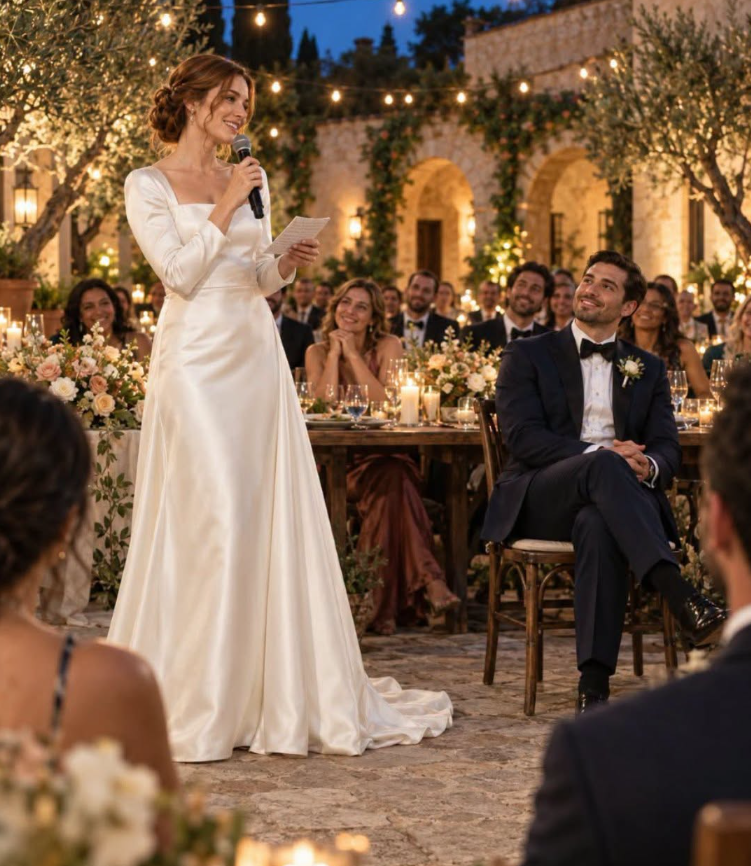
Clare walked toward the microphone.
She was holding a kraft-paper envelope in both hands.
Her face was pale.
Her shoulders were straight.
My father leaned back in his chair, expecting a traditional wedding speech.
Margaret smiled.
She looked pleased.
She seemed to believe this was the moment she had been waiting for all night.
But Clare wasn’t looking at them.
She was looking directly at me.
At table twenty-two.
“I need to honor someone tonight,” she said.
Her voice trembled slightly through the speakers.
“Someone this family tried to erase.”
The room stirred.
My father’s smile disappeared.
Clare raised the envelope.
I could see the seal from across the ballroom.
My stomach tightened.
It was the seal of the Department of the Air Force.
My hand tightened around my wine glass.
Clare opened the envelope.
She unfolded the document.
Then she began speaking.
“Seven years ago, I nearly died.”
The room became silent.
“Some of you know that story. Some of you don’t.”
She looked down for a moment.
Then she continued.
“I was driving home during a storm when my car went off Millstone Bridge.”
A murmur moved through the room.
“I remember the water.”
Her voice cracked.
“I remember the cold.”
She swallowed.
“And then I remember nothing.”
People were listening now.
Every person in the ballroom.
Clare explained that her vehicle had plunged into freezing water.
She had been trapped inside.
Her seat belt had jammed.
The water was rising.
And she had stopped responding.
Then a rescue aircraft arrived.
A rescue pilot entered the freezing water.
The pilot cut Clare free from her seat belt.
She was pulled from the vehicle.
Her heart had stopped.
The pilot performed CPR.
Again.
And again.
Until her heartbeat returned.
Clare looked down at the document in her hands.
“The official report says the rescue pilot was Captain Evelyn Ulette.”
My father’s face changed.
Completely.
Clare looked directly at me.
“Yes.”
The room seemed to stop breathing.
“Captain Evelyn Ulette.”
She smiled through tears.
“My sister.”
I lowered my eyes.
I hadn’t told many people about that rescue.
Certainly not my father.
He had never asked.
Clare continued.
“She saved my life.”
Then she lifted another document.
“And she didn’t stop there.”
Clare explained that the career my father had mocked, the career Margaret had reduced to “doing something with planes,” had become my entire life.
She told the room that I had continued serving.
That I had risen through the ranks.
That I had become a decorated rescue commander.
Then she said the words that made my father sit completely still.
“Today, my sister is a major general.”
The ballroom erupted in whispers.
People turned toward table twenty-two.
I could feel dozens of eyes on me.
Clare continued.
“She has been credited with saving 237 lives.”
Someone near the back of the room whispered, “Oh my God.”
Clare smiled.
“But that number doesn’t tell the whole story.”
She paused.
“Because to me, she isn’t a number.”
“She is the person who saved me.”
Then Clare did something I will never forget.
She turned toward me.
Standing there in her wedding dress, she raised her hand in an imperfect but deeply meaningful military salute.
My throat tightened.
I stood.
For several seconds, neither of us moved.
Then a retired colonel near the front of the room stood.
He saluted me.
Another veteran followed.
Then another.
Within seconds, people across the ballroom were standing.
The applause began quietly.
Then it grew.
And grew.
Until the entire room was filled with it.
I looked toward my father.
He wasn’t applauding.
He was staring at me.
For the first time in my life, he looked as though he didn’t know what to say.
He tried anyway.
“This could all be exaggerated.”
Clare immediately held up the official documents.
“They’re federal records.”
Denise, one of the family lawyers attending the wedding, had also seen the documents.
There was no family story being invented.
No exaggeration.
No publicity stunt.
The records were official.
The citations were real.
The rescue report was real.
My career was real.
Everything my father had spent fifteen years dismissing was standing in front of him.
But the evening wasn’t finished.
Before anyone could fully recover from Clare’s announcement, Richard Hail suddenly grabbed his chest.
His face changed.
Then he collapsed beside the head table.
People screamed.
Chairs moved.
Someone shouted for help.
I didn’t think.
I reacted.
I moved toward him.
I checked his breathing.
I called for an AED.
Someone brought one.
I began CPR.
The room that had been filled with music and celebration seconds earlier was suddenly silent except for instructions and the sound of the emergency equipment.
I continued.
One cycle.
Then another.
The AED advised a shock.
I delivered it.
Then another.
Finally, his heartbeat returned.
Paramedics arrived moments later.
They took over and prepared Richard for transport.
As they lifted him onto the stretcher, he looked at me.
His eyes were filled with embarrassment, fear, and something else.
Regret.
“I was wrong,” he said.
I nodded.
“Take care of yourself.”
That was all I said.
The irony of the evening wasn’t lost on anyone.
The career Richard had mocked had just saved his life.
The career my father had treated as a rebellion had saved my sister.
And the woman they had spent the evening trying to humiliate had become the person everyone was now looking to when someone collapsed.
Later that night, I stepped onto the terrace.
I needed air.
The ballroom behind me was still filled with conversation.
I could hear my name being mentioned again and again.
A few minutes later, the terrace door opened.
My father walked outside.
For once, he didn’t look powerful.
He looked like an old man.
He stood beside me without speaking.
Then he said:
“I was wrong.”
I didn’t answer immediately.
He looked out across the grounds.
“I should have known.”
“You could have asked.”
“I know.”
He lowered his head.
“I spent fifteen years telling myself that you abandoned us.”
I looked at him.
“You threw me out.”
He nodded.
“I know.”
He talked about my mother.
About Clare.
About the family.
About the business.
About the estate and the investments he had spent years protecting.
And eventually, he admitted something I had always suspected.
He had spent so much time protecting what he believed belonged to him that he had forgotten how to protect the relationships that actually mattered.
“I was proud,” he said.
“Too proud.”
I looked at him.
“Pride doesn’t give you those fifteen years back.”
“No.”
“It doesn’t erase what happened.”
“I know.”
I took a breath.
“But honesty can give us somewhere to begin.”
He looked at me.
It wasn’t forgiveness.
Not yet.
Maybe it wasn’t even reconciliation.
But it was the first honest conversation we had had in fifteen years.
And for that night, it was enough.
Before I left the wedding, Clare found me again.
She was holding a scrapbook.
“I’ve been keeping this for years,” she said.
I opened it.
Inside were newspaper articles.
Photographs.
Promotion announcements.
Rescue reports.
Military citations.
Every piece of my career she had quietly collected over the previous seven years.
She had saved everything.
Even the things I had forgotten.
I looked at her.
“You kept all this?”
She smiled.
“Of course.”
Then she took my hand.
Inside her wedding band was a small engraving.
One word.
Phoenix.
My military call sign.
I stared at it for several seconds.
Then I laughed through tears.
“Clare.”
She hugged me.
“You’re my sister.”
The same little girl who had once watched me leave through the window was now standing in front of me as a bride.
And somehow, despite everything that had happened, she had never stopped believing in me.
I drove home that night alone.
The road was dark.
The wedding was behind me.
My father’s words were still in my head.
But they no longer carried the same weight.
For years, I had believed success meant proving my father wrong.
That night, I realized I had been measuring my life by the wrong standard.
Success wasn’t the expensive watch.
It wasn’t the large mortgage.
It wasn’t the family business.
It wasn’t having someone important approve of your choices.
My father measured wealth in dollars.
I measured mine differently.
I measured it in lives.
In people pulled from wreckage.
In strangers carried away from fires.
In heartbeats restored after they had stopped.
And that night, my number changed.
For years, Clare had been one of the people I had saved.
Then Richard became another.
So when I finally drove away from the wedding, I realized something.
My father had spent fifteen years believing I had thrown my life away.
But I had spent those same fifteen years building a life he had never taken the time to understand.
And by the end of that night, I wasn’t counting the money I had lost.
I wasn’t counting the years I had lost.
I wasn’t even counting the people who had insulted me.
I was counting heartbeats.
There were 238 of them now.