My sister-in-law deliberately spilled an entire bottle of red wine over my parents at Christmas dinner, then laughed while my husband’s wealthy family mocked them for being farmers. I looked at my husband, gave him exactly five minutes to make it right, and when the grandfather clock finally chimed, everyone at that table discovered I hadn’t been threatening divorce, I’d been giving him one last chance to prevent it.
My name is Sara.
I built my company from nothing, but somewhere along the way, I made one spectacularly foolish decision.
I put our multimillion-dollar estate in my husband Thaddius’s name, hoping his aristocratic family would finally accept me.
They never did.
That Christmas, my parents flew to spend the holiday with us.
Mom wore the ivory silk blouse I’d bought her. Dad had polished the same brown shoes he’d owned for fifteen years.
They looked nervous simply sitting at our enormous dining table.
Then Cordelia approached.
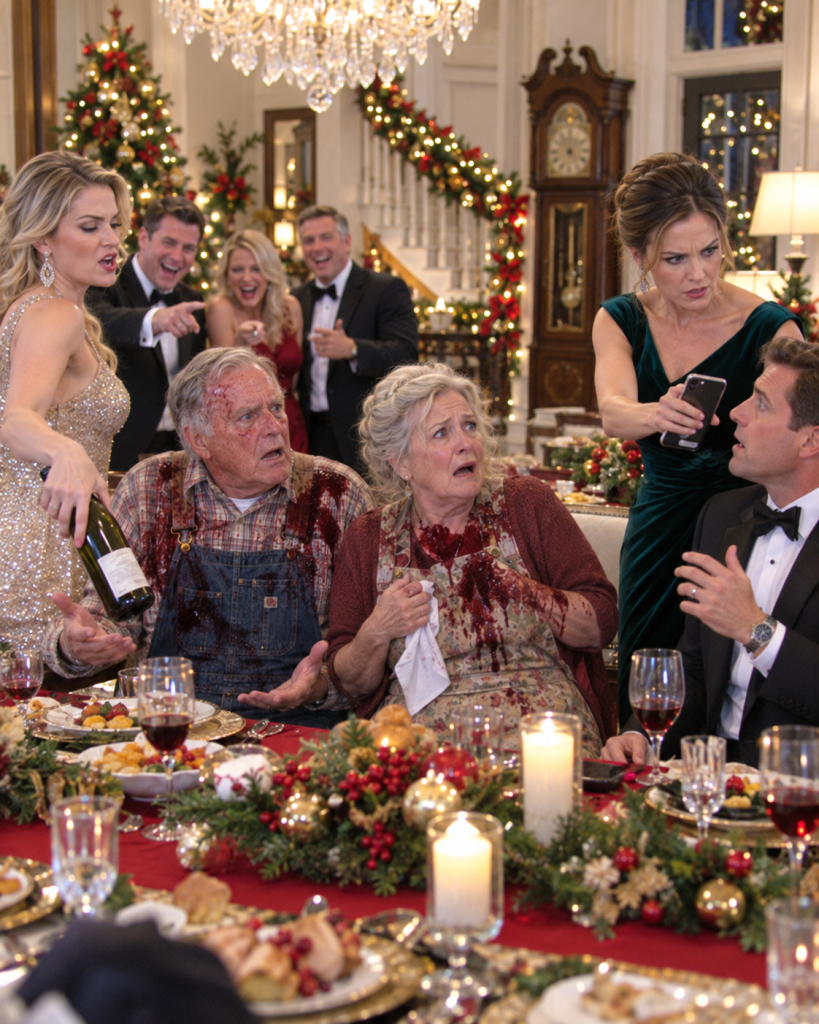
My sister-in-law wore a glittering designer gown and carried a bottle of vintage Cabernet.
She glanced at my mother.
Then her heel struck the table leg.
The bottle tipped.
Red wine poured across Mom’s blouse and splashed over Dad’s face.
Everyone froze.
Then Cordelia smiled.
“Honestly, this is why you don’t invite people like this to a proper dinner.”
Someone laughed.
Then another.
My mother-in-law calmly lifted her teacup.
I turned toward Thaddius.
He was staring at his phone.
“Thaddius.”
Nothing.
Mom caught my wrist.
“It’s okay, sweetheart,” she whispered. “Please don’t ruin Christmas over us.”
That sentence broke something inside me.
My parents had worked farmland before sunrise so I could attend college.
They had never once asked me for money after I became successful.
And now they were apologizing for being humiliated inside a house my success had paid for.
I walked to Thaddius and took the phone from his hand.
“You have five minutes.”
His eyes narrowed.
“For what?”
“Your sister apologizes sincerely to my parents, and you explain to everyone at this table why what happened was unacceptable.”
He stared at me.
“Or?”
“My next call is to my divorce attorney.”
Thaddius actually laughed.
“It’s wine, Sara.”
I looked at the grandfather clock.
Four minutes.
“You’re embarrassing yourself.”
Three.
“Give me my phone.”
Two.
Cordelia folded her arms, smiling.
My mother-in-law whispered, “She’ll calm down.”
One minute.
Thaddius leaned back confidently.
He genuinely believed I’d spent seven years paying for his family’s lifestyle because I was too afraid to walk away from it.
Then the clock chimed.
Five minutes.
I reached into my evening bag and removed my own phone.
Thaddius finally stopped smiling.
“Who are you calling?”
I looked around the dining room.
At Cordelia.
At his mother.
Then at the husband who’d chosen silence.
“My attorney.”
His face changed.
But before I pressed call, my father quietly stood beside me.
“Sara,” he said, “there’s something about this house you need to know before you do that.”
I slowly lowered the phone.
Thaddius went completely pale.
And that was when I realized my father knew something about my husband’s family that I didn’t.
PART 2
My father looked at Thaddius, then at me.
“Before you call your lawyer, you should know this house may not actually belong to him.”
The room went silent.
I stared at Dad.
“What are you talking about?”
He reached into his jacket and pulled out a folded envelope.
Thaddius stood so quickly his chair scraped the floor.
“This is ridiculous.”
Dad ignored him.
“Two years ago, your company bought the land beneath this estate through a holding trust. I recognized the parcel number because I helped survey this property decades ago.”
My pulse slowed.
“The land?”
Dad nodded.
“The house is in Thaddius’s name. The ground under it isn’t.”
Cordelia’s smile vanished.
I opened the envelope.
Inside were copies of deeds, tax records, and one document bearing the name of a subsidiary I owned entirely.
I had signed it years earlier among hundreds of acquisitions, never realizing what it contained.
My mother-in-law finally spoke.
“That doesn’t mean anything.”
“It means quite a lot,” Dad replied quietly.
“Especially because the lease agreement says any residential structure on that land reverts to the landowner if the tenant violates the occupancy terms.”
I looked at Thaddius.
“What occupancy terms?”
He said nothing.
That silence told me everything.
I found the clause halfway down the page:
No unauthorized transfer of permanent residency, no commercial use, no subletting, and no structural financing secured without the landowner’s consent.
Then I remembered the renovations.
The private club meetings.
The loan Thaddius had taken against the estate.
“You mortgaged my house,” I whispered.
His mother snapped, “Our house.”
I looked at her.
“Not anymore.”
For the first time that evening, Cordelia looked afraid.
I called my attorney.
Thaddius rushed toward me.
“Sara, wait. We can discuss this privately.”
“No,” I said. “You had five minutes.”
Then my father placed one final document on the table.
A notice of default.
Already signed.
Already filed.
I looked at him, stunned.
Dad gave me a small, tired smile.
“I found out last week.”
Before I could ask why he hadn’t told me, someone knocked at the front door.
Three hard knocks.
Thaddius went white.
Dad looked toward the hallway.
“They’re here for the property.”
The words had barely left my father’s mouth when the three knocks came again.
Harder this time.
More deliberate.
Nobody moved.
For several seconds, the only sound in the dining room was the faint ticking of the grandfather clock.
Then Thaddius whispered, “No.”
It wasn’t anger.
It was fear.
Real fear.
I looked at him.
“Who is at the door?”
He didn’t answer.
His mother stood abruptly.
“Thaddius, what’s happening?”
He shook his head.
“I don’t know.”
My father gave him a long look.
“You know exactly what’s happening.”
Another knock.
Then a voice came from the foyer.
“Mr. Thaddius Ashbourne?”
Thaddius’s face lost what little color remained.
I looked at my father.
“Who are they?”
Dad didn’t answer immediately.
Instead, he walked toward the hallway.
I followed.
Thaddius stayed where he was.
Cordelia remained beside the dining table, suddenly very quiet.
When my father opened the front door, two men and a woman stood on the stone steps.
The woman wore a dark navy suit.
She held a leather folder against her chest.
Beside her stood a county property officer and a uniformed deputy sheriff.
The woman looked directly at me.
“Mrs. Sara Ashbourne?”
“Yes.”
She extended her hand.
“Elizabeth Warren. I’m counsel for the landholding trust.”
I shook her hand.
She turned toward Thaddius.
“Mr. Ashbourne, we need to discuss the default notice.”
Thaddius finally stepped forward.
“There has been a misunderstanding.”
Elizabeth didn’t blink.
“No, sir.”
She opened the folder.
“There has been a series of violations.”
His mother rushed toward us.
“This is our private residence.”
Elizabeth looked at her calmly.
“It is a residence built upon property legally owned by the trust.”
“You can’t just come into our home,” Cordelia snapped.
Elizabeth’s eyes shifted toward her.
“I’m not entering your home.”
She pointed toward the ground.
“I’m representing the legal owner of the land beneath it.”
Cordelia’s mouth opened.
Then closed.
I looked at Dad.
“You said the company bought this land two years ago.”
Dad nodded.
“Yes.”
“Why didn’t you tell me?”
His expression softened.
“Because I didn’t know the whole story until last week.”
Elizabeth closed the folder.
“Your father contacted us after he discovered inconsistencies in the property’s financing documents.”
I looked at her.
“What inconsistencies?”
She glanced at Thaddius.
“Would you like him to explain?”
Nobody spoke.
Elizabeth continued.
“Mr. Ashbourne obtained a mortgage using the estate as collateral.”
I looked at Thaddius.
“I know.”
“No,” Elizabeth said quietly.
“You don’t know everything.”
She removed another document.
“The mortgage application stated that Mr. Ashbourne owned the underlying land.”
My stomach dropped.
“But he didn’t.”
“No.”
Elizabeth looked at me.
“He never did.”
Thaddius stepped forward.
“I was advised that the land was included with the estate.”
“By whom?”
He froze.
Elizabeth waited.
“Mr. Ashbourne?”
He swallowed.
“My attorney.”
Elizabeth nodded.
“Then your attorney will have an opportunity to explain that statement.”
She turned another page.
“The mortgage company is now aware that the borrower did not possess the land rights represented in the application.”
My mother-in-law grabbed the edge of the table.
“This is absurd.”
Elizabeth looked at her.
“Mrs. Ashbourne, the situation becomes considerably more serious because the mortgage was not the only issue.”
My heart started pounding.
“What else?”
She placed a photograph on the table.
It showed a large room inside our estate.
I recognized it immediately.
The private clubroom.
The room Thaddius had renovated without asking me.
The room where he hosted wealthy investors, political donors, and members of his family’s social circle.
Elizabeth pointed at the photograph.
“This room was being used for private commercial events.”
Thaddius shook his head.
“Those were family gatherings.”
I almost laughed.
“Family gatherings?”
I looked at him.
“You charged people admission.”
He stared at me.
“You knew?”
“I own the company that paid for the renovation.”
His jaw tightened.
Elizabeth continued.
“That violates the occupancy agreement.”
She pulled out another document.
“And the unauthorized commercial activity was only one violation.”
My father’s expression hardened.
“What else did you find?”
Elizabeth looked at me.
“The trust discovered that Mr. Ashbourne transferred substantial funds from the estate’s renovation account to an entity called Ashbourne Heritage Holdings.”
I frowned.
“What is that?”
Thaddius immediately said, “It’s nothing.”
Elizabeth looked at him.
“It is a company controlled by your husband.”
I slowly turned toward Thaddius.
“You moved money?”
He didn’t answer.
“How much?”
Silence.
Elizabeth answered for him.
“Approximately two point eight million dollars.”
My mother-in-law gasped.
Cordelia stepped backward.
I stared at Thaddius.
Two point eight million.
Money I had earned.
Money I had trusted him to manage.
Money that had apparently disappeared into another company.
“You stole from me.”
“No.”
His voice cracked.
“I borrowed it.”
“You borrowed my money?”
“I was going to put it back.”
“When?”
He looked away.
“When?”
“I had a plan.”
I laughed once.
It wasn’t a happy laugh.
It was the sound of someone finally understanding how deeply they’d been betrayed.
“Seven years.”
He looked at me.
“What?”
“Seven years I thought you were protecting our family.”
I pointed toward the dining room.
“I thought I was building a life with you.”
My voice shook.
“But you weren’t building a life with me.”
I swallowed.
“You were building a life around me.”
Thaddius stepped closer.
“Sara, please.”
“No.”
He stopped.
I had never seen him look so small.
“I trusted you.”
“I know.”
“That’s what makes this unforgivable.”
His mother suddenly stepped between us.
“This has gone far enough.”
I looked at her.
She lifted her chin.
“My son made mistakes, but this family has protected you for years.”
I stared at her.
“Protected me?”
“Yes.”
“You humiliated my parents tonight.”
She said nothing.
“You watched your daughter spill wine on my mother’s blouse.”
Cordelia looked away.
“You laughed.”
No one answered.
“You’ve spent seven years treating me like an outsider.”
My voice became quieter.
“And somehow you still believed I’d keep paying for your lives.”
Thaddius whispered, “Sara.”
I raised my hand.
“Don’t.”
He stopped.
Elizabeth cleared her throat.
“There is one more matter.”
Everyone looked at her.
She opened the final section of the folder.
“The trust has exercised its right under the occupancy agreement.”
She handed the document to me.
I read the first paragraph.
Then the second.
My hands became cold.
“What does this mean?”
Elizabeth spoke carefully.
“It means the estate is no longer available for residential occupancy under Mr. Ashbourne’s ownership.”
I looked at Thaddius.
“And me?”
“You’re the beneficial owner of the holding company that owns the land.”
I stared at the document.
“Then legally…”
Elizabeth nodded.
“Legally, you control the property beneath the estate.”
Thaddius closed his eyes.
Elizabeth continued.
“Mr. Ashbourne’s residential rights terminate upon default.”
His eyes opened.
“You can’t do that.”
“We already have.”
The deputy sheriff stepped forward.
He handed Thaddius an envelope.
“This is your formal notice.”
Thaddius stared at it.
“You’re evicting me?”
The deputy didn’t answer.
Elizabeth did.
“The landowner is terminating your occupancy rights.”
My husband looked at me.
“You can’t let them do this.”
I stared back at him.
“You did this.”
His face crumpled.
“Sara, please.”
I remembered my mother whispering,
“Please don’t ruin Christmas over us.”
I remembered my father’s polished shoes.
The wine soaking into my mother’s blouse.
The laughter.
The years of being told I wasn’t good enough.
And then I remembered something else.
Every dollar I had earned.
Every late night.
Every contract.
Every employee whose salary depended on my decisions.
Every sacrifice I’d made to build a company from nothing.
I had spent years trying to earn a place in their family.
I finally understood.
I never needed their approval.
I needed my own.
I looked at Elizabeth.
“What happens now?”
She closed the folder.
“That depends on what you want.”
I took a breath.
“I want the truth.”
Elizabeth nodded.
“Then we should talk to your attorney.”
I looked at my father.
He gave me a small nod.
And for the first time that night, I felt something I hadn’t felt in years.
Not anger.
Not fear.
Freedom.
But the story wasn’t over.
Because when I walked into my office upstairs to gather documents for my attorney, I found something waiting on my desk.
A black envelope.
My name was written across the front.
In handwriting I recognized immediately.
Thaddius’s.
I opened it.
Inside was a single sheet of paper.
Three words were written across the top.
YOU DESERVE THE TRUTH.
Beneath them was a list.
Dates.
Bank transfers.
Names.
Payments.
And beside one name, a number that made my blood run cold.
Cordelia.
I looked at the amount.
Then I looked at the date.
It was the same week my company had nearly lost its largest contract.
I turned the page.
There were dozens of transactions.
Payments from my company.
Payments to Cordelia.
Payments to my mother-in-law.
Payments to accounts I had never seen.
And one final transaction.
A transfer of $600,000.
The recipient was listed as:
ASHBOURNE FAMILY TRUST.
I stared at the page.
Then I heard footsteps behind me.
My father.
He looked at the papers in my hand.
“I was afraid you’d find that.”
I turned.
“What is the Ashbourne Family Trust?”
Dad sighed.
“The reason they wanted you.”
My heart stopped.
“What?”
He closed the office door.
“Your husband’s family wasn’t simply wealthy.”
He looked at me.
“They were drowning.”
I stared at him.
“Their estates were mortgaged. Their investments were failing. Their businesses had been losing money for years.”
“Then why did they act like I was beneath them?”
Dad gave me a sad smile.
“Because admitting they needed you would have destroyed their pride.”
I sat down slowly.
“So they married me for money?”
Dad didn’t answer.
He didn’t need to.
The truth was already sitting in front of me.
Seven years.
Seven years of dinners.
Holidays.
Birthdays.
Anniversaries.
Seven years of being treated like an outsider by people who had secretly depended on me.
I looked at the final page.
There was another signature.
Thaddius’s.
Under it was a note.
She’ll never know.
I closed my eyes.
Then I heard the office door open.
Thaddius stood there.
His face was exhausted.
“I didn’t want you to find that.”
I looked at him.
“How long?”
He didn’t answer.
“How long did you know?”
“From the beginning.”
My chest tightened.
“You knew your family needed my money when you married me?”
He looked down.
“Yes.”
“And you still let them humiliate my parents?”
His eyes filled with tears.
“I was afraid of them.”
I stood.
“You were afraid of your family.”
“Yes.”
“But not afraid of destroying me.”
He looked at me.
“I thought I could fix it.”
“You had seven years.”
“I know.”
“No.”
My voice was quiet.
“You had seven years to tell me the truth.”
He couldn’t look at me.
I walked past him.
“This marriage is over.”
He grabbed my wrist.
I immediately pulled away.
“Don’t touch me.”
He released me.
I walked downstairs.
The dining room was empty now.
My mother and father were waiting near the fireplace.
My mother had changed her blouse.
I walked toward her.
“I’m sorry.”
She touched my cheek.
“For what?”
“For bringing you here.”
She shook her head.
“You didn’t bring us here to be humiliated.”
She looked at my father.
“They did that themselves.”
I hugged her.
And for the first time in years, I cried.
Not because I had lost my marriage.
Because I had finally realized I had never lost myself.
I had simply forgotten where I left her.
PART 3
Three weeks later, the divorce papers were filed.
The Ashbourne family tried everything.
First came apologies.
Then threats.
Then lawyers.
Then the newspapers.
Someone leaked a story claiming I had manipulated my husband into signing away his family’s ancestral estate.
It was almost convincing.
Until my attorney released the documents.
The original deeds.
The holding trust.
The occupancy agreement.
The mortgage application.
The financial transfers.
And finally, the evidence showing that Thaddius had represented himself as the owner of land he had never legally owned.
The story changed overnight.
The headlines disappeared.
The whispers stopped.
And the Ashbourne family’s reputation collapsed under the weight of its own paperwork.
But I didn’t celebrate.
I had learned something important.
Winning didn’t always feel like victory.
Sometimes it felt like surviving.
My attorney advised me to pursue the money.
All of it.
The $2.8 million.
The unauthorized transfers.
The fraudulent mortgage application.
The money paid to Cordelia.
The funds transferred to the family trust.
I agreed.
Not because I wanted revenge.
Because I wanted accountability.
Cordelia eventually came to my office.
She didn’t wear designer clothes.
She didn’t carry expensive wine.
She looked exhausted.
She sat across from me and stared at the floor.
“I was jealous of you.”
I said nothing.
She continued.
“You had everything.”
“No.”
I looked at her.
“I built everything.”
Her eyes filled with tears.
“I thought you were trying to take our family away from us.”
“You never considered that I was your family.”
She looked down.
“I’m sorry.”
I nodded.
“I believe you.”
She looked surprised.
“But that doesn’t change what happened.”
She nodded slowly.
“I know.”
She left without asking for anything.
My mother-in-law never apologized.
She sent one final letter.
In it, she called me ungrateful.
I kept the letter.
Not because it hurt.
Because one day I wanted to remember exactly why I had walked away.
Thaddius was different.
He asked to meet me one last time.
We met at a small café downtown.
He looked older.
Not physically.
Emotionally.
He sat across from me for several minutes without speaking.
Then he said,
“I loved you.”
I looked at him.
“Maybe you did.”
His eyes lifted.
“Maybe?”
“Maybe you loved what my life gave you.”
He looked away.
“I don’t know how to separate the two anymore.”
“Neither do I.”
He took a breath.
“Do you hate me?”
I thought about it.
“No.”
His eyes widened.
“Why?”
“Because hate would mean you still have something from me.”
He said nothing.
“I gave you seven years.”
I stood.
“I’m not giving you another day.”
He looked down.
“I’m sorry, Sara.”
I believed him.
But forgiveness wasn’t the same as reconciliation.
I left.
Outside, the winter air was cold.
My father was waiting in the car.
He rolled down the window.
“Ready?”
I smiled.
“For what?”
He pointed toward the road.
“Your new life.”
I laughed softly.
“My new life?”
He nodded.
“You’ve been living their life for seven years.”
He smiled.
“It’s time you lived yours.”
Six months later, the estate changed completely.
I renovated the dining room.
Not because it reminded me of the humiliation.
Because I wanted to reclaim it.
I replaced the long formal table with a warm wooden one.
I removed the crystal glasses nobody was allowed to touch.
I replaced the expensive paintings with photographs.
My parents.
My employees.
My friends.
People who had been there before the money.
Before the mansion.
Before the Ashbourne name.
I kept the grandfather clock.
Every hour, it chimed.
And every time it did, I remembered that Christmas night.
Five minutes.
That’s all it took.
Five minutes to realize my husband had chosen silence.
Five minutes to realize his family would never respect me.
Five minutes to stop begging for a place at a table I had paid for.
But the most important thing happened later.
I changed the ownership structure of every property my company held.
No more putting assets in someone else’s name to earn their approval.
No more confusing loyalty with surrender.
No more believing love required me to make myself smaller.
My company grew.
We expanded into three new states.
I hired more employees.
I started a foundation in my parents’ name.
Its first program provided scholarships to students from farming families.
My father cried when he saw the first scholarship recipient receive her acceptance letter.
My mother hugged me.
“You remember where you came from.”
I smiled.
“How could I forget?”
One year after the Christmas incident, I hosted another Christmas dinner.
This time, the table was smaller.
There were no aristocrats.
No designer gowns.
No people pretending they were better than anyone else.
Just my parents.
A few close friends.
Some employees who had become family.
And me.
My mother wore a simple blue dress.
My father wore his old brown shoes.
The same ones he’d polished for fifteen years.
I looked at those shoes and smiled.
“Why are you staring at my feet?” Dad asked.
“Because I like those shoes.”
He laughed.
“They’re older than your company.”
“That’s why I like them.”
My mother raised her glass.
“To new beginnings.”
Everyone smiled.
Then the grandfather clock began to chime.
One.
Two.
Three.
I looked toward the doorway.
For a moment, I remembered Thaddius standing there.
Pale.
Afraid.
Begging me not to make the phone call.
But that woman was gone.
The woman who needed his family’s approval.
The woman who believed money could buy belonging.
The woman who apologized when other people were cruel to her parents.
She didn’t exist anymore.
I looked at my mother and father.
They were laughing.
Safe.
Loved.
Home.
And I finally understood the greatest irony of all.
The Ashbourne family had spent seven years believing the estate made them powerful.
They were wrong.
The house had never belonged to them.
The land had never belonged to them.
And most importantly, my future had never belonged to them.
It belonged to me.
I stood and walked to the window.
Outside, snow began falling across the gardens.
For years, I had looked at that estate and thought it represented everything I had achieved.
Now I understood.
It represented everything I had survived.
I placed my hand against the cold glass.
My father came to stand beside me.
“You okay?”
I smiled.
“Better than okay.”
He nodded.
Then he said something I’ll never forget.
“You spent years building a fortune, Sara.”
He looked at me.
“Don’t spend another day trying to prove you’re worthy of it.”
I turned toward the dining room.
Toward my mother.
Toward the people who loved me without asking what I could give them.
And I smiled.
Because the Christmas that was supposed to destroy my family had done something else instead.
It had finally shown me who my family really was.
And for the first time in my life, I wasn’t sitting at someone else’s table hoping to be accepted.
I was sitting at my own.
And everyone there was welcome.