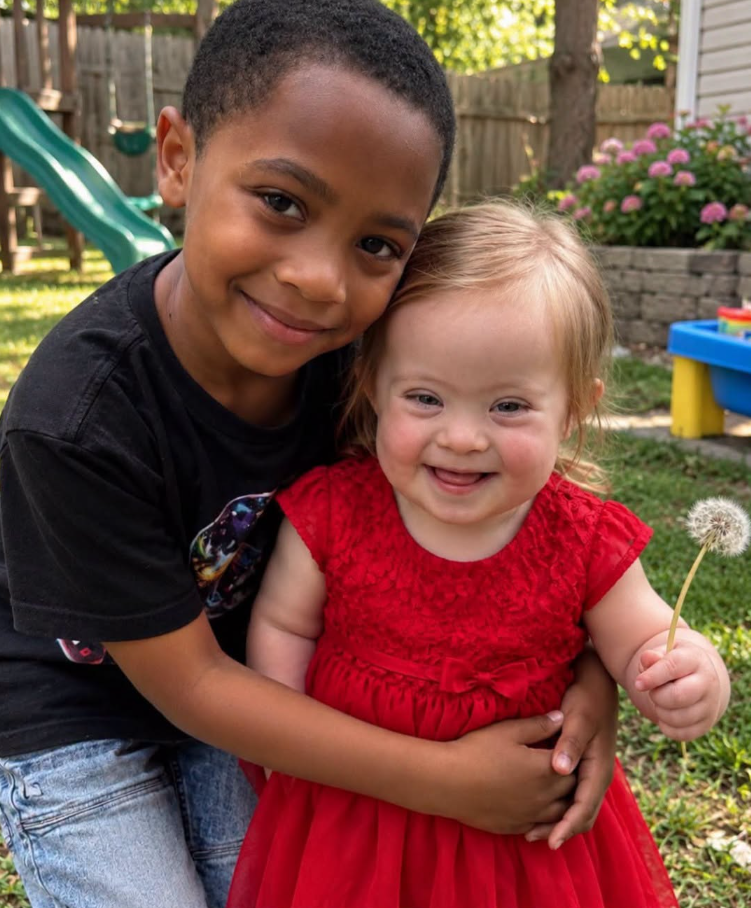
My eight-year-old son skipped lunch at school for weeks so he could save enough money to buy a little red birthday dress for a little girl with Down syndrome.
I knew he loved her.
I knew he wanted to make her birthday special.
What I didn’t know was just how much he was willing to sacrifice to do it.
And I certainly didn’t expect that, the morning after he gave Lucy the dress, I would wake up to find our entire front lawn covered with more than 50 lunchboxes.
Some were decorated with dinosaurs.
Others had footballs, superheroes, flowers, and bright colors splashed across them.
They stretched from our front porch almost all the way to the sidewalk.
But it wasn’t the number of lunchboxes that frightened me.
It was what was inside the biggest one.
My son found it first.
He opened the battered metal clasp, looked inside, and immediately stumbled backward.
His face went completely white.
“Mom…”
I hurried toward him.
He was trembling.
“Call the police,” he whispered.
Just one day earlier, his biggest secret had seemed so innocent.
It had started with a red dress.
Our neighbor Hannah had been raising her daughter, Lucy, alone since she was a baby.
Lucy was almost two years old, and she had Down syndrome.
My son, Noah, adored her.
He would sit beside her stroller and draw pictures while Hannah talked to me. He picked dandelions from our yard and carried them over to Lucy as if they were priceless gifts.
Most of all, he knew exactly how to make her laugh.
There was something about the two of them together that made people stop and smile.
Noah never treated Lucy differently.
To him, she was simply Lucy.
A little girl he loved.
About a month before Lucy’s second birthday, Noah and I were walking past a small clothing store when he suddenly stopped.
He pointed toward the window.
There, hanging beneath a row of children’s clothes, was a tiny red dress.
It wasn’t particularly expensive or elaborate.
But to Noah, it was perfect.
“Mom,” he said, staring through the glass, “Lucy would look like a princess in that.”
I smiled.
“She really would.”
Then I explained something he didn’t know.
Hannah wasn’t planning a birthday celebration for Lucy that year.
She had been spending almost everything she could on Lucy’s developmental activities, appointments and programs, and there simply wasn’t much left for a party.
Noah looked at the dress again.
He didn’t say anything.
But he didn’t forget it.
For the next several weeks, I began noticing little changes in him.
Whenever I offered him money for a treat, he turned it down.
When neighbors needed help raking leaves, he volunteered.
He started finding small jobs wherever he could.
I thought he was simply saving for a toy.
Then one evening, I found $38 in crumpled bills underneath his bed.
I also noticed something else.
The little red dress was hanging inside his closet.
That’s when I realized what he had been doing.
Noah had been saving the $5 I gave him for lunch at school.
And every afternoon, when I asked him whether he had eaten, he told me yes.
He hadn’t.
He had been going hungry so he could buy Lucy’s birthday present.
I was proud of his heart, but I was also upset.
“You can never skip meals to buy something for someone else,” I told him.
He looked down.
“I just wanted her to have the dress.”
“I know,” I said, pulling him into a hug. “And I’m incredibly proud of you. But kindness should never mean hurting yourself.”
I made him promise me he would never skip another meal.
He agreed.
My mother-in-law happened to be visiting when Noah proudly brought the dress downstairs.
He held it out like he had just won a prize.
“Look!”
My mother-in-law laughed.
“You skipped lunch for that?”
Noah nodded.
She shrugged.
“You’re wasting your money. Lucy doesn’t even understand birthdays.”
The smile disappeared from Noah’s face.
He looked at his grandmother for a moment before answering quietly.
“She knows when someone’s kind to her.”
The room went silent.
My mother-in-law didn’t respond.
The following afternoon, we went to Hannah’s backyard for Lucy’s small birthday celebration.
There weren’t many people.
There didn’t need to be.
When Noah handed Hannah the wrapped dress, she immediately realized what he had done.
Her eyes filled with tears.
Then she helped Lucy put it on.
When Lucy came outside, she looked down at the bright red skirt.
For a second, she simply stared.
Then she grabbed the fabric with both hands.
She twirled.
Once.
Twice.
Then again.
She spun so enthusiastically that she nearly lost her balance.
Everyone laughed.
Noah laughed the hardest.
His grandmother stood quietly near the fence, watching.
She didn’t say anything.
But she didn’t need to.
Lucy was happy.
And Noah knew exactly why.
That evening, after we came home, I sat beside Noah on his bed.
“I’m proud of you,” I told him.
He smiled.
“I told you she would look like a princess.”
I kissed his forehead.
I thought that was the end of the story.
I was wrong.
At 6:30 the next morning, someone burst into my bedroom.
“Mom!”
I woke up to Noah standing beside my bed.
“You have to see this!”
“What happened?”
“The yard!”
I followed him downstairs.
When I opened the front door, I stopped.
Our entire lawn was covered with lunchboxes.
There had to be fifty of them.
Maybe more.
They were everywhere.
Some were shaped like animals.
Some had cartoon characters.
There were dinosaur lunchboxes, football lunchboxes, superhero lunchboxes and brightly colored ones scattered across the grass.
They stretched from our porch almost to the sidewalk.
I stared through the glass.
“Noah…”
He looked at me.
“Are they all for me?”
“I don’t know.”
Then he saw something.
In the middle of the lawn sat one enormous, battered metal lunchbox.
It was different from all the others.
There was a note taped to the lid.
Three words were written across it:
Open this one first.
Noah walked toward it.
I followed.
He knelt down.
The metal clasp snapped open.
Then he froze.
For several seconds, he didn’t move.
His eyes widened.
He stumbled backward across the grass.
“Mom…”
I stepped closer.
“What is it?”
He was trembling now.
“Call the police.”
I looked inside.
And my stomach dropped.
Inside the large metal lunchbox were bundles of cash, a stranger’s work badge, an apartment key and a wedding photograph.
For a moment, I couldn’t make sense of what I was seeing.
There was no explanation.
No message.
Nothing that connected any of it to us.
Then I heard footsteps behind us.
A woman was hurrying toward our yard.
She looked frightened.
She raised both hands.
“Please,” she said. “Don’t call anyone.”
I turned toward her.
“Who are you?”
“My name is Tessa.”
She stopped near the edge of the lawn, breathing hard.
She was an adult with Down syndrome.
She explained that she worked at a bakery and helped organize programs at the neighborhood community center.
And she knew exactly why those lunchboxes were there.
The money wasn’t a reward for Noah.
It wasn’t connected to an attorney, an insurance settlement, a mortgage, an investment account, an estate or a court decision.
It wasn’t money that belonged to our family.
It had been donated.
The neighborhood community center was trying to complete funding for a weekend program for children with Down syndrome.
The program would give children opportunities to participate in art, music, gardening, movement and games alongside their siblings and friends.
Tessa explained that the lunchboxes were part of something the families had organized after hearing about Noah and the red dress.
Each one contained an object with personal meaning.
A memory.
A reminder.
A piece of someone’s story.
But the largest lunchbox belonged to Tessa.
And what it contained wasn’t just a collection of random objects.
It was proof of a life that other people had once assumed she would never have.
She picked up the work badge.
“This is from my job,” she said.
She had worked at the bakery for seven years.
Then she held up the apartment key.
“This is where I live.”
Finally, she picked up the wedding photograph.
It showed Tessa on her wedding day.
She looked at Noah.
“People had lots of ideas about what I might never do.”
Noah stared at the photograph.
Tessa smiled.
“Turns out people don’t always know as much about somebody else’s future as they think.”
Noah didn’t say anything.
He simply listened.
Then Tessa reached into another lunchbox.
She pulled out a new one and handed it to him.
Noah opened it.
Inside was a sandwich.
Fruit.
Juice.
And a cookie.
He frowned.
“It’s just lunch.”
Tessa smiled.
“Exactly.”
I looked at Noah.
He looked at the sandwich.
Then he looked back at Tessa.
I understood.
So did he.
The lesson wasn’t that kindness wasn’t important.
It was that kindness shouldn’t require a child to go hungry.
That afternoon, we went back outside.
Lucy was still wearing her red dress.
She was spinning around the yard again, grabbing the skirt and laughing.
At one point, my mother-in-law walked over to Hannah.
For the first time, she didn’t make an assumption.
She simply asked:
“Can Lucy have some cake?”
Hannah smiled.
“Of course.”
It was a small question.
But after everything that had happened, it felt like a big change.
Later, the lawn was empty.
The lunchboxes were gone.
The morning’s mystery had been replaced by the ordinary sounds of a neighborhood settling into the afternoon.
Noah sat on our porch eating his sandwich.
Lucy was nearby.
She reached toward his food.
Noah tore off a small piece and handed it to her.
Then he immediately took a large bite of his own sandwich.
“I’m eating too, Mom,” he assured me.
I laughed.
A moment later, jelly landed on the front of Lucy’s beautiful red dress.
I instinctively reached toward her.
Then I stopped.
I didn’t wipe it away.
The dress had already done exactly what Noah bought it to do.
It had made her happy.
And now it was covered in evidence of a child enjoying his birthday.
Lucy was laughing.
Noah was eating.
And the little red dress was still turning in circles every time she moved.
I looked at my son and realized that he had learned something that many adults spend a lifetime forgetting.
Kindness isn’t measured by how much you sacrifice.
It’s measured by whether you make someone else’s world a little better without forgetting that you matter, too.
Noah had wanted Lucy to feel special.
Instead, his simple act of kindness had reminded an entire community that every child deserves to be seen for what they can become—not for what someone else assumes they cannot.
And, in the end, the most important thing that arrived on our lawn that morning wasn’t the money.
It wasn’t the lunchboxes.
It wasn’t even the collection of stories inside them.
It was a much simpler gift.
A sandwich.
A reminder to eat.
And a lesson my eight-year-old son would carry with him long after the red dress had been outgrown.