PART 1
“Mom, you should probably eat back in the kitchen tonight. The big table upstairs is reserved for Janelle’s family.” Those were the first words I heard after ten years of working hundreds of miles away from home. I had pictured my return countless times during the long drive from Denver. In my imagination, I would quietly walk through the front door, put down my suitcase, and surprise my mother. Abigail would stare at me for a moment before wrapping her arms around me. Maybe she would cry. Maybe I would too.
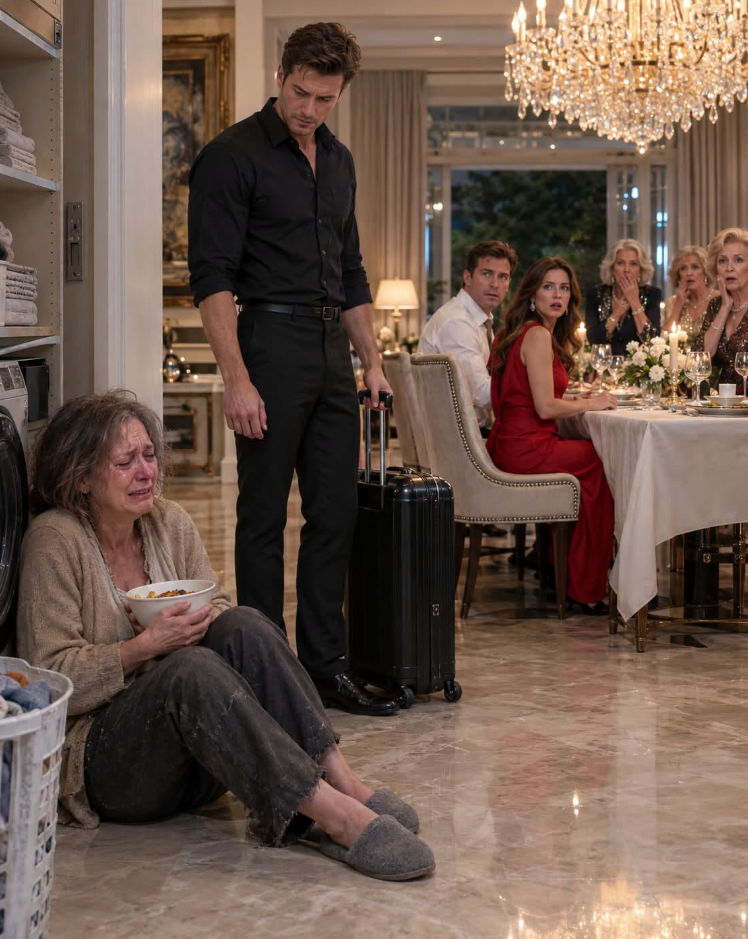
The long oak table was loaded with food that looked like it had come from an upscale restaurant—grilled steaks, buttered lobster tails, imported wine, glazed vegetables, and elaborate desserts displayed beneath the chandelier.
My sister-in-law, Janelle, stood near the head of the table, raising a glass of red wine toward her parents and siblings.
Everyone was smiling.
Everyone looked completely comfortable.
Except the woman I had built the house for.
A faint clattering sound came from downstairs.
I followed it toward the utility area beside the laundry room.
And there she was.
My mother.
Abigail sat by herself at a small plastic card table beside the washing machine. Her shoulders looked smaller than I remembered, tightly wrapped in an old knitted sweater. In front of her was a chipped plate containing canned beans, two biscuits that appeared several days old, and a glass of tap water.
For several seconds, I couldn’t say a word.
Ten years earlier, I had left Red Creek for Denver with barely more than two suitcases and a promise.
I had promised my mother that someday she would never have to worry about money again.
I worked overtime. I gave up vacations. I spent holidays in tiny apartments or airport terminals because work always seemed more important. Eventually, I earned enough to build the home I had always dreamed of giving her.
Wide hallways.
Bright windows.
A garden.
A comfortable bedroom downstairs.
A dining room big enough for the entire family.
Yet my mother was sitting beside a washing machine eating cold beans.
“Mom?”
She looked up.
The spoon stopped halfway to her mouth.
“Brandon?”
The color drained from her face.
Then, instead of smiling, she quickly shoved the plate away as though she had been caught doing something embarrassing.
“Oh, my sweet boy.” Her voice trembled. “When did you get back?”
I let go of my suitcase.
“What are you doing down here?”
She pulled her sweater tighter around herself.
“I’m perfectly fine. Please don’t make a fuss.”
“A fuss?”
I stared at the plate.
“Mom, why are you eating alone?”
Heavy footsteps sounded on the wooden staircase.
My younger brother Lucas appeared moments later.
His surprise at seeing me lasted barely a second before irritation took its place.
“Don’t start creating drama the minute you walk through the door,” he said.
I stared at him.
“Drama?”
“Mom doesn’t like steak or seafood. She prefers simple food. And she told us she likes being down here because it’s quieter.”
I said nothing.
Instead, I looked directly at my mother.
Her hands were squeezed together so tightly in her lap that her knuckles had turned pale.
“Is that true, Mom?”
She remained silent.
“Did you choose to eat down here?”
Her eyes dropped toward the concrete floor.
That silence told me more than any answer could have.
Then Janelle’s voice drifted down from upstairs.
“You’ve been gone for ten years, Brandon.”
She stood at the top of the staircase, one hand holding her wineglass.
“We’re the ones who actually live here with her. We’re the ones managing the house every day. You don’t get to come home after wiring money from another state and act like the perfect son.”
Something tightened painfully in my chest.
“I built this house for my mother.”
Janelle let out a humorless laugh.
“And if Lucas and I weren’t here, who exactly would look after her?”
I slowly turned toward the dining room.
Her family remained gathered around a table overflowing with food.
Then I looked back at my mother.
Cold beans.
Stale biscuits.
A chipped plate.
For three years, I had been sending Lucas $1,800 every month specifically for Mom’s living expenses.
That didn’t include the extra money I sent whenever he said she needed medication, repairs, new appliances, or help with household bills.
My phone suddenly felt heavy in my pocket.
I pulled it out.
Lucas frowned.
“What are you doing?”
I called my old friend Mason, a property lawyer.
“Mason,” I said when he answered, “I need you to pull the deed for the Red Creek house.”
Lucas’s expression shifted.
“If the property is still entirely in my name,” I continued, staring directly at him, “I want to discuss listing it for sale.”
Lucas moved toward me.
“Have you lost your mind?”
“No.”
“You’re going to tear the family apart over a dinner?”
I lowered the phone.
“This family started falling apart the moment Mom stopped having a seat at her own dining table.”
Behind me, I heard a quiet sob.
My mother wiped her eyes with the edge of her apron.
“Brandon, please. Don’t sell the house.”
Her words caught me off guard.
“Mom—”
“Where would Lucas and Janelle go?”
That question hurt more than anything Lucas or Janelle had said.
I looked at her.
“Mom, you’re worried about where they’ll live?”
She nodded weakly.
I swallowed.
“You’re the only person in this house who seems to have nowhere to live.”
Then another thought hit me.
I had designed a beautiful downstairs bedroom for her because I wanted her to avoid climbing stairs as she got older.
I headed toward it.
Lucas rushed after me.
“Brandon, wait.”
I opened the door.
And stopped.
The room was barely recognizable.
Boxes of expensive liquor were piled against one wall. Designer clothes hung from portable racks. Shopping bags filled the corners. Shoe boxes were lined up beneath the windows.
It looked more like storage for a luxury boutique.
“We just use it for extra things,” Lucas said behind me.
I slowly turned.
“Where does Mom sleep?”
He looked away.
“Lucas.”
Nothing.
I walked toward the back of the house.
Beside the laundry area was a narrow storage room I vaguely remembered using for tools when the house was built.
The door stood half open.
Inside was a small twin mattress pushed against the wall.
There was no proper window.
The concrete smelled damp.
A wooden crate served as a nightstand.
On top of it sat one possession that made my throat tighten instantly.
A framed photograph of my father. That was everything.
My mother had been sleeping in a damp storage room beside a washing machine while the bedroom I had built specifically for her was packed with expensive clothes and liquor.
I stood there staring at the small photograph until my vision became blurry.
Suddenly, all those years in Denver felt completely different.
Every overtime shift.
Every Christmas I missed.
Every birthday phone call.
Every transfer I had sent home, believing the money was keeping her safe.
I had been wrong.
The next morning, our longtime neighbor, Mrs. Gable, entered through the back door carrying homemade soup.
She had apparently heard enough of the argument from her driveway the night before to realize something was wrong.
When the subject of the money came up, she frowned.
“What money?”
“The money Brandon sends for Abigail,” Lucas said quickly.
Mrs. Gable stared at him.
“For Abigail?”
She placed the soup on the counter.
“That’s strange.”
Lucas stiffened.
“Why?”
“Because Abigail borrowed twenty dollars from me two months ago.”
My stomach dropped.
Mrs. Gable continued.
“She didn’t have enough money to buy her medicine.”
Silence spread through the kitchen.
I turned toward Lucas.
His face had turned white.
In that moment, I realized something terrifying.
The cold beans weren’t the whole story.
The storage room wasn’t the whole story.
They were simply the first things I had seen.
And whatever had been kept from me over the past several years was far worse.
PART 2
That afternoon, I opened my banking records.
At first, I could only stare at the screen.
Then I started calculating the amounts.
Month after month.
Year after year.
Money for groceries.
Money for household bills.
Money for repairs.
Money for medication.
Money for emergencies Lucas claimed couldn’t wait.
In just three years, I had sent him more than sixty thousand dollars.
I carried my laptop into the kitchen and placed it on the counter.
“Explain this.”
Lucas looked at the screen.
“I already told you. It went toward the house.”
“Sixty thousand dollars?”
“Utilities. Groceries. Furniture. Repairs. Everything costs money, Brandon.”
I gestured toward the living room.
“Janelle’s parents bought the leather sofa.”
He opened his mouth.
“And the bar cabinet.”
He closed it again.
“When I sent you four thousand dollars because you said the roof was leaking over Mom’s bedroom, you told me you hired professionals.”
“I did.”
“No. You covered the stain with plaster.”
Lucas rubbed his forehead.
“You don’t understand how much responsibility we had here.”
Before I could respond, someone knocked softly.
Valerie stepped inside.
Seeing her again after so many years brought back memories I wasn’t ready for.
Before Denver, Valerie and I had been inseparable. We had grown up together, dated for years, and talked about building a life in Red Creek.
Then an opportunity took me west.
Neither of us had betrayed the other. Life had simply pulled us in different directions.
But she had stayed close to Mom.
She walked directly toward my mother and placed a paper bag on the table.
“Your blood pressure medicine, Miss Abigail.”
Mom smiled at her gratefully.
Then Valerie turned to me.
“I think you need to see something.”
She handed me a metal document box.
Inside were receipts, medical reports, and hospital paperwork.
I picked up an emergency admission form.
The date was six months earlier.
I read the diagnosis twice because my mind refused to accept it the first time.
Severe malnutrition.
Hypertensive crisis.
My mother had collapsed.
She had been taken to the hospital.
Six months earlier.
I remembered that week perfectly.
I had called Lucas from Denver.
“How’s Mom?”
“She’s just a little tired,” he had told me. “I’m handling everything. Don’t worry.”
My hands began to shake.
“Why didn’t anyone tell me?”
Valerie’s expression hardened.
“Your mother begged me not to.”
I turned toward Mom.
She looked down.
Valerie continued.
“She was terrified you would quit your job and come back here.”
My anger desperately searched for somewhere to go.
“Why didn’t you call me anyway?”
Valerie held my gaze.
“Don’t ask me why I didn’t call you, Brandon.”
Her words hit harder than I expected.
“Ask yourself why, in ten years, you never checked who was actually taking your mother to the doctor.”
I stared at her.
There was no cruelty in her voice.
That made it hurt even more.
She was right.
I had convinced myself that providing financial support was the same as being present.
When Lucas told me everything was fine, I believed him because believing him made it easier to stay in Denver.
I could work another late night.
Accept another promotion. Miss another holiday.
After all, I was paying for everything.
Wasn’t I?
That excuse fell apart right in front of me.
Later that evening, Mason called.
“The house is still legally yours,” he said.
Relief washed over me.
But only for a moment.
“There’s more.”
I sat up straighter.
“What?”
“Lucas contacted a legal aid clinic several months ago.”
My eyes shifted toward the hallway.
“What about?”
“He wanted information about adverse possession and property claims based on maintenance and improvements.”
My stomach tightened.
“Maintenance on my house?”
“Yes.”
Mason paused.
“And I found something else.”
He emailed me a scanned document.
A power of attorney.
My mother’s name appeared near the bottom.
Her signature looked shaky and uneven.
I took the document to her.
“Mom, when did you sign this?”
She adjusted her glasses.
Confusion spread across her face.
“I don’t know.”
“Look carefully.”
She examined the page.
Then her eyes widened slightly.
“Lucas brought papers to me when I had that terrible fever.”
“What did he tell you they were?”
“Something for the clinic.”
My throat tightened.
“He said I needed to sign so they could manage some medical paperwork. I was dizzy. I just signed wherever he pointed.”
I found Lucas in the living room.
I set the document down in front of him.
“Were you taking care of Mom?”
He said nothing.
“Or were you preparing paperwork to take my house?”
His eyes dropped.
That silence was his confession.
The following afternoon, I called everyone into the dining room.
For the first time since coming home, my mother sat at the large table.
I placed one plate in front of Lucas.
Cold canned beans.
Two stale biscuits.
A glass of water.
He stared at it.
“What is this?”
“Dinner.”
He pushed the plate aside.
“Stop playing games.”
“Eat it.”
“What kind of ridiculous performance is this?”
I leaned closer.
“It’s what Mom was eating downstairs while you served lobster upstairs.”
Janelle’s father, Mr. Miller, slammed his palm against the table.
“That is enough!”
Everyone turned toward him.
Mr. Miller was the kind of man who seemed permanently offended by anything he considered beneath his status.
“Our family has invested tens of thousands of dollars improving this property,” he declared. “If you sell it, we expect reimbursement.”
Mason, sitting near the end of the table, calmly opened his briefcase.
“Excellent. Please provide the invoices.”
Mr. Miller blinked.
“What?”
“Receipts, contracts, payment confirmations, contractor information—anything showing the improvements your family funded.”
Mr. Miller eventually produced several documents.
They proved almost nothing.
Some were handwritten notes without dates.
Others were vague receipts.
Several purchases had been delivered to entirely different addresses.
For the first time since I came home, Mr. Miller had no confident response.
Lucas turned toward Mom.
He knew exactly where her weakness was.
“Tell him not to sell.”
Mom stiffened.
“If Brandon sells this house, Janelle will leave me. We’ll have nowhere to go.”
“Lucas,” I warned.
But he continued.
“Do you really want your youngest son homeless?”
Mom’s hands began to tremble.
Then, before I understood what she was doing, she slipped from her chair.
Onto her knees.
In front of me.
“Brandon,” she whispered, tears filling her eyes, “please don’t sell the house. Do it for your brother.”
My heart cracked.
I immediately reached down and helped her up.
“Mom, don’t.”
She was frighteningly light in my arms.
“Please.”
I looked over her shoulder.
Lucas was still standing beside his chair.
He didn’t even move to help her.
I held my mother by the shoulders.
“You are asking me to protect the people who made you sleep beside a washing machine.”
She cried silently.
That night, I decided to sell the house.
I thought nothing could change my mind.
Then, shortly before eleven, Mason sent another message.
Call me immediately.
My phone rang seconds later.
“I found Lucas’s construction claim.”
“What construction claim?”
“He submitted documents claiming approximately three hundred thousand dollars in structural improvements.”
I almost laughed in disbelief.
“Three hundred thousand?”
“If accepted, those claims could be used to argue for a significant financial interest in the property.”
“Mason, he didn’t do anything close to that amount.”
“I know.”
His voice grew quieter.
“Because I checked the invoices.”
I sat down.
“They’re fraudulent, Brandon.”
For a moment, the room seemed unnaturally quiet.
My brother hadn’t simply taken money.
He had created a paper trail.
He had prepared legal documents.
He had lied to our mother.
He had tried to manufacture an ownership claim against the house.
And suddenly, I understood that this was no longer just a family dispute.
It was fraud.
PART 3
The next morning, Mrs. Gable arrived before breakfast.
She looked nervous.
“Brandon, before you confront anybody, you need to hear this.”
She held up her phone.
“What is it?”
“A recording.”
Two weeks before I returned, Janelle’s family had hosted another gathering at the house. Mrs. Gable had been outside nearby and recorded part of an argument after becoming concerned about Mom.
She pressed play.
Janelle’s voice came through clearly.
“Miss Abigail, please take your food down to the utility room today. We have important business guests coming. With those old clothes you wear, people will start asking questions.”
I felt my jaw tighten.
Then Lucas’s voice followed.
“Yeah, Mom. Just stay downstairs for a few hours. Don’t make Janelle uncomfortable in front of everyone.”
There was a pause.
Then came my mother’s voice.
Soft. Resigned.
“Okay, son. I understand.”
I played those words again.
Then once more.
Okay, son. I understand.
There was no protest.
No anger.
Only surrender.
I stormed upstairs and found Lucas and Janelle in the living room.
I placed the phone on the table.
Then I pressed play.
The color drained from Janelle’s face.
“That’s completely out of context.”
“What context?”
She folded her arms.
“You weren’t here.”
“What possible context makes it acceptable to hide a seventy-year-old woman in a laundry room because you’re embarrassed by her clothes?”
My voice rang through the room.
Then I sensed someone behind me.
Mom.
She slowly entered the living room.
Her hands were trembling.
But for once, she didn’t look down.
“Janelle.”
Everyone fell silent.
“I never asked you to cook for me.”
Janelle stared at her.
“I never asked you to wash my clothes. I never asked you to spend your money on me. When you married Lucas, I welcomed you as my daughter.”
Mom swallowed.
“And whenever you asked me to stay out of the way, I did.”
Janelle’s expression hardened.
“Because living with you wasn’t easy either!”
Mom flinched.
“You all act like she’s some helpless victim,” Janelle snapped, turning toward me. “I had to deal with this enormous house every day.”
Lucas suddenly exploded.
“Mom, just shut your mouth!”
The room froze.
“This whole mess got out of control because of you!”
I stepped between them before I even realized I had moved.
“Do not speak to her like that again.”
Lucas stepped backward.
For a moment, we simply stared at one another.
Then a painful truth settled over me.
Lucas had failed her.
Janelle had humiliated her.
But I had failed her too.
Maybe in a different way.
Maybe without cruelty.
But absence could hurt just as deeply as harsh words.
I had sent checks instead of coming home.
I had accepted reassuring phone calls instead of asking difficult questions.
I had built my mother a house and convinced myself that meant I had given her a home.
That evening, I walked to my father’s old cottage.
It was a small place he had built years ago, before we had any money. Mom had always refused to sell it because so many memories of him remained there.
Valerie sat on the porch.
I joined her.
For several minutes, neither of us said anything.
“I thought I was doing everything right,” I finally said.
She waited.
“I thought sending money meant I was taking care of her.”
The confession tasted bitter.
“I thought the house would make up for me being gone.”
Valerie looked toward the dark yard.
“Your mother never cared about having a big house.”
I swallowed.
“She deserved one.”
“That’s not the same thing.”
I looked at her.
“Before you moved to Denver, do you know what she told me she wanted?”
I shook my head.
“She wanted you to come home for Christmas dinner.”
The words struck me so unexpectedly that I looked away.
Ten years.
Ten Christmases.
I had missed some because of work.
Others because flights were expensive.
A few because I had convinced myself I would come home the following year instead.
All that time, I had been trying to build her a better future.
She had only wanted her son at the table.
A few days later, the first prospective buyers came.
Lucas and Janelle did everything possible to sabotage the viewing.
Trash suddenly appeared in hallways that had been clean earlier.
Music began blasting through the house.
Lucas told one couple the property was tied up in a complicated legal dispute.
When the buyers drove away, he followed me into the driveway.
“We’ll do it every time.”
I stared at him.
“As many buyers as you bring, we’ll scare them off.”
Mason stepped forward.
He handed Lucas an envelope.
“What’s this?”
“A formal notice to vacate.”
Lucas opened it.
“You have thirty days,” Mason said.
That evening, more pieces of the truth began to surface.
Lucas was drowning in debt.
Credit cards.
A sports car.
Designer watches.
Luxury clothes.
Parties.
He had spent years trying to impress Janelle’s family.
Mr. Miller constantly compared him with wealthier relatives. Lucas had apparently responded by creating an elaborate illusion of success.
My money helped fund it.
So did Mom’s deprivation.
When Janelle found the overdue notices hidden inside Lucas’s desk, their argument shook the house.
“Did you pawn my grandmother’s bracelets?” she screamed.
Lucas looked trapped.
“Answer me!”
“I needed the money.”
“You pawned my jewelry?”
“I did all of this for you!”
“For me?”
“Your father never stopped comparing me to everyone else! Every time one of your brothers-in-law bought something, you wanted something better.”
Janelle stared at him.
“So that justified stealing from your mother?”
“No!”
“You let her go hungry so you could pretend to be rich!”
“And you loved pretending with me!”
Silence followed.
For perhaps the first time, they were forced to face exactly what their obsession with appearances had cost.
That night, a violent rainstorm swept through Red Creek.
I went downstairs to check on Mom.
Her bed was empty.
So was the small canvas bag where she kept her clothes.
“Mom?”
No answer.
I searched the bathroom.
Kitchen.
Garden.
Nothing.
Within minutes, Valerie and Mrs. Gable joined me.
Neighbors drove through the nearby streets.
Even Lucas climbed onto his motorcycle and began searching. For two hours, rain battered the town.
Then I thought about the cottage.
I drove there as fast as I could.
And found her sitting beneath the porch overhang.
She was drenched.
A plastic bag with two changes of clothes rested in her lap.
“Mom.”
I dropped to my knees beside her.
“What are you doing?”
She looked at me with an expression I would never forget.
Not anger.
Not fear.
Defeat.
“If I leave,” she whispered, “you boys won’t have anything to fight about anymore.”
Rain pounded against the roof.
“You can keep the house. Sell it. Divide the money. Whatever makes everyone stop fighting.”
I wrapped my arms around her.
“No.”
Her body was cold.
“No, Mom.”
I held her even tighter.
“We spent all this time fighting over a pile of bricks that we forgot the only person who mattered didn’t even feel like she had a home.”
My voice broke.
For the first time since my father’s funeral, I sobbed against my mother’s shoulder like a child.
“I’m sorry.”
She touched the back of my head.
“I’m so sorry.”
The next morning, we moved her into Valerie’s spare room.
It was modest.
A clean bed.
A wooden dresser.
A bright window overlooking flowers.
There was no chandelier.
No marble.
No enormous dining room.
But that evening, my mother slept peacefully.
There was no washing machine vibrating against her wall.
And for the first time since I came home, I understood exactly why the big house had to be sold.
Not because I wanted revenge.
Because it had stopped being a home.
Lucas made one final attempt to stop me.
Several days later, he came to Valerie’s house and knelt in front of Mom.
“Come home.”
She looked at him sadly.
“Please, Mom. Janelle and I will change everything.”
Mom’s heart had always softened too easily when it came to Lucas.
Eventually, she agreed to visit.
The moment another prospective buyer arrived, however, I understood Lucas’s plan.
He seated Mom prominently on the living room sofa.
He arranged cushions behind her.
He brought fruit and tea.
Then, within the buyers’ earshot, he announced:
“As you can see, my mother lives here permanently. We all want the property to stay within the family. Anyone buying it will be walking into a serious dispute.”
Valerie stepped into the room.
“Lucas.”
He turned.
“Did you bring your mother here because you missed her?”
His expression hardened.
“Or because you needed her sitting on this sofa to scare away the buyers?”
Mom slowly set her cup down.
She looked at Lucas.
“Is that why you asked me back?”
“No, Mom. Of course not.”
She stood.
“Don’t call this love.”
“Mom—”
“You remember me when you think you are losing the house.”
Her voice trembled.
“But when you believed the house was yours, you were embarrassed to let people see me.”
Lucas had no response.
That same week, Janelle left him.
She packed several suitcases and returned to her parents’ home.
But even there, she found herself facing the same disease that had poisoned her marriage.
Appearances.
Mr. Miller met her at the door.
“Marital problems belong behind closed doors.”
Janelle stared at him.
“What?”
“What will everyone say if you move back here separated from your husband?”
She stood on the porch, tears streaming down her cheeks.
For the first time, she realized her father cared more about maintaining an image than whether his daughter was happy.
And perhaps, in that painful moment, she finally understood what she had done to my mother.
Several days later, Lucas came to see us.
No dramatic entrance.
No kneeling.
No speeches.
He simply sat across from Mom.
“I started small,” he admitted.
His hands were clasped between his knees.
“I took a little from what Brandon sent.”
Mom listened.
“I told myself I’d replace it after payday.”
He laughed bitterly.
“Then I needed more. Every lie needed another lie. Eventually, I didn’t know how to stop.”
He finally looked at me.
“I was terrified you would come home and see what a failure I was.”
Mom leaned forward.
“Lucas.”
He turned toward her.
“You didn’t become poor when your money ran out.”
Her voice was gentle.
“You became poor when you traded your dignity and love for appearances.”
Lucas covered his face.
His shoulders began to shake.
No one hurried over to comfort him.
That may sound cruel.
But sometimes regret has to be felt before it can teach anything.
Soon afterward, Mason confirmed that we had enough evidence to challenge every fraudulent claim Lucas had filed.
We could also take the evidence to the authorities.
Part of me wanted to.
I had seen my mother’s hospital records.
Her bedroom.
Her dinner plate.
The forged paperwork.
I wanted Lucas held responsible for every lie.
But another part of me still remembered the little brother who used to follow me everywhere when we were children.
I didn’t know whether justice required destroying whatever remained of his life.
Valerie sat beside me while I wrestled with the decision.
“Forgiveness doesn’t mean pretending nothing happened,” she said.
I looked at her.
“And accountability doesn’t require revenge.”
Those words stayed with me.
So we arranged one final meeting at Mason’s office.
Mom came.
Lucas.
Janelle.
Mr. Miller.
Valerie.
Mason.
I laid the documents across the conference table.
“The house is being sold.”
Nobody interrupted.
“That decision is final.”
Lucas stared at the carpet.
I continued.
“You have two options.”
He looked up.
“We can turn the fraudulent documents over and allow the legal process to decide what happens.”
His face tightened.
“Or you sign a waiver renouncing every claim to the property. You sign a binding repayment agreement for every dollar you misused, with payments taken from your wages if necessary.”
I paused.
“And you apologize to Mom without blaming Janelle, Mr. Miller, me, or anyone else.”
Before Lucas could answer, Mr. Miller spoke.
“This is humiliating.”
Everyone looked at him.
“Think about what people will say when all this becomes public.”
Suddenly, Janelle stood.
“Dad, stop.”
He blinked.
“Excuse me?” “Stop.”
Her voice became louder.
“We are sitting here because you spent my entire life teaching me that looking successful mattered more than being honest.”
Mr. Miller stared at her.
“I pressured Lucas because I was terrified you would think I had married beneath our family.”
She wiped her face.
“He lied because he was desperate to impress you. I kept demanding more because I wanted your approval. Mom was treated like an embarrassment because we cared more about impressing strangers than respecting our own family.”
She shook her head.
“And even now, you’re worried about gossip.”
Mr. Miller opened his mouth.
Then slowly closed it.
Lucas stood.
He walked toward Mom and instinctively started lowering himself to his knees again.
Mom caught his arms.
“No.”
He looked surprised.
“Stand up.”
“Mom…”
“I don’t need you kneeling.”
Her voice was firmer than I had ever heard it.
“I need you standing on your own feet. Working. Paying back what you owe. Becoming an honest man.”
Lucas nodded.
That was the beginning of his real apology.
Not the tears.
Not the pleading.
The choice to face the consequences.
Later that evening, Mom and I sat together alone.
She told me something she had never shared before.
Near the end of my father’s life, he had been worried about Lucas.
“Brandon will be all right,” Dad had told her. “He’s strong. He’ll build something for himself.”
Then he had added:
“Lucas worries me. He wants people’s approval too much. Don’t let him lose himself.”
Mom wiped away a tear.
“I thought protecting Lucas meant hiding his mistakes.”
My chest tightened.
“I knew he was taking some of the money.”
I stared at her.
“You knew?”
“Not everything. But enough.”
“Why didn’t you tell me?”
“Because I was afraid.”
Her voice broke.
“I thought you would hate him.”
She squeezed my hand.
“And I was afraid you would leave Denver and throw away everything you had worked for just to come home and solve my problems.”
I closed my eyes.
“Mom…”
“I thought keeping quiet would protect both my sons.”
She cried.
“But silence protected no one.”
I wrapped my arms around her.
“You spent years making yourself smaller so everyone else could feel bigger.”
She rested her head against me.
“Yes.”
Then she whispered:
“And that was my mistake too.”
A FEW MONTHS LATER, THE BIG HOUSE SOLD.
The buyers were a young family with two children who raced through the empty rooms, laughing.
Watching them, I felt surprisingly little sadness.
The house had once represented everything I believed success meant.
Now I understood it differently.
With part of the proceeds, I bought Mom a small single-story cottage on the peaceful edge of Red Creek.
Nothing about it was extravagant.
A front porch.
A sunny kitchen.
Two bedrooms.
A garden.
A large backyard.
On the day she received the keys, she slowly walked from room to room.
She opened cabinets.
Touched the curtains.
Stood beside the bedroom window.
Then she stepped outside.
“Brandon?”
“Yes?”
She looked toward the backyard.
“Do you think I could keep chickens here?”
The question caught me so off guard that I laughed.
“As many as you want.”
Her eyes filled with tears.
“Really?”
“Really.”
She smiled.
“Then I think I’m finally home.”
Those words meant more to me than the Denver salary I had spent ten years chasing.
I didn’t abandon Lucas either.
Accountability was necessary.
So was giving him a chance to rebuild.
I paid the security deposit and first month’s rent on a modest one-bedroom apartment.
An acquaintance who owned an auto repair shop agreed to hire him as an apprentice mechanic.
Before handing him the keys, I looked him directly in the eye.
“This is the last safety net I will give you.”
He nodded.
“You will repay everything you owe.”
“I know.”
“No shortcuts.”
“I understand.”
“No pretending.”
He met my gaze.
“I promise.”
And for once, Lucas kept that promise.
He worked.
Slowly, painfully, honestly.
Janelle eventually moved into the apartment with him.
She found a job as an administrative secretary at a local clinic.
They sold most of their expensive belongings and used the money to reduce their debts.
Their marriage was no longer built around parties, luxury purchases, or impressing her family.
Whether that marriage would last forever, I couldn’t know.
But at least they had stopped pretending to be people they weren’t.
Even Mr. Miller changed.
Not overnight.
People rarely do.
But the bragging faded.
So did the constant comparisons.
Perhaps watching his daughter’s life nearly collapse finally taught him what his obsession with appearances had cost.
As for me, I never permanently returned to Denver.
A year after coming home, I used my savings and the experience I had gained in logistics to start a small regional transportation company in Red Creek.
I earned less.
Much less.
But I started having dinner with my mother several times a week.
I attended birthdays.
I stopped treating Christmas like an inconvenience on a calendar.
And for the first time in years, my life genuinely felt like mine.
One evening, I found Valerie in Mom’s backyard planting red roses.
I had been carrying a small velvet box in my pocket for nearly an hour, trying to find the courage to say something.
Finally, I walked over.
“Valerie.”
She looked up.
I opened the box.
Her hands immediately rose to her mouth.
“I spent ten years chasing a future somewhere else,” I said.
My voice shook.
“I kept thinking one more promotion, one more contract, one more year would finally give me everything I wanted.” I looked toward Mom’s little cottage.
“But what I wanted was here.”
Valerie’s eyes filled with tears.
“I don’t want to spend another ten years figuring out what should have been obvious.”
I extended the ring toward her.
“Will you marry me?”
She laughed through her tears.
“Yes.”
I smiled.
“But I have one condition,” she said.
“Name it.”
“We never convince ourselves that silence is the same thing as love.”
I thought about Mom.
About Lucas.
About all those years filled with secrets, assumptions, and things none of us had been courageous enough to say.
“I promise.”
I slipped the ring onto her finger.
Some time later, our entire family gathered in Mom’s backyard on a warm Sunday afternoon.
There was no lobster.
No imported wine.
No expensive table decorations.
We had roasted chicken, seasoned rice, warm biscuits, potato salad, berry cobbler, and pitchers of cold sweet tea.
Mom sat in the center.
Exactly where she belonged.
Lucas arrived after his shift at the repair shop. There was still grease beneath his fingernails, though he scrubbed his hands thoroughly before taking his seat.
Janelle carried glasses outside.
Valerie brought the cobbler.
Mrs. Gable came through the side gate carrying a giant bowl of potato salad.
She looked around our table and laughed.
“Well, would you look at that.”
Everyone turned toward her.
“All that fighting over lobster and expensive liquor, and everybody seems happier eating chicken in the garden.”
Lucas laughed.
Janelle did too.
Even Mom shook her head with amusement.
A few minutes later, she and Lucas started arguing over how many biscuits he was allowed to take.
“You’ve had three.”
“Two.”
“I watched you eat the third one.”
“That was half a biscuit.”
“Lucas.”
Everyone burst out laughing.
I sat quietly for a moment, looking around the table.
Ten years of work.
For most of my adult life, I believed those ten years had paid for the big house.
The expensive fixtures.
The wide hallways.
The polished floors.
But I had been wrong.
What those years ultimately gave us was a second chance.
A chance for Lucas to stop lying before his entire life collapsed.
A chance for Janelle to realize that appearances were never worth sacrificing people.
A chance for Mom to stop believing love required her to disappear.
And a chance for me to learn that providing for someone is not the same as being present for them.
We often convince ourselves that caring for aging parents can be measured financially.
We send money.
Pay bills.
Buy comfortable houses.
Make sure the refrigerator is full.
Those things matter.
But a bank transfer cannot sit beside someone when they are lonely.
A large house cannot ask how their day was.
An expensive bedroom means nothing if the person it was built for feels unwelcome inside it.
And no amount of material comfort can erase the humiliation of feeling like a burden to your own family.
I looked at my mother again.
She was smiling.
Eating slowly.
Surrounded by people.
Nobody was hidden downstairs.
Nobody was pretending to be wealthy.
Nobody was eating alone.
And finally, I understood.
That simple table beneath the afternoon sun was all my mother had ever truly wanted.
Not a mansion.
Not lobster.
Not money.
Just a place at the table with the people she loved.
And after ten long years, we had finally come home to her.
THE END