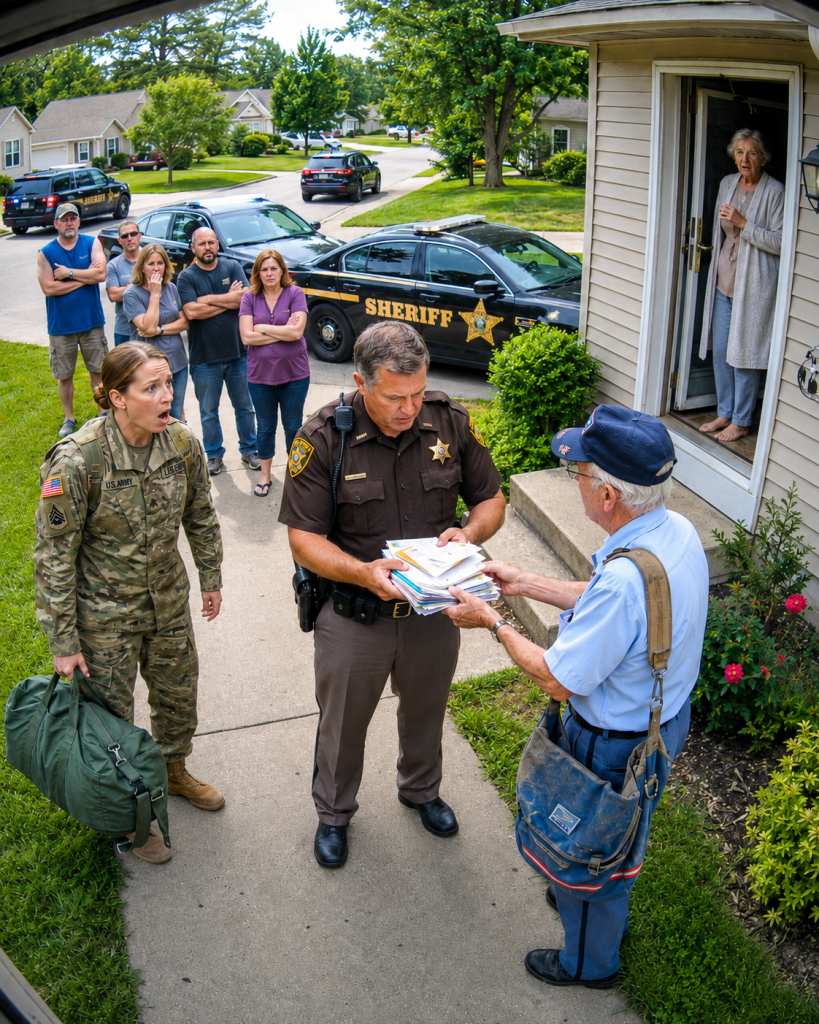
The sheriff looked down at the military casualty notice one more time before raising his eyes toward the Carter house. The paper was not a death confirmation. It was a record showing that Emily Carter had been part of an active deployment process, and that someone had received information about her military status while telling neighbors a completely different story.
The retired mail carrier explained that he had delivered mail on the same route for decades. He knew the Carter family routine, their mailbox, and the way returned letters appeared after Emily stopped receiving responses.
At first, he assumed it was a family issue.
Then he noticed the pattern.
Every month, another envelope came back unopened.
Some contained holiday messages. Some contained updates from bases overseas. One included a photograph of Emily in uniform with her unit. Another described the first time she had received an award during deployment
Mr. Holloway kept them because something about the situation bothered him.
He had delivered enough mail to know that people sometimes lost touch. But four years of unanswered letters from a daughter who was actively serving did not feel accidental.
Emily stood in the driveway listening as the story she had never been allowed to tell finally reached the people who had believed another version.
She remembered the first few months after leaving Ohio.
She had expected homesickness. She had expected difficult days. She never expected silence from the two people who raised her.
Before deployment, Emily and her parents had argued about her decision to join the Army. Her mother wanted her to stay close, finish school locally, and choose a safer path. Her father believed military service would make her independent in a way they could not control.
The argument ended badly.
Emily still remembered her mother’s final words before she left.
You always think you know better.
Emily thought time would heal the disagreement.
She wrote anyway.
She sent letters after training. She sent letters during holidays. She sent updates after difficult missions and small victories.
She never stopped believing her parents would eventually answer.
But the responses never came.
Then she came home and discovered the town had been told she was someone else entirely.
Sheriff Dalton turned the letters over carefully.
He asked Emily if she had any other records proving where she had been.
She reached into her bag and pulled out her service documents, deployment records, and identification.
But the question was no longer whether Emily was telling the truth.
The question was why her parents had built such a detailed lie.
Her mother stepped forward from the porch.
She insisted there had been misunderstandings. She said Emily did not know everything that happened while she was away.
But the explanation sounded different now.
Before, neighbors had heard a worried mother describing a dangerous situation.
Now, they were watching a mother struggle to explain four years of unopened letters.
Emily looked at her father.
He avoided her eyes.
That hurt more than anything else.
The accusation had been shocking, but the silence was worse. The people who should have known her best had chosen a story where she disappeared instead of admitting they had pushed her away.
Sheriff Dalton asked the question again.
Why did you tell people she was gone?
Her father finally answered.
He said the family had been dealing with something before Emily deployed.
Something they believed would destroy their reputation if anyone found out.
Emily felt the anger in the crowd shift into confusion.
Her parents had not simply wanted attention.
They had been protecting something.
Sheriff Dalton asked what that something was.
Her father looked toward the house.
Then he admitted there was a file inside the home that explained everything.
Emily wanted to know why he had waited four years to mention it.
Her father said because once Emily returned, the truth would become impossible to control.
That was the first honest thing he had said all day.
The sheriff entered the home with permission from the family after confirming the situation did not involve an immediate safety threat.
Emily waited outside with Mr. Holloway.
The retired mail carrier handed her the letters one by one.
She recognized her own handwriting on every envelope.
There were notes about birthdays she missed. Questions about family traditions. Messages asking if her parents were proud of her.
There were also letters she had written after receiving no response.
The final one was dated only weeks before she returned.
In it, Emily wrote that she hoped they could stop fighting and start over.
She had never known whether they read it.
Now she knew they had not wanted anyone else to know it existed.
Inside the house, Sheriff Dalton found the file her father mentioned.
It was not about Emily being dangerous.
It was about a decision made before she left.
Years earlier, Emily’s parents had taken financial control of several family matters after believing she would never return home permanently. They had changed how neighbors viewed her because they needed her absence to remain believable.
They had told people she was unstable because admitting she was serving overseas would create questions about why she had stopped being part of their lives.
The file contained documents, messages, and records showing they had contacted others while knowing Emily was safe.
The lie was not built from one moment.
It was maintained through hundreds of choices.
Sheriff Dalton called Emily inside.
Her parents were sitting at the kitchen table.
For the first time that day, there was no audience outside and no performance for neighbors.
Emily asked the question she had carried for four years.
Why?
Her mother cried and said they were afraid.
Emily asked what they were afraid of.
Her father admitted they were afraid people would ask why they had abandoned their daughter while she was serving.
That answer changed something for Emily.
She realized the lie had never been about protecting her.
It had been about protecting their image.
The sheriff documented the evidence and explained that the next steps would depend on the specific records involved. The investigation would follow the facts, not the emotions of the crowd outside.
Emily understood that justice would not erase four years of silence.
A report would not bring back missed holidays.
A public apology would not replace the letters that sat unanswered.
But she finally had something she had not had since leaving Ohio.
The truth was no longer trapped inside her.
Mr. Holloway later told her he kept the letters because he believed someone would eventually need them.
Emily asked why he never threw them away.
He said because every letter represented a person trying to reach someone else.
He did not want those attempts to disappear.
The town slowly changed its view of Emily.
People who had avoided her stopped her in public and apologized. Some admitted they should have questioned the story sooner.
Emily did not forgive everyone immediately.
She learned that forgiveness and trust were not the same thing.
Her relationship with her parents did not return to what it had been before deployment.
Some damage could not be repaired by one conversation in a kitchen.
But Emily chose what happened next.
She kept the letters.
She kept the uniform.
She kept the proof of the years she had spent serving while others pretended she was gone.
Months later, she moved into her own apartment near her next assignment.
On her desk, she placed the first letter she ever mailed home beside the last one returned to her.
The two envelopes looked almost identical.
The difference was that one represented hope.
The other represented everything she had survived.
Emily never got the homecoming she imagined when she stepped out of that truck.
Instead, she got something harder and more valuable.
She got the truth back.
Epilogue
Emily sat by the window of her new apartment, watching the rain trace slow paths down the glass. The Ohio town was far behind her now, a chapter closed not with a dramatic explosion, but with the quiet hum of a refrigerator and the steady ticking of a wall clock. Her new assignment at the base required early mornings and sharp focus, a rhythm she welcomed. The uniform hanging neatly in her closet was no longer a disputed artifact or a point of contention; it was simply hers, earned through sweat, discipline, and years of standing firm when everything around her fractured.
A knock at the door broke the quiet.
She opened it to find a standard-issue postal service box resting on the welcome mat. There was no return address that immediately caught her eye, just a neat block of handwriting she recognized instantly. It was from Mr. Holloway, who had since retired fully and moved to a small coastal town down south.
Inside the box was a single, thick manila envelope and a handwritten note on lined paper.
Emily carried the box to the kitchen table, setting it down beside her morning coffee. She unfolded Mr. Holloway’s note first. His handwriting was shaky with age, yet every stroke was deliberate. He wrote that while cleaning out the back corner of his old post office desk, he had found one final bundle tucked behind an old sorting tray—letters that had never made it into the main return bin because they arrived the very week the station underwent its digital transition.
She reached into the manila envelope and pulled out three small, weathered envelopes.
Her breath caught. They were letters she had written during her second year of deployment, right after the hardest operation her unit had faced. At the time, she had wept over those pages, pouring out her fear, her exhaustion, and her desperate longing for a word from home. She had assumed her parents had read them and simply chosen not to care.
Now, holding them in her hands, she felt a strange, cold clarity.
She turned the first envelope over. The postal stamps were faded, but the ink was undeniably hers. The red “RETURN TO SENDER” stamp slashed across her address was stark against the paper. She opened the flap carefully, sliding out the folded sheets inside.
Dear Mom and Dad, she read, her voice whispering the words aloud in the quiet kitchen. Today was heavy. I lost a friend, and all I wanted was to hear your voice, even if it was just to argue about my choices. Please tell me you are reading these. Please tell me I am not entirely alone out here.
The silence in the room stretched, heavy and profound.
Four years ago, reading those words would have shattered her. They would have reopened the raw wound of abandonment and set off a familiar cycle of self-doubt. But as Emily looked down at her own teenage handwriting, she felt no burning urge to pack a bag and drive back to Ohio to demand another explanation. There was nothing left to extract from her parents. Their silence had already revealed the limits of their character; these letters only confirmed what she already knew. They had been too cowardly to face the reality of who their daughter had become, choosing instead to build a fortress of convenient fiction.
She set the letter down and reached for the second one.
This time, a small photograph slipped out from between the folds. It was a polaroid taken by one of her squad mates on a rare afternoon off. Emily was grinning, her hair cropped short, dust on her cheeks, holding a canteen up in a mock toast. She looked tired, resilient, and entirely unbroken.
Her parents had missed this version of her. They had chosen a ghost story instead of embracing the living, breathing reality of a daughter who had traveled across the world, stood her ground, and survived.
Emily picked up her pen—a black ballpoint that sat beside her current duty log—and pulled a blank sheet of paper toward her.
She did not write to her parents. She did not draft an angry response or a plea for reconciliation. Instead, she wrote a letter to the version of herself who had sat in a dusty barracks tent four years ago, writing into the dark without a single reply coming back.
Dear Emily, she wrote, her hand steady and sure across the page. You made it. You survived the silence, the lies, and the waiting. You don’t need to look back anymore, because the truth finally caught up with you, and you are standing tall in the light.
She folded the paper and slipped it into an envelope, sealing it with a firm press of her thumb. She placed it right beside the recovered letters from Mr. Holloway, creating a small, quiet archive of her own history.
The past could not be rewritten, and the lost years could not be reclaimed. But as she looked toward the window where the morning sun was finally breaking through the gray clouds, Emily realized something fundamental. The story was hers now, and she was the only one holding the pen.