Chapter 1: The Anatomy of a Midnight Call
The digital clock on the mahogany nightstand glowed a pale, ghostly 1:58 AM, casting a sickly luminescence across the empty expanse of the California King bed. The house was dead quiet. It was a heavy, suffocating silence that had taken up permanent residence in the corners of the rooms ever since my wife, Martha, passed away three years ago. There was only the low, rhythmic hum of the kitchen refrigerator down the hall and the occasional groan of the settling floorboards—the sounds of an old house slowly dying alongside its owner. I lay perfectly still, staring at the ceiling fan, counting the rotations, a habit born of insomnia and decades of hyper-vigilance that I had never quite managed to switch off.
I pressed the phone to my ear, the plastic cold against my skin. “Chloe? Sweetheart, it’s Grandpa. Are you okay?”
For a terrifying second, there was only the sound of shallow, labored breathing. Then, a voice came through—a paper-thin, raspy whisper, trembling with a primal terror that instantly froze the blood in my veins.
“Grandpa,” she wheezed. The sound was wrong. It was sluggish, heavy, as if her vocal cords were submerged in thick oil. “I feel… I feel really hot. My tummy hurts.”
“Where are your parents, Chloe?” I asked, swinging my legs out of bed. My feet hit the hardwood floor, and the elderly widower vanished, instantly replaced by the operative. “Where is Wyatt?”
“Mommy and Daddy… they went to the airport for Daddy’s special trip,” she whispered, her voice trailing off into a soft, agonizing whimper. “They said… they said they gave me special medicine so I wouldn’t be sad. But I’m so hot, Grandpa. And Wyatt… Wyatt is crying.”
“I am on my way, Chloe. I am leaving right now. Leave the phone off the hook. Do not move.”
I didn’t bother changing out of my sweatpants or my heavy flannel shirt. I shoved my feet into a pair of laceless boots, grabbed the heavy iron keyring off the kitchen counter, and bolted out the door into the freezing, torrential autumn rain.
The frantic, fourteen-minute drive to Patrick’s house in the affluent, manicured suburb of Columbus was a blur of rain-slicked asphalt, sweeping windshield wipers, and panicked, desperate prayers to Martha. Watch over them, Martha. Please, just keep them breathing until I get there. The V8 engine of my old Ford truck roared as I pushed it to ninety down the empty suburban boulevards, running three red lights. My hands gripped the leather steering wheel so tightly my knuckles were bone white. My mind raced through a thousand terrifying scenarios. Had they hired a negligent babysitter? Had there been an accident? But the phrase special medicine echoed in my skull, carrying a dark, insidious weight.
I careened onto their street, a pristine avenue of sprawling colonial homes and perfectly manicured hedges that hid the rot of modern greed. I slammed the truck into park, the tires tearing up the edge of their pristine lawn.
The driveway was entirely empty. No silver Lexus SUV. No minivan. No luggage on the porch. The house was completely dark, a monolithic black shape against the stormy sky.
I sprinted up the concrete steps, the rain plastering my hair to my skull. I fumbled with my keyring, finding the emergency spare key Patrick had reluctantly given me years ago. I jammed it into the deadbolt, twisted it savagely, and threw the heavy oak door open.
I stepped into the grand foyer. It didn’t smell like a home. It smelled sickeningly of artificial cherry syrup, copper, and the stale, sour scent of frightened sweat. The silence in the house was absolute, thick, and deeply unnatural.
“Chloe! Wyatt!” I bellowed, my voice echoing off the vaulted ceilings.
No answer. Just the steady drumming of the rain against the bay windows.
I pulled a small tactical flashlight from my pocket, the beam cutting through the oppressive darkness. I swept the living room, the pristine white sofas, the massive television. Nothing. I moved toward the kitchen, the beam bouncing off the stainless steel appliances.
And then I saw her.
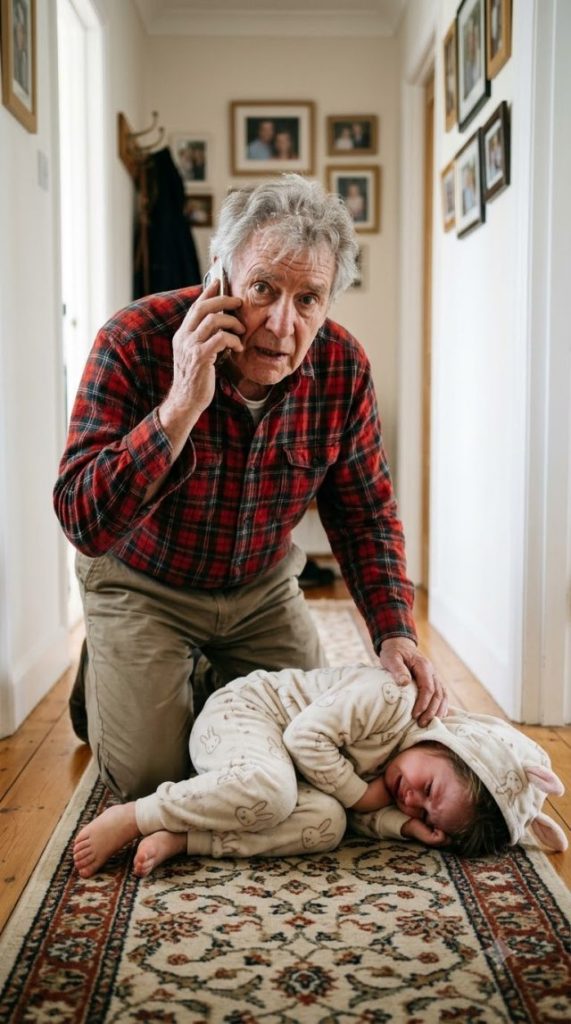
Chloe was curled into a tight, fetal ball on the cold hardwood floor near the kitchen island. Her pink pajamas, decorated with little unicorns, were soaked dark with sweat. Her small face was flushed a dangerous, mottled red, burning with a severe chemical fever. Her eyes were rolled back slightly, her breathing rapid and terrifyingly shallow.
I dropped to my knees, sliding across the floor, and scooped her small, limp body into my arms. She felt like a furnace. “Chloe, sweetie, Grandpa is here. Stay with me,” I pleaded, my voice cracking, pressing two fingers to the carotid artery on her neck. Her pulse was a frantic, terrifying flutter.
I pulled my cell phone from my pocket, my thumb hovering over the dial pad to call 911, when my tactical light swept across the granite kitchen counter directly above us.
There, illuminated in the harsh white beam, was a large, half-empty bottle of liquid promethazine—heavy adult sedatives, restricted and dangerous. Beside it was a small plastic dosage cup, coated in sticky red residue.
And right next to the bottle, resting perfectly centered on the granite, was a folded piece of heavy cardstock.
I reached up, my hand trembling for the first time in thirty years, and pulled the note down. I unfolded it. The handwriting was neat, slanted, and unmistakably Patrick’s.
Dad, Don’t overreact like you always do. We gave her something heavy to sleep so she wouldn’t ruin Wyatt’s birthday trip to Orlando. She’s fine. We’ll be back Sunday evening. We just needed a break from the noise. And whatever she tells you, DO NOT BELIEVE ANYTHING SHE SAYS ABOUT WHAT IS INSIDE THE CLOSET.
I stopped breathing. The blood in my veins turned to ice water.
We gave her something heavy… We needed a break… Don’t believe her about the closet.
This wasn’t negligence. This was a calculated, sociopathic dosage. He had poisoned his own daughter to keep her quiet, left her on a cold floor, and driven to the airport.
But it was the last sentence that made the hair on the back of my neck stand on end.
The hallway closet was ten feet away from where I knelt. It was a standard, double-louvered wooden door, usually holding winter coats and the vacuum cleaner.
Suddenly, a sound cut through the silence of the kitchen.
It was a quiet, desperate scratch. Then a muted, rhythmic thumping, coming from the bottom of the closet door.
Chloe’s tiny, burning fingers suddenly gripped the collar of my flannel shirt with a desperate, fading strength. Her eyelids fluttered open, revealing terrified, glassy pupils.
“Grandpa,” she weakly pleaded, her voice barely a breath against my ear, the sound tearing my soul in half. “Don’t open it. The monster… Daddy said the monster will eat us if we open it.”
I looked at the louvered door. The scratching continued, frantic, like a trapped animal suffocating in the dark.
I gently laid Chloe back down on the hardwood floor, slipping off my heavy flannel shirt and bundling it under her head as a pillow. “I’ll be right back, Chloe. I promise,” I whispered.
I stood up. I didn’t reach for my phone to call the police. I didn’t call an ambulance yet. The primal instincts that Martha had begged me to suppress were clawing their way out of the grave.
I walked slowly across the kitchen tile, my boots making no sound. I reached the closet. The scratching stopped the moment my shadow fell across the slats.
I wrapped my calloused hand around the cold brass doorknob. I took a slow, deep breath, preparing myself for whatever horrific abuse my son was hiding in the dark. I twisted the knob and threw the heavy wooden doors open.
But it wasn’t a monster. And it wasn’t just abuse.
It was a truth so profoundly disturbing, so mathematically evil, that the entire axis of my world violently shifted. The closet did not contain a monster.
It contained my ten-year-old grandson, Wyatt.
He was bound, sitting cross-legged on top of a massive, heavily wired, steel lockbox. But the bomb was not amateur. It was an absolute masterclass in lethal engineering. Wires snaked around Wyatt’s small torso like mechanical vines.
But the true horror was clamped between his teeth.
It was a custom-machined pressure switch, wrapped in surgical tape, wired directly into the detonator. A bite-switch. Wyatt was weeping silently, his jaw trembling violently as he bit down on the trigger. If his jaw relaxed—if he cried out, if he panicked and dropped it, or if he simply grew too exhausted to hold his mouth shut—the circuit would complete.
And strapped to the front of the steel box, blinking with a relentless, bloody red glare, a digital timer counted down.
02:45.
Chapter 2: The Architecture of Absolute Zero
The closet smelled of urine, sheer, primal fear, and the unmistakable, sharp, chemical tang of military-grade C-4 explosive.
02:44. Two minutes and forty-four seconds.
In that microscopic fraction of a second, as the red digits ticked down to 02:43, the Arthur Vance who had raised Patrick, the man who had taught him how to throw a baseball and tie a Windsor knot, died completely. That father was incinerated.
A cold, absolute zero washed over my central nervous system. The panic, the shock, the agonizing heartbreak of a father’s ultimate betrayal evaporated into the ether. The slight trembling in my aging hands ceased entirely.
Decades-old muscle memory—forged in the unforgiving, blood-soaked sands of a life I had sworn to Martha I had left behind in the military’s most shadowed, unacknowledged explosive ordnance disposal units—roared back to life with terrifying clarity.
Assess. Isolate. Execute.
“Wyatt, listen to my voice,” I commanded. My tone was no longer the soft, comforting cadence of a grandfather. It was impossibly steady, a low, authoritative baritone that brooked absolutely no argument. It was a frequency designed to cut through panic. “Do not nod. Do not speak. Just listen. Keep biting down on that plastic. If you bite down, you live. Do you understand? Blink twice for yes.”
Wyatt, tears streaming down his soot-stained cheeks, blinked twice.
02:12.
I dropped to one knee, my eyes rapidly tracing the wiring. The cartel had designed this to punish the victim. The bite-switch was wired to a micro-relay. The lockbox under him was a pressure plate. If I just pulled the switch from his mouth, it blew. If I just pulled him off the box, it blew.
“I need to cut your hands free, Wyatt. Keep your jaw locked,” I whispered. I pulled a heavy, carbon-steel folding knife from my pocket, snapping the blade open with my thumb. I reached behind him, sliding the blade between his wrists, twisting the steel to snap the heavy zip-ties without slicing his radial artery. His hands fell to his sides, bruised and shaking.
“Bring your hands up, slowly. Hold the plastic switch in your mouth with your fingers. Squeeze it tight. Don’t rely just on your jaw. Squeeze it.”
Wyatt brought his trembling hands up, his small fingers wrapping around the taped trigger module, holding it firmly between his teeth.
01:45.
I spun around, my eyes scanning the foyer and the kitchen. I needed mass. I needed dead weight for the pressure plate. Against the hallway wall was a heavy oak bookshelf. I rushed to it, grabbing a thick stack of heavy, hardbound encyclopedias. I sprinted back to the closet, dropping them on the floor. I kicked off my heavy, steel-toed boots.
01:10.
“Wyatt, look at me,” I said, my voice cutting through the ticking of the timer. I placed my heavy boots on the very edge of the steel lockbox, right next to his thighs. I began stacking the encyclopedias on top of the boots, creating a dense, heavy tower of counter-weight.
“I am going to pull you off this box. The absolute second your weight leaves, I am shoving these books onto the plate. You keep your hands clamped on that switch in your mouth. You do not let go until we are outside. Understood? Blink twice.”
Two frantic blinks.
00:45.
I positioned myself, planting my stockinged feet firmly on the hardwood. I reached out, gripping the thick leather of Wyatt’s belt with my right hand. I placed my left hand flat against the tower of books and boots.
“One,” I counted, my breathing slowing, perfectly synced with the adrenaline. “Two.”
00:30.
“Three!”
I yanked backward with explosive force. Wyatt flew forward, sliding off the lockbox. In the exact same millisecond, my left hand violently shoved the heavy stack of encyclopedias and steel-toed boots directly onto the center of the lockbox lid.
There was a terrifying metallic clack as the lid depressed slightly, then caught on the new weight.
No spark. No beep. The pressure switch held.
“Move!” I roared, dragging Wyatt up by his collar.
I sprinted the ten feet to the kitchen, scooping Chloe’s burning, limp body off the floor with my left arm, shoving Wyatt ahead of me. “Keep squeezing that switch, Wyatt! Run!”
I hit the heavy oak front door with my shoulder, bursting through it into the freezing, torrential rain.
00:15.
We cleared the porch. We hit the wet, manicured grass of the front lawn. My lungs burned, my stockinged feet slipping in the mud. We reached the property line, diving behind the thick, concrete retaining wall of the neighbor’s driveway.
“Throw it over the wall, Wyatt! Throw the switch!” I screamed.
Wyatt ripped the switch from his mouth and hurled it over the concrete wall into the street. I threw myself over the children, pressing their small bodies into the wet earth, covering them with my own.
00:03. 00:02. 00:01.
The earth beneath us didn’t just shake; it ruptured.
A deafening, concussive shockwave ripped through the night, a sound so loud it physically punched the air from my lungs. The ground heaved violently. I looked up just in time to see the beautiful, pristine facade of Patrick’s colonial home violently expand outward.
The massive bay windows blew out in a spectacular shower of diamond-like shards and brilliant, blinding orange flame. The roof lifted entirely off its trusses, suspended in the air for a fraction of a second before collapsing into the inferno. The heat washed over the concrete retaining wall, instantly singing the hair on the back of my neck and evaporating the rain on my skin.
A heavy, burning piece of the front door landed in the grass five feet away from us, hissing in the mud.
The house was gone. It was nothing but a roaring, towering pyre of shattered wood and burning chemical accelerant, lighting up the suburban neighborhood like a false sunrise.
Wyatt was screaming, burying his face in my chest. Chloe was unconscious, her breathing shallow but steady. We were alive. We had survived the purge.
And then, as I knelt in the freezing mud, shielding my grandchildren from the falling ash, I felt a vibration against my ribs.
My cell phone, tucked into the inner pocket of my undershirt, was buzzing.
I pulled it out. The caller ID flashed PATRICK.
My thumb hovered over the green accept button. My heart, which had been beating at a hundred and fifty beats per minute, suddenly slowed to a deadly, rhythmic calm.
I pressed the phone to my ear. The crackle of the connection hissed against the roar of the burning house behind me.
“Dad?” Patrick’s voice came through the speaker. It was calm. It was chillingly, sociopathically steady. There was no background noise of an airport terminal. There was only quiet.
“Yes, Patrick,” I answered, my voice a hollow, echoing void.
There was a brief pause on the line. Then, my son asked the question that sealed his fate in the book of the damned.
“Did you open the closet, Dad?”
I looked at the burning wreckage. He wasn’t in Orlando. He was close. He was calling to confirm the kill.
“No, Patrick,” I lied, my voice perfectly masking the lethal, calculating monster awakening inside me. “I just pulled into the driveway. The house… Patrick, the house is on fire. It exploded.”
“Oh my god,” Patrick gasped, a perfectly executed theatrical performance of a horrified father. “Dad! Are the kids inside? You have to get them! The fire department…”
“I’ll call you back, Patrick,” I said, and ended the call.
I picked up my grandchildren, carried them to my truck hidden down the street, and disappeared into the storm.
An hour later, as we drove through the torrential rain toward the mountains, Wyatt stared blankly out the passenger window, clutching a blanket. He finally broke his silence.
“Grandpa,” Wyatt whispered, his voice trembling in the dark cab of the truck. “Mom wasn’t scared of the men in the garage. When they tied me up… she didn’t beg. She smiled. And she spoke to them in words I didn’t understand. She called the man with the gun ‘Viper’.”
My foot eased off the gas pedal as a new, terrifying reality crystallized in the cold air of the truck. Patrick hadn’t just gotten into debt with the mob. He had married into it.
Chapter 3: The Trojan Horse
The rhythmic, heavy thud of the relentless rain against the rusted tin roof of my old Appalachian hunting cabin was the only sound for hours.
We were three hundred miles away from the smoking crater in Columbus, deep in the heavily forested, off-the-grid foothills of the mountains. Inside the cabin, the air was thick with the smell of burning oak from the cast-iron woodstove. Chloe was finally sleeping peacefully on a military-surplus cot in the corner. The terrifying chemical fever had broken after I forced activated charcoal slurry down her throat.
Wyatt sat cross-legged on a braided rug by the woodstove, wrapped tightly in a heavy wool blanket.
I poured a mug of hot, sweetened tea and knelt beside him. “Tell me exactly what happened in the garage, Wyatt. Every detail.”
Wyatt took a slow sip, his eyes haunted. “Dad was crying. He was on his knees. There were two men in suits. They said Dad owed them five million dollars. Dad begged Mom to go get her jewelry, to give them something. But Mom…” Wyatt swallowed hard. “Mom laughed.”
“She laughed?”
“Yes. She walked up to the biggest man. The one with the gun. She didn’t look like Mom anymore. Her face was… cold. She touched his shoulder and she said, ‘Status on the payload, Viper?’ The man bowed his head to her, Grandpa. He called her ‘Ma’am’. She told them that the insurance policies were ready, and that the ‘old man’—she meant you—would be in the house. She said it was a clean sweep.”
A cold fury anchored itself in my chest. Samantha wasn’t an innocent bystander corrupted by a desperate husband. She was a Syndicate operative. A plant. A Trojan Horse sent into Patrick’s life years ago, likely to launder money through his corporate accounts. And when Patrick had outlived his usefulness, she orchestrated the ultimate liquidation event. She had priced the lives of her own children at five million dollars.
“They heard me gasp,” Wyatt sobbed. “Dad grabbed me. Mom told the men to set the timer. She went upstairs to drug Chloe. She didn’t even look back.”
“You are safe now, Wyatt,” I whispered fiercely, pulling him into a tight embrace. “I swear to you on my life, you will never see them again.”
Once Wyatt fell asleep, I stood in the center of the cabin. The grandfather was gone. Only the ghost remained.
I walked over to the corner of the room, pulling a heavy, dust-covered canvas duffel bag from beneath a pile of old tarps. Inside, smelling of gun oil and ozone, lay the tools of my former trade. I lifted out the matte black steel of a heavily customized Colt M1911 pistol. Next to it lay a satellite-encrypted, hardened laptop.
I booted the machine up. My fingers flew across the keyboard. I didn’t hack the police; I hacked Patrick. Within thirty minutes, I found the active GPS ping from Samantha’s meticulously curated social media account, linked directly to her phone’s location services.
They weren’t in Orlando. They were in the Presidential Penthouse at the Grand Continental Hotel in downtown Columbus.
I loaded a magazine into the Colt, holstered the weapon at the small of my back, and slipped a tactical combat knife into my boot. I stepped out of the heavy wooden door of the cabin, preparing to begin the hunt.
But as my boots hit the wooden planks of the porch, I stopped dead.
The dawn light was just beginning to bleed through the trees. My Ford truck was parked exactly where I left it. But it was sitting heavily on its rims. All four thick, off-road tires had been brutally, expertly slashed.
And resting perfectly centered on the windshield was a single, stark black envelope.
The crunch of a heavy boot on wet gravel directly behind me was the only warning.
He was fast, but he was expecting an elderly victim. I pivoted on my heel, dropping my center of gravity. As the massive, leather-jacketed enforcer lunged forward with a collapsible baton, I sidestepped, driving my elbow with bone-shattering force directly into his throat. The man made a wet, gagging sound, dropping to his knees.
Before his body hit the mud, the second enforcer stepped out from behind the truck, raising a suppressed pistol.
I drew the Colt M1911 in a single, fluid motion. I fired through the fabric of my own jacket. Two suppressed hollow-point rounds caught the second enforcer dead center in the chest, dropping him instantly into the brush.
I walked over to the first man, suffocating in the mud, and pulled a key fob from his pocket. It bore the emblem of a luxury SUV.
“Thank you for the transportation,” I whispered.
I found their black Range Rover parked a quarter-mile down the logging road. I climbed in, started the engine, and checked the GPS. Their last destination was programmed in: The Grand Continental Hotel.
The drive back into the city was a quiet, singular meditation on violence. I was not angry. Anger makes you sloppy. I was filled with a cold, terrifying purpose.
By 8:00 AM, I had bypassed the main entrance of the Grand Continental, pulling the stolen Range Rover into the underground delivery bay. I took the service elevator to the forty-second floor. The penthouse level.
The hallway was lined with thick, sound-dampening carpet. I reached the double mahogany doors of the Presidential Suite. I pulled a sleek, electronic lock-pick gun from my pocket. With a soft, electronic click, the deadbolt disengaged.
I pushed the door open silently, expecting to find Patrick sipping champagne, celebrating his newfound wealth.
Instead, the metallic scent of fresh blood hit my nose before I even cleared the foyer.
I stepped into the opulent living room, bathed in the soft, golden light of morning.
Patrick wasn’t celebrating. He was stripped to his undershirt, strapped tightly to a heavy wooden dining chair in the center of the room. His face was a brutalized, swollen mess of purple bruises and lacerations. He was weeping hysterically.
Standing over him, holding a pair of heavy, blood-stained pliers, was a towering man in a sharp bespoke suit.
And sitting calmly on the white leather sofa, sipping an espresso and watching her husband being tortured with absolute, chilling indifference, was Samantha.
Chapter 4: The Execution of Ego
“I told you, you pathetic worm,” Samantha said, her voice devoid of the high-pitched, suburban shrillness she had faked for a decade. Her tone was now flat, cold, and coated in a thick, metallic Russian accent. “The insurance company flagged the claim. The police found the detonator fragments. You promised me a clean burn, Patrick. You promised me no loose ends.”
“I did! I did!” Patrick sobbed, spitting blood onto the marble floor. “My dad went in! He was supposed to die with them! I don’t know what happened!”
“What happened,” I said, stepping out of the shadows of the foyer and raising the heavy Colt M1911, “is that you vastly underestimated your father.”
The tall man in the suit whirled around, dropping the pliers and reaching for his shoulder holster. I didn’t hesitate. I put a single .45 caliber round through his right kneecap. The roar of the unsuppressed gunshot in the penthouse was deafening. The man screamed, collapsing to the floor in a heap of shattered bone and expensive fabric.
Samantha didn’t flinch. She didn’t scream. She slowly placed her porcelain espresso cup on the glass coffee table and looked at me. For the first time, she looked at me with genuine respect.
“Arthur,” Samantha purred, leaning back into the sofa. “I must admit, I am impressed. Viper told me you were just a retired contractor. A relic. Clearly, his intel was flawed.”
Patrick craned his bruised neck to look at me, his eyes wide with desperate, pathetic hope. “Dad! Dad, thank God! She’s crazy! She’s Syndicate! You have to save me, Dad! Cut me loose!”
I didn’t look at Patrick. I kept my eyes locked on the monster wearing my daughter-in-law’s skin.
“Where are the children, Arthur?” Samantha asked, calmly reaching into her designer handbag resting on the sofa next to her.
“They are beyond your reach,” I replied, keeping the sights of the Colt dead center on her chest. “Take your hand out of the bag, Samantha. Slowly.”
She smiled—a chilling, reptilian stretching of her lips. She slowly pulled her hand out, holding a sleek, suppressed 9mm pistol. But she didn’t aim it at me. She pointed it directly at Patrick’s head.
“Here is the situation, Arthur,” Samantha said smoothly. “Patrick is a liability. His gambling debts were merely the leverage my superiors used to gain access to his firm’s offshore accounts. Now, he is useless. Drop your weapon, tell me where the children are, and I will let your son live. Refuse, and I paint this beautiful hotel suite with his brains.”
Patrick shrieked, thrashing against his zip-ties. “Dad! Do what she says! Please!”
I looked at the weeping, broken man tied to the chair. The man who had willingly strapped his own son to a bomb. The man who had poisoned his own daughter so she wouldn’t make a sound while she burned.
“You think I came here to save him?” I asked, my voice dropping to a whisper that echoed in the silent room.
Samantha’s smile faltered. Confusion flickered in her cold eyes.
“I came here to look him in the eye,” I continued, stepping closer, “and let him know that his children will grow up forgetting his name. I came to let him know that he died to me the moment I opened that closet door.”
Patrick let out a guttural wail of despair, finally realizing there was no salvation coming.
Samantha’s face hardened into a mask of pure malice. “Then you can all die together.” She pivoted the gun away from Patrick, leveling it at my chest.
Before her finger could tighten on the trigger, the entire dynamic of the room violently fractured.
Through the massive, floor-to-ceiling glass window behind Samantha, a brilliant, ruby-red laser dot suddenly materialized. It danced across the white leather sofa, tracked instantly across the room, and settled perfectly, dead center, on Samantha’s forehead.
I froze.
But it wasn’t just a laser. The tiny red dot began to blink rapidly.
Dot-dot-dash… dot-dash-dot-dot…
Morse code.
My blood ran cold as I translated the flashing red light in real-time.
H-E-L-L-O… A-R-T-I-E.
Only one person in the world had ever called me Artie. A sniper named Elias. A man I had personally watched take a mortar round to the chest in a dusty compound in Kandahar, Afghanistan, twelve years ago. A man whose dog tags I had buried.
The ghost wasn’t just in the room. The ghost had the high ground.
Chapter 5: The Ghosts of Kandahar
I didn’t choose to save Samantha. I chose to survive.
I stayed low behind the marble bar. Elias—if it truly was Elias, resurrected by the Syndicate—wasn’t just cleaning up Samantha. He was wiping the board entirely.
I reached into my pocket, pulled out a small, high-decibel tactical smoke grenade from my duffel bag, pulled the pin, and rolled it across the floor of the suite.
Thick, blinding, acrid white smoke instantly billowed into the room, filling the space from floor to ceiling, completely obscuring the sniper’s line of sight through the shattered window.
The hotel’s fire alarm immediately triggered. Sirens blared, and the overhead sprinklers activated, raining cold water down on the chaotic scene.
“Dad! Help me!” Patrick shrieked from the smoke, coughing violently, thrashing on the wet marble. “Take me with you! Please! Cut me loose!”
I stood up, the smoke swirling around me. I walked over to the thrashing chair. I looked down at the pathetic creature on the floor.
“The police are coming, Patrick,” I said, my voice calm over the blaring alarms. “If I cut you loose and you run, Elias will put a bullet through your spine before you reach the lobby. If you stay, you spend the rest of your life in a concrete box for terrorism and conspiracy.”
I stepped over him.
“Dad! No! You can’t leave me here! I’m your son!”
“I have no son,” I replied.
I didn’t look back. I slipped out the front door of the suite, joining the chaotic flood of terrified hotel guests pouring down the emergency stairwells, vanishing entirely into the panic of the city, leaving Patrick to the sirens and the ghosts.
Eight months later.
The relentless, sterile fluorescent lights of the Federal District Courthouse beat down on the defense tables like an interrogation lamp. Patrick sat at the table, wearing an ill-fitting, orange prison jumpsuit. He was entirely unrecognizable from the arrogant golden boy he had once been. His hair was thinning rapidly, graying at the temples. His posture was permanently stooped, crushed under the terrifying weight of a federal indictment.
The judge, a stern woman with zero tolerance for familial betrayal, banged her gavel. As she read the sentence—consecutive life terms in a maximum-security federal penitentiary, without the absolute possibility of parole—Patrick finally turned around. He looked back into the crowded gallery, searching for me. Searching for a father’s pity.
But I wasn’t there. I had no interest in watching him fade away into a concrete cell.
Two thousand miles away, the air was a completely different color.
The golden, late-afternoon sun reflected brilliantly off the pristine, cold waters of Puget Sound in Washington State. The light illuminated the expansive, wrap-around porch of a heavy, fortified cedar farmhouse I had purchased with untraceable cash, nestled deep within a hundred acres of private, impenetrable pine forest.
I sat in a heavy, wooden rocking chair, wrapped in a thick wool sweater, a steaming mug of black coffee resting in my hand.
Down on the expansive green lawn, sloping toward the water, the world was healing. Chloe was laughing—a bright, beautiful, unburdened sound that echoed through the trees. She was chasing a clumsy golden retriever puppy, her little pink boots stomping joyfully in the puddles.
Wyatt was sitting on the bottom step of the porch, carefully carving a piece of driftwood with a pocket knife I had given him. He was learning to build, to create, rather than destroy.
“Grandpa,” Wyatt asked, brushing wood shavings from his jeans. “Do you think he’ll ever get out? Do you think he’ll ever come looking for us?”
I looked at the boy who had sat with a bomb in his mouth and survived.
“No, Wyatt,” I promised, my voice carrying the absolute, unshakeable certainty of a steel vault slamming shut. “He is locked in his own closet now. And no one is ever going to open that door.”
Wyatt smiled—a small, genuine expression of profound peace—and went back to carving.
The sanctuary was secured. The nightmare was over.
But as I leaned back in my rocking chair, watching the sun begin to dip below the horizon, I felt a familiar, silent vibration against my ribs.
Deep inside the inner pocket of my heavy coat, the encrypted satellite phone I kept for emergencies was flashing silently.
I pulled it out, shielding the screen from Wyatt.
I expected a text message. A job offer from the Syndicate. A threat.
But there was no text. The phone didn’t ring. The screen simply illuminated with a high-resolution photograph that had just been transmitted to the device.
My breath caught in my throat. My blood turned to liquid nitrogen.
It was a photograph of Chloe. She was laughing, chasing the golden retriever puppy across the green lawn.
The photograph had been taken less than thirty seconds ago.
And judging by the subtle crosshairs etched faintly into the digital compression of the image, the photograph had been taken through the high-powered telescopic lens of a sniper rifle, positioned somewhere deep within the pine tree line surrounding my supposedly impenetrable property.
Beneath the chilling image, a single line of text appeared, blinking rhythmically like a heartbeat.
Beautiful family, Artie. The game is just beginning.
Chapter 6: The Long Game
The encrypted screen glowed with a harsh, tactical green light against the encroaching twilight of the Pacific Northwest. I stared at the photograph, the digital crosshairs resting perfectly over Chloe’s small, pink coat.
Elias.
Twelve years ago, I watched him bleed out in the dust. I held the compress against his chest until his eyes glazed over. But the Syndicate didn’t just buy politicians and bankers; they bought corpses. They had resurrected my best friend, rebuilt him, and weaponized him. And now, they had sent him to my doorstep.
He didn’t pull the trigger. He took a photo.
In the language of the shadow world, this wasn’t an assassination attempt. This was a checkmate declaration. He was proving that my fortress was made of glass. He was proving that no matter how far I ran, the reach of the Syndicate was absolute.
I sat perfectly still in the rocking chair, the cold ocean breeze whispering through the pines.
A year ago, before the midnight phone call, before the ticking bomb and the smell of C-4, a dark, hidden part of me—the lonely, grieving widower—might have felt fear. I might have panicked. I might have packed the children into the truck and run again in the dead of night.
But I looked down the length of the porch.
Chloe was giggling hysterically, burying her face in the golden puppy’s thick fur. Wyatt stood up, walking over to me. He proudly held up his finished carving—a rough, slightly asymmetrical, but undeniably beautiful shape of a soaring eagle.
“Look, Grandpa,” Wyatt beamed, his eyes shining with pride. “I finished it. It’s for you. For the mantle.”
I looked at the wooden eagle, and then I looked at the dark, impenetrable tree line where my old friend was currently lying in the damp pine needles, peering at my family through a scope.
The fear evaporated. The panic vanished.
What replaced it was a terrifying, absolute clarity. A cold, calculating violence that had been dormant for decades, now fully awakened and unchained.
They wanted a game. They thought they were hunting a retired old man hiding in the woods. They didn’t realize they had just trapped a demon in a cage with the only two things he loved in the entire world.
“It’s a masterpiece, Wyatt,” I whispered, taking the wooden eagle and giving him a warm, grandfatherly smile that betrayed absolutely none of the lethal calculus running through my mind. “It’s going right in the center of the fireplace. Why don’t you take your sister inside and help her wash up for dinner?”
“Okay, Grandpa!” Wyatt called out, running down the steps to corral Chloe and the dog.
As the heavy oak door of the farmhouse closed behind them, securing them inside, I stood up from the rocking chair.
I didn’t turn off the satellite phone. I didn’t break the SIM card. I opened the encrypted messaging app, typed a single reply to the ghost in the woods, and hit send.
I’ll leave the porch light on.
I slipped the phone into my pocket. I turned to the heavy iron woodstove burning on the edge of the porch, feeling the heat radiate against my face.
I was not Arthur Vance, the quiet neighbor who mowed his lawn in Ohio. I was not the grieving widower. I was the architect of absolute zero, and I was going to systematically dismantle the entire Syndicate, brick by bloody brick, until there was nothing left but ash.
I walked into the house, the lock engaging with a heavy, metallic click behind me, ready to go to war.
If you want more stories like this, or if you’d like to share your thoughts about what you would have done in my situation, I’d love to hear from you. Your perspective helps these stories reach more people, so don’t be shy about commenting or sharing.