Mother Slaps Daughter Over Fallen General’s Compensation, Unaware Senior Officers Are Watching Her Closely Tonight
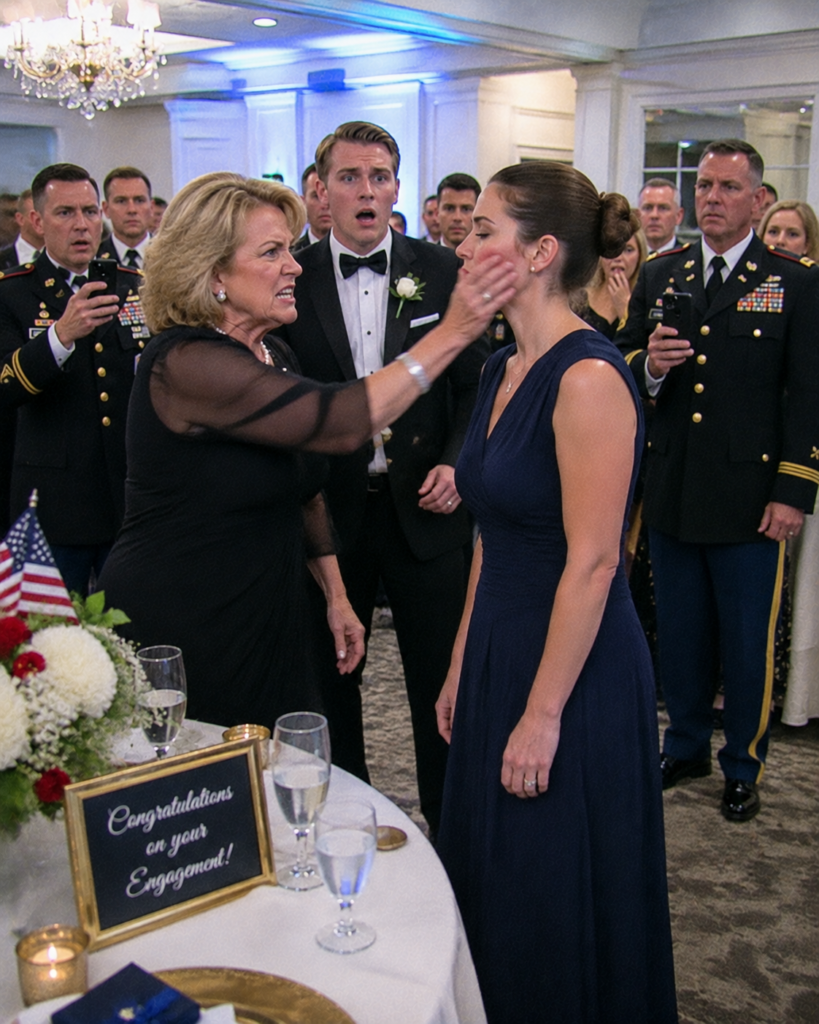
By the time my mother struck me twice, the musicians had stopped playing, and every conversation inside the ballroom seemed to collapse into silence around us completely. My cheek burned beneath the crystal chandeliers, yet the deeper pain came from recognizing the satisfaction flashing across Chloe’s face beside our stunned relatives that terrible evening.
She believed the scene had ended exactly as our childhood arguments always ended, with me humiliated, apologizing, surrendering whatever she demanded simply to restore peace.May be an image of wedding
But behind my mother, three senior Army officers had already lowered their champagne glasses, stepped apart from the crowd, and quietly reached for their phones.
Ethan did not rush toward me, because the discipline governing his military career remained stronger than anger, even while fury sharpened every line of him.
He simply met my eyes across the room, and the steadiness in his expression told me something irreversible had already begun moving beyond my family.
My mother mistook his restraint for weakness, straightened her dress, and announced that difficult daughters sometimes needed reminders about loyalty, gratitude, and proper family responsibility.
Several guests shifted uncomfortably, while Chloe raised her glass again, wearing the small triumphant smile she always wore whenever someone else paid for her mistakes.
I touched my burning cheek, looked at both women, and repeated the words they had not understood moments earlier: now it was their turn to lose.
My mother laughed once, coldly, then demanded I stop being dramatic before I ruined an expensive celebration that she insisted had already cost enough money.
That sentence almost made me smile, because she had contributed nothing toward the engagement party, although she had spent weeks telling relatives she organized everything.
Ethan finally crossed the ballroom, not hurriedly, but with the measured authority that could silence soldiers during chaos and make confident executives reconsider careless decisions.
He stopped beside me without touching my face, because he knew I hated being treated as fragile when what I needed most was control in that moment.
Then he asked one quiet question, whether I wanted the police called, and the room changed again as my mother’s expression finally lost its certainty.
She stared at him, apparently expecting an apology, but Ethan’s attention remained fixed on me while the senior officers behind us began speaking into phones.
I told him not yet, because before anyone left that ballroom, I wanted my mother and sister to understand what my father’s compensation actually represented.
The fund had never been a family prize, emergency wallet, or reward waiting for whichever relative created the loudest crisis and demanded rescue from everyone.
It came after my father died overseas, following an operation whose details remained classified even years later, and whose consequences permanently altered our family forever afterward too.
General Thomas Carter had been remembered publicly for medals, command decisions, and service, but privately he was simply the man who taught me courage from the beginning.
He made pancakes badly, fixed broken cabinet doors beautifully, and called every Sunday when deployments allowed, even if he had only five exhausted minutes available.
My father also understood my mother better than I did then, which explained why he had placed strict legal protections around the compensation before deploying.
According to his instructions, my portion could support education, housing, medical emergencies, or long-term security, but nobody else could compel me to surrender it under any circumstances.
My mother knew those conditions, yet for years she described the account as family money whenever Chloe crashed another car, abandoned another job, or accumulated debt.
I had paid Chloe’s rent twice, covered a hospital bill once, and rescued her from credit cards she reopened weeks after promising permanent change without lasting consequences.
Each rescue taught her the wrong lesson, because she never learned responsibility; instead, she learned that creating enough panic could eventually force me to pay.
After our father died, my mother transformed that pattern into something uglier, using grief as leverage whenever ordinary guilt stopped producing the result she wanted.
She reminded me that Chloe was sensitive, vulnerable, and unlucky, while describing my independence as evidence that I needed less care than everybody else in our household.
For years I accepted that cruel mathematics, believing strength meant absorbing more pressure without complaint, until military service finally taught me something my childhood never had.
Strength was not endless surrender, and loyalty did not require financing another adult’s destruction simply because refusing them made the dinner table uncomfortable afterward for anyone involved.
So months before the engagement party, when Chloe demanded nearly two hundred thousand dollars to erase gambling losses and failed investments, I finally refused completely.
My mother reacted as though I had abandoned a starving child, although Chloe was thirty-one, healthy, educated, and carrying a handbag worth several monthly salaries.
What neither woman knew was that Chloe’s desperation had already crossed beyond reckless spending into conduct that could expose both of them to serious consequences.
Two weeks earlier, the bank managing my protected account had contacted me about documents requesting a transfer supposedly authorized with my signature and identification late one afternoon.
The signature was close enough to fool a stranger, but not close enough to fool me, especially because my middle initial had been formed incorrectly.
I immediately reported the request, then learned someone had also submitted copies of private family records that had never been given to Chloe legitimately at any point.
Investigators advised me not to confront anyone while they traced the submission, so I entered my engagement party already carrying a secret heavier than champagne.
I had hoped, perhaps foolishly, that my mother would choose celebration over pressure for one evening, giving me one memory untouched by money or manipulation.
Instead, she cornered me before dinner, threatened my reputation, struck me publicly, and provided dozens of witnesses to the coercion investigators had struggled to prove.
That was why the officers were calling, although my mother assumed they were arranging cars, checking schedules, or dealing with some unrelated military inconvenience outside.
One of them, Major General Samuel Reeves, had served beside my father for years and had known me since I was a nervous teenager for many years.
Reeves moved toward us slowly, his expression carrying none of the warmth he had shown earlier when congratulating Ethan and me near the entrance earlier that evening.
He asked my mother whether she had struck me twice, and she answered that private family discipline was nobody else’s concern inside a celebration.
The general’s jaw tightened, but before he responded, Chloe stepped forward and accused me of staging the confrontation because I enjoyed making them appear cruel.
I almost admired the confidence required to say that while my face was still red and more than sixty guests had witnessed everything themselves.
Then Reeves turned toward me, addressed me by rank, and asked whether I wished to make an official statement before civilian officers arrived.
The title landed across the ballroom harder than either slap, because my mother had spent years telling relatives my government position was merely administrative.
Her eyes narrowed first with confusion, then widened as Ethan stepped beside Reeves and another officer addressed him with a title she recognized immediately.
For the first time that night, Chloe stopped smiling, because the successful businessman she had mocked at family dinners suddenly stood revealed as something else.
Ethan explained nothing about classified assignments, but he confirmed that both of us were active-duty officers and that our private service records required discretion.
My mother looked between us as though strangers had replaced the daughter and future son-in-law she believed she could embarrass without consequences before everyone.
She whispered that I had lied to her, and I answered that privacy was not deception, especially when disclosure could endanger operations and colleagues.
Then I asked why she needed details about my career when she had rarely asked whether I was safe, tired, lonely, or afraid.
Her mouth opened, but no answer came, because the question exposed a truth money had hidden for years beneath birthdays, holidays, and carefully staged photographs.
She knew what I earned only when she wanted help, remembered my father’s sacrifice only when invoking guilt, and noticed my strength only when exploiting it.
Before she recovered, two plainclothes investigators entered with hotel security, followed moments later by local police responding to reports of an assault inside the ballroom.
My mother’s face drained of color when one investigator spoke her full name and asked whether she would step aside to discuss a financial inquiry.
Chloe immediately demanded a lawyer, which told me more than any confession could have, because nobody had yet publicly mentioned the forged transfer request.
The investigator noticed that reaction too, and his glance toward his partner was brief, controlled, and devastatingly clear to everyone standing nearest the confrontation.
My mother turned on Chloe with sudden suspicion, but Chloe stared at the carpet, clutching her designer purse against her body like a shield.
I realized then that whatever they had planned together was already breaking apart, because fear makes fragile alliances collapse faster than any accusation ever could.
The investigators separated my mother and Chloe before asking me to describe the earlier threat, including the demand that I transfer my father’s compensation Monday.
I repeated her words carefully, resisting the temptation to embellish anything, because the plain truth was finally powerful enough without anger helping it along.
Several nearby guests confirmed hearing the demand and both slaps, while hotel security preserved camera footage showing my mother following me through the ballroom.
Then the bank investigator revealed that the attempted transfer had been linked to an account controlled by a company Chloe quietly created months earlier.
That company had no employees, no real office, and no legitimate revenue, yet it had recently promised creditors a large infusion of family capital.
Chloe began crying immediately, insisting she never intended to steal anything and claiming our mother had assured her the compensation belonged equally to everyone.
My mother snapped that Chloe was twisting everything, then accused me of poisoning investigators against them because I had always resented my sister’s happiness.
I looked at Chloe’s trembling hands and wondered how many times I had mistaken chaos for vulnerability simply because our mother taught me that interpretation.
Reeves remained silent until my mother invoked my father again, claiming he would have wanted his daughters to share everything and protect each other.
Then the general finally interrupted, saying Thomas Carter had discussed exactly that fear with him before his final deployment overseas several years earlier.
My father had worried that guilt would become a weapon after his death, especially if my mother continued rewarding Chloe whenever consequences became uncomfortable.
Reeves said Thomas loved both daughters deeply, but loving Chloe never meant financing choices that could destroy Natalie’s future or erase personal accountability.
Those words broke something open inside me, because I had spent years wondering whether refusing Chloe meant betraying the father whose memory shaped everything.
My mother stared at Reeves with disbelief, perhaps realizing the dead man she had quoted so confidently had left witnesses to intentions she distorted.
Reeves then handed me a sealed envelope he had planned to give privately after dinner, explaining my father entrusted it to him years earlier.
The envelope had remained unopened in a secure personal file, accompanied by instructions that it should reach me only when I became formally engaged.
My hands shook as I opened it, while Ethan stood close enough to support me without interrupting the private moment unfolding beneath dozens of eyes.
Inside was a letter in my father’s unmistakable handwriting, the same strong slant that appeared on every birthday card he mailed from distant bases.
I could not read every line aloud, but one passage asked me never to confuse sacrifice with surrender or family love with permanent financial rescue.
He wrote that my future belonged to me, and anyone using his death to control my choices was dishonoring rather than protecting his memory.
When I finished, the ballroom remained silent, but the silence no longer felt humiliating; it felt like space opening where fear had controlled me for years.
My mother reached toward the letter, and I stepped back, telling her she had already borrowed enough authority from a man who could no longer object.
At that moment, another investigator quietly informed her that the forged transfer was not the only transaction being examined under my father’s name that month.
Records from the memorial foundation she chaired showed payments routed toward Chloe’s debts, personal travel, and luxury purchases that had been described as charitable family assistance.
My mother denied stealing anything, but the investigator explained that accountants would determine what happened, and her access to foundation accounts had been temporarily suspended.
That consequence frightened her more than police questions, because the foundation had become the center of her social identity and her connection to powerful donors.
She looked around desperately for allies, yet several board members attending our party were already exchanging messages, their expressions tightening as the implications became unavoidable.
Chloe finally admitted she had sent the transfer documents, but insisted our mother provided the records and promised Natalie would eventually forgive them as always.
My mother called her a liar, Chloe called her controlling, and within seconds their polished alliance dissolved into accusations neither seemed able to contain anymore.
I watched them destroy each other without satisfaction, because winning did not feel like revenge; it felt like finally setting down something unbearably heavy.
Police documented the assault and escorted my mother away for further questioning, while Chloe left separately with investigators handling the suspected financial fraud that night.
No one applauded, and I was grateful, because what happened was not entertainment or victory; it was the painful ending of a lifelong family pattern.
Ethan asked whether I wanted to cancel everything, but I looked around at friends who had stayed quietly beside us and chose to continue celebrating.
The musicians began again softly, servers replaced abandoned champagne glasses, and Reeves placed my father’s letter beside my engagement ring before offering a restrained salute.
I cried then, not because my cheek hurt, but because my father’s words had reached me at the exact moment I finally understood their purpose.
Months later, investigators confirmed enough evidence for prosecutors to pursue fraud-related charges, while the memorial foundation’s board permanently removed my mother from financial authority.
Chloe entered a repayment agreement and treatment program after her attorney negotiated consequences, and for the first time nobody in our family erased what followed.
My mother sent letters blaming me, Ethan, investigators, and even my father, but I stopped answering explanations designed only to rebuild the same old cage.
I kept the compensation untouched, not because money mattered more than family, but because honoring sacrifice sometimes means protecting the future that sacrifice was meant to preserve.
On our wedding morning, I wore my father’s insignia inside my dress and remembered the night two slaps finally ended thirty years of surrender.