Victoria Mercer answered on the second ring.
She did not gasp.
She did not offer sympathy.
That was why I had called her.
“Where are you?” she asked.
“Terminal C.”
“Are you alone?”
“Yes.”
“Does Julian know you saw him?”
“No.”
A pause.
“Good,” Victoria said. “Keep it that way.”
I walked through the terminal without feeling my legs.
Around me, families argued over luggage. A businessman shouted into a headset. Somewhere behind me, a child began crying because his mother had taken away his tablet.
Normal life continued with almost insulting efficiency.
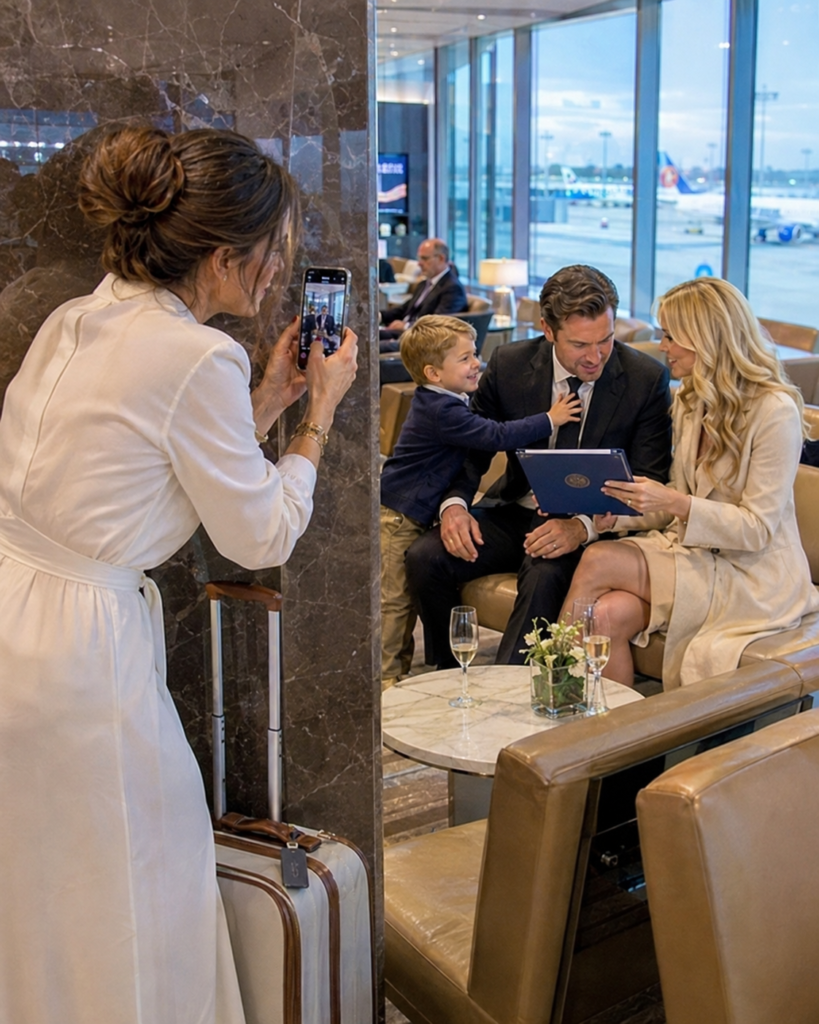
My own life had split open behind a marble wall.
Victoria’s voice stayed calm.
“Send me everything.”
I forwarded the video, the photographs, and a close-up of the forged signature.
Three dots appeared.
Then vanished.
Then appeared again.
“Oh,” Victoria finally said.
“What?”
“This isn’t just divorce fraud.”
I stopped near an empty gate.
“What is it?”
“The lender named on that document is Northbridge Strategic Capital.”
I knew the name.
Everyone in aviation finance did.
Northbridge specialized in distressed acquisitions. They bought companies with cash-flow problems, replaced management, stripped valuable assets, and sold what remained.
“They’ve been circling Pendelton for years,” I said.
“Yes.”
My fingers tightened around the handle of my suitcase.
“Julian told me they stopped approaching us.”
“Apparently they stopped approaching you.”
I closed my eyes.
That distinction hurt more than it should have.
Victoria continued.
“The collateral authorization would allow Julian to pledge your controlling shares. If the company defaults under certain loan terms, Northbridge can seize them.”
“But the board would never approve a loan large enough to threaten control.”
“Unless the board believes you already approved it.”
I looked back toward the lounge.
Julian was still inside.
Still laughing.
Still wearing the watch I had given him.
“What do you need from me?” I asked.
“First, do nothing emotional.”
“I am not emotional.”
“You recorded your husband plotting to bankrupt you while sitting beside his mistress and secret child.”
“Fine. I am emotional.”
“But?”
“But I’m functional.”
“That’s the Audrey I remember.”
Victoria had known me before Julian.
Before the dresses and benefits and charity committees.
Before people started introducing me as Julian Pendelton’s wife instead of Audrey Bell Pendelton, former assistant U.S. attorney.
“Go home,” she said. “Act normal. I’m initiating the trust’s emergency review.”
“Can you freeze the accounts?”
“Not yet.”
“Why?”
“Because if Julian notices the freeze before we know how deep this goes, he starts destroying evidence.”
I hated that she was right.
“How long?”
“Give me until tonight.”
Then her voice changed.
Lower.
More careful.
“Audrey, one more thing.”
“Yes?”
“Do not confront the woman.”
“I wasn’t planning to.”
“Good.”
“Why?”
Victoria hesitated.
“I ran her face through a private database.”
My stomach tightened.
“You already identified her?”
“Her name is Celeste Marrow.”
The name meant nothing to me.
“Who is she?”
“She isn’t just Julian’s girlfriend.”
“Then what is she?”
Another pause.
“She’s general counsel for Northbridge Strategic Capital.”
For the first time since the lounge, I truly understood the scale of what I had heard.
Not an affair.
Not even simply a theft.
A corporate ambush.
My husband was helping an acquisition firm steal my family’s company.
And he had brought his son to the meeting.
“Victoria?”
“Yes?”
“Freeze nothing yet.”
“That was my recommendation.”
“No. I mean freeze nothing until I know exactly what they’re buying.”
A faint note of approval entered her voice.
“There you are.”
I stared at the lounge doors.
“I’m going home.”
“Good.”
“And Victoria?”
“Yes?”
“Find out who Liam’s mother really is.”
“I thought we just established that.”
“No.”
I watched Celeste emerge through the lounge glass, holding the little boy’s hand.
Julian followed.
Liam looked up at him with complete trust.
“There’s something wrong,” I said.
“What?”
“I don’t know yet.”
Then I disconnected.
Julian arrived home at nine twenty-three that evening.
I knew because I had been watching the security feed.
At six, he had texted me.
Flight delayed. Nightmare. Finally taking off. Love you.
At seven thirty, another message.
Just landed. Exhausted. Heading to hotel.
At eight fifteen:
Early meetings tomorrow. Miss you already.
He had not left the city.
I knew that because one of our security cameras showed his car turning into our driveway.
He did not know I had regained access to the system.
Three months earlier, he had insisted we upgrade our home security and move all administrative privileges into his name because, as he put it, “You always forget passwords.”
He had been right.
I did forget passwords.
But I remembered subpoenas.
I remembered warrants.
I remembered how people hid things when they believed no one was looking.
And before coming home, I had visited the security contractor who had installed the system.
The company was owned by my cousin.
Julian had apparently forgotten that too.
When he entered the house, I was sitting in the dark library.
He crossed the foyer quietly.
No rolling suitcase.
No briefcase.
He went upstairs.
Stayed there four minutes.
Then came back down carrying a black duffel bag.
I waited.
He entered the office.
The lock clicked.
A minute later, the tiny camera my cousin had installed behind a bookshelf showed Julian opening our floor safe.
He removed a packet of documents.
A passport.
And three bundles of cash.
Thirty thousand dollars, perhaps more.
Then he reached deeper.
His hand disappeared inside the safe.
When it emerged, he was holding something I had never seen before.
A second phone.
He turned it on.
My own phone vibrated in my hand.
Victoria.
I answered silently.
“What?”
“I found something.”
“So did I.”
I kept watching Julian.
“What did you find?” she asked.
“A burner phone.”
“That’s useful. Mine is better.”
I listened.
“Celeste Marrow has no children.”
I frowned.
“She was traveling with Liam.”
“Yes. But she is not his mother.”
“Then who is?”
“Still working on that.”
“Could he be Julian’s child from someone else?”
“Possibly. But there’s more.”
I heard keyboard taps.
“Northbridge filed a confidential UCC financing statement three weeks ago.”
“Against Pendelton?”
“Against three subsidiaries. All subsidiaries Julian directly oversees.”
I stood.
“How?”
“Someone internally certified the collateral schedules.”
“Who?”
“I’m sending it.”
A document appeared on my screen.
At the bottom was an electronic authorization.
Not mine.
My father’s.
I stared at it.
Impossible.
My father, Henry Bell, had founded Pendelton Aviation before it was called Pendelton Aviation.
Back then, it had been Bell Aeronautics, operating from a metal hangar with six employees and one government contract.
When my father died, Julian convinced the board that changing the name would help attract international investors.
I allowed it.
That decision suddenly felt like vandalism.
“There’s a problem,” I whispered.
“I know.”
“My father has been dead for eight years.”
“Yes.”
Julian moved inside the office.
I watched him photograph pages with the burner phone.
“Victoria, someone is forging dead people now.”
“No.”
The word came too quickly.
“What?”
“The electronic certificate tied to Henry Bell’s authorization is active.”
“That’s impossible.”
“Legally? Yes. Technically? Apparently not.”
“Where was it issued?”
“I’m tracing it.”
Julian placed the documents back in the safe.
Then my phone chimed.
A message from him.
Heading to bed, beautiful. Long day tomorrow.
I almost laughed.
Instead I typed:
Sleep well. Love you.
He was twenty feet away.
The typing bubble appeared.
Love you more.
I watched him on the camera.
He smiled at his screen.
Then the smile disappeared.
Someone was calling the burner phone.
Julian answered.
I increased the audio.
“Yes?”
A man spoke.
I could not hear the words.
Julian’s expression tightened.
“No, she doesn’t know.”
Silence.
“I said she doesn’t know.”
His voice dropped.
“Tomorrow is too soon.”
Another pause.
Then:
“Because she’s still my wife.”
My blood turned cold.
He glanced toward the office door.
“I understand.”
More silence.
Then Julian said something that made my entire body go still.
“If you hurt Audrey, there’s no deal.”
I stopped breathing.
He listened.
“No. You listen to me. The shares are enough. She walks away alive, or I burn everything.”
He disconnected.
For several seconds, he simply stood there.
Then he threw the phone across the room.
It struck the wall.
I stared at the feed.
Victoria whispered, “Audrey?”
“You heard that?”
“Yes.”
My mind struggled to catch up.
Julian was stealing from me.
Planning to divorce me.
Planning to bury me in debt.
But someone else wanted me dead.
And apparently my husband had just threatened them to stop it.
“What deal?” I asked.
“I don’t know.”
“Northbridge?”
“Possibly.”
“No.”
I watched Julian bend and pick up the shattered phone.
“Celeste wasn’t afraid of him in the lounge. She talked like a partner.”
“Agreed.”
“And Julian wasn’t talking to a partner just now.”
“No.”
“He was talking to someone above him.”
Victoria said nothing.
I remembered his words.
The shares are enough.
Enough for what?
I whispered, “Julian isn’t the architect.”
“I was reaching the same conclusion.”
“He’s working for someone.”
“Yes.”
“Who?”
“I’m going to find out.”
Upstairs, a door opened.
I ended the call.
Two minutes later, Julian entered the library.
He froze when he saw me.
“Audrey?”
I turned on the lamp.
I had changed into pajamas and poured myself a glass of wine.
The perfect wife awaiting her traveling husband.
“What are you doing here?” he asked.
I blinked.
“In my house?”
“I mean—” He recovered quickly. “Your flight.”
“Canceled.”
His face barely changed.
Barely.
“Oh.”
“I came home.”
“When?”
“Hours ago.”
A muscle moved in his jaw.
“You should have told me.”
“Why?”
“I would have called.”
“From London?”
The silence lasted half a second too long.
Then he smiled.
That same beautiful, practiced smile that had fooled investors, board members, journalists.
And me.
“Well,” he said, “that’s embarrassing.”
“What is?”
He walked toward me.
“My lie.”
I felt every muscle in my body tighten.
He sat opposite me.
“I’m not in London.”
I forced a surprised laugh.
“Clearly.”
“There was a problem with the acquisition negotiations.”
“Acquisition?”
“A small parts company we’re considering buying.”
He reached for my hand.
I allowed him to take it.
“I needed to meet their representatives quietly. If the board knew before terms were finalized, they’d interfere.”
“So you stayed in Boston?”
“Yes.”
“Why lie to me?”
“Because you worry.”
I almost admired him.
Almost.
“And you think telling me you’re on another continent makes me worry less?”
His smile softened.
“You know how I am.”
I did.
Finally.
Better than ever.
He kissed my knuckles.
“I’m sorry.”
I looked into his eyes.
For the briefest second, I wondered whether he could see the truth in mine.
Whether somewhere behind that polished confidence, Julian understood that the woman in front of him was no longer his wife.
She was evidence collection.
She was probable cause.
She was the witness who had stopped loving the defendant.
Then he smiled again.
“Come upstairs.”
“I’m tired.”
“So am I.”
“I want to finish my wine.”
He studied me.
Then nodded.
“Don’t stay up too late.”
He kissed my forehead.
When he left, I remained motionless.
Only after his footsteps disappeared upstairs did I realize my hand was shaking.
Not from grief.
From fury.
At four thirty the next morning, Julian left the house.
At four thirty-seven, I left through the garage.
Victoria waited inside a gray SUV one block away.
She wore black trousers, a camel coat, and the expression she used to wear when attorneys lied in her courtroom.
She handed me coffee.
“You look terrible.”
“Thank you.”
“You’re welcome.”
I climbed in.
“Where are we going?”
“Cambridge.”
“Why?”
“Henry Bell’s digital certificate was authenticated yesterday from a biometric identity center.”
I stared at her.
“Yesterday?”
“Yes.”
“Someone renewed my dead father’s identity yesterday?”
“Not someone.”
Victoria started driving.
“Someone who passed a facial scan.”
My coffee stopped halfway to my mouth.
“What?”
“That authentication platform requires live facial confirmation.”
“My father was cremated.”
“I remember.”
“So either their system is compromised—”
“Or someone who looks enough like Henry Bell passed the scan.”
“That’s ridiculous.”
“Perhaps.”
We drove in silence.
Then Victoria said, “Audrey, how much do you know about your father’s family?”
“Everything.”
“Do you?”
I looked at her.
“My grandparents died before I was born. My father was an only child.”
“That is what his official biography says.”
“Why?”
“Because last night I found a sealed probate matter from 1986.”
“What kind of probate matter?”
“I don’t know. The file was restricted.”
“By whom?”
“A federal judge.”
I felt a familiar irritation.
“You were a federal judge.”
“I retired.”
“Useful time to develop ethics.”
She smiled without humor.
“I made a call.”
“And?”
“The file involved your grandfather.”
“My grandfather died in 1980.”
“No.”
The coffee turned bitter in my mouth.
“What?”
“According to the sealed record, a man identifying himself as Thomas Bell appeared in Massachusetts in 1986.”
I stared at her.
“That was my grandfather’s name.”
“I know.”
“He had been dead six years.”
“Apparently dead people are very active in your family.”
“This is not funny.”
“I wasn’t joking.”
We pulled into an underground garage beneath an anonymous glass building.
Victoria parked.
“Before we go inside,” she said, “there is something else.”
I waited.
“Liam.”
My chest tightened.
“You found his mother?”
“No.”
“Then what?”
“I found his birth certificate.”
She handed me her tablet.
The certificate listed the child as:
Liam Henry Bell.
I read it twice.
Then a third time.
Father: unknown.
Mother: sealed by court order.
I looked at Victoria.
“Bell?”
“Yes.”
“That could be coincidence.”
“It could.”
“You don’t think it is.”
“No.”
My mouth went dry.
“How old?”
“Five years, eight months.”
I calculated automatically.
Julian and I had been married ten years.
Five years ago, our marriage had been…
Good.
At least I had thought so.
The year Liam was born was the year Julian surprised me with a month in Italy.
The year he talked about trying for children.
The year I suffered my second miscarriage.
I looked away.
Victoria reached for my hand.
I pulled mine back.
Not because I was angry.
Because I could not bear kindness.
“Let’s go inside,” I said.
The identity center’s director met us in a private conference room.
He was pale before we sat down.
That told me more than his words did.
“We received your legal demand,” he said.
“Then you understand the urgency,” Victoria replied.
“Yes.”
He placed a printed authentication record on the table.
“At 3:14 p.m. yesterday, an individual requested renewal of a secure corporate identity certificate under the name Henry Thomas Bell.”
“Show us the image,” I said.
The director swallowed.
“There are complications.”
“Show me.”
He turned the laptop around.
The photograph loaded.
My first thought was that someone had found an old picture of my father.
My second was that the picture moved.
It was surveillance footage.
An elderly man stood inside a verification booth.
White hair.
Straight shoulders.
Narrow face.
The same deep-set eyes.
The same sharp bridge of the nose.
I stopped breathing.
The man turned toward the camera.
My coffee slipped from my hand.
Victoria caught the cup before it hit the floor.
“Audrey?”
I could not speak.
I had seen that face in hundreds of photographs.
Across breakfast tables.
At graduations.
Beside my hospital bed.
In a coffin.
“No,” I whispered.
The director looked miserable.
“The biometric comparison returned a ninety-seven percent confidence match against the original identity record.”
I stood.
“That is impossible.”
Neither of them answered.
“Where did he go?”
The director hesitated.
“We don’t track clients after they leave.”
“Security cameras?”
“Yes.”
“Parking records?”
“Yes.”
“Give them to me.”
“I cannot without—”
Victoria placed a court order on the table.
“You can.”
Twenty minutes later, we had a license plate.
Twelve minutes after that, Victoria’s investigator had an address.
The car was registered to a shell corporation.
The shell corporation owned a residence in Beacon Hill.
I knew the building.
Because my father had once owned it.
He sold it two years before he died.
At least, that was what I had been told.
The townhouse stood behind black iron gates.
No name on the buzzer.
No doorman.
No sign of life.
Victoria parked across the street.
“Police?” she asked.
“No.”
“Audrey.”
“If that man is pretending to be my father, I want to know why before we alert Julian.”
“And if he actually is your father?”
I looked at her.
“Then I want to know why before I kill him.”
“That was almost a joke.”
“It wasn’t.”
We crossed the street.
The front door opened before we reached it.
A woman stepped outside.
I stopped.
Celeste Marrow wore a cream coat and dark sunglasses.
She looked up.
Saw me.
And froze.
For three long seconds, neither of us moved.
Then Celeste turned and ran.
“Seriously?” Victoria muttered.
I kicked off my heels.
Some instincts never disappear.
I caught Celeste before she reached the corner.
She fought harder than I expected.
I twisted her wrist behind her back and shoved her against a parked car.
“Where is he?”
“Get off me!”
“Who is Liam?”
Her entire body went still.
That was the right question.
“Answer me.”
Celeste slowly turned her head.
Up close, her polished confidence was gone.
She looked terrified.
Not of me.
Of the townhouse.
“You need to leave,” she whispered.
“Who is Liam?”
“Audrey—”
“How do you know my name?”
Her eyes filled with something that looked almost like pity.
“Because this was always about you.”
I tightened my grip.
“What was?”
She laughed once.
A broken sound.
“You really don’t know.”
“Know what?”
She looked toward the townhouse.
Then back at me.
“Julian was never supposed to marry you.”
My stomach dropped.
Behind me, Victoria approached carefully.
Celeste continued.
“He was supposed to get close to you. Learn the company. Learn the trust. Find the access points.”
My voice came out thin.
“Who sent him?”
Celeste said nothing.
“Who sent my husband?”
The townhouse door opened.
All three of us looked up.
An old man stood in the doorway.
For one wild second, the world disappeared.
The street.
The cars.
Victoria.
Celeste.
Everything.
He was older.
Thinner.
But the tilt of his head was exactly the same.
My father used to look at me that way when I lied as a child.
Not angry.
Disappointed that I had underestimated him.
“Audrey,” he said.
My knees nearly gave out.
No recording could reproduce that voice.
No actor could imitate the slight rasp from the skiing accident when I was twelve.
No stranger would know to pronounce my name the way he did.
Not Aw-dree.
Audrey-girl.
Except he did not say the second word.
He simply stood there.
Alive.
I forgot Celeste.
Forgot Julian.
Forgot everything except the coffin I had touched eight years earlier.
“You’re dead,” I whispered.
The man smiled.
“You always were observant.”
I crossed the pavement before Victoria could stop me.
I slapped him.
Hard.
His head turned.
Celeste gasped.
My father slowly faced me again.
A red mark formed across his cheek.
“Fair,” he said.
I slapped him again.
This time he caught my wrist.
“Enough.”
“Eight years.”
“I know.”
“I buried you.”
“I know.”
“I watched them lower your coffin into the ground.”
“Yes.”
My voice broke.
“Who was in it?”
His eyes changed.
“Someone who owed me.”
I stared at him.
Then I pulled away.
“You’re sick.”
“Possibly.”
“You forged documents in your own dead name.”
“No.”
“You authenticated your identity yesterday.”
“Yes.”
“To help Julian steal my company?”
His eyebrows lifted.
“My company.”
“Not anymore.”
A faint smile.
“That depends on whether you’ve learned anything since I left.”
Behind me, Victoria said, “Audrey, we should go.”
My father looked at her.
“Judge Mercer.”
“Henry.”
“You became predictable.”
“And you became a felon.”
“Retirement made you dramatic.”
“Death made you worse.”
I barely heard them.
One thought consumed me.
“Liam.”
My father’s expression changed.
Not enough for anyone else to notice.
Enough for me.
“Who is he?”
Celeste whispered, “Don’t.”
I turned to her.
“Who is Liam?”
My father answered.
“He is family.”
Ice moved through my veins.
“How?”
He stepped aside and opened the townhouse door wider.
“Come inside.”
“No.”
“Then remain ignorant.”
“I said tell me.”
The old cruelty in his smile returned.
The same cruelty I had spent my childhood pretending was discipline.
“Your husband did not betray you for another woman, Audrey.”
He looked directly into my eyes.
“He betrayed you for a child.”
I stopped breathing.
“What does that mean?”
My father glanced at Celeste.
She looked away.
Then he said the words that broke the last remaining shape of my life.
“Liam isn’t Julian’s son.”
Silence.
I swallowed.
“Then why does he call Julian Dad?”
“Because Julian was paid to make him believe it.”
My hands went numb.
“Paid by whom?”
My father smiled.
“By me.”
I stared at him.
Nothing made sense.
Not the lounge.
Not Celeste.
Not Northbridge.
Not the forged shares.
Not Julian’s threats on the phone.
“What do you want?” I whispered.
My father’s smile vanished.
“You.”
He stepped closer.
“You were never supposed to inherit Pendelton Aviation.”
“I already did.”
“No.”
His voice became almost gentle.
“You inherited the public company.”
I frowned.
He continued.
“The thing underneath it is much older.”
Victoria shifted beside me.
“What thing?”
My father ignored her.
“Audrey, do you remember what I told you when you were sixteen?”
I shook my head.
“You told me many things.”
“About airplanes.”
A memory surfaced.
My father standing with me inside Hangar Three.
His hand resting on the wing of an unfinished aircraft.
Airlines transport people. Aviation companies transport governments. The real money is in what never appears on a passenger manifest.
At sixteen, I thought he meant military contracts.
Now I was not sure.
“What did you build?” I asked.
His face softened with pride.
“A network.”
“What kind?”
“Come inside.”
“No.”
“Audrey.”
“No more riddles.”
For the first time, anger flashed across his face.
“You think your husband is the villain in this?”
“He planned to steal my shares.”
“Yes.”
“He planned to divorce me.”
“Yes.”
“He forged my signature.”
“Yes.”
“Then what exactly would you call him?”
My father looked almost amused.
“A man trying desperately to buy your freedom.”
I stared at him.
“What?”
Celeste closed her eyes.
My father continued.
“Julian discovered the truth two years ago.”
“What truth?”
“About me. About the company. About what happens to you when the trust reaches its final maturity date.”
My mind raced.
The Bell family trust matured when I turned forty.
My birthday was in twelve days.
“What happens?”
His gaze held mine.
“You become irrevocably responsible for every asset held beneath the Bell structure.”
“That’s impossible. I know every trust asset.”
“No,” he said softly.
“You know every legal one.”
A car engine roared behind us.
A black SUV accelerated around the corner.
Celeste saw it first.
Her face drained of color.
“Inside!”
The rear window lowered.
Victoria grabbed my arm.
My father shouted.
Then came the unmistakable crack of gunfire.
Glass exploded from a parked car.
People screamed.
My father pulled me toward the doorway.
Victoria shoved Celeste ahead of us.
Another shot struck the stone beside my head.
We fell through the entrance.
My father slammed the reinforced door.
Metal locks engaged automatically.
For several seconds, no one spoke.
My heart hammered against my ribs.
Victoria reached beneath her coat and drew a compact handgun.
I stared at her.
“You carry?”
“I was a judge.”
“That does not answer my question.”
“It answers everything.”
Celeste slid to the floor.
My father crossed to a control panel.
Security feeds appeared across a wall.
The SUV had already disappeared.
“Who was that?” I demanded.
No answer.
“Father.”
He turned.
“Northbridge?”
“No.”
“Julian?”
His expression darkened.
“No.”
“Then who?”
The old man studied me.
“Now you understand why I died.”
I looked from him to Celeste.
“Who is trying to kill me?”
He walked toward a locked interior door.
“There are people who spent thirty years believing I buried something valuable.”
“What?”
He entered a code.
The door unlocked with a heavy mechanical sound.
My father looked over his shoulder.
“Your inheritance.”
The room beyond was filled with filing cabinets, encrypted servers, maps, photographs, and boxes bearing government seals.
At the center stood a table.
On it was a photograph.
I walked closer.
It showed my father decades younger, standing beside three men.
One I recognized as a former U.S. senator.
One had become a billionaire defense contractor.
The third man made my blood run cold.
Julian.
Not Julian as he looked now.
Younger.
Perhaps twenty.
But unmistakably him.
The photograph was dated sixteen years ago.
Four years before Julian claimed he first met me.
I turned it over.
On the back, in my father’s handwriting, were five words.
Operation Pendelton — Phase One Complete.
I looked at my father.
“You knew Julian before I did.”
“Yes.”
“How long?”
“Since he was seventeen.”
I could barely form the next question.
“What was Phase One?”
My father’s face became unreadable.
“Making you love him.”
The room tilted.
And before I could answer, my phone vibrated.
Julian.
I almost ignored it.
Then I saw the message.
A photograph.
Liam sitting in the back seat of a car.
Beside him was a newspaper showing today’s date.
Under the image, Julian had written:
Audrey, if you are with your father, do not believe a word he says. Liam is the reason Henry Bell faked his death. And if Henry finds out who Liam’s mother really is, he will kill the boy himself.
A second message appeared.
I never wanted your company. I was trying to steal enough of it to trade for Liam.
Then a third.
This one contained only an address.
And six words.
Come alone if you want the truth.
I slowly raised my eyes.
My father was watching me.
“What did Julian say?”
I locked my phone.
“Nothing.”
For the first time that morning, Henry Bell looked afraid.
And that terrified me more than the bullets.
Because my father had apparently survived criminals, governments, billion-dollar conspiracies, and his own funeral.
Yet the name of a five-year-old boy was enough to make his hands tremble.
Behind him, on one of the monitors, a hidden file suddenly appeared.
LIAM BELL — MATERNAL IDENTITY: RESTRICTED
I moved toward the keyboard.
My father stepped in front of me.
“No.”
I stared at him.
“Move.”
“Audrey.”
“Move.”
“You are not ready.”
I almost laughed.
“My husband has a fake son. My dead father is alive. Someone just shot at me in broad daylight. I think we are past readiness.”
I reached around him.
He seized my wrist.
And for the first time in my life, I saw genuine panic in Henry Bell’s eyes.
“If you open that file,” he whispered, “you will never forgive your mother.”
I froze.
My mother had died when I was nine.
At least, that was what I had always believed.
The screen blinked.
A system notification appeared.
REMOTE ACCESS DETECTED.
Victoria rushed toward the server.
“Someone’s inside the network.”
The restricted file opened by itself.
A photograph loaded.
A woman holding a newborn baby.
Older now.
Silver in her hair.
But alive.
I knew her face immediately.
Every child knows her mother’s face.
Even after thirty-one years.
My knees gave way.
And beneath the photograph was a single line:
MATERNAL GRANDMOTHER: ELEANOR BELL.
Grandmother.
Not mother.
I stared at Liam’s photograph.
Then at the woman who was supposedly dead.
My mother.
Meaning Liam’s mother was—
The screen went black.
Every light in the townhouse died.
Somewhere upstairs, a door opened.
Footsteps entered the house.
And in the darkness, my father whispered:
“They found us.”
PART 3 — THE MAN I BURIED CAME BACK WITH A WARNING
The man standing in the doorway had my father’s face.
Not a resemblance.
Not the cruel coincidence of a stranger with the same gray eyes and narrow mouth.
It was him.
Eight years earlier, I had stood beside a polished walnut coffin while rain soaked through my black dress. I had watched six men lower Richard Pendelton into the ground. I had touched the cold brass handle myself.
And now he was standing ten feet away from me in a quiet townhouse outside Boston.
“Audrey,” he whispered.
My knees almost gave out.
“You’re dead.”
His expression cracked.
“I know.”
I backed away.
He looked older. Much older. His hair had gone almost completely white, and a thin scar ran from his temple toward his ear.
But I knew the way he held his shoulders.
I knew the small twitch near his left eye when he was afraid.
“Don’t come closer.”
He stopped immediately.
Behind me, Victoria whispered, “Audrey, we should leave.”
My father looked at her.
“Victoria Mercer.”
Her face hardened.
“You know me?”
“I remember the woman who almost sent me to prison twenty-three years ago.”
I turned sharply.
Victoria stared at him.
“You really are Richard.”
He nodded.
I should have screamed.
Instead, I walked into the house.
Maybe shock had hollowed me out so completely that fear no longer had room to live there.
The sitting room looked temporary—bare walls, rented furniture, no photographs.
My father poured three glasses of water.
None of us touched them.
“Start talking,” I said.
He sat opposite me.
“The man you buried was not me.”
I laughed once.
It sounded ugly.
“That is not an explanation.”
“No. It’s a confession.”
He folded his hands.
Eight years earlier, Pendelton Aviation had been preparing to acquire a navigation-security company called Kestrel Dynamics.
Kestrel supposedly built civilian flight systems.
In reality, it had developed software capable of manipulating aircraft identification signals, customs manifests, and cargo routing systems.
“Whoever controlled Kestrel,” my father said, “could make an aircraft appear somewhere it had never been.”
Victoria’s eyes narrowed.
“Smuggling.”
“Anything,” he said. “Money. Weapons. People.”
I felt cold.
“And you bought them?”
“I tried to expose them.”
According to my father, three members of Pendelton Aviation’s board had secretly financed Kestrel.
When he discovered it, someone attempted to kill him.
A car exploded outside Geneva.
His security driver died.
The body recovered was burned beyond recognition.
My father had been injured and unconscious in a private clinic.
Someone used the opportunity to declare him dead.
“And you let me believe it?”
His eyes filled.
“I thought you were safer grieving me.”
I stood so quickly the chair scraped backward.
“Safer?”
My voice broke.
“You missed my wedding anniversary. You missed birthdays. You let me stand over an empty grave for eight years because you thought grief was safer?”
“I watched you.”
That stopped me.
“What?”
“From a distance.”
He swallowed.
“When Julian entered your life, I had him investigated.”
My entire body tensed.
“What did you find?”
My father looked toward the window.
“Nothing.”
“That’s impossible.”
“Exactly.”
Julian appeared to have been born from paperwork.
Perfect school records.
Perfect employment history.
Perfect credit.
Perfect references.
But almost no trace of childhood before age sixteen.
Julian Cross did not exist until sixteen years before our marriage.
Victoria leaned forward.
“Who is he?”
My father’s answer came slowly.
“I don’t know.”
My phone buzzed.
A message from an unknown number.
There was a photograph attached.
Julian.
The woman from the airport.
Liam.
They were standing in a parking garage.
Behind them stood a man I recognized immediately.
Graham Vale.
Chairman of Pendelton Aviation.
My father went pale.
Then another message appeared.
BRING RICHARD TO THE OLD HANGAR BY MIDNIGHT. COME ALONE OR YOUR HUSBAND AND THE CHILD DIE.
My pulse thundered.
I stared at my father.
“You said Graham was involved with Kestrel?”
“Yes.”
“He’s been chairman since you died.”
“Yes.”
A horrible shape began forming in my mind.
Julian’s forged documents.