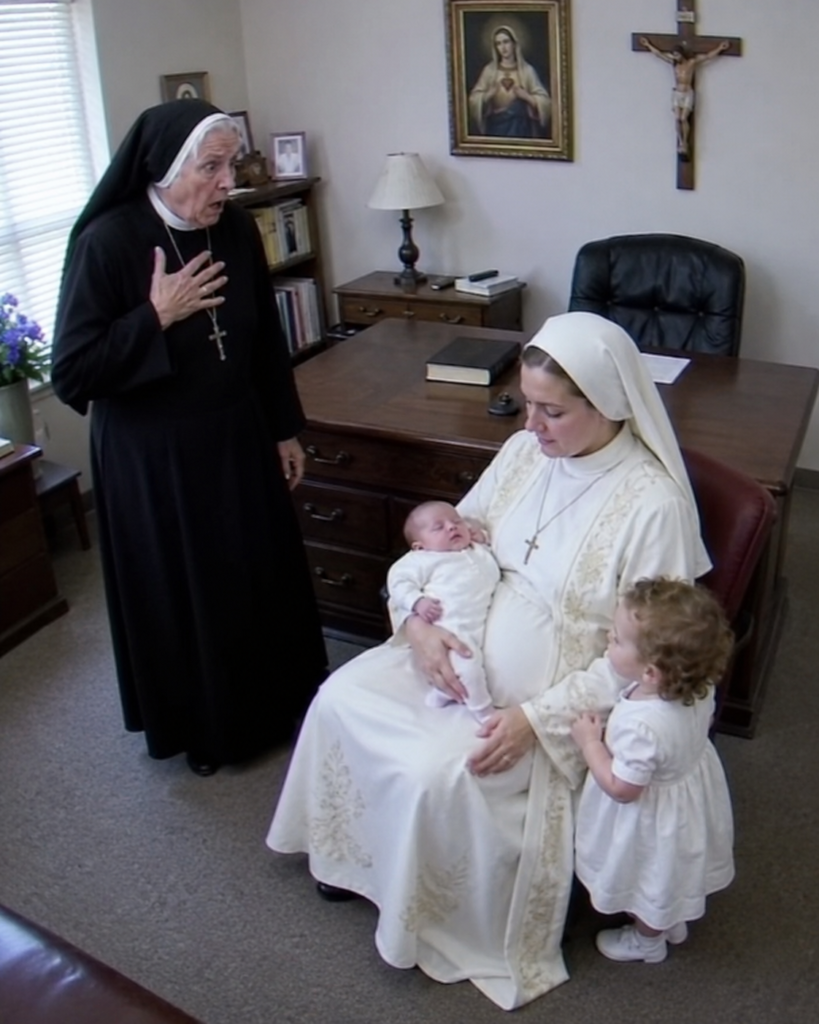
Mother Caridad held the strip of medical tape beneath the desk lamp and turned it carefully between her fingers. There was nothing extraordinary about it. It was no longer than the first joint of her thumb, with one edge folded over as though it had been pulled hastily from someone’s skin. Yet the faint medicinal scent brought back a memory she could not immediately place—a white room, a metal tray, Doctor Paloma speaking in a calm voice while rain tapped against the infirmary windows.
Mother Caridad set the tape on a clean handkerchief and reached for the telephone.
She paused before lifting the receiver.
For three years, she had tried to protect Sister Esperanza from gossip. She had answered every question from the bishop’s office with carefully chosen words. She had reassured the other sisters that charity sometimes required patience before understanding. She had arranged baptisms quietly, registered the children through proper channels, and made certain that little Tomás and Miguel were raised in warmth rather than suspicion.
But beneath all those practical decisions lived a truth she had barely admitted to herself.
She was afraid.
Not of Esperanza.
Not even of scandal.
She was afraid that someone she trusted had been hiding something from her inside the very walls she had spent her life guarding.
She dialed Doctor Paloma’s number.
The doctor answered after the fourth ring.
“Paloma speaking.”
“It is Mother Caridad.”
A small silence followed.
“Mother,” the doctor said, her voice brightening with professional warmth. “Is one of the sisters unwell?”
“I need you to come to the convent.”
“Of course. What has happened?”
Mother Caridad looked toward the open doorway.
In the corridor beyond, she could hear soft footsteps, the clink of cups from the kitchen, and Sister Esperanza singing quietly to one of the children.
“She believes she is pregnant again.”
This time, Doctor Paloma did not answer immediately.
Mother Caridad felt her fingers tighten around the receiver.
“Doctor?”
“I heard you,” Paloma said.
There was something in her tone now—not surprise, but weariness.
“You do not sound shocked.”
“I am a physician. I try not to react before examining a patient.”
“That is not what I meant.”
Another silence.
Then Paloma exhaled.
“I can be there before noon.”
“Please come sooner.”
“I will.”
Before the doctor could end the call, Mother Caridad added, “And Paloma?”
“Yes?”
“I found something in my office. A strip of medical tape.”
The doctor’s breathing seemed to change.
“Where?”
“Near the chair where Esperanza was sitting.”
“That may mean nothing.”
“Perhaps.”
Mother Caridad looked at the tape again.
“But you recognize why I am asking.”
“I will come at once,” Paloma said, and the line went dead.
Mother Caridad lowered the receiver slowly.
Outside, a bell rang to mark the morning hour. Its familiar sound moved through the convent with measured grace, calling the sisters toward their duties.
Usually, the bell settled her.
That morning, every note seemed to ask a question.
Sister Esperanza sat at the long kitchen table with Miguel on her lap and Tomás beside her.
Sunlight poured through the high windows, warming the stone walls and turning the steam above a pot of milk into pale ribbons. Sister Lucía stood near the stove, slicing bread while keeping an affectionate eye on the children.
Tomás had decided that his wooden spoon was a horse.
He galloped it across the table, making soft clicking sounds with his tongue.
“No riding near the milk,” Lucía warned.
Tomás stopped immediately.
“Horse thirsty.”
“Then the horse must wait until after breakfast.”
Esperanza smiled and kissed the top of his head.
“He is learning patience.”
“He is learning how to negotiate,” Lucía replied.
Miguel stirred against Esperanza’s shoulder. He was a quiet baby, round-cheeked and content whenever he was held. His fingers curled around a fold in her habit.
Sister Lucía placed two slices of bread on a plate and sat across from Esperanza.
“You look pale.”
“I did not sleep well.”
“Because of the baby?”
Esperanza glanced down at her stomach.
There was no visible change yet, but she had already begun touching it unconsciously, as if protecting something hidden.
“I suppose so.”
Lucía lowered her voice.
“Are you frightened?”
Esperanza hesitated.
“No.”
It was the same answer she had given each time before, but this morning it did not sound convincing, even to her.
Lucía studied her face.
“You are allowed to be frightened.”
“I know.”
“Mother Caridad will find answers.”
Esperanza’s smile weakened.
“She has been trying for years.”
“That does not mean she has failed.”
Esperanza looked toward the kitchen door.
Through it, she could see part of the cloister garden. A narrow path curved between rosemary bushes and white roses. Beyond the garden stood the old infirmary wing, closed most days except when Doctor Paloma visited.
A strange uneasiness passed through her.
She remembered waking there once.
Or believed she remembered it.
There had been a lamp above her. A cold cloth on her forehead. Someone saying, “You are safe.”
But when had that happened?
During her first pregnancy?
Her second?
Before either of them?
The memory dissolved whenever she tried to hold it.
“Esperanza?” Lucía asked.
She blinked.
“Yes?”
“You went somewhere far away.”
“I was only thinking.”
“About what?”
“I do not know.”
Lucía leaned closer.
“That is a troubling answer.”
Esperanza looked down at Miguel. The child’s eyes had opened, dark and trusting.
“There are pieces missing,” she said quietly.
“Pieces of what?”
“My memory.”
Lucía’s hand stopped beside the bread plate.
“What do you mean?”
Esperanza searched for words.
“There are mornings when I wake and feel as though I have forgotten a dream. Not an ordinary dream. Something important. I can almost see a room, or hear a voice, but then it vanishes.”
“Has this happened recently?”
“It has happened for years.”
“Why have you never told anyone?”
Esperanza gave a small, embarrassed shrug.
“I thought it was exhaustion. Then Tomás was born. Then Miguel. There was always something more urgent.”
Lucía’s expression softened, but concern remained in her eyes.
“You should tell Mother Caridad.”
“She already doubts me.”
“She does not doubt you.”
Esperanza looked toward the doorway again.
“She doubts the story I am able to give her.”
“That is not the same thing.”
“No,” Esperanza said. “But it feels the same when you are the person without answers.”
Tomás pushed his wooden spoon toward her.
“Horse for Mama.”
Esperanza accepted it and smiled.
“Thank you.”
He leaned against her arm, satisfied.
Whatever else remained uncertain, these children were real. Their laughter, their hunger, their warm hands, their sleepy weight against her shoulder—none of that could be questioned.
Yet for the first time, Esperanza wondered whether loving them had made her too willing not to ask how they had come to be.
Doctor Paloma arrived before ten.
Her gray motorcar stopped just beyond the convent gate, and Sister Beatriz hurried to admit her. The doctor stepped inside carrying a black medical case, her hair pinned beneath a simple hat.
Mother Caridad waited in the entry hall.
“You came quickly.”
“You sounded worried.”
“I am worried.”
Paloma removed her gloves.
“Where is Esperanza?”
“In the kitchen with the children.”
“May I examine her in the infirmary?”
Mother Caridad nodded.
As they walked, the doctor’s gaze moved over the corridors with an attention that seemed too deliberate. She glanced at the locked linen room, the chapel passage, and the narrow staircase leading toward the unused guest quarters.
Mother Caridad noticed.
“You are looking for something.”
“I am remembering the layout.”
“You have visited us for eleven years.”
“I know.”
They reached the infirmary door.
Mother Caridad took the handkerchief from her pocket and unfolded it.
The strip of tape lay in the center.
Doctor Paloma stared at it.
“Is it yours?” Mother Caridad asked.
“It is ordinary surgical tape.”
“That was not my question.”
Paloma’s eyes lifted.
“It could have come from my case during an earlier visit.”
“It was fresh.”
“How can you be certain?”
“It still had adhesive on it.”
The doctor pressed her lips together.
“Mother Caridad, let me examine Esperanza before we create explanations from scraps.”
“Very well.”
But when Paloma reached for the door, Mother Caridad said, “I have trusted you with the health of every woman in this convent.”
The doctor’s hand remained on the latch.
“I know.”
“I would like to continue doing so.”
Paloma turned.
There was no anger in her face. Only sadness.
“You may find,” she said softly, “that trust and complete knowledge are not always the same thing.”
Before Mother Caridad could answer, footsteps approached.
Sister Esperanza appeared with Lucía. Miguel slept in a cloth cradle against Lucía’s chest, while Tomás held her hand.
Esperanza looked from the doctor to Mother Caridad.
“You came quickly.”
“I wanted to make sure you were well,” Paloma said.
She opened the infirmary door.
“Shall we?”
The examination was gentle and brief.
Doctor Paloma asked Esperanza a series of questions, took her pulse, and carefully pressed her abdomen. She then opened a small leather pouch and prepared a test.
Mother Caridad stood by the window.
Sister Lucía waited outside with the children.
Esperanza sat on the edge of the narrow bed, watching the doctor’s hands.
“You seem tired,” Paloma said.
“I have two little ones.”
“That would explain much of it.”
“Will there be a third?”
“We will know soon.”
Esperanza looked at her.
“You already know.”
Paloma paused.
“What makes you say that?”
“The way you looked when you entered.”
“That is not a medical sign.”
“No. It is a human one.”
The doctor placed the test aside and met her gaze.
“You have become more observant.”
“I have had reason to.”
Mother Caridad turned from the window.
“Esperanza, is there something you wish to tell us?”
The young nun folded her hands.
“I remember pieces of things.”
Doctor Paloma went still.
“What things?”
“A room. A light. Sometimes a voice. I think it may be yours.”
The doctor closed her case halfway, then opened it again.
“Memories can become confused during periods of illness.”
“Was I ill?”
“You have fainted more than once.”
“Before my first pregnancy?”
Paloma did not respond.
Mother Caridad stepped closer.
“Doctor?”
Paloma glanced at the test.
“It is positive.”
The room became very quiet.
Esperanza lowered her eyes.
Although she had expected the answer, hearing it confirmed seemed to remove something from her strength. Her shoulders fell slightly.
Mother Caridad moved toward her.
“Are you unwell?”
“No.”
Esperanza’s voice trembled.
“I am only tired of being surprised by my own life.”
Mother Caridad sat beside her and took her hand.
For a moment, the mystery disappeared behind something simpler: a young woman who had carried more uncertainty than anyone should have been asked to bear alone.
“We will find the truth,” Mother Caridad said.
Esperanza looked at her.
“Will we still call it truth if it changes what we believe about one another?”
Mother Caridad tightened her hand around hers.
“Yes.”
Doctor Paloma turned away and began placing instruments into her case.
The click of each metal clasp sounded unusually loud.
Mother Caridad watched her.
“Paloma, we need to speak privately.”
“I expected that.”
Esperanza rose.
“No.”
Both women looked at her.
She stood unsteadily but with determination.
“If this concerns me, I will remain.”
“It may be difficult,” Paloma said.
“That does not make it less mine.”
Mother Caridad saw something new in Esperanza’s face. The softness was still there, but beneath it lived a firmness that motherhood had perhaps given her.
“Very well,” Mother Caridad said. “You will stay.”
Paloma closed her eyes for a moment.
Then she pulled the single wooden chair away from the wall and sat down.
“This did not begin three years ago,” she said.
At first, neither Mother Caridad nor Esperanza spoke.
Outside, Tomás laughed at something Sister Lucía had said. The sound drifted beneath the door, light and innocent.
Doctor Paloma placed both hands over the handle of her medical case.
“Six years ago,” she began, “before Esperanza took her final vows, she became seriously ill.”
Esperanza frowned.
“I do not remember that.”
“I know.”
Mother Caridad looked at the doctor.
“What illness?”
“Severe anemia, fever, and exhaustion. She had been caring for Sister Magdalena during the influenza outbreak. Esperanza refused to rest. One night, she collapsed near the chapel.”
Mother Caridad searched her memory.
“I remember an illness, but not that it was so serious.”
“You were away at the diocesan meeting. Mother Inés was still alive then.”
The name changed the air in the room.
Mother Inés had led the convent before Caridad. She had been disciplined, private, and deeply respected. She had died five years earlier after a brief illness and was buried in the small cemetery beyond the orchard.
Mother Caridad’s expression hardened with concentration.
“What did Mother Inés do?”
“She asked me to treat Esperanza here.”
“That is ordinary.”
“Not entirely.”
Paloma looked at Esperanza.
“During your fever, you spoke about your family.”
“My family?”
“You said you had a sister.”
Esperanza’s face changed.
“I had a sister?”
“You have a sister,” Paloma corrected gently. “At least, you did six years ago.”
Esperanza stood so suddenly that the bed frame creaked.
“That cannot be true.”
“Sit down,” Mother Caridad said softly.
“No. My parents died when I was young. I was raised by my aunt. I was told I had no brothers or sisters.”
“Who told you that?” Paloma asked.
“My aunt.”
“What was her name?”
“Rosa Valdés.”
Paloma nodded as though confirming something long suspected.
“Rosa was not your aunt.”
Esperanza stared at her.
Mother Caridad rose too.
“Explain.”
“She was your mother’s cousin. After your parents died, you and your younger sister were separated. Rosa took you. Another relative took the younger child.”
Esperanza pressed a hand to her mouth.
“Why would no one tell me?”
“I cannot answer that.”
“But you knew?”
“Not at first. During your fever, you repeated a name—Elena. Mother Inés recognized it.”
Mother Caridad’s eyes narrowed.
“How?”
“Because Elena had written to the convent.”
The doctor opened a side compartment in her case and removed a folded sheet of paper.
It was old, worn at the creases, and sealed inside a transparent protective sleeve.
She held it out.
Mother Caridad accepted it but did not open it.
“You have carried this with you?”
“For years.”
“Why?”
“Because Mother Inés made me promise not to give it to Esperanza unless certain circumstances arose.”
Esperanza’s voice was barely audible.
“What circumstances?”
Paloma looked at her.
“If you began to remember.”
The young nun sat down again.
Mother Caridad unfolded the paper.
The handwriting was uneven, as though the writer had paused often.
Dear Ana,
I do not know whether they still call you by that name. I have been told you entered the convent and may never wish to hear from the life you had before. I will respect that if it is your choice, but I need you to know that I am alive.
My name is Elena, and I believe I am your sister.
I have spent years searching for you. I found Rosa only after she became ill. She admitted that we were separated after our parents died because neither household could afford two children. She said she told you I had died because she feared you would leave her to find me.
I do not blame you for not searching. You did not know.
I am married now. My husband is named Gabriel. We have tried to have children, but the doctors say it may not happen for us. Still, my reason for writing is not to ask anything from you. I only want the chance to meet you once and tell you that you were never alone in the world.
Your sister,
Elena
Mother Caridad lowered the letter.
Esperanza looked as though the floor had shifted beneath her.
“My name was Ana?”
“Yes,” Paloma said.
“Why do I not remember her?”
“You were very young when you were separated. Perhaps four or five.”
“Did I meet her after she wrote?”
Paloma hesitated.
“Yes.”
Mother Caridad’s head lifted sharply.
“When?”
“During the weeks after your illness.”
“Inside the convent?”
“In the old guest parlor.”
Mother Caridad felt anger rise, but she kept her voice controlled.
“I was never told.”
“Mother Inés believed it should remain private until Esperanza decided what she wanted.”
Esperanza gripped the edge of the bed.
“What did I decide?”
The doctor’s face softened.
“You wanted to help her.”
“With what?”
Paloma did not answer at once.
And in that pause, Mother Caridad understood why the medical tape had frightened her.
She looked at Esperanza, then at the positive test on the tray.
“Her sister could not have children,” she said slowly.
Paloma nodded.
Esperanza stared between them.
“No.”
“Esperanza—”
“No,” she repeated, but there was no anger in the word. Only disbelief. “You are saying that I agreed to carry a child for someone else?”
“You agreed to consider it.”
“The children are Elena’s?”
“Biologically, that was the intention.”
The words hung between them.
From the corridor came the soft murmur of Sister Lucía singing to Miguel.
Esperanza looked toward the door.
“Intention?”
Doctor Paloma lowered her gaze.
“The first procedure was performed six years ago.”
Mother Caridad blinked.
“Six years?”
“It was unsuccessful.”
Esperanza’s fingers trembled.
“I remember nothing.”
“You became frightened afterward,” Paloma said. “Not because anyone forced you. Because you were uncertain whether your decision had come from love, guilt, or the fevered need to repair a family you had just discovered.”
Mother Caridad stepped forward.
“Then it should have ended.”
“It did.”
“But the pregnancies began three years later.”
“Yes.”
“How?”
Paloma reached into her case again and removed a small notebook bound in dark leather.
It was not a medical record. The pages were filled with dates, initials, and short handwritten entries.
“Mother Inés kept this,” she said. “After her death, I found it among the records she asked me to preserve.”
Mother Caridad did not take the notebook.
“You are avoiding the answer.”
“I am trying to give it in the right order.”
“Then stop arranging the truth as though you own it.”
Paloma flinched.
Esperanza looked at Mother Caridad.
“Please.”
The older nun fell silent.
Doctor Paloma opened the notebook.
“After the first attempt failed, Elena and Gabriel left the region. They wrote several times. Esperanza answered twice.”
“I wrote to her?”
“Yes.”
“Do you have the letters?”
“No. But Mother Inés copied a line from one of them.”
Paloma read from the page.
“I cannot promise you a child, but I do not want fear to decide whether we remain sisters.”
Esperanza closed her eyes.
The sentence seemed to touch something in her memory.
A table.
A blue envelope.
Rain on glass.
Her own hand shaking as she wrote.
“I remember the ink,” she whispered.
Paloma leaned forward.
“What color?”
“Blue.”
The doctor nodded.
“You are remembering.”
Esperanza pressed her fingertips to her temples.
“There was a woman across from me. She had my eyes.”
“Elena.”
“She was crying.”
“Yes.”
“But she was not asking me for a baby.”
“No.”
“She said…” Esperanza struggled, then opened her eyes. “She said she had spent too many years wanting a sister to risk losing one over a child.”
Doctor Paloma’s face filled with relief.
“That is what she said.”
Mother Caridad looked from one woman to the other.
“Then how did Esperanza become pregnant?”
Paloma closed the notebook.
“That is what I do not fully understand.”
The three women remained in the infirmary for nearly an hour.
Doctor Paloma explained that the first medical procedure had taken place with Esperanza’s written consent, witnessed by Mother Inés and an independent physician from the city. Because of Esperanza’s illness and later distress, the documents had been sealed. No further attempt was supposed to occur without her renewed agreement.
Yet three years later, Esperanza had become pregnant with Tomás.
Tests performed after his birth suggested he was related to Esperanza.
But Paloma had never been allowed to complete further testing.
“Allowed by whom?” Mother Caridad asked.
“Mother Inés was already dead. The diocesan administrator advised discretion.”
“Discretion is not an answer.”
“No,” Paloma said. “It is often the place where answers are buried.”
Miguel began to fuss in the corridor.
Esperanza opened the door, and Sister Lucía brought him in.
The baby settled as soon as Esperanza held him.
Mother Caridad watched her.
“Do you still believe these children were sent to you as miracles?”
Esperanza ran one finger along Miguel’s cheek.
“I believe every child can be received as a gift,” she said. “But perhaps I used the word miracle because I was afraid to ask what had been taken from my memory.”
Doctor Paloma looked stricken.
“Nothing was taken deliberately.”
Esperanza lifted her gaze.
“Then why can I not remember?”
“You were ill. You were given sedatives during treatment. Later, you suffered episodes of confusion.”
“Three years later?”
“No.”
The doctor’s answer was too quick.
Mother Caridad heard it.
“So there were no sedatives before Tomás was conceived?”
Paloma looked toward the window.
“I did not administer any.”
The distinction was unmistakable.
Mother Caridad’s voice became very quiet.
“Who did?”
“I do not know.”
Esperanza held Miguel closer, not from fear for him, but as if the steady warmth of his body helped keep her grounded.
“Was Doctor Paloma present when I became pregnant with Tomás?”
“No,” the doctor said.
“And Miguel?”
“No.”
“And this time?”
“No.”
Mother Caridad frowned.
“Then why did you sound as though you expected today’s result?”
Paloma reached inside her coat and removed an envelope.
It had been opened, but the paper remained crisp.
“This arrived at my clinic two weeks ago.”
Mother Caridad took it.
Inside was a single typed sentence.
Sister Esperanza may require your care again before the summer ends.
There was no signature.
No return address.
Esperanza looked at the doctor.
“You knew before I did.”
“I suspected someone knew.”
“And you said nothing.”
“I did not want to frighten you without proof.”
Mother Caridad unfolded the paper fully.
At the bottom, almost invisible, was a faint embossed mark.
A circle surrounding three small branches.
She recognized it.
“That seal belonged to Mother Inés.”
Paloma nodded.
“It was used on private convent correspondence.”
“But Mother Inés has been dead for five years.”
“Yes.”
The room fell silent again.
This time, the silence did not feel supernatural.
It felt human.
Someone had kept old stationery.
Someone had known the history.
Someone had been watching Esperanza closely enough to predict the pregnancy.
That narrowed the mystery, but it did not make it easier.
After the examination, Mother Caridad asked Sister Lucía to take Esperanza and the children into the garden.
“Stay with them,” she said.
Lucía nodded.
“Of course.”
As Esperanza passed, Mother Caridad touched her arm.
“We will speak again soon.”
Esperanza gave a tired smile.
“Please do not decide everything without me.”
“I will not.”
It was a promise, and Mother Caridad intended to keep it.
Once they were alone, she led Doctor Paloma to her office.
The strip of medical tape still lay on the handkerchief.
Paloma examined it more closely.
“There is something beneath the adhesive.”
She angled it toward the light.
A tiny blue thread clung to one corner.
Mother Caridad stared at it.
“The infirmary blankets are blue.”
“So are the old curtains in the guest rooms.”
“The guest rooms are locked.”
“Who has the keys?”
“I do. Sister Beatriz has a second set.”
“Anyone else?”
Mother Caridad thought.
“Mother Inés kept a private ring of keys. After her death, they were never found.”
Paloma sat down.
“There is something more.”
Mother Caridad did not respond. She had expected as much.
“The night before Esperanza told you she was pregnant with Tomás, she was brought to my clinic.”
Mother Caridad’s expression changed.
“By whom?”
“A driver.”
“Whose driver?”
“He said he worked for the diocese.”
“Did you see Esperanza?”
“No. By the time I arrived, the car had gone.”
“Why was she taken there?”
“I was told she had fainted and recovered.”
“Who told you?”
Paloma opened her notebook and turned to a page near the back.
“A man named Father Esteban.”
Mother Caridad knew the name.
He had served as diocesan administrator during the year after Mother Inés died. He was a quiet, orderly man who rarely visited the convent in person.
“He retired two years ago,” she said.
“He moved to the coastal parish.”
“Did you contact him?”
“I wrote twice. He did not answer.”
Mother Caridad crossed to the cabinet where old correspondence was stored.
She unlocked the bottom drawer and searched through several folders.
“Father Esteban approved the children’s registrations,” she said.
“I know.”
“He also recommended that their parentage remain sealed.”
“I know that too.”
Mother Caridad turned.
“And you accepted this?”
“I objected.”
“Not strongly enough.”
The words landed hard.
Paloma’s face tightened.
“No,” she said. “Not strongly enough.”
For the first time that day, Mother Caridad saw no defense in her. Only regret.
“I told myself I was protecting Esperanza from scandal,” Paloma continued. “I told myself that if she was healthy and the children were loved, forcing an investigation might cause more harm than good. But perhaps I was also protecting myself from admitting I had lost control of something I helped begin.”
Mother Caridad looked at her for a long moment.
Then she returned to the desk.
“Regret is useful only if it changes what we do next.”
“What do you suggest?”
“We begin with what can be proven.”
She placed the letter from Elena beside the anonymous note.
“Is Elena alive?”
“I believe so.”
“Where?”
“The last address I had was in San Aurelio.”
“That is four hours away.”
“Yes.”
“Does she know about Tomás and Miguel?”
Paloma hesitated.
“I do not know.”
“You have said those words too many times today.”
“They are still the truth.”
Mother Caridad looked through the office window.
In the garden, Esperanza sat beneath the old fig tree with Miguel in her arms. Lucía crouched beside Tomás, helping him arrange pebbles in a row.
A family had formed inside the convent, though no one had planned it.
Whatever biology revealed, these bonds were not temporary.
“We will contact Elena,” Mother Caridad said.
“And Father Esteban?”
“Him too.”
“You may need diocesan permission.”
“I have spent half my life asking permission to do what conscience already required.”
Paloma almost smiled.
“Mother Inés used to say the same.”
Mother Caridad looked back at her sharply.
“She also left us a maze of secrets.”
“She believed secrets could protect people.”
“They can,” Mother Caridad said. “For a time. Then they begin protecting themselves.”
That afternoon, Esperanza asked to see the old guest parlor.
Mother Caridad unlocked the passage and went with her.
The room had not been used in years. Dust lay across the table, and the air smelled of dry wood and lavender sachets. Blue curtains framed the single window.
Esperanza touched the fabric.
The color matched the thread on the tape.
“Do you remember this place?” Mother Caridad asked.
Esperanza walked slowly toward the table.
“A little.”
“What do you see?”
“Elena sitting there.”
She pointed to the chair near the window.
“She wore a yellow dress. Not bright yellow. The color of old sunlight.”
Mother Caridad said nothing.
Esperanza moved to the opposite chair.
“I was sitting here.”
“And Mother Inés?”
“Near the door.”
“Doctor Paloma?”
“By the window.”
Her voice grew more certain with each detail.
“There was another person.”
Mother Caridad’s attention sharpened.
“Who?”
“I cannot see his face.”
“A man?”
“Yes.”
“Was it Father Esteban?”
“I do not know.”
Esperanza closed her eyes.
“He had a ring.”
“What kind of ring?”
“A dark stone.”
Mother Caridad had seen Father Esteban wear a silver ring set with black onyx.
“Did he speak to you?”
“He said families were made by sacrifice.”
Esperanza’s expression tightened.
“I did not like that.”
“What did you say?”
“I said families were made by staying.”
The answer came quickly, as though she had been waiting years to hear herself say it.
Mother Caridad moved closer.
“That sounds like you.”
Esperanza smiled faintly.
“I hope so.”
She ran her hand over the dusty tabletop.
“There was a box here.”
“What kind?”
“Wooden. Small. Mother Inés placed papers inside it.”
“Consent forms?”
“Perhaps.”
Esperanza opened her eyes.
“She said she would keep them where no one could use them without my permission.”
Mother Caridad looked around the room.
“Did she say where?”
“No.”
They searched the cabinet, the desk, and the shelves.
Nothing.
At last, Esperanza sat down.
“Mother, what happens if Elena is the biological mother of Tomás and Miguel?”
“We do not know that she is.”
“But if she is?”
Mother Caridad pulled the other chair closer.
“What are you afraid of?”
Esperanza looked toward the garden beyond the window.
“That she will want them.”
“They are legally in your care and the convent’s care.”
“That was not my question.”
Mother Caridad understood.
“You are asking whether she will feel they belong to her.”
“Yes.”
“And whether loving her as a sister will require giving them up.”
Esperanza’s eyes filled, though she did not cry.
“I have only just learned she exists, and already I am afraid of what she may ask.”
“That fear does not make you selfish.”
“It feels selfish.”
“Love often arrives carrying more than one loyalty.”
Esperanza folded her hands.
“What would you do?”
Mother Caridad looked toward the distant orchard.
“I would not decide before hearing her truth.”
“And after?”
“After, I would remember that Tomás and Miguel are not questions to be solved. They are children with routines, attachments, and a home. Any choice must begin with their well-being.”
Esperanza nodded.
The answer steadied her.
Then she glanced at the blue curtains again.
“Mother?”
“Yes?”
“If someone used this room recently, there should be signs.”
Mother Caridad followed her gaze.
The floor was dusty.
Everywhere except near the far wall.
A narrow line beneath the curtains appeared cleaner than the rest.
Together, they drew the fabric aside.
Behind it stood a small door Mother Caridad had forgotten.
It opened into a storage alcove built into the thickness of the stone wall.
The lock had been broken long ago.
Inside were folded blankets, an empty water pitcher, and a wooden chest.
Esperanza’s breath caught.
“That is the box.”
Mother Caridad lifted it carefully onto the table.
The wood was dark with age. Its brass clasp opened without resistance.
Inside lay several documents tied with blue ribbon.
There was Esperanza’s original consent form.
A letter from Elena withdrawing from the arrangement.
A statement signed by Doctor Paloma.
And beneath them, three sealed envelopes.
Each bore a date.
The first was written one month before Esperanza became pregnant with Tomás.
The second was written one month before Miguel was conceived.
The third was dated six weeks earlier.
Mother Caridad opened the newest envelope.
Inside was a medical appointment card from a private clinic in the city.
The patient’s name was listed as Ana Valdés.
Esperanza touched the card.
“That is me.”
The appointment date was seven weeks earlier.
Mother Caridad turned it over.
On the back, someone had written a brief note by hand.
She read it aloud.
You asked me long ago to keep the truth until you were strong enough to choose it freely. I fear I waited too long.
There was no signature.
But beneath the sentence was an address.
Not for the clinic.
Not for Father Esteban.
For a house in San Aurelio.
The same town where Elena had last lived.
Esperanza sat very still.
“Do you think my sister wrote this?”
“I do not know.”
“Then we must go there.”
Mother Caridad looked at the appointment card again.
“Yes.”
“When?”
“Soon.”
Esperanza’s gaze moved toward the corridor, where Tomás could be heard asking Sister Lucía whether stones went to sleep.
“I want the children to remain here with Lucía.”
“That is sensible.”
“And Doctor Paloma should come with us.”
“I agree.”
Esperanza drew a slow breath.
For years, she had accepted uncertainty as a form of faith. Now she understood that faith did not always mean waiting quietly. Sometimes it meant walking toward an answer without knowing what it would require.
Mother Caridad gathered the documents.
As she lifted the final page from the box, something slipped from beneath it and landed on the table.
A photograph.
It showed two young women standing outside a small house.
One was unmistakably Elena. She had Esperanza’s eyes and the same gentle tilt to her smile.
The other woman was Sister Esperanza herself.
She was not wearing her habit.
She stood with one hand resting over the beginning curve of a pregnant belly.
On the back of the photograph, in Esperanza’s handwriting, were seven words:
I have chosen this. Please help me remember.
Esperanza stared at the sentence.
Mother Caridad turned the photograph over again.
In the window of the house behind the two sisters, a third figure stood partly hidden by the curtain.
A man wearing a ring with a dark stone.
And beneath the photograph, written in a different hand, was a final line:
Ana remembered everything once before.
PART 3
The photograph remained on the table between them.
Mother Caridad studied the younger version of Sister Esperanza standing outside the small house in San Aurelio. Without the white habit, she looked almost unfamiliar. Her hair fell loosely over her shoulders, and one hand rested against the gentle curve of her stomach.
Beside her stood Elena.
The resemblance between the two women was unmistakable now that Mother Caridad knew to look for it. They shared the same dark eyes, the same narrow chin, and the same expression people wore when they were smiling for someone they trusted but still carried private worries.
On the back of the photograph, Esperanza’s handwriting seemed to belong to a stranger.
I have chosen this. Please help me remember.
Below it, written by someone else:
Ana remembered everything once before.
Esperanza touched the edge of the photograph but did not pick it up.
“Once before,” she repeated.
Mother Caridad watched her carefully.
“Does anything return when you look at it?”
Esperanza shook her head.
“Only feelings.”
“What kind?”
She searched the photograph again.
“Relief,” she said after a moment. “And sadness. As though I had reached the end of a long conversation and still knew another one was waiting.”
Mother Caridad gathered the letters, medical appointment card, and consent papers into a neat stack.
“We should not decide what this means without speaking to Elena.”
Esperanza looked toward the corridor. Beyond the guest parlor, the quiet routines of the convent continued. A door closed. Someone carried a basket across the cloister. From the garden came Tomás’s laughter as Sister Lucía tried to convince him that pebbles did not need blankets.
“I agree,” Esperanza said.
Her voice was steady, though her fingers remained curled around the table’s edge.
Mother Caridad slipped the photograph into the folder.
“We will leave tomorrow morning.”
“So soon?”
“Would waiting make you calmer?”
“No.”
“Then there is little kindness in delay.”
Esperanza nodded.
“Doctor Paloma should come.”
“She will.”
“And Lucía will remain with the children?”
“I have already considered it.”
Esperanza let out a breath she had been holding.
“Thank you.”
Mother Caridad reached across the table and covered her hand.
“You do not have to thank me for making sure they are safe.”
Esperanza’s eyes lowered.
“I think I have thanked people too often for giving me what should have been ordinary.”
Mother Caridad felt the truth of that sentence.
For years, Esperanza had accepted protection without demanding honesty. She had trusted those around her because trust came naturally to her, and because doubt felt too close to ingratitude.
That gentleness had helped her become a loving mother.
It had also left her life open to decisions she did not remember making.
Mother Caridad tightened her hand around hers.
“Then perhaps this journey begins with something ordinary.”
“What?”
“You are allowed to ask questions without apologizing for them.”
A faint smile appeared on Esperanza’s face.
“I may have many.”
“Good.”
They left the guest parlor together.
Before Mother Caridad locked the door, Esperanza looked back once at the blue curtains, the small wooden chest, and the dust disturbed by their search.
The room had kept her secrets for years.
Now, at last, it had given them back.
Sister Lucía received the news with concern but without surprise.
She sat in the kitchen feeding Miguel small spoonfuls of mashed pear while Tomás arranged slices of bread into a crooked tower.
“You always knew we would eventually reach this point,” she told Esperanza.
“I did not know there was a point to reach.”
Lucía wiped Miguel’s chin.
“You have never been as calm as you appeared.”
Esperanza sat across from her.
“Was it so obvious?”
“To me.”
“Why did you never say anything?”
“You were raising two children, recovering from two pregnancies, and trying to remain yourself in a house where everyone looked at you as though you were either blessed or hiding something.”
Lucía set the spoon down.
“I thought you needed one person who did not ask you to explain.”
Esperanza’s expression softened.
“You gave me that.”
“And now you need people who will help you ask.”
Tomás placed another piece of bread on his tower. It collapsed across the plate.
He stared at it in disappointment.
Lucía leaned toward him.
“That is what towers do when the bottom is too narrow.”
Tomás considered this.
“Build wide?”
“Exactly.”
Esperanza watched as he began again, this time placing two slices side by side.
Lucía lowered her voice.
“You are doing the same.”
Esperanza looked at her.
“Building wide?”
“Trying to.”
Miguel reached for the spoon, impatient with the pause in his meal.
Lucía laughed and gave it to him.
“You see? He believes he should manage his own breakfast.”
“He believes he should manage everything,” Esperanza said.
For a few minutes, the room felt normal.
That normality helped.
It reminded Esperanza that the journey ahead was not a departure from her life. It was part of caring for the life she already had.
“When I return,” she said, “I may know who they are connected to by blood.”
Lucía glanced at the children.
“They will still be connected to you by every morning, every fever, every song, every night you walked the floor with them.”
“But if Elena is their biological mother—”
“Then that truth will matter.”
Esperanza waited.
Lucía met her eyes.
“But it will not erase the other truth.”
Tomás held up a wider bread tower.
“Look!”
Esperanza smiled.
“That one is strong.”
He beamed.
Lucía reached across the table and squeezed Esperanza’s wrist.
“So are you.”
Doctor Paloma arrived just after evening prayers.
She found Mother Caridad in the office preparing travel papers.
“You are certain about tomorrow?” the doctor asked.
Mother Caridad did not look up from the envelope she was sealing.
“No.”
Paloma removed her gloves.
“But you are going.”
“Yes.”
The doctor sat in the chair beside the desk.
“I telephoned the clinic listed on the appointment card.”
Mother Caridad’s hand stopped.
“And?”
“They confirmed that a patient named Ana Valdés attended an appointment seven weeks ago.”
“Esperanza?”
“They would not provide details without written permission.”
“That is proper.”
“Yes.”
“Did they describe the patient?”
“No. But they gave me the name of the physician.”
Mother Caridad waited.
“Doctor Mateo Serrano.”
She recognized the surname.
“Do you know him?”
“Professionally. He specializes in reproductive medicine and complex fertility cases.”
“Was he involved six years ago?”
“No.”
“Then how did he become involved now?”
“I do not know.”
Mother Caridad leaned back.
“You believe someone has continued arranging procedures under Esperanza’s former name.”
“That appears likely.”
“Could a clinic do that without her understanding?”
“Not lawfully.”
Mother Caridad studied the doctor.
“And in practice?”
Paloma’s face tightened.
“A patient could misunderstand forms, especially if she trusted the person guiding her. A clinic could also believe proper consent had already been obtained. But repeated pregnancies would require repeated medical contact. There should be memories.”
“Unless she was sedated.”
Paloma looked down.
“Yes.”
Mother Caridad’s expression hardened.
“I will not accept another vague answer tomorrow.”
“You should not.”
“Will Doctor Serrano speak with us?”
“I asked him to meet us at Elena’s address.”
“You gave him the address?”
“I gave him the name. He already knew where she lived.”
Mother Caridad rose slowly.
“He knows Elena.”
“Yes.”
“Why did you not lead with that?”
“Because I learned it only an hour ago.”
Paloma reached into her bag and withdrew a folded note.
“He said something else.”
Mother Caridad took it.
The note contained a sentence Paloma had written during the telephone call.
Elena Valdés has spent the last three years trying to prevent another pregnancy.
Mother Caridad read it twice.
“That does not fit what we assumed.”
“No.”
“Did he explain?”
“He said the explanation belonged to Elena.”
“Convenient.”
“Perhaps. But he did not sound evasive.”
Mother Caridad folded the note.
“How did he sound?”
“Tired.”
The answer unsettled her more than defensiveness would have.
A dishonest person might be frightened, angry, or careful.
A tired person was often someone who had been carrying the truth too long.
They left at sunrise.
Sister Lucía stood at the convent gate with Miguel in her arms and Tomás beside her. The boy had insisted on giving Esperanza a small cloth pouch filled with smooth stones from the garden.
“For the road,” he explained.
Esperanza crouched and kissed his forehead.
“What should I do with them?”
“Keep them.”
“All of them?”
He nodded seriously.
“So you come back.”
She hugged him.
“I will come back.”
Miguel stretched both arms toward her.
Esperanza held him for a long moment, breathing in the warm, clean scent of his hair. Then she returned him to Lucía.
“His cough is almost gone,” Lucía said. “I will keep him away from the morning chill.”
“I know.”
“And Tomás has promised not to climb the fig tree.”
Tomás looked away.
Lucía raised an eyebrow.
“He has promised to consider not climbing the fig tree.”
Despite herself, Esperanza laughed.
Mother Caridad watched the exchange from beside the motorcar.
The children were safe. They were loved. The convent would continue around them as it always had.
Still, when Esperanza stepped into the car, she looked back until the gate disappeared behind the bend in the road.
The journey to San Aurelio passed through low hills and farming villages.
Doctor Paloma drove. Mother Caridad sat beside her, while Esperanza rested in the back seat with the folder of documents on her lap.
For the first hour, no one spoke much.
Morning mist lifted from the fields. Farmers guided carts along the roadside. Small houses appeared and vanished behind rows of poplars.
Esperanza opened the pouch Tomás had given her.
Five gray stones and one white one lay inside.
She held the white stone between her fingers.
“Tomás always chooses the unusual one,” she said.
Mother Caridad turned in her seat.
“He believes unusual means important.”
“Perhaps he is right.”
Doctor Paloma glanced at Esperanza through the rearview mirror.
“How are you feeling?”
“Well enough.”
“Nausea?”
“A little.”
“I brought biscuits.”
“You always bring biscuits.”
“You always forget to eat when you are anxious.”
Esperanza looked at the doctor.
The familiarity in that exchange reached deeper than she expected. Paloma had cared for her through both pregnancies. She had delivered Tomás and Miguel. She had sat beside her through long nights of fever and exhaustion.
Yet she had also kept the letter from Elena.
She had accepted sealed records.
She had chosen caution when truth was needed.
“Why did you keep helping?” Esperanza asked.
Paloma’s hands tightened slightly on the wheel.
“With the children?”
“With everything.”
The doctor waited before answering.
“Because you needed care.”
“That is not the whole answer.”
“No.”
“Then what is?”
Paloma looked toward the road ahead.
“Because I felt responsible.”
“For the first procedure?”
“For introducing the possibility.”
Esperanza studied her reflection in the mirror.
“Did you believe I wanted it?”
“Yes.”
“Did I?”
“At the time, yes.”
“And afterward?”
“You were unsure.”
“Then why did no one tell me when Tomás began?”
“I thought you knew more than you said.”
Esperanza frowned.
“You believed I was hiding the truth?”
“I believed you might be protecting Elena.”
“From what?”
“From losing her marriage. From gossip. From being judged for wanting a child. I did not know.”
Esperanza leaned back.
“And when Miguel came?”
Paloma’s voice became quieter.
“By then, I knew something was wrong.”
“But you still said nothing.”
“I asked questions.”
“Not to me.”
“No.”
The admission hung in the car.
Mother Caridad looked out the window, allowing the conversation to remain between them.
Esperanza closed her hand around the white stone.
“I trusted you.”
“I know.”
“That is not an accusation.”
“It should be.”
Esperanza shook her head.
“It is a fact.”
Doctor Paloma swallowed.
“I am sorry.”
Esperanza did not answer immediately.
Outside, the road climbed through a line of olive trees.
At last, she said, “I do not know yet what forgiveness will require.”
Paloma nodded.
“I understand.”
“But I do know this: I need you to stop deciding what I can bear.”
The doctor’s eyes shone in the mirror.
“I will.”
It was not absolution.
But it was the first honest promise between them.
San Aurelio was smaller than Mother Caridad expected.
The town rested near the sea, though the water was hidden behind a line of pale cliffs. Its streets were narrow, its houses painted in faded blues and yellows. Laundry moved in the breeze above small courtyards.
They found the address on a quiet lane near the edge of town.
The house from the photograph stood behind a low stone wall.
Its shutters were green now instead of white, but the front steps were the same. A lemon tree grew beside the window where the man with the dark ring had once been standing.
Esperanza remained in the car.
Mother Caridad did not hurry her.
Doctor Paloma turned off the engine.
For several seconds, they listened to the ticking sound of the cooling motor.
“That is the house,” Esperanza said.
“Yes,” Paloma replied.
“I remember the lemon tree.”
Mother Caridad looked back.
“Do you remember coming here?”
“A doorway. The smell of soap. Someone touching my hair.”
She pressed a hand against her chest.
“My body remembers before my mind does.”
Mother Caridad opened her door.
“We can leave.”
Esperanza looked at her.
“You would let me?”
“Yes.”
“Even after coming all this way?”
“The distance does not decide for you.”
Esperanza took a slow breath.
Then she opened the pouch, placed the white stone in her pocket, and stepped out.
A woman answered on the third knock.
She was older than in the photograph. Fine lines marked the corners of her eyes, and her dark hair was threaded with silver. She wore a blue cardigan over a simple dress.
For a moment, she looked only at Mother Caridad.
Then she saw Esperanza.
Her hand rose to her mouth.
“Ana.”
The name carried no surprise.
Only recognition.
Esperanza stood at the bottom of the steps.
“Are you Elena?”
The woman nodded.
Tears filled her eyes, but she did not move forward.
“Yes.”
Esperanza looked at her face as if studying a forgotten mirror.
“You knew I was coming.”
“Doctor Serrano called.”
“Did you send the appointment card?”
“No.”
“Did you send the anonymous note to Doctor Paloma?”
Elena shook her head.
“No.”
“Did you arrange this pregnancy?”
The question was direct.
Elena closed her eyes briefly.
“No.”
Esperanza watched her.
“I need more than that.”
“You deserve more than that.”
Elena opened the door wider.
“Please come inside.”
The front room was warm and modest. Books lined one wall. A bowl of lemons sat on the table. Near the window stood the same wooden chair visible in the photograph.
Doctor Mateo Serrano was already there.
He was in his late fifties, with graying hair and a careful manner. He rose when they entered.
Mother Caridad noticed immediately that he wore no ring.
“Doctor,” Paloma said.
“Paloma.”
Their greeting was polite but strained.
Elena offered tea.
No one accepted at first.
Then Esperanza said, “Yes, please.”
The ordinary request seemed to release everyone from a held breath.
Elena went to the kitchen.
Esperanza remained standing.
Her gaze moved over the room.
A framed photograph on the mantel showed Elena beside a man with kind eyes and a broad smile. Another showed Elena alone beside the sea.
There were no photographs of children.
Mother Caridad noticed.
So did Esperanza.
“Gabriel?” she asked when Elena returned.
Elena followed her gaze.
“He died two years ago.”
“I am sorry.”
“Thank you.”
She set the tea tray down.
“He knew about you. He always hoped you would remember him kindly.”
Esperanza sat.
“Did I know him well?”
“Well enough to trust him.”
“Did I agree to carry a child for you?”
Elena lowered herself into the chair opposite her.
“Yes.”
The answer came gently, without excuse.
“Once?”
“Once.”
“And the child?”
“The pregnancy did not continue.”
Doctor Paloma looked at Serrano.
“That matches the records.”
Esperanza held her cup but did not drink.
“Then Tomás and Miguel are not yours?”
Elena’s eyes filled again.
“No.”
“Are you certain?”
“Yes.”
“How?”
“Because Gabriel and I ended the process after the first attempt. Everything connected to us was destroyed. Doctor Paloma signed the statement. Mother Inés witnessed it.”
Paloma nodded.
“That is true.”
Esperanza looked at Serrano.
“Then why was I at your clinic seven weeks ago?”
The doctor folded his hands.
“You were not.”
Silence spread through the room.
Mother Caridad leaned forward.
“The clinic confirmed an appointment for Ana Valdés.”
“Yes.”
“But not for her?”
“No.”
Esperanza stared at him.
“Who attended?”
Serrano looked at Elena.
Elena’s face had gone pale.
“I did.”
Esperanza set the cup down carefully.
“Using my name?”
“Yes.”
“Why?”
Elena pressed her palms together.
“Because I was trying to find out who had been using it.”
No one spoke.
Elena continued.
“Three years ago, after Tomás was born, I received a copy of a clinic invoice. It listed Ana Valdés as the patient and used this house as the billing address.”
Mother Caridad’s eyes narrowed.
“Did you contact the clinic?”
“I did. They refused to speak with me because I was not the patient.”
“So you did nothing?”
“I began writing letters.”
“To whom?”
“The diocese. Doctor Paloma. Father Esteban. Mother Inés, before I remembered she had already died.”
Her mouth tightened at the last admission.
“I was frightened and confused. Gabriel was ill by then. I did not know whether Ana—whether Esperanza—had chosen another arrangement and wanted privacy.”
Esperanza looked at her.
“You thought I might have chosen to become pregnant again?”
“I did.”
“Why?”
Elena glanced toward the mantel.
“Because you once told me motherhood felt like a room inside you that had always been waiting to open.”
Esperanza looked down.
The words felt familiar.
“I said that?”
“Yes.”
Elena smiled sadly.
“You loved children. You always had. I thought perhaps, after the first attempt, you realized you wanted a child of your own.”
“Inside a convent?”
“You told me the convent was your family. I thought perhaps they had found a way.”
Mother Caridad closed her eyes briefly.
So many people had built explanations rather than asking the woman at the center.
Elena continued.
“When Miguel was born, another invoice came. This time, I knew something was wrong. I contacted Doctor Serrano because his clinic’s name appeared on the paperwork.”
Serrano nodded.
“I reviewed the records.”
“And?” Mother Caridad asked.
“They were incomplete.”
“In what way?”
“The consent forms were photocopies. The signatures looked authentic, but the dates had been altered.”
Esperanza’s hand moved toward the pocket holding Tomás’s stone.
“Was my signature used?”
“Yes.”
She closed her fingers around the stone.
“From six years ago?”
“That is my belief.”
Mother Caridad’s voice became firm.
“How could repeated procedures occur based on an old signature?”
Serrano looked ashamed.
“They should not have.”
“But they did.”
“Yes.”
“Who submitted the documents?”
“A representative claiming to act on behalf of the convent.”
Mother Caridad sat straighter.
“Name.”
“Father Esteban.”
The room became still.
Esperanza looked at Elena.
“Did you speak to him?”
“Once.”
“When?”
“After Miguel was born.”
“What did he say?”
Elena’s eyes moved toward the window.
“He said you had made a private choice and that honoring it required silence.”
Esperanza’s face tightened.
“And you believed him?”
“For a time.”
“Why?”
“Because he knew details from our first meeting. Things only a few people knew.”
“Such as?”
“The yellow dress. The wooden box. The words you wrote to me.”
Esperanza looked at Mother Caridad.
“He had access to everything.”
“Yes,” Mother Caridad said.
Elena nodded.
“But then Gabriel asked a simple question.”
“What question?”
“If Ana had chosen silence, why did the invoices keep coming to me?”
That question had changed everything.
Elena began investigating the clinic appointments. She discovered that the private clinic had received payments from a charitable fund connected to the diocese. She found no proof that Esperanza had attended any of the listed consultations.
“Then why did you make the appointment seven weeks ago?” Paloma asked.
“To force the clinic to speak with me. I used the same name, the same address, and presented the old correspondence.”
“Did they tell you another procedure had occurred?”
“No.”
Elena looked at Esperanza.
“They told me one had been scheduled.”
Esperanza’s breath caught.
“For when?”
“Eight weeks ago.”
One week before the date on the appointment card.
“But I never left the convent,” Esperanza said.
Mother Caridad remembered the night.
Esperanza had complained of dizziness after evening prayers. Sister Beatriz had taken her to the infirmary. By morning, she had seemed well.
Mother Caridad turned slowly toward Doctor Paloma.
“You were not called.”
“No.”
“Who was on duty?”
“Sister Beatriz,” Esperanza said.
The name settled uncomfortably between them.
Lucía had trusted Beatriz with the spare keys.
Beatriz had admitted Doctor Paloma through the gate that morning.
Beatriz had served as Mother Inés’s secretary for years.
Mother Caridad’s first instinct was disbelief.
Sister Beatriz was dependable, reserved, and deeply devoted to the convent. She kept the accounts when Caridad was ill. She knew every lock, every cupboard, every visitor.
But trust, Mother Caridad had learned, could not replace questions.
Elena reached across the table but stopped before touching Esperanza’s hand.
“I did not know you were pregnant again until Doctor Serrano told me yesterday.”
Esperanza looked at her.
“Do you want the children?”
Elena’s expression broke—not dramatically, but quietly, as though the question had touched an old bruise.
“I wanted a child once.”
“That is not what I asked.”
“No,” Elena said. “I do not want to take Tomás or Miguel from you.”
Esperanza’s shoulders lowered slightly.
Elena continued.
“I would like to know them someday, if that is good for them and acceptable to you. But not as their mother.”
“What as?”
Elena gave a small, uncertain smile.
“As their aunt.”
The word filled the space between them.
Esperanza looked at her sister for a long time.
“You would accept that?”
“I would be grateful for it.”
A tear slipped down Elena’s cheek.
“I spent years believing I had lost the chance to be your sister. I will not lose it again by demanding a place that is not mine.”
Esperanza looked down at the white stone in her palm.
Tomás had given it to her so she would come back.
She thought of Lucía feeding Miguel pear at the kitchen table. Of Mother Caridad sitting beside her after each impossible announcement. Of Elena writing letter after letter into silence.
Family, she realized, was not one claim.
It was a series of choices.
Some made badly.
Some made too late.
Some still waiting to be made well.
Esperanza placed the stone on the table between them.
“My son gave me this.”
Elena looked at it.
“He has good taste.”
“He says unusual things are important.”
Elena smiled through tears.
“He may be right.”
Esperanza slowly extended her hand.
Elena took it.
Neither woman called the gesture forgiveness.
It was smaller than that.
And perhaps more honest.
It was permission to begin.
They stayed in San Aurelio until late afternoon.
Doctor Serrano provided copies of the clinic records. The documents showed altered dates, reused signatures, and authorization letters bearing Father Esteban’s name.
But one detail remained unexplained.
The medical records for Tomás and Miguel listed the same anonymous donor code.
The recent procedure used a different one.
“Does that mean this child may not be related to the boys?” Esperanza asked.
“It means we cannot assume anything yet,” Serrano said.
“Can we test?”
“Yes, but later in the pregnancy, and only if you choose.”
Esperanza nodded.
The choice mattered.
Not because she knew what she would decide, but because someone had finally stated clearly that it belonged to her.
Before leaving, Elena gave her a small envelope.
“I wrote this after our first meeting.”
Esperanza held it but did not open it.
“Why did you keep it?”
“I hoped one day you would ask what I remembered.”
“What does it say?”
Elena smiled faintly.
“That should be your choice too.”
They embraced at the doorway.
It was awkward at first.
Then familiar in a way neither could explain.
The sun was low when the motorcar turned back toward the convent.
Esperanza sat in the rear seat with Elena’s letter unopened beside her.
Mother Caridad watched the road.
Doctor Paloma drove more slowly than before.
“We should telephone the convent,” she said. “They will be expecting us.”
“We will stop at the next village,” Mother Caridad replied.
Esperanza looked out at the fields.
She felt tired, but not lost.
The mystery remained. Father Esteban’s role was still unclear. Sister Beatriz might know something—or might only have been used by someone she trusted. The pregnancy itself carried questions no one could yet answer.
But one fear had softened.
Elena was not coming to take her children.
Her sister had been searching for truth too.
Esperanza reached for the envelope.
Mother Caridad turned slightly.
“You do not need to read it now.”
“I know.”
Esperanza opened it anyway.
Inside was a single sheet.
Ana,
You asked me to write down what happened in case your memory became uncertain again.
You chose to help me once, and then you chose to stop. Both choices were yours.
After the first procedure failed, you told Mother Inés you were frightened by how easily others spoke about your body as though it belonged to a plan instead of to you.
You asked her to destroy every remaining authorization.
She promised she would.
You also asked one more thing.
You said that if you ever became pregnant without remembering your choice, someone must tell Mother Caridad immediately.
You trusted her to protect your right to decide.
Esperanza stopped reading.
Her eyes lifted toward the front seat.
“Mother.”
Caridad turned.
Esperanza handed her the letter.
Mother Caridad read it once, then again.
Her face changed—not with anger, but recognition.
“What is it?” Paloma asked.
Mother Caridad looked toward the road ahead.
“There is something I remember now.”
Esperanza leaned forward.
“What?”
“The night before your first pregnancy was discovered, Mother Inés came to my room.”
Doctor Paloma glanced at her.
“You never told me this.”
“I did not understand it then.”
Mother Caridad’s hands tightened around the letter.
“She was already ill. She gave me an envelope and asked me to keep it safe until she could explain.”
“Where is it?” Esperanza asked.
“I placed it in the chapel archive.”
“Did you open it?”
“No. The next morning, Mother Inés was taken to the hospital. She died three days later.”
The car grew silent.
Mother Caridad stared through the windshield.
“I forgot about it.”
“After all these years?” Paloma asked.
“I thought it contained old parish records.”
Esperanza felt the white stone still warm in her palm.
“What was written on the envelope?”
Mother Caridad looked back at her.
“Your name.”
They reached the next village as the church bell rang six times.
Mother Caridad entered the small post office and telephoned the convent.
Sister Lucía answered.
“Everything is fine here,” she said. “The children have eaten, Miguel is asleep, and Tomás has not climbed the fig tree.”
Mother Caridad allowed herself a brief smile.
“Good.”
“Did you find Elena?”
“Yes.”
“And Esperanza?”
“She is well.”
A pause followed.
Then Lucía’s voice lowered.
“Mother, there is something you should know.”
Mother Caridad’s smile disappeared.
“What happened?”
“Sister Beatriz left the convent this afternoon.”
“Left?”
“She said she had been summoned to the diocesan office.”
“By whom?”
“She did not say.”
Mother Caridad looked through the glass toward the motorcar, where Esperanza and Doctor Paloma waited.
“Did she take anything?”
“I do not know. But after she left, I went to check the chapel archive.”
Mother Caridad gripped the receiver.
“Why?”
“Because she had been carrying one of the old archive keys.”
“And?”
Lucía hesitated.
“The cabinet was open.”
Mother Caridad closed her eyes.
“Was anything missing?”
“One envelope.”
“Did you see the name?”
“Yes.”
Lucía’s voice became almost a whisper.
“It was addressed to Ana Valdés.”
Mother Caridad looked toward the darkening road.
The letter Mother Inés had entrusted to her years ago was gone.
And for the first time, they knew exactly who had taken it.
But they still did not know whether Sister Beatriz was trying to hide the truth—
or finally bring it back.