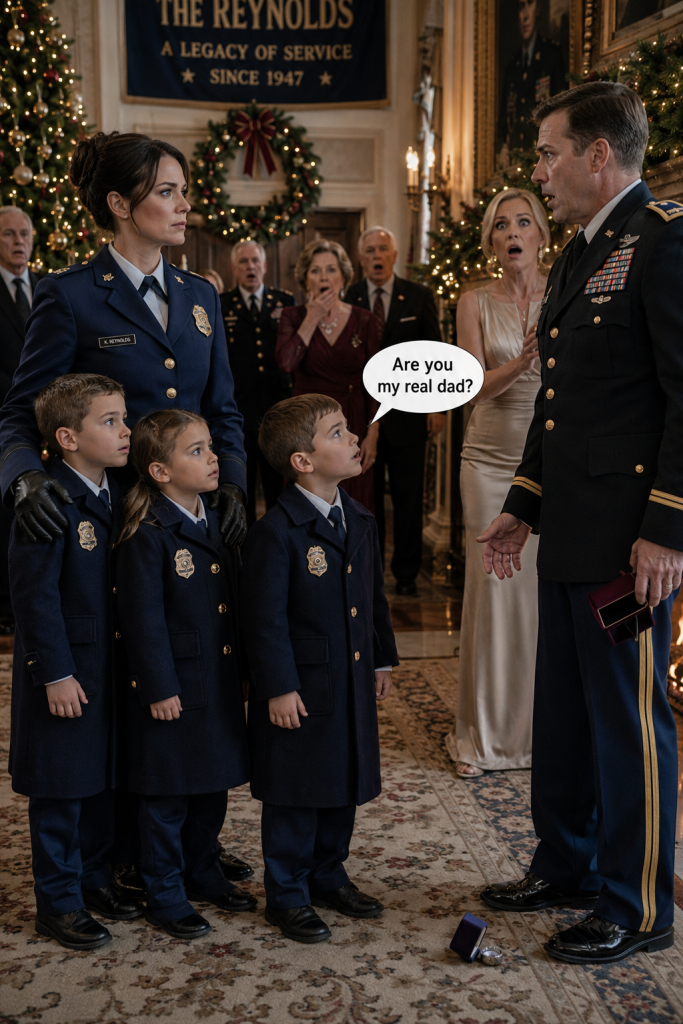
Noah looked up at Daniel with wide, curious eyes.
“Are you the daddy who said we never existed?”
The words echoed through the grand hall like a rifle shot.
Daniel staggered back, his face draining of every trace of confidence. His girlfriend slowly removed her hand from his arm, staring at him in disbelief.
“What… does he mean?” she whispered.
No one answered.
Daniel’s mother suddenly covered her mouth, tears filling her eyes as she looked from one child to the next. Four identical pairs of steel-gray eyes. Four unmistakable Reynolds smiles.
“Oh, dear God…” she murmured.
Daniel finally found his voice.
“Kesha… I—I didn’t know.”
I met his eyes without emotion.
“You chose not to know.”
Silence swallowed the room.
Then two investigators from the Texas Department of Public Safety stepped inside, their dark coats dusted with snow. Every relative instinctively turned toward them.
Daniel frowned.
“What is this?”
“One moment, Colonel,” I replied calmly.
I removed a sealed envelope from my briefcase and handed it to his mother.
“These are the hospital records, DNA reports, birth certificates, and every certified letter I mailed to Daniel after the divorce.”
Her trembling hands opened the packet.
One document after another slipped onto the polished table.
Certified mail receipts.
Returned envelopes marked REFUSED.
DNA results confirming a 99.99% match.
Ultrasound photographs.
Eight years of ignored truth.
Daniel stared at the papers as if they belonged to someone else.
His fiancée slowly stepped backward.
“You lied to everyone,” she whispered before pulling the engagement ring from her finger and placing it on the table.
But the investigators hadn’t come because of the children.
As one of them quietly unfolded a second folder bearing Daniel’s name, I realized Christmas dinner was about to become the least of his problems.
The older investigator, a square-jawed woman with silver threaded through her dark hair, stepped forward.
“Colonel Daniel Reynolds?”
Daniel straightened instinctively. Years of command returned to his shoulders even as his face remained pale.
“Yes.”
“I’m Special Investigator Marlowe. This is Investigator Haines. We need to ask you several questions regarding the disappearance of funds from the Lone Star Veterans Relief Foundation.”
A different silence fell.
The first silence had been shock.
This one was fear.
Daniel’s father pushed back his chair. “What are you talking about?”
Marlowe did not look at him. Her eyes stayed on Daniel.
“The foundation received multiple federal and state grants between 2019 and 2023. We have reason to believe portions of those funds were diverted into private accounts and shell entities connected to Colonel Reynolds.”
Daniel gave a hard, sharp laugh, the kind of laugh men use when they are trying to convince a room before they convince themselves.
“This is absurd.”
“Then you won’t mind answering questions.”
“I do mind,” Daniel snapped. “You walk into my mother’s home on Christmas Eve, in front of my family, throwing accusations around—”
“Daniel,” his mother whispered.
He turned on her. “Not now.”
The words struck her harder than he intended. She flinched, and for the first time since I had known Marianne Reynolds, I saw the elegant, steel-backed matriarch of the family shrink inside her own skin.
My sons noticed too.
Liam moved closer to me. Noah still stared at Daniel with that unbearable, innocent curiosity. Caleb, always the quietest, clutched his stuffed dinosaur so tightly the seams strained. Jonah, the oldest by three minutes, stood in front of his brothers with his chin lifted, as if his small body could shield them from the entire room.
I placed a hand on his shoulder.
“Stay with Grandma Kesha,” I murmured.
He nodded, but his eyes never left Daniel.
Daniel’s fiancée, Vanessa, looked at the investigators and then at the glittering ring she had abandoned on the table. The diamond caught the chandelier light, throwing fractured pieces of brightness across the documents that proved Daniel had rejected his own sons before ever seeing their faces.
“Daniel,” she said quietly, “tell them it isn’t true.”
He looked at her as if she had betrayed him.
“Don’t be dramatic.”
Her lips parted.
That was all it took.
Eight years earlier, I had loved that man enough to mistake arrogance for strength. Enough to explain away the coldness. Enough to believe that discipline was simply another form of devotion.
But there, in his mother’s hall, with snow tapping the windows and his children standing ten feet away, I watched Vanessa learn in ten seconds what had taken me years.
Daniel did not love people.
He acquired them.
He displayed them.
And when they became inconvenient, he denied they had ever existed.
Investigator Haines placed a tablet on the table. “Do you recognize this account?”
Daniel glanced down.
“No.”
“Strange,” Haines said. “It was opened using your Social Security number and a military identification scan.”
“I said I don’t recognize it.”
Marlowe’s tone remained calm. “Funds from the Veterans Relief Foundation were transferred into that account in twelve separate payments, then moved through businesses registered under names connected to your former aide, Lieutenant Patrick Sloane.”
At the mention of that name, Daniel’s jaw tightened.
It was small.
Almost invisible.
But I saw it.
So did Marlowe.
“Patrick Sloane?” Daniel’s father repeated. “The young man who used to come here for Thanksgiving?”
No one answered.
Daniel’s uncle stood up next. “This has to be some kind of mistake. Daniel is decorated. He served three tours.”
“So did several of the veterans who were denied housing grants when funds disappeared,” Marlowe replied.
That landed harder than anything else.
A murmur spread through the relatives like wind through dry leaves. Christmas candles flickered on the long dining table. The smell of roasted turkey and cinnamon suddenly felt obscene.
Daniel looked around, measuring the room.
He had always been good at that. He could sense weakness, loyalty, hesitation. He knew which person would break first and which could be used as a shield.
His gaze settled on me.
“You did this.”
I laughed softly, not because anything was funny, but because the accusation was so perfectly him.
“No, Daniel. You did.”
“You show up with four children I was never told about—”
“Careful,” I said.
My voice was quiet, but it cut through his.
He stopped.
I picked up one of the refused certified letters and held it between two fingers.
“You can lie to your fiancée. You can lie to your family. You can even lie to investigators if you think you’re clever enough. But do not stand in front of my sons and say I didn’t tell you.”
My sons.
Not our sons.
The distinction landed exactly where I wanted it to.
Marianne lowered herself into a chair, tears spilling down her face as she reached toward the boys.
“May I?” she whispered to me.
I looked down at Jonah.
He studied her for a moment, cautious and serious, then stepped forward.
Marianne touched his cheek like he was something sacred.
“My grandson,” she breathed.
Jonah frowned. “There are four of us.”
A broken laugh escaped her. “Yes. Yes, sweetheart. Four miracles.”
Noah edged forward next. “Do you have cookies?”
Even in that shattered room, a few people let out stunned little laughs.
Marianne wiped her face. “I have so many cookies.”
“Are they the kind with icing?”
“Yes.”
Noah considered this. “Then I forgive you.”
His brothers nodded solemnly, as if an ancient treaty had been signed.
Daniel looked at them with something I could not read. Not tenderness. Not regret. Maybe calculation. Maybe panic wearing the mask of emotion.
“Boys,” he began.
All four turned.
The room waited.
“I’m your father.”
Noah tilted his head. “That’s not what Mommy said.”
Daniel’s eyes flashed toward me.
I kept my expression still.
“What did your mother say?”
Jonah answered before Noah could.
“She said a father is someone who stays.”
There are moments in life when truth enters a room so cleanly that no one can defend against it.
Daniel had medals, rank, money, charm, a family name carved into buildings, and a fiancée who had once looked at him like he was the safest place in the world.
But he had no answer for an eight-year-old boy.
Investigator Marlowe closed the folder.
“Colonel Reynolds, we are not placing you under arrest tonight. But you are being formally notified that you are the subject of an active financial crimes investigation. You are not to leave the state. You are not to contact Patrick Sloane. You are not to destroy, alter, or remove any financial records, electronic devices, or communications related to the foundation.”
Daniel’s face hardened. “You can’t restrict my movement without a court order.”
Haines reached into his coat and produced another document.
“We have one.”
Daniel stared at it.
For the first time all night, true fear touched his eyes.
Not shame.
Not sorrow.
Fear.
Vanessa saw it too.
She took another step away from him.
“I need air,” she whispered, and walked toward the front doors.
Daniel grabbed her wrist.
The movement was fast, too familiar, too ugly.
“Vanessa, don’t make a scene.”
Every adult froze.
But Caleb did not.
He stepped out from behind me, his little dinosaur dangling from one hand.
“Mommy doesn’t like when men grab ladies.”
Daniel released Vanessa instantly.
His face flushed. “I wasn’t—”
“Yes, you were,” Vanessa said.
Her voice trembled, but she did not step back this time.
She pulled her wrist to her chest and looked around the room, seeing not strangers but witnesses.
Then she turned to me.
“I’m sorry,” she said.
It surprised me.
Not because I needed it.
Because she meant it.
I nodded once.
Daniel let out a harsh breath. “This is unbelievable. All of you are turning on me because my ex-wife walks in here with some paperwork and a dramatic performance?”
His mother stood.
The room seemed to shift around her.
Marianne Reynolds had spent most of the evening looking broken. Now something old and formidable returned to her spine.
“Daniel Arthur Reynolds,” she said, “sit down.”
He blinked. “Mother—”
“Sit. Down.”
He did not sit, but he went still.
She lifted the DNA report with trembling fingers.
“I taught you pride. That was my mistake. I thought pride would make you honorable.” Her voice cracked, but she kept going. “Instead, it made you cruel.”
Daniel’s father said her name softly.
She ignored him.
“You refused letters from a pregnant woman carrying your children. You let me mourn grandchildren I never knew existed. You brought another woman into this house tonight to celebrate a wedding built on lies.” She looked at the investigators’ folder. “And now this.”
“Nothing has been proven,” Daniel said.
Marianne’s eyes narrowed.
“No. But enough has been revealed.”
The words settled like judgment.
For one moment, Daniel looked younger. Not innocent, never that, but boyish in the way powerful men become boyish when the women who protected them finally stop.
Then his mask returned.
He turned to the investigators. “I’ll have my attorney contact you.”
“I’m sure you will,” Marlowe said.
He looked at Vanessa. “Get your coat.”
She did not move.
“Vanessa.”
“I’m not going with you.”
His mouth tightened. “You’re upset.”
“Yes,” she said. “And awake.”
That simple sentence snapped something in him.
He looked at me then, and the hatred there was no longer hidden.
“You planned this.”
I stepped closer, lowering my voice so only he and the nearest few could hear.
“No, Daniel. I survived you. There’s a difference.”
His nostrils flared.
“You think this makes you powerful?”
“No,” I said. “It makes me finished.”
Then Noah tugged my sleeve.
“Mommy, can we have the cookies now?”
A strange laugh rose in my throat. I swallowed it, because if I started laughing, I might not stop.
Marianne turned immediately, desperate for something human to hold on to.
“Yes,” she said, wiping her cheeks. “Yes, my darlings. Come with me.”
The boys looked at me for permission.
I nodded.
“Stay together.”
They followed Marianne toward the kitchen, and half the family moved after them as if pulled by gravity. People wanted distance from Daniel. From the documents. From the investigators. From the man they had spent years admiring.
Only Daniel, his father, Vanessa, the investigators, and I remained in the hall.
Snow thickened against the windows.
For a while, no one spoke.
Then Daniel’s father turned to me.
“Kesha.”
I looked at him.
He had always been polite to me. Distant, but never cruel. In another life, I might have mistaken that for kindness. Now I understood politeness could be just another locked door.
“I don’t know what to say,” he murmured.
“That makes two of us.”
His eyes dropped to the birth certificates.
“All boys?”
“All boys.”
“And they’re eight?”
“Almost nine.”
He swallowed.
Almost nine years of birthdays. Almost nine Christmas mornings. Almost nine years of scraped knees, missing teeth, nightmares, school plays, bedtime stories, fevers, drawings on the refrigerator, and four little voices asking why every other child seemed to come with two parents and they only had one.
Almost nine years of Daniel’s family celebrating legacy while his legacy learned to tie their shoes without him.
Vanessa sat slowly in a chair, staring at nothing.
“I met him at a fundraiser,” she said. “The veterans’ one.”
Daniel closed his eyes. “Vanessa, stop talking.”
She looked up at the investigators.
“He told me he personally covered administrative shortages because he didn’t want wounded veterans to suffer while grants were delayed.”
Marlowe’s expression sharpened.
“When was this?”
“Last March,” Vanessa said. “At the Austin gala. He said the board didn’t appreciate what he sacrificed.”
“Vanessa,” Daniel warned.
She turned on him.
“No. I gave a speech for you. I stood on that stage and told everyone you were the most honorable man I knew.”
The diamond ring still lay on the table between them like a small, glittering accusation.
“And you let me.”
Daniel’s face had gone dangerously still.
“You’re emotional. Anything you say right now could be misunderstood.”
Marlowe reached into her coat. “Ms. Caldwell, we can take your statement privately.”
Vanessa nodded.
Daniel laughed once. “Of course. Wonderful. My ex-wife produces surprise children, my fiancée becomes a witness, and my family applauds. Merry Christmas.”
He reached for his coat.
Haines stepped in his path.
“Remember the order, Colonel. Do not leave the state.”
Daniel stared at him with open contempt.
“I’m going home.”
“That is allowed.”
The insult of permission nearly choked him.
He turned toward the doors, then paused beside me.
For a heartbeat, he said nothing.
Then, low enough that only I could hear, he whispered, “You have no idea what you’ve opened.”
I looked straight ahead.
“Yes, I do.”
But the truth was, I didn’t.
Not fully.
Not yet.
Daniel walked out into the snow without looking back at his sons.
That was what finally broke something in me.
Not the refused letters. Not the lies. Not the mistress-turned-fiancée, not the investigators, not even the years of abandonment.
It was that.
Four little boys were in the next room tasting their grandmother’s Christmas cookies for the first time, and Daniel did not even turn his head.
The front door closed behind him.
The sound was soft.
Final.
Or so I thought.
Two hours later, the Reynolds mansion had transformed into something unreal.
The dining room table, once arranged for a perfect engagement celebration, was now crowded with cookie plates, half-empty cocoa mugs, crumpled napkins, and four boys being adored by relatives who had learned their names too quickly and their favorite colors not quickly enough.
Noah had icing on his chin.
Caleb had fallen asleep against Marianne’s side, his dinosaur tucked beneath his arm.
Liam was explaining to Daniel’s uncle how tornadoes formed, with the confidence of a scientist and the volume of a preacher.
Jonah sat quietly at the end of the table, watching everyone.
He was the one I worried about most.
The other boys processed pain through questions, food, stories, motion.
Jonah processed it by becoming still.
I sat beside him.
“You okay?”
He shrugged.
“Did I say the wrong thing?” he asked.
My chest tightened.
“No, baby. You told the truth.”
“Did it hurt him?”
I glanced toward the empty hall where Daniel had stood.
“I don’t know.”
Jonah looked down at his untouched cookie.
“I wanted it to.”
There it was.
The sentence most adults would rush to soften.
But I had promised myself never to lie to my children just to make their feelings easier for me to hear.
So I placed my hand over his.
“I understand.”
His eyes filled, but no tears fell.
“He looked at us like we were strangers.”
I brushed a curl from his forehead.
“That’s because he is one.”
Jonah leaned against me then, and I held him while Christmas music played faintly from another room, absurdly cheerful and distant.
Across the table, Marianne watched us with red-rimmed eyes.
Later, when the boys were curled up in a guest room beneath too many quilts, she found me in the library.
The fire had burned low. The house smelled of pine, smoke, and sugar.
She closed the door behind her.
“I need to ask you something,” she said.
I stood near the window, watching snow bury the long driveway.
“All right.”
“Why tonight?”
I expected accusation.
Instead, I heard grief.
I turned.
Marianne stood with her arms folded tightly, as if holding herself together by force.
“Why come here tonight, after all these years?”
I could have told her about the invitation Daniel sent by mistake to my old email address. I could have told her about the engagement announcement, about seeing his smiling face in the society pages beside Vanessa’s, under the headline A HERO’S CHRISTMAS PROPOSAL.
I could have told her about Noah asking why his father had never sent a birthday card.
But those were only pieces.
“The boys are old enough now,” I said. “Old enough to ask questions I can’t answer with bedtime stories anymore.”
Marianne nodded, tears slipping down again.
“And the investigators?”
“I didn’t bring them.”
She searched my face.
“I gave a statement three months ago,” I admitted. “About Daniel’s finances during our marriage. About accounts I didn’t recognize. About signatures he asked me to put on forms when I was too exhausted from pregnancy to read them properly.”
Her face changed.
“What forms?”
“I don’t know. Not all of them.”
“Kesha.”
The fear in her voice made me look away.
“I was twenty-six, Marianne. Pregnant with quadruplets. My husband told me I was unstable, paranoid, hormonal. He controlled every account, every appointment, every conversation with his family. By the time I realized I needed to leave, I was already alone.”
She covered her mouth.
“I didn’t know.”
“No,” I said. “You didn’t ask.”
It was not cruel.
It was simply true.
She accepted it like a wound she deserved.
After a long moment, she crossed the room and took something from the desk drawer. A small brass key on a faded ribbon.
“This house has a west guest wing,” she said. “Private entrance. Four bedrooms. Stay tonight. Please. Not for me. For them.”
“I don’t need charity.”
“It isn’t charity.” Her voice shook. “It is the first decent thing I have been allowed to offer my grandchildren.”
I looked at the key.
Then at the snow-covered darkness outside.
The boys were exhausted. The roads were icy. And despite everything, this house was part of their blood.
I took the key.
“One night.”
Marianne nodded quickly, gratefully.
“One night.”
But neither of us knew Daniel had not gone home.
At 2:13 a.m., I woke to the sound of glass breaking.
For one breath, I was back in my old life.
Back in the house Daniel and I had shared.
Back in the master bathroom, six months pregnant, staring at a shattered mirror while he apologized with roses and explanations.
Then Caleb cried out from the next room.
I moved before fear could catch me.
The hallway was dark except for the blue glow of snowlight through tall windows. I ran barefoot across the cold floor and pushed open the boys’ door.
All four were awake.
Jonah had already gathered his brothers into the corner.
“Mommy,” Liam whispered, “someone’s outside.”
Another crash sounded downstairs.
Then a voice.
Daniel’s voice.
“Where is she?”
My blood went cold.
I locked the boys’ door and dragged a dresser in front of it. My hands were steady. That frightened me more than trembling would have.
“Listen to me,” I whispered. “Bathroom. Now.”
The guest bathroom connected to a storage closet with a sloped ceiling. I had noticed it earlier, a habit from years of scanning every room for exits and hiding places.
The boys obeyed without question.
That was another thing Daniel had left us.
Children who knew when fear was real.
I tucked them into the storage closet behind folded blankets.
“No sounds,” I whispered. “No matter what.”
Noah grabbed my wrist.
“Are you coming?”
“In a minute.”
His eyes widened.
I kissed his forehead. “I promise.”
I closed the closet door.
Downstairs, voices rose.
Marianne.
Then Daniel.
Then his father.
I grabbed my phone and dialed 911 as I stepped into the hallway.
Before the call connected, a hand clamped over my mouth from behind.
I slammed my heel down hard.
A man cursed.
Not Daniel.
Patrick Sloane.
I recognized him instantly despite the beard, despite the years, despite the wildness in his eyes.
He dragged me backward. I twisted, biting his palm until I tasted blood.
He released me with a snarl.
“You should’ve stayed gone,” he hissed.
I ran.
Not away from the boys.
Away from their door.
Patrick followed, limping slightly. At the staircase landing, Daniel appeared below, his coat dusted with snow, his face flushed with fury.
For a second, seeing them together made every hidden piece click into place.
The aide.
The accounts.
The forms.
The investigation.
Patrick had not been Daniel’s subordinate.
He had been his accomplice.
Daniel looked up at me.
“Where are the documents?”
I gripped the banister.
“With the investigators.”
“Don’t lie to me.”
Marianne stood behind him in her robe, trembling but upright.
“Daniel, stop this.”
He rounded on her.
“You don’t understand what she’s done.”
“I understand what you are doing.”
Patrick moved behind me.
I had nowhere to go except down.
So I did the only thing Daniel never expected from me.
I went toward him.
I charged down the stairs, not gracefully, not bravely, but with every ounce of terror sharpened into motion.
Daniel reached for me.
I ducked, slammed my shoulder into his chest, and we both crashed into the entry table. A vase shattered. Water and white lilies spilled across the marble floor.
Patrick thundered down after us.
Then the front doors burst open.
Blue and red lights washed over the hall.
Investigator Marlowe entered first, gun drawn, followed by Haines and two uniformed officers.
“Hands where I can see them!”
Patrick froze.
Daniel did not.
He grabbed me by the arm and pulled me against him.
Something cold pressed beneath my jaw.
A small silver letter opener from the entry table.
Marianne screamed.
Marlowe’s eyes locked onto mine.
Daniel’s breath burned against my ear.
“You ruined everything,” he whispered.
“No,” I said, though the blade nicked my skin. “I stopped hiding it.”
For one suspended second, no one moved.
Then a small voice spoke from the top of the stairs.
“Let go of my mommy.”
Jonah stood there in his pajamas, holding Caleb’s stuffed dinosaur like a weapon, his three brothers behind him.
My heart stopped.
Daniel looked up.
And in that fraction of distraction, I drove my elbow back into his ribs.
Marlowe moved.
Haines moved.
The room exploded into motion.
Daniel hit the floor hard, the letter opener skidding across the marble. Patrick tried to run and slammed directly into one of the officers, who took him down beside the ruined lilies.
The boys cried out.
I crawled away on my hands and knees until four small bodies collided with me.
“I told you to stay hidden,” I sobbed.
Jonah clung to my neck.
“You promised you were coming.”
I held all of them at once, shaking so violently I could barely breathe.
Across the hall, Daniel was forced onto his stomach and handcuffed beneath the portrait of his decorated grandfather.
His eyes found mine.
Even then, even with blood at his lip and officers around him, he smiled.
Not wide.
Not victorious.
Just enough.
“You still don’t know,” he said.
Marlowe hauled him up.
“Know what?” I asked.
Daniel’s smile deepened.
Before he could answer, Patrick began laughing from the floor.
It was a broken, panicked sound.
Then he looked at me with red eyes and said the sentence that turned my blood to ice.
“Ask her about the fifth birth certificate.”
The room went silent.
I stared at him.
“What did you say?”
Patrick’s grin trembled.
Daniel closed his eyes, as if Patrick had finally made a mistake he could not repair.
Marlowe looked from Patrick to Daniel.
Marianne whispered, “Fifth?”
I shook my head.
“No.”
My voice sounded far away.
“No, I had four babies.”
Patrick laughed again, softer this time.
“That’s what they told you.”
The boys clung to me.
The officers dragged Patrick upright, but he kept looking at me, his expression gleeful and ruined.
“Four boys came home,” he said. “That doesn’t mean four were born.”
The hall tilted.
Daniel said nothing.
And somehow his silence was worse than denial.
Marlowe stepped closer to me.
“Kesha,” she said carefully, “did you ever request the full delivery file from the hospital?”
I tried to answer.
No sound came.
I remembered the delivery only in pieces. Bright lights. Too many voices. Daniel beside me in scrubs. A mask over my face. Someone saying baby A. Someone saying baby B. Then darkness. Pain. Waking up later to Daniel holding my hand, telling me there had been complications, telling me not to upset myself, telling me we had four sons and I needed to be grateful they were alive.
Four sons.
Four cribs.
Four names.
Four miracles.
My knees weakened.
Marianne reached for me.
The snow kept falling outside, soft and silent, burying every track Daniel had left in the driveway.
Then Investigator Haines returned from the front porch holding a black leather bag.
“We found this in Colonel Reynolds’ vehicle,” he said.
He unzipped it.
Inside were passports, cash, a burner phone, and a faded hospital bracelet sealed in a plastic evidence sleeve.
The name printed on it was mine.
Beneath it, in tiny letters, were two words I had never seen before.
Baby E.
PART 3 — THE FOLDER THAT TURNED CHRISTMAS INTO A TRIAL
The second folder landed on the table with a sound so small, it should not have frightened anyone.
And yet every person in the Reynolds family hall went still.
Daniel stared at it.
His mother, Margaret Reynolds, held the first packet against her chest as though the birth certificates inside were living things she was terrified someone would take away.
Across the room, the Christmas fire cracked and shifted. Gold ornaments trembled on the twelve-foot tree. Champagne bubbles rose silently in abandoned glasses.
My children stood behind me now, four small bodies pressed close enough that I could feel their breaths through my coat.
Noah, who had asked the question that split the room open, looked confused by the fear in the adults’ faces.
Ethan had gone quiet, which meant he was watching everything.
Sophia’s fingers curled around mine.
Olivia whispered, “Mama, did we do something wrong?”
I bent slightly and touched her cheek. “No, baby. You told the truth by existing.”
Daniel flinched at that.
The investigator nearest the table, Captain Marcus Hale, removed his gloves with deliberate care. He had worked internal investigations for seventeen years. Nothing in his expression gave away emotion, but his eyes missed nothing.
“Colonel Daniel Reynolds,” he said, “we need to ask you several questions regarding documents connected to your divorce proceedings, your overseas transfer requests, and the communications you claimed never to have received.”
Daniel straightened automatically, as though rank alone could rescue him.
“This is a family gathering,” he said. “You have no authority to conduct an interrogation here.”
Captain Hale’s gaze flicked once to me, then back to Daniel.
“We are not interrogating you at this moment. We are notifying you that an inquiry has been opened. Since Commander Reynolds is a state official and the matter includes alleged falsification of legal declarations submitted across state lines, obstruction of notification records, and possible benefits misrepresentation, jurisdiction has been coordinated.”
The blonde woman—Daniel’s almost-fiancée—turned pale.
“Benefits misrepresentation?” she repeated.
Daniel’s jaw hardened. “Abigail, don’t listen to this.”
Abigail.
So that was her name.
She looked at him the way a person looks at a bridge only after hearing it crack beneath their feet.
“Don’t listen?” she said quietly. “There are four children standing in front of me, Daniel.”
Margaret stepped forward, her silver hair trembling around her face. For the first time since I had known her, the grand general’s widow looked less like a portrait on a wall and more like a mother.
“Daniel,” she whispered. “Tell me you didn’t know.”
He did not answer quickly enough.
That was all she needed.
Her hand went to her throat.
“My God. My God, what have you done?”
Daniel turned toward me then, anger finally cutting through the shock.
“You planned this.”
I gave a small laugh, though nothing about me felt amused.
“You invited me.”
“You brought investigators to humiliate me in my home.”
“No,” I said. “I brought the truth to protect my children. The investigators came because truth leaves a paper trail.”
His eyes narrowed. “You always were dramatic.”
It was such a familiar insult that for one second, the room disappeared.
I was twenty-six again, standing outside a military courthouse in a pale blue dress, one hand on my barely rounded stomach, rain soaking my hair while Daniel looked at me with cold certainty.
You’re lying, Kesha.
You just can’t stand that I’m leaving.
I blinked, and the memory shattered.
Eight years later, I stood in a command uniform with four children beside me and the most powerful family in his world watching.
“No,” I said. “I became precise.”
Captain Hale opened the second folder.
Inside were copies of Daniel’s sworn statements during the divorce: statements claiming he had no knowledge of any pregnancy, no pending family obligations, no dependents, and no reason to delay transfer. There were affidavits. Digital records. A notarized declaration stating he believed my pregnancy claim was “fabricated for emotional leverage.”
And then there was the line that made Margaret sway.
I, Colonel Daniel Reynolds, do hereby request all private correspondence from Kesha M. Reynolds be declined and returned unread for the preservation of personal and operational stability.
Margaret gripped the edge of the table.
“You told us she vanished,” she said.
Daniel’s face tightened.
“You told us she wanted nothing to do with this family. You told me she lied about the baby after the divorce was final. You told me she was unstable.”
The word landed like a slap.
Unstable.
That had been his favorite word when I cried.
Unreasonable when I asked questions.
Emotional when I wanted answers.
Unstable when I fought to be believed.
Abigail turned toward me. Her eyes shone, but her voice remained composed.
“Did you try to reach us?”
I opened my briefcase again. This time I removed a smaller bundle tied with a navy ribbon. Not because I was sentimental, but because my children had once asked why I kept letters from people who never replied.
“These were addressed to Margaret Reynolds,” I said. “Three were signed for by estate staff. Two were returned. One was delivered to Daniel’s commanding office. I never received a reply.”
Margaret took them with trembling hands.
On top was a photograph.
Four newborns in hospital incubators.
Noah, Ethan, Sophia, and Olivia.
Each smaller than my forearm.
Each fighting for every breath.
Margaret made a broken sound.
“I never saw this,” she whispered. “Kesha, I swear to you, I never saw this.”
I believed her.
That surprised me.
For years I had imagined this woman sitting in her beautiful home, reading my letters and tossing them aside because I was no longer useful to the Reynolds name. But the grief in her face was too raw to be performed.
Daniel saw my expression soften toward his mother, and panic sharpened his tone.
“Mother, don’t let her manipulate you.”
Margaret looked at him slowly.
There was a kind of death in her eyes.
Not of love.
Of illusion.
“Do not call me Mother while lying to my face.”
The room inhaled as one.
Daniel stepped back as though she had struck him.
The children pressed closer.
Ethan whispered, “Mama, are they mad at us?”
Daniel heard him.
For a fraction of a second, something like shame crossed his face. Then he buried it beneath pride.
“No,” I said, loud enough for every person in the room to hear. “No one is mad at you. Adults are responsible for their own choices.”
Captain Hale closed the folder.
“Colonel Reynolds, formal questioning will be scheduled. Today, we are serving notification. You are advised not to destroy records, alter communications, contact potential witnesses, or attempt to influence testimony.”
Daniel’s nostrils flared.
“Are you threatening me?”
“No, Colonel. I’m documenting procedure.”
One of Daniel’s uncles, a retired brigadier general, stepped out from the crowd. General Paul Reynolds had always carried himself like a man who expected silence to follow him. Even now, in a burgundy dinner jacket instead of uniform, the room gave way.
He stared at the children.
Then at Daniel.
“Is this true?”
Daniel said nothing.
General Paul’s mouth tightened.
“I asked you a question.”
Daniel finally snapped. “I had reason to doubt her!”
“Four reasons are standing right there,” Paul said.
Noah lifted his chin at the old general, perhaps recognizing command even without understanding it. “There are four of us because Mama says God likes surprises.”
A small, painful laugh escaped someone near the stairs.
Sophia nudged Noah. “You’re not supposed to say that at serious times.”
Noah frowned. “This is serious?”
Olivia whispered, “I think Daddy is in trouble.”
The word Daddy twisted through the room.
Daniel’s face changed.
Not enough.
Not yet.
But his eyes fixed on Olivia with a stunned helplessness, as though the title had reached a locked room inside him and knocked once.
Abigail wiped beneath her eye.
“I can’t be here,” she said.
Daniel turned quickly. “Abigail, wait.”
She looked down at the ring box near his boot. “You were going to propose to me in front of a woman you abandoned and children you erased.”
“It isn’t that simple.”
“No,” she said. “It is exactly that simple.”
Then she walked toward the door.
Daniel took a step after her, but Captain Hale’s voice stopped him.
“Colonel.”
Daniel froze.
Abigail passed me.
For one second, she paused. Her face was pale with humiliation, but there was no hatred in it.
“I’m sorry,” she said quietly.
I nodded. “So am I.”
The front doors opened. Cold air swept through the hall. Then Abigail was gone, her heels clicking across the stone steps where Margaret’s shattered crystal still glittered in the snow.
The Christmas music playing softly from some hidden speaker seemed grotesque now.
Joy to the World.
Margaret looked at my children.
Her grandchildren.
She took one uncertain step.
Then another.
“May I…” Her voice broke. “May I know their names properly?”
I felt Sophia’s hand tighten around mine.
I knelt before my children.
“This is Mrs. Reynolds,” I said carefully. “She is Daniel’s mother. She didn’t know about you.”
Noah studied her. “So she’s Grandma?”
I looked up at Margaret.
The older woman’s face crumpled.
“Only if you want me to be,” she said.
Olivia, the softest of my four, walked forward first.
She held out one small mittened hand.
“My name is Olivia Grace Reynolds. I like drawing horses, and I don’t like peas.”
Margaret took her hand as though accepting a sacred oath.
“I’m very pleased to meet you, Olivia Grace.”
Sophia followed. “I’m Sophia Marie. I read faster than Noah, but he says it’s because books like me better.”
“I never said that,” Noah objected.
“You did.”
“I said maybe.”
Margaret gave a watery smile.
Then Ethan stepped forward, serious as a judge. “I’m Ethan James. Are there rules here?”
A startled laugh moved through the room.
Margaret nodded, tears shining. “There used to be many.”
“Are they good rules?”
She looked toward Daniel.
Then back at Ethan.
“Some will need changing.”
Finally Noah marched up.
“I’m Noah Daniel,” he said.
Daniel’s head jerked.
The room went utterly silent.
Noah did not notice. “Mama said she gave me that name before she knew if you were coming back. But you didn’t.”
I closed my eyes for one breath.
That one hurt.
Daniel looked at me as if I had wounded him.
But I had not chosen his absence.
I had only survived it.
Margaret sank to her knees in front of Noah, uncaring of the expensive dress touching the floor.
“Noah Daniel,” she whispered. “You are very welcome in this house.”
Noah considered her gravely.
“Do you have cookies?”
Margaret laughed through her tears.
“Yes,” she said. “I have an entire kitchen full.”
“Then I think we can be friends.”
The relatives exhaled, some laughing softly, some crying openly.
For a brief moment, the room remembered how to breathe.
Then Daniel spoke.
“They are my children.”
Every head turned.
His voice was hoarse now, stripped of command.
“They’re my children too.”
The words fell between us like a claim.
Not an apology.
A claim.
Something cold moved through me.
“No,” I said.
His eyes flashed. “You don’t get to decide that.”
“I decided every fever. Every surgery. Every school form. Every nightmare. Every birthday where they asked why other kids had fathers and they didn’t. I decided because you were not there.”
“I didn’t know.”
“You refused to know.”
His voice rose. “I was deployed!”
“You had a phone. You had mail. You had lawyers. You had a mother who would have crossed the country if she had known. You had every chance.”
His mouth opened.
Closed.
Then he looked at the children again, and desperation cracked his face.
“I want to speak with them.”
“No,” I said.
Daniel’s anger returned at once. “You cannot keep me from them forever.”
I took a step closer.
The hall seemed to shrink around us.
“You’re right. The law will decide what contact, if any, is in their best interest. But today? Today you do not get to walk into their lives because your pride finally ran out of hiding places.”
He looked as if he wanted to shout.
But behind him, Captain Hale still stood with the folder.
General Paul still watched with disgust.
Margaret still knelt beside four children she had just discovered.
And the entire Reynolds family had seen him.
Not as a decorated colonel.
Not as the golden son.
As a man who had built his life on a lie.
The grandfather clock struck noon.
Twelve heavy chimes rolled through the hall.
Christmas Day.
The day Daniel had planned to erase me one final time.
Instead, his past had arrived by helicopter.
And it had four heartbeats.
PART 4 — FOUR HEARTBEATS IN A HOUSE OF MEDALS
Margaret insisted we stay for dinner.
I refused twice.
The third time, Olivia tugged my sleeve and whispered, “Mama, I want to see the cookies.”
That was how the Reynolds family Christmas continued after its own detonation.
Not because forgiveness arrived.
Not because pain vanished.
But because four hungry children in navy coats had never seen a mansion kitchen decorated with gingerbread soldiers, sugared cranberries, and a chocolate train running around a cake shaped like a snowy mountain.
Children are strange miracles.
They walk into ruins and ask where the dessert is.
Within twenty minutes, my quadruplets had transformed the war museum atmosphere of the estate into something almost alive.
Noah discovered the grand staircase and immediately asked whether sliding down the banister was a court-martial offense.
Ethan counted the portraits of uniformed Reynolds men and asked why none of the women had swords.
Sophia found the library and nearly forgot the rest of us existed.
Olivia sat at the kitchen island beside Margaret, decorating cookies with more frosting than architecture should allow.
I stood in the doorway, watching.
Margaret had removed her pearls. Her elegant silver hair had loosened at the temples. Flour dusted one sleeve of her emerald dress. She looked younger, and older, and devastated all at once.
“This one is for you,” Olivia said, pushing a crooked star toward her.
Margaret accepted it with reverence.
“It’s beautiful.”
“It has too many sprinkles,” Ethan observed.
Olivia glared. “There is no such thing.”
Noah nodded solemnly. “Sprinkles are tactical.”
“Tactical?” Margaret asked.
“For morale,” Noah explained.
A laugh escaped her, then turned into a sob she tried to hide with her hand.
Olivia touched her arm.
“Are you sad because you missed us being babies?”
Margaret froze.
I stepped forward, but she shook her head slightly. She wanted to answer.
“Yes,” she said softly. “Very sad.”
Olivia thought about that.
“We cried a lot anyway,” she said. “Mama says we sounded like tiny angry goats.”
Margaret laughed again. This time it held.
From the hall behind me came low voices.
Daniel had not joined the children.
He remained with General Paul and Captain Hale in the study, where the second folder had followed him like a sentence waiting to be read.
I did not ask what was happening.
I already knew enough.
For years, I had collected every returned letter, every legal document, every financial inconsistency, not because I wanted revenge but because motherhood taught me something command later perfected: protect the vulnerable by preserving evidence.
At first, I only wanted proof that I had tried.
Proof for my children, when they were old enough to ask.
Then, two years ago, a routine review of survivor benefits flagged something unusual. Daniel had declared no dependents repeatedly, but under military family transition records, he had also certified that no biological children had been born or claimed by any former spouse. That certification had allowed him to preserve certain career pathways and financial classifications. It had also helped him avoid legal inquiry when my first child support request vanished into bureaucracy.
I had not pursued him then.
Not because I was afraid.
Because the children were five, then six, then seven, and their world was small and bright. I did not want to drag them into a battle before they even understood the wound.
But Daniel called me.
Daniel opened the door.
And Daniel, in his arrogance, ordered me through it.
A shadow fell across the kitchen doorway.
I knew it was him before I turned.
Daniel stood there without the ring box, without Abigail, without the effortless arrogance that had once made rooms rearrange around him.
He looked at the children like a starving man looking at bread through glass.
“Can I talk to them?” he asked.
The kitchen quieted.
Noah licked frosting from his thumb. Sophia closed her book halfway. Ethan watched Daniel’s hands. Olivia looked from me to Margaret.
“Not alone,” I said.
Daniel swallowed. “Fine.”
He stepped into the kitchen as though entering unfamiliar territory.
It occurred to me then that Daniel Reynolds had faced armed conflict overseas, political briefings, disciplinary boards, and command decisions that could alter lives.
But he had never looked more frightened than he did approaching four eight-year-olds with frosting on their sleeves.
He stopped three feet away.
“I’m Daniel,” he said.
Noah frowned. “We know.”
Sophia whispered, “That was awkward.”
Ethan said, “Mama says adults get nervous too.”
Olivia asked, “Are you allergic to cookies?”
Daniel blinked. “No.”
“Then you can have one.”
She offered him a gingerbread man with a crooked face.
Daniel stared at it.
His hand trembled slightly when he took it.
“Thank you.”
Olivia nodded. “It’s not my best one.”
Noah leaned forward. “Why didn’t you believe Mama?”
The question struck without warning.
Daniel looked at me.
I did not rescue him.
He lowered his eyes to the cookie.
“I thought…” He stopped. Started again. “I thought she was trying to stop me from leaving.”
“Why?” Ethan asked.
Daniel’s face tightened. “Because I was selfish.”
The word seemed to cost him more than any rank ever had.
Sophia’s brows drew together. “That’s not an answer. That’s a description.”
Margaret made a small sound that might have been a laugh or a sob.
Daniel nodded slowly. “You’re right.”
Sophia waited.
He took a breath.
“Your mother and I were unhappy near the end. I was focused on my career. I wanted command. I wanted assignments that mattered. When she told me she was pregnant, I thought it meant my life would change in ways I didn’t want.”
My chest tightened.
There it was.
The truth, ugly and bare.
No dramatic misunderstanding.
No villain hiding letters behind his back in a storm.
Just a man who wanted freedom more than responsibility and called disbelief a strategy.
Noah’s small face hardened in a way I hated.
“So you decided we weren’t real?”
Daniel closed his eyes.
“Yes.”
The kitchen fell silent.
Olivia pushed her cookie tray away.
“I don’t like that.”
“No,” Daniel whispered. “You shouldn’t.”
Ethan studied him. “Are you sorry because you got caught or because you hurt us?”
That question came from my son who remembered everything.
Who lined up his toy cars by color and noticed if one was missing.
Who once asked me whether people can miss someone they never met.
Daniel looked at him for a long time.
“I don’t know how to answer in a way that makes it better.”
“You can answer true,” Ethan said.
Daniel’s throat moved.
“At first, today, I was sorry because I got caught. Then I saw you. All of you. And now I’m sorry because I don’t know how to survive knowing what I did.”
No one spoke.
That was the first honest thing he had said all day.
Not enough.
But honest.
Sophia closed her book completely.
“Mama survived it.”
Daniel looked at me.
“Yes,” he said quietly. “She did.”
His gaze carried something I had wanted once, years ago. Recognition. Not love. Not desire. Recognition of the weight I had carried.
But it came too late to lighten anything.
Margaret touched Olivia’s shoulder.
“Children, would you like to see the Christmas village in the dining room?”
Noah brightened. “Does it have trains?”
“Three.”
“Real trains?”
“Small ones.”
“Acceptable.”
Sophia gathered her book, Ethan took Olivia’s hand, and the four of them followed Margaret out.
At the doorway, Olivia looked back at Daniel.
“You can keep the cookie,” she said.
Then she disappeared.
Daniel stared after her until they were gone.
For the first time in eight years, we were alone in the same room.
The kitchen smelled of cinnamon, butter, and sugar. Outside the tall windows, snow fell softly over the parade lawn where my helicopter waited like a dark bird.
Daniel did not speak for several seconds.
When he did, his voice was ruined.
“Kesha.”
“No.”
He flinched.
“You don’t know what I’m going to say.”
“I know every version of my name in your mouth. The angry one. The charming one. The courtroom one. The one you used when you wanted me to doubt myself. I’m not interested in any of them.”
His shoulders sagged.
“I deserve that.”
“Yes.”
“I need to make this right.”
“You can’t.”
The answer cut him more deeply than I expected.
He stepped closer, then stopped himself.
“There has to be something.”
“There is. You can cooperate with the investigation. You can stop lying. You can respect boundaries. You can explain to your family what you did without blaming me. You can start a trust for the children without demanding gratitude. You can enter therapy before ever asking them for time. You can accept that being their biological father does not make you their dad.”
His eyes reddened.
“Who is?”
The question surprised me.
I looked toward the doorway where my children’s laughter drifted faintly down the hall.
“No one,” I said. “And everyone. My unit showed up. My friends showed up. Their teachers, neighbors, Lena from my office, the nurses from the NICU who still send birthday cards. They were loved by a village you were too proud to join.”
Daniel looked at the floor.
“I thought about you,” he said.
The old me would have wanted that.
The new me pitied it.
“Thinking is not showing up.”
“I know.”
“No, Daniel. You don’t. Showing up is holding one baby while another is screaming and two more need feeding. Showing up is driving to the emergency room at two in the morning with a feverish child and three terrified siblings. Showing up is sitting through kindergarten graduation while they look into the crowd, trying not to ask why one chair is empty.”
My voice shook despite myself.
I hated that.
I had faced armed suspects without trembling. I had testified before hostile committees without blinking.
But motherhood had rooms inside me no armor could reach.
Daniel whispered, “I’m sorry.”
I looked at him then.
Really looked.
He was older. Still handsome in the way that had once undone me. Still tall, still decorated, still carrying the Reynolds name like polished steel.
But now I could see the hollowness under it.
The man I had once loved was not hidden beneath his pride.
His pride had been the man.
“Apologize to them when they’re ready,” I said. “Not to ease yourself. To give them truth.”
He nodded, tears finally spilling.
The sight did not satisfy me.
That was how I knew I was free.
Footsteps approached quickly.
Captain Hale appeared at the doorway.
“Commander,” he said, his expression sharpened. “We need to speak.”
Daniel stiffened.
“What now?”
Captain Hale looked at me, not him.
“We found something in the estate office records. It involves the returned letters.”
My pulse slowed.
“Show me.”
He hesitated.
That alone chilled me.
Then he handed me a scanned copy of one of my old envelopes.
I recognized my handwriting immediately.
Margaret Reynolds.
Private and urgent.
Regarding unborn grandchildren.
Across the front, in black ink, were the words REFUSED BY ADDRESSEE.
But beneath the postal stamp was a signature.
Not Margaret’s.
Not Daniel’s.
It was signed by someone I had not thought about in years.
Victor Reynolds.
Daniel’s father.
The dead general.
PART 5 — THE DEAD GENERAL’S SIGNATURE
For a moment, I could not understand what I was seeing.
Victor Reynolds had died six years ago.
A heart attack, according to the obituary.
A decorated general. A titan of the old military world. A man whose photograph still hung above the estate’s central staircase, sword at his side, eyes fixed forward as if even death had not relieved him of command.
He had been alive when my letters came.
Alive when I begged someone in the Reynolds family to listen.
Alive when the quadruplets were born premature and fighting for breath.
And according to the document in my hand, he had refused the envelope addressed to his wife.
My first instinct was anger.
My second was worse.
Recognition.
Victor had never liked me.
Not openly. He had been too disciplined for that. But from the first time Daniel brought me to this estate, Victor Reynolds had studied me as though I were a weakness entering his bloodline.
A state trooper’s daughter.
A scholarship graduate.
No old family name.
No military pedigree.
“You are resilient,” he had told me once at dinner, smiling without warmth. “Women like you often are.”
I had been young enough then to mistake insult for compliment.
Now I held his signature and felt the past rearrange itself.
Daniel stared at the page.
“That’s impossible,” he said.
Captain Hale remained still. “The estate office has archived mail logs. Several letters from Commander Reynolds were intercepted and marked refused by General Victor Reynolds or his personal aide.”
Margaret appeared behind him.
She had come silently.
Her face went white when she saw the signature.
“Victor?” she breathed.
Captain Hale’s voice softened by one degree.
“There are more.”
He handed her another sheet.
Then another.
Margaret read them with shaking hands.
The room seemed to tilt around her.
“No,” she whispered. “No, he would have told me.”
But no one in the kitchen believed that.
Not even her.
Daniel’s voice sharpened with defensive disbelief.
“My father was strict. He was not cruel.”
Margaret looked up.
Something ancient and exhausted moved through her expression.
“Oh, Daniel,” she said. “Your father was cruel whenever cruelty protected the family image.”
Daniel recoiled.
“Don’t rewrite him because of her.”
“Because of her?” Margaret’s voice cracked like ice. “Because of the four children in the dining room. Because of eight years stolen from me. Because I am holding proof in my hands that my husband decided I did not deserve to know my grandchildren existed.”
She turned away from Daniel as if she could not bear his face.
Then, slowly, she walked toward the hall.
I followed.
We found the children on the floor beside a miniature Christmas village, watching three tiny trains circle painted houses and frozen ponds. Noah and Ethan were arguing over which train would win in a race that clearly did not exist. Sophia had arranged little ceramic people into what appeared to be a public hearing. Olivia had placed a frosted cookie beside the church.
“For the tiny people,” she explained when she saw me.
Margaret stood behind them, one hand pressed to her mouth.
Eight years of grandmotherhood sat before her, unreachable and alive.
Olivia looked up.
“Grandma, are you crying again?”
Margaret knelt.
“Yes, sweetheart.”
“Do you cry a lot?”
“Not before today.”
Noah frowned. “Christmas is supposed to be happy.”
“It will be,” Margaret said, though her voice trembled. “I’m just learning how much happiness I missed.”
Sophia studied her carefully.
“That’s a sad kind of happy.”
Margaret nodded. “Yes. Exactly.”
From behind us, Daniel entered the room. He looked shaken, but there was a dangerous confusion in him now. The discovery of Victor’s involvement had given him something to cling to.
A villain larger than himself.
A father to blame.
I saw it before he spoke.
“If my father intercepted the letters,” Daniel said, “then I didn’t know because he made sure I didn’t.”
I turned.
The room chilled.
“No,” I said. “He made sure your mother didn’t know. You made sure you didn’t.”
Daniel’s face tightened.
“I was influenced by him my whole life.”
“I know.”
“He taught me to doubt weakness, to protect command, to avoid emotional traps.”
“I know.”
“He told me you were unstable. He said you’d ruin everything.”
“I know.”
My calm unsettled him more than anger would have.
“And then you chose to believe him,” I said.
Daniel’s mouth closed.
Margaret rose.
“Your father has much to answer for in whatever world he inhabits,” she said. “But you signed the divorce affidavit. You refused her calls. You requested correspondence be returned. You told me Kesha fabricated the pregnancy after the court date. Your father may have built the house, Daniel, but you lived in it willingly.”
The children had gone quiet.
Too quiet.
I hated that this truth was unfolding in front of them.
I turned to Captain Hale.
“That’s enough for today.”
He nodded. “Understood.”
Daniel looked startled. “You’re leaving?”
“Yes.”
“But they just met my mother.”
“And they will see her again when arrangements are made safely.”
Margaret turned toward me with panic.
“Kesha, please.”
I touched her arm gently.
“This is not punishment. This is protection. They’ve had enough shocks for one day.”
She looked toward the children, then nodded through tears.
“You’re right.”
Olivia ran to her and wrapped both arms around her waist.
“We can come back?”
Margaret held her as though afraid to breathe too hard.
“I hope so.”
Noah approached Daniel with solemn caution.
Daniel crouched slowly, careful not to reach.
For one fragile moment, father and son looked at each other.
Noah’s voice was quiet.
“You should have asked Mama.”
Daniel’s face broke.
“Yes,” he whispered. “I should have.”
“And you should not call people unstable when they are just sad.”
Daniel covered his mouth with one hand.
I looked away.
There are punishments no court can design.
Noah stepped back and took Ethan’s hand.
Sophia hugged Margaret with careful politeness. Ethan allowed Margaret to kiss the top of his head after asking, “Is this a one-time permission or recurring?” which made her laugh while crying.
Then we walked toward the front hall.
The Reynolds relatives parted for us.
No one whispered now.
At the door, General Paul stopped me.
“Commander Reynolds.”
I turned.
The old man’s eyes were heavy.
“The family failed you.”
I looked at him.
“Yes.”
He nodded once, accepting the weight without argument.
“If there is any assistance within my power, it is yours.”
“My children are not a family restoration project,” I said.
“No,” he replied. “They are the only innocent Reynolds in this house.”
That answer, at least, was honest.
Outside, the snow had thickened.
The helicopter waited across the lawn, blades still.
My children ran ahead, boots crunching, their laughter returning in bursts now that the house was behind them.
Margaret followed us onto the steps without a coat.
Daniel came after her.
Cold wind struck his uniform, but he seemed not to feel it.
“Kesha,” he called.
I stopped at the bottom of the steps.
He descended slowly.
“I know you don’t owe me anything.”
“No,” I said. “I don’t.”
“I’ll cooperate.”
“Good.”
“I’ll tell the truth.”
“Better.”
“I want to earn a place.”
I looked at him for a long time.
Snow gathered on his shoulders.
Once, that image would have undone me. Daniel Reynolds in uniform beneath a winter sky, eyes full of remorse, voice lowered in the tone that had made me believe promises.
Now I saw only a man standing at the edge of consequences.
“You don’t earn a place by wanting one,” I said. “You earn it by becoming safe enough that they never have to recover from you again.”
He absorbed that like a blow.
Then he nodded.
I turned to Margaret.
She took my hands.
Her fingers were freezing.
“I am sorry,” she said. “For what he did. For what Victor did. For what I didn’t see.”
I could have told her it was not her fault.
But mothers know better than anyone that innocence does not erase regret.
So I said, “You can know them now. Slowly.”
Her breath broke.
“Thank you.”
The children climbed into the helicopter, arguing over seats.
Noah pressed his face to the window and waved at Margaret.
She waved back with both hands.
Daniel lifted one hand too.
Noah hesitated.
Then, after a second, he gave the smallest wave.
Daniel looked as if he had been handed mercy and did not know how to hold it.
I climbed in last.
As the helicopter rose above the snowy estate, I looked down once.
The Reynolds family residence shrank beneath us, all stone, glass, flags, and secrets.
Margaret stood alone on the steps.
Daniel stood several feet behind her.
Between them lay eight years.
Behind them, in a second-floor window, the portrait of General Victor Reynolds stared out over the lawn.
For the first time, he looked less like a legend.
And more like a locked door someone had finally broken open.
PART 6 — THE PRICE OF A NAME
The investigation moved faster than I expected.
Powerful families often believe time belongs to them. They delay. They pressure. They call favors wrapped in polite language. They use phrases like misunderstanding, optics, internal resolution, and unnecessary escalation.
But paperwork has no respect for family names.
Within three weeks, Daniel Reynolds was placed under formal review. By the end of January, he had temporarily stepped down from his command role pending inquiry. The news never became public in the way tabloids would have loved; military institutions prefer their scandals folded into official language and locked behind polished doors.
Still, the Reynolds world knew.
And that was enough.
Margaret called every Sunday.
At first, the children treated the calls like diplomatic negotiations.
“Do we have to call her Grandma?” Sophia asked.
“No,” I said. “You can call her whatever feels right.”
“Mrs. Reynolds sounds like school,” Ethan said.
“Grandma sounds like she was there,” Noah muttered.
Olivia, coloring a horse purple at the kitchen table, said, “I’m calling her Grandma because she sends glitter markers.”
And so she became Grandma to Olivia first.
Then Grandma Margaret to Sophia.
Then Grandma M to Ethan, who liked labels.
Noah held out the longest.
He called her “the cookie lady” for two months.
Margaret accepted every title like a medal.
She did not push. That mattered.
She asked what they liked. She remembered answers. She mailed books to Sophia, science kits to Ethan, art supplies to Olivia, and for Noah, a wooden model helicopter that took two weekends and several dramatic speeches to assemble.
Daniel did not call.
Not directly.
That was part of the agreement.
Before any contact with the children, he was required to complete therapy sessions, provide full documentation to the investigation, establish financial support through proper channels, and write individual letters to each child—letters reviewed by a child psychologist before delivery.
His first drafts were terrible.
Dear Noah, I am sorry circumstances prevented me from being part of your life.
Rejected.
Dear Sophia, adult relationships can be complicated.
Rejected.
Dear Ethan, I was misinformed.
Rejected.
Dear Olivia, I hope one day you understand.
Rejected so hard the psychologist wrote, Do not ask the child to carry emotional interpretation for the adult.
I read them in my office after midnight, laughing once without humor.
Lena Brooks stood across from my desk with two coffees.
“He writes like a press release in a uniform.”
“He writes like a man still negotiating with guilt.”
“Are you okay?”
I leaned back.
That question had followed me for eight years. Nurses asked it. Lawyers asked it. Friends asked it. My children asked it with their eyes before they had words.
For a long time, the answer had been no.
Then maybe.
Then yes, but tired.
Now?
“I don’t know,” I admitted.
Lena sat.
She had been with me since the children were toddlers and I was still climbing ranks with formula stains on my sleeves. She knew when to speak and when to let silence work.
Finally she said, “Seeing him didn’t heal anything, did it?”
“No.”
“But it changed something.”
“Yes.”
“What?”
I looked at the photos on my desk.
The children at six months, asleep in a pile.
The children at five, wearing paper crowns.
The children on Christmas morning inside the helicopter, their faces lit with adventure before they understood the wound waiting at Fort Carson.
“For years,” I said, “I thought the hardest thing would be making him see them.”
“And?”
“The hardest thing is letting them see him.”
Lena nodded slowly.
Outside my office window, patrol lights moved blue and red across the night.
The next letter drafts came in February.
They were shorter.
Better.
Not perfect.
But human.
Noah,
Your mother told me you asked whether I was the daddy who said you never existed. The truthful answer is yes. I said that because I was afraid, selfish, and wrong. You were real. You mattered. You should have been protected by me, and instead you were protected from me. I am sorry.
I do not expect you to forgive me. I do not expect you to call me Dad. I am going to work on becoming honest enough that, someday, you may feel safe asking me questions.
Daniel Reynolds
I read it three times.
Then I cried in the office bathroom where no one could see.
The children received the letters on a rainy Saturday.
We sat together in the living room, all five of us under one enormous blanket because Olivia insisted emotional things required “nesting.”
I gave each child their envelope.
“You don’t have to read it today,” I said.
Noah tore his open immediately.
Sophia read hers twice, lips pressed together.
Ethan asked for a pencil and underlined things.
Olivia leaned against me and whispered, “Can you read mine?”
I did.
Her letter apologized for missing birthdays, first steps, first words, and all the small moments that make love grow roots. Daniel wrote that he had no right to ask for anything, but if Olivia ever wanted to show him a drawing, he would be honored to receive it.
Olivia listened silently.
Then she took the letter and folded it carefully.
“Can I send him a picture of a horse?”
“Yes.”
“Not my best horse.”
“That’s fair.”
Noah stood abruptly and walked to his room.
I waited five minutes before following.
He sat on the floor beside his bed, Daniel’s letter crumpled in one hand.
“I hate that he sounds sorry,” he said.
I sat beside him.
“That can be confusing.”
“It was easier when he was just bad.”
“I know.”
“Is he bad?”
I looked at my son.
No mother wants to place the burden of adult complexity in a child’s hands too soon. But lies had already stolen enough from him.
“He did bad things,” I said. “Very harmful things. He also may be trying to change. Both can be true.”
Noah wiped his face angrily.
“If he changes, do I have to love him?”
“No.”
“If he’s sorry, do I have to forgive him?”
“No.”
“If Grandma loves him, can she still love us?”
“Yes.”
He leaned into me then, and I held him like I had when he was small enough to fit against my chest with three siblings waiting their turn.
“I don’t want another dad,” he whispered.
“You don’t need one.”
“Do you?”
The question pierced me.
I kissed his hair.
“No, baby. I needed peace. I have that.”
But that night, after the children were asleep, I stood in the kitchen and wondered whether that was entirely true.
Peace, yes.
But also loneliness in the quiet hours.
Not for Daniel.
Never again for Daniel.
But for the version of myself who had built walls so strong even comfort needed permission to enter.
Spring arrived with bluebonnets across Texas highways and Margaret on a plane to Austin.
She did not come to the house first.
She asked.
That mattered too.
We met at a park near Lady Bird Lake. Public. Neutral. Easy to leave.
Margaret stepped from a black car wearing simple slacks, flat shoes, and a nervous smile. No pearls. No estate authority. Just a grandmother holding four wrapped gifts and trying not to cry before the children reached her.
Olivia ran first.
Sophia followed at a dignified pace until Margaret opened a book signed by one of her favorite authors, at which point dignity lost the battle.
Ethan accepted a museum membership card and immediately asked about visitor policies.
Noah lingered near me.
Margaret did not approach him.
Instead, she set his gift on the picnic table and said, “This is yours. You can open it whenever you want.”
He eyed it suspiciously.
“What is it?”
“A flight logbook. For model helicopters. Or real ones someday.”
His face betrayed interest.
He opened it.
Inside the front cover, Margaret had written:
For Noah Daniel,
Every flight deserves a record.
Grandma Margaret
Noah traced the words with his finger.
Then he looked up.
“You spelled my whole name.”
“Of course.”
“My middle name is his name.”
“Yes.”
“Does that make you sad?”
Margaret inhaled carefully.
“It makes me sad for what was lost. But your name belongs to you now. You make it mean something new.”
Noah considered this.
Then he sat beside her.
Not close.
But beside.
I watched Margaret’s face as she fought not to react too much and scare him away.
A small hand slipped into mine.
Sophia.
“Mama,” she said quietly, “is this happy or sad?”
I watched Olivia showing Margaret her horse drawings, Ethan explaining train mechanics, Noah pretending not to enjoy attention.
“Both,” I said.
Sophia nodded. “Life is rude like that.”
I laughed.
For the first time in months, it did not hurt.
By summer, Daniel had met the children twice under professional supervision.
The first meeting was painfully polite.
The second was worse.
Not because it went badly.
Because it went well.
Daniel arrived without uniform, wearing jeans and a plain gray shirt. I had never seen him look less like Colonel Reynolds. He brought no gifts after being advised not to buy affection. He answered questions honestly. When Noah asked, “Did you love Mama?” Daniel looked shaken but said, “Yes. Not well enough. Not bravely enough. But yes.”
When Sophia asked, “Are you still selfish?” he said, “Sometimes. I’m working on noticing before it hurts people.”
When Ethan asked, “Do you have proof you’re working on it?” Daniel almost smiled and handed him a therapy attendance record.
Ethan inspected it. “Acceptable evidence.”
Olivia showed him a drawing of a horse with wings.
Daniel said, “It’s beautiful.”
She narrowed her eyes. “It’s still not my best one.”
“I understand.”
Afterward, I sat in my car gripping the steering wheel.
Daniel came out of the visitation center alone.
He stopped several feet away.
“You were right,” he said.
I looked through the windshield.
“About what?”
“Seeing them isn’t the hard part. Leaving them after an hour is.”
I said nothing.
He put his hands in his pockets.
“My review hearing is next week.”
“I know.”
“I’m resigning my commission.”
That made me turn.
Daniel’s face was calm in a way I had never seen.
“No deal?” I asked.
“No. No quiet reassignment. No family pressure. I gave them everything. The documents. My statements. What my father did. What I did.”
“And the Reynolds name?”
A faint, sad smile touched his mouth.
“I think it has survived enough lies.”
I studied him.
There was no triumph in me.
No satisfaction.
Just a strange mourning for the years that could not be returned and the future that would not look like anything I had imagined.
“Why are you telling me?”
“Because I wanted you to hear it from me instead of a report.”
I nodded once.
He turned to go.
“Daniel.”
He stopped.
“For what it’s worth, that was the first decision you’ve told me that sounded like a father instead of a soldier.”
His shoulders stiffened.
Then he nodded without turning around.
I watched him walk away.
For the first time, he did not look like a man retreating.
He looked like a man beginning the long march back to himself.
PART 7 — WHEN THE TRUTH LEARNED TO BREATHE
A year after the Christmas at Fort Carson, the Reynolds estate looked different.
Not physically.
The stone walls remained. The flags still snapped in the mountain wind. The portraits still lined the halls, though one had been removed from the grand staircase.
General Victor Reynolds no longer watched over arrivals.
Margaret had taken him down in March.
In his place hung a new portrait.
Not of Daniel.
Not of any general.
It was a photograph taken in Austin beneath a blooming oak tree: Margaret seated on a picnic blanket while four children leaned against her, laughing so hard none of them looked dignified.
The first time I saw it, I stood beneath the staircase and lost the ability to speak.
Margaret appeared beside me.
“I hope you don’t mind.”
I shook my head.
“No.”
Her voice softened. “This house needed living faces.”
The children had grown more comfortable there, though comfort came in uneven ways.
Olivia loved the kitchen, the gardens, and Margaret’s closet full of silk scarves.
Sophia loved the library and had declared the estate acceptable because “any house with rolling ladders deserves a second chance.”
Ethan loved the records room, where Margaret allowed him to organize old family documents into acid-free folders.
Noah loved the helicopter landing lawn but pretended he only tolerated the place because the cookies remained tactically useful.
Daniel no longer lived at the estate.
After resigning, he moved into a modest townhouse outside Colorado Springs and began consulting for veteran transition programs. The work was quiet, unglamorous, and according to Margaret, the first useful thing he had done without needing applause.
His relationship with the children remained careful.
They saw him once a month at first, then twice, always with structure, always with their therapist’s guidance, always with my final approval.
There were good days.
There were terrible ones.
On one visit, Noah refused to get out of the car.
Daniel stood outside in the cold for forty minutes, not pressuring him, not pleading, simply waiting.
Finally Noah rolled down the window and shouted, “I’m mad again!”
Daniel nodded.
“I understand.”
“No, you don’t!”
“You’re right. I don’t fully.”
“You ruined Christmas.”
Daniel’s mouth tightened with pain.
“Yes.”
“And birthdays.”
“Yes.”
“And family tree day at school.”
Daniel looked confused. “Family tree day?”
“I had to draw Mama four times because she was everyone!”
Daniel crouched beside the car, eyes wet.
“I’m sorry.”
Noah glared. “Stop saying that.”
“What should I say?”
“Nothing!”
So Daniel said nothing.
For forty more minutes.
Noah did not get out of the car that day.
But on the way home, he said, “He didn’t leave.”
“No,” I said. “He didn’t.”
The next month, Noah got out.
Healing was not a sunrise.
It was weather.
Some days clear.
Some days violent.
Some days both before noon.
As for me, I learned the strange discipline of not confusing my children’s healing with my own.
Their ability to know Daniel did not require me to soften history.
Their curiosity did not erase my pain.
Their laughter with him did not betray me.
That lesson was harder than any command training.
One evening, after a supervised family dinner at Margaret’s estate, I found Daniel alone in the library.
He stood before the fireplace, looking at a framed photograph on the mantel.
It was not one of the children.
It was a photo of me from ten years earlier, taken during my first visit to the estate. I wore a cream sweater and nervous smile, one hand tucked into Daniel’s arm.
I had forgotten that girl.
Margaret had found the picture in an old album and placed it there without asking either of us.
Daniel noticed me in the doorway.
“I can ask her to remove it,” he said.
“No need.”
He looked back at the photo.
“She looks young.”
“She was.”
“I was cruel to her.”
“Yes.”
He closed his eyes briefly.
“I used to tell myself you became strong after I left.”
I leaned against the doorway.
“I was strong before. You just benefited from me not knowing it yet.”
He turned.
For a moment, silence stretched between the people we had been and the people we had become.
“I’m seeing someone,” I said.
Daniel blinked.
It was the first time in years that I had managed to surprise him without documents, helicopters, or children.
“Oh.”
I almost smiled. “That’s all?”
He swallowed. “I’m trying very hard not to say the wrong thing.”
“Wise.”
“Is he good to you?”
“Yes.”
“Do the children like him?”
“They adore him. Mostly because he can cook and doesn’t panic during science fair week.”
Daniel nodded, but grief crossed his face.
“I’m glad,” he said.
The words were quiet.
Painful.
Sincere.
His reaction mattered less than I expected.
The man I was seeing was Aaron Bell, a pediatric trauma surgeon I met during a task force fundraiser. He had kind hands, calm eyes, and the rare ability to enter chaos without needing to control it.
He knew my history.
He did not try to rescue me from it.
The first time he came to dinner, Ethan asked for his credentials, Sophia asked his opinion on dragons in modern literature, Olivia asked whether doctors could fix broken doll legs, and Noah asked, “Are you going to disappear?”
Aaron had set down his fork.
“No,” he said. “But I won’t make promises with fancy words. I’ll show up when I say I will, and you can keep track.”
Noah did.
He made a chart.
Aaron never missed a box.
I told Daniel about Aaron not to hurt him, but because secrecy had poisoned enough of our lives.
Daniel looked once more at the photograph of my younger self.
“I hope he knows what he has.”
“He does,” I said.
Daniel nodded.
Then, with the faintest trace of old humor, he said, “Your standards improved.”
That startled a laugh out of me.
He smiled, briefly and sadly.
It was the first laugh we had shared that did not belong to our marriage.
Maybe that was why it felt safe.
The evening ended with the children staging a snowball ambush against every adult foolish enough to step outside.
Margaret proved surprisingly ruthless.
Aaron, who had flown in with us, betrayed me immediately and joined Olivia’s team.
Daniel took a snowball to the chest from Noah and dramatically fell backward into a snowbank.
Noah stared down at him, uncertain.
Then Daniel groaned, “I have been defeated by superior command.”
Noah’s mouth twitched.
“You’re supposed to surrender.”
Daniel lifted both hands. “I surrender.”
Noah considered.
Then he threw another snowball.
“For birthdays,” he said.
Daniel accepted it.
“For birthdays,” he agreed.
I watched from the porch beside Aaron.
His warm hand found mine.
“You okay?” he asked.
I looked at Daniel lying in the snow while four children shouted battle commands around him. Margaret laughed so hard she had to hold onto General Paul’s arm. The estate glowed behind them, no longer a monument to silence but something messier, louder, more human.
“I think so,” I said.
Aaron squeezed my hand.
Inside my coat pocket, my secure phone buzzed.
A message from Lena.
Commander, you need to see tomorrow’s hearing schedule. Victor Reynolds’ former aide has come forward.
My breath caught.
Aaron noticed immediately.
“What is it?”
I looked at the snowy lawn.
At Daniel.
At Margaret.
At my children.
For one foolish second, I thought the past had finished confessing.
I should have known better.
Some secrets do not die when the liar does.
They wait for the right witness.
PART 8 — THE CHILDREN WHO CAME FROM THE SKY
The former aide’s name was Thomas Greer.
He was seventy-four, thin as a winter branch, and dying of pancreatic cancer.
He gave his statement from a hospital bed in Denver, with oxygen whispering beneath his nose and a lawyer seated beside him. I watched remotely from Texas, Daniel and Margaret joining from separate rooms in Colorado.
Thomas Greer had served General Victor Reynolds for twenty-two years.
He knew where bodies were buried.
Not literal bodies, as far as the investigation found.
Worse, perhaps, for a family built on reputation.
He knew where truths had been filed.
“I handled the mail,” Greer said, voice rasping. “General Reynolds instructed me to intercept all correspondence from Kesha Reynolds after the divorce filing.”
Margaret sat frozen on the video feed.
Daniel’s face was gray.
Greer continued.
“He believed Colonel Reynolds’ advancement would be damaged by scandal. A contested pregnancy, possible custody proceedings, financial obligations—he said it would distract from command trajectory.”
My hands curled beneath the desk.
“Did Colonel Daniel Reynolds know the letters were being intercepted?” Captain Hale asked.
Greer coughed.
“Not at first.”
Daniel closed his eyes.
At first.
The two words entered the room like smoke.
Captain Hale leaned forward. “Please clarify.”
Greer looked toward the camera, and for one moment I felt those old military ghosts pressing close.
“Colonel Reynolds asked his father whether any letters had come from his ex-wife. This was approximately seven months after the divorce, shortly before the children were born. General Reynolds told him yes. He said the letters contained manipulative claims about a pregnancy and demands for money.”
Margaret made a sound so soft it barely registered.
Daniel did not move.
“What did Colonel Reynolds say?” Hale asked.
Greer swallowed.
“He said, ‘Handle it.’”
Silence.
Even through a screen, I felt Daniel break.
Not dramatically.
Not with denial.
Something simply collapsed.
Captain Hale’s voice remained steady.
“Did Colonel Reynolds later know children had been born?”
Greer’s eyes shifted.
“Yes.”
My heart stopped.
The room blurred for half a second.
Beside me, Lena whispered a curse.
Captain Hale’s jaw tightened. “When?”
“After the hospital packet arrived. Photos. Birth announcement. Medical information. Four infants.”
Margaret covered her face.
“General Reynolds showed him?”
Greer closed his eyes.
“I was in the office. Colonel Reynolds came home on emergency leave. The general had the documents on his desk. They argued.”
Daniel suddenly stood on his video feed and walked out of frame.
No one stopped the recording.
Greer’s voice trembled now.
“I heard Colonel Reynolds say, ‘Four?’ And the general said, ‘Four complications you cannot afford.’”
My lungs forgot how to work.
Eight years.
Eight years of Daniel saying he did not know.
Eight years of me believing the deepest sin was refusal to check.
But this?
This was knowledge.
Not at the beginning.
Not through all of it.
But enough.
Enough to turn abandonment into something colder.
Captain Hale asked the question carefully.
“What happened to the documents?”
“General Reynolds burned the originals. I was told to mark copies as received in closed family files. Colonel Reynolds left that night.”
“Did he protest?”
Greer stared at the ceiling.
“He said, ‘If I see them, I won’t be able to leave.’”
Margaret lowered her hands.
Her face was unrecognizable.
Captain Hale paused.
“Mr. Greer, why come forward now?”
The old aide’s eyes filled with tears.
“Because I watched Mrs. Reynolds meet those children last Christmas. I helped steal them from her. I thought loyalty meant obedience. It didn’t. It meant cowardice.”
The recording ended twenty minutes later.
No one spoke in my office.
Lena stood behind me, one hand on the back of my chair.
I stared at the blank screen.
The anger did not come first.
Grief did.
Huge, black, endless grief.
Because some small part of me had allowed the children a version of Daniel who had truly not known. A coward, yes. A liar, yes. But one who had never seen their newborn faces and turned away.
Now that version died too.
My phone rang.
Daniel.
I let it ring.
Then I answered.
Neither of us spoke at first.
His breathing was ragged.
“Kesha,” he said.
I closed my eyes.
“You knew.”
A sob tore through him.
“I saw the pictures.”
My hand tightened around the phone.
“How many?”
“All of them.”
The room tilted again.
“The incubators?”
“Yes.”
“The medical notes?”
“Yes.”
“The letter where I begged your mother to come because I was scared they would die?”
Silence.
Then, barely audible, “Yes.”
I stood so fast my chair rolled backward.
Lena reached for me, but I shook my head.
“You let me bury that fear alone.”
“I was weak.”
“No,” I said, voice shaking now. “Weak is not enough. You were their father for ten minutes in that office, and you chose to become a stranger again.”
He cried openly.
“I know.”
“No, Daniel. You knew then. That’s the problem.”
The line filled with his broken breathing.
“I thought if I went to the hospital, my career was over. My father said I would lose everything.”
“You did lose everything. You just waited eight years to notice.”
He had no answer.
There was no answer.
I hung up.
That night, I told Aaron.
I expected rage from him. Protective fury. Something sharp.
Instead, he sat beside me on the kitchen floor while I pressed my palms against my eyes and tried not to make sounds that would wake the children.
He said, “That is a second wound.”
I nodded.
“Different from the first.”
“Yes.”
“You don’t have to decide anything tonight.”
“I have to decide what to tell them.”
“Not tonight.”
But mothers do not sleep when truth stands outside their children’s door.
Three days later, with guidance from their therapist, I told them.
Not every detail.
Enough.
We sat in the same living room nest where they had read Daniel’s letters months before.
Noah knew first.
I saw it in his face.
“He saw us,” he said.
I nodded.
“When we were babies?”
“Yes.”
“And left anyway?”
I swallowed.
“Yes.”
Olivia began crying quietly.
Sophia stared at the wall.
Ethan asked, “Did his apology letters include that information?”
“No.”
“Then the apology was incomplete.”
“Yes.”
Noah stood.
His face had gone frighteningly calm.
“I don’t want visits.”
I nodded. “Okay.”
Sophia said, “Me neither. Not now.”
Ethan folded Daniel’s letter into a precise square. “I need updated data before reconsidering.”
Olivia crawled into my lap like she was much younger than eight.
“Can Grandma still come?”
“Yes,” I said immediately. “Grandma did not know.”
Noah looked at me.
“Did you know?”
The question nearly broke me.
“No, baby. I didn’t.”
He crossed the room and wrapped his arms around my neck.
“I’m sorry he hurt you again.”
I held him fiercely.
“I’m sorry he hurt you.”
The court recognized the new statement. Daniel’s visitation was suspended by request of the children’s therapist and by his own agreement. He did not fight it.
That surprised everyone.
Maybe even him.
He wrote one letter after the revelation.
Not to the children.
To me.
I did not open it for nine days.
When I finally did, it contained only seven lines.
Kesha,
There is no version of the truth that saves me.
I saw them.
I left.
Everything you said about me was less than I deserved.
I will not ask the children for contact until they ask for me.
I have established the trust, completed the legal admissions, and will continue therapy without using it as proof I deserve access.
I am sorry for the years I stole.
Daniel
I placed the letter in the evidence box.
Then I went outside and watched my children ride bicycles in the fading gold of evening.
Noah raced ahead, shouting that speed limits were suggestions.
Ethan objected that laws were not decorative.
Sophia rode one-handed because she was trying to read a book, which I stopped immediately.
Olivia decorated her handlebars with ribbons that streamed like wings.
They were not erased.
They were not hidden.
They were not complications.
They were thunder in sneakers.
A month later, Margaret came to Austin for Easter.
She brought no gifts this time except one.
A small wooden box.
Inside were four silver baby bracelets.
I recognized them.
Hospital bracelets.
Noah Daniel Reynolds.
Ethan James Reynolds.
Sophia Marie Reynolds.
Olivia Grace Reynolds.
My breath vanished.
“Where did you get these?”
Margaret’s eyes filled.
“Thomas Greer kept them. He said Victor ordered everything burned, but he couldn’t destroy these. He sent them to me before he died.”
I touched the bracelets with shaking fingers.
I had thought they were gone.
Lost in the chaos of NICU transfers and paperwork and survival.
Olivia climbed into my lap.
“Were these ours?”
“Yes,” I whispered. “When you were very tiny.”
Ethan examined his. “This confirms hospital identity continuity.”
Sophia smiled faintly. “That means it proves we were always us.”
Noah held his bracelet in his palm.
His face was unreadable.
Then he walked to the mantel and placed it beside our family photo.
“There,” he said. “Now nobody gets to say we weren’t real.”
No one spoke.
Because sometimes an eight-year-old says the final word better than any court.
Life did not become magically easy after that.
Happy endings rarely arrive with trumpets.
They arrive in pieces.
Daniel remained outside the children’s lives for a long time. He sent support. He attended therapy. He wrote letters he did not mail. He worked with veterans who were trying to rebuild families after war and pride and silence had damaged them. Perhaps helping them was the closest he could come to confessing daily.
Margaret became family.
Not instantly.
Honestly.
She learned school pickup routines, favorite snacks, which nightmares belonged to which child, and why Noah hated being surprised from behind. She came to recitals, science fairs, reading nights, and one disastrous soccer game where Olivia scored for the wrong team and bowed anyway.
Aaron stayed.
Quietly.
Reliably.
He learned the rhythm of our loud, complicated house. He fixed pancakes shaped like helicopters. He let Ethan label his medical bag. He listened to Sophia explain entire novels. He let Olivia paint his nails blue before a hospital fundraiser and did not remove the polish.
And Noah kept his chart.
One year.
Two years.
Three.
Aaron never missed a box.
On a bright December afternoon, three years after the helicopter landing at Fort Carson, the children and I returned to the Reynolds estate for Christmas.
Not because Daniel invited us.
Because Margaret did.
The house was full, but different now. Fewer stiff uniforms. More children. More music. More imperfect laughter. General Victor’s portrait remained gone. In its place, the photograph of Margaret and the quadruplets had been joined by others: birthdays, school plays, picnic days, and one picture of Noah standing beside a real helicopter, grinning so wide his Reynolds dimple nearly split his cheek.
Daniel was there.
Margaret had asked my permission. Then she had asked the children.
They agreed on rules.
No forced hugs.
No private conversations.
No pretending.
Daniel obeyed every one.
He greeted them gently.
Noah nodded.
Sophia said hello.
Ethan asked whether he had continued therapy, and Daniel said yes.
Olivia handed him a drawing.
He looked startled. “Is this for me?”
She nodded.
It was a horse with wings, soaring above a snowy house.
Daniel’s eyes filled.
“Is this your best one?”
Olivia smiled.
“No. But it’s close.”
That was all she gave him.
It was enough to make him turn away and wipe his face.
Dinner was loud.
Margaret cried during grace.
General Paul carved the turkey badly and blamed the knife.
Noah announced he wanted to become a pilot and maybe a lawyer “in case pilots need better rules.”
Ethan corrected three historical inaccuracies in a family story.
Sophia read a Christmas poem she had written, which began sweetly and ended with a dragon eating a corrupt king.
Olivia fell asleep before dessert with frosting on her sleeve.
After dinner, snow began falling.
The children dragged Aaron outside for their annual snowball campaign. Margaret followed with a red scarf around her shoulders.
I remained on the porch.
Daniel stepped out a minute later, keeping a careful distance.
For a while, we watched in silence.
Aaron lifted Olivia onto his shoulders. Noah shouted commands. Sophia declared herself queen of the northern front. Ethan tried to draft battlefield regulations and was ignored by everyone.
Daniel said, “They’re happy.”
“Yes.”
“You gave them that.”
I watched Aaron catch a snowball meant for his face and dramatically collapse, sending all four children into shrieks of laughter.
“No,” I said. “I protected enough space for happiness to find them.”
Daniel nodded.
Snow gathered on the railing between us.
“I’m leaving Colorado,” he said.
I looked at him.
“Where?”
“Montana. There’s a residential program for veterans and their families. They offered me a permanent role.”
“That’s good work.”
“I think so.”
“Do the children know?”
“I was going to tell them after Christmas. With you present.”
I nodded.
He looked toward them again.
“I used to think a name was something you inherited,” he said. “Now I think it’s something people survive.”
I said nothing.
Then he added, “They survived mine better than I deserved.”
The honesty no longer shocked me.
Maybe that was growth.
Maybe it was simply time.
From the lawn, Noah shouted, “Mama! Aaron says he needs reinforcements!”
Aaron looked up at me, snow in his hair, love plain on his face.
And suddenly, I knew.
Not with fear.
Not with urgency.
With peace.
I walked down the porch steps.
Aaron met me halfway, laughing, breath clouding in the cold.
Before he could speak, I took his gloved hand.
“Yes,” I said.
He blinked. “I didn’t ask yet.”
“You’ve been carrying the ring for six weeks.”
Behind us, Sophia gasped. “I knew it!”
Ethan said, “Statistically obvious.”
Olivia woke fully. “Are we getting married?”
Noah narrowed his eyes at Aaron. “This affects the chart.”
Aaron laughed, then dropped to one knee in the snow.
He did not make a speech about saving me.
He knew better.
“Kesha,” he said, voice thick with emotion, “you built a life out of courage, truth, and impossible love. I don’t want to replace anything. I want to stand where I’m invited, stay where I’m trusted, and love all five of you for as long as you’ll let me.”
My children crowded around us.
Margaret cried openly from the porch.
Daniel stood behind her, quiet and pale, but he did not look away.
Aaron opened the ring box.
A simple diamond caught the Christmas lights.
Not a command.
Not a claim.
An offering.
I looked at my children.
Noah crossed his arms. “He has not missed a box.”
Ethan nodded. “Longitudinal data supports approval.”
Sophia wiped her eyes. “This is better than the dragon poem.”
Olivia shouted, “Say yes!”
I laughed through tears.
“Yes.”
Aaron stood and kissed me as the children exploded around us, jumping, cheering, throwing snow into the air until it fell like silver confetti.
From the porch, Margaret pressed both hands to her heart.
Daniel watched the family he had lost become whole without him at its center.
And perhaps the final miracle was that he accepted it.
Later that night, after the children fell asleep in guest rooms once reserved for visiting generals, I walked alone into the grand hall.
The Christmas tree glowed softly.
The fireplace burned low.
On the mantel sat four silver hospital bracelets in a glass case Margaret had commissioned.
Beneath them, engraved in small letters, were the words:
They were always here.
I touched the glass.
Eight years before, Daniel Reynolds had left a young pregnant woman outside a courthouse and believed silence could erase consequence.
Three years before, he had invited his “childless” former wife to Christmas dinner, expecting loneliness to walk through the door.
Instead, the sky opened.
A helicopter descended.
And four children stepped into the snow carrying the truth in their faces.
The shocking part was not that Daniel lost his reputation.
It was not that a dead general’s secrets came to light.
It was not even that the Reynolds family, built on command and image, had to kneel before four small witnesses it could not deny.
The shocking part was that happiness came anyway.
Not cleanly.
Not easily.
Not by returning to what had been broken.
But by building something no lie could reach.
A home where children were believed.
A love that did not demand erasure.
A family chosen not by blood alone, but by presence.
Behind me, Aaron’s voice softened the room.
“Ready?”
I turned.
He stood beneath the staircase, one hand extended, blue nail polish still faintly visible from Olivia’s last masterpiece.
I took his hand.
Outside, snow fell over the estate, over the helicopter lawn, over the old stone walls that had once guarded secrets and now held laughter.
For the first time, I did not feel like the woman Daniel abandoned.
I did not feel like the commander who came back with evidence.
I did not feel like a ghost demanding recognition.
I felt like Kesha.
Mother.
Survivor.
Beloved.
And upstairs, four children slept peacefully beneath a roof that finally knew their names.
The End.