The third yellow onesie had a loose thread near the collar, right where the baby’s chin would rest. I went to pull it, but a sharp, hot needle of pain flared across my lower back, forcing me to sit down hard on the edge of our mattress.
Nathan stopped buttoning his shirt and looked over at me from the cherry wood dresser. His eyes went straight to my hands, which were curled tightly into the soft cotton fabric of the tiny garment.
“That is the second time you have winced this morning, Evelyn,” he said, his voice carrying that smooth, rehearsed warmth he used when presenting a new commercial lease to a hesitant client.
I slid my thumb over the silver band of my wedding ring, turning it twice around my finger to steady myself. “It is just a dull ache from sitting at the computer last night, Nathan, I have a school board meeting at seven and twenty biology exams to grade before my first-period class.”
“You are not going to any meetings today,” he said, stepping across the room and gently taking the tiny yellow sleeve from my fingers.
He set the onesie on the nightstand, right next to the stack of newborn diapers we had purchased the previous Tuesday at the pharmacy on Main Street. His hand was warm against my shoulder, but his grip remained firm enough to keep me from standing up.
“The board can manage without their secretary for one morning,” he said.
“The budget vote is scheduled for today, Nathan, and they need the certified minutes from our last session or the district funding will be delayed.”
“They will survive without you, Evelyn,” he said, his right knee starting to bounce against the edge of the mattress as he waited for me to agree.
I reached down to adjust the silver strap of my wristwatch, pulling it one notch tighter against my skin. The pain in my lower back had subsided to a low, warm throb, but the restriction of his hand on my shoulder remained.
“I dislike leaving them short-handed when the district is already facing a deficit,” I said.
“Your only job right now is to keep our child safe, not to worry about school budgets,” he said, offering a bright, re-assuring smile that did not show in his eyes.
He patted my knee and walked toward the closet to retrieve his damp gray wool coat from the hanger. I watched his reflection in the vanity mirror, wondering when my daily schedule had stopped being a matter of my own choice.
“I can drive myself to the clinic later if you need to get to the office,” I said.
“We are taking my car,” he said, pulling his coat on and adjusting the collar. “I have already cleared my morning schedule.”
By eight o’clock, the scent of burnt toast filled the downstairs kitchen, a familiar sign that my mother was trying to make herself useful. Clara stood by the porcelain sink, carefully rinsing the blue ceramic plates we had used for breakfast.
“He is only worried about you, Evelyn,” she said, her voice soft with the gentle, cautious optimism she always wore when she wanted to smooth over a rough patch.
I sat at the wooden kitchen table, my fingers tracing the grain of the oak where the varnish had worn thin. “There is a distinction between worry and supervision, Mom.”
Clara turned off the faucet, dried her hands on a checkered dish towel, and immediately smoothed the front of her pleated wool skirt. It was a physical habit she fell back on whenever she sensed a small conflict beginning.
“He has invested a great deal of his heart in this pregnancy, just as you have,” she said, looking down at the soapy water draining away.
“He treats me like a fragile vessel that might crack if I take a full step,” I said, looking out the kitchen window at the damp autumn leaves clinging to the concrete driveway.
“A husband who wants to protect his wife is a blessing, Evelyn,” she said, her voice dropping into a quieter tone. “Your father never noticed if I was standing or sitting during those final weeks.”
“Nathan changed our medical portal password last night without asking me,” I said.
My mother paused, her hand hovering over the cabinet handle. The small kitchen grew quiet, save for the low hum of the refrigerator in the corner.
“I am sure he was just trying to save you the trouble of logging in,” she said, though her shoulders tightened.
“He told me he wanted to streamline our digital files so I would not have to manage the administrative details,” I said.
“Well, that sounds very thoughtful,” she said, though she still did not turn around to look at me.
I looked down at my wrist, my fingers finding the cold metal of my watch. “I had to ask him three times just to get the confirmation number for our next ultrasound appointment.”
“He is a developer, Evelyn, he is used to managing projects from start to finish,” she said.
“I am his wife, Mom, not a project.”
She turned around then, her eyes showing a trace of worry that she quickly tried to blink away. “Just let him help you, please. A young family needs stability more than absolute independence.”
The drive to the Briar Hill Fertility Center was quiet, save for the hum of the heater against our boots. Nathan parked the sedan on the third level of the garage, where the automated machine printed out a ticket for a thirty-five dollar parking fee.
The lobby of the fertility center smelled of industrial pine cleaner and old paper. Nathan walked three paces ahead of me, his leather shoes clicking sharply against the polished linoleum floor.
I took a seat in one of the blue plastic chairs near the window, watching the gray autumn light filter through the glass. The air in the waiting room was dry and warm, making the synthetic wool of my coat feel heavy.
“Evelyn Cooper,” the receptionist called, her eyes looking up from her flat computer screen.
I started to rise, but Nathan was already at the counter, his broad shoulders blocking my view of the desktop terminal completely.
“We are here for the eleven o’clock with Dr. Marcus,” Nathan said.
“Of course, Mr. Cooper,” she said, tapping her keyboard with a rapid, rhythmic sound. “I see a pending balance on your secondary account from the October lab work.”
I stepped forward, reaching into my purse for our shared checkbook. “How much is the balance, Susan?”
Nathan quickly stepped between me and the glass partition, his hand resting on the counter. “We will handle the billing details at the end of the month, Susan, let us just focus on the clinical appointment today.”
“The system shows a hold on the laboratory clearance form, sir, and I cannot print the routing slip until the balance is cleared,” Susan said.
“I spoke with the office manager yesterday,” Nathan said, his voice dropping into a low, confidential register that I could barely hear. “It has been resolved on our end.”
I looked at the back of Nathan’s neck, noticing the small muscle near his jaw twitching as he waited for her reply. “Nathan, if there is a balance from my hormone panels, we should pay it now.”
“It is taken care of, Evelyn,” he said, turning to face me with a quick, bright smile that did not feel genuine.
He guided me back toward the blue plastic chairs, his hand firm on my elbow. I looked back at the receptionist, who was now staring at her screen with a small, puzzled frown that she did not try to hide.
“Why did you tell her the balance was resolved if she still has a hold on the account?” I asked.
“It is a corporate billing error, Evelyn, and my accountant is handling it,” he said, his right knee starting to bounce again as he sat beside me.
“We have never had a hold on our account before,” I said.
“There are many details about the clinic’s corporate structure that you do not need to worry about,” he said.
Dr. Marcus’s office was lined with dark wood shelving and framed medical diplomas. The doctor sat behind his mahogany desk, reviewing a thick paper chart with a blue stamp on the cover.
“Your blood pressure is slightly elevated today, Evelyn,” Dr. Marcus said, looking over his spectacles at the chart.
“She had a very busy morning,” Nathan said from his chair, his voice smooth and reassuring.
“I feel perfectly fine,” I said, adjusting my silver watch strap. “The back pain from this morning has entirely cleared up.”
Dr. Marcus nodded, turning a page in the folder. “I see the supplementary consent form for the secondary protocol was uploaded to your file on Monday.”
I frowned, looking from the doctor to my husband. “What secondary protocol?”
Dr. Marcus paused, his pen hovering over the chart. “The laboratory protocol for the late-stage embryo monitoring, the one we discussed during your active cycle.”
“I do not recall signing any supplementary forms on Monday,” I said, my voice quiet and precise
Nathan leaned forward, placing his hand over mine on the armrest of the chair. “We discussed this during the drive over last week, honey, it was the standard clearance for the laboratory technician.”
“I did not sign anything, Nathan,” I said, looking directly into his eyes.
“We do not need to worry about the paperwork, Evelyn, just focus on your breathing,” Nathan said, his voice smooth and steady.
He looked up at Dr. Marcus. “Can we check the baby’s heart rate now, Doctor? That is really what we are here to see.”
Dr. Marcus closed the paper folder, the heavy cardboard cover making a dry, sliding sound against the wood desk. “Of course, let us move to the examination room.”
As they stood up, my eyes lingered on the corner of the desk where a small brass key sat next to Dr. Marcus’s letter opener. I thought of our study back on Maple Street, and the locked drawer in Nathan’s oak desk that he had kept closed since our active IVF cycle began in the summer.
Nathan reached out to open the door for me, his expression perfectly calm, as if we had merely been discussing the weather.
I stared at the closed door of the billing office, my hand resting on my watch, knowing there was a locked drawer in our study that held the answers.
The house was perfectly still when Nathan finally went down to the basement to check the water heater. I slipped into the study and closed the door without letting the latch click.
The silver key was small, cold, and heavy in my palm. It slid into the lock of his oak desk drawer with a faint, grease-slicked give, turning once before the brass tumbler released.
Inside lay a single neat stack of real estate deeds and, beneath them, a cream-colored envelope from the Oak Creek Specialized Clinic.
The invoice inside was dated October fourteenth, three weeks before our last transfer attempt, and it was addressed to Diana Vance.
The total at the bottom was fourteen thousand two hundred dollars, paid in full from our joint household development fund.
My hand went to my silver watch, my thumb tracing the cold metal rim of the bezel.
Nathan’s footsteps sounded on the basement stairs, heavy and slow.
By eight the next morning, the gray light of November lay flat across the sedan. Nathan was already in the driver seat, warming up the engine while I searched the passenger side pocket for my sunglasses.
My hand brushed against something soft and slippery behind the owner manual in the glove box.
I pulled out a folded square of emerald green silk, smelling of expensive white lilies.
“What is this, Nathan?”
He did not look at me, his fingers tightening on the steering wheel as he backed down the driveway.
“Arthur Vance’s wife must have dropped that when we went to lunch on Tuesday,” he said, his voice carrying that practiced, easy warmth he used on clients.
“Diana is an old friend, Evelyn, and her health issues are none of our business.”
His right knee began its rhythmic, restless bounce against the console.
“I thought Diana moved to Chicago five years ago,” I said.
Nathan adjusted the heater vent, his eyes fixed on the rearview mirror.
“She did,” he said, shifting the car into drive.
The Oak Creek Diner was crowded with the lunch rush, the air thick with the smell of grilled onions and fried potatoes. Clara, my mother, was already seated in the corner booth, carefully smoothing her blue wool skirt as I sat down.
She looked at my pale face and immediately reached for the sugar dispenser, sliding it toward my side of the table.
“You look like you did not sleep a wink, Evelyn,” she said.
“I was looking through some old files last night,” I said, keeping my voice low. “Did you know Diana Vance was back in town?”
Clara hesitated, her hand hovering over her napkin before she began folding it into a tight triangle.
“People are saying she came back in August,” Clara whispered, leaning across the table. “Her uncle Arthur helped her lease that cottage out by the lake, but she does not go out much.”
“Why would she come back now?”
“Her health is very poor, honey,” Clara said, her voice gentle and cautious. “That heart condition of hers. They say she wanted to be near her family before things got worse, but you must not let those old rumors worry you.”
The waitress set down two plates of chicken salad, the heavy white ceramic clattering against the laminate table.
“Nathan has been working late three nights a week,” I said.
Clara reached across the table and touched my wrist, her fingers warm and dry.
“Men in real estate work strange hours, Evelyn. Your father was the same way when the housing market slowed down.”
I looked at my plate, the food suddenly looking gray and unappealing.
The rain started at three, a cold, steady drizzle that turned the streets of Oak Creek slick and black. Nathan had texted me after lunch to say he would be locked in a real estate conference in Columbus until past seven.
I parked my station wagon three rows back in the gravel lot of the Briar Hill Fertility Center, the windshield wipers squeaking against the glass.
At ten past four, a familiar black sedan turned into the driveway, its headlights cutting through the gray afternoon.
Nathan parked in the reserved space marked for clinic staff, right under the blue awning.
He did not get out immediately.
Instead, he leaned across the passenger seat, his arm moving as if he were reaching for the glove box.
A woman in a thick winter coat with a silk scarf tied high around her neck walked out of the clinic side door.
She opened the passenger door of Nathan’s car and slid inside, her movements fragile and slow.
I tucked the green scarf back into the glove box, my fingers cold against the silk, realizing my husband’s schedule was no longer my own.
At nine o’clock the next morning, the fluorescent lights of the Briar Hill Fertility Center records department hummed with a low, rhythmic vibration. The air smelled of vinegar cleaner and old paper.
A waist-high counter separated me from Susan, a woman with graying hair and a plastic name tag pinned to her cardigan. She did not look up when I cleared my throat.
“I need the complete laboratory logs for my embryo transfer,” I said.
Susan clicked her ballpoint pen once. “Name on the account?”
“Evelyn Cooper. The procedure was in October.”
She tapped her keyboard, her screen reflecting blue light onto her glasses. “I see the patient file, Mrs. Cooper. But the laboratory log request form requires a secondary authorization.”
“I am the patient,” I said, my finger tracing the edge of my silver wristwatch. “Those are my eggs, my transfer, and my medical records.”
Susan pulled a yellow sheet of paper from a drawer and set it on the laminate counter. In the top right corner, a heavy ink pad had left a bright blue stamp shaped like an hourglass, with the words Restrictive Release Only printed inside the border.
“The primary signature on the original clinic intake belongs to Nathan Cooper,” Susan said, her voice dropping into a flat, practiced tone. “He marked the laboratory files as restricted. Only his signature can release the digital log sheets.”
I stared at the blue stamp on the paper, the ink still smelling faintly of alcohol. “Why would my husband restrict my access to my own medical files?”
“I cannot answer that,” Susan said, sliding the form back into her drawer. “Our policy is very clear about primary accounts.”
I left the clinic without signing the yellow form, the image of that blue hourglass stamp burned into my mind.
By noon, the wind had picked up, blowing dry sycamore leaves across the concrete paths of the park near the high school. My mother, Clara, sat on a green bench with her wool coat buttoned to her chin. She was smoothing the front of her skirt with both hands, a slow, rhythmic motion she only used when she wanted to keep her voice steady.
“Five thousand dollars is a lot of money to draw from a savings account, Evelyn,” she said.
“I need to hire someone to look into the clinic,” I said. “And into Nathan’s accounts.”
“A private investigator?” Clara looked toward the empty playground, her eyes narrowing against the bright noon glare. “That is the sort of thing people do when they want to end a marriage, not fix one.”
“He locked me out of the medical records, Mother. The clerk showed me the form. He put a restriction on my own files.”
Clara stopped smoothing her skirt and clasped her hands in her lap. “He is trying to protect you. You are thirty-four weeks pregnant, and your blood pressure has been creeping up at every appointment. Nathan is carrying the financial weight of this whole family.”
“This is not about money,” I said
“It is always about money when you start hiring strangers to dig into your husband’s business,” Clara said, her voice dropping to a whisper as a woman pushing a stroller passed our bench. “Your father and I had hard years. If I had run to a detective every time he stayed late at the office, we wouldn’t have made it to our tenth anniversary.”
“This is different,” I said.
“It is only different if you choose to make it different,” Clara said, looking directly at me. “If you push Nathan this hard, Evelyn, you will find yourself raising this baby in a rented apartment with nothing but a monthly check to show for it.”
She reached into her purse, pulled out a tissues pack, and did not offer me one.
I stood up from the bench, the cold wind cutting through my maternity coat. “I have to go back to the school to grade biology quizzes.”
“Evelyn, wait,” she said, but she did not stand up to follow me.
I walked three blocks to the municipal parking lot, my hand resting on my watch face to keep it from slipping on my wrist. I did not go back to the high school. Instead, I drove downtown to the brick building where Cooper Development had its offices on the fourth floor.
The elevator doors opened onto a quiet lobby carpeted in dark green. There was no receptionist at the front desk, only a brass bell and a neat stack of real estate brochures.
A door down the hallway clicked open.
Arthur Vance stepped out of Nathan’s private office. He was wearing a camel-hair overcoat that looked too warm for the office building, and his gold pocket watch chain glinted against his gray vest. In his left hand, he held a thick, white envelope sealed with red wax.
He stopped when he saw me, his heavy eyebrows twitching upward.
“Evelyn,” Arthur said, his voice booming in the quiet hallway. “I did not expect to see you downtown today. Shouldn’t you be resting?”
“I had an errand nearby,” I said, keeping my eyes on the white envelope. “Is Nathan in?”
Arthur checked his gold pocket watch, the cover snapping shut with a sharp metallic click. “He is finishing a call. We were just finalizing some details on the Oak Creek development project.”
“You seem very involved in his projects lately, Arthur,” I said.
“Nathan is a talented young man, but he needs solid backing,” Arthur said, tapping the edge of the sealed envelope against his palm. “We are securing the family future. That requires a great deal of paperwork.”
He walked past me toward the elevator, the heavy scent of his expensive cologne lingering in the air long after the doors slid shut.
I walked down the short hallway to Nathan’s office and pushed the door open without knocking.
Nathan was sitting at his mahogany desk, his right knee bouncing rapidly under the wood. He had a black felt-tip pen in his hand, and he was staring at a blank yellow legal pad.
“Evelyn,” he said, his face smoothing into his familiar, warm smile. “What a surprise. Is everything alright with the doctor?”
“I didn’t go to the doctor,” I said, sitting in the leather chair opposite his desk. “I went to the fertility center records department.”
The pen in Nathan’s hand stopped moving. He laid it down carefully, aligning it parallel to the edge of the legal pad.
“And why would you do that?” he asked.
“I wanted the lab logs from our transfer,” I said. “They told me I couldn’t have them because you put a restriction on the account.”
Nathan leaned back in his chair, his hands locking behind his head. “We talked about this, Evelyn. The billing and the administrative details are complicated. I didn’t want you getting stressed over laboratory codes and technician signatures.”
“They are my records, Nathan. I have a right to see what happened during my own procedure.”
“You do not need those records, Evelyn, unless you are looking for a reason to doubt me,” he said, his voice quiet and steady.
“Arthur Vance was just here,” I said, pointing toward the door. “He was holding a sealed envelope. Does he have access to our files?”
Nathan’s knee started bouncing again, a sharp, silent vibration that shook the corner of his desk. “Arthur is my primary investor. He has an interest in making sure my focus remains on the business, not on baseless worries at home.”
“What business does Arthur have with our medical history?” I asked.
Nathan stood up, walking to the window that looked out over the gray downtown rooftops. “He doesn’t. You are imagining connections that do not exist because your hormones are making you hyper-vigilant.”
“Do not use my pregnancy to dismiss my questions,” I said.
“I am not dismissing you,” he said, turning around to face me. “I am trying to keep our lives from falling apart over a set of bureaucratic forms. Let’s go home.”
We drove back to Maple Street in separate cars.
By six o’clock, the kitchen was cold. I stood by the stove, watching a pot of water rise to a slow boil, but I had not yet opened the box of pasta.
Nathan walked into the kitchen, his tie loosened but still around his neck. He did not touch my shoulder as he passed. He took a bottle of mineral water from the refrigerator and set it on the counter with a soft thud.
“Susan from the clinic called my office fifteen minutes ago,” Nathan said.
I kept my back to him, staring at the small bubbles rising from the bottom of the pot. “Did she tell you I asked for the forms?”
“She told me you made a scene,” Nathan said. “She said you demanded files that are protected by federal privacy laws.”
“I asked for my own logs,” I said, turning to look at him. “There is no law that prevents a patient from seeing her own embryo transfer sheets.”
Nathan took a slow drink of water. “There is when the account is flagged for legal review. You are putting our family in a very difficult position with the board, Evelyn.”
“What legal review?” I asked, my fingers tightening on the edge of the counter.
Nathan walked to the kitchen table and sat down, his face half-hidden in the dim evening light. “The kind of review that happens when a patient starts asking questions that imply clinical malpractice. If you keep pushing this, they will freeze our accounts.”
The kitchen went dark as the sun set, but neither of us reached for the light switch.
Nathan clicked the switch, flooding the linoleum with yellow light. He did not look at me as he set his water glass in the sink, his movements deliberate and silent.
“My mother and the partners will be here in forty minutes,” he said, checking his watch before he turned to face me. “Let us try to put on a pleasant face.”
By seven o’clock, the dining table was set with Clara’s linen napkins, the ones with the small scalloped edges she saved for holidays. Clara herself was already in the kitchen, smoothing the front of her pleated blue skirt as she helped me lift the pot roast onto the serving platter. She kept her voice low, her eyes scanning my face for any sign of the tension she had sensed earlier in the week.
“He seems very attentive tonight, Evelyn,” she whispered, nodding toward the dining room where Nathan was pouring wine for his business associates. “A man does not buy a twenty-dollar cut of beef if he is planning an exit.”
“He is planning something, Mother,” I said, my voice barely carrying over the sound of the oven fan.
Before she could reply, Nathan walked into the kitchen, his right hand sliding easily around my waist. He gave Clara a warm, reassuring smile that made her shoulders drop with relief.
“She has been pushing herself too hard at the high school,” Nathan said, his voice carrying that smooth, rehearsed warmth that always made people lean in. “I tell her the AP Biology students will survive without her for one semester, but she refuses to step back.”
“It is just my job, Nathan,” I said, adjusting the strap of my silver watch.
We moved into the dining room, where the light from the brass chandelier reflected off the water glasses. Nathan sat at the head of the table, commanding the space with the easy confidence of a man who had just secured another acre of commercial zone near the interstate. He waited until Clara had her fork in her hand before he cleared his throat.
“We are so grateful Clara could join us tonight,” Nathan said, raising his glass of red wine. “Especially now, when Evelyn is carrying so much extra worry.”
Clara tilted her head, her fork hovering over her plate. “Worry, Nathan?”
“The pregnancy has been a bit of a marathon,” Nathan said, keeping his eyes on me with a look of tender concern. “Lately, her mind has been playing tricks on her. She is convinced the fertility clinic is mismanaging our files, tracking down every billing clerk in Oak Creek.”
The silence that followed was small but heavy, the kind that makes guests focus very hard on their potatoes. I kept my hands flat on the edge of the table, the wood cold against my palms.
“I am looking into our records,” I said, keeping my voice even. “There is a balance we did not account for.”
“It is just the hormones, Clara,” Nathan said, reaching over to pat my hand, though his fingers were remarkably firm. “The doctor warned us about this stage. High progesterone can make even the most logical schoolteacher see monsters in every ledger.”
Clara looked between us, her hand moving automatically to smooth her skirt. She did not say a word, but the pity in her eyes was a physical weight.
I excused myself to the hallway under the pretense of finding the extra dessert plates in the linen closet. Within ten seconds, the floorboards creaked behind me, and Clara appeared in the dim light of the corridor, her face pale.
“Evelyn, you must stop this,” she said, her voice a hushed, urgent breath. “You are making a scene in front of his associates.”
“He is hiding something about Diana Vance,” I said, my back to the shelves as I held a stack of saucers. “Her name was on a medical bill in his desk drawer.”
“Diana is an old story, and her family has all the money in this county,” Clara said, taking the saucers from my hands and setting them on the hall table. “If Nathan is assisting them with their business affairs, it is because he needs Arthur’s investment. You will ruin this marriage before the baby even arrives.”
“You think I am losing my mind too,” I said.
“I think you are tired, and you are letting your imagination run,” Clara said, her fingers tightening on my forearm. “Your father had his moods, Evelyn, but I learned when to look away. For the sake of your child, you need to let this go.”
She turned back toward the dining room, leaving me alone in the narrow hallway with the sound of Nathan’s laughter drifting from the table.
The house was finally quiet by eleven, the scent of roast beef fading into the cool air of the vents. Nathan was already in the guest bedroom, folding his gray trousers over the back of the wooden chair. He did not look up when I closed the door behind me.
“The clinic payments,” I said, standing near the foot of the bed. “I saw the bill for eleven thousand four hundred dollars under Diana’s name.”
Nathan paused, his fingers resting on his belt buckle. He turned slowly, his face perfectly composed, showing none of the anger I had expected.
“I knew you had been through my desk,” he said, his voice dropping to that quiet, reasonable register he used during difficult negotiations. “The key was not where I left it.”
“Why are we paying her medical bills, Nathan?”
“We are not paying them, Evelyn,” he said, taking a step toward me and placing his hands on my shoulders. “Her uncle, Arthur, needed a short-term bridge loan to cover some of her specialized treatments while their estate funds were tied up in the North Ridge development. I structured it through our account to keep it off the corporate books.”
“A medical loan for his former partner,” I said, my voice shaking slightly despite my efforts. “Without telling me.”
“Diana is an old friend, Evelyn, and her health issues are none of our business,” he said, his thumb brushing my collarbone. “I am doing everything to keep this family safe, but your mind is playing tricks on you.”
“She is back in Oak Creek,” I said. “Clara told me.”
“Of course she is back,” Nathan said, his smile thin and patient. “She is very ill, Evelyn. Her heart condition has worsened. Is it so difficult to believe that I would help a family that has funded every project I have built in the last five years?”
He looked at me with such genuine concern that for a fraction of a second, the floor seemed to tilt beneath my feet. His explanation was logical, solid, and completely cleared him of any romantic betrayal, leaving only my own suspicion looking ugly and small.
“You made me look like a fool in front of my mother,” I said.
“I am trying to protect you from yourself,” he whispered, kissing my forehead before he turned back to the bed. “Go get some rest.”
I walked into the master bathroom and locked the door behind me, the brass bolt sliding home with a tiny click. The white tiles were cold under my bare feet.
I turned on the faucet, letting the cold water run over my wrists to stop the sudden heat rising in my neck. In the mirror, my reflection looked tired, the dark circles under my eyes deeper than they had been a week ago.
I adjusted my silver wrist watch, my fingers tracing the cold metal of the band. His voice still echoed in the small space, steady and sure, while my own memories of the billing files felt suddenly fragile, like paper left out in the rain.
I turned off the faucet, listening to my husband’s steady breathing through the wall, wondering if the enemy was indeed inside my own head.
The morning sun did not clear the gray haze over the hospital parking lot when I arrived for my weekly monitoring appointment.
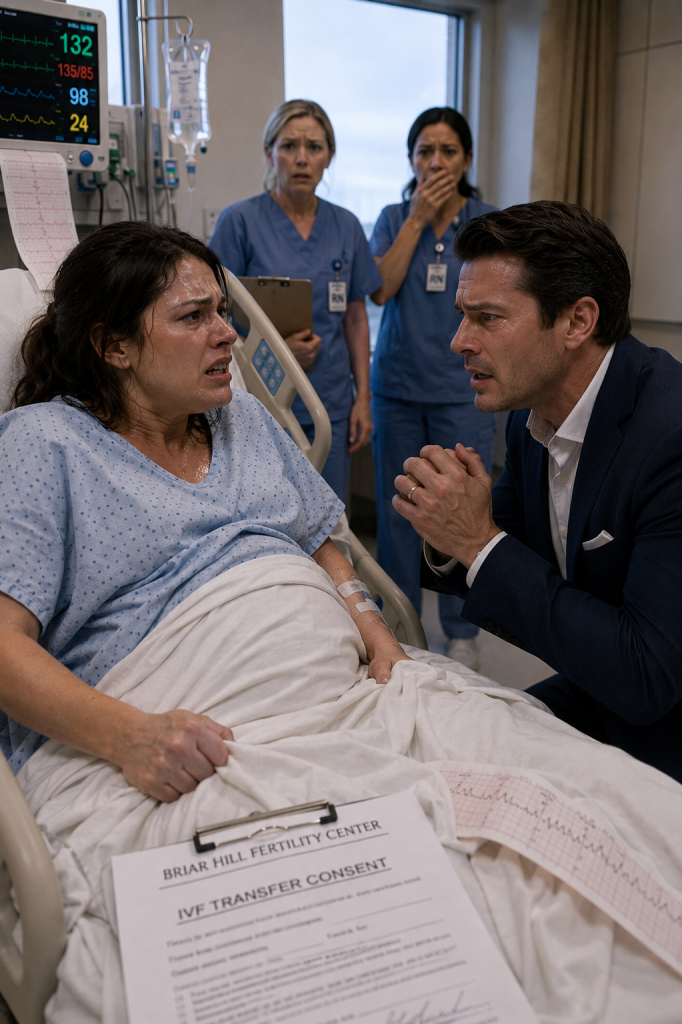
Inside Room 412, the steady hum of the fetal monitor filled the small space, its paper tape spilling onto the floor in a long, white tongue.